

You have found a stock on your broker app. The price is frozen. There are hundreds of buyers queued up — but no trades are going through. Or the opposite: sellers everywhere, the price stuck at the bottom, and your exit order just sits there. This is what a circuit breaker looks like in real life, and if you have recently started investing in Indian stocks, you will encounter it sooner or later.
Circuit breakers are one of the most misunderstood features of the Indian stock market. Beginners often mistake an upper circuit for a guaranteed profit signal, or a lower circuit for a company collapse. Neither is automatically true. Understanding circuit breaker meaning — what it actually is, how upper circuit and lower circuit work, and what the market-wide version does — will help you avoid costly mistakes and make smarter decisions. This article explains everything with a simple ₹100 example, without jargon. For broader context on how the stock market works, read our guide to stock market basics.
Quick Answer: Circuit Breaker Meaning in Stocks
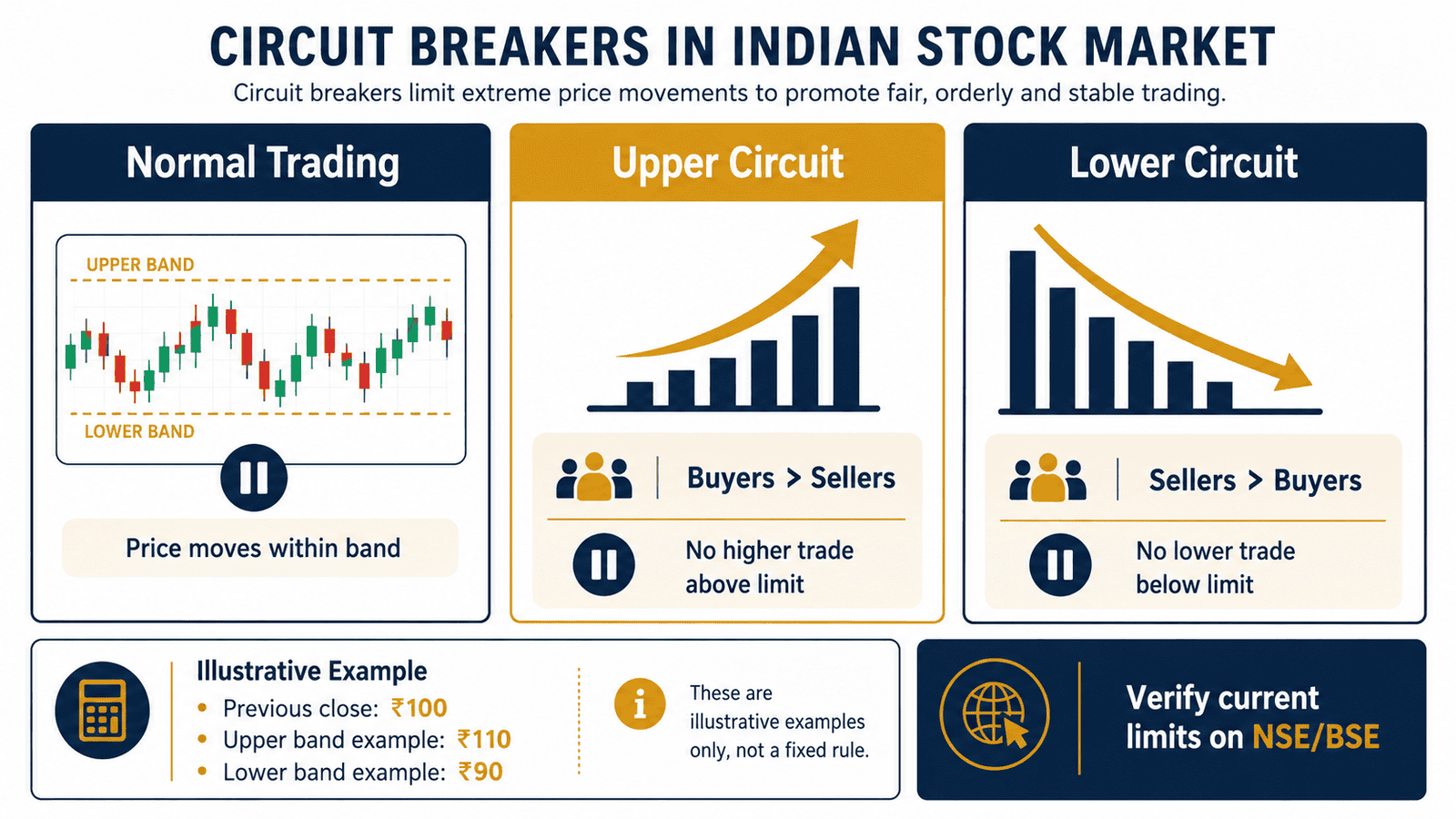
Circuit breaker meaning in stocks refers to a price limit or trading halt system that slows extreme market moves. For example, if a ₹100 stock has a 10% price band, it may not trade above ₹110 or below ₹90 that day, unless exchange rules allow a revision.
Key Takeaways
- A circuit limit controls how much a stock’s price can move within a single trading session — for example, a 10% band on a ₹100 stock caps it at ₹110 on the upside and ₹90 on the downside.
- Upper circuit means the stock has hit its maximum allowed trading price for the session — there are buyers but no sellers willing to trade at that level or lower.
- Lower circuit means the stock has hit its minimum allowed trading price for the session — there are sellers but no buyers willing to trade at that level or higher.
- A stock locked in a circuit is a liquidity situation, not automatically a profit or loss signal — you may not be able to buy or sell even if the price looks attractive.
- Market-wide circuit breakers are separate from stock-level price bands — they apply when a broad index like Nifty 50 or Sensex moves sharply, triggering a full market trading halt.
- NSE and BSE publish current price-band classifications for individual stocks — always verify before trading, as bands can differ by stock category.
Key Facts at a Glance
| Term | What It Means | Where to Verify |
|---|---|---|
| Circuit Breaker | Price-limit or trading-halt mechanism to control extreme moves | nseindia.com, bseindia.com |
| Upper Circuit | Maximum allowed price level for a stock in a session | nseindia.com, bseindia.com |
| Lower Circuit | Minimum allowed price level for a stock in a session | nseindia.com, bseindia.com |
| Price Band | Permitted daily price range — e.g., 2%, 5%, 10%, or 20% on either side of previous close | nseindia.com |
| Market-Wide Circuit Breaker | Index-based trading halt when Nifty 50 or Sensex moves by a set percentage | sebi.gov.in, nseindia.com |
| Circuit Filter | Another name for the price band applied to a security | nseindia.com, bseindia.com |
How Circuit Breakers and Price Bands Work in Indian Stocks
The Indian stock market does not let prices move without limits. Exchanges apply rules to prevent panic or manipulation from sending a stock to zero — or to a price that has no basis in reality — in a single session. These rules are called price bands or circuit filters.
What Is a Price Band?
A price band sets the permitted trading range for a stock on a given day, calculated from its previous closing price. NSE lists price-band categories including 2%, 5%, 10%, and 20%. Some derivative-eligible scrips have no daily price band applied to them — the rules vary by stock classification. Your broker app may show a stock’s circuit levels, but always confirm directly on NSE or BSE for accuracy.
If you are new to equity trading, it helps to first set up a demat account — here is a complete guide to opening a demat account in India.
Upper Circuit: Too Many Buyers, No Sellers
When a stock reaches its upper price limit for the session, it is said to be “locked in upper circuit.” What this actually means at the order level: there are buyers who want to purchase at ₹110 (the upper limit), but there are no sellers willing to sell at that price or lower. So trades cannot execute. The price is visible, demand looks strong — but no transaction goes through.
This creates a queue of pending buy orders. The stock may open the next session at a higher price if demand continues, or it may fall back sharply if buyers lose confidence. An upper circuit is not a buy signal. It is a liquidity condition.
Lower Circuit: Too Many Sellers, No Buyers
When a stock reaches its lower price limit, it is locked in lower circuit. The reverse situation applies — sellers are queued at ₹90 (the lower limit), but no buyers are stepping in at that price or higher. Your exit order sits in the queue. You cannot sell, even though you can see a price on screen.
This is the liquidity risk that many beginners discover the hard way. A lower circuit does not automatically mean the company is failing. It may recover. But if you need to exit urgently, you may not be able to.
Stock-Level Circuits vs Market-Wide Circuit Breakers
These are two entirely separate mechanisms.
Stock-level circuits apply to individual securities based on their assigned price band. They affect only that specific stock during normal trading hours.
Market-wide circuit breakers apply when a major index — Nifty 50 or Sensex — moves by a set percentage during the trading day. According to NSE guidelines, index-based market-wide circuit breakers apply at 10%, 15%, and 20% movement levels. When triggered, trading across the entire exchange halts for a defined period. This is a much broader event than a single stock hitting a price limit.
Understanding the difference between NSE and BSE difference also matters here — each exchange may have its own notices and stock-specific classifications, so checking both can be relevant depending on where a stock is traded.
Real Example: Rohit’s ₹100 Stock in Upper Circuit
Rohit Sharma, 29, a software engineer from Pune earning ₹1.2 lakh per month, recently started investing through a demat account. He notices a small-cap stock that closed at ₹100 yesterday. By 10 AM today, his broker app shows the price at ₹110 — with a long queue of buy orders and zero sellers. Trades: nil.
Here is what happened: the stock carries a 10% daily price band. Using yesterday’s close of ₹100, the upper circuit is ₹110 and the lower circuit is ₹90. The stock hit ₹110 in early trading. Now buyers keep placing orders at ₹110, but sellers are absent. The price cannot go higher than ₹110 today because the exchange rule does not permit it. Rohit’s buy order will sit pending unless a seller appears at or below ₹110.
In the opposite scenario: if bad news hits and the stock drops to ₹90, sellers swamp the order book. Rohit tries to exit but there are no buyers. His sell order queues at ₹90 with no execution. This is the lower circuit scenario.
This example is simplified and illustrative. Actual price bands depend on the stock’s exchange classification. Verify current rules on NSE and BSE before trading.
How to Calculate Upper and Lower Circuit Levels
Upper Circuit = Previous Close × (1 + Price Band %)
Lower Circuit = Previous Close × (1 − Price Band %)
Using Rohit’s example:
Upper Circuit = ₹100 × (1 + 10%) = ₹110
Lower Circuit = ₹100 × (1 − 10%) = ₹90
The permitted trading range for the day is ₹90 to ₹110. The stock cannot trade above ₹110 or below ₹90 during that session, subject to exchange rules.
| Scenario | Previous Close + Band | Circuit Levels |
|---|---|---|
| 10% band (small-cap example) | ₹100 + 10% | Upper ₹110 / Lower ₹90 |
| 5% band (mid-cap example) | ₹100 + 5% | Upper ₹105 / Lower ₹95 |
| 20% band (certain small-caps) | ₹100 + 20% | Upper ₹120 / Lower ₹80 |
Illustrative only. Actual price bands vary by stock and exchange category. NSE lists multiple classification categories — verify current bands at nseindia.com before making any trade decision.
Comparison: Upper Circuit vs Lower Circuit vs Market-Wide Circuit Breaker
| Feature | Upper Circuit | Lower Circuit |
|---|---|---|
| What triggers it | Stock price reaches maximum daily limit | Stock price reaches minimum daily limit |
| Order-book situation | Many buyers, no sellers — buy orders pending | Many sellers, no buyers — sell orders pending |
| Applies to | Individual stock | Individual stock |
| Beginner risk | Cannot enter easily; overpaying risk | Cannot exit; liquidity risk |
| Verification source | Stock quote page on NSE/BSE | Stock quote page on NSE/BSE |
| Confusion risk | Mistaken for guaranteed profit | Mistaken for company collapse |
| Feature | Stock-Level Circuit | Market-Wide Circuit Breaker |
|---|---|---|
| What triggers it | Individual stock hits its price band limit | Nifty 50 or Sensex moves by defined % levels |
| Scope | One stock only | Entire exchange — all stocks halt |
| Halt duration | Price locked for the session or until band revision | Defined halt period per exchange rules |
| Index levels (NSE) | Not applicable | 10%, 15%, 20% index movement triggers halt |
| How to track | Stock’s circuit level on broker or NSE/BSE | Sensex and Nifty meaning — index level on NSE/BSE |
How to Decide What’s Right for You
A stock is locked in upper circuit and you want to buy — THEN check volume, delivery percentage, and any company announcement before placing an order; a pending queue means you may not get a fill at all.
A stock is locked in lower circuit and you want to sell — THEN understand that exit may not be possible today; assess whether you can hold without urgent need for the funds before placing a sell order.
You are a long-term investor and a stock you hold hits lower circuit — THEN first look for an official exchange notice or company announcement before concluding the business is in trouble.
A market-wide circuit breaker has triggered — THEN do not place any new orders until trading resumes and you understand why the index fell; a full-market halt is a more serious event than a single stock circuit.
You see a small-cap stock hitting upper circuit for several consecutive days with no news — THEN treat it as a warning for potential operator activity, not a safe entry point.
You do not understand the liquidity and order-execution rules around circuit-hit stocks — THEN this is not the right time to trade based on circuit movement; study the rules on NSE first and consult a SEBI-registered investment adviser before acting.
Common Mistakes to Avoid
Treating Upper Circuit as a Guaranteed Buy Signal
A stock in upper circuit has hit its maximum daily price limit — it does not mean the price will continue rising tomorrow.
Many beginners rush to buy a circuit-hit stock expecting next-day gains. But if the fundamental reason for the move is weak, the stock can open lower the next session and fall sharply. Chasing circuits without researching the reason for the move is one of the most common ways beginners lose money quickly.
Always look for the underlying news or company announcement before acting on a circuit-hit stock.
Treating Lower Circuit as a Company Collapse Signal
A lower circuit means the stock hit its minimum daily price limit — not that the company is necessarily failing.
Panic selling at lower circuit, especially in illiquid stocks, can lock you into a position with no exit. Sometimes lower circuits are triggered by temporary market sentiment, not fundamental deterioration. Check for official announcements before concluding the worst.
Avoid placing market sell orders in stocks already near lower circuit without understanding current depth.
Ignoring Liquidity Risk in Small-Cap Stocks
A ₹50,000 position in a small-cap stock hitting lower circuit can leave you completely unable to exit for days.
Small-cap and micro-cap stocks with low trading volumes are most vulnerable to extended circuit locks. Unlike large-cap stocks where depth is usually available, a small-cap in lower circuit can stay locked session after session.
Before buying illiquid stocks, check their average daily volume. If it is very low, the exit risk in a circuit scenario is high.
Confusing Circuit Limits with Stop Loss
A stop-loss is an order you place with your broker to limit your loss — it is an investor tool. A circuit limit is an exchange-imposed price boundary.
Your stop loss will not save you if a stock gaps down and opens directly at lower circuit. The exchange-level rule applies regardless of your personal order settings. Understanding the difference between these two is critical for risk management. Read our guide on intraday and delivery trading to understand how order types interact with circuit risks differently for short-term and long-term trades.
Never rely on stop loss alone in highly volatile or illiquid stocks.
Acting on Social Media Tips About Circuit Stocks
A message in a WhatsApp group claiming a stock will “hit upper circuit tomorrow” is not a research input.
Circuit-hitting stocks attract social media noise — operator accounts, rumour channels, and coordinated groups. Acting on such tips without independent verification exposes you to pump-and-dump risk. SEBI has warned repeatedly about unregistered investment advice circulating on messaging platforms. Verify all claims using official sources.
Never place trades based on anonymous tips about circuit-related moves.
Placing Blind Market Orders in Circuit-Hit Stocks
A market order in a volatile stock near its circuit level can execute at an unexpected price if the band shifts or depth changes rapidly.
Use limit orders instead. A limit order lets you control the exact price at which you buy or sell. This is especially important during circuit-related volatility when bid-ask spreads can widen significantly.
Always use limit orders in circuit-adjacent trading situations.
Assuming Price Band Rules Are Uniform Across All Stocks
Not all stocks have the same price band. NSE and BSE categorise stocks into different bands — 2%, 5%, 10%, 20% — and some derivative-eligible stocks have no daily price band at all.
A beginner who assumes every stock has a 10% band may be surprised when a large-cap derivative stock moves 15% intraday without triggering a circuit. Checking the actual band for your specific stock on NSE before trading is mandatory, not optional.
Verify the current price band of any stock directly at nseindia.com or bseindia.com before you trade.
When This May Not Be the Right Choice
Actively trading circuit-hit stocks is not suitable for everyone. Avoid acting on circuit movements in the following situations:
No clear company news or announcement. If a stock hits upper or lower circuit with no corresponding announcement on the NSE/BSE notice board, the move may be rumour-driven or operator-managed. Entering without knowing why is speculation, not investing.
Very low trading volume or liquidity. If the stock’s average daily traded volume is thin, you may be unable to exit when you want — regardless of the displayed circuit price. Illiquid circuits can persist for multiple sessions.
Your funds are needed in the short term. If you need access to this money within days or weeks, holding a stock locked in lower circuit is a serious risk. Your capital could be tied up with no exit available when you need it most.
You do not fully understand order execution in circuits. If this is your first encounter with circuit limits and you have not reviewed NSE or BSE rules, acting on instinct in a circuit situation is avoidable risk. Study the rules first.
If any of these apply to your situation, it may be worth exploring alternatives before committing.
Official Rules and Where to Verify
Circuit breaker rules, price-band classifications, and market-wide trading halt thresholds are set by regulators and exchanges — not by brokers or apps. Always verify the current rules directly from the following official sources before making any trade decision:
- SEBI (sebi.gov.in) — Regulatory framework for investor protection, circuit breaker policy, and market-wide circuit breaker rules.
- NSE (nseindia.com) — Price-band listings, stock-specific circuit levels, market-wide circuit breaker notices, and daily market data.
- BSE (bseindia.com) — Exchange-specific stock notices, price-band information, and trading halt announcements.
Do not rely solely on your broker app’s display for circuit-level accuracy. Broker platforms may update with a delay or display simplified information. Check Sensex and Nifty meaning for context on how index levels relate to market-wide circuit triggers.
Rules, limits, and rates on this topic can change with each Budget or regulatory update. Always verify current figures directly from the official source before making any financial decision.
Expert Tips
- Distinguish stock circuit from market halt immediately. When your broker app shows a frozen price, first check whether it is a single stock in circuit or a market-wide halt. The action you take — and the urgency — is completely different in each case. NSE and BSE post real-time notices on their websites.
- Check order book depth, not just the price. A stock locked at upper circuit with 50 lakh shares in pending buy orders and zero sell orders tells you more than the price alone. High pending buy depth with zero sellers may mean the demand is real — or it may mean buyers are testing the market. Order depth is visible on NSE and most broker platforms.
- Use limit orders when trading near circuit levels. Never place a market order in a stock that is near its upper or lower circuit limit. Use a specific limit price so you control execution. Unexpected fills at unintended prices are common in thin-volume circuit situations.
- Do not confuse your stop loss with exchange circuit rules. A stop loss is an order condition you set — it is separate from the exchange’s price band. If a stock opens at lower circuit below your stop-loss trigger price, your stop loss may not execute at the price you expected. Understand both tools independently.
- Avoid chasing stocks with consecutive upper circuits and no fundamentals. Multiple upper circuit days in a small-cap stock with no earnings growth, no news, and very low float is a classic pattern associated with price manipulation. SEBI has issued advisories on this. Fundamentals must support the price level.
- Check NSE circuit-band page before entering a new position. You can look up the current daily price band for any listed stock directly on nseindia.com. This takes under a minute and prevents a basic misunderstanding about how far the stock can legally move today.
Frequently Asked Questions
What is circuit breaker meaning in stocks?
A circuit breaker in stocks is a regulatory mechanism that limits how much a stock’s price can move in a single trading session — or halts the entire market when a major index drops by a set percentage. Stock-level circuit breakers are controlled by price bands assigned by NSE and BSE. Market-wide circuit breakers are triggered by Nifty 50 or Sensex movements at defined thresholds. Both exist to protect investors from extreme volatility.
What is upper circuit meaning in the stock market?
Upper circuit is the maximum price a stock can reach during a trading session, based on its assigned price band. When a stock hits its upper circuit, there are buyers but no sellers willing to trade at that level or lower. New buy orders queue up but no trades execute. The upper circuit level resets with the next session’s opening price.
What is lower circuit meaning in the stock market?
Lower circuit is the minimum price a stock can fall to during a trading session. When it is hit, sellers are queued but no buyers are available at that price or higher. Sell orders accumulate without execution. For investors, a lower circuit means you may be unable to exit your position that day — the liquidity risk is real and should not be ignored.
Can I buy a stock that is locked in upper circuit?
You can place a buy order, but it will join a pending queue. Whether your order executes depends entirely on whether any seller places an order at or below the upper circuit price. In many cases — especially in small-cap stocks with strong demand — orders stay pending without a fill. There is no guarantee you will buy even if you submit an order.
Can I sell a stock that is locked in lower circuit?
Placing a sell order is possible, but execution is not guaranteed. In a lower circuit, there are no buyers at the current price or higher. Your sell order will queue and may not execute that session. If liquidity remains poor, this situation can persist across multiple sessions, preventing you from exiting your position.
Are circuit limits the same for all stocks in India?
No. NSE and BSE assign different price bands to different stocks — common bands include 2%, 5%, 10%, and 20%. Some stocks, particularly those with active derivatives, may have no daily price band. The specific band for a stock depends on its exchange classification and can change. Check the current band for any stock directly on nseindia.com or bseindia.com before trading.
What is a market-wide circuit breaker and how does it differ from a stock circuit?
A market-wide circuit breaker halts trading across the entire exchange when a key index — Nifty 50 or Sensex — moves by a defined percentage. According to NSE, these levels are at 10%, 15%, and 20% index movement. All stocks stop trading during such a halt. A stock-level circuit, by contrast, affects only that single stock and does not pause the rest of the market.
Where can I check the current price band for a stock?
The most reliable sources are NSE (nseindia.com) and BSE (bseindia.com). You can look up any listed stock’s current price band on these platforms. Your broker app may also display circuit levels, but for accuracy — especially before placing a trade — always confirm directly with the exchange. Do not rely only on third-party apps or financial news portals.
Is a stock hitting upper circuit a good time to buy?
Not necessarily. An upper circuit tells you the stock has hit its maximum allowed price today, with strong buying interest and no sellers. It does not tell you whether the price is justified by fundamentals. Many circuit-hit stocks reverse sharply in subsequent sessions. Evaluate the reason for the move, check company announcements, and verify the stock’s fundamentals before deciding. This is an educational point — not a buy or sell recommendation.
What happens to my pending order if the circuit is revised?
Exchanges may revise price bands intraday in certain market conditions. If the band is revised upward during an upper circuit, the new upper limit shifts higher and pending buy orders may get a chance to execute — or new sellers may appear at the revised level. Price-band revisions are announced on the exchange websites. Monitoring NSE and BSE notices during the trading day is the most reliable way to track changes.
Final Verdict
Circuit breakers are safety mechanisms built into Indian stock exchanges — not trading signals. Upper circuit and lower circuit show you that a stock has reached its price limit for the session, with a lopsided order book and poor liquidity. They do not tell you whether to buy or sell. Market-wide circuit breakers are a separate, more serious event that freezes the entire exchange when major indices swing sharply.
For beginners, the most important lesson is this: a circuit-hit stock is not automatically an opportunity — it is first a warning to understand liquidity and rules. Check price bands on NSE and BSE, look for official company announcements, and use limit orders carefully. Understanding circuit breaker meaning properly keeps you from making one of the most common beginner mistakes in Indian equity markets.
Always verify the latest rules from official sources or consult a qualified professional before making any financial decision.
Mutual fund investments are subject to market risks. Past performance does not guarantee future returns. For investment advice, refer to a SEBI-registered investment adviser.
This article is for educational purposes only and should not be treated as personalised financial, tax, investment, insurance, or legal advice. Tax rules, interest rates, regulatory limits, and product features can change with each Budget or policy update. Please verify current rules from official government sources or consult a qualified and registered professional before making any financial decision.

Devika Shah writes about stock market basics for Indian beginners who want to understand equity investing before taking financial risk. Her content is educational and does not provide stock tips, trading calls, price predictions, or personalised investment advice.
She covers topics such as demat account meaning, trading account basics, IPOs, dividends, brokerage charges, delivery vs intraday trading, market orders, limit orders, stock indices, blue-chip stocks, capital gains tax, stock market terminology, risk management, and the difference between long-term investing and short-term speculation.
Devika’s writing is clear, balanced, and risk-conscious. She helps readers understand how the stock market works, what accounts and documents are needed, what charges may apply, and what mistakes beginners should avoid. Her articles are suitable for students, salaried employees, and first-time investors who want a foundation before investing. Since market rules, tax treatment, brokerage fees, IPO processes, and regulatory requirements can change, readers should verify current information from SEBI, exchanges, brokers, and official tax sources.