

If you have ever browsed SIP recommendations online, you have almost certainly come across flexi cap funds — often listed alongside large cap, mid cap and index funds, with very little explanation of what actually makes them different. The name sounds reassuring. Flexible. Adaptable. But what does that actually mean for your money?
The confusion is real. Many beginners assume flexi cap means lower risk because the fund can “move around.” Others assume it means more aggressive because it can hold small cap stocks. Both assumptions can be wrong — and either can lead to mismatched expectations when markets move.
This article explains the flexi cap fund meaning in plain language, covers how it works, what the risks actually are, how it compares to other fund types, and most importantly — whether it belongs in your portfolio. This is not a list of best flexi cap funds. It is a practical decision guide for Indian investors who want to understand before they invest.
Quick Answer: Flexi Cap Fund Meaning
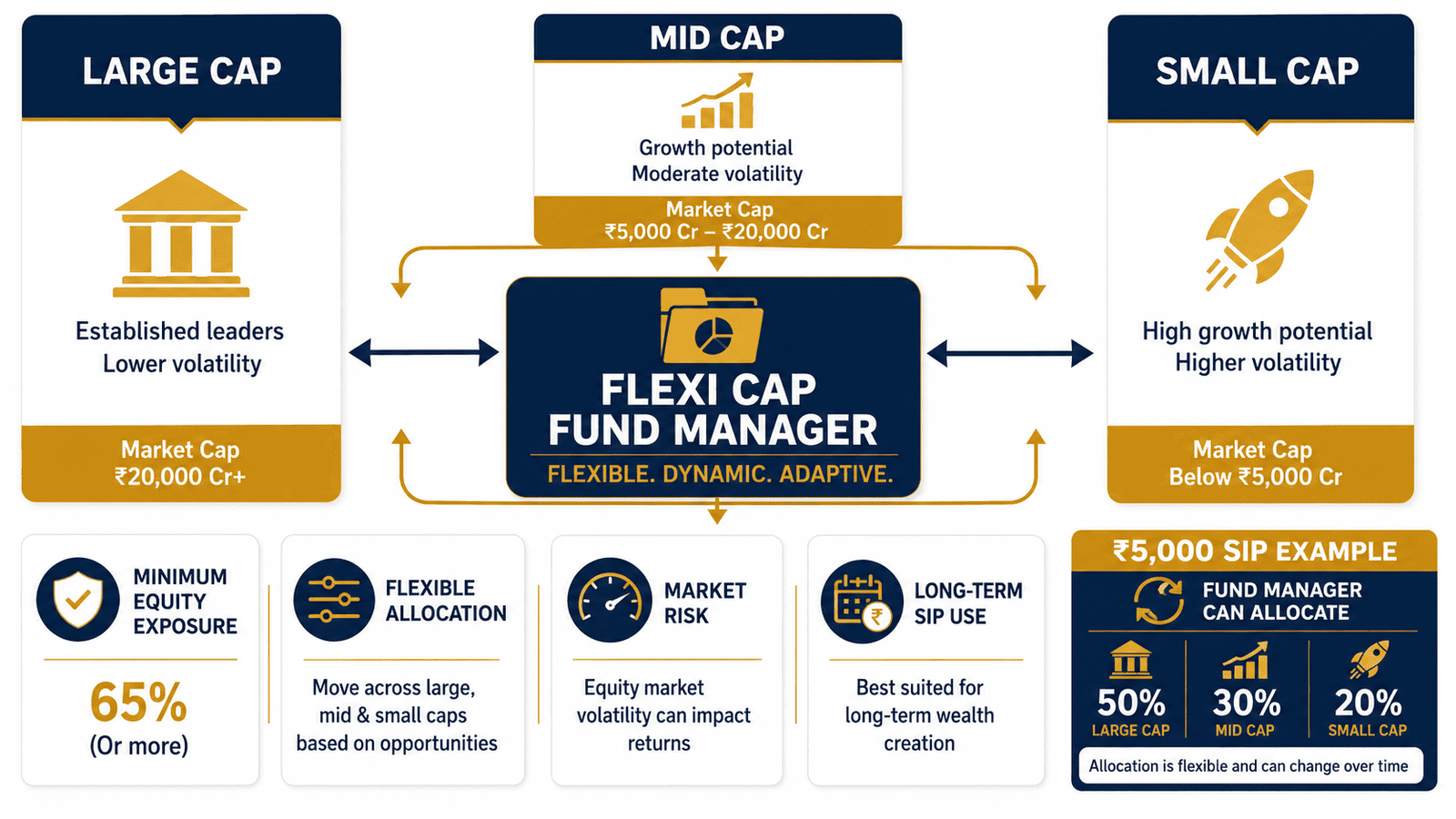
Flexi cap fund meaning is simple: it is an equity mutual fund that can invest across large cap, mid cap and small cap stocks without fixed allocation to each segment. For example, a ₹5,000 SIP in a flexi cap fund gives the fund manager freedom to shift exposure based on market conditions.
Key Takeaways
- A flexi cap fund is an equity mutual fund regulated by SEBI that can invest across large cap, mid cap and small cap stocks — with no mandatory fixed percentage in any segment.
- The fund manager decides how much to allocate across market caps. You, the investor, have no control over this allocation once you invest.
- Because it holds equity across market caps, a flexi cap fund carries market-linked risk — it is not a low-risk or capital-protection product.
- Flexi cap funds suit long-term investors with a horizon of at least 5–7 years who are comfortable with equity market volatility.
- Unlike multi cap funds, flexi cap funds have no SEBI-mandated minimum allocation to mid cap or small cap — the manager can concentrate heavily in large caps if they choose.
- Taxation follows standard equity mutual fund rules — verify current short-term and long-term capital gains rates before investing, as these can change.
- Using a SIP to invest in a flexi cap fund can reduce the pressure of timing the market, but it does not remove equity risk.
Key Facts at a Glance
| Parameter | Detail |
|---|---|
| Fund Category | Equity mutual fund (SEBI categorisation) |
| Market Cap Exposure | Large cap, mid cap and small cap — no fixed minimum per segment |
| Minimum Equity Allocation | 65% in equity and equity-related instruments (SEBI guideline) |
| Who Decides Allocation | Fund manager — investor has no control over segment mix |
| Risk Level | High — market-linked equity risk across all capitalisation segments |
| Ideal Investment Horizon | 5 years or more |
| Taxation | Equity mutual fund taxation applies — verify current rates before investing |
| Regulator | SEBI (sebi.gov.in) |
| Suitable For | Long-term equity investors comfortable with volatility |
What Is Flexi Cap Fund Meaning — Explained Simply
To understand flexi cap funds, you first need to understand how SEBI classifies Indian companies by market capitalisation. According to SEBI guidelines, large cap companies are the top 100 listed companies by market cap. Mid cap companies rank from 101 to 250. Small cap companies rank 251 and beyond. These are not arbitrary labels — they determine how mutual fund categories are structured and regulated. If you are new to mutual funds, read this guide on mutual fund basics before going further.
The Core Idea: No Allocation Lock-In
Most equity fund categories have a mandatory allocation rule. A large cap fund must invest at least 80% in large cap stocks. A mid cap fund must invest at least 65% in mid cap stocks. A multi cap fund must invest at least 25% each in large, mid and small cap stocks.
A flexi cap fund has none of these segment locks. According to SEBI’s mutual fund categorisation circular, a flexi cap fund must invest at least 65% in equity and equity-related instruments — but there is no mandated split across large, mid and small cap. The fund manager can put 80% in large caps today and 50% in mid and small caps six months later, based entirely on their assessment of market conditions.
This is what makes the category genuinely different — not that it is smarter or safer, but that it gives the manager far more room to move.
What the Fund Manager Actually Does
In a flexi cap fund, the fund manager’s skill and investment style matter more than in a passive index fund. Some managers run concentrated portfolios — 25 to 35 stocks across market caps. Others run diversified books of 60 to 80 stocks. Some tilt heavily towards large caps for stability. Others aggressively chase mid and small cap growth opportunities.
When you invest in a flexi cap fund, you are not just buying exposure to the Indian equity market. You are also trusting that manager’s judgement about which segments offer the best risk-adjusted opportunity at any given time. This is a critical point that many beginners overlook.
Flexi Cap Is Not Automatically Safer Than Other Equity Funds
A common misconception is that because a flexi cap fund can “go defensive” and move into large caps, it is inherently safer. This is not reliable in practice. Most flexi cap funds still hold meaningful mid and small cap exposure during bull markets — which means they can fall sharply when markets correct. The flexibility is the manager’s tool, not the investor’s safety net.
Flexi cap funds are equity funds. They carry equity risk. In a major market downturn, a flexi cap fund invested 40% in mid and small caps will fall harder than a pure large cap or index fund. That is not a flaw — it is simply the risk profile of the category, which every investor should understand before investing.
Real Example: Rohan’s ₹5,000 Monthly SIP in a Flexi Cap Fund
Rohan, 31, is a software engineer in Pune earning ₹18 lakh per year. He already runs a ₹10,000 monthly SIP split across two funds and wants to understand if a flexi cap fund makes sense as his next addition. He decides to start a separate ₹5,000 SIP specifically in a flexi cap fund to observe how it behaves over time.
In the first two years, the fund manager holds roughly 70% in large cap stocks — stable, well-known Indian companies — with the rest in mid cap businesses in manufacturing and financial services. The fund’s net asset value (NAV) moves steadily, with moderate short-term dips during global market events. Rohan does not panic because he understands the allocation is driven by the manager’s view, not his own choices.
By year four, the manager shifts to a more aggressive mix — 55% large cap, 30% mid cap and 15% small cap — as economic conditions improve. The fund’s NAV becomes more volatile. There are months when the fund dips 8–10%. But because Rohan’s SIP continues through the dips, he accumulates more units at lower NAVs — a direct benefit of staying invested through volatility.
The key insight here: Rohan did not pick which sectors or market caps to hold. He handed that decision to the fund manager. Whether that turns out well depends entirely on the manager’s skill and consistency. To understand how the SIP mechanism works in detail, see this guide on how SIP works.
How to Calculate Potential SIP Outcomes
Many investors want to know: if I invest ₹5,000 per month in a flexi cap fund for 10 years, what will I have at the end? The honest answer is: it depends entirely on the actual returns delivered — which are unknown in advance.
Estimated SIP Corpus = Monthly Investment × [(1 + assumed monthly return)^months − 1] ÷ assumed monthly return × (1 + assumed monthly return)
To illustrate how outcomes vary by assumed return rate, consider a ₹5,000 monthly SIP over 10 years:
| Assumed Annual Return | Total Invested | Estimated Corpus (Illustrative) |
|---|---|---|
| 8% per year | ₹6,00,000 | Approx. ₹9,07,000 |
| 10% per year | ₹6,00,000 | Approx. ₹10,16,000 |
| 12% per year | ₹6,00,000 | Approx. ₹11,62,000 |
These are purely illustrative scenarios. Equity mutual funds do not deliver smooth annual returns — actual year-on-year returns can swing widely. Short-term estimates for equity funds are especially unreliable. Use a SIP calculator estimate tool to explore your own scenarios with different assumptions — but treat every result as a rough planning figure, not a promise.
Comparison: Flexi Cap vs Other Fund Types
Understanding flexi cap fund meaning becomes clearer when you compare it to nearby categories. Here is how flexi cap stacks up against the options most Indian investors consider. For a deeper look at risk levels across market caps, read about large mid small caps.
| Parameter | Flexi Cap Fund | Multi Cap Fund | Large Cap Fund | Index Fund |
|---|---|---|---|---|
| SEBI Allocation Rule | 65% equity, no cap split mandated | Min 25% each in large, mid, small cap | Min 80% in large cap stocks | Mirrors index — no active decisions |
| Manager Discretion | High | Medium | Medium | None |
| Risk Level | High — depends on allocation choices | High — mandated small cap exposure | Moderate — large cap stability | Moderate — tracks index, no active bets |
| Expense Ratio (typical) | Higher (active fund) | Higher (active fund) | Moderate (active fund) | Low |
| Suitable For | Long-term investors comfortable with active management | Investors wanting guaranteed cap spread | Investors wanting large-cap stability | Low-cost, passive long-term investors |
| Investor Control Over Allocation | None | None | Partial | Tracks index |
The most important distinction: in a multi cap fund, SEBI forces the manager to hold at least 25% in mid cap and 25% in small cap at all times. In a flexi cap fund, the manager can hold almost everything in large caps if they believe that is the better choice. This means two flexi cap funds from different fund houses can behave very differently, depending on each manager’s style and conviction.
How to Decide What’s Right for You
You have a long-term equity goal of 7 years or more and want an actively managed fund that can shift across market caps — THEN a flexi cap fund may be worth considering as part of your equity portfolio.
You want guaranteed exposure to mid and small cap growth alongside large caps — THEN a multi cap fund may be more suitable, since its allocation is SEBI-mandated across all three segments.
You prefer lower costs and want broad market exposure without betting on any manager’s skill — THEN a Nifty 50 or Nifty 500 index fund may serve you better than a flexi cap fund.
You already hold a large cap fund or an index fund — THEN adding a flexi cap fund that is heavily large-cap-oriented may give you significant portfolio overlap without meaningful diversification.
You are a beginner investor setting up your first equity SIP — THEN starting with a simple index fund to understand equity market behaviour before adding actively managed categories is a reasonable approach.
You are comfortable with the idea that the fund manager’s decisions — not yours — will determine how your money is allocated across market caps, THEN a flexi cap fund is not the right category for you, regardless of recent returns.
Common Mistakes to Avoid
Chasing Recent High Returns
Many investors discover flexi cap funds after a period of strong performance and assume those returns will continue.
Equity fund returns are cyclical. A fund that returned 35% in a bull year may return −15% in the following year. Investing based on recent performance rather than long-term consistency can lead to buying at a peak and holding through a deep correction.
Instead, check rolling 3-year and 5-year returns across different market cycles, not just the most recent calendar year.
Assuming Flexi Cap Means Lower Risk
The word “flexible” makes investors believe the fund will automatically protect them during downturns by shifting to safer assets.
Flexi cap funds are equity funds. They must hold at least 65% in equities at all times. The manager cannot park everything in debt or cash during a crash. If mid and small cap stocks fall sharply, a flexi cap fund with significant exposure to those segments will fall with them.
Understand that flexibility is the manager’s tool for seeking return — not your protection against loss.
Investing in a Regular Plan Without Checking the Cost Difference
Many investors end up in a regular plan of a flexi cap fund — sold through a distributor or bank — without realising the ongoing cost difference versus a direct plan.
A regular plan of an equity fund typically carries a higher expense ratio than its direct counterpart, which means lower returns compounded over many years. Understand the direct vs regular plans difference before selecting a plan type.
Holding Too Many Overlapping Equity Funds
Some investors hold a large cap fund, an index fund, and a flexi cap fund simultaneously — believing more funds means better diversification.
In practice, if the flexi cap fund is large-cap-heavy, the three funds may hold many of the same stocks. You get the costs of three funds and the diversification of roughly one and a half. Review portfolio overlap across your existing SIPs before adding a new category.
Exiting During Short-Term Market Dips
Equity markets go through corrections. A 10–20% fall over a few months is normal in equity investing. Investors who exit a flexi cap SIP during such dips lock in their losses and miss the recovery.
If the investment horizon and goal are unchanged, short-term dips should not trigger an exit decision. Review your investment thesis, not your recent NAV statement.
Not Reading the Scheme Information Document
Every flexi cap fund has a Scheme Information Document (SID) that explains the fund’s investment objective, the manager’s style, the benchmark used and the risk profile.
Many investors skip this entirely. Without reading the SID, you cannot know whether the fund’s stated philosophy aligns with your expectations — particularly for an active fund where manager discretion is high.
When This May Not Be the Right Choice
A flexi cap fund may not be suitable if your financial goal is less than 3–4 years away. Equity funds in general — and actively managed ones in particular — need time to ride out market cycles. Using a flexi cap fund to save for a car purchase next year or a home down payment in two years exposes short-term money to unnecessary equity risk.
If you cannot tolerate seeing your portfolio value drop by 15–25% without making a hasty decision, a flexi cap fund may cause more stress than benefit. Equity losses are temporary on paper but feel permanent when you exit early.
If you are already holding two or three actively managed equity funds, adding another flexi cap fund may create overlap without adding meaningful diversification. A review of your existing portfolio allocation is a better use of effort than adding a new fund.
If you are a beginner who has never invested in equity before and wants to start with the lowest-cost, simplest structure, a broad market index fund may be a more straightforward first step. Active management adds a variable that is hard to evaluate until you have some experience observing equity fund behaviour.
If any of these apply to your situation, it may be worth exploring alternatives before committing.
Official Rules and Where to Verify
Flexi cap funds are regulated under SEBI’s mutual fund categorisation and rationalisation framework. The authoritative source for category definitions, allocation rules and investor protection guidelines is the Securities and Exchange Board of India at sebi.gov.in.
Before investing in any flexi cap fund scheme, read the Scheme Information Document (SID) and the Key Information Memorandum (KIM) published by the fund house. These documents contain the investment objective, asset allocation range, risk factors, benchmark, expense ratio and the fund manager’s stated investment approach.
For taxation rules applicable to equity mutual funds — including current short-term and long-term capital gains tax rates and holding period thresholds — verify the current rules from official tax guidance before making any decision. Tax rules for equity mutual funds can change with each Budget announcement.
- SEBI — sebi.gov.in (mutual fund categories, investor rights, fund disclosures)
- Fund house websites — for SID, KIM, portfolio disclosures and expense ratio
- AMFI — amfiindia.com (fund NAVs, fund house list, investor education resources)
Rules, limits, and rates on this topic can change with each Budget or regulatory update. Always verify current figures directly from the official source before making any financial decision.
Expert Tips
- Check rolling returns, not calendar year returns. A flexi cap fund that shows 40% returns for one year may have delivered inconsistent results over 3-year and 5-year rolling periods. Rolling returns show how often and by how much the fund beat its benchmark — a much more meaningful measure. Use fund return methods like CAGR and XIRR to compare funds correctly.
- Always compare the direct plan, not the regular plan, when evaluating a fund’s track record. Most third-party fund listings display regular plan returns by default. The direct plan of the same fund delivers higher returns over time because of the lower expense ratio. Make sure you are comparing apples to apples.
- Check the fund’s actual large cap, mid cap and small cap split in the latest portfolio disclosure. Two flexi cap funds can be extremely different in practice — one may hold 80% large cap while another holds 50% mid and small cap. The current allocation tells you the actual risk you are taking on today.
- Understand the fund manager’s tenure and consistency before investing. Because flexi cap funds depend heavily on active allocation decisions, a recent change in fund manager is a material event. If the person who built the track record has left, the historical returns carry less predictive value.
- Avoid starting a flexi cap SIP just before a major financial goal. If your goal is 2–3 years away, equity market timing risk is high. A flexi cap SIP works best when started at least 5–7 years before a goal — giving the fund time to recover from any market cycles it passes through.
Frequently Asked Questions
What is flexi cap fund in simple terms?
A flexi cap fund is an equity mutual fund regulated by SEBI that can invest across large cap, mid cap and small cap stocks in any proportion the fund manager chooses. Unlike large cap or mid cap funds, there is no mandatory minimum allocation to any specific market cap segment. The fund must hold at least 65% in equities, but the split across company sizes is entirely at the manager’s discretion.
Is a flexi cap fund good for SIP investing?
A flexi cap fund can be a reasonable choice for long-term SIP investing if you have a horizon of 5 years or more and are comfortable with equity market volatility. SIP investing reduces the pressure of timing the market by spreading purchases across market cycles. However, the suitability depends on the specific fund’s style, your risk tolerance and whether the fund overlaps with other equity holdings you already have.
Is flexi cap fund better than large cap fund?
Not universally. A flexi cap fund offers the manager more freedom and potentially higher return opportunities through mid and small cap exposure — but with higher volatility. A large cap fund is more conservative and less dependent on the manager’s allocation bets. Whether one is “better” depends on your goal timeline, risk comfort and whether you want active management or more predictable large-cap exposure. Neither is inherently superior.
How risky is a flexi cap fund?
Flexi cap funds carry high equity market risk. Because the fund can hold mid cap and small cap stocks — which are more volatile than large cap stocks — the portfolio can experience sharp falls during market corrections. SEBI classifies these funds with a high riskometer rating. This does not mean avoid them — it means invest only if you can stay invested through market downturns without exiting.
Who should invest in flexi cap funds?
Flexi cap funds are broadly suitable for investors with a long investment horizon of 5 years or more, who are comfortable with equity volatility and who want an actively managed fund with broad market exposure. They are not suitable for short-term goals, investors who need capital protection or those who are not comfortable with the fund manager making all allocation decisions on their behalf.
How is a flexi cap fund taxed in India?
Flexi cap funds are taxed as equity mutual funds. Capital gains taxation applies — the rate and holding period thresholds depend on whether gains are short-term or long-term, and these rules are governed by the Income Tax Act. Tax rules for equity mutual funds have changed in recent Budgets, so verify the current applicable rates and holding period definitions from official sources before investing or redeeming.
What is the difference between flexi cap and multi cap funds?
The key difference is allocation flexibility. A multi cap fund must invest at least 25% each in large cap, mid cap and small cap stocks — this is a SEBI mandate. A flexi cap fund has no such requirement. The manager can hold 90% in large caps or 60% in mid and small caps depending on their market view. This gives flexi cap managers more freedom but also makes the category harder to predict for investors.
Can beginners invest in flexi cap funds?
Yes, but with awareness. A flexi cap fund is not the simplest starting point for a first-time investor because the fund’s behaviour depends on the manager’s active allocation decisions — which beginners may find harder to monitor and evaluate. A broad market index fund is often suggested as a simpler first step. If a beginner chooses a flexi cap fund, selecting the direct plan, staying invested for the long term and not reacting to short-term NAV changes are the three most important disciplines.
What happens to a flexi cap fund during a market crash?
A flexi cap fund will generally fall during a significant market correction — the degree of fall depends on how much mid and small cap exposure the fund holds at that time. The manager may shift some allocation towards large caps, but this is not guaranteed and does not eliminate losses. Investors who stay invested through corrections and continue their SIPs typically accumulate units at lower prices, which benefits long-term wealth creation — but this requires patience and a clear long-term plan.
Final Verdict
The flexi cap fund meaning is ultimately about manager freedom — the ability to invest across the full equity universe without being locked into any single market cap segment. For long-term investors who want a single actively managed equity fund that can adapt to changing market conditions, flexi cap funds are a legitimate and well-regulated category to consider as part of a diversified portfolio.
But this freedom comes with a trade-off. You are handing full allocation control to the fund manager. If their approach aligns with market conditions, the fund can perform well. If it does not, you bear the cost. This is meaningfully different from an index fund, where the market itself drives outcomes rather than a manager’s judgement.
Flexi cap funds are not suitable for short-term goals, investors who need capital protection or beginners who have not yet experienced equity market volatility firsthand. Mutual fund investments are subject to market risks. Past performance does not guarantee future returns.
If you decide a flexi cap fund suits your goals, evaluate it by looking at rolling returns, portfolio composition, fund manager track record and expense ratio — not just recent headline performance. Always verify the latest rules from official sources or consult a qualified professional before making any financial decision.
This article is for educational purposes only and should not be treated as personalised financial, tax, investment, insurance, or legal advice. Tax rules, interest rates, regulatory limits, and product features can change with each Budget or policy update. Please verify current rules from official government sources or consult a qualified and registered professional before making any financial decision.

Arjun Kapoor writes about mutual funds, SIPs, ELSS, fund categories, investment returns, and beginner investing concepts for Indian readers. His focus is on education, not product promotion or fund recommendations. He helps readers understand how mutual funds work before they start investing or comparing schemes.
He covers topics such as mutual fund meaning, SIP meaning, SIP calculator, direct mutual funds vs regular plans, NAV, ELSS tax-saving funds, CAGR, absolute returns, XIRR, expense ratio, large cap vs mid cap vs small cap funds, flexi cap funds, index funds vs active funds, liquid funds, debt mutual funds, SIP pause vs SIP stop, lumpsum vs SIP, and how to start SIP in India.
Arjun’s writing is simple, risk-aware, and long-term oriented. He avoids guaranteed-return language and explains investment concepts using examples, timelines, and comparison tables. His articles remind readers that mutual fund investments are subject to market risks, and past performance does not guarantee future returns. Readers should verify scheme details from SEBI, AMFI, fund houses, and official scheme documents.