

If you have ever opened a mutual fund app, checked your SIP statement, or tried to redeem units, you have seen NAV — a number that changes every day and sits next to your fund name without much explanation. Most beginners assume a fund with NAV ₹20 is cheaper or better value than one with NAV ₹200. That assumption is wrong, and it costs real money when it drives fund selection decisions.
Mutual fund NAV meaning is one of the most searched finance terms in India — and one of the most misunderstood. This article explains what NAV actually is, the formula behind it, how it affects your SIP instalments and redemption value, why high or low NAV means very little on its own, and what you should actually look at when comparing mutual funds.
Quick Answer: Mutual Fund NAV Meaning
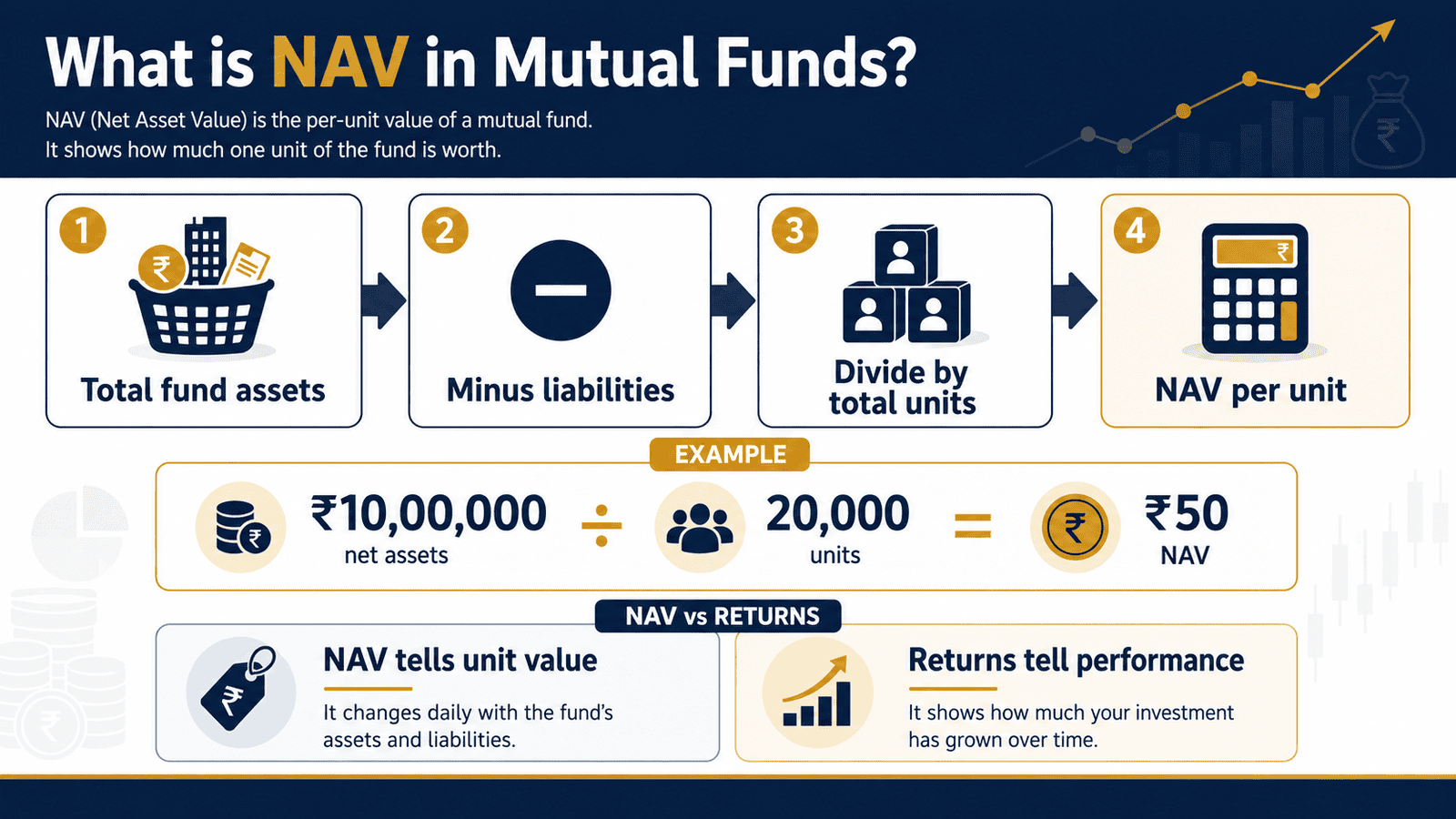
Mutual fund NAV meaning is the per-unit value of a mutual fund scheme. If a fund’s net assets are ₹10 crore and it has 20 lakh units, its NAV is ₹50. NAV helps decide how many units you get, but returns, risk, portfolio quality, and costs matter more.
Key Takeaways
- NAV stands for Net Asset Value — it is the rupee value of one unit of a mutual fund scheme, calculated daily by dividing net assets by outstanding units.
- A fund with NAV ₹20 is not cheaper than a fund with NAV ₹200 — both can grow at the same rate if portfolio quality is identical.
- Investing ₹10,000 in a fund with NAV ₹50 gives you 200 units; investing the same in a fund with NAV ₹100 gives you 100 units — but both investments are worth ₹10,000 on day one.
- Every SIP instalment buys units at the applicable NAV on the allotment date — your returns depend on how NAV grows from that point, not on how low it was when you entered.
- Direct plans of the same fund show a higher NAV than regular plans because direct plans carry a lower expense ratio, and that saving compounds over time.
- NAV is a useful tool to calculate units and current portfolio value — it is not a quality score, a return indicator, or a reason to choose or avoid a fund.
Key Facts at a Glance
| Parameter | Detail |
|---|---|
| Full Form | Net Asset Value |
| Formula | (Total Assets − Liabilities) ÷ Outstanding Units |
| Who Declares NAV | The Asset Management Company (AMC / fund house) |
| Frequency | Every business day for open-ended mutual funds |
| Used For | Unit allotment at purchase, redemption value at exit |
| Regulatory Oversight | SEBI and AMFI (amfiindia.com) |
| Where to Check NAV | AMC website, AMFI website, fund apps, factsheets |
What Is Mutual Fund NAV? The Basics Explained
When you invest in a mutual fund, you are pooling your money with thousands of other investors. The fund manager takes this combined pool and buys a portfolio of securities — equities, bonds, treasury bills, or a mix depending on the fund type. That portfolio has a total market value on any given day. NAV is simply your share of that total value, expressed as the price of one unit.
Think of it this way. If a pizza is cut into eight equal slices and the whole pizza is worth ₹800, each slice is worth ₹100. NAV is that per-slice price. If the pizza increases in value to ₹1,000, each slice is now worth ₹125. The slice did not change — its value did.
What Goes Into NAV
According to AMFI (amfiindia.com), the Net Asset Value of a mutual fund scheme is derived from the total market value of the scheme’s assets minus its liabilities, divided by the number of outstanding units. Assets include:
- Market value of all securities held (equities, bonds, money market instruments)
- Cash and cash equivalents
- Receivables and accrued income on holdings
Liabilities include fund management expenses, audit fees, and other payable obligations of the scheme. These are deducted before calculating the NAV that investors see. This is why the expense ratio of a scheme directly affects NAV — higher costs mean lower net assets and therefore a lower NAV over time.
For beginners who want to understand how mutual fund basics work before diving into NAV mechanics, starting with the structure of mutual funds makes the NAV concept far easier to follow.
NAV Changes Every Day
The stock and bond markets move every trading day. A fund holding 50 different stocks sees the combined value of those holdings shift with every market session. At the end of each business day, the AMC calculates the updated portfolio value, deducts liabilities, and divides by outstanding units to arrive at the closing NAV. That NAV is published on the AMC website and on AMFI’s website (amfiindia.com) by a specified time each evening.
This is why when you place a mutual fund purchase or redemption order before a certain time — called the cut-off time — you receive the NAV of that day. Orders placed after the cut-off receive the next business day’s NAV. SEBI regulates these cut-off timings to ensure fairness for all investors.
NAV Is Not a Quality Score
Here is the key thing most beginners miss: a fund’s NAV tells you how much one unit is worth right now. It does not tell you whether the fund is good or bad, expensive or cheap, risky or safe. A fund with NAV ₹500 may have delivered 8% returns in five years. A fund with NAV ₹30 may have delivered 18% in the same period. The NAV number alone tells you nothing about quality.
Real Example: How NAV Works for Rohan in Pune
Rohan, 29, is a software engineer in Pune earning ₹85,000 per month. He invests ₹10,000 in a mutual fund and wants to understand exactly what happens to his money on day one.
Fund A has a NAV of ₹50. Rohan invests ₹10,000. Units allotted: ₹10,000 ÷ ₹50 = 200 units.
Fund B has a NAV of ₹100. Rohan invests ₹10,000. Units allotted: ₹10,000 ÷ ₹100 = 100 units.
At the time of investment, both positions are worth exactly ₹10,000. Now suppose both funds grow by 15% in one year.
Fund A NAV becomes ₹57.50. Rohan’s 200 units are now worth ₹11,500. Fund B NAV becomes ₹115. Rohan’s 100 units are now worth ₹11,500. The outcome is identical — because growth percentage is what matters, not the starting NAV or the number of units. This is exactly the confusion Rohan had when he asked himself whether a ₹20 NAV fund was “cheaper” than a ₹200 NAV fund. It is not. They are simply funds at different stages of their history.
For investors running a monthly SIP, understanding how SIP works makes this even clearer — each instalment buys units at that month’s applicable NAV, and the eventual corpus depends on how NAV grows across all those allotment dates, not on whether any single NAV was high or low.
How to Calculate NAV
NAV Formula = (Total Assets − Total Liabilities) ÷ Number of Outstanding Units
Let us walk through a simple calculation using AMFI’s framework.
Suppose a mutual fund scheme has:
- Total market value of securities: ₹10,50,000
- Cash and receivables: ₹30,000
- Total liabilities (expenses payable): ₹80,000
- Outstanding units: 20,000
Step 1: Total Assets = ₹10,50,000 + ₹30,000 = ₹10,80,000
Step 2: Net Assets = ₹10,80,000 − ₹80,000 = ₹10,00,000
Step 3: NAV = ₹10,00,000 ÷ 20,000 units = ₹50 per unit
Unit Allotment Formula = Investment Amount ÷ Applicable NAV
If Rohan invests ₹10,000 when NAV is ₹50: Units allotted = ₹10,000 ÷ ₹50 = 200 units.
| Scenario | Key Inputs | Result |
|---|---|---|
| Base calculation | Net assets ₹10,00,000 / 20,000 units | NAV = ₹50 |
| Investment at NAV ₹50 | ₹10,000 invested | 200 units allotted |
| Investment at NAV ₹100 | ₹10,000 invested | 100 units allotted |
Note: Actual unit allotment may vary slightly depending on the applicable NAV date, transaction cut-off rules, and whether any transaction charges apply. Always confirm with your AMC or platform before transacting.
Comparison: NAV Concepts That Confuse Beginners
| Concept | What It Actually Means | Common Misconception |
|---|---|---|
| High NAV vs Low NAV | Reflects historical growth of the scheme, not current expensiveness | Myth Low NAV = cheaper fund to buy |
| NAV vs Returns | Returns measure percentage growth; NAV is just current unit price | Myth Rising NAV = good investment decision |
| Direct plan NAV vs Regular plan NAV | Direct plans have higher NAV because expenses are lower — direct versus regular plans differ in cost structure | Myth Higher NAV in direct plan means it costs more |
| Purchase NAV vs Redemption NAV | Purchase uses applicable NAV at allotment; redemption uses NAV on the processing date | Myth You redeem at the same NAV you bought at |
| NAV vs Stock Price | NAV is calculated once daily after market close; stock price changes second by second | Myth NAV and stock price work the same way |
How to Decide What’s Right for You
NAV is a calculation tool — not a selection tool. Here is how to think about it correctly when making investment decisions.
You want to know how many units you will receive for ₹5,000 — THEN divide ₹5,000 by the applicable NAV on the transaction date.
You want to check your current portfolio value — THEN multiply your units held by the latest NAV published on the AMC or AMFI website.
You are comparing two funds in the same category (say, two large-cap equity funds) — THEN compare returns, risk metrics, consistency, fund manager track record, and expense ratio — not NAV levels.
You are planning a long-term SIP and want to estimate how your corpus might grow — THEN use a SIP calculator to estimate your investment value based on expected return assumptions, not based on current NAV.
You are choosing between a direct plan and a regular plan of the same fund — THEN the direct plan’s higher NAV is actually a good sign — it means lower expenses have been compounding in your favour.
You should not choose a mutual fund based primarily on its NAV being “low” — a fund with NAV ₹12 that has delivered 6% over five years is a worse choice than a fund with NAV ₹180 that has delivered 14% consistently.
Common Mistakes to Avoid
Mistake 1: Treating Low NAV as a Cheap Entry Point
Many beginners assume a fund with NAV ₹15 is like a low-priced stock — a bargain waiting to rise. It is not.
A low NAV simply means the scheme is newer or has not grown much. If you invest ₹1,00,000 in a NAV ₹15 fund and it grows 10%, your investment becomes ₹1,10,000. The same ₹1,00,000 in a NAV ₹500 fund that also grows 10% becomes ₹1,10,000. The outcome is identical.
Evaluate fund category, returns history, and expense ratio instead of chasing low NAV.
Mistake 2: Avoiding High NAV Funds as “Too Expensive”
A high NAV fund — say, NAV ₹700 — is not expensive in the way a high-priced stock might be. High NAV usually reflects years of compounding since the fund’s launch.
Avoiding a high-NAV fund means potentially missing out on schemes with strong long-term track records. Your entry NAV simply becomes your cost price, and growth is measured from there.
Focus on returns delivered, consistency, and risk — not the NAV number.
Mistake 3: Comparing NAV Across Unrelated Fund Categories
Comparing the NAV of a liquid fund at ₹1,200 with an equity fund at ₹45 tells you nothing useful.
Liquid funds have higher NAVs because they started earlier and grow steadily. Equity funds may have lower NAVs because they are newer or experienced drawdowns. Comparing across categories is like comparing the price of a kilogram of rice with a kilogram of almonds — the numbers are incomparable.
Always compare NAV — if at all — only within the same fund category and time period.
Mistake 4: Ignoring Expense Ratio and Focusing Only on NAV
The expense ratio is deducted from the fund’s assets before NAV is declared. A scheme with a 2% expense ratio will have a lower NAV trajectory than an identical scheme with a 0.5% ratio — even if both hold the same portfolio.
Over 20 years on a ₹5,000 monthly SIP, the difference in corpus between a 0.5% and a 2% expense ratio can run into lakhs. Understanding mutual fund returns — CAGR, absolute, and XIRR helps you measure this impact correctly.
Check the expense ratio before investing, not just the NAV.
Mistake 5: Assuming Rising NAV Means a Good Investment Decision
NAV can rise during a market rally for almost every equity fund — including poorly managed ones. Rising NAV during a bull market does not tell you whether your fund is outperforming its benchmark or category peers.
A fund whose NAV rose 20% when the Nifty 50 rose 30% in the same period is actually underperforming. Use category returns and benchmark comparisons, not raw NAV change, to evaluate fund quality.
Check rolling returns and benchmark outperformance data from the AMC’s factsheet.
Mistake 6: Not Checking the Applicable NAV for SIP Allotment
For SIP transactions, the unit allotment happens based on the NAV applicable on the date the amount is received and processed by the AMC — not necessarily the date your bank debits the amount.
If your SIP is debited on the 5th but reaches the AMC on the 6th, your units may be allotted at the 6th’s NAV. A short delay during month-end holidays can shift the applicable NAV.
Confirm the SIP allotment NAV date with your platform or AMC to avoid surprises during redemption calculations.
When This May Not Be the Right Choice
NAV should not be your primary fund selection tool in these situations:
Choosing between fund categories: If you are deciding between an equity fund, a debt fund, a hybrid fund, and a liquid fund, NAV is irrelevant to that decision. Risk profile, investment horizon, and goal alignment matter far more.
Evaluating short-term parking of money: If you need to park emergency funds or short-term money for 1–3 months, comparing NAVs of liquid funds versus savings accounts tells you nothing useful. Look at returns consistency and redemption timelines instead.
Deciding between SIP and lumpsum: Neither option becomes better or worse because of a fund’s current NAV level. The choice depends on cash availability, market conditions, and investment horizon — not on whether NAV is high or low today.
Assessing a fund’s risk: A low NAV does not mean low risk. An equity small-cap fund with NAV ₹18 can be significantly more volatile than a debt fund with NAV ₹35. Risk is determined by portfolio composition, not unit price.
If any of these apply to your situation, it may be worth exploring alternatives before committing.
Official Rules and Where to Verify
Mutual fund NAV rules in India are governed by SEBI and AMFI. Here are the sources you should use for authoritative, up-to-date information:
- SEBI (sebi.gov.in): Regulates mutual fund operations in India, including NAV declaration rules, cut-off timing requirements, and investor protection guidelines.
- AMFI (amfiindia.com): The Association of Mutual Funds in India publishes daily NAVs for all schemes, investor education resources, and industry-level data.
- AMC / Fund House Websites: Each fund house publishes scheme-specific NAV history, portfolio disclosures, and factsheets. These are your most granular source for a specific scheme’s NAV data.
- Scheme Information Document (SID): The SID for any fund contains the complete terms of the scheme, including NAV declaration policy and applicable NAV rules for purchases and redemptions.
Rules, limits, and rates on this topic can change with each Budget or regulatory update. Always verify current figures directly from the official source before making any financial decision.
Expert Tips
- Read NAV trend alongside returns data: A steadily rising NAV over five years combined with strong category rank is a meaningful signal. NAV movement in isolation is not. Always check the scheme’s CAGR against its benchmark before drawing conclusions. Check how the expense ratio affects NAV and long-term returns in parallel.
- Compare funds only within the same category: Large-cap fund NAVs cannot be meaningfully compared with small-cap or liquid fund NAVs. Stick to same-category comparisons and use returns and risk data, not NAV level, as your metric.
- Direct plans will always have higher NAV than regular plans: This is not a reason to avoid them — it is the reason to choose them. Lower expense ratios mean more net assets are retained in the scheme every year, which pushes NAV higher over time.
- Check the applicable NAV date before large transactions: For lumpsum investments above ₹2 lakh, SEBI has specific cut-off timing rules linked to fund receipt. Confirm applicable NAV rules with your AMC before investing a large amount to avoid unintended allotment dates.
- Use NAV to track portfolio value, not fund performance: Log in to your account, multiply your units by the latest NAV, and compare with your total investment. This tells you profit or loss in rupees. For percentage performance, use XIRR — not NAV difference.
- A new fund at NAV ₹10 is not automatically a better deal: NFOs launch at ₹10 by convention, not because they are priced attractively. An existing fund with a 10-year track record and NAV ₹250 gives you far more information to evaluate than a new fund at ₹10 with no history.
Frequently Asked Questions
What is NAV in mutual funds?
NAV stands for Net Asset Value. It is the per-unit price of a mutual fund scheme, calculated by dividing the scheme’s net assets (total assets minus liabilities) by the number of outstanding units. AMFI publishes daily NAVs for all schemes at amfiindia.com.
Is a lower NAV better when choosing a mutual fund?
No. A lower NAV does not mean a fund is cheaper or a better investment. It simply means the scheme is newer or has not grown as much since launch. Two funds investing in identical portfolios would deliver the same percentage return regardless of their starting NAV levels. What matters is returns, expense ratio, consistency, and category fit.
Is a higher NAV a bad sign?
No. A high NAV typically reflects a scheme’s long history of compounding. A fund with NAV ₹600 that has delivered 14% CAGR over 15 years is a strong performer — not an expensive one. Your gains are measured from your purchase NAV, not from zero.
How is NAV calculated?
NAV = (Total Assets − Total Liabilities) ÷ Outstanding Units. Total assets include the market value of securities, cash, and receivables. Total liabilities include expenses payable by the scheme. The AMC performs this calculation every business day after market hours.
Which NAV applies to a SIP instalment?
For most equity and hybrid funds, the applicable NAV is the NAV of the day on which the SIP amount is received and processed by the AMC — subject to SEBI’s cut-off time rules. If the amount is received before the cut-off, same-day NAV applies. Received after cut-off or on a non-business day, the next business day’s NAV applies. Confirm the specific policy with your AMC or investment platform.
Why is direct plan NAV different from regular plan NAV?
A direct plan and a regular plan of the same scheme hold identical portfolios, but the direct plan has a lower expense ratio because there is no distributor commission. That saving stays within the scheme, increasing net assets and therefore NAV. Over years, direct plans accumulate meaningfully higher NAVs than their regular plan counterparts for the same fund.
Does NAV show how much return a mutual fund has earned?
Not directly. NAV movement tells you the change in unit value over time, but return on your investment depends on the NAV at your specific purchase date and the current NAV. To calculate your personal returns accurately, use XIRR — especially if you have made multiple SIP instalments at different NAVs on different dates.
Can a mutual fund’s NAV become zero?
Theoretically, yes — if the entire portfolio value of the scheme drops to zero. In practice, this is extremely unlikely because equity mutual funds hold diversified baskets of multiple companies. Even if several holdings fall sharply, it is nearly impossible for every single holding to become worthless simultaneously. However, NAV can fall significantly in a market downturn, which is why mutual fund investments carry market risk.
What is the difference between purchase NAV and redemption NAV?
Purchase NAV is the NAV at which units are allotted when you invest. Redemption NAV is the NAV at which units are bought back by the AMC when you exit. The difference between your redemption NAV and your purchase NAV (multiplied by units held) is your profit or loss in rupee terms — before tax and exit load.
Can I time the market using NAV?
No — NAV is not a market timing tool. Because NAV is declared once daily after market close, you cannot buy or sell mid-day like a stock. For long-term SIP investors, market timing is generally considered less effective than staying invested consistently across market cycles, according to investor education resources from AMFI.
Final Verdict
Mutual fund NAV meaning comes down to one idea: NAV is the price of one unit of a scheme on a given day, nothing more. It helps you calculate how many units you receive when you invest and what your holdings are worth when you redeem. It is a useful operational number — but not a quality signal.
A fund with NAV ₹20 is not cheaper, safer, or more promising than a fund with NAV ₹500. A fund with a high NAV is not overpriced or past its best days. Both need to be evaluated on returns history, benchmark performance, expense ratio, portfolio composition, and category fit relative to your goals and risk tolerance.
For beginners starting their mutual fund journey, the practical takeaway is straightforward: use NAV to understand units and current value, not to pick funds. Always verify the latest rules from official sources or consult a qualified professional before making any financial decision.
This article is for educational purposes only and should not be treated as personalised financial, tax, investment, insurance, or legal advice. Tax rules, interest rates, regulatory limits, and product features can change with each Budget or policy update. Please verify current rules from official government sources or consult a qualified and registered professional before making any financial decision.

Arjun Kapoor writes about mutual funds, SIPs, ELSS, fund categories, investment returns, and beginner investing concepts for Indian readers. His focus is on education, not product promotion or fund recommendations. He helps readers understand how mutual funds work before they start investing or comparing schemes.
He covers topics such as mutual fund meaning, SIP meaning, SIP calculator, direct mutual funds vs regular plans, NAV, ELSS tax-saving funds, CAGR, absolute returns, XIRR, expense ratio, large cap vs mid cap vs small cap funds, flexi cap funds, index funds vs active funds, liquid funds, debt mutual funds, SIP pause vs SIP stop, lumpsum vs SIP, and how to start SIP in India.
Arjun’s writing is simple, risk-aware, and long-term oriented. He avoids guaranteed-return language and explains investment concepts using examples, timelines, and comparison tables. His articles remind readers that mutual fund investments are subject to market risks, and past performance does not guarantee future returns. Readers should verify scheme details from SEBI, AMFI, fund houses, and official scheme documents.