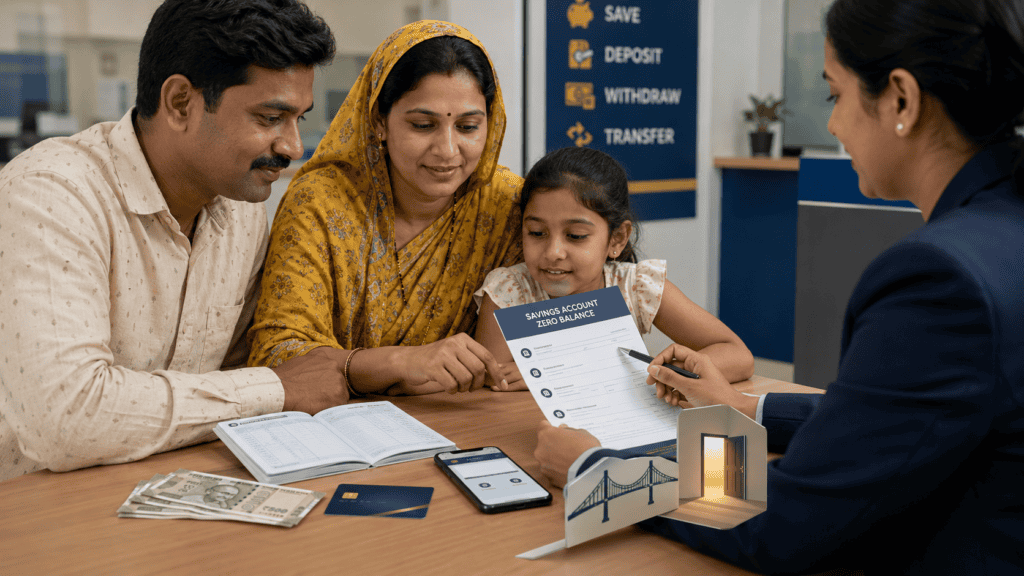
Millions of Indian families have money moving through their hands every month — wages, MGNREGA payments, pension transfers — but no safe place to put it. PM Jan Dhan Yojana was launched precisely to fix that. If your family is still managing cash without a formal bank account, or if you want to know whether this scheme actually delivers on its promises before walking into a branch, this article covers everything: what the account includes, who qualifies, what documents you need, which benefits are confirmed versus conditional, and where to verify the rules yourself.
Before we go further: PMJDY is a financial inclusion scheme, not an investment product. It will not grow your money the way a PPF or fixed deposit would. What it can do is give your household a verified banking address — and that matters more than most people realise.
Quick Answer: PM Jan Dhan Yojana
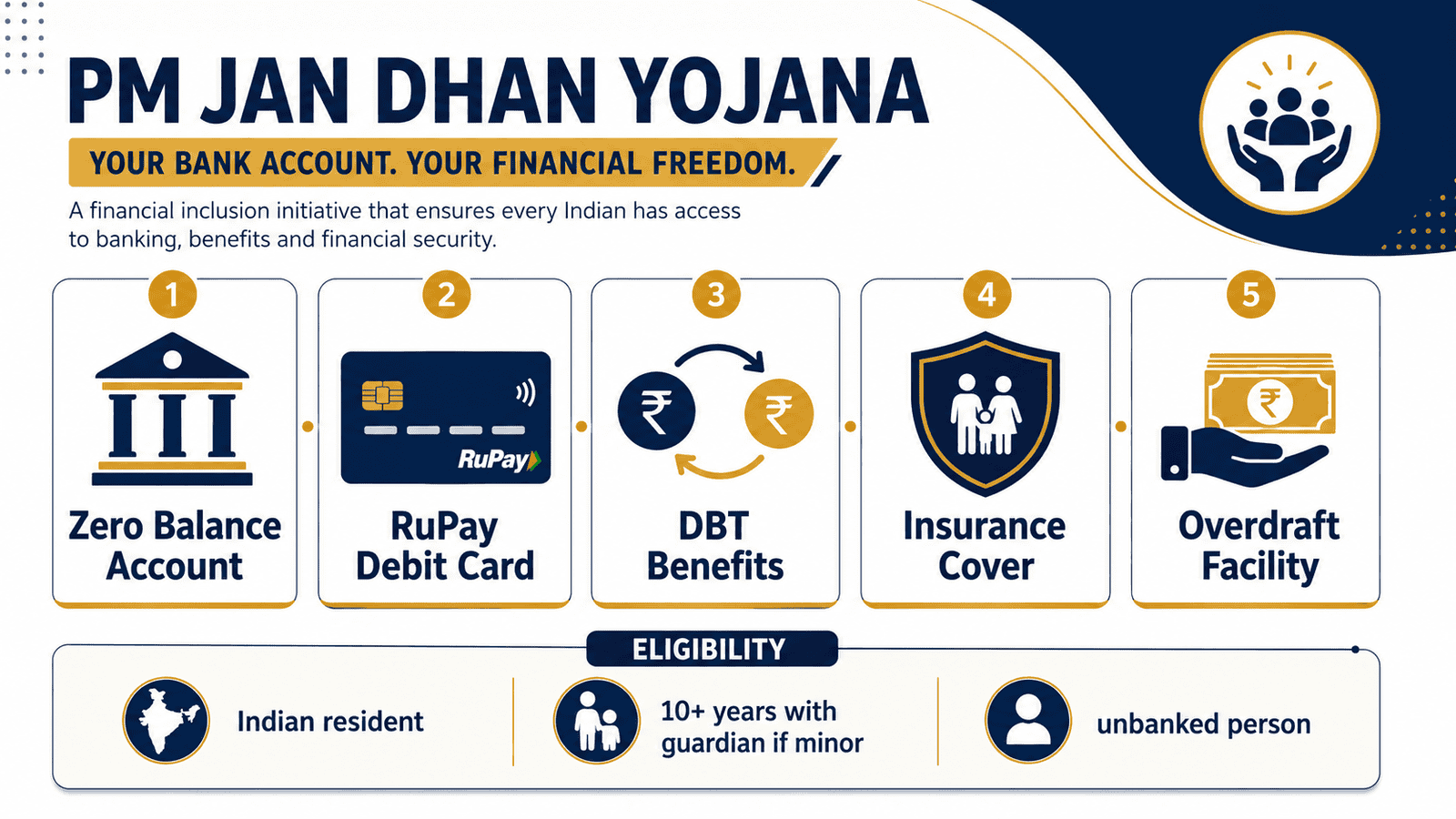
PM Jan Dhan Yojana is a government financial inclusion scheme that helps eligible Indian residents open a basic bank account with ₹0 minimum balance. It may offer RuPay card access, DBT receipt, insurance-linked benefits and overdraft support, but conditions must be checked before applying.
Key Takeaways
- PMJDY accounts are basic savings bank accounts — they are designed to give unbanked Indian residents formal banking access, not investment returns.
- The minimum balance requirement is ₹0, but zero balance does not mean every service, charge, or benefit is automatically free or active — check with your specific bank branch.
- A RuPay debit card is typically issued with the account and can be used at ATMs and point-of-sale terminals, subject to card activation and usage conditions.
- Insurance-linked benefits and overdraft eligibility are conditional — they do not apply automatically to every account holder on day one; verify current rules at pmjdy.gov.in.
- Aadhaar seeding and mobile number linking significantly affect your ability to receive Direct Benefit Transfer payments and operate the account smoothly.
- Keeping the account active and KYC details updated is the single most important thing you can do to protect access to any linked government benefits.
- PMJDY is a starting point for financial inclusion — once your banking access is stable, explore separate savings and investment products for long-term goals.
Key Facts at a Glance
| Feature | Detail | Verify Before Relying On |
|---|---|---|
| Scheme name | Pradhan Mantri Jan-Dhan Yojana (PMJDY) | No — scheme name is fixed |
| Account type | Basic Savings Bank Deposit Account (BSBDA) | No — account classification is fixed |
| Minimum balance | ₹0 | Yes — confirm at your bank branch |
| RuPay debit card | Issued with account; ATM and PoS access | Yes — activation conditions vary by bank |
| Overdraft facility | Available to eligible account holders | Yes — eligibility and limit: verify at pmjdy.gov.in |
| Accidental insurance | Linked to RuPay card usage; conditions apply | Yes — cover amount and conditions: verify at pmjdy.gov.in |
| Life insurance cover | Available to certain early account openers | Yes — confirm eligibility at your bank or pmjdy.gov.in |
| Direct Benefit Transfer | Account can receive government DBT payments | Yes — Aadhaar seeding required in most cases |
| Eligible applicants | Indian residents aged 10 and above (minors with guardian) | Yes — verify current age and residency rules at pmjdy.gov.in |
| Key documents | Aadhaar or OVD (officially valid document); photo | Yes — document list: verify at bank branch or pmjdy.gov.in |
| Official portal | pmjdy.gov.in | Always use for current rules and data |
How PM Jan Dhan Yojana Works
Launched in August 2014, PM Jan Dhan Yojana set out to bring every unbanked Indian household into the formal banking system. The scheme operates through public sector banks, private sector banks, regional rural banks, and small finance banks. You walk into any participating branch, submit your documents, and open what is formally called a Basic Savings Bank Deposit Account — or BSBDA.
A BSBDA is a regulated account type defined by the Reserve Bank of India. It is not a special Jan Dhan-only product invented by the government — it is a standardised basic account structure that PMJDY uses to ensure uniform access across banks. For a broader look at where Jan Dhan fits among government savings options and other financial inclusion tools, the guide on government savings schemes is worth reading.
What the Account Does
Once your account is open, you can deposit and withdraw cash, receive salary or wages digitally, and collect government DBT payments. The RuPay debit card issued with the account allows you to withdraw from ATMs and pay at shops. The account does not have a minimum balance requirement — but this does not mean there are no conditions at all. Banks may have rules around inactivity, transaction frequency, and service charges for specific services. Always check with your branch.
Direct Benefit Transfer and Aadhaar Seeding
One of the most practical uses of a Jan Dhan account is receiving Direct Benefit Transfer payments — subsidies, welfare payments, pension amounts, and emergency relief funds from the central or state government. For DBT to flow into your account reliably, the account typically needs to be seeded with your Aadhaar number. UIDAI (uidai.gov.in) manages Aadhaar; if your Aadhaar details have changed — new address, updated mobile number — update them before linking to avoid payment failures.
RuPay Card and Insurance-Linked Benefits
The RuPay debit card issued to Jan Dhan account holders comes with insurance benefits linked to card usage. Accidental insurance cover is typically available to cardholders who meet specific usage conditions — the card must have been used for eligible transactions within a defined period before any claim arises. Life insurance cover was also offered to account holders who opened accounts during specific windows of the scheme. Both insurance amounts and eligibility conditions are subject to change; verify current rules directly at pmjdy.gov.in before assuming any cover is active.
Overdraft Facility
PMJDY provides an overdraft facility to eligible account holders. This is a small emergency credit line — not a loan product with a formal application. To qualify, your account generally needs to be active for a minimum period, KYC must be complete, and Aadhaar must be seeded. The overdraft limit and eligibility conditions are set by the government and may be revised. Do not treat overdraft as a guaranteed benefit; it is conditional and the amount available should be verified at your bank or at pmjdy.gov.in before relying on it in an emergency.
Who Can Apply
Any Indian resident aged 10 years and above can apply. Minors between 10 and 18 years typically need a guardian to operate the account jointly. You do not need to prove income or employment. You do not need to belong to a particular income group. The scheme was designed to be broadly accessible, but specific eligibility conditions — including documentation requirements for non-Aadhaar applicants — should be confirmed at your nearest bank branch or at the official PMJDY portal.
Documents Required
Aadhaar is the most common and convenient document for opening a PMJDY account because it serves both as identity proof and address proof in one. If you do not have Aadhaar, an officially valid document (OVD) — such as a voter ID, passport, driving licence, or NREGA job card — may be accepted. A passport-sized photograph is typically required. Some banks may have slightly different document checklists, so confirm the exact requirements at your branch before visiting. According to RBI guidelines on basic savings accounts, banks are expected to maintain accessible account-opening processes for underserved populations.
Real Example: Ramesh Opens a Jan Dhan Account in Lucknow
Ramesh Kumar, 34, works as a delivery supervisor in Lucknow earning ₹28,000 per month. He receives his salary in cash and has been keeping savings at home. After hearing about a government subsidy payment his colleague received directly in her bank account, he decides to check PMJDY.
Ramesh visits the nearest public sector bank branch with his Aadhaar card and a passport photo. The account is opened the same day — no minimum deposit required. He is issued a RuPay debit card within a few days. He starts depositing ₹1,500–₹2,000 per month in the account and uses the card to withdraw at the ATM near his house. When the state government announces a direct benefit transfer for workers in his category, the payment arrives in his account because Aadhaar is already seeded.
Six months later, Ramesh’s employer offers salary transfer directly to his bank account. His Jan Dhan account is already active and KYC-compliant — the transition is smooth. He has not yet checked the overdraft or insurance conditions, and his next step is to visit the branch to clarify whether he qualifies and what the current limits are.
Key insight: The account’s real value showed up not in the insurance or overdraft — but in DBT access and the shift from cash management to formal banking. That is what PMJDY is primarily designed to deliver.
Comparison: Jan Dhan Account vs Regular Savings Account vs Zero-Balance Account
| Parameter | Jan Dhan Account (PMJDY) | Regular Savings Account |
|---|---|---|
| Minimum balance | ₹0 | Varies: ₹500–₹10,000+ depending on bank and branch |
| Account type | Basic Savings Bank Deposit Account (BSBDA) | Standard savings account |
| Target user | Unbanked or underbanked residents; DBT recipients | Salaried, self-employed, anyone with regular income |
| DBT suitability | Yes — primary purpose | Yes — if Aadhaar seeded |
| Debit card | RuPay card issued; insurance conditions apply | Visa/Mastercard/RuPay; higher spending limits typically |
| Overdraft | Conditional; small limit; verify at pmjdy.gov.in | Not standard; requires separate application |
| Transaction limits | May be restricted under BSBDA rules | Higher limits; varies by bank product |
| Penalty charges | No minimum balance penalty; other charges: verify with bank | Non-maintenance charges apply if balance falls below minimum |
| Best suited for | First bank account, DBT, basic savings | Higher transaction frequency, salary account, broader banking |
If you are comparing account types in detail, the article on zero balance account comparison explains the key differences and when each type makes sense.
How to Decide What’s Right for You
You do not have any bank account and need a safe place to receive government DBT payments — a Jan Dhan account is the most direct path to banking access with no minimum balance requirement.
Your primary need is to receive salary transfers, make regular digital payments, and use a debit card freely — consider whether a regular savings account suits you better once basic banking access is established.
You want to build long-term savings after opening a Jan Dhan account — explore government-backed options like PPF once your banking foundation is in place. Start with public provident fund basics to understand how regular savings can grow over time.
Your family already has a full-service savings account and you are looking for overdraft or insurance-linked features — compare Jan Dhan’s conditional benefits with what your existing bank already offers before opening a new account.
You are unsure whether you qualify for the overdraft or insurance benefit — do not assume either is active. Visit your branch, ask specifically, and confirm the current conditions before relying on those features.
You should not rely solely on a Jan Dhan account if you need higher transaction limits, advanced digital banking features, or a product that builds a financial corpus — PM Jan Dhan Yojana is banking access, not a wealth-building tool.
Common Mistakes to Avoid
Assuming Every Benefit Activates Automatically
Many first-time account holders believe that insurance cover and overdraft access are available from day one simply by opening the account.
They are not. Insurance-linked benefits typically depend on RuPay card usage within a specific recent window. Overdraft eligibility usually requires the account to be active for a defined period and KYC to be fully complete. Assuming these are live without checking can leave you without cover when you need it most.
Before relying on any benefit, visit your bank branch or check pmjdy.gov.in for current eligibility conditions.
Leaving the Account Inactive
If you open a Jan Dhan account and then do not use it for months, the account may be classified as dormant or inactive.
An inactive account can disrupt DBT credit, delay government payments, and create friction when you need the account urgently. Reactivating a dormant account requires a branch visit and may take time. Consistent small deposits or withdrawals — even ₹100–₹200 a month — are enough to keep the account active.
Set a reminder to use the account at least once every two to three months.
Ignoring KYC and Aadhaar-Seeding Requirements
Incomplete KYC or unlinked Aadhaar is one of the most common reasons DBT payments fail to reach account holders.
If your Aadhaar details have changed, or if you updated your mobile number with UIDAI but not with the bank, the mismatch can block incoming government transfers. The fix is straightforward — visit the branch and update your details — but it can take days, during which payments may be delayed or redirected.
Update KYC proactively, not after a payment has already failed.
Sharing Debit Card PIN, OTP, or Account Details
Scammers specifically target first-time banking users by posing as bank officials or government scheme representatives.
No bank or government department will ever ask for your PIN, OTP, or full account number over a phone call or message. Sharing these details even once can result in your account being drained. If you receive any such call claiming to be from your bank or from PMJDY, hang up and call the bank’s official helpline directly.
Refer others in your household to the same safety rule — new account holders are a common target for banking fraud in India.
Assuming Zero Balance Means No Bank Charges Ever
Zero minimum balance means the bank cannot penalise you for keeping a low or nil balance. It does not mean all services are free indefinitely.
Some banks may charge for excess ATM withdrawals beyond a monthly free limit, for SMS alerts, or for replacement cards. These charges vary by bank. Reading the account terms at the time of opening — or asking the branch staff to explain any applicable charges — prevents unpleasant surprises. For more on avoiding account-related penalties, the guide on avoiding bank penalties is useful.
Always ask: “Are there any other charges I should know about?” when opening the account.
Treating Overdraft as Free or Guaranteed Money
The overdraft facility, if available, is a credit feature — not a grant or benefit that does not need to be repaid.
If you use the overdraft, you are borrowing from the bank and it must be returned. Using it repeatedly or failing to repay it can affect your credit record and disqualify you from future facility access. Check the current overdraft limit and repayment terms at your branch before using this feature.
Use overdraft only for genuine short-term emergencies, not for routine expenses.
Neglecting Nominee Registration
Many account holders skip the nominee section when opening an account, assuming they can fill it in later.
Without a registered nominee, accessing funds in the account after the account holder’s death becomes significantly more complex for the family — requiring legal documentation and additional procedures. Registering a nominee at the time of account opening takes two minutes and protects your family from unnecessary paperwork during a difficult time.
If you have an existing Jan Dhan account without a nominee, visit the branch to add one.
When This May Not Be the Right Choice
PM Jan Dhan Yojana is a strong first step — but it may not be sufficient as your only bank account in these situations:
You already have a full-service savings account. If you have a functioning savings account with a bank and are already receiving salary or government payments into it, opening a second PMJDY account adds administrative complexity without meaningful benefit. Maintain one active, well-managed account rather than splitting usage across multiple idle accounts.
You need higher transaction volumes or advanced banking features. BSBDA accounts may have transaction limits under RBI rules. If your business or employment requires frequent large-value transactions, internet banking with broad feature access, or premium debit card benefits, a regular savings account is better suited to your needs.
You are looking for investment returns or retirement corpus growth. Jan Dhan accounts do not offer competitive returns or tax benefits. If retirement planning or wealth building is your goal, comparing retirement options like NPS, PPF, and EPF is a more relevant starting point.
You cannot meet KYC or documentation requirements. Without Aadhaar or an accepted officially valid document, account opening may face hurdles. Resolve documentation first — UIDAI has a process for Aadhaar enrolment for residents who do not yet have one.
If any of these apply to your situation, it may be worth exploring alternatives before committing.
Official Rules and Where to Verify
PMJDY rules, benefit amounts, eligibility conditions, and document requirements can and do change. Before opening an account or relying on any specific benefit, verify current information directly from these official sources:
- PMJDY portal — pmjdy.gov.in — scheme features, account statistics, current benefit details, and FAQs
- Ministry of Finance — finmin.nic.in — policy updates, scheme notifications, and scheme expansion announcements
- Reserve Bank of India — rbi.org.in — BSBDA account rules, customer protection guidelines, and banking regulations
- NPCI — npci.org.in — RuPay card rules, insurance conditions linked to card usage, and Digital India payment infrastructure
- UIDAI — uidai.gov.in — Aadhaar seeding, update processes, and identity verification for account KYC
- Your bank branch — for account-specific charges, overdraft eligibility, card activation status, and nominee updates
Rules, limits, and rates on this topic can change with each Budget or regulatory update. Always verify current figures directly from the official source before making any financial decision.
Expert Tips
- Seed your Aadhaar the day you open the account. Do not leave the branch without confirming that your Aadhaar number is linked. This single step unlocks DBT access and prevents the most common account-operation problem for Jan Dhan holders.
- Register a nominee at account opening — not later. Nominee registration takes two minutes at the branch and can save your family significant paperwork in an emergency. Most first-time account holders skip this step; do not be one of them.
- Check whether your RuPay card is active and understand the usage conditions for insurance. Insurance benefits linked to the RuPay card typically depend on the card being used for eligible transactions within a recent period. Confirm the exact condition at your branch so you are not surprised if a claim arises.
- Do not borrow against overdraft unless it is a genuine emergency. The overdraft facility is emergency credit, not a monthly buffer. Using it for regular shortfalls builds a repayment habit that can hurt your credit standing. Verify the current overdraft limit and repayment terms at pmjdy.gov.in before you need to use it.
- Use the account at least once a month to keep it active. A ₹100 deposit or a single ATM withdrawal is enough. Dormant accounts create friction at exactly the moment you need banking access most.
- Once basic banking is established, build savings separately. A Jan Dhan account is a foundation — not a savings strategy. Once your account is active and KYC-complete, consider a separate recurring deposit or post office savings product for disciplined savings. For a government-backed starting point, see the guide on post office savings choices like Kisan Vikas Patra.
- Never share your PIN, OTP, or account number with anyone — including callers claiming to be from your bank or from PMJDY. Scams targeting new account holders are common. When in doubt, visit the branch in person.
Frequently Asked Questions
Who is eligible to open a PM Jan Dhan Yojana account?
Any Indian resident aged 10 years and above is generally eligible to open a PMJDY account. There is no income or employment requirement. Minors between 10 and 18 years typically require a guardian to jointly operate the account. Confirm current eligibility conditions at pmjdy.gov.in or your nearest participating bank branch before applying.
Can I open a Jan Dhan account with zero balance?
Yes — PMJDY accounts do not require a minimum opening balance or a minimum maintenance balance. However, zero balance does not mean all services are free under all conditions. Some banks may have charges for specific services such as excess ATM withdrawals or card replacement. Ask the branch about all applicable charges at the time of opening.
Is Aadhaar mandatory to open a PMJDY account?
Aadhaar is the most convenient document because it serves as both identity and address proof. If you do not have Aadhaar, you can use another officially valid document such as a voter ID, passport, or NREGA job card. However, Aadhaar seeding is strongly recommended after account opening to enable DBT receipts and smooth account operation. Verify current document requirements at your branch.
What documents are required to open a Jan Dhan account?
Typically: Aadhaar card (or another officially valid document such as voter ID, passport, or driving licence), a recent passport-sized photograph, and your mobile number. If your documents do not have your current address, the bank may ask for a self-declaration. Document requirements can vary slightly by bank — confirm the exact list before visiting the branch.
Does everyone automatically get insurance and overdraft benefits?
No. Both benefits are conditional. Accidental insurance cover is typically linked to RuPay card usage — the card must have been used for an eligible transaction within a specific period before a claim. Overdraft eligibility generally requires the account to be active for a minimum period with complete KYC. Neither benefit should be assumed active without verifying current conditions at pmjdy.gov.in or your bank branch.
Can I open a Jan Dhan account if I already have another bank account?
Yes — having an existing savings account does not disqualify you from opening a PMJDY account. However, each person can hold only one BSBDA at a given bank. If you already have a full-service savings account that meets your banking needs, evaluate whether a second Jan Dhan account adds practical value before opening one.
What happens if I do not use my Jan Dhan account for a long time?
An unused account may become classified as dormant or inoperative. This can interrupt DBT payments and may require a branch visit to reactivate. Keeping the account active with even a small transaction every two to three months prevents this. If your account is already dormant, contact your bank branch with your identity documents to reactivate it.
Is a Jan Dhan account the same as a zero-balance savings account offered by private banks?
Not exactly. A Jan Dhan account is a specific government financial inclusion scheme account classified as a BSBDA under RBI rules. Some private banks also offer zero-balance accounts independently, but these are not PMJDY accounts and may not carry the same government-backed insurance or overdraft features. The eligibility conditions, benefits, and scheme linkages are different. Check the specific account terms before applying to either.
Can I receive my salary in a Jan Dhan account?
Yes — a PMJDY account can receive salary transfers. Many workers use their Jan Dhan account as their primary salary account, especially for government or public sector employment. If you later need a higher-feature account for broader banking services, you can open a regular savings account and notify your employer of the new account details.
What is the maximum overdraft amount available under PMJDY?
The overdraft limit under PMJDY is set by the government and is subject to revision. The current limit should be verified directly at pmjdy.gov.in or your bank branch — do not rely on older figures that may have been updated. Eligibility conditions also apply; not every account holder qualifies automatically.
Final Verdict
PM Jan Dhan Yojana is one of the most practical government financial inclusion schemes for Indian households that are new to formal banking. The zero minimum balance requirement, RuPay debit card, and DBT access make it a meaningful first step for families managing wages and government payments in cash. If your household does not yet have formal banking access — or if someone in your family is still waiting for a DBT payment with no bank account to receive it — PMJDY is worth exploring.
But keep the expectations accurate. This is banking access, not a savings product, investment scheme, or insurance policy in the traditional sense. Insurance and overdraft benefits are conditional, not automatic. To build financial security beyond basic banking, you will need to layer in separate savings and planning tools over time.
Always verify the latest rules from official sources or consult a qualified professional before making any financial decision.
This article is for educational purposes only and should not be treated as personalised financial, tax, investment, insurance, or legal advice. Tax rules, interest rates, regulatory limits, and product features can change with each Budget or policy update. Please verify current rules from official government sources or consult a qualified and registered professional before making any financial decision.
Suresh Nair writes about Indian government savings schemes, post office schemes, and conservative long-term savings options. His content is especially useful for families, parents, senior citizens, and low-risk savers who want to understand scheme rules before depositing money.
He covers topics such as Public Provident Fund, Sukanya Samriddhi Yojana, Senior Citizens’ Savings Scheme, National Savings Certificate, Kisan Vikas Patra, Post Office Monthly Income Scheme, National Pension System, post office fixed deposits, post office recurring deposits, child savings schemes, senior citizen savings options, maturity rules, withdrawal rules, lock-in periods, and tax treatment.
Suresh’s writing is mature, rule-focused, and cautious. He explains eligibility, deposit limits, tenure, interest calculation, tax benefits, withdrawal conditions, and practical use cases in simple language. His articles are useful for readers who prefer safety and predictable rules over high-risk investments. Since government scheme interest rates, deposit limits, lock-in rules, and tax treatment may change through official notifications, readers should verify current details from India Post, PFRDA, Income Tax Department, or relevant government sources before investing.