

If you have ever looked at your EPFO passbook and wondered why your employer’s PF contribution does not fully show up in your EPF balance — you are not alone. Rohit, a software engineer in Bengaluru earning ₹12 lakh a year, had the same question. He noticed an “EPS” entry in his UAN passbook and assumed it was a mistake. It was not. A portion of what his employer contributes to PF every month is quietly going into a separate pension fund — the Employees’ Pension Scheme — not into his savings balance. EPS pension is real, it is regulated by EPFO, and it affects your retirement in ways most salaried employees do not realise until they resign or retire. This article explains what EPS pension means, who qualifies, how contributions work, and what you should do next.
Quick Answer: What Is EPS Pension?
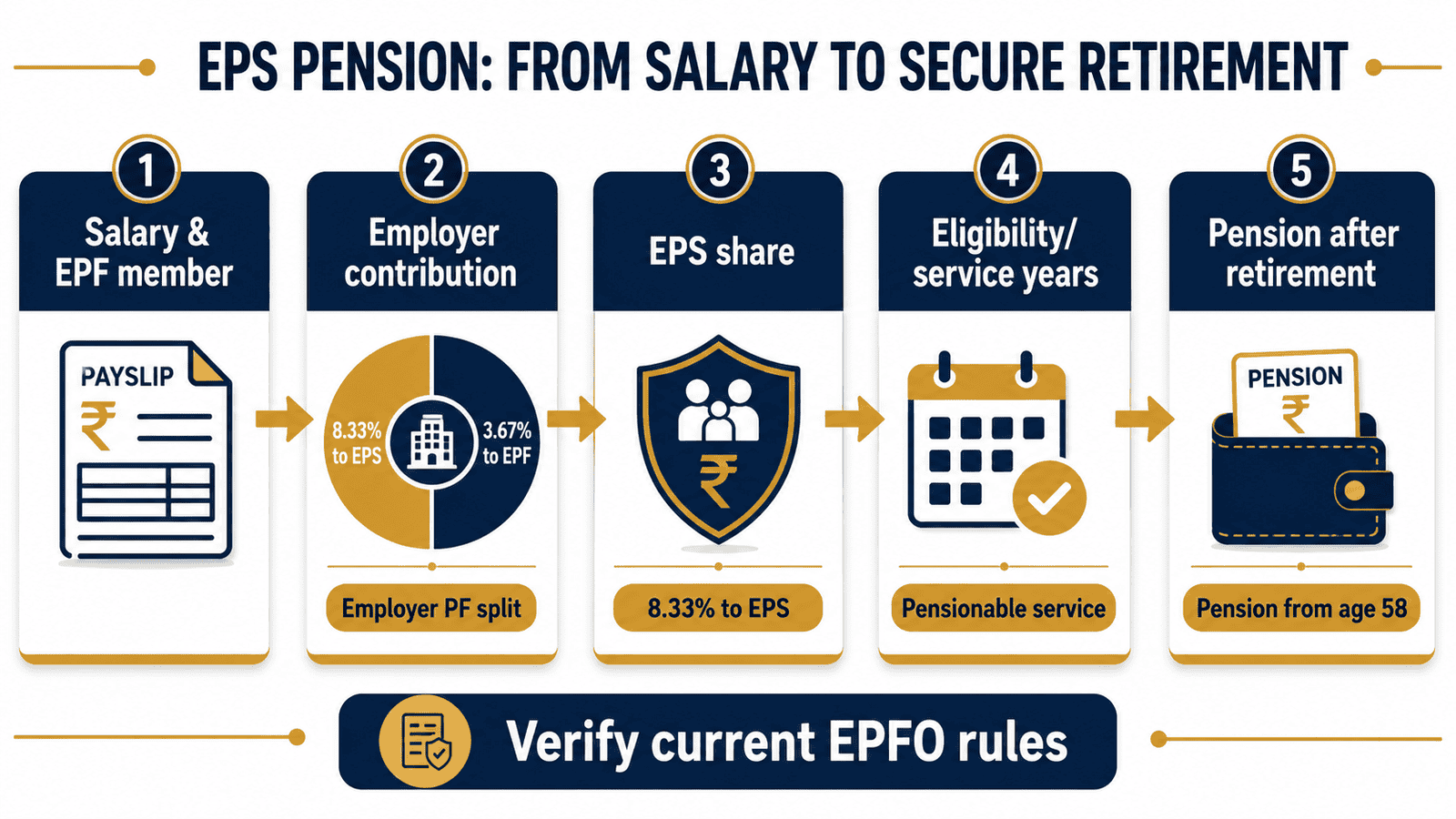
EPS pension is the monthly pension benefit under EPFO’s Employee Pension Scheme for eligible salaried employees. A portion of the employer’s PF contribution, generally 8.33% of wages subject to the applicable wage ceiling, goes to EPS, and pension is linked to service years, pensionable salary and retirement age.
Key Takeaways
- EPS is funded from a portion of the employer’s PF contribution — no separate deduction appears on your salary slip for EPS.
- The EPS contribution is generally calculated as 8.33% of wages subject to the applicable wage ceiling set by EPFO — the amount going to EPS is capped, not based on your full salary.
- Pension eligibility under EPS depends on completing a minimum qualifying service period and reaching the applicable retirement age — verify current thresholds from EPFO before assuming eligibility.
- EPS and EPF are separate: EPF is your savings accumulation; EPS tracks your pension eligibility — they appear differently in your UAN passbook.
- When you leave a job, EPS rules around withdrawal, scheme certificate, and transfer are different from EPF withdrawal rules — acting without checking can cost you pension years.
- All EPS records — service history, date of joining, date of exit — must be accurate in EPFO’s system for any claim to process without rejection.
- Always verify current EPS rules, wage ceiling, contribution rates, and pension formula directly from epfindia.gov.in before making any claim decision.
Key Facts at a Glance
| Parameter | Detail |
|---|---|
| Scheme Name | Employees’ Pension Scheme (EPS), commonly referred to as EPS 1995 |
| Administered by | Employees’ Provident Fund Organisation (EPFO) |
| Who contributes | Employer (portion of their PF contribution) and Central Government (where applicable) |
| EPS contribution rate | Generally 8.33% of wages, subject to the applicable EPFO wage ceiling |
| Pension eligibility age | Superannuation at age 58; reduced pension available at age 50 (verify from EPFO) |
| Minimum qualifying service | 10 years of eligible service for monthly pension (verify current threshold from EPFO) |
| Claim forms | Form 10C (withdrawal benefit / scheme certificate) and Form 10D (monthly pension) |
| Official source | epfindia.gov.in |
What Is EPS Pension and How Does It Work?
The Employees’ Pension Scheme is a social security scheme run by EPFO under the Employees’ Provident Funds and Miscellaneous Provisions Act, 1952. While EPF (Employee Provident Fund) is essentially a retirement savings account — your money plus your employer’s money growing with interest — EPS is a pension eligibility track. It does not accumulate a balance you can watch grow; instead, it quietly builds your entitlement to a monthly pension after you retire.
Think of it this way: EPF is your retirement savings pot. EPS is the pension eligibility scorecard running in parallel.
According to EPFO guidelines, every employer who contributes to PF is required to divert a portion of that contribution into the EPS fund. This is why, when you look at your UAN passbook, the EPF employer column and the EPS column show different amounts — and why your EPF balance does not equal the total of all employer contributions made on your behalf.
For a deeper understanding of how the overall EPF system works before diving into EPS, see our guide on EPF basics explained.
Who Is Eligible for EPS?
EPS eligibility generally applies to employees who are members of EPFO, earn up to the applicable wage ceiling at the time of joining, and are employed in an establishment covered under the EPF Act. Employees who joined service after a certain age threshold as specified by EPFO may have restricted eligibility — verify current conditions from epfindia.gov.in, as rules can change through EPFO circulars.
Key EPS Terms You Must Know
Pensionable Salary: This is the salary figure used to calculate your EPS pension — generally the average monthly salary drawn during the last 60 months of pensionable service, subject to the applicable wage ceiling. It is not your gross salary or your CTC.
Pensionable Service: The total number of years of qualifying service under EPS, rounded as per EPFO rules. Service periods across different employers can be linked through PF transfer, which is why transferring your PF after a job change matters for EPS.
Superannuation Pension: The monthly pension you receive upon retiring at the applicable superannuation age after completing the minimum qualifying service period.
Reduced Pension: If you retire before the superannuation age but after reaching the applicable early retirement age and minimum service threshold, you can opt for a reduced pension. The reduction is a fixed percentage for each year drawn early — verify the current reduction factor from EPFO before assuming any amount.
Scheme Certificate: If you leave a job before completing the minimum service required for monthly pension but have completed a shorter minimum threshold, you can obtain a Scheme Certificate. This preserves your EPS service record so it can be linked to future employment rather than being withdrawn as a lump sum.
Real Example: How EPS Contribution Works in Rohit’s Salary
Rohit is 31 years old, a software engineer in Bengaluru. His basic salary plus DA is ₹15,000 per month — a figure used here purely as an illustration aligned with the standard wage ceiling context in EPS calculations.
Here is how his monthly PF and EPS contributions look:
| Contribution Type | Who Pays | Amount (Illustrative) |
|---|---|---|
| Employee EPF contribution | Rohit | ₹1,800 (12% of ₹15,000) |
| Employer EPF contribution (net) | Employer | ~₹550 (balance after EPS diversion) |
| Employer EPS contribution | Employer | ~₹1,250 (8.33% of ₹15,000 — illustrative) |
So when Rohit’s employer contributes ₹1,800 on the employer side, roughly ₹1,250 goes to the EPS fund and only the remaining ~₹550 flows into Rohit’s EPF savings account. This is why Rohit’s EPF balance does not grow as fast as he expected — part of his employer’s contribution is funding his future pension eligibility, not his savings balance.
Note: Actual figures depend on the current EPFO wage ceiling, your salary structure, and your employer’s payroll treatment. Use this only as a conceptual illustration. For a detailed breakdown of how employer contributions are split, read our article on PF contribution split.
How to Calculate EPS Pension
EPS Monthly Pension = (Pensionable Salary × Pensionable Service) ÷ 70
This is the standard formula used in EPS pension calculations, as referenced in EPFO documentation. Each variable matters:
- Pensionable Salary: Generally the average of the last 60 months of wages, subject to the applicable wage ceiling — not your gross or CTC figure.
- Pensionable Service: Total qualifying years under EPS, including past employment if PF was transferred. Partial years may be rounded per EPFO rules — verify current rounding treatment from EPFO before computing.
- 70: The divisor in the standard formula. This figure is part of the official EPS calculation framework.
Illustrative example using Rohit’s numbers:
Assume Rohit’s pensionable salary is ₹15,000 (subject to current wage ceiling — verify from EPFO) and his total pensionable service is 25 years at retirement.
Estimated monthly pension = (₹15,000 × 25) ÷ 70 = ₹3,75,000 ÷ 70 = approximately ₹5,357 per month.
This is an illustrative figure only. Rohit’s actual pension will depend on EPFO’s official records, applicable wage ceiling, exact pensionable service, any breaks in service, and official rules at the time of claim. Use EPFO’s official pension calculator at epfindia.gov.in for an estimate based on your own records.
EPF vs EPS: Key Differences at a Glance
| Parameter | EPF | EPS |
|---|---|---|
| Purpose | Retirement savings accumulation | Monthly pension after retirement |
| Who contributes | Employee + employer (net share) | Employer (diverted portion) + Central Govt where applicable |
| Appears in UAN passbook as | EPF balance (growing with interest) | EPS column — no interest accumulation |
| Withdrawal on resignation | Can withdraw EPF balance subject to rules | Can withdraw as lump sum (short service) or get scheme certificate |
| Retirement benefit type | Lump sum corpus | Monthly pension for life |
| Verification route | UAN passbook at unifiedportal-mem.epfindia.gov.in | Same UAN passbook; EPS service history |
How to Decide What’s Right for You
You are currently employed and see an EPS entry in your UAN passbook — THEN verify your service history, date of joining, and date of exit are accurate for every past employer.
You are changing jobs — THEN transfer your PF to your new UAN rather than withdrawing, to preserve your EPS pensionable service continuity.
You have resigned and completed a shorter service period below the monthly pension threshold — THEN check whether a Scheme Certificate is the right option to protect your EPS service record rather than taking a lump sum withdrawal.
You have completed the minimum qualifying service and are approaching retirement age — THEN verify your pensionable service, nominee details, Aadhaar seeding, and bank KYC in your UAN account before filing Form 10D.
You are unsure whether your past EPS service from a previous employer has been linked — THEN check your UAN passbook service history and contact EPFO or your employer’s HR for clarification before any claim.
You should not assume that simply having a PF account for several years automatically qualifies you for a monthly EPS pension — eligibility depends on meeting the minimum service threshold, age conditions, and correct EPFO records. Verify current eligibility conditions from epfindia.gov.in before expecting a monthly pension.
Common Mistakes to Avoid
Assuming EPS Balance Equals EPF Balance
Many employees see a lower-than-expected EPF employer balance and assume an error.
The missing amount is not lost — it has gone to EPS. The EPS column in your UAN passbook confirms this. Confusing the two can lead to unnecessary EPFO grievances or incorrect claim filings.
Always read both columns in your passbook separately and understand what each represents.
Ignoring EPS Service When Changing Jobs
Withdrawing PF after leaving a job seems straightforward — but if you also withdraw the EPS portion before completing qualifying service, you may lose accumulated pension years.
Even a few years of EPS service lost early in your career can reduce your total pensionable service at retirement. Over a 25–30 year career, this can meaningfully affect your monthly pension entitlement.
Transfer your PF when changing jobs and verify that your EPS service is being carried forward. Read our complete guide on PF after resignation before taking any action.
Not Checking UAN Service History for Errors
Date of joining or date of exit errors in EPFO’s records are common — especially when employers make late or incorrect filings.
An incorrect date of exit can reduce your pensionable service on paper, affecting your pension calculation. Correcting EPFO records after retirement is significantly harder than correcting them while employed.
Log into your UAN portal and verify your service history once a year.
Filing the Wrong EPS Claim Form
Form 10C is for withdrawal benefit or scheme certificate. Form 10D is for monthly pension. Filing the wrong form, or filing prematurely, can delay your claim by weeks or months.
Eligibility conditions, applicable service thresholds, and form requirements should be verified from EPFO before filing — especially since rules and processes can change.
Do not rely on what a colleague did in a different year or a different employer situation.
Not Updating Aadhaar, PAN, and Bank Details Before Claiming
EPFO processes pension and withdrawal claims digitally. Any mismatch between UAN records and Aadhaar or bank account details leads to claim rejection.
A single rejected claim can delay your pension or withdrawal by several weeks. EPFO requires Aadhaar-seeded and employer-verified UAN details for most online claims.
Update and verify all KYC details well before the claim date — not on the same day.
Treating EPS as a Complete Retirement Plan
EPS pension is a benefit, but for most salaried employees it is a relatively modest monthly amount, particularly when pensionable salary is subject to the wage ceiling.
Relying on EPS alone for retirement income without building EPF, NPS, or other savings alongside it is a significant gap in planning.
Treat EPS as one layer of retirement support — not the whole plan.
When This May Not Be the Right Choice
Short service periods: If you have worked for fewer years than the minimum qualifying service threshold required for a monthly EPS pension, you will not receive a monthly pension. Instead, you may be eligible for a withdrawal benefit or a Scheme Certificate. The specific thresholds must be verified from EPFO, as they can change.
Very early career stages: Young employees in their 20s and 30s should not treat EPS as a meaningful standalone retirement benefit. Given the wage ceiling that caps pensionable salary, the monthly pension amount alone is unlikely to be sufficient for retirement income. Building EPF, NPS, or other investments in parallel is essential.
Fragmented PF accounts: If you have worked with multiple employers and never transferred your PF, your EPS service may be split across different EPFO accounts. Fragmented service records can complicate pension calculation and claim processing. Consolidate your UAN and verify service history before making any assumptions about pension eligibility.
Higher-income employees above the wage ceiling: If your basic salary significantly exceeds the applicable EPFO wage ceiling, the EPS contribution is still capped at the ceiling amount. Your actual EPS pension will not reflect your full salary — it will reflect only the pensionable salary subject to the ceiling. Verify the current ceiling from EPFO to understand the practical limits of your EPS pension.
If any of these apply to your situation, it may be worth exploring alternatives before committing.
Official Rules and Where to Verify
EPS pension rules — including wage ceilings, contribution rates, pension formula, service thresholds, and claim procedures — are set and updated by EPFO and the Ministry of Labour and Employment. These can change through government notifications and Budget announcements.
Rules, limits, and rates on this topic can change with each Budget or regulatory update. Always verify current figures directly from the official source before making any financial decision.
- EPFO — epfindia.gov.in: Primary source for EPS scheme rules, FAQs, circulars, claim forms, and the EPFO pension calculator.
- UAN Member Portal: Log in at unifiedportal-mem.epfindia.gov.in to check your UAN passbook, EPS service history, KYC status, and claim history.
- Income Tax Department — incometax.gov.in: For any questions about the tax treatment of EPS pension income or PF/EPS withdrawal amounts.
- PFRDA — pfrda.org.in: Relevant only if comparing EPS with NPS (National Pension System) as a retirement option.
To verify your own EPS entries and contribution history, see our guide on how to check PF balance and use your UAN to access the EPS column in your passbook. For setting up and navigating your UAN account, refer to our UAN account guide.
Expert Tips
- Check your UAN passbook every quarter: Look specifically at the EPS column — not just the EPF balance. Confirm that contributions are appearing for every month you were employed. A missing month can indicate an employer filing error that is easier to correct early.
- Always transfer, never withdraw, when changing jobs: Each time you withdraw EPS on resignation instead of transferring, you potentially lose that stretch of pensionable service. Over a three-job career, even two early withdrawals can reduce your total pensionable service significantly.
- Verify your date of joining and date of exit for every employer in EPFO records: Log into the UAN portal and cross-check service history. A date error that reduces your service by even six months can affect pension calculation. Raise a correction request with your past employer or EPFO before you retire.
- Seed Aadhaar, PAN, and bank account in UAN well before any claim: EPFO’s claim processing requires fully verified KYC. Do not wait until you are ready to claim — do this while you are still employed so your employer can verify and approve it easily.
- Get a Scheme Certificate if you are leaving before the pension threshold: If you are not yet eligible for a monthly pension but have completed a minimum service period, a Scheme Certificate preserves your EPS service years for future linkage rather than converting them to a one-time withdrawal. This is a decision point with long-term consequences — verify the current rule from EPFO before choosing.
- Track your claim status online instead of refiling: After submitting a Form 10C or Form 10D, track the claim at the EPFO portal before filing again. Duplicate submissions can cause processing delays. See our guide on how to track your EPFO claim for step-by-step instructions.
Frequently Asked Questions
What is EPS pension?
EPS pension is the monthly pension benefit provided under EPFO’s Employees’ Pension Scheme to eligible salaried employees after they complete the minimum qualifying service and reach the applicable retirement age. It is separate from the EPF savings balance and is funded by a portion of the employer’s PF contribution, not by the employee directly.
Is EPS deducted from my salary?
No. EPS is not a separate deduction from your take-home salary. It is funded from the employer’s share of PF contribution. Your salary slip shows your 12% PF deduction going to EPF — EPS is funded by diverting a portion of the employer’s 12% PF contribution into the pension fund, which is why your EPF employer balance is lower than you might expect.
How much of the employer contribution goes to EPS?
Generally, 8.33% of wages — subject to the applicable EPFO wage ceiling — is diverted to EPS from the employer’s PF contribution. The remaining employer contribution goes to EPF. The exact rate and wage ceiling must be verified from epfindia.gov.in, as they can be revised by EPFO or government notification.
Can I withdraw EPS while I am still working?
No. EPS cannot be withdrawn while you are in active employment. EPS benefits — whether a monthly pension, withdrawal benefit, or Scheme Certificate — are triggered only upon leaving employment, reaching retirement age, or meeting specific conditions such as death or disability. Verify current conditions from EPFO before assuming any specific withdrawal right.
What happens to EPS after I resign?
After resignation, your options depend on your total pensionable service and age. If you have completed the minimum service for monthly pension and are at or near retirement age, you may be eligible for Form 10D (monthly pension). If your service is below the threshold, you can claim a withdrawal benefit via Form 10C or obtain a Scheme Certificate to preserve your EPS service for future employment. Verify current thresholds from EPFO before deciding.
What is an EPS Scheme Certificate?
A Scheme Certificate is an EPFO document that records your EPS pensionable service from a particular employer. Instead of withdrawing EPS as a lump sum when you leave a job, you can obtain this certificate and submit it to your next employer’s EPFO account. This links your past service to your future employment, preserving your total pensionable service for pension calculation at retirement. Verify current eligibility rules for Scheme Certificate from EPFO.
What is Form 10C?
Form 10C is used to claim either the EPS withdrawal benefit (lump sum) or a Scheme Certificate upon leaving employment. It is filed through the UAN member portal online. The applicable conditions, service thresholds, and current process must be verified from epfindia.gov.in before filing, as EPFO procedures can be updated.
What is Form 10D?
Form 10D is used to claim the monthly EPS pension after retirement. It is filed once you meet the minimum qualifying service and age conditions for superannuation or reduced pension. Supporting documents typically include proof of date of birth, bank details, and a cancelled cheque. Verify the current filing process and document requirements from EPFO before submitting.
How is EPS pension calculated?
The standard EPS pension formula is: Monthly Pension = (Pensionable Salary × Pensionable Service) ÷ 70. Pensionable salary is generally the average of the last 60 months of wages subject to the EPFO wage ceiling. Pensionable service is total qualifying years under EPS. Both variables are subject to EPFO’s current rules — verify the formula and inputs from epfindia.gov.in before relying on any estimate. For a guided estimate, use our EPF calculator.
Is EPS pension taxable?
EPS pension received as a monthly annuity after retirement is generally taxable as income in the hands of the pensioner, in the same way as salary income, and is reported under the head “Income from Salaries” or “Income from Other Sources” depending on applicable tax rules. Tax treatment of EPS withdrawal (lump sum) depends on the nature of the claim and applicable Income Tax provisions. Verify the current tax treatment from incometax.gov.in or a qualified tax professional before filing returns.
Final Verdict
EPS pension is one of the most overlooked parts of the PF system — hidden in plain sight in your UAN passbook, yet directly affecting your retirement income. It is not your EPF savings balance, and it does not work the same way. For salaried employees who stay in formal employment for 10 or more years, EPS is a genuine retirement benefit worth understanding and protecting. For those who change jobs frequently without transferring PF, it is also one of the easiest benefits to accidentally erode — one premature EPS withdrawal at a time.
The most important thing you can do right now is log into your UAN portal, check your EPS service history, and verify that every employer and every year of service is recorded correctly. Clean records today mean a smoother claim tomorrow.
Eligibility, contribution rates, wage ceiling, pension formula, and claim procedures all depend on EPFO’s current official rules — not assumptions from a previous year or a colleague’s experience. Always verify the latest rules from official sources or consult a qualified professional before making any financial decision.
This article is for educational purposes only and should not be treated as personalised financial, tax, investment, insurance, or legal advice. Tax rules, interest rates, regulatory limits, and product features can change with each Budget or policy update. Please verify current rules from official government sources or consult a qualified and registered professional before making any financial decision.

Raghav Menon writes about employment-linked retirement benefits in India, including EPF, PF, UAN, gratuity, EPS pension, EDLI, VPF, superannuation, and NPS-related salary benefits. His content is designed for employees who see deductions and benefit components in their salary structure but do not fully understand how those amounts work over time.
He covers practical topics such as EPF contribution, employer PF, employee PF, PF withdrawal rules, PF transfer after job change, UAN activation, PF balance checks, EPFO claim status, multiple PF account merging, EPF nomination, gratuity calculation, EPS pension eligibility, EDLI benefits, and tax treatment of PF withdrawals. His articles are useful for freshers, job switchers, employees planning resignation, and families thinking about retirement-linked savings.
Raghav’s writing is rule-focused, patient, and structured around common employee doubts. He aims to simplify official processes without overpromising outcomes. Since EPFO procedures, interest rates, withdrawal rules, contribution limits, and tax treatment may change, readers should verify current rules from EPFO, Income Tax Department, and relevant official sources.