

You want to start investing every month — but you’re not sure where to begin. SIP sounds simple until you actually try to set one up and realise you need to choose a fund, complete KYC, pick a date, set up an auto-debit mandate, and figure out whether to go direct or regular. That’s a lot of decisions before you invest even ₹500.
SIP — Systematic Investment Plan — is not a product by itself. It is a method of investing a fixed amount into a mutual fund scheme every month. Returns depend on the scheme, the market, and how long you stay invested. There is no guaranteed outcome.
This guide will walk you through exactly how to start SIP in India: what to do first, which documents you need, how to choose a fund category that matches your goal, how auto-debit works, and what to watch for once your SIP is running.
Quick Answer: How to Start SIP in India
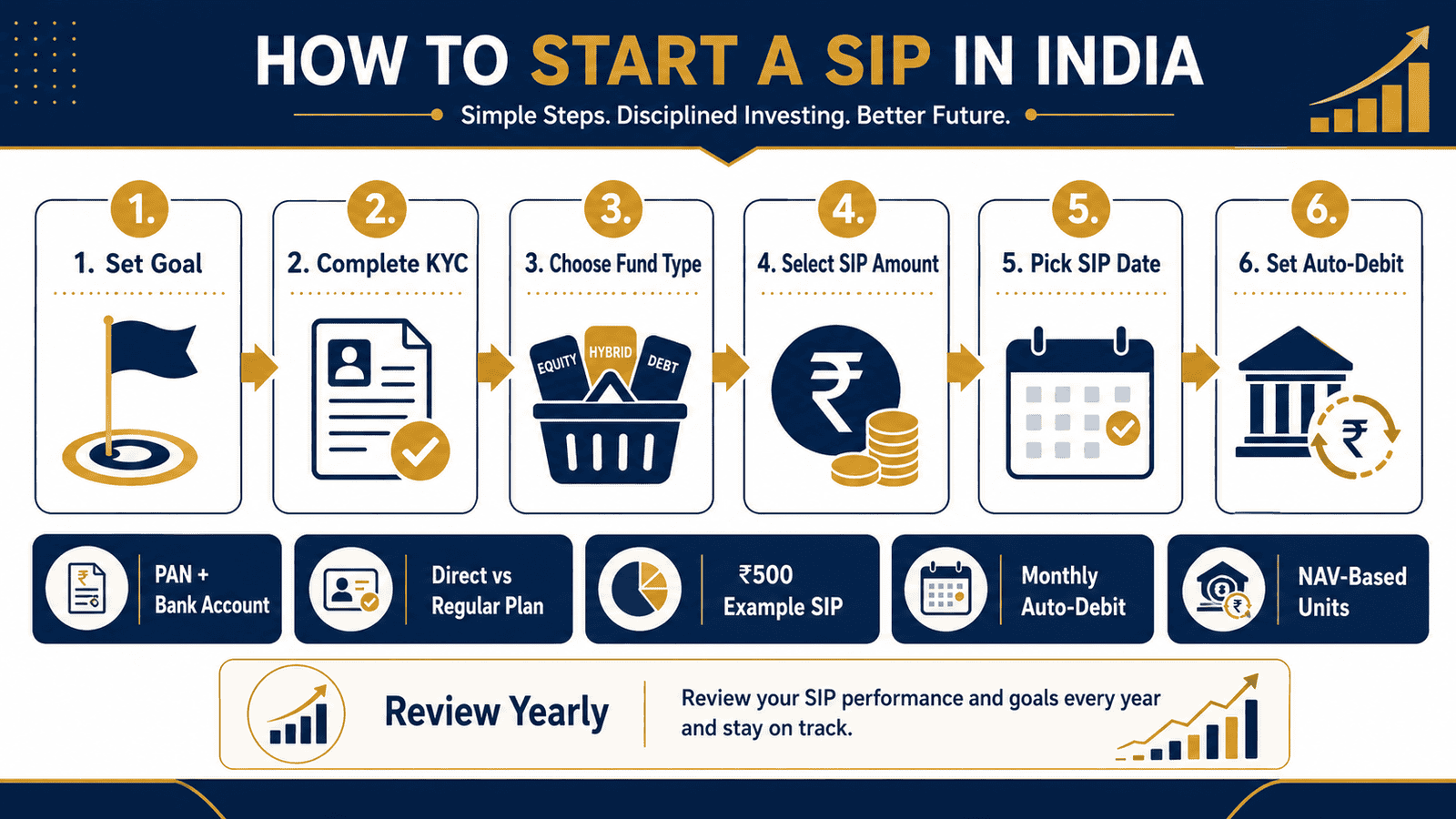
How to start SIP in India is simple: complete mutual fund KYC, choose a fund based on your goal and risk level, select a monthly SIP amount such as ₹500, pick a debit date, approve the bank auto-debit mandate, and review the SIP once or twice a year.
Key Takeaways
- SIP is a disciplined way to invest in mutual funds monthly — units are allotted based on NAV on the applicable transaction date, not a fixed price.
- You need a valid PAN, a bank account, completed mutual fund KYC, and a registered mobile number and email to start an SIP online.
- Choose your fund category based on your investment goal and time horizon — equity for long-term (5+ years), debt or liquid for shorter goals, hybrid for moderate timelines.
- A monthly SIP of ₹500 is a practical starting point to understand the process; consistency matters more than starting with a large amount.
- Set your SIP debit date 2–5 days after your salary credit to avoid mandate failures.
- Review your SIP performance against its category benchmark once or twice a year — not after every market dip.
- Starting SIP without an emergency fund or with high-interest debt already in place is a common and costly beginner mistake.
Key Facts at a Glance
| Parameter | Detail |
|---|---|
| What is SIP? | A method of investing a fixed amount into a mutual fund scheme at regular intervals (typically monthly) |
| Documents typically needed | PAN card, Aadhaar (for KYC), bank account details, registered mobile number and email |
| Setup routes | AMC (fund house) website, AMFI-registered investment app, SEBI-registered advisor, or distributor |
| Payment mode | Bank auto-debit mandate (eNACH) set up during SIP registration |
| Minimum SIP amount | Varies by fund house and scheme — some allow ₹500/month; verify with the specific AMC |
| Risk level | Depends on scheme category — equity (higher risk), debt (lower risk), hybrid (moderate) |
| Review frequency | Once or twice a year is generally sufficient for a goal-based SIP |
| Regulatory oversight | SEBI — sebi.gov.in |
How to Start SIP in India: What You Need to Understand First
Before you tap “Start SIP” on any app, it helps to understand exactly what you’re doing — and what SIP does not do.
What Is SIP and How Does It Work?
SIP stands for Systematic Investment Plan. It is not a separate investment product — it is a way of investing in a mutual fund scheme. Each month, on the date you choose, a fixed amount is debited from your bank account and used to buy units of the mutual fund scheme you selected. The number of units you receive depends on the Net Asset Value (NAV) of the scheme on the applicable transaction date.
When the market is down, the same ₹2,000 buys more units. When the market is up, it buys fewer. Over time, this can average out your cost of buying units — a concept called rupee-cost averaging. However, rupee-cost averaging does not remove market risk. If your fund consistently underperforms or you exit at a low point, SIP does not protect you from losses.
For a detailed understanding of the mechanism, read our guide on basic SIP meaning before you begin the setup process.
According to SEBI’s investor awareness guidelines, mutual fund investments are subject to market risks, and investors should read all scheme-related documents carefully before investing.
Step 1: Complete Your Mutual Fund KYC
KYC — Know Your Customer — is a one-time compliance requirement for all mutual fund investments in India. You need to complete KYC before you can invest in any mutual fund scheme, whether through an app, an AMC website, or a distributor.
For most beginners, online KYC using PAN and Aadhaar-based video verification is the fastest route. You will typically need your PAN card, Aadhaar number (for OTP or video verification), a selfie or live photo, and your bank account details. Once your KYC is registered, it applies across mutual fund houses and AMFI-registered platforms — you do not need to repeat it for every fund.
KYC status can be verified through official registrar routes. If your KYC is rejected or pending, you cannot proceed with any SIP registration until it is resolved.
Step 2: Choose Your Fund Category Before Picking a Fund
The most common beginner mistake is picking a fund based on last year’s returns. Fund category first, then specific scheme — that is the correct sequence.
A broad starting framework:
- Goal in 5+ years (retirement, wealth building): equity mutual fund categories — large-cap, flexi-cap, or index funds are commonly considered starting points.
- Goal in 2–4 years (vehicle, holiday, down payment): hybrid or conservative hybrid funds, or short-duration debt funds.
- Goal in less than 1 year: liquid funds or ultra-short-duration debt funds. Starting equity SIP for a near-term goal is generally unsuitable.
Expense ratio matters more than most beginners realise. A fund with a 1.5% expense ratio versus a 0.5% expense ratio can cost you a meaningful difference in returns over 10–15 years, especially in an index fund context.
Step 3: Choose Direct or Regular Plan
Every mutual fund scheme in India has two versions: direct plan and regular plan. The direct plan has a lower expense ratio because no distributor commission is paid. The regular plan includes distributor or advisor commission in the expense ratio — it is higher, but it may come with guidance if you use a SEBI-registered advisor.
If you are comfortable researching and selecting funds yourself, the direct plan typically costs less over time. If you prefer guidance from a registered professional, the regular plan through an advisor may be worth the higher cost.
Step 4: Select Your SIP Amount and Date
SIP amount should come from your monthly surplus — what remains after essential expenses, EMIs, insurance premiums, and emergency savings contributions. Starting small is perfectly fine. Many fund houses allow SIPs starting from ₹500 per month on certain schemes, though this varies by AMC and scheme. Verify the minimum for the specific scheme you are investing in.
For SIP date, the general advice is to set it 2–5 days after your salary credit date. This reduces the chance of your bank account having insufficient balance on the debit date, which can lead to a failed transaction and affect your SIP continuity.
Step 5: Set Up the Auto-Debit Mandate (eNACH)
Once your SIP is registered, the platform or AMC will prompt you to approve a bank auto-debit mandate — often called eNACH. This is a permission you give to your bank to allow the AMC or platform to debit a fixed amount from your account on the SIP date each month. Without an approved mandate, your SIP will not run.
eNACH approval typically takes a few days after submission. Some banks allow net-banking-based instant approval; others require a physical form for the first mandate. Check your bank’s process before you finalise the SIP setup.
Step 6: Review — Not Daily, But Periodically
Once your SIP is running, checking NAV every day is one of the most counterproductive habits a new investor can develop. Market fluctuations are normal, especially in equity funds. Review your fund’s performance against its benchmark and category peers once or twice a year. If the fund has consistently underperformed its benchmark over three or more years without a clear reason, that is a legitimate trigger to review — not a single bad month.
Real Example: How Rohan Started His First SIP
Rohan, 27, works as a software support analyst in Pune and earns ₹55,000 per month. He had been putting off investing for months — mostly because he wasn’t sure which app to use or whether his KYC was done.
Before starting his SIP, Rohan made a list of his monthly outflows: rent ₹14,000, groceries and utilities ₹8,000, travel ₹3,500, EMI on a personal loan ₹5,500, and phone and subscriptions ₹2,000. Total fixed and semi-fixed expenses: ₹33,000. Surplus: ₹22,000.
He kept ₹15,000 aside in a liquid fund as an emergency buffer (he was still building his emergency corpus) and decided to start with ₹2,000 per month in a flexi-cap equity fund via direct plan. He verified his KYC status online, completed it through an AMFI-registered platform, and set his SIP date as the 7th of each month — his salary credits on the 1st.
He used the monthly SIP estimate tool to see rough illustrative projections at different return assumptions before finalising ₹2,000 as his starting amount. He set a calendar reminder to check fund performance every six months. He did not touch the SIP for the first 12 months — even during a volatile patch in the market.
The key insight: Rohan did not start with the biggest amount he could afford. He started with an amount that would not stress his budget — and committed to increasing it as his income grew.
How to Calculate Your SIP Affordability
Monthly SIP Budget = Monthly Income − Essential Expenses − EMIs − Insurance Premiums − Emergency Savings Contribution
Using Rohan’s numbers as an illustration:
| Item | Monthly Amount (₹) | Notes |
|---|---|---|
| Gross salary | 55,000 | Take-home after TDS |
| Rent + utilities | 14,000 | Fixed |
| Groceries + travel | 11,500 | Semi-fixed |
| Loan EMI | 5,500 | Personal loan |
| Emergency savings | 5,000 | Until 6-month buffer is built |
| Insurance premium | 1,000 | Monthly equivalent |
| Available for SIP | 18,000 | Start conservatively — ₹2,000 to ₹5,000 |
Starting with ₹2,000 leaves buffer for irregular expenses. Rohan can step up to ₹4,000 or ₹5,000 in 12–18 months once the emergency fund is complete and the personal loan is closed.
Use the monthly SIP estimate calculator to model different amounts and time horizons. Treat all projections as illustrative — actual returns depend on market performance and fund category, and are not guaranteed.
Comparison: Direct vs Regular Plan, and Other Key SIP Choices
| Parameter | Option A | Option B |
|---|---|---|
| Plan type | Direct plan — lower expense ratio; no intermediary commission Lower cost | Regular plan — higher expense ratio; includes distributor/advisor commission May include guidance |
| Setup route | AMC website / AMFI-registered app — self-service; no advice provided | Distributor or SEBI-registered advisor — guided; may charge fee or earn commission |
| Fund type (broad) | Equity fund — higher potential return over long term; higher short-term volatility Higher risk | Debt / hybrid fund — lower volatility; suitable for shorter goals Moderate-lower risk |
| Payment method | eNACH auto-debit — automated; no monthly action needed Convenient | Manual payment — available on some platforms; requires action each month |
| Return option | Growth option — gains reinvested; suitable for wealth building | IDCW option — periodic payouts if declared; not suitable for compounding goals |
For a full breakdown of the cost difference and which scenario suits each plan, read our detailed guide on direct versus regular mutual fund plans.
How to Decide What’s Right for You
your goal is 5 or more years away and you can tolerate short-term NAV fluctuations — THEN consider an equity mutual fund SIP (large-cap, flexi-cap, or index fund) via direct plan.
your goal is 2–4 years away — THEN consider a hybrid or conservative hybrid fund SIP rather than a pure equity fund, as shorter timelines reduce the time available for equity recovery after a downturn.
you are new to investing and want to research and select funds yourself — THEN the direct plan route via an AMFI-registered app or AMC website is typically lower cost and fully self-service.
you want structured guidance from a professional — THEN a SEBI-registered investment advisor or a trusted distributor offering the regular plan may be appropriate, even at a higher expense ratio.
your salary credits on the 1st of the month — THEN set your SIP date between the 5th and 10th to ensure sufficient bank balance and avoid failed debits.
you do not yet have an emergency fund covering at least 3–6 months of expenses — THEN starting a large equity SIP immediately may not be the right priority; build the emergency buffer first, even if SIP starts small.
Common Mistakes to Avoid
Starting SIP Before Building Emergency Savings
Investing in an equity SIP while having no emergency fund means you may be forced to redeem units during a market downturn to cover an unexpected expense.
Redeeming equity fund units at a loss to pay for a medical emergency or job loss — when the market happens to be down — can wipe out months of SIP gains. This is one of the most damaging beginner errors.
Build a liquid emergency buffer of at least 3 months of expenses before committing to a significant equity SIP amount.
Choosing Funds Based on Last Year’s Returns Alone
A fund that ranked first in 1-year returns may have taken outsized risk to get there — and may not sustain that performance.
Checking only recent returns ignores expense ratio, fund manager consistency, category benchmark performance, and whether the fund’s strategy matches your goal. Beginners who chase top-1-year-return funds often end up in concentrated or thematic funds unsuitable for their risk level.
Instead, look at 3-year and 5-year performance relative to the category benchmark, alongside the expense ratio. Read our guide on fund return basics to understand how to read SIP performance correctly.
Stopping SIP During Normal Market Dips
When the market falls 10–15%, many first-time SIP investors panic and pause or stop their SIP.
Stopping SIP during a market dip means you miss the months when your fixed amount buys more units at lower NAV — which is precisely when rupee-cost averaging works most in your favour. Stopping and restarting also breaks investment discipline and can trigger unnecessary exit loads or missed investment periods.
Unless your financial goal has materially changed, a market dip alone is rarely a valid reason to stop a long-term SIP.
Running Too Many Overlapping Funds
Starting five SIPs of ₹500 each across five different large-cap funds does not create diversification — it creates overlap.
Most large-cap funds hold the same top 50 companies with minor variation. Running multiple SIPs in the same category adds complexity without spreading risk. Two to three well-chosen funds across different categories are usually sufficient for a beginner portfolio.
Consolidate before adding more SIPs.
Ignoring Bank Balance on SIP Debit Date
A failed SIP debit — because your bank account had insufficient balance — does not cancel your SIP permanently, but it does mean you miss that month’s investment.
Repeated mandate failures can attract bank charges and may result in the SIP being paused by the platform or AMC. Set a phone reminder 2–3 days before your SIP date, or keep a minimum balance in your SIP-linked account.
Setting the SIP date 2–5 days after salary credit — as Rohan did — is the simplest way to prevent this.
When This May Not Be the Right Choice
You have high-interest debt and no emergency fund. If you are servicing a personal loan or credit card balance at 18–36% interest per year, routing money into an equity SIP that may return 10–12% over the long term may not be the most effective use of surplus cash until the high-cost debt is cleared.
Your goal is less than 12 months away. Equity fund NAVs can fall sharply in a short period. Starting an equity SIP for a goal you need money for next year — a wedding, a car down payment, or a course fee — exposes that money to market risk with insufficient time to recover.
You cannot tolerate seeing your invested value fall. SIP in equity funds will, at times, show a negative return in your portfolio statement. If that would cause you significant stress or prompt impulsive redemptions, a debt or hybrid fund with lower volatility is worth considering first.
You are confusing SIP with a guaranteed-return product. SIP in a mutual fund is not a fixed deposit or a PPF. Returns are not guaranteed and can be negative in a given year. If you need certainty of principal return for a specific goal, a market-linked SIP may be unsuitable for that portion of your plan.
If any of these apply to your situation, it may be worth exploring alternatives before committing.
Official Rules and Where to Verify
Mutual fund regulations, KYC requirements, expense ratio limits, and SIP-related rules are governed by SEBI and implemented by AMCs and AMFI-registered intermediaries. Before investing, verify the following from official sources:
- Check that your mutual fund KYC is complete and active — use our guide on mutual fund KYC for a step-by-step walkthrough and official verification routes.
- Verify that the platform or distributor you are using is AMFI-registered — amfiindia.com
- Read the Scheme Information Document (SID) and Key Information Memorandum (KIM) of the fund before investing — available on each AMC’s official website.
- Confirm auto-debit mandate status with your bank or through your investment platform.
- For regulatory rules, investor rights, and grievance redressal: sebi.gov.in
Rules, limits, and rates on this topic can change with each Budget or regulatory update. Always verify current figures directly from the official source before making any financial decision.
Expert Tips
- Start with one or two funds, not six. A beginner with a single flexi-cap or large-cap index fund SIP has a cleaner, easier-to-track portfolio than someone with seven overlapping equity funds. Add complexity only when you understand what you already own.
- Match fund category to goal duration before anything else. A 3-year goal and a 15-year goal require very different fund categories. Getting this alignment right matters more than picking the “best” fund within a category.
- Set your SIP date after salary credit — not on the 1st. Salary delays, bank processing times, or unexpected debits on the 1st can cause SIP failures. The 5th to 10th window gives you a practical buffer.
- Review against benchmark, not against your anxiety. If your large-cap fund has returned 11% over 3 years and its benchmark returned 13%, that is a performance gap worth understanding. If the market fell 8% and your fund fell 6%, that may actually indicate resilience. Read our guide on fund return basics to review SIP performance the right way.
- Increase your SIP when income increases — not when the market is high. The time to increase SIP is when your take-home goes up, your loan EMI ends, or your emergency fund reaches 6 months. Not because the Sensex hit a new high.
- Keep the direct plan for self-directed investing. If you are using an AMFI-registered app and researching funds yourself, the direct plan will typically cost less over time — sometimes 0.5–1% less in annual expense ratio, which compounds significantly over 10–15 years.
Frequently Asked Questions
Can I start SIP with ₹500 per month?
Some mutual fund schemes allow SIPs starting from ₹500 per month, but the minimum varies by AMC and scheme. Check the Scheme Information Document or the AMC’s official website for the specific scheme you want to invest in. ₹500 is a reasonable starting amount to learn the process and build the habit.
Is SIP safe?
SIP is a method of investing in mutual funds — not a product with a guaranteed return. Safety depends on the fund category. Debt fund SIPs carry lower risk than equity fund SIPs. Equity fund NAV can fall in the short term, and there is no capital protection. Mutual fund investments are subject to market risks. Read all scheme documents before investing.
Can I stop my SIP anytime?
Yes. You can stop or pause most SIPs through the platform or AMC portal without penalty. However, check whether the scheme has an exit load — a charge if you redeem units within a specified period after purchase. Stopping the SIP and redeeming units are two separate actions.
What happens if my SIP debit fails?
If your bank account has insufficient balance on the SIP date, the debit fails. You miss that month’s investment. Repeated failures may attract bank charges and could result in your SIP being paused by the platform. Keep sufficient balance before the debit date, and contact your platform if failures recur.
Which date is best for SIP?
There is no universally “best” SIP date for returns — research has not established a clear date-of-month effect in SIP outcomes over the long term. Practically, choose a date 2–5 days after your salary credit to ensure your bank balance is sufficient when the auto-debit runs.
Do I need a Demat account to start a mutual fund SIP?
No. For most SIP routes — through AMC websites, AMFI-registered investment apps, or distributors — you do not need a Demat account. Mutual fund units are held in statement of account form (SOA) through registrars like CAMS or KFintech. A Demat account is only required if you choose to hold mutual fund units in Demat form through a stockbroker, which is optional.
What is the difference between SIP and a mutual fund?
A mutual fund is the investment product — a pool of money managed by an AMC and invested in securities. SIP is a method of investing in that mutual fund at regular intervals. You can also invest a lump sum in a mutual fund. SIP is one of several ways to invest; it does not refer to a specific fund or guarantee any outcome.
Can I have multiple SIPs in different funds?
Yes. You can run SIPs in multiple mutual fund schemes simultaneously. Each SIP will have its own debit mandate and debit date. Beginners are generally advised to start with one or two funds and expand only once they are comfortable tracking what they already hold.
Final Verdict
Learning how to start SIP in India is straightforward once you understand the six steps: KYC, fund category selection, amount planning, plan type choice (direct or regular), SIP date, and auto-debit mandate. The process takes less than 30 minutes once KYC is in place.
The harder part is not the setup — it is staying disciplined. Choose a fund category that matches your goal, not the one that topped last year’s returns. Start with an amount that fits your monthly surplus comfortably. Set a review reminder and look at performance once or twice a year, not every time the market moves.
As your income increases, consider stepping up your SIP amount — read our guide on increase SIP yearly to understand how even small annual increases can significantly change your long-term outcome.
Always verify the latest rules from official sources or consult a qualified professional before making any financial decision.
This article is for educational purposes only and should not be treated as personalised financial, tax, investment, insurance, or legal advice. Tax rules, interest rates, regulatory limits, and product features can change with each Budget or policy update. Please verify current rules from official government sources or consult a qualified and registered professional before making any financial decision.

Arjun Kapoor writes about mutual funds, SIPs, ELSS, fund categories, investment returns, and beginner investing concepts for Indian readers. His focus is on education, not product promotion or fund recommendations. He helps readers understand how mutual funds work before they start investing or comparing schemes.
He covers topics such as mutual fund meaning, SIP meaning, SIP calculator, direct mutual funds vs regular plans, NAV, ELSS tax-saving funds, CAGR, absolute returns, XIRR, expense ratio, large cap vs mid cap vs small cap funds, flexi cap funds, index funds vs active funds, liquid funds, debt mutual funds, SIP pause vs SIP stop, lumpsum vs SIP, and how to start SIP in India.
Arjun’s writing is simple, risk-aware, and long-term oriented. He avoids guaranteed-return language and explains investment concepts using examples, timelines, and comparison tables. His articles remind readers that mutual fund investments are subject to market risks, and past performance does not guarantee future returns. Readers should verify scheme details from SEBI, AMFI, fund houses, and official scheme documents.