

If you have been investing through SIP for even a few months, someone has probably told you to “just buy a Nifty 50 index fund” — or the opposite, to stick with a proven active fund manager. Both sides sound convincing. That is exactly the problem.
Index funds and active mutual funds both invest in stocks. Both carry market risk. The real question is which approach suits your goal, your willingness to review performance, and the cost you are comfortable paying. This article breaks down the index fund vs active fund debate for Indian investors — covering expense ratios, tracking error, benchmark returns, and how to apply a decision framework to your own SIP without being sold a specific scheme.
Quick Answer: Index Fund vs Active Fund
Index fund vs active fund depends on whether you prefer low cost and benchmark-like returns or are willing to pay higher fees for possible outperformance. For many Indian beginners investing ₹5,000 monthly through SIP, a broad index fund can be simpler, while active funds need deeper review of consistency, risk and costs.
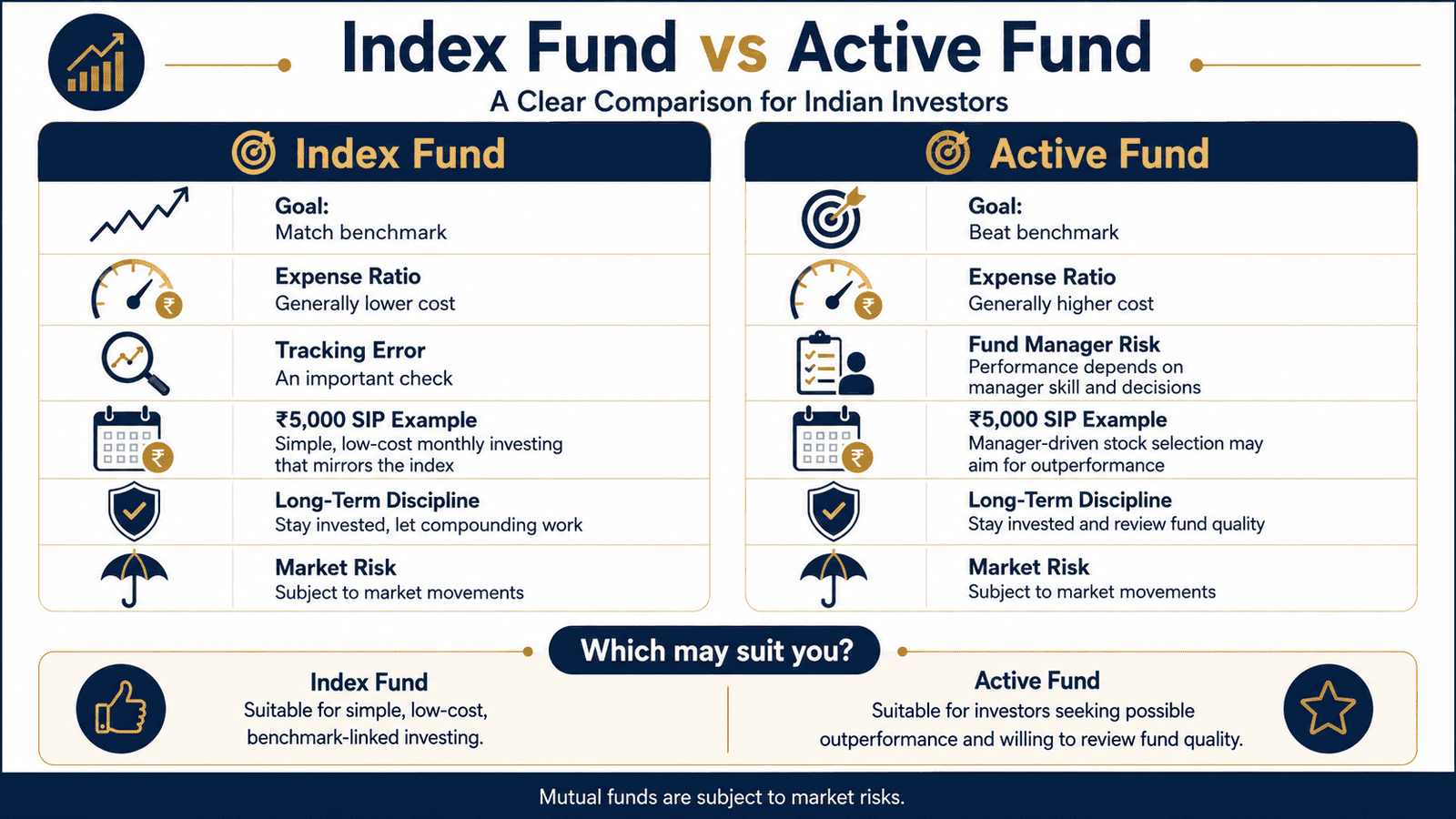
Key Takeaways
- Index funds aim to match a benchmark like Nifty 50 — not beat it. Your return will closely follow the index, minus a small tracking error and expense ratio.
- Active funds aim to beat a benchmark, but SEBI data and long-term studies consistently show that many active large-cap funds underperform their benchmark after costs over a 10-year period.
- Expense ratio is not a small number: a difference of 1% per year in TER can reduce your final SIP corpus by ₹2–4 lakh or more on a 15-year ₹5,000 monthly SIP, depending on returns.
- Tracking error, not just NAV return, is the right measure for an index fund — a fund tracking Nifty 50 with 0.08% tracking error is doing its job better than one showing 0.5%.
- For beginners, a low-cost direct plan index fund on a broad benchmark is a simpler starting point — but this is not personalised investment advice.
- A core-satellite portfolio — index fund as the base, select active funds for specific categories — is one approach some investors use, though no allocation percentage is universally right.
- Both index and active equity funds are market-linked and can lose value. Past performance does not guarantee future returns.
Index Fund vs Active Fund: Side-by-Side Comparison
| Parameter | Index Fund | Active Fund |
|---|---|---|
| Management style | Passive — replicates a benchmark index | Active — fund manager selects stocks |
| Objective | Match benchmark returns | Beat benchmark returns (alpha) |
| Typical expense ratio (direct plan) | Generally lower — often 0.10%–0.30% | Generally higher — often 0.60%–1.50%+ |
| Key risk | Market risk + tracking error | Market risk + fund manager underperformance |
| What to check before investing | Tracking error, expense ratio, benchmark covered | Rolling return consistency, downside capture, benchmark outperformance, fund manager tenure |
| Research required | Lower — benchmark does the heavy lifting | Higher — requires periodic performance review |
| Best suited for | Simplicity-focused and cost-conscious investors | Investors who can evaluate fund performance across market cycles |
| Plan type matters? | Yes — direct plan reduces cost further | Yes — regular plan commissions erode alpha significantly |
Key Facts at a Glance
| Factor | What It Means | Why It Matters |
|---|---|---|
| Benchmark index | Nifty 50, Sensex, Nifty Next 50, Nifty Midcap 150, etc. | Index funds track this; active funds try to beat it |
| Expense ratio (TER) | Annual fee deducted from NAV; expressed as % of assets | Higher TER creates a bigger return hurdle for active funds to clear |
| Tracking error | How closely an index fund follows its benchmark | Lower is better; high tracking error means the fund drifts from the index |
| Alpha | Return generated above the benchmark, after costs | The only valid reason to pay higher fees for an active fund |
| Direct vs regular plan | Direct plan has no distributor commission; regular plan does | Choosing a regular plan over a direct plan costs you 0.5%–1% per year — in either fund type |
| Risk level | Depends on the underlying stocks and market-cap segment | A Nifty 50 index fund and a large-cap active fund carry broadly similar market risk |
Understanding Index Funds and Active Funds in India
Before comparing, it helps to understand that both are mutual fund basics — pooled vehicles regulated by SEBI where your money is invested in a basket of securities. The difference is in how that basket is built and managed.
What Is an Index Fund?
An index fund is a passively managed mutual fund designed to replicate the composition and performance of a specific benchmark index — say, the Nifty 50, which tracks India’s top 50 listed companies by market capitalisation. The fund buys the same stocks in roughly the same proportions as the index. There is no fund manager making active stock picks.
Because there is minimal buying and selling and no stock research team to pay, the cost of running an index fund is significantly lower. This lower expense ratio is the index fund’s biggest structural advantage. According to SEBI guidelines, all mutual funds must disclose their Total Expense Ratio (TER), and you can verify this from scheme documents or AMC factsheets at sebi.gov.in.
The relevant quality metric for an index fund is tracking error — how much the fund’s daily returns deviate from the index. A Nifty 50 index fund with a tracking error of 0.05% is doing an excellent job of replication. One with 0.50% tracking error is drifting and costing you silently.
What Is an Active Mutual Fund?
An active mutual fund is managed by a professional fund manager and a research team who select stocks they believe will outperform the market or a benchmark. They can overweight sectors they like, avoid stocks they distrust, and shift allocation based on market conditions. The goal is to generate alpha — returns above and beyond what the benchmark delivers.
That alpha has to be meaningful enough to justify the higher expense ratio. If an active large-cap fund charges 1.10% TER and the comparable index fund charges 0.15%, the active fund needs to beat the index by more than 0.95% every year — consistently, not just occasionally — to be worth the extra cost.
Why the Comparison Is More Complex in India
In the large-cap equity category, SEBI regulations require active funds to invest at least 80% of assets in the top 100 stocks by market cap. This limits the fund manager’s room to differentiate significantly from a Nifty 50 or Nifty 100 index. Consistent outperformance is harder to achieve when the investment universe overlaps heavily.
The flexi-cap and mid-cap categories give fund managers more room to deviate from a large-cap index — which means the comparison between an index fund and an active fund changes depending on which category you are looking at. Comparing a Nifty 50 index fund with a mid-cap active fund is not a like-for-like comparison.
Both types remain fully market-linked. Neither offers guaranteed returns or protection from losses during market downturns. This is a critical point that often gets lost in the “index vs active” debate.
Real Example: Rohan Compares His SIP Options
Rohan, 31, is a software engineer in Pune earning ₹14 lakh per year. He has decided to invest ₹5,000 per month through SIP and wants to understand how SIP works before locking in a fund choice.
He is comparing two options. Option A is a Nifty 50 index fund with a direct plan TER of around 0.15%. Option B is an actively managed large-cap fund with a direct plan TER of around 1.10% that has shown strong performance over the past three years.
Rohan’s first instinct is to pick Option B because its recent 3-year return looks higher on the comparison app. But his adviser points out two things. First, three-year performance during a bull run does not tell him how the fund behaved in 2020 or how consistently it beat the Nifty 50 over rolling 5-year and 7-year periods. Second, he is looking at a regular plan NAV on the app, not the direct plan.
When Rohan checks the direct plan TERs and rolling 5-year returns — and not just the 1-year headline number — the gap between the active fund and the index fund narrows considerably. He decides to start with the index fund because he does not yet have the time or framework to evaluate active funds properly. His key insight: SIP discipline and staying invested through market cycles matters more than picking the “winning” fund every year.
How to Calculate the Cost Impact on Your SIP
Effective Return = Gross Fund Return − Expense Ratio (TER) − Tracking Error (for index funds)
Let’s illustrate how a 1% difference in TER affects outcomes. This is a hypothetical illustration only — actual returns depend on market performance, fund manager decisions, and other factors.
Assume two hypothetical funds, both investing ₹5,000 monthly over 15 years:
| Scenario | Assumed Gross CAGR (Hypothetical) | TER |
|---|---|---|
| Fund A — Index Fund | 12% (illustrative only) | 0.15% |
| Fund B — Active Fund | 12% (same gross return, illustrative only) | 1.15% |
If both funds deliver the same gross return before fees, Fund A’s investor ends up with a materially larger corpus because Fund B’s investor has paid an extra 1% per year over 15 years. On a ₹5,000 monthly SIP at 12% gross CAGR, that difference compounds to approximately ₹2–3 lakh or more over 15 years. The active fund needs to generate that much extra above the index — consistently — just to break even on cost.
You can estimate outcomes for your own SIP amount and period using the SIP return estimate tool. Remember to adjust the assumed return down by the TER of the fund you are evaluating.
How to Decide What’s Right for You
You want simple, low-cost investing that tracks a broad benchmark without requiring ongoing research — THEN a direct plan index fund on Nifty 50 or Nifty Next 50 may be a sensible starting point.
You are willing to spend time evaluating rolling returns, downside capture, and expense ratios across multiple market cycles — THEN active funds in flexi-cap or mid-cap categories may be worth exploring alongside an index fund core.
You are investing through a distributor in a regular plan — THEN understanding how plan type affects your costs in both fund styles is essential before comparing returns. Review direct and regular plans to understand the annual cost difference.
Your investment horizon is under 3 years — THEN equity mutual funds of either type carry meaningful short-term capital loss risk and may not be appropriate for that goal.
You want both simplicity and some active exposure — THEN a core-satellite approach, with an index fund forming the majority allocation and active funds in specific categories, is one framework some investors use. No specific percentage is universally correct.
You cannot review an active fund’s 5-year rolling return, benchmark comparison, downside capture, and expense ratio at least once a year — THEN active funds may add complexity without commensurate benefit for you at this stage.
Common Mistakes to Avoid
Choosing an Active Fund Based on Last Year’s Return Alone
A fund that topped the charts in the past 12 months may have benefited from a specific market rally or sector concentration — not necessarily from superior fund management.
Selecting purely on 1-year return means you are likely buying at peak recent performance, which often mean-reverts. A fund that returned 45% in one year may deliver 8% the next.
Instead, check rolling 5-year and 7-year returns versus the benchmark and category average. Consistency of outperformance matters more than peak performance.
Ignoring the Expense Ratio — Especially in Regular Plans
Many investors compare fund returns from apps that default to the regular plan NAV. The regular plan charges a commission to the distributor, which is deducted from your returns before you see them.
A 0.80% difference between a direct and regular plan on ₹10,000 monthly over 20 years can amount to ₹8–12 lakh or more in lost corpus, depending on returns. Review fund expense ratio to understand exactly how this fee compounds over time.
Always compare like with like: direct plan vs direct plan, same benchmark, same category.
Assuming an Index Fund Always Delivers Exact Benchmark Returns
Tracking error means the fund’s return will differ slightly from the index — always. A higher tracking error in an index fund is itself a hidden cost and a sign of poor replication.
An index fund with 0.50% tracking error and 0.20% TER is effectively costing you 0.70% per year in drag — more than some active funds charge on a direct plan.
When selecting an index fund, look for low TER and low tracking error together.
Comparing a Large-Cap Index Fund with a Mid-Cap or Small-Cap Active Fund
This is one of the most common errors in Indian investing discussions. A Nifty 50 index fund and a mid-cap active fund are not investing in the same stocks or carrying the same risk level.
A mid-cap active fund may have outperformed a Nifty 50 index fund over five years simply because mid-caps as a segment did better — not because the active manager was exceptional. The correct comparison is within the same benchmark and category.
Compare index funds with active funds of the same category: large-cap vs large-cap, flexi-cap vs flexi-cap.
Switching Funds Frequently Based on Short-Term Underperformance
Index funds will have periods — sometimes one to two years — where they trail a well-run active fund, and vice versa. Reacting to every such period by redeeming and reinvesting creates tax events, exit load costs, and destroys compounding.
Most long-term SIP wealth is built by staying invested through volatility, not by optimising fund choices every quarter.
Set a review frequency — typically once or twice a year — and evaluate on rolling multi-year performance, not monthly rankings.
Not Checking the Benchmark of an Active Fund
An active fund can show strong absolute returns and still be underperforming its benchmark. If a flexi-cap fund returned 14% in a year when its benchmark returned 18%, that fund is destroying value relative to a low-cost index alternative — even though the absolute number looks attractive.
Always compare active fund performance to the fund’s declared benchmark, not to a different index or another active fund’s returns.
When This May Not Be the Right Choice
Index funds may not suit you if you are expecting downside protection or guaranteed returns during market corrections. Index funds fall with the market — there is no active defensive positioning. A Nifty 50 index fund fell significantly in early 2020 along with the broader market, just as active funds did.
Active funds may not suit you if you are unable to review performance, expense ratios, and benchmark comparison at least annually. Paying for active management without monitoring whether you are getting alpha is paying a fee with no accountability check.
Both are unsuitable for short-term financial goals — money you need within 1–3 years. Equity mutual funds of either type can show negative returns over short horizons. For short-term needs, consider debt mutual funds or other instruments appropriate to your timeline.
Thematic or sectoral active funds carry concentrated risk that neither broad index funds nor diversified active funds carry. These should not be confused with diversified large-cap or flexi-cap options in this comparison.
If any of these apply to your situation, it may be worth exploring alternatives before committing.
Official Rules and Where to Verify
Mutual fund regulations in India are governed by SEBI. Before investing in any mutual fund — index or active — verify the following from official and fund-level sources:
- SEBI (sebi.gov.in) — Mutual fund regulations, categorisation and rationalisation norms, TER limits by fund size, investor education material, and AMFI-registered adviser directory.
- AMC (Asset Management Company) websites and factsheets — Each fund’s Scheme Information Document (SID), Key Information Memorandum (KIM), monthly factsheet with portfolio, TER, tracking error (for index funds), and riskometer.
- AMFI (amfiindia.com) — NAV history, fund category data, and registered adviser verification.
For comparing returns correctly, understand the difference between CAGR, absolute return, and XIRR — each is relevant in different contexts. You can read more on fund return methods to avoid misreading fund performance data.
Rules, limits, and rates on this topic can change with each Budget or regulatory update. Always verify current figures directly from the official source before making any financial decision.
Expert Tips
- Start by understanding what the benchmark actually is. Before comparing any index or active fund, look up the Nifty 50 or Nifty 500 constituents. Knowing what you are tracking makes every subsequent comparison more meaningful.
- Use rolling returns, not trailing returns. Trailing 3-year or 5-year returns are a snapshot from today. Rolling 5-year returns — checked across multiple start dates — show whether an active fund consistently beats the benchmark or just got lucky in one period.
- Look at downside capture ratio for active funds. A fund that drops more than the benchmark in a downturn and gains less in a recovery is not providing value. A good active fund should show lower downside capture even if it has slightly lower upside capture.
- Treat SIP investing as boring by design. The investor who automates ₹10,000 per month into a low-cost index fund and does not touch it for 15 years will often outperform the investor who switches between funds every 18 months chasing returns.
- If you choose active funds, choose direct plans. In a regular plan active fund, you are paying both the active management fee and a distributor commission. The commission can erode a meaningful portion of any alpha generated by the fund manager.
- Review annually, not monthly. Monthly NAV fluctuations are noise. Reviewing fund performance quarterly or monthly creates anxiety and encourages switches that hurt long-term compounding. Set a half-yearly or annual review calendar instead.
- For your first SIP, keep it simple. A low-cost direct plan index fund on a broad benchmark like Nifty 50 or Nifty 500 is a reasonable, low-complexity starting point. You can add active funds once you understand how to evaluate them properly.
Frequently Asked Questions
Is an index fund safer than an active fund?
Neither is inherently safer in absolute terms — both are market-linked equity mutual funds that can lose value. An index fund’s return closely tracks the benchmark, so there is no surprise from fund manager decisions. An active fund introduces an additional layer of risk: if the manager makes poor stock calls, returns can be worse than the index. Safety in this context means predictability, not capital protection.
Can active funds beat index funds in India?
Yes — some can and do, particularly in mid-cap, small-cap, and flexi-cap categories where there is more room to deviate from a concentrated large-cap index. However, consistently beating the benchmark after costs over long periods (10 years or more) is difficult. The challenge increases in large-cap funds, where SEBI mandates heavy overlap with the top 100 stocks. You should assess each fund individually using rolling returns and net-of-cost performance against its declared benchmark.
Is a Nifty 50 index fund good for beginners?
A Nifty 50 index fund is a commonly cited starting point for Indian equity SIP investors because it is low-cost, transparent about what it holds, and easy to understand. It gives exposure to the top 50 Indian companies by market cap. That said, even a Nifty 50 index fund is a full-equity instrument and can show negative returns over short periods. It is suitable for long-term goals with a 7-year-plus horizon, not short-term needs.
Should I invest through SIP in index funds?
SIP works with both index and active mutual funds. The mechanics are the same — a fixed amount invested at regular intervals. For an index fund, SIP smooths out your average purchase cost over time and removes the need to time the market. There is no structural reason to prefer lumpsum over SIP for index funds; your goal, cash flow, and investment horizon should determine the approach.
What is tracking error in simple terms?
Tracking error measures how closely an index fund’s daily returns match the benchmark it is supposed to follow. A tracking error of 0.05% means the fund deviates very slightly from the index each day — nearly perfect replication. A tracking error of 0.50% means the fund drifts meaningfully, and that drift compounds over years. When comparing two index funds on the same benchmark, the one with lower tracking error is doing a better job, assuming the TER is similar.
Does expense ratio matter more than returns?
Both matter, but the expense ratio is within your control — returns are not. A fund’s future return is uncertain; its TER is disclosed upfront. For index funds especially, where the objective is to replicate the benchmark, TER and tracking error are the primary differentiators between funds on the same index. For active funds, TER is the hurdle the manager must clear every year before delivering net positive alpha.
Can I keep both index funds and active funds in my portfolio?
Yes. Many investors use a core-satellite approach: a broad index fund forms the core of the portfolio for stability and low cost, while select active funds in specific categories form the satellite for potential outperformance. This is not a universally prescribed formula, and the right balance depends on your goals, time horizon, and ability to monitor the active portion. What matters is that you understand what each fund is doing and why it is in your portfolio.
What happens if my active fund starts underperforming its benchmark?
Short-term underperformance — one to two years — is not necessarily a reason to switch. Active fund managers go through phases when their style is out of favour. The question is whether the fund is underperforming on a rolling 5-year basis consistently and whether the fund manager or mandate has changed. If an active fund is underperforming its own benchmark net of costs over a sustained period, it is worth reviewing whether the active fee is justified.
Is it better to invest in a direct plan or regular plan for index funds?
Direct plan is almost always preferable for index funds specifically. Because the index fund’s value proposition is low cost and benchmark replication, paying an additional distributor commission through a regular plan directly undermines that advantage. The TER difference between direct and regular plans for the same index fund can be 0.50%–0.80% per year, which on a long-term SIP becomes a significant corpus difference.
Final Verdict
For most Indian beginners — especially those investing through monthly SIP and building equity exposure for the first time — a low-cost direct plan index fund on a broad benchmark is a practical, transparent, and easy-to-monitor starting point. It removes fund manager risk, keeps costs down, and delivers benchmark-linked returns without requiring ongoing performance evaluation.
Active funds are not obsolete. In categories where fund managers have genuine room to differentiate — flexi-cap, mid-cap, and beyond — consistent outperformers do exist. But identifying and monitoring them requires reviewing rolling returns, expense ratios, benchmark outperformance, and downside capture across multiple market cycles. That is not a problem with active investing; it is simply the due diligence the higher fee demands.
The index fund vs active fund choice is not a permanent, binary decision. What matters most is understanding the fund you hold, keeping costs low, and staying invested through market cycles. Always verify the latest rules from official sources or consult a qualified professional before making any financial decision.
This article is for educational purposes only and should not be treated as personalised financial, tax, investment, insurance, or legal advice. Tax rules, interest rates, regulatory limits, and product features can change with each Budget or policy update. Please verify current rules from official government sources or consult a qualified and registered professional before making any financial decision.

Arjun Kapoor writes about mutual funds, SIPs, ELSS, fund categories, investment returns, and beginner investing concepts for Indian readers. His focus is on education, not product promotion or fund recommendations. He helps readers understand how mutual funds work before they start investing or comparing schemes.
He covers topics such as mutual fund meaning, SIP meaning, SIP calculator, direct mutual funds vs regular plans, NAV, ELSS tax-saving funds, CAGR, absolute returns, XIRR, expense ratio, large cap vs mid cap vs small cap funds, flexi cap funds, index funds vs active funds, liquid funds, debt mutual funds, SIP pause vs SIP stop, lumpsum vs SIP, and how to start SIP in India.
Arjun’s writing is simple, risk-aware, and long-term oriented. He avoids guaranteed-return language and explains investment concepts using examples, timelines, and comparison tables. His articles remind readers that mutual fund investments are subject to market risks, and past performance does not guarantee future returns. Readers should verify scheme details from SEBI, AMFI, fund houses, and official scheme documents.