

Every year, Indian families face hospital bills that run into lakhs — and many discover too late that their health insurance policy covered far less than expected. The room rent was above the limit. The procedure had a sub-limit. A pre-existing condition was under a waiting period. Understanding health insurance meaning before you buy — not after a claim is rejected — is one of the most practical financial decisions you can make.
This article explains what health insurance is, what a standard policy typically covers, what it excludes, how waiting periods work, and what to check before you sign. Whether you are buying your first policy or reviewing an existing one, the policy wording — not the sales brochure — is what decides your claim. For a broader look at protecting your family with the right mix of policies, see our family insurance guide.
Quick Answer: Health Insurance Meaning
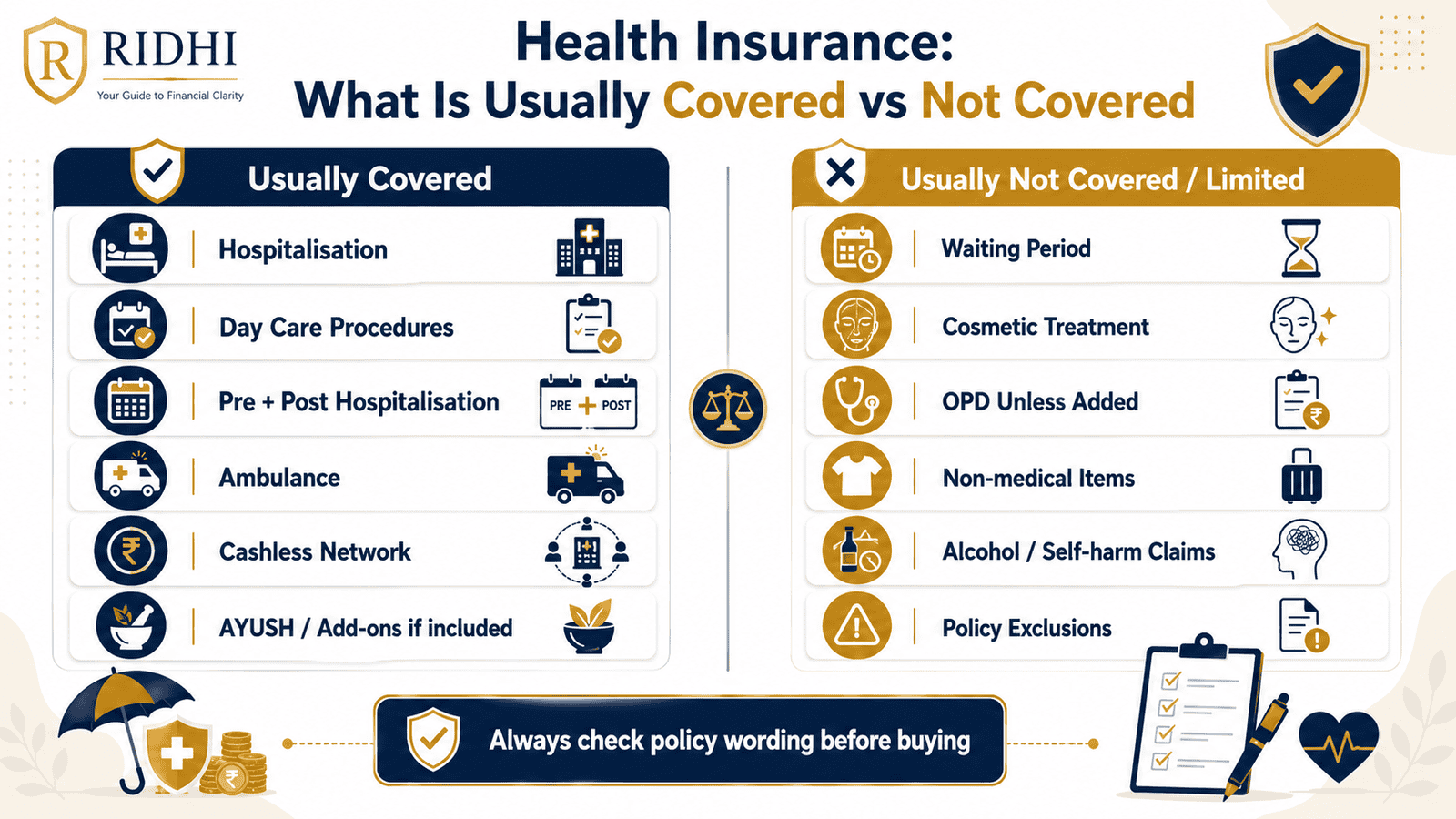
Health insurance meaning is simple: it is a policy that helps pay covered medical costs such as hospitalisation, day-care procedures, ambulance charges, and pre/post-hospitalisation expenses up to the chosen sum insured. It does not cover every treatment, exclusion, waiting-period claim, non-medical item, or hospital condition unless the policy wording allows it.
Key Takeaways
- Health insurance is a contract — not a blank cheque. It pays covered expenses up to your sum insured, subject to conditions, limits, and exclusions in the policy wording.
- A ₹5 lakh sum insured means the insurer pays eligible claims up to ₹5 lakh per policy year — not every rupee of every hospital bill automatically.
- Waiting periods can delay coverage for pre-existing diseases by 2–4 years depending on the insurer and policy — claims filed during this window are typically rejected.
- Cashless hospitalisation is not the same as free hospitalisation — room rent limits, co-payments, deductibles, and non-medical consumable exclusions can still leave an out-of-pocket balance.
- Common exclusions include cosmetic procedures, self-inflicted injury, fertility treatments (unless specifically added), non-medical consumables, and treatments during the waiting period.
- Always read the Customer Information Sheet and policy wording — not just the insurer’s product page — before purchasing or renewing a health insurance policy.
- Premiums paid toward health insurance may qualify for deduction under Section 80D of the Income Tax Act — verify the current limits at incometax.gov.in before filing.
Key Facts at a Glance
| Feature | What It Means | Key Point |
|---|---|---|
| Health insurance meaning | Contract to pay eligible medical costs up to sum insured | Policy wording defines what is eligible |
| Sum insured | Maximum the insurer pays in a policy year | Family floater sum insured is shared among all members |
| Waiting period (pre-existing) | Period before pre-existing disease claims are admitted | Typically 2–4 years — varies by insurer and condition |
| Cashless claim | Insurer pays the network hospital directly | Requires pre-authorisation; limits and exclusions still apply |
| Room rent limit | Cap on daily room charges the insurer will pay | Exceeding it can trigger proportionate deduction on entire bill |
| Co-payment | Percentage of each claim you must pay yourself | Common in senior citizen policies and some group plans |
| Common exclusions | Cosmetic treatment, non-medical items, waiting-period claims | Listed in policy schedule — read before buying |
| Regulator | IRDAI — Insurance Regulatory and Development Authority of India | irdai.gov.in |
What Is Health Insurance — and How Does It Actually Work?
Health insurance is a legal contract between you (the policyholder) and an insurance company (the insurer). You pay a regular premium. In return, the insurer agrees to pay eligible medical expenses — up to the sum insured you chose — when you or your covered family members are hospitalised or incur other covered medical costs. Health insurance is regulated in India by the Insurance Regulatory and Development Authority of India (IRDAI), under irdai.gov.in.
The key word is eligible. Every policy has a defined list of what is covered, what is excluded, what has sub-limits, and what requires a waiting period before the insurer will admit a claim. No two policies are identical — which is why comparing policy wording, not just premium, is critical.
The Core Components of a Health Insurance Policy
Premium: The amount you pay — monthly, quarterly, or annually — to keep the policy active. Premiums vary significantly based on your age, health condition, city of residence, sum insured, add-ons, number of members, and the insurer. A 34-year-old in Pune will pay a different premium than a 55-year-old in Mumbai for the same sum insured.
Sum insured: The maximum the insurer will pay in a single policy year. If your sum insured is ₹5 lakh and you make two claims totalling ₹5 lakh in one year, the policy is exhausted for that year. A family floater plan pools this sum insured across all covered members — one large claim can use up coverage for the entire family.
Policy period: Typically one year, with renewal required to keep coverage active. Some policies allow multi-year purchase.
Individual plan vs family floater: An individual plan covers one person. A family floater covers the whole family under one shared sum insured, usually at a lower combined premium. The trade-off: a single large claim from one family member can exhaust the cover for everyone else. For a detailed breakdown, read our guide on family floater choice.
How Waiting Periods Work
A waiting period is a window after the policy start date during which the insurer will not pay certain claims. Three types matter most:
Initial waiting period: Usually 30 days from policy start. Claims for illnesses (not accidents) during this window are generally not payable.
Pre-existing disease (PED) waiting period: If you had a health condition — diabetes, hypertension, thyroid disorder, for example — before buying the policy, the insurer typically excludes treatment for that condition for 2–4 years. After this period, the condition becomes covered. The exact duration depends on your insurer and policy. For the full rules, read our detailed guide on waiting period rules.
Specific disease waiting period: Many policies apply a separate 1–2 year waiting period for specific conditions such as cataracts, hernia, knee replacement, or joint disorders — even if these are not pre-existing for you.
Not disclosing a pre-existing condition at the time of purchase is one of the most common reasons claims are rejected. IRDAI regulations require honest disclosure — the insurer has the right to repudiate a claim if material information was withheld.
Real Example: Ramesh’s ₹2 Lakh Hospital Bill
Ramesh, 34, works as a project manager in Pune and earns ₹12 lakh a year. He bought a family floater health insurance policy with a ₹5 lakh sum insured covering himself, his spouse, and their child. His policy has a room rent limit of 1% of sum insured per day (₹5,000/day) and a 10% co-payment clause.
Ramesh’s spouse is hospitalised for an appendectomy. The total hospital bill is ₹2,00,000. Here is how the claim breaks down:
Hospital room charges: The hospital charges ₹7,500/day for a private room. The policy allows ₹5,000/day. Because Ramesh chose a room above the policy’s room rent limit, the insurer applies a proportionate deduction — not just on room rent, but on related charges like surgeon fees, nursing, and ICU. This can significantly increase the out-of-pocket amount.
Non-medical consumables: Items like gloves, syringes, PPE kits, and certain dressings are listed as excluded consumables under many standard policies. Say ₹8,000 of the bill falls under this head — that amount is not payable.
Co-payment: After the above deductions, say the admissible claim is ₹1,60,000. With a 10% co-pay clause, Ramesh pays ₹16,000 himself. The insurer pays the remaining ₹1,44,000.
Ramesh opts for cashless claim — the insurer settles directly with the hospital for the admissible amount. Ramesh pays the balance at discharge. This is a common real-world outcome: cashless does not mean zero out-of-pocket. For a step-by-step walkthrough of the process, read our guide on the cashless claim process.
The figures above are illustrative only. Actual claim payout depends on your specific policy wording, insurer guidelines, and hospital billing.
Comparison: What Is Usually Covered, Conditionally Covered, and Not Covered
| Category | Examples | Key Condition |
|---|---|---|
| Usually covered | In-patient hospitalisation (24+ hrs), surgery, ICU, daycare procedures (dialysis, chemotherapy), ambulance charges, pre-hospitalisation expenses (typically 30–60 days), post-hospitalisation expenses (typically 60–90 days) | Subject to sum insured, room rent limit, sub-limits, and policy terms |
| Covered with conditions | Pre-existing diseases (after waiting period), maternity (after waiting period, often 2–4 years), OPD treatment (only if explicitly included), dental (only if accident-related or add-on), mental health (as mandated, but check coverage extent), domiciliary treatment (if insurer-approved), AYUSH treatment (if policy includes it), modern treatments (robotics, laser — check policy) | Waiting periods, add-ons, or specific insurer inclusion required |
| Usually not covered | Cosmetic or aesthetic procedures, non-medical consumables (gloves, dressings, PPE), self-inflicted injury, fertility treatments (IVF, IUI — unless added), unproven or experimental treatments, claims during waiting periods, outpatient pharmacy (unless OPD add-on included), war or nuclear hazard-related conditions | Listed as exclusions in policy schedule — always verify with policy wording |
Every row in this table is subject to your specific policy wording. IRDAI regulations set a framework, but insurers can differ on what they include or exclude within that framework. The waiting period rules article covers how delayed coverage works in detail — read our guide on waiting period rules for a full breakdown.
How to Decide What’s Right for You
You are buying for a young family (under 45, no major pre-existing conditions) — THEN a family floater with a ₹10–25 lakh sum insured and a broad network of hospitals in your city is a practical starting point for most Pune or metro households.
Your parents are above 60 or have pre-existing conditions — THEN buy a separate senior citizen policy for them rather than adding them to your family floater, so one large claim does not exhaust your family’s coverage.
You prefer a premium private hospital in your city — THEN check the room rent limit carefully before buying; a 1% of sum insured cap on a ₹5 lakh policy means only ₹5,000/day is covered, which may fall short of premium room rates.
Your base policy sum insured is below ₹10 lakh — THEN consider a top-up or super top-up plan to extend coverage cost-effectively beyond the base sum insured. Read our guide on top-up health cover to understand how this works.
You want a critical illness lump-sum payout if diagnosed with cancer, stroke, or heart disease — THEN a standard health insurance policy alone will not cover this; a separate critical illness plan is needed.
You want maternity cover — THEN check the waiting period on the specific policy; most policies require you to hold the policy for 2–4 years before a maternity claim is admissible.
You are solely relying on your employer’s group health insurance — this is not enough long-term. Group cover typically ends when you leave the job, often has lower sum insured, and may not cover all family members. A personal retail policy is essential alongside it.
Common Mistakes to Avoid
Buying the cheapest premium without reading exclusions
A low premium often signals high co-pay, low sum insured, a long list of exclusions, or limited network hospitals.
You may discover at claim time that the policy covers far less than a mid-premium alternative. Two policies at ₹8,000/year and ₹14,000/year can have very different claim payouts for the same hospitalisation.
Compare the policy wording and exclusion list, not just the premium quote.
Hiding a pre-existing disease at the time of purchase
Many buyers do not disclose conditions like diabetes, hypertension, or thyroid disorder, assuming the insurer will not find out.
If a claim is linked to an undisclosed condition, the insurer has the right to repudiate it. IRDAI regulations support this — non-disclosure of material facts is valid grounds for claim rejection. The policy may even be cancelled.
Disclose all pre-existing conditions honestly. The waiting period is a manageable delay; a claim repudiation is a financial disaster.
Assuming employer group health insurance is sufficient
Group health insurance from your employer typically covers only while you are employed. A job change, layoff, or retirement removes the cover immediately.
Buying a personal retail policy while young and healthy is far cheaper than buying one at 50 after a health event. Do not wait until you lose employer cover.
Ignoring room rent limits and proportionate deduction
Room rent limits are one of the most under-noticed features in health insurance. If your policy caps room rent at ₹5,000/day but you choose a ₹9,000/day room, the insurer does not just reject the ₹4,000 difference.
Under proportionate deduction, all related charges — surgeon fees, nursing, OT charges — are reduced in the same proportion. A ₹50,000 surgeon fee could be reduced to ₹27,000. This can create a large out-of-pocket balance even on a cashless claim.
Check whether your policy has a room rent cap or an unlimited room option — and factor this in when choosing sum insured.
Not verifying network hospitals near your home
Cashless claims are only available at insurer-empanelled network hospitals. If your preferred hospital is not in the network, you must pay upfront and file a reimbursement claim.
Before buying, check whether the major hospitals near your home and workplace are in the insurer’s cashless network. This single check prevents significant hassle at claim time.
Buying only after a health scare
Waiting until you are sick or have a diagnosis before buying health insurance typically results in higher premiums, specific exclusions for the new condition, or outright rejection of the application.
Buy while healthy and young. Premiums are substantially lower — and the waiting period for pre-existing conditions is easier to manage when no claim is imminent.
Treating the sum insured as always enough
A ₹3–5 lakh sum insured may have felt adequate five years ago. In metro hospitals, a single cardiac surgery or cancer treatment can exceed ₹10–20 lakh. Underinsurance is a real and growing risk for Indian families.
Review your sum insured at every renewal and consider a top-up or super top-up plan to fill the gap cost-effectively.
When This May Not Be the Right Choice
A standard health insurance policy is not a complete solution for every medical-financial risk. Consider these specific scenarios where it may fall short:
You expect OPD, dental, or routine wellness costs to be covered by default. Most standard health insurance policies cover in-patient hospitalisation, not daily outpatient consultations, routine dental care, annual health check-ups, or pharmacy bills. These require specific OPD riders or add-ons, which come at additional premium.
You have a major pre-existing condition and need immediate coverage. If you have diabetes, hypertension, or a recent cardiac event, a standard policy may exclude related treatment for 2–4 years. If you need coverage for that condition right away, a standard policy will not deliver it — look for policies with shorter or waived waiting periods, which exist but come at higher premiums.
You need income replacement, not just hospital bill coverage. Health insurance reimburses hospital expenses. If you are diagnosed with cancer or suffer a stroke, you may face months of lost income alongside hospital bills. A critical illness plan pays a lump sum on diagnosis — a standard health policy does not.
You have no emergency fund and are treating health insurance as your only financial buffer. Health insurance does not cover every expense — deductibles, co-pays, non-medical items, and out-of-network care create gaps. Without a separate emergency fund, even a well-insured family can face a cash-flow crisis at claim time.
If any of these apply to your situation, it may be worth exploring alternatives before committing.
Official Rules and Where to Verify
Health insurance is regulated and the rules covering exclusions, waiting periods, disclosure norms, and claim settlement timelines can change. Always verify current terms directly from official sources rather than relying on third-party summaries or sales materials.
- IRDAI (Insurance Regulatory and Development Authority of India) — irdai.gov.in — The primary regulator for all health insurance products and insurer conduct in India.
- Your insurer’s policy wording and Customer Information Sheet — The definitive source for what your specific policy covers, excludes, and limits. This document overrides any generic explanation, including this article.
- Income Tax Department — incometax.gov.in — For the current Section 80D deduction limits on health insurance premiums. For a worked example of how the deduction applies, read our guide on tax benefit rules.
Rules, limits, and rates on this topic can change with each Budget or regulatory update. Always verify current figures directly from the official source before making any financial decision.
Expert Tips
- Read the exclusions list before the benefits page. When comparing two policies, open the exclusion schedule first. What is not covered tells you more about a policy’s real-world value than the list of covered benefits.
- Check network hospital coverage in your pin code. Type your city or pin code into the insurer’s hospital locator before buying. A policy with 10,000 network hospitals nationwide is useless if none are within 5 km of your home or preferred hospital.
- Understand whether room rent has a cap or is unlimited. Policies with no room rent cap cost more in premium but eliminate the risk of proportionate deduction entirely. For families who prefer private rooms, this feature is worth the premium difference.
- Disclose every medical condition at application — even minor ones. A thyroid condition, a past fracture, or managed hypertension must be declared. Undisclosed conditions are grounds for claim repudiation even years later.
- Buy in your 20s or early 30s if possible. Health insurance premiums are age-linked. Buying a ₹10 lakh policy at 30 costs significantly less annually than buying the same policy at 45 — and you lock in the waiting period early.
- Keep all policy documents, premium receipts, and claim records in one place. At claim time, you will need the policy number, pre-authorisation letters, discharge summaries, and original bills. Create a dedicated folder — physical and digital — for all insurance documents.
- Review your sum insured at every renewal. Medical inflation in India runs well above general inflation. A ₹5 lakh sum insured that felt adequate in 2019 may be significantly underinsured for a major hospitalisation today. Add a top-up plan if the base premium for a higher sum insured feels steep.
Frequently Asked Questions
What is health insurance in simple words?
Health insurance is a policy where you pay a regular premium and the insurer agrees to pay your eligible hospital bills — up to your chosen sum insured — when you or your covered family members need medical treatment. It does not cover every expense, and the policy wording defines exactly what is and is not payable.
What is covered in health insurance?
Most standard policies cover in-patient hospitalisation (24+ hours), surgery, ICU charges, daycare procedures (chemotherapy, dialysis, cataract — after applicable waiting period), ambulance charges, and pre/post-hospitalisation expenses for a defined number of days. Coverage varies by policy — read your specific policy wording.
What is not covered in health insurance?
Standard exclusions include cosmetic or aesthetic treatments, non-medical consumables (gloves, syringes, dressings), self-inflicted injury, fertility treatments (unless specifically added), experimental or unproven treatments, and any claim falling within a waiting period. The full exclusion list is in your policy schedule.
Is cashless health insurance fully free at the hospital?
No. Cashless means the insurer pays the admissible amount directly to the network hospital — you do not need to pay upfront for that portion. However, room rent above the policy limit, co-payments, non-covered consumables, and excluded treatments must still be paid by you at discharge.
Are pre-existing diseases covered in health insurance?
Yes — but only after the waiting period is complete. Most policies have a pre-existing disease waiting period of 2–4 years. Claims related to a pre-existing condition filed before this period ends are typically not payable. After the waiting period, the condition is covered like any other illness.
Is maternity covered in health insurance?
Maternity cover is available in some policies — but almost always as an add-on or specifically included benefit with its own waiting period, typically 2–4 years from policy start. If you are planning a family, buy the policy well before you need maternity coverage and verify the waiting period before purchasing.
What is a waiting period in health insurance?
A waiting period is a defined timeframe after policy start during which certain claims are not payable. The initial waiting period (usually 30 days) applies to most new illnesses. Pre-existing disease waiting periods (2–4 years) apply to conditions you had before the policy started. Specific disease waiting periods (1–2 years) apply to defined conditions like cataract or hernia regardless of pre-existing status.
Is my employer’s group health insurance enough?
Generally, no — for two reasons. First, group cover ends when you leave the job. Second, employer policies often have lower sum insured (typically ₹1–5 lakh) with limited family coverage. A personal retail health insurance policy acts as a permanent, portable safety net that continues regardless of your employment status.
Can I claim health insurance for OPD and routine doctor visits?
Standard health insurance policies do not cover outpatient department (OPD) consultations, routine pharmacy expenses, or wellness check-ups by default. Some insurers offer OPD riders or wellness benefits as add-ons at additional premium. Check whether your policy includes this feature specifically.
What happens if I do not disclose a pre-existing condition?
Non-disclosure of material health information is grounds for claim repudiation under IRDAI regulations. If the insurer discovers at claim time that you withheld a relevant condition, the claim can be rejected and the policy may be cancelled. Always disclose fully — the waiting period is a far better outcome than a rejected claim.
Final Verdict
Health insurance meaning is straightforward: it is a policy that protects your family from the financial impact of covered medical costs — up to your sum insured, within policy terms. But the gap between what a policy promises on its sales page and what it pays at claim time often comes down to details that most buyers skip: room rent limits, waiting periods, co-payments, deductibles, and the exclusions list.
The best health insurance policy for your family is not simply the one with the lowest premium. It is the one whose coverage, network hospitals, claim process, and limits actually match your family’s real-world healthcare needs. Compare policy wording before comparing price. Buy young, disclose honestly, review your sum insured every year, and never treat a policy as final protection without reading what it excludes.
Health insurance meaning only becomes fully clear when you have read the full policy document — not just the brochure. Always verify the latest rules from official sources or consult a qualified professional before making any financial decision.
This article is for educational purposes only and should not be treated as personalised financial, tax, investment, insurance, or legal advice. Tax rules, interest rates, regulatory limits, and product features can change with each Budget or policy update. Please verify current rules from official government sources or consult a qualified and registered professional before making any financial decision. Insurance is a subject matter of solicitation. Please read the policy document carefully before purchasing.

Priya Nambiar writes about insurance concepts for Indian families, salaried employees, self-employed professionals, and first-time policy buyers. Her content focuses on helping readers understand coverage, exclusions, claim conditions, premiums, riders, and policy documents before buying or renewing insurance.
She covers topics such as term insurance, health insurance, family floater plans, riders, critical illness cover, employer insurance vs personal insurance, waiting periods, exclusions, deductibles, co-payment, no-claim bonus, claim settlement, premium comparison, renewal rules, and tax benefits linked to insurance.
Priya’s writing is careful, consumer-focused, and policy-document oriented. She explains why insurance should be understood as financial protection, not just a tax-saving tool or investment substitute. Her articles encourage readers to compare coverage, understand limitations, and ask better questions before buying a policy. Premiums, exclusions, claim rules, and benefits vary by insurer, age, health, sum insured, and product type. Insurance is a subject matter of solicitation, and readers should read the official policy document carefully before purchasing.