
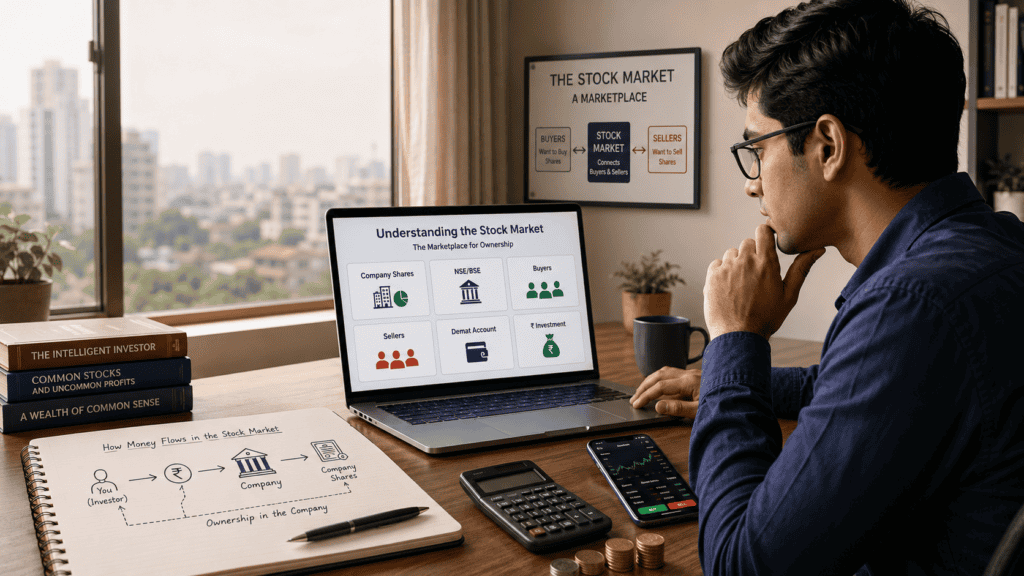
Stock market meaning is one of the most searched personal finance questions in India — and one of the most poorly answered. You have seen headlines about Sensex crashing 1,200 points or a mid-cap stock tripling in two years. Neither tells you what the market actually is or what it means for your money. This article does exactly that: plain-English explanations of how shares, NSE, BSE, brokers, demat accounts and real financial risk work — with rupee examples at every step.
By the end, you will know enough to make one clear decision: whether to start investing, explore further, or wait until you are better prepared. No hype. No jargon without explanation.
Quick Answer: Stock Market Meaning
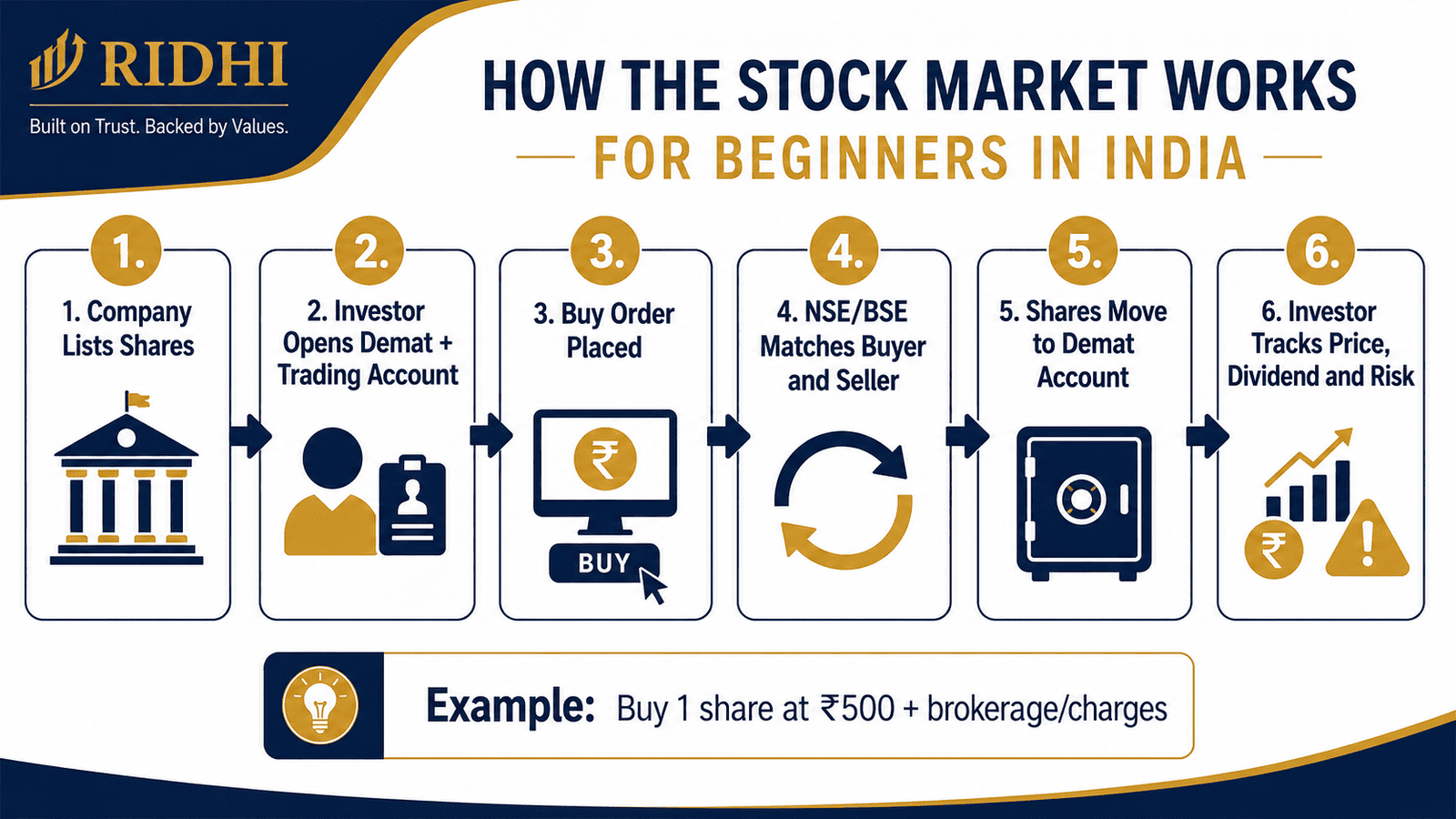
Stock market meaning refers to a regulated marketplace where investors buy and sell shares of listed companies. In India, shares trade mainly through NSE and BSE using a broker, trading account and demat account. For example, buying 1 share at ₹500 means owning a tiny part of that company, with both profit and loss risk.
Key Takeaways
- SEBI (Securities and Exchange Board of India) regulates every broker, exchange, and listed company in India’s stock market — all must follow strict disclosure and capital rules.
- India’s two main exchanges — NSE and BSE — settle all trades in a T+1 cycle, meaning shares appear in your demat account the very next business day after purchase.
- To invest, you need three things: a PAN card, a demat account (which holds shares digitally), and a trading account (which places your orders) — both opened simultaneously through a SEBI-registered broker.
- Buying a share makes you a proportional part-owner of that company: if TCS has 370 crore shares outstanding and you own 20, you hold a real stake in that business — including its profits and losses.
- The primary market is where companies sell new shares to the public for the first time (via IPO); the secondary market is where you and I trade those shares among ourselves, with no company involvement.
- Share prices change every second based on supply and demand — no tool, app or analyst predicts them with certainty, and past price performance never guarantees future returns.
- Risk is real and measurable: a ₹10,000 single-stock investment can fall to ₹4,000 or rise to ₹28,000 — beginners must understand both directions before committing money.
Key Facts at a Glance
| Topic | Key Detail | Authority |
|---|---|---|
| Regulator | SEBI — Securities and Exchange Board of India | Government of India |
| Main exchanges | NSE (tracks Nifty 50) and BSE (tracks Sensex) | SEBI-recognised |
| Settlement cycle | T+1 (shares credited next business day) | SEBI mandate |
| Trading hours | 9:15 AM – 3:30 PM, Monday to Friday | NSE / BSE |
| Minimum investment | 1 share — can be under ₹50 or above ₹50,000 depending on the stock | No SEBI minimum |
| Short-term capital gains tax | 20% on gains (held under 12 months) | Income Tax Department |
| Long-term capital gains tax | 12.5% on gains above ₹1.25 lakh/year (held over 12 months) | Income Tax Department |
| Accounts required | Demat account + Trading account, via SEBI-registered broker | SEBI |
What Stock Market Meaning Actually Covers
The stock market is not a single building. It is a regulated infrastructure — exchanges, brokers, depositories, and clearing corporations — all overseen by SEBI. When you place a buy order, it travels through your broker to an exchange, gets matched with a willing seller, and is settled by a clearing house. Your shares are then held as an electronic record in your demat account with a SEBI-registered depository (NSDL or CDSL). No physical certificates. No paperwork after the first account opening.
This infrastructure is what separates the stock market from speculation or gambling. Every participant — from the broker routing your order to the company whose shares you hold — operates under legally mandated disclosure rules, investor protection guidelines, and capital requirements set by SEBI.
NSE and BSE: India’s Two Main Exchanges
The National Stock Exchange (NSE), founded in 1992, is India’s largest exchange by trading volume and home to the Nifty 50 index. The Bombay Stock Exchange (BSE), established in 1875, is one of Asia’s oldest exchanges and tracks the 30-stock Sensex. Most large companies — Reliance Industries, HDFC Bank, Infosys — are listed on both. For retail investors, the difference in day-to-day execution is minimal: your broker automatically routes your order to the exchange offering the best available price. For a full breakdown of when and why the difference matters, read NSE and BSE difference.
What Sensex and Nifty Actually Tell You
When the news says “Sensex fell 800 points today,” it does not mean every listed stock fell. Sensex is an index — a weighted score tracking the 30 largest companies on BSE. Nifty 50 tracks the 50 largest companies on NSE. Both are market scorecards, not individual stocks. A falling index means those benchmark companies collectively moved down in price. Your portfolio could rise on the same day if you hold different stocks. For a full explanation of how both indices are calculated and what they signal, see Sensex and Nifty explained.
What a Share Actually Represents
A share is a unit of ownership in a company. When a company lists on the stock market, it divides its total equity into millions or billions of equal units and sells a portion to the public. Each share you buy gives you proportional ownership — not of its products or offices, but of its equity: assets minus liabilities. You are not lending the company money. You become a part-owner. That means you participate in the company’s growth through rising share prices and dividends — and in its decline through falling prices. To understand the different types of shares and what ownership actually entitles you to, read what a share means.
Primary Market vs Secondary Market
Two distinct layers make up the stock market, and beginners routinely confuse them.
Primary market: A company sells brand-new shares directly to investors for the first time, typically through an Initial Public Offering (IPO). The money raised goes to the company. This is a one-time event per listing.
Secondary market: After the IPO, shares trade between investors on NSE or BSE. When you buy Zomato or NTPC shares today through your broker, you are buying from another investor — not from the company. The company receives nothing from secondary market transactions. This is where the overwhelming majority of daily market activity takes place.
How a Trade Is Actually Executed
Here is the exact sequence when you place a buy order for 10 shares at ₹540 each:
- You open your broker’s app and enter: Buy 10 shares of [Company], Limit Price ₹540.
- Your broker routes the order electronically to NSE or BSE.
- The exchange matches your buy order with a seller willing to sell at ₹540.
- Trade confirmed — ₹5,400 plus charges is debited from your linked bank account via your trading account.
- By the next business day (T+1), 10 shares appear in your demat account.
Your trading account is the tool for placing orders. Your demat account is the digital locker where the shares are held. Both are opened simultaneously through the same broker — you cannot invest without both.
What Moves Share Prices — and Why Prediction Is Impossible
Prices move because of supply and demand. More buyers than sellers pushes a price up; more sellers than buyers pushes it down. What shapes that demand? Company quarterly earnings, RBI interest rate decisions, global commodity prices, government Budget announcements, geopolitical events, and sometimes simply market sentiment. According to SEBI’s investor education framework, retail investors must distinguish between short-term price volatility — which is noise — and the long-term earnings trajectory of a business, which is signal. Confusing the two is the root cause of most beginner mistakes.
Real Example: Rohan’s First Share Purchase
Rohan is 24, works as a junior software engineer in Pune, and earns ₹55,000 per month. He has been putting ₹5,000 a month into a savings account at 3.5% interest and is now curious whether the stock market offers a better use of that surplus.
In March 2024, Rohan opens a demat and trading account with a discount broker in under 30 minutes using his PAN and Aadhaar. He picks an IT services company he follows in his professional work and buys 10 shares at ₹540 each. Total invested: ₹5,400.
Six months later, the company announces strong revenue guidance. The share price climbs to ₹620. Rohan’s 10 shares are now worth ₹6,200 — an unrealised gain of ₹800. He has not sold yet, so no tax applies at this point.
Separately, the company announces a ₹5 per share interim dividend. ₹50 is credited directly to Rohan’s bank account — simply for holding the shares on the record date. For more on how this works, read dividend income basics.
His key insight: he did not need a large sum or a financial advisor to start. ₹5,400 bought him a real ownership stake in a real company — and he understood exactly what he had purchased before he bought it.
How to Calculate Returns on a Share Investment
Net Return = ((Selling Price − Buying Price) × Quantity) − Total Charges − Tax on Gain
Step-by-Step Using Rohan’s Numbers
Buy price: ₹540 × 10 shares = ₹5,400
Sell price: ₹620 × 10 shares = ₹6,200
Gross profit = ₹6,200 − ₹5,400 = ₹800
Estimated total charges on this trade (STT, flat brokerage of ₹20 per order, exchange transaction charges, SEBI turnover fee, GST): approximately ₹45–₹55. Using ₹50 as a round estimate.
Net profit before tax = ₹800 − ₹50 = ₹750
STCG tax (held under 12 months): 20% × ₹750 = ₹150
Net amount in hand = ₹750 − ₹150 = ₹600
Return on ₹5,400 invested = ₹600 ÷ ₹5,400 = 11.1% in 6 months
Use our brokerage calculator to estimate the exact charges for your own trade size before you invest — charges vary meaningfully by broker and order type.
| Scenario | Buy / Sell Price (10 shares) | Net Outcome (after charges, before tax) |
|---|---|---|
| Rohan’s gain | ₹540 → ₹620 | +₹750 gain |
| Price fell to ₹480 | ₹540 → ₹480 | −₹650 loss |
| Price unchanged | ₹540 → ₹540 | −₹50 (charges only, zero gain) |
Comparison: Long-Term Investing vs Short-Term Trading
| Parameter | Long-Term Investing | Short-Term Trading |
|---|---|---|
| Typical holding period | Months to years | Intraday to weeks |
| Tax on gains | LTCG: 12.5% above ₹1.25L/year | STCG: 20% |
| Risk level | Moderate | High |
| Time commitment | Low — periodic review | High — active daily monitoring |
| Primary skill needed | Company research, patience | Technical analysis, fast execution |
| Suitable for beginners | Yes | No |
| Demat account required | Yes | Yes |
How to Decide What’s Right for You
You are a first-time investor with no experience reading company financials — start with long-term investing in large-cap or index funds, not intraday trading. The learning curve for trading is steep and expensive for beginners.
You have a stable income, a 3–5 year horizon, and ₹1,000 or more to invest each month — the secondary equity market is worth exploring. Your first step is to open a demat and trading account to understand the process.
You want equity market exposure without picking individual stocks — a Nifty 50 index fund SIP starting at ₹500 per month gives you broad-market ownership with automatic diversification across 50 companies.
You are in the 30% income tax slab and plan to hold quality shares for more than 12 months — your gains above ₹1.25 lakh are taxed at only 12.5% LTCG, which is far below your income tax slab rate.
Your first question is “how much can I make quickly?” — the stock market will very likely disappoint you until you reframe that to “what risk am I comfortable taking, and over what time horizon?”
You have high-interest debt — personal loan EMIs, outstanding credit card balances above ₹30,000 — do not invest in equities first. Eliminating 18–36% annual interest is a guaranteed return that market investing cannot reliably beat for most beginners.
You do not yet have an emergency fund of 3–6 months’ expenses — do not put money you may urgently need into the stock market. You could be forced to sell at exactly the wrong moment.
Ready to take the next step? Read our complete guide to open a demat account — including the exact documents needed, a broker comparison, and the difference between full-service and discount brokers.
Common Mistakes to Avoid
Treating the Market as a Get-Rich-Quick System
Many beginners enter after seeing viral posts about stocks that doubled or tripled in weeks.
This mindset leads to chasing high-momentum stocks, overtrading, and ignoring downside risk. Historical Nifty 50 data shows long-run CAGR in the range of 12–14% over 15-year periods — not 100% in a year. Expecting outsized short-term returns pushes beginners toward speculative bets they do not understand.
Set a realistic return expectation before investing a single rupee.
Acting on Tips Without Research
Following “hot tips” from WhatsApp groups, Telegram channels, or social media influencers — without verifying them against company filings — is one of the fastest ways to lose money in the stock market.
SEBI has taken regulatory action against multiple unregistered advisory services for misleading investors. A ₹10,000 investment in an unresearched tip can become ₹2,000 before you understand what happened. Only act on information verifiable in the company’s official BSE or NSE filings, or from a SEBI-registered research analyst.
Confusing the Demat Account with the Trading Account
These are two different accounts with different functions. The demat account holds your shares digitally. The trading account lets you place buy and sell orders.
Opening only one and attempting to trade will result in failed orders or inaccessible holdings. Both accounts are opened simultaneously through your broker — the process takes the same paperwork and the same 15–30 minutes.
Ignoring Charges on Small Trade Sizes
On a ₹1,000 trade, total charges of ₹25–₹40 represent a 2.5–4% drag before your stock moves at all. That is a significant headwind on small positions.
Beginners placing ₹500 orders repeatedly are often paying more in cumulative charges than they earn in returns. Batch your purchases — buy fewer times with larger amounts — or choose a flat-fee discount broker where ₹20 per order is the same regardless of trade size.
Panic-Selling During a Market Dip
Selling the moment your portfolio turns red — down 10%, down 15% — is the single most common and costly beginner mistake. It converts a paper loss into a real, locked-in loss.
If the business fundamentals of the company you bought have not changed, a short-term price fall is market noise, not a signal to exit. The decision to sell should be based on a change in the company’s outlook — not a change in the number on your screen.
Missing the 12-Month Threshold Before Selling
Selling shares held for 11 months and 20 days means your entire gain is taxed at 20% STCG. Waiting another 10 days drops the applicable rate to 12.5% LTCG on gains above ₹1.25 lakh.
On a ₹40,000 gain, that difference is ₹3,000 — saved by simply checking your purchase date before placing the sell order. Always check your holding period before selling.
When This May Not Be the Right Choice
Direct equity investing in the stock market is not the right fit for everyone, even if you have surplus income each month.
If you carry high-interest debt — personal loans, credit card balances, buy-now-pay-later dues — eliminating interest costs of 18–36% per year almost certainly delivers a better financial outcome than equity returns a beginner can realistically expect.
If you need the money within 12–18 months — for a wedding, a home deposit, or a large planned expense — stock market volatility makes it an unsuitable vehicle. A 30–40% temporary fall in quality stocks is not unusual, and your timeline may not allow recovery.
If you cannot emotionally tolerate watching your account balance drop by 20% without reacting, direct stock picking will consistently lead to poor decisions at the worst times. Diversified mutual funds or index-linked SIPs may serve you better — they offer the same equity market exposure with automatic diversification across dozens of companies. Note: Mutual fund investments are subject to market risks. Past performance does not guarantee future returns. SEBI regulates all mutual funds in India and maintains a public registry at sebi.gov.in.
If any of these apply to your situation, it may be worth exploring alternatives before committing.
Official Rules and Where to Verify
The rules, tax rates, and regulatory guidelines governing India’s stock market are set by government bodies and statutory regulators — not by brokers or financial websites. Always go to the primary source before making any financial decision.
- SEBI (sebi.gov.in) — investor protection rules, broker and exchange registration, advisory regulations
- NSE (nseindia.com) — listed company data, market statistics, circuit breaker rules
- BSE (bseindia.com) — listed company data, Sensex details, exchange circulars
- Income Tax Department (incometax.gov.in) — STCG, LTCG, STT rates and capital gains reporting requirements
Rules, limits, and rates on this topic can change with each Budget or regulatory update. Always verify current figures directly from the official source before making any financial decision.
For a complete guide to how profits, losses and transactions are taxed when investing in Indian equities, read our article on stock market tax rules.
Expert Tips
- Before buying any stock, look up its price-to-earnings (P/E) ratio on NSE or BSE and compare it to the sector average. A banking stock with a P/E of 30 is very different from a fast-growth tech company with a P/E of 80 — the number alone means nothing without sector context.
- Use the 12-month rule before every sell decision: open your demat statement, check the exact purchase date, and if you are fewer than 30 days from the 12-month mark, the LTCG tax saving (20% STCG vs 12.5% LTCG) is almost always worth waiting for.
- If you are not yet ready to pick individual stocks, start with a Nifty 50 index fund SIP at ₹1,000–₹2,000 per month. You get exposure to India’s 50 largest companies without needing to research any of them individually.
- Keep brokerage charges proportionate to your investment size. On trades under ₹2,000, total charges of ₹30–₹50 represent a 1.5–2.5% drag before your position moves. Consolidate orders where possible.
- Never invest money you may need within 12 months in equity. T+1 settlement means you can sell quickly — but selling at a market low because you need emergency funds is a mistake that wipes out months of gains.
- Bookmark SEBI’s investor education portal (investor.sebi.gov.in). It has free resources on identifying fraud, understanding your rights as a shareholder, and a complaint platform if your broker acts improperly. Use it before you invest — not after a problem arises.
Frequently Asked Questions
What is the stock market in simple words?
The stock market is a regulated system where shares of publicly listed companies are bought and sold by investors. In India, this happens electronically through NSE and BSE, under SEBI oversight. When you buy a share, you become a proportional part-owner of that company and participate in its financial performance.
What is the difference between a stock market and a share market?
There is no practical difference in India. “Stock market,” “share market,” and “equity market” all refer to the same thing — the regulated marketplace where equity shares of listed companies are traded. All three terms are used interchangeably in Indian financial media and regulation.
Can I start investing in the stock market with ₹500?
Yes. Many listed companies have shares trading under ₹500, and you can buy as little as 1 share. However, on very small trade sizes, brokerage and statutory charges can represent a disproportionately large percentage cost. Starting with ₹2,000–₹5,000 per transaction is more practical once all charges are factored in.
Is the stock market safe for beginners in India?
The market is regulated and not inherently unsafe — but it carries real financial risk. Share prices can fall 30–50% in a broad market downturn. Beginners who invest money they cannot afford to lose, use borrowed funds, or trade without research carry significantly higher risk. Starting with small amounts in well-known large-cap stocks or index funds while you learn is a more measured approach.
What is a demat account and why do I need one?
A demat account (short for dematerialised account) is a digital account where your shares are stored after you buy them — similar to a bank account, but for securities. Without one, you cannot hold shares in India. You also need a separate trading account to place orders — both are opened together through your broker.
What happens if the company I invested in goes bankrupt?
If a company is wound up, equity shareholders are the last in the repayment queue — after secured creditors, unsecured creditors, and preference shareholders. In most bankruptcy proceedings, ordinary equity shareholders receive very little or nothing. This is exactly why concentrating all your money in a single company is considered high risk, and why diversification across multiple businesses or funds is recommended.
What is the difference between the primary market and secondary market?
The primary market is where a company raises fresh capital by issuing brand-new shares directly to investors — typically through an IPO. The secondary market is where those shares subsequently trade between investors on NSE or BSE. The company receives no proceeds from secondary market trades. The overwhelming majority of daily stock market activity is secondary market trading.
How much tax do I pay when I sell shares in India?
If you sell shares held for under 12 months, your gains are taxed at 20% as Short-Term Capital Gains (STCG). If held for over 12 months, gains above ₹1.25 lakh per year are taxed at 12.5% as Long-Term Capital Gains (LTCG). Securities Transaction Tax (STT) is also levied on every equity trade at the point of execution. Always verify current rates at incometax.gov.in before filing.
Can I lose all my money in the stock market?
If you invest entirely in a single company that collapses or gets delisted, yes — you can lose all the money in that position. If you hold a diversified portfolio of 15–20 companies or a broad-market index fund, a complete simultaneous loss across every holding is extremely unlikely. Diversification is the primary tool for managing catastrophic loss risk in equities.
Is there a minimum age to invest in the stock market in India?
You must be at least 18 years old to open a demat and trading account independently. Minors can invest through a guardian-operated account, with control transferring to the individual when they turn 18. A PAN card is mandatory for all demat account applications regardless of age.
Final Verdict
Stock market meaning, stripped to its core, is this: a SEBI-regulated system where you can buy proportional ownership in real Indian companies and participate in their long-term growth. For a first-time investor like Rohan — 24, earning ₹55,000 per month, willing to learn before buying — the market is genuinely accessible, transparent, and capable of building meaningful wealth over time. But it requires preparation: clear high-interest debt first, build an emergency fund, open a proper demat and trading account, and invest only money you can leave untouched for at least 3–5 years.
Direct stock investing is not the right fit for everyone. Those with short time horizons, low risk tolerance, or limited time to research companies may find diversified mutual funds or index SIPs more suitable — the underlying equity exposure is the same, with built-in diversification.
Always verify the latest rules from official sources or consult a qualified professional before making any financial decision.
This article is for educational purposes only and should not be treated as personalised financial, tax, investment, insurance, or legal advice. Tax rules, interest rates, regulatory limits, and product features can change with each Budget or policy update. Please verify current rules from official government sources or consult a qualified and registered professional before making any financial decision.

Devika Shah writes about stock market basics for Indian beginners who want to understand equity investing before taking financial risk. Her content is educational and does not provide stock tips, trading calls, price predictions, or personalised investment advice.
She covers topics such as demat account meaning, trading account basics, IPOs, dividends, brokerage charges, delivery vs intraday trading, market orders, limit orders, stock indices, blue-chip stocks, capital gains tax, stock market terminology, risk management, and the difference between long-term investing and short-term speculation.
Devika’s writing is clear, balanced, and risk-conscious. She helps readers understand how the stock market works, what accounts and documents are needed, what charges may apply, and what mistakes beginners should avoid. Her articles are suitable for students, salaried employees, and first-time investors who want a foundation before investing. Since market rules, tax treatment, brokerage fees, IPO processes, and regulatory requirements can change, readers should verify current information from SEBI, exchanges, brokers, and official tax sources.