

You’ve decided to explore PPF — but before locking money away for 15 years, you want a clear number. A PPF calculator gives you that number: maturity amount, year-wise interest, and total growth, all based on your yearly deposit, the current interest rate, and your investment tenure. The problem is that most calculator pages show you a figure and stop there. They skip the year-wise breakdown, they don’t explain how compounding accelerates over time, and they rarely address what happens when the rate changes. This article solves all three gaps — with a complete 15-year table, worked examples, comparison context, and a plain-language guide to reading calculator output before you invest.
Quick Answer: PPF Calculator
PPF calculator helps estimate your Public Provident Fund maturity amount using yearly deposit, tenure and current PPF interest rate. For example, a ₹1.5 lakh yearly deposit over 15 years can show total deposit, interest earned and final maturity value.
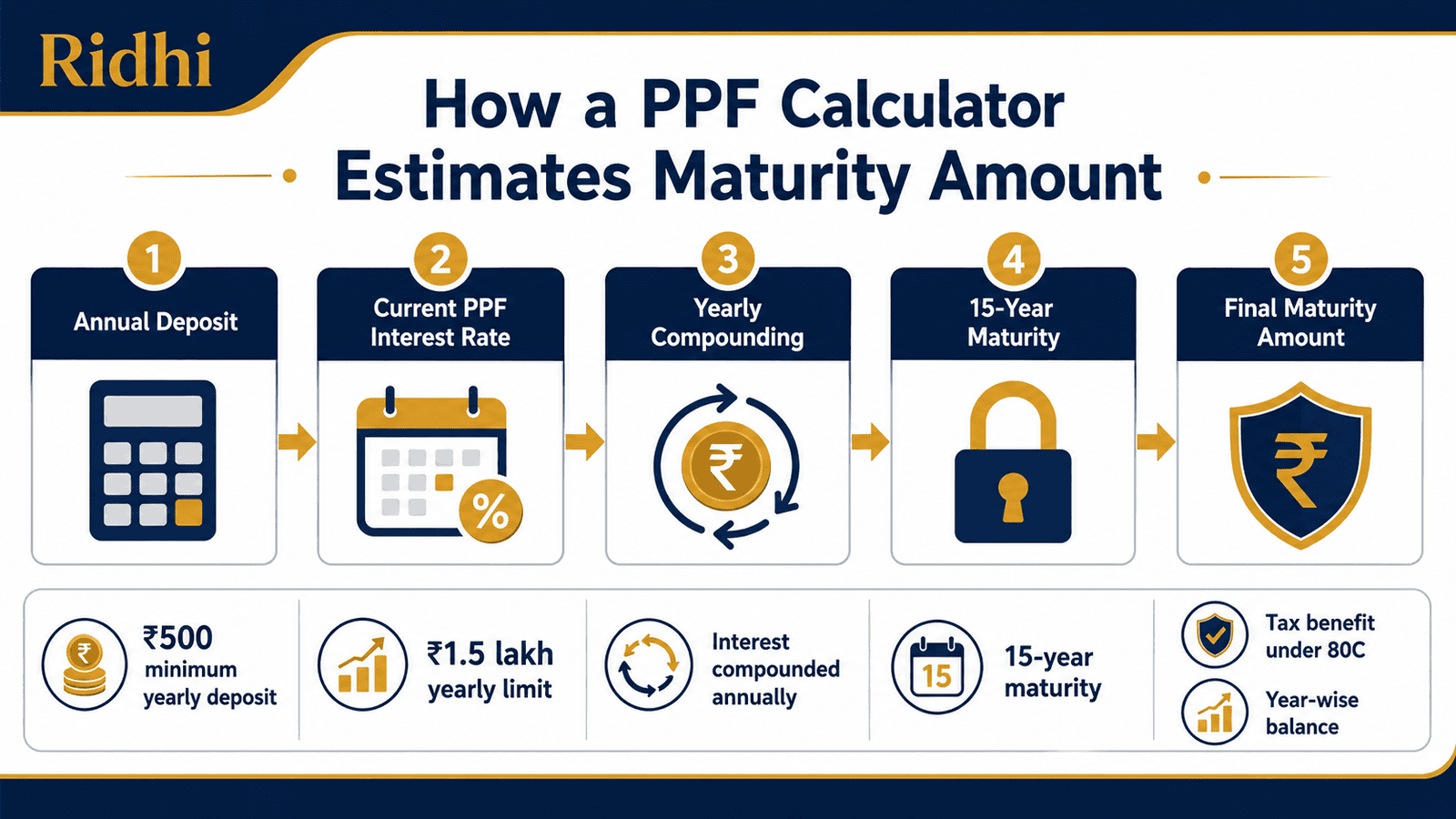
PPF Calculator: Formula, Inputs, and 15-Year Breakdown
PPF uses annual compounding — interest is calculated on your account balance and credited once, on 31 March each year. The earlier in the financial year you deposit, the more interest you earn. A deposit made before 5 April earns interest for the full year. A deposit made in December earns interest only for the remaining months of that financial year.
The standard formula used by PPF calculators is:
Maturity Amount = P × [((1 + r)^n − 1) ÷ r] × (1 + r)
Where: P = yearly deposit amount, r = annual interest rate as a decimal, n = number of years. This formula assumes one deposit at the start of each financial year. If you deposit in monthly instalments or after the 5th of the month, your actual maturity will be slightly lower.
The table below shows a year-wise breakdown for a ₹1,50,000 yearly deposit at an assumed rate of 7.1% per annum, deposited before 5 April each year. Verify the current rate from the Ministry of Finance before making any deposit decisions.
| Year | Annual Interest Earned (₹) | Closing Balance (₹) |
|---|---|---|
| 1 | 10,650 | 1,60,650 |
| 2 | 22,056 | 3,32,706 |
| 3 | 34,273 | 5,16,979 |
| 4 | 47,356 | 7,14,335 |
| 5 | 61,368 | 9,25,703 |
| 6 | 76,375 | 11,52,078 |
| 7 | 92,448 | 13,94,526 |
| 8 | 1,09,661 | 16,54,187 |
| 9 | 1,28,097 | 19,32,284 |
| 10 | 1,47,842 | 22,30,126 |
| 11 | 1,68,989 | 25,49,115 |
| 12 | 1,91,637 | 28,90,752 |
| 13 | 2,15,893 | 32,56,645 |
| 14 | 2,41,872 | 36,48,517 |
| 15 | 2,73,245 | 41,21,762 |
At ₹1,50,000 per year at an assumed 7.1% rate, total deposits over 15 years are ₹22,50,000 and the estimated maturity value is approximately ₹41,21,762 — meaning roughly ₹18,71,762 in interest alone, entirely tax-free under current rules. Notice that the interest earned in Year 15 (₹2,73,245) is more than 25 times the interest in Year 1 (₹10,650). That acceleration is annual compounding at work. These figures are illustrative; the actual maturity depends on rates applicable at the time you invest and any revisions during the 15-year period. Use the Ridhi PPF calculator to run your own scenarios with updated rates.
Key Takeaways
- PPF maturity depends on three things: your yearly deposit, the government-notified interest rate, and the tenure. Change any one and the calculator output changes significantly — a 0.5% rate cut over 15 years on a ₹1,50,000 annual deposit can reduce your maturity by ₹2–3 lakh.
- Interest is compounded annually. Your closing balance each 31 March becomes the base for the next year’s interest calculation, so the growth acceleration is most visible between years 10 and 15.
- At an assumed 7.1% rate, ₹1,50,000 per year for 15 years yields approximately ₹41,21,762 at maturity — roughly ₹18.7 lakh in interest on ₹22.5 lakh invested, all tax-free.
- The minimum deposit to keep a PPF account active is ₹500 per financial year. The maximum deposit eligible under scheme rules is ₹1,50,000 per financial year. Verify both limits from the National Savings Institute before each deposit.
- PPF has a 15-year maturity period. After maturity, extensions in 5-year blocks are possible. Verify current extension procedures from nsiindia.gov.in before your account matures.
- PPF qualifies for Section 80C deduction on contributions, interest credited each year is tax-free, and the maturity amount is fully tax-free — an EEE (Exempt-Exempt-Exempt) product under current tax rules. Verify current tax treatment from incometax.gov.in before investing.
Key Facts at a Glance
| Feature | Current Rule or Figure |
|---|---|
| Interest Rate | 7.1% per annum (verify current rate from Ministry of Finance notification) |
| Minimum Yearly Deposit | ₹500 per financial year |
| Maximum Yearly Deposit | ₹1,50,000 per financial year |
| Maturity Period | 15 years from date of account opening |
| Extension Option | 5-year blocks after maturity — with or without fresh contributions |
| Section 80C Deduction | Deposits qualify up to ₹1,50,000 per year |
| Tax on Interest | Fully tax-free each year |
| Tax on Maturity Amount | Fully tax-free (EEE status) |
| Compounding Frequency | Annual — interest credited on 31 March |
| Who Can Open | Resident Indian individuals — one account per person |
For a full list of investments that qualify under Section 80C alongside PPF, see the tax-saving options list.
What is PPF and How Does It Work?
Public Provident Fund is a government-backed small savings scheme introduced under the Public Provident Fund Act. It is administered by the National Savings Institute under the Ministry of Finance and is available through post offices and designated banks across India. According to NSI guidelines at nsiindia.gov.in, the scheme is designed to give individuals a long-term savings instrument with a government-notified interest rate, full capital safety, and tax-free returns.
Any resident Indian individual can open one PPF account. You cannot hold two PPF accounts in your own name. Minors can have accounts opened on their behalf by a guardian — but the ₹1,50,000 annual deposit limit applies to the combined deposits across the guardian’s own account and the minor’s account in the same financial year.
How Deposits Work
You can deposit in a PPF account as a lump sum or in up to 12 instalments per financial year. The financial year runs from 1 April to 31 March. The critical rule: interest for each month is calculated on the lowest balance between the 5th and the last day of that month. Practically, this means deposits made after the 5th of a month miss that month’s interest. Depositing on 1 or 2 April maximises annual interest. Depositing on 20 April costs you one month’s interest on the full deposit — roughly ₹888 in Year 1 at 7.1% on ₹1,50,000.
If you fail to deposit even ₹500 in any financial year, your account is treated as discontinued. You can still revive it, but you must pay the minimum deposit for each defaulted year plus a penalty per year of default. Verify current revival charges from your bank or post office.
How Interest Is Calculated and Credited
PPF interest is calculated monthly on the minimum balance between the 5th and the last day of the month, but it is credited only once — at the end of the financial year on 31 March. This means the interest you earn in Year 2 is not just on your Year 2 deposits — it is on the full balance including Year 1’s closing amount. That compounding base grows every year, which explains why the interest earned in Year 15 (₹2,73,245 in the table above) is so much larger than in Year 1 (₹10,650).
Why Calculator Results Are Estimates
The PPF interest rate is reviewed quarterly by the Ministry of Finance through official notifications. The rate applicable in Year 1 of your account may not be the rate in Year 8 or Year 15. Most PPF calculators — including the table above — assume a single fixed rate across all years. This is a simplification. If the rate drops from 7.1% to 6.5% partway through your tenure, your actual maturity will be lower than the calculator shows. Always run your estimate at two or three different rate scenarios before making a long-term deposit commitment.
For a full explanation of PPF eligibility, nomination rules, and account operations, see our guide to Public Provident Fund basics.
Real Example: Two PPF Scenarios for Rohit
Rohit, 34, is an IT manager in Pune earning ₹18 lakh per year. He wants to use PPF for long-term, low-risk savings alongside his EPF contributions. He runs two scenarios at an assumed rate of 7.1% per annum, with deposits made before 5 April each year.
Scenario A — ₹50,000 per year: Rohit invests a smaller amount to test the waters. Over 15 years, his total deposit is ₹7,50,000. Estimated maturity value at 7.1%: approximately ₹13,73,921. Interest earned: approximately ₹6,23,921 — fully tax-free.
Scenario B — ₹1,50,000 per year (maximum limit): Rohit invests the maximum. Total deposit: ₹22,50,000. Estimated maturity value: approximately ₹41,21,762. Interest earned: approximately ₹18,71,762 — also fully tax-free.
The key insight from Rohit’s comparison: the interest earned in Scenario B is not just triple Scenario A — it follows the same compounding curve, so the absolute gains from committing more early are substantial. His deciding factor is whether ₹1,50,000 per year is affordable without draining his emergency fund. The PPF calculator tells Rohit the outcome; his monthly cash flow decides what deposit is actually realistic.
Comparison: PPF vs EPF, ELSS, NPS and FD
Understanding how PPF’s calculator output compares to other long-term options helps you contextualise what the maturity estimate actually means relative to your full savings plan.
| Scheme | Return Type | Tax on Returns |
|---|---|---|
| PPF | Government-notified rate (currently 7.1% p.a.), fixed per quarter | Fully Tax-Free (EEE) |
| EPF | Government-notified rate, salary-linked, employer contributes too | EEE (within threshold) |
| ELSS | Market-linked equity returns — higher potential, no guarantee | LTCG beyond ₹1L taxable |
| NPS | Market-linked equity and debt mix — subscriber-chosen allocation | 60% tax-free; 40% as annuity |
| FD (5-year tax-saving) | Bank-declared rate — typically 6–7.5%, varies by institution | Interest taxable at slab rate |
To understand whether your EPF contributions already reduce the value of adding PPF to your plan, read our detailed guide to compare EPF and PPF.
How to Decide What’s Right for You
your primary goal is long-term, low-risk, tax-free savings and you can invest close to ₹1,50,000 per year without straining your cash flow — THEN PPF is among the strongest government-backed instruments available to you.
you are in the 30% tax bracket and have not yet used your full Section 80C limit — THEN every ₹1,50,000 deposited in PPF can reduce your tax outgo by ₹46,800 (30% plus 4% cess), on top of the tax-free interest benefit.
your EPF contributions and other deductions already exhaust your ₹1,50,000 Section 80C limit — THEN PPF deposits above that threshold provide no additional tax deduction, though the EEE interest advantage still holds.
you are comfortable with equity market risk and want higher long-term growth potential within a 3-year lock-in — THEN ELSS may be a better fit than PPF for the equity-growth portion of your tax-saving plan.
your main goal is structured retirement income with exposure to both equity and debt and an additional ₹50,000 deduction under Section 80CCD(1B) — THEN NPS may complement PPF rather than replace it.
you cannot commit to at least ₹500 per year consistently, or you may need the money within 5 to 7 years — PPF’s lock-in structure may not suit your liquidity needs. Consider shorter-tenure options before opening an account.
For a detailed comparison between market-linked and government-backed tax saving, read our guide on ELSS versus PPF.
Common Mistakes to Avoid
Assuming the Interest Rate Will Stay the Same for 15 Years
Most PPF calculators use a fixed rate for the entire tenure. The actual PPF rate is reviewed quarterly by the Ministry of Finance and can move in either direction.
If the rate drops from 7.1% to 6.5% after year 5, your maturity at ₹1,50,000 per year could fall by ₹2–4 lakh versus the calculator’s original estimate.
Always run three scenarios: current rate, 0.5% lower, and 1% lower. If the lowest scenario still meets your goal, the investment is robust.
Depositing After 5 April and Losing a Month of Interest
PPF interest is calculated on the minimum balance between the 5th and the last day of each month. A deposit on 20 April instead of 2 April means ₹1,50,000 earns nothing for April.
At 7.1%, that single missed month costs ₹888 in Year 1 alone. Repeated over 15 years, the cumulative cost of consistently late deposits can exceed ₹10,000–₹15,000 in lost interest.
Set a recurring reminder to deposit before 5 April every year.
Treating the Maturity Estimate as a Guaranteed Figure
A PPF calculator output is an estimate, not a contract. No online calculator can predict how many rate changes will occur during your 15-year tenure.
Do not plan major financial commitments — retirement, a child’s education, or a property purchase — based solely on one calculator output at today’s rate.
Use the number as a planning range, not a precise forecast.
Letting the Account Go Discontinued by Missing ₹500
If you miss the ₹500 minimum in any financial year, the account is discontinued. You cannot make new deposits until you revive it, and revival requires paying the minimum deposit plus a penalty for each defaulted year.
During a cash-flow crunch, deposit ₹500 to keep the account active. Increase contributions when your finances recover.
Ignoring That Your 80C May Already Be Full
If EPF contributions, home loan principal, school fees, and LIC premium already exhaust your ₹1,50,000 Section 80C limit, PPF deposits add no tax deduction benefit on the amount invested — only the tax-free interest and maturity advantage remain.
Check your 80C utilisation before the financial year ends so your PPF deposit targets are calibrated correctly.
Comparing PPF Returns With ELSS Returns on a Like-for-Like Basis
A 12% historical ELSS return is not directly comparable to a 7.1% PPF return. ELSS returns are pre-tax; PPF interest is already fully exempt. At the 30% slab, a 12% ELSS return reduces to approximately 10.4% after LTCG tax on gains above ₹1 lakh, while PPF’s 7.1% is fully retained. Always compare on an after-tax basis.
When This May Not Be the Right Choice
PPF may not fit your situation if your financial goals are short or medium term — a home purchase in 6 years, a child’s college fees in 8 years, or rebuilding an emergency fund. The 15-year lock-in means your capital is largely inaccessible during most of the tenure, and partial withdrawals are only permitted from Year 7 onward under specific conditions.
If your EPF contributions already fill your Section 80C deduction and you are comfortable with equity risk, ELSS offers a 3-year lock-in and the potential for meaningfully higher returns — making it a more flexible alternative for the tax-saving portion of your plan.
If you cannot reliably commit ₹500 or more every financial year for the full 15-year period, the risk of the account going discontinued — and the penalties and friction of revival — may outweigh the benefit. For details on what you can access early and when, see the withdrawal rule details.
If any of these apply to your situation, it may be worth exploring alternatives before committing.
Official Rules and Where to Verify
PPF rules, interest rates, deposit limits, and tax treatment are subject to government notifications and can change with each Budget cycle or quarterly review. Before investing, extending, or withdrawing, verify the current position directly from official sources:
- National Savings Institute — nsiindia.gov.in — scheme rules, deposit limits, maturity period, extension procedures, and loan and withdrawal rules
- Ministry of Finance — quarterly small savings interest rate notifications, typically announced in March and revised quarterly
- Income Tax Department — incometax.gov.in — current Section 80C deduction rules and EEE tax treatment for PPF
- Your bank or post office — for account operations, deposit processes, and revival or extension procedures specific to your branch
Rules, limits, and rates on this topic can change with each Budget or regulatory update. Always verify current figures directly from the official source before making any financial decision.
For the rules on borrowing against your PPF balance — including eligibility years and maximum loan amount — see our guide on loan rules explained.
Expert Tips
- Run three deposit scenarios every time you use the PPF calculator: ₹500 per year (minimum to stay active), ₹50,000 per year (manageable mid-range), and ₹1,50,000 per year (maximum). This range shows you the real impact of contribution size and helps you pick a deposit that your monthly cash flow can sustain for 15 years — not just for Year 1.
- Also run your chosen scenario at two lower interest rate assumptions alongside the current rate — for example, 6.5% and 6.8%. If the lowest-rate maturity still meets your goal, PPF is a strong fit. If you need today’s rate to work, build a margin into your savings plan.
- Depositing ₹1,50,000 as a lump sum before 5 April will consistently outperform splitting the same amount into monthly instalments of ₹12,500. The lump sum earns interest from April; monthly deposits average through the year. Over 15 years, the difference at 7.1% can exceed ₹60,000–₹75,000 in additional maturity value.
- Keep a separate liquid emergency fund before committing to maximum PPF deposits. PPF money is effectively locked for 15 years — partial withdrawals are restricted to Year 7 onwards and subject to limits. Do not use PPF as your emergency reserve.
- After every Ministry of Finance quarterly rate notification — check in March, June, September, and December — recalculate your projected maturity. A 0.25% rate change on a ₹1,50,000 annual deposit over the remaining tenure can shift your maturity estimate by ₹1–2 lakh.
- If you are investing for a child’s long-term goal, open the PPF account in the child’s name with you as guardian as early as possible. The 15-year clock starts from account opening — the sooner it starts, the sooner the child gains full access and extension rights.
Frequently Asked Questions
How is PPF maturity amount calculated?
PPF maturity is calculated using annual compounding. The formula is: Maturity Amount = P × [((1 + r)^n − 1) ÷ r] × (1 + r), where P is the yearly deposit, r is the annual interest rate as a decimal, and n is the number of years. Most PPF calculators assume deposits are made at the start of each financial year and a fixed rate throughout. The actual result depends on the quarterly rates notified during your tenure and when within the year you make each deposit.
What is the current PPF interest rate?
The PPF interest rate as of the most recently confirmed quarterly notification is 7.1% per annum. This rate is reviewed each quarter by the Ministry of Finance. Verify the current applicable rate from the official quarterly small savings notification or at nsiindia.gov.in before making any deposit decisions, as it may have changed since this article was written.
What is the maximum deposit allowed in a PPF account per year?
The maximum deposit allowed in a PPF account in a single financial year is ₹1,50,000. This is a combined limit — if you are a guardian for a minor’s PPF account, deposits to both your account and the minor’s account together cannot exceed ₹1,50,000 in the same financial year. Deposits above this limit do not earn interest and do not qualify for Section 80C deduction. Verify this limit from nsiindia.gov.in before each deposit.
Can I extend my PPF account after 15 years?
Yes. After the 15-year maturity period you can extend the account in blocks of 5 years. You can choose to extend with continued contributions — in which case you can deposit up to ₹1,50,000 per year and continue earning interest — or without contributions, where the existing balance continues to earn interest without fresh deposits. You must notify your bank or post office within one year of maturity to exercise the extension with contributions. Verify current extension deadlines and procedures at nsiindia.gov.in.
Is PPF maturity amount fully tax-free?
Under current tax rules, PPF has EEE status: the deposit qualifies for Section 80C deduction (Exempt at investment stage), the interest credited annually is not taxable income (Exempt on accrual), and the full maturity amount received after 15 years is also tax-free (Exempt on withdrawal). Verify the current tax treatment from the Income Tax Department at incometax.gov.in before investing, as tax rules can change with each Budget.
What happens if I miss the minimum deposit in a year?
If you deposit less than ₹500 in any financial year, your account is treated as discontinued. You cannot make fresh deposits until you revive it. Revival requires depositing ₹500 for each defaulted year plus a penalty per year of default. The account continues to earn interest on its existing balance even while discontinued, but you cannot add new money until it is revived. Verify current penalty amounts from your bank or post office.
Does depositing monthly versus yearly affect my PPF maturity?
Yes. PPF interest is calculated on the minimum balance between the 5th and the last day of each month. A single lump sum deposited before 5 April earns interest for all 12 months. Monthly instalments of ₹12,500 each earn interest only from the month of deposit. At ₹1,50,000 per year and 7.1% rate, the lump-sum strategy can generate ₹60,000–₹75,000 more at maturity over 15 years compared to monthly deposits spread across the year.
Is PPF available to NRIs?
No. NRIs are not eligible to open a new PPF account, according to National Savings Institute guidelines. An existing PPF account opened while the person was a resident Indian can generally be continued until maturity but cannot be extended after that. If your residency status has changed, verify the current rules and account continuation terms from nsiindia.gov.in and your bank’s NRI servicing documentation before taking any action.
Final Verdict
A PPF calculator is most useful when you treat it as a planning range rather than a guaranteed outcome. Run your own numbers at multiple deposit levels — ₹50,000, ₹1,00,000, and ₹1,50,000 per year — and at two or three interest rate scenarios before committing to a deposit size. For salaried investors in India who want government-backed, tax-free, long-term savings without market risk, PPF remains one of the cleanest instruments available. The 15-year lock-in is a feature for those with a genuinely long horizon — not a drawback. If you need higher growth potential or greater flexibility, compare your PPF calculator output with ELSS or NPS projections side by side before deciding. Always verify the latest rules from official sources or consult a qualified professional before making any financial decision.
This article is for educational purposes only and should not be treated as personalised financial, tax, investment, insurance, or legal advice. Tax rules, interest rates, regulatory limits, and product features can change with each Budget or policy update. Please verify current rules from official government sources or consult a qualified and registered professional before making any financial decision.

Suresh Nair writes about Indian government savings schemes, post office schemes, and conservative long-term savings options. His content is especially useful for families, parents, senior citizens, and low-risk savers who want to understand scheme rules before depositing money.
He covers topics such as Public Provident Fund, Sukanya Samriddhi Yojana, Senior Citizens’ Savings Scheme, National Savings Certificate, Kisan Vikas Patra, Post Office Monthly Income Scheme, National Pension System, post office fixed deposits, post office recurring deposits, child savings schemes, senior citizen savings options, maturity rules, withdrawal rules, lock-in periods, and tax treatment.
Suresh’s writing is mature, rule-focused, and cautious. He explains eligibility, deposit limits, tenure, interest calculation, tax benefits, withdrawal conditions, and practical use cases in simple language. His articles are useful for readers who prefer safety and predictable rules over high-risk investments. Since government scheme interest rates, deposit limits, lock-in rules, and tax treatment may change through official notifications, readers should verify current details from India Post, PFRDA, Income Tax Department, or relevant government sources before investing.