

Two colleagues join the same company, earn roughly the same salary, and retire decades later with completely different bank balances. The difference is rarely income. It is almost always time. One of them started putting money aside at 25. The other waited until 35, thinking “I’ll invest more later.” By then, a decade of growth had already compounded — and catching up is harder than most people realise.
The power of compounding is the reason why financial planners repeat “start early” so consistently. It is not a slogan. It is arithmetic. When your returns stay invested and begin generating their own returns, the growth curve eventually stops looking like a straight line and starts bending upward — sometimes sharply.
This article explains how compounding works, shows you real Indian examples using SIPs, FDs and lump-sum investments, and is honest about where compounding can disappoint. None of this is personalised investment advice — it is a foundation for understanding one of the most important concepts in personal finance.
Quick Answer: Power of Compounding
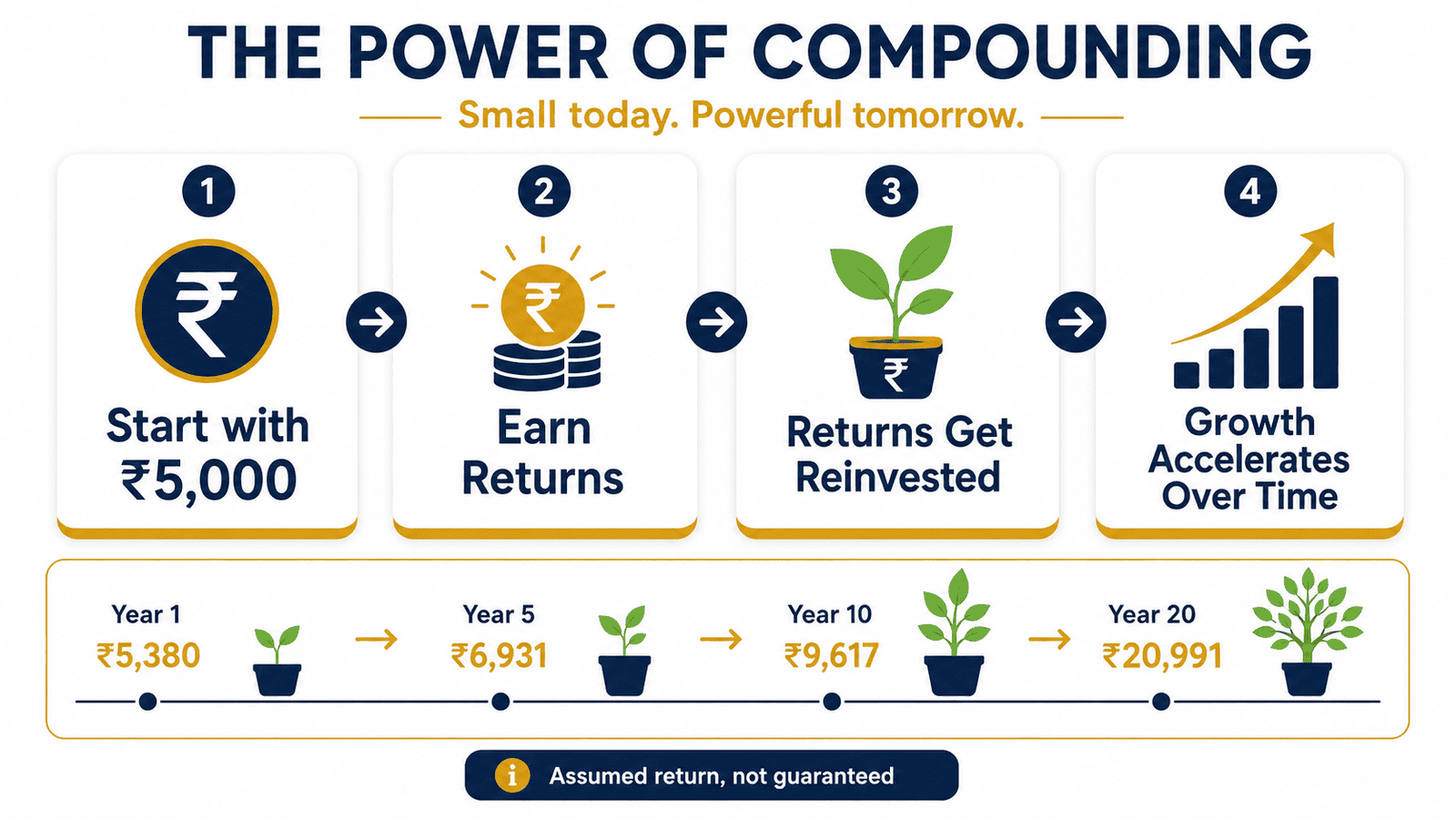
Power of compounding means your money earns returns, and those returns also start earning returns over time. For example, ₹5,000 invested monthly for many years can grow faster later because earlier returns remain invested. It works best when you start early, stay consistent, and avoid withdrawing gains too soon.
Key Takeaways
- Compounding works only when returns are reinvested — withdrawing gains early breaks the cycle and can significantly reduce long-term growth.
- Time typically matters more than the invested amount: a 25-year-old investing ₹3,000 per month can potentially build more wealth than a 35-year-old investing ₹6,000 per month over the same period, depending on assumed returns.
- The Rule of 72 gives a quick mental shortcut — divide 72 by your assumed annual return to estimate roughly how many years it takes to double your money.
- Higher return assumptions come with higher risk: a 12% assumed return in a market-linked investment is not the same as the guaranteed 7–7.1% from a PPF (rate subject to revision each quarter).
- Inflation and taxes reduce your real return — if your investment grows at an assumed 10% and inflation runs at 6%, your real gain is closer to 4%.
- Compounding needs discipline: stopping SIPs during market falls or dipping into long-term savings for short-term needs can undermine years of patient growth.
Key Facts at a Glance
| Parameter | Detail | Note |
|---|---|---|
| What compounding means | Returns earn further returns when reinvested | Core concept, not a product |
| Best suited for | Long-term goals: retirement, education, wealth creation | Not ideal for short-term needs |
| Common Indian examples | FD, PPF, EPF, SIP in mutual funds, NPS | Each carries different risk and guarantee levels |
| Main growth drivers | Principal amount, return rate, time horizon, reinvestment, consistency | Time is often the biggest lever |
| Key risk | Assuming market-linked returns are guaranteed | Past returns do not guarantee future performance |
| Rule of 72 | 72 ÷ annual return % = approximate doubling years | Quick mental estimate only |
How the Power of Compounding Actually Works
Most people understand simple interest intuitively — you put in ₹1,00,000 and earn 8% each year on that same ₹1,00,000. So every year, you earn ₹8,000. At the end of ten years, you have collected ₹80,000 in interest. Simple. Linear. Predictable.
Compounding is different. In the second year, you don’t earn 8% only on your original ₹1,00,000. You earn 8% on ₹1,00,000 plus the ₹8,000 you earned in year one — if that interest was reinvested. Your base grows. Your next year’s return is larger. That larger return then becomes part of the base the following year. And so on.
The result is a curve, not a line. Early years look slow. The math is quietly doing its work. Later years — especially from year 15 onwards — the growth can look dramatic. This is what people mean when they talk about the “curve bending upward.”
The Snowball Analogy
Think of rolling a small snowball down a long hill covered in snow. At the top, it picks up just a little extra with each roll. But as it grows, it covers more surface area and picks up far more snow per rotation. By the bottom of the hill, the snowball is enormous — not because it accelerated, but because it had more mass picking up more snow continuously.
Your invested money works the same way. The “snow” it picks up is returns. The longer the hill (time horizon), the larger the final snowball. Stopping halfway — by withdrawing returns or pausing contributions — is like rolling the snowball backwards. You lose not just what you removed but every future snowflake that would have stuck to it.
Simple Interest vs Compound Interest
The practical difference becomes clearest in a side-by-side comparison. On ₹1,00,000 at 10% over 20 years, simple interest gives you ₹2,00,000 in interest. Compound interest (annual compounding) gives approximately ₹5,72,750 — the same principal, the same rate, the same 20 years. The only difference is whether your returns stayed invested or were paid out and spent.
For a deeper look at how these two methods differ mathematically, see our guide on the simple interest difference between both approaches.
Frequency of Compounding
Returns can compound annually, half-yearly, quarterly, monthly or even daily. More frequent compounding means slightly faster growth, all else being equal. Bank FDs in India typically compound quarterly. Some savings instruments compound annually. Mutual fund NAVs reflect daily market movements, so the compounding effect is continuous — though with the added reality of market volatility.
Real Example: Priya vs Rajan — The Cost of Waiting
Priya, 25, a software engineer in Bengaluru earning ₹60,000 per month, starts a ₹5,000 monthly SIP in a diversified mutual fund. She invests for 30 years, stopping at age 55. Total amount invested: ₹18,00,000 over 30 years.
Rajan, 35, an accountant in Mumbai earning ₹80,000 per month, also starts a ₹5,000 monthly SIP — but a decade later. He invests for 20 years, stopping at age 55. Total amount invested: ₹12,00,000 over 20 years.
At an assumed 12% annual return (illustrative only — not guaranteed; actual mutual fund returns vary and may be higher or lower), Priya’s corpus could be approximately ₹1.76 crore. Rajan’s could be approximately ₹49.9 lakh. Priya invested ₹6 lakh more than Rajan — but her corpus is potentially more than three times larger. The extra decade of compounding is doing the work, not the extra ₹6 lakh alone.
For a rough sense of how long doubling takes, the Rule of 72 estimate is a useful mental tool: at 12% assumed return, money roughly doubles every 6 years. At 9%, every 8 years.
How to Calculate Compound Growth
Compound Interest Formula = P × (1 + r)ⁿ − P
Where: P = Principal amount | r = Annual rate of return (as a decimal) | n = Number of years
Using a simple lump-sum example: Rohan, 27, a salaried employee in Pune earning ₹70,000 per month, invests ₹1,00,000 as a lump sum in a fixed deposit offering 7% annually (compounded quarterly). After 10 years, his approximate maturity amount would be ₹2,00,160 (using quarterly compounding formula). At an assumed 10% annual return in a different instrument, the same ₹1,00,000 could grow to approximately ₹2,59,374 over 10 years. Both are illustrative; actual returns depend on the specific product and its terms.
For SIP-style investing, the calculation is different because each contribution compounds for a different number of years. ₹5,000 invested in month one has 20 years to grow; ₹5,000 invested in month 240 has almost no time to compound. This is why SIP calculators use specific formulas, and why using one will give you a far more accurate picture than rough mental arithmetic.
Use our SIP calculator estimate to project different scenarios based on your own contribution and time horizon.
| Scenario | Key Inputs (Illustrative) | Approximate Result |
|---|---|---|
| Lump sum at 7% for 10 years | ₹1,00,000 | 7% p.a. compounded quarterly | ~₹2,00,160 (FD-style, illustrative) |
| Lump sum at 10% for 20 years | ₹1,00,000 | 10% p.a. assumed return | ~₹6,72,750 (not guaranteed) |
| ₹5,000/month SIP for 20 years | ₹5,000/month | 12% p.a. assumed return | ~₹49.9 lakh (not guaranteed) |
Comparison: Compounding Across Different Scenarios
| Scenario | Simple Interest Approach | Compound Interest Approach |
|---|---|---|
| ₹1 lakh at 10% for 20 years | ₹2 lakh total (₹1L interest) | ~₹6.73 lakh total (illustrative, not guaranteed) |
| Start investing at age 25 vs 35 | Later start Smaller corpus at 55 | Early start Potentially 2–3× larger corpus |
| FD compounding vs mutual fund compounding | FD: Predictable rate, lower risk | MF: Higher potential, market-linked risk |
| Nominal return vs inflation-adjusted return | Assumed 10% nominal return | ~4% real return if inflation is 6% (illustrative) |
| Lump sum vs monthly SIP discipline | Lump sum needs large capital upfront | SIP builds the habit; each instalment compounds for its own period |
How to Decide What’s Right for You
your goal is 10 or more years away — THEN compounding in a market-linked instrument like a diversified mutual fund SIP may be worth exploring, keeping in mind that returns are not guaranteed and values can fall.
you want predictable compounding with no market risk — THEN a bank FD or PPF (Public Provident Fund) compounds at a fixed or declared rate; PPF rates are set by the government each quarter and can change.
you do not yet have three to six months of expenses saved as an emergency fund — THEN build that first before starting any long-term compounding investment, because early withdrawals break the compounding cycle.
you have high-interest debt — THEN clearing that debt often gives a better “guaranteed return” than any investment; an 18% credit card interest rate compounding against you is harder to beat than an assumed 12% compounding for you.
your investment goal is retirement, your child’s education, or buying a home 15 years away — THEN compounding works in your favour most powerfully here; long time horizons absorb short-term volatility.
inflation is eroding the real value of your goals — THEN nominal return projections can be misleading; factor in rising costs when planning. Our guide on how inflation reduces value explains this in detail.
you need this money within two to three years — THEN compounding in volatile instruments is unlikely to help, and may hurt; a short time horizon means market falls may not have time to recover before you need the money.
Common Mistakes to Avoid
Waiting Until You Have “Enough” to Invest
Many beginners delay investing because ₹1,000 or ₹2,000 per month feels too small to matter.
Small amounts compounding over long periods can grow substantially — and every year of delay costs future growth. ₹2,000 per month from age 25 at an assumed 12% could potentially grow to more than ₹70 lakh by age 55 (illustrative, not guaranteed). Waiting five years to “invest properly” with ₹5,000 may still fall short of that.
Start with whatever you can afford consistently. Increase as your income grows.
Stopping SIPs During Market Falls
When mutual fund NAVs drop, some investors stop their SIPs or redeem units out of fear.
Market falls are precisely when SIP investors buy more units for the same ₹5,000. Stopping during a downturn not only interrupts the compounding cycle but means missing potentially lower purchase prices. According to SEBI’s investor education guidelines (sebi.gov.in), systematic investing over long periods is designed to navigate market volatility through rupee cost averaging.
If your goal is long-term and your fund is a regulated, diversified one, staying invested through short-term falls is generally more consistent with the compounding logic than reacting to headlines.
Withdrawing Returns Too Early
Taking out your mutual fund gains, FD interest, or dividends the moment they appear resets your compounding base.
This is equivalent to plucking fruit off a tree every season and then wondering why the tree isn’t growing larger. Reinvested returns become the foundation for the next round of growth. Spent returns do not.
Keep long-term compounding money mentally — and practically — separate from your spending money.
Assuming Market-Linked Returns Are Fixed
Projections showing ₹1 crore after 20 years at 15% often fuel unrealistic expectations.
Market-linked instruments can give higher returns than FDs — but also negative returns in some years. An assumed 12% is an average, not a floor. Actual returns can vary significantly depending on market conditions, fund selection and timing. Treating a projection as a promise leads to under-saving and over-spending based on money you may not have.
Label your projections as assumptions. Revisit them periodically.
Ignoring Expense Ratios and Taxes
A mutual fund with a 1.5% expense ratio doesn’t sound expensive — but over 20 years, that fee compounds too, working against your returns.
LTCG tax on equity mutual fund gains above ₹1.25 lakh per year at 12.5% (rate as applicable; verify from the Income Tax Act) and short-term gains tax also reduce real compounding outcomes. Factor these into your projections, not just the gross assumed return.
Compare direct and regular plan expense ratios before choosing a fund. For SIP investing basics, see our guide on how to start SIP early.
Treating All Compounding Instruments as Equal
PPF compounds at a declared government rate with tax benefits. An equity mutual fund compounds at market-linked rates with associated risk. A savings account also compounds — but at 2.5–4% per annum, which often trails inflation.
Each instrument has a different risk, liquidity, tax treatment and guarantee level. Choosing based only on the highest projected return — without considering risk and lock-in — is a common beginner error.
When This May Not Be the Right Choice
Compounding is a powerful concept, but it does not suit every situation.
If your financial goal is less than two to three years away — a trip, a gadget, a short-term expense — putting money into volatile, long-term instruments and expecting compounding to save you is a mistake. The market may not cooperate in your timeframe.
If you have no emergency fund, long-term investing before building that buffer means you may need to withdraw from your investments at the worst possible time — a market low, a crisis, or a period when withdrawals carry exit loads or tax consequences.
If you are carrying expensive debt — personal loans above 12–14% or credit card balances at 18–42% per annum — compounding is working against you more aggressively than it could ever work for you at typical investment return assumptions. Paying off high-interest debt first often makes more financial sense. According to RBI guidelines on responsible lending (rbi.org.in), borrowers should be aware of the annualised cost of credit, which compounds just as investment returns do.
If an investment is being marketed with guaranteed high returns and no visible risk disclosures, be cautious. Genuine compounding in regulated products comes with honest risk communication.
If any of these apply to your situation, it may be worth exploring alternatives before committing.
Official Rules and Where to Verify
The power of compounding is a mathematical concept, not a regulated product — so there is no single government page governing it. However, the investments that use compounding are regulated, and you should verify product-specific details directly from authoritative sources.
- SEBI (Securities and Exchange Board of India) — sebi.gov.in: For information on mutual funds, SIPs, SEBI-registered advisors, and investor education resources on market-linked investing.
- RBI (Reserve Bank of India) — rbi.org.in: For information on bank FD regulations, savings account interest norms, and guidelines around deposit-taking institutions.
- Product documents and scheme information documents (SID): Every mutual fund scheme publishes an SID and Key Information Memorandum (KIM) that states the actual costs, risks and fund mandate. Read these before investing.
- AMFI — amfiindia.com: For mutual fund-related investor education and fund NAV data.
Rules, limits, and rates on this topic can change with each Budget or regulatory update. Always verify current figures directly from the official source before making any financial decision.
Expert Tips
- Start with a fixed SIP date linked to your salary credit date. Setting your SIP to trigger within 2–3 days of your salary credit means you invest before you spend — this removes the temptation to delay or skip a month.
- Step up your SIP by 10% every year with salary hikes. If you earn a 10% increment and increase your SIP by the same proportion, your investing rate keeps pace with your income. ₹5,000 per month stepped up by 10% annually can grow your overall corpus significantly faster than a flat ₹5,000 forever.
- Do not disturb long-term investments for short-term needs. Create a separate, accessible emergency fund (ideally in a liquid fund or high-interest savings account) so you never need to break your SIP or FD for an unplanned expense.
- Run a projection scenario with 2–3% lower assumed returns. If you plan for 10% but the market delivers 8%, you want to know whether your goal is still achievable. Conservative scenario planning is more useful than optimistic projections.
- Reinvest your FD maturity instead of spending the payout. When a fixed deposit matures, the easiest path is to let it auto-renew or roll it into the next FD. Taking the payout and spending it restarts the compounding clock at zero.
- Review your compounding assumptions every 2–3 years. Return assumptions, your tax bracket, fund expense ratios, and your goals will all change over time. A one-time projection at age 25 may no longer be accurate at age 32. Adjust your investment amount if needed.
- Choose a direct plan over a regular plan for mutual funds. Direct plans have no distributor commission, so a larger share of your return stays invested and compounds. The difference in expense ratio — typically 0.5–1% — sounds small but compounds meaningfully over 20+ years.
Frequently Asked Questions
What is the power of compounding in simple words?
Compounding means your money earns returns, and those returns also earn returns when they stay invested. Over time, the growth accelerates because each period’s returns are calculated on a larger base than the last. The longer you leave money invested without withdrawing gains, the more pronounced this effect becomes.
Is compounding guaranteed?
It depends entirely on the instrument. FD and PPF interest compounding at declared rates is generally more predictable for the period stated. Market-linked products like mutual funds use compounding logic, but the rate is not guaranteed — it reflects actual market returns, which can be positive or negative in any given year. Compounding is a mechanism, not a promise.
Does SIP use compounding?
Yes. In a SIP, each monthly contribution is invested and grows for its own period. The contribution made in month one has the full investment duration to compound. The contribution in month 24 has less time. Combined, the portfolio follows a compounding trajectory — though the rate of growth is tied to the performance of the underlying fund, which carries market risk.
What is the Rule of 72?
The Rule of 72 is a quick mental shortcut: divide 72 by your annual assumed return rate to estimate roughly how many years it takes to double your money. At an assumed 9% return, money doubles in approximately 8 years. At 12%, roughly 6 years. This is an approximation, not a prediction, and does not account for taxes, costs or market volatility.
Is compounding better than simple interest?
For a borrower, simple interest is preferable because costs grow linearly. For an investor, compounding is generally more favourable because returns grow exponentially when reinvested. The difference becomes very significant over long time horizons. On ₹1,00,000 at 10% for 20 years, simple interest adds ₹2,00,000; annual compounding can produce approximately ₹5,72,750 total (illustrative only).
How early should someone start investing?
From a compounding perspective, earlier is consistently better. Even a five-year head start can make a substantial difference to the final corpus because those early returns compound for more cycles. There is no single “right” age — the right time is whenever you have an emergency fund in place, no very high-interest debt, and a basic understanding of the product you are investing in.
Can compounding work against me?
Yes — if you are borrowing, compounding works in the lender’s favour, not yours. Credit card debt at 36–42% per annum compounds aggressively. A ₹50,000 unpaid credit card balance can balloon rapidly if only minimum payments are made. Understanding that compounding is neutral — a mechanism that can work for or against you depending on which side of the transaction you are on — is important.
What happens if I stop my SIP midway?
If you stop a SIP, the units already purchased remain invested and continue to grow or fall with the market. No penalty is charged for stopping an SIP in most cases. However, the compounding benefit of future contributions is lost. The longer your intended horizon, the more costly a prolonged SIP pause can be in terms of foregone growth.
Does inflation affect compounding?
Yes. If your investment grows at an assumed 8% and inflation runs at 6%, your real purchasing power gain is approximately 2%, not 8%. This is why financial planning uses real return (nominal return minus inflation) for long-term goal projections. Nominal compounding figures alone can be misleading when planning goals that are 15–25 years away.
Which Indian instruments use compounding most effectively?
PPF, EPF, NPS, bank FDs (interest compounded quarterly), and equity or debt mutual funds all use compounding. The key differences are guaranteed vs market-linked returns, tax treatment, liquidity, and lock-in periods. There is no universally “best” instrument — the right choice depends on your goal, time horizon, and risk comfort.
Final Verdict
The power of compounding is not magic. It is consistent mathematics applied over time. The single biggest insight is that time is usually a more powerful variable than the amount you invest — which means starting early, even with a small amount, can outperform starting late with a larger amount.
SIPs use compounding through reinvested returns in a market-linked environment. FDs and PPF offer more predictable compounding at lower, declared rates. Neither is “better” in isolation — each suits a different risk appetite, time horizon and goal type.
What genuinely undermines compounding is not market volatility or low rates — it is behaviour. Withdrawing early, stopping during downturns, and delaying the start are the real enemies of long-term growth. Compounding rewards patience and penalises impatience.
If you are planning for a major long-term goal — retirement, your child’s education, or financial independence — our guide on retirement corpus planning shows how these compounding principles translate into a real savings target. Always verify the latest rules from official sources or consult a qualified professional before making any financial decision.
This article is for educational purposes only and should not be treated as personalised financial, tax, investment, insurance, or legal advice. Tax rules, interest rates, regulatory limits, and product features can change with each Budget or policy update. Please verify current rules from official government sources or consult a qualified and registered professional before making any financial decision.

Sanya Malhotra writes about everyday personal finance for Indian individuals and families. Her content focuses on budgeting, saving, emergency funds, debt control, net worth tracking, family money decisions, and practical habits that help readers manage money with more confidence.
She covers topics such as monthly budgeting, expense planning, saving habits, emergency fund behaviour, debt repayment, household financial planning, family discussions about money, financial mistakes, net worth tracking, short-term vs long-term goals, and beginner personal finance concepts.
Sanya’s writing style is warm, simple, and realistic. She avoids making personal finance feel intimidating and instead explains money decisions through relatable Indian examples, ₹ budgets, checklists, and step-by-step frameworks. Her articles are useful for students, freshers, couples, parents, and families who want to improve daily money habits. Her content is educational and does not provide personalised financial advice. Readers should adapt examples to their own income, family responsibilities, city, debt level, risk comfort, and financial goals.