
Most investors know that mutual fund profits are taxable — but when the actual redemption comes, they freeze. Is tax calculated on the entire ₹2 lakh you just redeemed, or only the ₹40,000 gain? Does your SIP age start from the very first instalment, or does each instalment have its own clock? And with Finance Act changes every Budget, which rules actually apply in FY 2026-27?
Mutual fund taxation in India is not a single rule. It depends on the fund type, how long you held your units, and whether the income is a capital gain or a payout. Equity funds, debt funds, hybrid funds, ELSS, and IDCW options are each treated differently under the Income Tax Act. A taxable event arises when you redeem, switch, or receive a payout — not merely because your NAV has gone up.
This article explains the FY 2026-27 mutual fund tax framework in plain language, covering all major fund categories, SIP redemption rules, and what you need to verify before filing your ITR. It is written for educational purposes only and does not constitute personalised tax or investment advice.
Quick Answer: Mutual Fund Taxation FY 2026-27
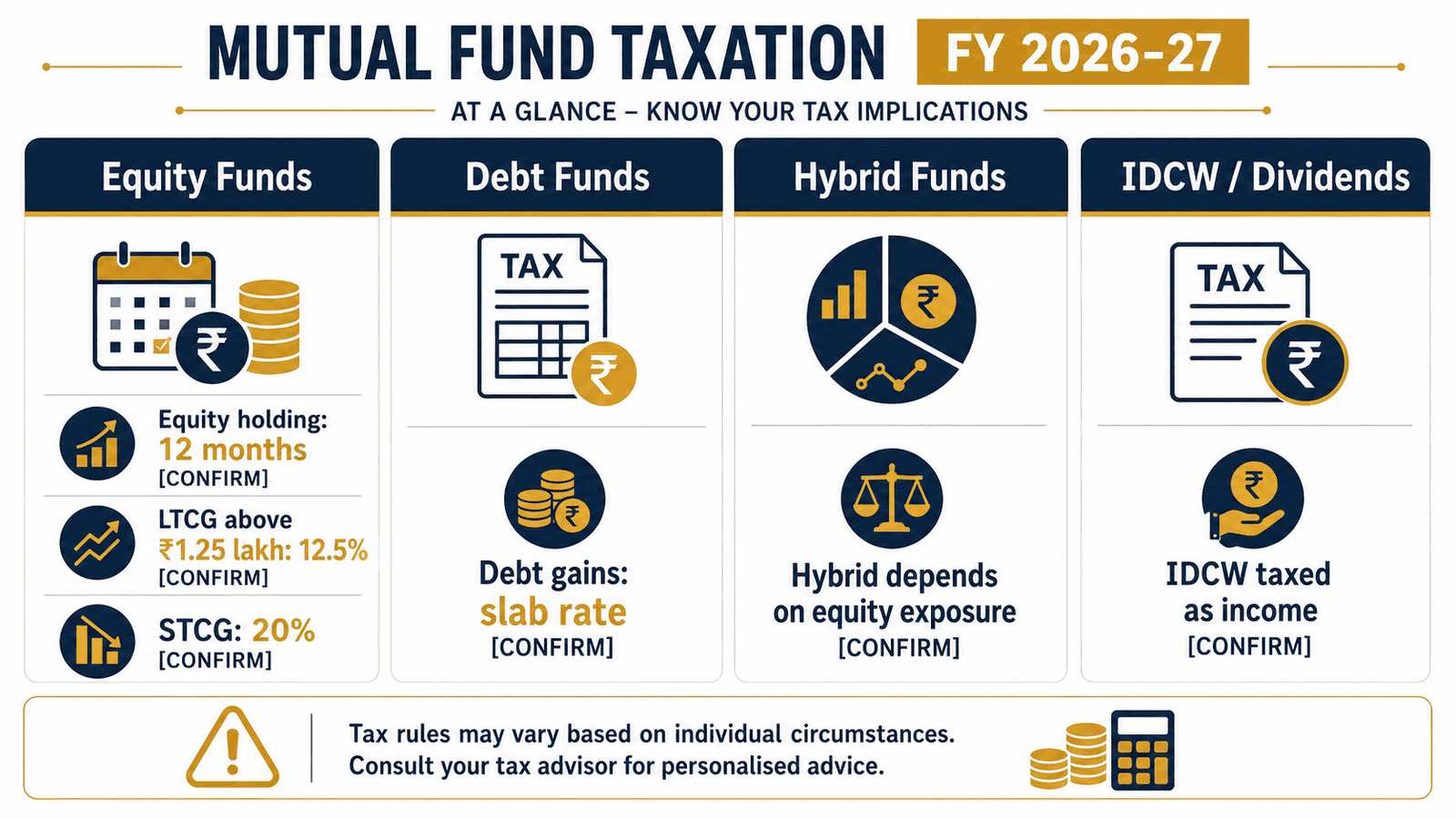
Mutual fund taxation FY 2026-27 depends on fund type, holding period and redemption date. Equity-oriented funds generally use 12-month rules, with STCG at 20% and LTCG above ₹1.25 lakh at 12.5% [rates to be verified from incometax.gov.in before publishing]. Debt and some hybrid funds may be taxed at slab rates. Tell readers to verify from Income Tax Department and fund statements.
Key Takeaways
- Equity-oriented mutual funds are taxed differently from debt and non-equity funds — LTCG above ₹1.25 lakh is taxed at 12.5% and STCG at 20% for transfers after 23 July 2024, subject to verification from incometax.gov.in.
- Tax applies only on the capital gain — the profit — not on the full redemption amount.
- Each SIP instalment has its own purchase date and holding period. A SIP started in January 2023 and partially redeemed in February 2024 may have some short-term and some long-term units depending on which instalments are redeemed.
- IDCW (Income Distribution cum Capital Withdrawal) payouts are generally added to investor income and taxed at the applicable slab rate — verify from your fund house statement and incometax.gov.in before filing.
- Switching between mutual fund schemes is treated as a redemption from the source scheme and a fresh purchase in the destination scheme — this triggers a capital gains taxable event.
- Debt mutual funds and certain hybrid schemes classified as specified mutual funds under Section 50AA may be taxed at slab rates without indexation benefit — verify current classification with AMFI and incometax.gov.in.
- All FY 2026-27 rates, thresholds and holding-period rules must be verified from the Income Tax Department at incometax.gov.in before you file your ITR.
Key Facts at a Glance
| Fund Type / Situation | Holding Period Rule | Tax Treatment (Verify Before Publishing) |
|---|---|---|
| Equity-oriented fund — Short Term | 12 months or less | STCG at 20% under Section 111A — verify rate at incometax.gov.in |
| Equity-oriented fund — Long Term | More than 12 months | LTCG above ₹1.25 lakh at 12.5% under Section 112A — verify limit and rate |
| Debt mutual fund / Specified mutual fund | Any period | Slab-rate taxation under Section 50AA — verify current classification |
| Hybrid fund (equity-oriented) | Same as equity-oriented fund | Equity-oriented tax rules apply if equity exposure meets threshold — verify |
| Hybrid fund (non-equity-oriented) | Any period | May be taxed at slab rate — verify fund classification with fund house |
| ELSS fund | 3-year lock-in; LTCG threshold applies | Equity-oriented LTCG rules at redemption — verify current rate |
| SIP redemption | Unit-wise from each instalment date | Each SIP unit assessed separately for STCG or LTCG |
| IDCW payout | Not applicable | Added to investor income; taxed at slab rate — verify treatment at incometax.gov.in |
How Mutual Fund Taxation Works in India
Before you calculate a single rupee of tax, you need to answer one question: what type of fund is this? The Income Tax Act does not treat all mutual funds the same. Equity-oriented funds, debt funds, hybrid funds, ELSS, and the IDCW option each follow different rules. Getting the classification wrong means calculating the wrong tax.
For readers who are new to mutual funds, understanding the basics of units, NAV and fund structure will help you follow the rest of this guide. You can start with our beginner fund basics explainer before returning here.
Capital Gains Are on Profit, Not Redemption Amount
This is the most common misunderstanding. When you redeem ₹2 lakh from a fund, you are not taxed on ₹2 lakh. You are taxed on the gain — the difference between the sale value and the cost of acquisition (purchase price). If you bought units worth ₹1.6 lakh and redeemed them for ₹2 lakh, only ₹40,000 is the capital gain subject to tax.
Equity-Oriented Mutual Funds: STCG and LTCG
An equity-oriented fund is one that invests a specified minimum portion of its corpus in Indian equity shares. According to Income Tax Department guidelines at incometax.gov.in, gains from such funds are classified as short-term or long-term based on the holding period.
If you hold equity-oriented fund units for 12 months or less, the gain is a Short-Term Capital Gain (STCG) taxable under Section 111A. The STCG rate for equity-oriented fund transfers after 23 July 2024 is 20% — verify the applicable rate from incometax.gov.in before filing for FY 2026-27.
If you hold units for more than 12 months, the gain is a Long-Term Capital Gain (LTCG) taxable under Section 112A. LTCG up to ₹1.25 lakh per year is exempt. Gains above ₹1.25 lakh are taxed at 12.5% without indexation. Both the ₹1.25 lakh threshold and the 12.5% rate must be verified from incometax.gov.in for FY 2026-27, as these can change with each Budget.
Debt Mutual Funds and Section 50AA
After Finance Act 2023, many debt mutual funds lost the long-term capital gains treatment with indexation. Funds classified as specified mutual funds under Section 50AA — those with less than a specified minimum equity exposure — are taxed at the investor’s applicable income-tax slab rate, regardless of how long units were held. No indexation benefit applies.
For investors in the 30% tax bracket, this makes debt fund gains significantly more expensive than they were before 2023. If you are considering a debt fund for your portfolio, our debt fund basics guide explains what to look for beyond taxation.
Hybrid Funds: Classification Decides Tax
Hybrid funds invest in both equity and debt in varying proportions. Whether a hybrid fund is taxed as equity-oriented or as a debt/specified fund depends on its actual equity exposure — not its name or category label. If equity exposure meets the threshold for equity-oriented classification, equity tax rules apply. If it does not, slab-rate or other treatment may apply. Always check your fund’s category classification in its Scheme Information Document or AMFI’s website at amfiindia.com before calculating tax.
ELSS Funds: Lock-In and Tax on Redemption
ELSS (Equity Linked Savings Scheme) funds give you a deduction under Section 80C up to ₹1.5 lakh in the year of investment. This deduction is available under the old tax regime. At redemption after the mandatory 3-year lock-in, gains are taxed as long-term capital gains under equity-oriented fund rules — the same ₹1.25 lakh threshold and 12.5% rate apply, subject to verification. Read our detailed ELSS tax saving guide for the full picture, including SIP-based ELSS redemption rules.
Mutual fund investments are subject to market risks. Past performance does not guarantee future returns.
IDCW Option Taxation
The IDCW (Income Distribution cum Capital Withdrawal) option distributes periodic income to investors. Unlike the Growth option — where gains are realised only on redemption — IDCW payouts are a taxable event in the year they are received. The payout is generally added to the investor’s total income and taxed at their applicable slab rate. Verify IDCW tax treatment for FY 2026-27 from incometax.gov.in and your fund house’s investor documents. Reference SEBI for advisory context regarding regulated mutual fund disclosures.
Real Example: Rohan’s Equity Fund and SIP Redemption
Rohan is 34, an IT professional in Pune earning ₹22 lakh per year. He has been investing through SIPs in an equity-oriented large-cap fund since April 2022. In June 2024, he redeems units worth ₹2 lakh. His cost of acquisition for those units is ₹1.6 lakh, so his capital gain is ₹40,000.
Because Rohan held these particular units for more than 12 months, the ₹40,000 gain is a Long-Term Capital Gain. His total LTCG for the year remains below ₹1.25 lakh — so under current rules (verify rate and threshold for FY 2026-27), this gain attracts zero tax. If his total LTCG exceeded ₹1.25 lakh across all equity investments, he would pay 12.5% on the amount above the threshold.
Now consider Rohan’s SIP instalments bought in May 2024. When he redeems some units in June 2024 — just one month after purchase — those particular units are short-term. That gain, if any, is taxed as STCG at 20%. Each SIP instalment has its own clock. For more on how each SIP purchase date creates a separate holding period, see our guide on SIP redemption rules.
Rohan also holds units in a debt fund. When he redeems those, the gain — regardless of how long he held — is taxed at his income slab rate under Section 50AA (verify with incometax.gov.in for current classification). At ₹22 lakh income, Rohan falls in the 30% bracket, making debt fund gains materially more expensive than equity LTCG.
How to Calculate Mutual Fund Capital Gains Tax
Capital Gain = Sale Value − Cost of Acquisition (Purchase Price)
Step 1: Identify whether your fund is equity-oriented, debt, hybrid, or ELSS. Check the fund’s Scheme Information Document or amfiindia.com.
Step 2: Find the purchase date, cost of acquisition, redemption date and redemption value from your fund house statement or Annual Information Statement (AIS).
Step 3: For SIP-based redemptions, match each redeemed unit to its specific purchase date. Units held for more than 12 months (equity-oriented) are long-term; units held for 12 months or less are short-term. Platforms typically do this automatically using FIFO (First-In, First-Out) unless the investor specifies otherwise.
Step 4: Apply the applicable rate — STCG at 20% under Section 111A, or LTCG above ₹1.25 lakh at 12.5% under Section 112A for equity-oriented funds. For debt/specified funds, apply your income-tax slab rate. Verify all rates for FY 2026-27 from incometax.gov.in.
Step 5: Add applicable surcharge and health and education cess at 4%. Final tax will also depend on your total income, residential status and any other capital gains during the year.
| Scenario | Key Inputs | Estimated Tax Outcome (Verify Rates) |
|---|---|---|
| Equity fund LTCG — gain ₹80,000 | Held 18 months; total LTCG below ₹1.25L | Zero tax if total LTCG for year stays under ₹1.25L threshold |
| Equity fund LTCG — gain ₹2,00,000 | Held 18 months; no other equity LTCG | ₹75,000 taxable (₹2L minus ₹1.25L); ~₹9,375 at 12.5% plus cess |
| Equity fund STCG — gain ₹50,000 | Held 8 months | ₹50,000 taxable at 20% = ₹10,000 plus cess |
Comparison: Equity, Debt, Hybrid, ELSS and IDCW Taxation
| Fund Type | Tax Category and Rate | Key Condition (Verify Before Acting) |
|---|---|---|
| Equity-oriented fund — STCG | 20% under Section 111A | Held 12 months or less; rate applicable post 23 Jul 2024 — verify |
| Equity-oriented fund — LTCG | 12.5% above ₹1.25L under Section 112A | Held more than 12 months; threshold and rate must be verified |
| Debt fund / Specified mutual fund | Slab rate under Section 50AA | No indexation; applies regardless of holding period — verify classification |
| Hybrid — equity-oriented | Same as equity-oriented fund rules | Fund must meet equity exposure threshold — Check SID |
| Hybrid — non-equity-oriented | Likely slab rate | Verify fund category classification with fund house or AMFI — Verify |
| ELSS | Equity LTCG rules after 3-year lock-in | Section 80C deduction on investment; LTCG at redemption — Equity rules |
| IDCW payout | Slab rate in year of receipt | Added to total income; TDS may apply — verify at incometax.gov.in |
For a deeper understanding of debt fund risk and return, the debt fund basics guide on Ridhi is a useful starting point before you assess the tax angle.
How to Decide What’s Right for You
you are redeeming equity-oriented fund units held for more than 12 months — THEN calculate whether your total LTCG for the year will exceed ₹1.25 lakh. Only gains above that threshold attract tax at 12.5% (verify for FY 2026-27).
you are redeeming SIP units — THEN check which instalments are being redeemed and their individual purchase dates. Do not assume all units are long-term just because your SIP is old.
you hold debt mutual funds or funds classified as specified mutual funds under Section 50AA — THEN expect your gains to be taxed at your full income-tax slab rate. Verify current classification from amfiindia.com and incometax.gov.in.
you are planning to switch from one fund to another — THEN remember that every switch is a taxable event. Calculate capital gains on the source fund before switching. See our guide on switching fund tax before acting.
you received IDCW payouts during the year — THEN check your AIS and Form 26AS for the amounts reported. These will be taxed as income at your slab rate in the year of receipt.
you are an ELSS investor redeeming after 3 years — THEN equity-oriented LTCG rules apply. The Section 80C deduction was claimed in the year of investment; it does not reduce your cost of acquisition at redemption.
you have verified the current FY 2026-27 rates and thresholds from incometax.gov.in — THEN do not file your ITR using this article alone. Rates and limits can change with each Budget or Finance Act notification.
Common Mistakes to Avoid
Assuming the SIP Age Counts from the First Instalment Only
Many investors believe their SIP is “long-term” simply because they started it three years ago.
Each SIP instalment creates a separate lot of units with its own purchase date. When you redeem, the holding period is calculated unit-by-unit — not from the first instalment date. Redeeming in year 3 can still leave some recent units as short-term and liable for STCG.
Always check which specific units are being redeemed and on which date they were purchased.
Calculating Tax on the Full Redemption Amount
Some investors panic because they redeemed ₹3 lakh and worry they owe tax on ₹3 lakh.
Tax applies only on the capital gain — the profit over your cost of acquisition. If you invested ₹2.5 lakh and redeemed for ₹3 lakh, only ₹50,000 is taxable. The original ₹2.5 lakh is your own capital returned to you.
Request your capital gains statement from your fund house or platform to get the correct gain figure before filing.
Forgetting That Switching Is a Taxable Event
Switching from one mutual fund scheme to another — even within the same fund house — is treated as a redemption followed by a fresh purchase.
This triggers a capital gains calculation on the source scheme. Investors who switch frequently to “rebalance” or chase returns may generate multiple short-term gains without realising it. Before switching, calculate the tax cost. Our switching fund tax guide explains the full process, tax, and timing implications.
Treating All Hybrid Funds as Equity-Oriented
Not all hybrid funds qualify as equity-oriented for tax purposes.
If a balanced advantage fund or multi-asset fund has equity exposure below the threshold at the time of your redemption, it may be taxed at slab rates — not at equity LTCG rates. The name “balanced” does not guarantee equity-oriented classification. Verify equity exposure in the latest portfolio statement or Scheme Information Document before assuming tax treatment.
Ignoring AIS and Form 26AS Mismatch
Fund houses report mutual fund redemptions to the Income Tax Department. This data appears in your Annual Information Statement (AIS).
If the capital gains you report in your ITR do not match the data in AIS or Form 26AS, your return may be flagged for scrutiny. Many investors rely entirely on app-generated summaries, which may not always reflect redemptions from multiple platforms or all folios. Cross-check every redemption against AIS before submitting your ITR.
Ignoring Surcharge and Cess on Large Capital Gains
LTCG at 12.5% or STCG at 20% is the base rate before surcharge and cess.
A 4% health and education cess applies to all taxpayers. Surcharge applies if your total income crosses certain thresholds. For investors with large capital gains, effective rates can be materially higher than the headline rate. Verify applicable surcharge rates from incometax.gov.in for your income level in FY 2026-27.
When This May Not Be the Right Choice
Redeeming long-term equity mutual fund investments primarily to avoid a small tax bill may hurt your financial goals more than it saves in tax. If your LTCG is below ₹1.25 lakh, the exemption threshold means no tax is due anyway — there is no need to redeem early to “save” on tax that would not arise.
Switching funds frequently to harvest losses or rebalance can generate multiple short-term capital gains, trigger exit loads, and increase transaction costs — the net outcome may be worse than simply holding. Consider reviewing your portfolio allocation annually, not reactively.
Choosing the IDCW option purely for regular “income” without understanding that IDCW payouts are taxable at your slab rate — and are in fact a return of your own invested capital plus any distributable surplus — can create unnecessary tax liability compared to a systematic withdrawal from the Growth option.
Selecting a debt fund only for its tax characteristics without considering liquidity needs, credit risk, interest rate risk, and duration may expose you to risks that outweigh the tax angle. Tax is one input, not the only one.
If any of these apply to your situation, it may be worth exploring alternatives before committing.
Official Rules and Where to Verify
Mutual fund taxation rules in India are set by the Income Tax Act and amended by each Finance Act. For FY 2026-27, verify all applicable rates, thresholds, holding-period rules and fund classifications from the following official sources before publishing this article and before filing your ITR:
- Income Tax Department — incometax.gov.in: Capital gains rules, Section 111A, Section 112A, Section 50AA, ITR filing guidance, and the Annual Information Statement (AIS) portal.
- AMFI (Association of Mutual Funds in India) — amfiindia.com: Fund category classification, investor education, and scheme-level tax information.
- SEBI (Securities and Exchange Board of India) — sebi.gov.in: Mutual fund regulations, investor protection framework and scheme categorisation circulars.
- Your fund house and platform: Capital gains statements, cost of acquisition data, SIP instalment dates and IDCW transaction history.
Rules, limits, and rates on this topic can change with each Budget or regulatory update. Always verify current figures directly from the official source before making any financial decision.
For salaried employees preparing to file, our ITR filing checklist walks you through how to connect your mutual fund capital gains statement with your ITR documents.
Expert Tips
- Download your capital gains statement before April 1. Most fund houses and platforms generate this report for the previous financial year. Do not wait until ITR filing season — mismatches with AIS take time to resolve.
- Match your AIS with your capital gains statement line by line. Every redemption, switch and IDCW payout should appear in both. If something is missing from AIS or shows a different figure, report it before you file.
- Check your LTCG total before a planned redemption. If you are close to the ₹1.25 lakh LTCG exemption threshold, redeeming just over it in the same year means tax on every rupee above — consider timing across financial years (verify threshold for FY 2026-27).
- Keep a record of every SIP instalment date and NAV. Fund house statements and AMC apps record this, but also maintain your own backup, especially if you transfer folios or switch platforms.
- Do not rely solely on app-generated tax summaries for complex portfolios. If you have SIPs across multiple AMCs, folios inherited or gifted, or an NRI status change, the app summary may not capture all nuances. Verify with a qualified tax professional.
- For NRIs and high-income investors: TDS is deducted at source on mutual fund redemptions for NRIs. Surcharge slabs can apply to large capital gains. These scenarios have additional rules — consult a registered tax professional before redeeming.
- Estimate your tax before switching or making a large redemption using our income tax calculator to understand how capital gains might affect your total tax liability for the year.
Frequently Asked Questions
Is SIP redemption taxable in India?
Yes. When you redeem SIP units, capital gains tax applies on the profit from each unit. Each SIP instalment is treated as a separate purchase with its own date. Units held for more than 12 months in an equity-oriented fund are long-term; those held for 12 months or less are short-term. Tax is calculated unit-by-unit, not on the total SIP amount. Verify applicable rates from incometax.gov.in for FY 2026-27.
Is tax charged on the full mutual fund redemption amount or only the profit?
Only on the profit. Capital gains tax applies on the difference between your sale value and your cost of acquisition. If you redeemed ₹2 lakh and your purchase cost was ₹1.5 lakh, only ₹50,000 is the taxable gain. The ₹1.5 lakh you originally invested is your own capital — it is returned to you without tax.
How are equity mutual funds taxed in FY 2026-27?
Equity-oriented mutual funds are taxed based on holding period. Short-term gains (units held 12 months or less) are taxed under Section 111A. Long-term gains (units held more than 12 months) above ₹1.25 lakh are taxed under Section 112A. The STCG rate is 20% and LTCG rate is 12.5% for transfers after 23 July 2024 — both must be verified from incometax.gov.in before filing for FY 2026-27.
How are debt mutual funds taxed in FY 2026-27?
Most debt mutual funds and funds classified as specified mutual funds under Section 50AA are taxed at the investor’s applicable income-tax slab rate, regardless of holding period. The indexation benefit available before Finance Act 2023 no longer applies to these funds. Verify current fund classification from amfiindia.com and incometax.gov.in.
Are IDCW payouts from mutual funds taxable?
Yes. IDCW (Income Distribution cum Capital Withdrawal) payouts are generally added to the investor’s total income and taxed at their applicable slab rate in the year of receipt. TDS may be deducted by the fund house depending on the payout amount and investor category. Verify current TDS and income treatment from incometax.gov.in.
Is switching mutual funds taxable?
Yes. A switch from one mutual fund scheme to another is treated as a redemption from the source scheme and a fresh purchase in the destination scheme. This creates a capital gains event. If units in the source fund are short-term, STCG applies. If long-term, LTCG rules apply. Exit load may also apply. Always calculate the tax cost before switching.
Are ELSS funds tax-free after 3 years?
Not entirely. ELSS funds have a 3-year mandatory lock-in. At redemption, gains are taxed under equity-oriented LTCG rules — the same ₹1.25 lakh annual exemption and 12.5% rate apply to gains above that. So if your ELSS gain after 3 years is below ₹1.25 lakh and you have no other LTCG in that year, you effectively pay zero tax. But it is not legally “tax-free” — the exemption threshold applies. Read our ELSS tax saving guide for full details. Verify applicable rates before filing.
Can I set off mutual fund losses against other capital gains?
Yes, subject to conditions. Short-term capital losses can generally be set off against both short-term and long-term capital gains. Long-term capital losses can be set off only against long-term capital gains. Unabsorbed losses can be carried forward for up to 8 assessment years, provided you file your ITR on time. Verify the current set-off and carry-forward rules from incometax.gov.in before filing.
What is the difference between Section 111A and Section 112A for mutual funds?
Section 111A governs STCG on equity-oriented funds — units held for 12 months or less. Section 112A governs LTCG on equity-oriented funds — units held for more than 12 months, with gains above ₹1.25 lakh taxable at 12.5%. Section 50AA covers specified mutual funds (primarily debt-heavy funds) and mandates slab-rate taxation. The correct section depends on fund type and holding period — verify classification before calculating tax.
What documents do I need for mutual fund capital gains tax reporting?
You need: a capital gains statement from your fund house or CAMS/KFintech consolidated account statement, your Annual Information Statement (AIS) from the Income Tax Department portal, Form 26AS showing TDS if any, and purchase confirmation statements showing NAV and dates for each investment. Cross-check all figures before entering them in your ITR.
Final Verdict
Mutual fund taxation FY 2026-27 is not one rule — it is a framework that depends on fund classification, holding period, and the nature of each transaction. Equity-oriented funds, debt funds, hybrid funds, ELSS, and IDCW payouts are each taxed under different provisions of the Income Tax Act. The most important thing to internalise: tax applies on profit, not on the total redemption amount, and each SIP instalment carries its own holding period clock.
For investors in India who hold a mix of equity, hybrid and debt funds — and redeem through SIPs — the unit-wise calculation matters more than any headline rate. Classify your fund correctly before calculating anything.
Because tax rates, thresholds like the ₹1.25 lakh LTCG exemption, and debt fund treatment can change with each Budget or Finance Act, all FY 2026-27 figures in this article must be verified from incometax.gov.in before you publish this article or file your ITR. Always verify the latest rules from official sources or consult a qualified professional before making any financial decision.
This article is for educational purposes only and should not be treated as personalised financial, tax, investment, insurance, or legal advice. Tax rules, interest rates, regulatory limits, and product features can change with each Budget or policy update. Please verify current rules from official government sources or consult a qualified and registered professional before making any financial decision.

Arjun Kapoor writes about mutual funds, SIPs, ELSS, fund categories, investment returns, and beginner investing concepts for Indian readers. His focus is on education, not product promotion or fund recommendations. He helps readers understand how mutual funds work before they start investing or comparing schemes.
He covers topics such as mutual fund meaning, SIP meaning, SIP calculator, direct mutual funds vs regular plans, NAV, ELSS tax-saving funds, CAGR, absolute returns, XIRR, expense ratio, large cap vs mid cap vs small cap funds, flexi cap funds, index funds vs active funds, liquid funds, debt mutual funds, SIP pause vs SIP stop, lumpsum vs SIP, and how to start SIP in India.
Arjun’s writing is simple, risk-aware, and long-term oriented. He avoids guaranteed-return language and explains investment concepts using examples, timelines, and comparison tables. His articles remind readers that mutual fund investments are subject to market risks, and past performance does not guarantee future returns. Readers should verify scheme details from SEBI, AMFI, fund houses, and official scheme documents.