
When you leave a salaried job, your employer’s group health insurance goes with it. Most freelancers in India realise this only after a hospital bill arrives — and by then, the waiting period clock has not even started. Health insurance for freelancers in India works differently from the group cover salaried employees take for granted: there is no HR department, no employer subsidy, no automatic enrolment. You have to choose a policy, compare it carefully, buy it early, and manage it yourself. This article explains what to look for, what to check before buying, and what mistakes to avoid — so your medical emergency does not also become a financial one.
Quick Answer: Health Insurance for Freelancers in India
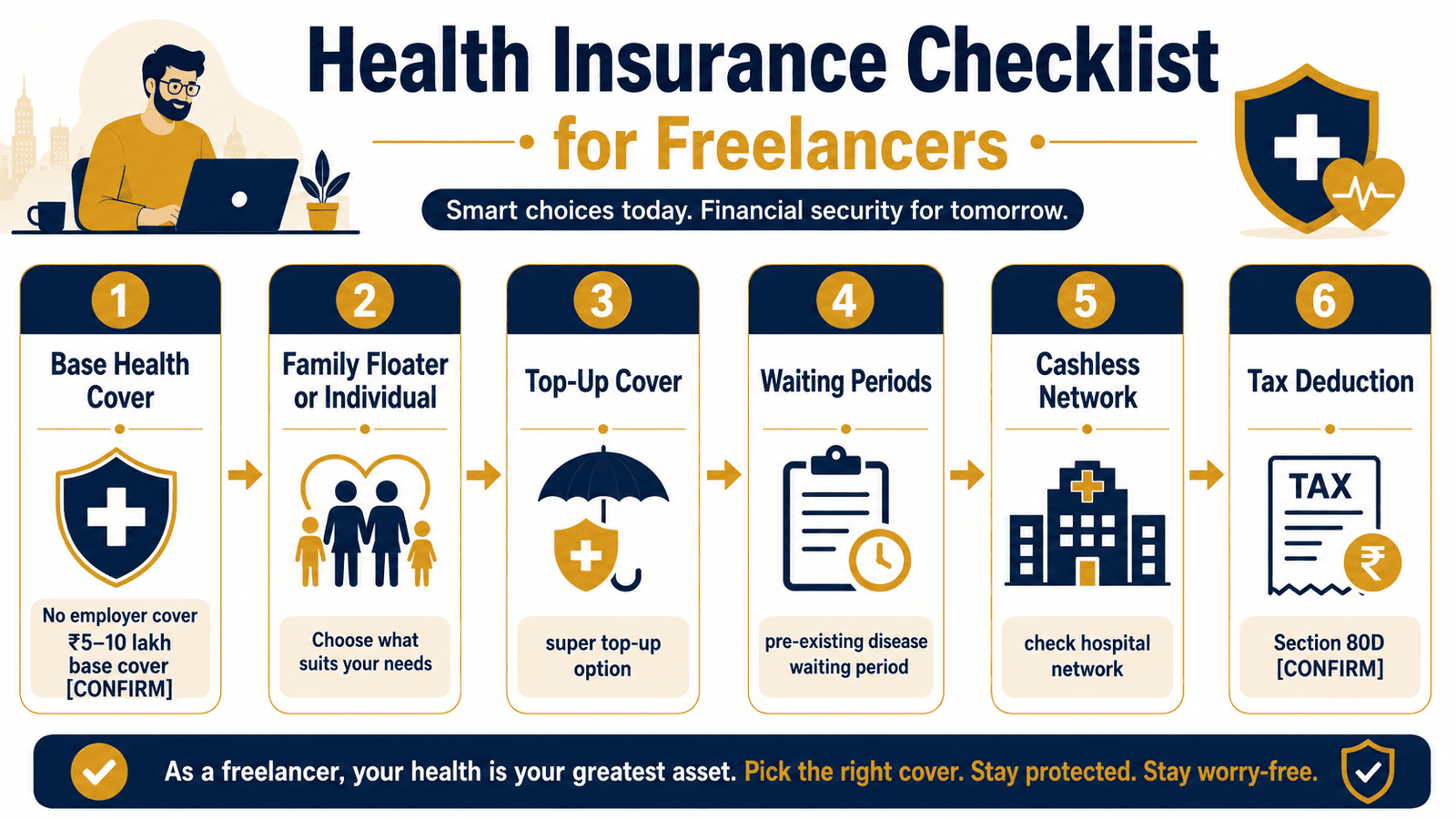
Health insurance for freelancers in India should start with an individual or family floater base policy, then add a top-up or super top-up if needed. Compare ₹5–10 lakh base cover, waiting periods, exclusions, cashless hospitals, claim process, and Section 80D benefit. Premiums, eligibility, and deduction limits can change — verify current figures from your insurer and incometax.gov.in before purchasing.
Key Takeaways
- Freelancers have no employer group cover — a medical emergency without insurance can wipe out months of savings and disrupt business cash flow simultaneously.
- A base individual or family floater policy should come first; top-up or super top-up cover is a second layer, not a replacement for a base policy.
- Pre-existing disease waiting periods — commonly 2–4 years — mean claims on existing conditions may not be paid in the early years of a new policy.
- Room rent limits, co-payment clauses, and specific exclusions can significantly reduce the actual payout even when a claim is admitted — check these before buying.
- Section 80D allows a deduction on health insurance premiums paid; the exact limit depends on your age, your parents’ age, and current tax rules — confirm at incometax.gov.in.
- Cashless hospitalisation is available only at network hospitals — always check whether your preferred hospital in your city is on the insurer’s cashless list.
- Buy early, before health conditions develop — waiting periods, premium loading, or outright exclusions become more likely as you age or if you disclose existing conditions.
Key Facts at a Glance
| Policy Type | May Suit | Key Risk to Check |
|---|---|---|
| Individual base policy | Single freelancer or when family members need different sum insured | Higher total premium if covering multiple family members separately |
| Family floater base policy | Freelancer with spouse and/or children; covers all under one sum insured | One large claim can exhaust the full sum insured for all members |
| Top-up health insurance | Freelancer who already has a base policy and wants a higher total cover at lower additional premium | Triggers only if a single hospitalisation bill crosses the deductible — multiple small claims do not add up |
| Super top-up health insurance | Freelancer wanting protection across multiple hospitalisations in a year | Deductible must still be met; check whether it is per hospitalisation or aggregate per year |
| Section 80D deduction | Taxpayers who pay premium for self, spouse, children, and/or parents | Limits and eligible payment modes — verify current rules at incometax.gov.in before filing |
How Health Insurance Works Differently When You Are a Freelancer
Salaried employees are usually enrolled in a group health insurance policy on their first working day — no medical tests, no waiting periods for most conditions, and a portion of the premium paid by the employer. Freelancers get none of this. When you work independently, you must buy a retail individual health insurance policy on your own, complete underwriting requirements, serve waiting periods from the start date, and pay the entire premium yourself.
According to IRDAI, which regulates all health insurance in India under the Insurance Act, retail health policies are governed by standardised guidelines covering waiting periods, renewability, and portability. Understanding these rules matters because a policy that looks cheap on the premium comparison screen may have room rent caps, co-payment requirements, or sub-limits that reduce your actual payout considerably.
To understand the full scope of what a health policy covers and what it excludes, see our guide on health policy coverage. And if you are thinking about your broader freelance financial planning, our article on freelancer tax basics covers how insurance premiums connect to tax deductions in the context of your overall income picture.
Base Policy, Family Floater, Top-Up, and Super Top-Up — What Each Does
A base individual policy covers one person up to the sum insured per year. It is the foundation — without it, a top-up policy cannot work because there is nothing to act as the deductible layer.
A family floater policy covers all listed family members under a single sum insured. If the sum insured is ₹10 lakh and your spouse uses ₹7 lakh in one hospitalisation, only ₹3 lakh remains for any other family member during that policy year. This is the shared-pool risk that many buyers overlook.
A top-up policy activates only after a single hospitalisation bill exceeds the deductible amount. If your deductible is ₹5 lakh and your base policy covers up to ₹5 lakh, the top-up pays the excess beyond ₹5 lakh for that single hospitalisation. It does not aggregate claims across multiple hospitalisations.
A super top-up policy aggregates all hospitalisation bills during the policy year. Once your total expenses across multiple hospitalisations exceed the deductible, the super top-up covers the balance. For freelancers with unpredictable health events, this can offer broader annual protection than a standard top-up.
Why Waiting Periods, Exclusions, and Claim Process Matter More Than Premium
Freelancers often focus on the annual premium when comparing policies. The premium is one data point. What matters more is whether the policy will actually pay your claim when you need it. Three things determine this more than price:
- Waiting periods: Most retail health policies have an initial waiting period of 30 days (some emergencies are exempt), a 1–2 year waiting period for specific illnesses, and a 2–4 year waiting period for pre-existing diseases. If you buy at age 35 with hypertension and need a related hospitalisation in year one, it may not be covered.
- Exclusions and sub-limits: Room rent caps (e.g., only 1% of sum insured per day) can shift a large portion of the bill back to you even on an admitted claim. Always read the policy document, brochure, and Customer Information Sheet before purchase.
- Claim settlement ratio: IRDAI publishes annual insurer-level claim settlement data. A high claim settlement ratio does not guarantee your claim will be approved — but a persistently low ratio is a meaningful flag about an insurer’s claims culture.
Tax saving under Section 80D should be considered only after you are satisfied with the coverage — not as the reason to choose a policy.
Real Example: Neha’s Cover Decision in Bengaluru
Neha is 31, a freelance UX designer in Bengaluru earning around ₹12 lakh per year with variable monthly income. She left a salaried job two years ago and has no employer health cover. Her husband, Arjun, works in a startup that provides a group cover of ₹3 lakh — which she is not included in. Her parents, aged 58 and 60, live in Mysuru.
After researching options, Neha considers a ₹7 lakh individual base policy for herself. Premium varies by insurer, age, city, and health declaration — she finds indicative annual premiums between ₹8,000 and ₹14,000 per year for her profile (these are illustrative figures only and not market quotes; actual premium depends on the insurer, sum insured, and underwriting). She also enquires about a super top-up of ₹20 lakh with a ₹5 lakh deductible, which adds a smaller incremental premium on top of her base policy cost.
For her parents, she looks at a separate senior citizen or family floater policy designed for older individuals — rather than adding them to her own policy — because their age and potential pre-existing conditions would affect underwriting differently. She keeps a portion of her emergency fund specifically for deductibles, non-payable items (ambulance, consumables, registration charges), and to cover income gaps during recovery. The key insight: her base policy, top-up, and emergency fund are three separate layers — not alternatives to each other.
How to Calculate Your Deductible Exposure
Top-up claim trigger = Single hospitalisation bill exceeds deductible amount
Super top-up trigger = Aggregate hospitalisation bills in policy year exceed deductible amount
Using Neha’s illustrative scenario — base cover of ₹7 lakh, super top-up of ₹20 lakh with ₹5 lakh deductible:
| Scenario | Total Hospitalisation Cost | How Cover Works (Illustrative) |
|---|---|---|
| Minor procedure, one stay | ₹1.5 lakh | Base policy pays; super top-up deductible not crossed — super top-up does not trigger |
| One major surgery | ₹9 lakh | Base policy pays up to ₹7 lakh; remaining ₹2 lakh is either paid from deductible headroom or out of pocket depending on policy structure |
| Two hospitalisations totalling ₹8 lakh (super top-up) | ₹8 lakh combined | Aggregate exceeds ₹5 lakh deductible; super top-up may cover the ₹3 lakh excess — subject to policy terms |
These are illustrative examples only. Actual claim outcomes depend on policy terms, exclusions, room rent limits, and the insurer’s assessment. Always read the policy document before purchase. Your emergency fund should cover the deductible and all non-payable expenses regardless of which scenario applies.
Comparison: Individual vs Family Floater vs Top-Up vs Super Top-Up
| Policy Type | When It May Suit a Freelancer | Key Limitation |
|---|---|---|
| Individual base policy | Single freelancer; or when each family member needs a separate sum insured due to age or health | Premiums add up if covering multiple people; no shared pool |
| Family floater base policy | Freelancer with a young family — spouse and children with similar health profiles | One large claim can exhaust the entire pool for all members in the same year — Shared pool risk |
| Top-up health insurance | Freelancer with existing base cover who wants a higher ceiling for a single large claim | Does not help when multiple moderate-cost hospitalisations occur in the same year — Single-claim only |
| Super top-up health insurance | Freelancer who wants aggregate annual protection beyond the base cover deductible | Deductible must be understood clearly; aggregate or per-hospitalisation terms vary by policy — Read terms carefully |
| Employer group cover | Not available to most freelancers unless covered under a spouse’s or family member’s group policy | Cannot be relied upon; no portability to individual policy without serving new waiting periods — Not available |
For a deeper comparison of the individual versus family floater decision, see our guide on family floater choice. If you are evaluating whether to add a top-up layer, our article on top-up cover explained walks through how the deductible mechanism works in practice.
How to Decide What’s Right for You
You are a single freelancer with no dependents — THEN an individual base policy with adequate sum insured for your city’s hospitalisation costs may be the starting point to consider.
You have a spouse and children and all are relatively young and healthy — THEN a family floater base policy may offer broader per-rupee cover, but confirm the sum insured is sufficient if one member has a major hospitalisation.
Your base policy sum insured feels low relative to your city’s hospital costs — THEN a super top-up policy may add aggregate annual protection at a relatively lower incremental premium compared to increasing base cover.
You want to include senior parents — THEN evaluate whether a separate senior citizen policy may suit them better than adding to your floater, given different underwriting and premium implications.
Your preferred hospital in your city is not in the insurer’s cashless network — THEN check reimbursement claim processes and turnaround times before finalising that insurer.
You understand how the deductible works in a top-up or super top-up policy — THEN do not add a top-up layer yet. Buy only a base policy first and understand the deductible mechanism before adding another layer.
You have an emergency fund to cover deductibles and non-payable hospitalisation expenses — THEN your insurance strategy is incomplete regardless of which policy you buy. Build that buffer alongside your insurance cover.
Common Mistakes to Avoid
Buying the Cheapest Policy Without Reading the Terms
A lower premium often signals tighter sub-limits, higher co-payment requirements, or more exclusions.
If your policy has a room rent cap of 1% of sum insured per day on a ₹5 lakh policy, you are capped at ₹5,000/day for the room — a private room in most Tier 1 city hospitals will cost more. The excess room rent also proportionally reduces other payable items on the bill, multiplying the out-of-pocket impact.
Read the Customer Information Sheet (CIS) and policy brochure before purchase — not after.
Ignoring Pre-Existing Disease Waiting Periods
Most retail health policies have a pre-existing disease waiting period of 2–4 years.
If you buy a policy at 35 with a known condition such as diabetes or hypertension and are hospitalised for a related reason within the waiting period, that claim may be rejected. The financial impact is not just the unpaid claim — it is the assumption of coverage that led you to under-save for that event.
Disclose all health conditions honestly at the time of purchase. Concealment can lead to claim rejection even years later. For a full explanation of how waiting periods work, see our guide on waiting period rules.
Assuming a Top-Up Policy Replaces a Base Policy
A top-up policy requires an existing deductible to be met — either by a base policy or out of pocket.
Freelancers who buy only a top-up policy to save on premium may find that moderate hospitalisation costs (below the deductible) are entirely out of pocket. The top-up is a second layer, not a standalone policy.
Always confirm you have adequate base cover before adding a top-up layer.
Not Checking the Cashless Hospital Network for Your City
Cashless hospitalisation is only available at network hospitals empanelled with the insurer or TPA.
If your nearest preferred hospital is not on the cashless network, you will need to pay upfront and file a reimbursement claim — which requires maintaining documentation, waiting for settlement, and managing cash flow during recovery. For a freelancer with irregular income, this can be a significant problem.
Check the network list specifically for your city and preferred hospital before buying.
Buying Insurance Primarily for Section 80D Tax Deduction
Section 80D allows a deduction on health insurance premiums — but the deduction limits and eligible modes can change with each Budget.
Buying a policy with poor claim terms because it costs just enough to fill your 80D limit is the wrong approach. The purpose of health insurance is claim utility — tax saving is a secondary benefit. Verify current 80D rules at incometax.gov.in.
Choose coverage first, then note the tax benefit — not the other way around.
Not Reviewing Cover After a Life Change
A policy bought when you were single may not be adequate after marriage, children, or a move to a higher-cost city.
Many freelancers set and forget their health policy for years. Premium increases at renewal, the addition of dependents, or changes in income all warrant a policy review. Portability under IRDAI guidelines allows you to shift insurers without losing accrued waiting period benefits — check portability terms with your insurer.
Schedule a policy review annually at minimum.
Leaving Parents Uncovered or Assuming They Are Covered Under Your Policy
Senior parents often need separate evaluation — premiums for older individuals are significantly higher, and underwriting may impose exclusions for existing conditions.
Adding parents to a young individual’s family floater is not always the most effective structure and may increase premium for all members. A separate senior citizen policy for parents aged 60 and above may suit better in some cases — always check insurer-specific terms before deciding.
Do not assume your floater automatically covers parents without confirming the policy terms.
When This May Not Be the Right Choice
A standard retail health insurance policy may need additional review or may not be sufficient in specific situations. If you have a declared pre-existing condition, some insurers may load your premium, exclude the condition, or decline cover — in which case you may need specialist insurer options or government-backed schemes. Senior parents aged above 65 often face similar underwriting challenges and may need insurers that specifically offer senior citizen plans without age-based loading.
If you are already covered under a spouse’s employer group policy as a dependent, buying a duplicate individual policy may not be the priority — though it is worth checking whether the group cover is portable if your spouse changes jobs or loses employment. Freelancers who need maternity cover, critical illness cover, or international travel medical cover will find standard base policies insufficient and should look for specific riders or standalone products after reading the exact terms.
Those with highly unstable income who have not yet built an emergency fund should prioritise the fund alongside the policy — insurance does not cover non-payable items, income loss during illness, or deductibles on top-up policies.
If any of these apply to your situation, it may be worth exploring alternatives before committing.
Official Rules and Where to Verify
Insurance regulation in India is governed by IRDAI. Before purchasing any health insurance policy, verify current rules, your rights as a policyholder, and grievance redressal processes at irdai.gov.in. IRDAI publishes annual reports that include insurer-level claim settlement data.
- IRDAI — irdai.gov.in: Insurance regulation, policyholder rights, grievance redressal, and annual insurer data.
- Your insurer’s policy document, brochure, and Customer Information Sheet: The definitive source for your specific cover terms — always read before purchase.
- Income Tax Department — incometax.gov.in: Current Section 80D deduction limits, eligible premium payers, and payment modes. Rules can change with each Budget — always verify before filing.
- Insurer or TPA cashless helpline: For hospital network lists, pre-authorisation procedures, and claim process specific to your policy.
For a detailed walkthrough of Section 80D rules with examples, see our article on Section 80D deduction.
Rules, limits, and rates on this topic can change with each Budget or regulatory update. Always verify current figures directly from the official source before making any financial decision.
Expert Tips
- Buy before a health condition appears, not after. Underwriting is far smoother when you are healthy. Once you have a declared condition, the insurer may exclude it, load the premium, or decline — your options narrow as you age or accumulate conditions.
- Disclose all health history honestly at the time of purchase. Concealment — even unintentional — is grounds for claim rejection under the policy terms. If you are unsure what to declare, ask the insurer directly before signing.
- Save your policy document, CIS, insurer helpline number, and TPA number in a place your family can access during a medical emergency. A cashless claim pre-authorisation request must typically be made before or shortly after planned hospitalisation — your family needs that number at 2 AM, not the next morning.
- Check the cashless hospital list for your specific city, not the national aggregate. A large insurer with 10,000 empanelled hospitals nationally may have only a handful of your preferred hospitals in your specific locality. Verify the list at network search on the insurer’s website — not on a comparison portal.
- Review your cover after any major life event. Marriage, a child, a city change, a parent reaching 60, or a significant income increase each warrants a policy review. Waiting period accrual is preserved under IRDAI portability guidelines — switching insurers does not reset your waiting period clock if done at renewal.
- Use super top-up rather than simply increasing base cover if affordability is a concern. A higher base sum insured increases premium significantly; a super top-up with a matched deductible can expand annual protection at a lower incremental cost. Compare both options before deciding.
- Keep a separate emergency fund earmarked for health — not just a general buffer. Insurance does not cover consumables, ambulance charges, attendant costs, or income loss during recovery. A ₹50,000–₹1,00,000 health-specific buffer can prevent you from dipping into business capital during a claim event.
Frequently Asked Questions
Do freelancers get a tax benefit on health insurance premiums?
Yes. Section 80D of the Income Tax Act allows a deduction on health insurance premiums paid for yourself, your spouse, children, and parents. The deduction limits differ based on whether you or your parents are senior citizens. The exact limits and eligible payment modes can change with each Budget — verify current rules at incometax.gov.in before filing your return.
Is a family floater policy enough for freelancers?
A family floater can be a practical base cover structure for a younger family. The risk to understand is that the sum insured is shared — one large claim can use up the entire pool, leaving no cover for other members in that policy year. If your family includes senior parents or members with existing health conditions, a separate policy for them may be worth evaluating.
Should freelancers buy a top-up health insurance policy?
A top-up or super top-up can make sense as a second layer after you have a base policy in place. Without a base policy, a top-up is difficult to use effectively because the deductible must be met from your own funds. Understand whether a top-up (single-claim trigger) or super top-up (aggregate-claim trigger) better matches your risk pattern before purchasing.
What is a waiting period in health insurance?
A waiting period is the time after policy start during which certain claims are not payable. Common types include: initial waiting period (usually 30 days, emergencies may be exempt), specific illness waiting period (1–2 years for listed conditions), and pre-existing disease waiting period (2–4 years). Claims related to conditions within the waiting period are typically not admissible — read your policy document for exact terms.
Is cashless hospitalisation guaranteed at all hospitals?
No. Cashless hospitalisation is only available at hospitals empanelled with your insurer or TPA. The insurer also has the right to decline a cashless request and ask you to file a reimbursement claim instead. Always check whether your preferred hospital in your city is on the cashless network before buying a policy — and have the insurer helpline number ready for emergencies.
Can a freelancer claim health insurance premium as a business expense?
Personal health insurance premiums are generally claimed under Section 80D as a deduction from income — not as a business expense for the purpose of profit and loss computation under most circumstances. Tax treatment for self-employed individuals can be nuanced and may depend on how your practice is structured. Verify this with a qualified chartered accountant and check current Income Tax Act provisions at incometax.gov.in before filing.
What happens if I do not disclose a pre-existing disease?
Non-disclosure of material health facts at the time of purchase is grounds for claim rejection and policy cancellation under IRDAI guidelines, even years after the policy is issued. If you are uncertain about what constitutes a disclosable condition, consult with the insurer directly before completing the proposal form — honest disclosure is the only approach that protects your claim.
Can I switch my health insurer without losing waiting period benefits?
Yes. IRDAI portability guidelines allow you to port your health insurance policy to another insurer at the time of renewal while retaining accrued waiting period benefits. Portability must be requested before the renewal date and is subject to the receiving insurer’s underwriting. Check the exact portability process with both your current and prospective insurer.
What is claim settlement ratio and how should I use it?
Claim settlement ratio is the percentage of claims an insurer has settled out of total claims received in a year. IRDAI publishes this data annually. A higher ratio is generally more reassuring, but it does not guarantee your specific claim will be admitted — outcomes depend on policy terms, correct documentation, and disclosure. Use it as one of several factors, not the only one, when comparing insurers.
How much health cover should a freelancer typically consider?
This depends on your city’s private hospital costs, your family structure, income stability, and existing savings — there is no universal number. In larger metros, hospitalisation costs for even moderate procedures can run into several lakhs. As a starting point to research, ₹5–10 lakh base cover is commonly discussed, with top-up cover to extend the ceiling. Verify actual costs in your city and consult insurer product summaries before deciding on a sum insured.
Final Verdict
For freelancers in India, health insurance for freelancers in India is not optional — it is the first financial safety net you must build once employer cover is gone. Start with a base individual or family floater policy that matches your family structure and city hospital costs. Understand waiting periods, room rent limits, co-payment clauses, and the cashless hospital network before buying — premium is secondary to claim utility. Add a super top-up policy as a second layer only after you understand how the deductible mechanism works. Keep a separate emergency fund for deductibles, non-payables, and income gaps during recovery. Section 80D provides a useful deduction on premiums — verify current limits at incometax.gov.in and treat tax saving as a secondary benefit, not the buying criterion. Always verify the latest rules from official sources or consult a qualified professional before making any financial decision.
This article is for educational purposes only and should not be treated as personalised financial, tax, investment, insurance, or legal advice. Tax rules, interest rates, regulatory limits, and product features can change with each Budget or policy update. Please verify current rules from official government sources or consult a qualified and registered professional before making any financial decision. Insurance is a subject matter of solicitation. Please read the policy document carefully before purchasing.

Amit Verma writes about money management for Indian freelancers, consultants, creators, professionals, and self-employed workers. His content focuses on income planning, tax basics, GST awareness, cash flow, invoicing, business expenses, and financial stability for people who do not receive a fixed monthly salary.
He covers topics such as Section 44ADA, presumptive taxation, professional income, advance tax, GST basics, TDS for freelancers, invoice planning, business expense tracking, ITR filing for self-employed professionals, emergency funds, health insurance, retirement planning, and irregular income management.
Amit’s writing is practical, relatable, and built around the realities of independent work. He understands that freelancers often deal with delayed payments, uneven income, unclear tax deductions, missing employer benefits, and uncertainty around compliance. His guides help readers organise their financial life better, but they are educational and not a substitute for professional advice. Since tax rules, GST limits, filing requirements, and deduction treatment can change, readers should verify current rules from official sources or consult a qualified professional.