Earning ₹10 LPA puts you comfortably above the minimum income threshold most banks set for credit card applications. That means you will rarely be turned away purely on salary. The real problem starts after that — because a salary of ₹10 lakh gives you access to dozens of cards, from no-frills lifetime-free options to mid-tier cashback cards to paid cards with lounge access and reward catalogues. Choosing the wrong one can mean paying ₹1,000–₹5,000 in annual fees for rewards you never actually use, or getting locked into interest charges that easily cost more than any cashback earned. This article does not rank cards by brand. It breaks down what credit cards for 10 LPA salary holders should actually be compared on — eligibility factors beyond income, fee structures, reward value after caps, and the hidden costs that most comparison pages skip entirely.
Quick Answer: Credit Cards for 10 LPA Salary
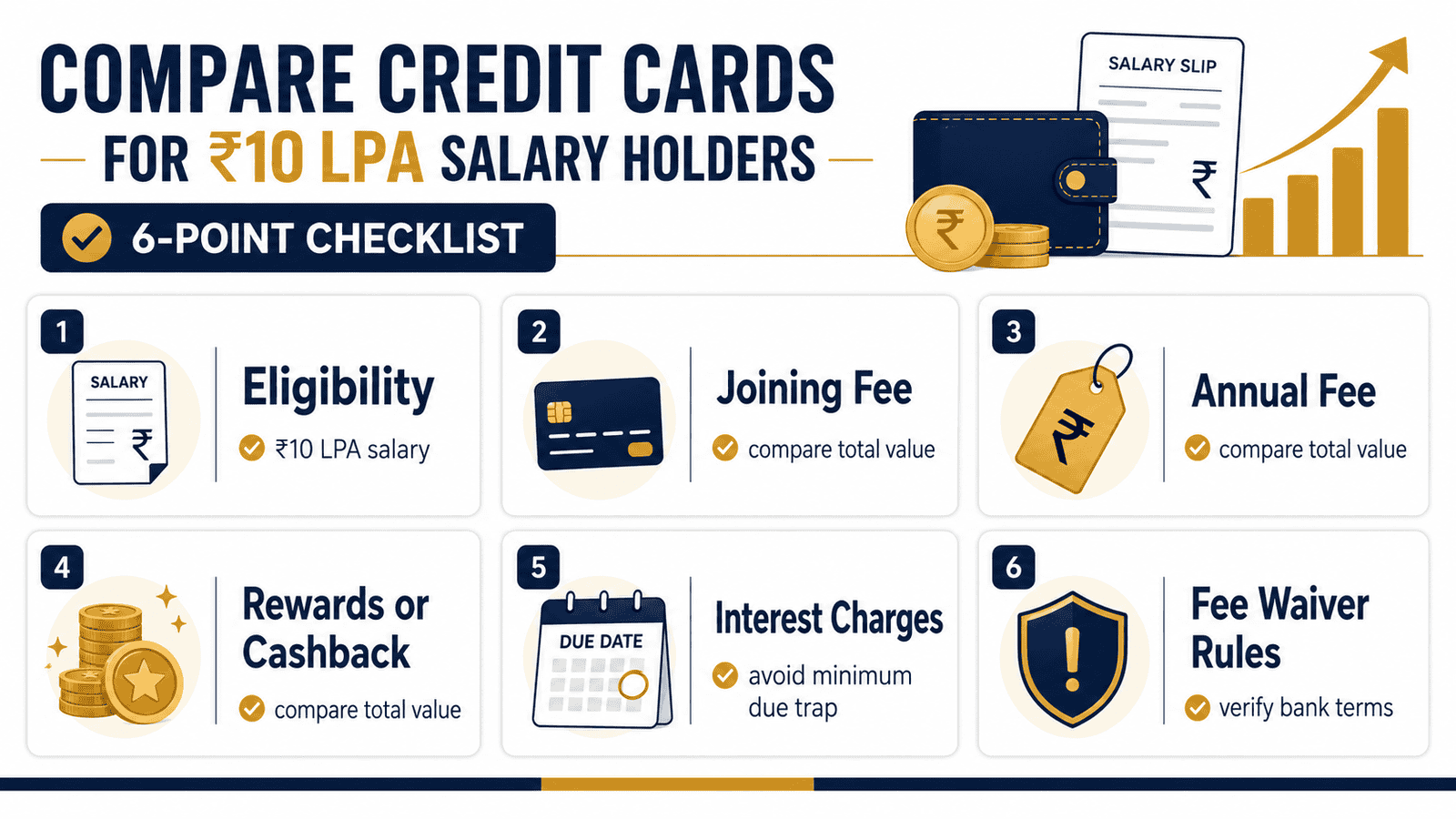
Credit cards for 10 LPA salary holders should be compared by eligibility, annual fee, joining fee, reward value, cashback limits, interest rate and waiver rules. A ₹10 lakh salary may qualify you for many entry-level and mid-tier cards, but approval still depends on bank policy, credit score, existing EMIs and repayment history. Always verify current card terms, fees, and eligibility criteria directly from the issuing bank’s official website or MITC document before applying.
Key Takeaways
- A ₹10 LPA salary may meet the income bar for entry-level and many mid-tier credit cards, but banks also evaluate credit score, employer profile, existing loan obligations, and repayment history before approving.
- Lifetime-free cards carry no annual fee risk — making them safer if your monthly card spending is under ₹10,000 or irregular, since there is no minimum spend needed to justify the cost.
- Paid cards with annual fees ranging from ₹500 to ₹5,000 or more only make financial sense if the rewards, cashback, or benefits you actually use exceed the total fee including 18% GST.
- Reward points and cashback advertised at headline rates almost always come with category exclusions, monthly caps, and redemption fees — compare the net value after these, not the headline percentage.
- Paying only the minimum amount due avoids a late payment flag but does not stop interest from accruing on the unpaid balance — as per most card MITC documents, interest can apply from the transaction date on outstanding amounts.
- Each fresh credit card application triggers a hard inquiry on your credit bureau report — multiple applications within a few months can reduce your CIBIL score and lower approval chances.
- The credit limit you receive is set by the issuer based on income, credit score, and risk assessment — no fixed credit limit is guaranteed for any income level, including ₹10 LPA.
Comparison: Credit Card Types for ₹10 LPA Salary Holders
| Card Type | Who It May Suit | Key Trade-Off |
|---|---|---|
| Lifetime-Free Card Joining fee: Nil Annual fee: Nil |
First-time users, irregular spenders, those building credit history with low risk | Rewards and benefits are typically basic; no fee pressure but limited perks |
| Cashback Card Joining fee: Nil to ₹500 Annual fee: Nil to ₹1,500 (approx.) |
Users with predictable monthly spend concentrated in 2–3 categories (groceries, fuel, utilities) | Cashback caps and category exclusions often reduce real annual value; verify MITC carefully |
| Rewards Card Joining fee: ₹500–₹2,000 (approx.) Annual fee: ₹500–₹2,000 (approx.) |
Users who spend regularly online or in partner categories and will actually redeem points | Reward point value varies widely by redemption option; points expire; redemption fees may apply |
| Travel Card Joining fee: ₹500–₹3,000 (approx.) Annual fee: ₹500–₹3,000 (approx.) |
Users who fly 4–6 times a year and stay in hotels frequently enough to use lounge access and miles | Benefits go largely unused for occasional travellers; lounge access caps apply per quarter |
| Premium Card Joining fee: ₹2,500–₹10,000+ (approx.) Annual fee: ₹2,500–₹10,000+ (approx.) |
High spenders who consistently use premium benefits — golf, concierge, milestone vouchers | Annual fee burden is significant; value recovery needs very high monthly spending; rarely justified for ₹10 LPA profile unless spend pattern matches |
For a deeper comparison of how cashback and reward structures actually work, see cashback versus rewards before shortlisting.
Key Facts at a Glance
| Factor | What to Know | Verification Source |
|---|---|---|
| Salary profile | ₹10 LPA salaried employee (approx. ₹83,333/month gross) | Issuer’s eligibility page |
| Income eligibility | Most entry-level and mid-tier cards require ₹3–₹6 LPA minimum; ₹10 LPA typically meets the bar — but issuer policy differs | Official bank website / MITC |
| Credit score requirement | A score of 700+ is generally considered acceptable; 750+ improves approval chances — thresholds vary by issuer | Credit bureau report; issuer policy |
| Credit limit | Determined by issuer based on income, credit history, and risk — no fixed limit is guaranteed at any salary level | Issuer’s offer letter at approval |
| Documents typically needed | PAN card, address proof (Aadhaar/passport/utility bill), income proof (salary slips — last 3 months — or Form 16), and recent bank statement | Issuer’s application checklist |
| Annual fee + GST | Annual fee is charged exclusive of 18% GST in most cases — a ₹1,000 annual fee becomes ₹1,180 effective | Issuer MITC / Schedule of Charges |
| Interest rate (APR) | Credit card interest rates in India are typically in the range of 36%–52% per annum — exact rate depends on issuer and card variant | Issuer MITC / RBI — rbi.org.in |
| Annual fee waiver | Many cards waive the annual fee if annual spend crosses a defined threshold — waiver conditions vary by card | Issuer MITC |
What ₹10 LPA Salary Actually Means for Credit Card Eligibility
Salary is one input — not the whole picture. When a bank evaluates your credit card application, it looks at your gross monthly income, but it also runs a credit bureau check, assesses your existing EMI obligations, reviews your employer’s profile, and applies its own internal risk criteria. A ₹10 LPA salary with no credit history, three existing EMIs, or a recent loan default can still result in a rejected application or a low credit limit.
How Banks Typically Assess Your Application
Most issuers consider four main dimensions: income and employment, credit score and bureau report, existing liabilities, and location. Salaried employees at large private or public-sector companies are generally viewed as lower risk than those at smaller employers, even at the same income. According to RBI guidelines on credit risk, lenders are required to apply their own internal credit assessment policies — which means two banks can reach different decisions on the same applicant.
If you are applying for your first credit card, the absence of a credit history can be as problematic as a poor one. In that case, a secured credit card — issued against a fixed deposit — may be a better starting point. Before comparing card features, read our first credit card guide to understand the basics of how card selection and credit building work together.
Entry-Level, Mid-Tier, and Premium Cards — What the Difference Means
Entry-level cards typically have lower income requirements (₹3–₹5 LPA), simpler fee structures, and basic rewards. Mid-tier cards target incomes in the ₹6–₹15 LPA range and may offer better cashback categories, higher reward rates, or limited lounge access. Premium cards are usually designed for high spenders and carry annual fees of ₹2,500 and above — they are rarely worthwhile unless your monthly spend is high enough and varied enough to unlock the stated benefits consistently.
At ₹10 LPA, you sit comfortably within the mid-tier range for most issuers. But mid-tier does not automatically mean the mid-tier card is better for you. It only means you are eligible. Whether the card is worth applying for still depends on your spending categories, payment discipline, and whether the fee structure makes sense for your usage pattern.
Credit Limit Is Not Fixed at Any Income Level
Some applicants assume a ₹10 LPA salary guarantees a ₹2–₹3 lakh credit limit. That is not how credit limit assessment works. Issuers determine limits based on income, credit score, existing obligations, and internal policy — and the initial limit offered at approval can be lower than expected. Your credit utilisation ratio after approval — how much of the limit you consistently use — can affect your credit profile and future limit reviews. Using less than 30% of your limit is a widely cited benchmark for maintaining a healthy credit profile.
Simplicity First for First-Time or Low-Volume Users
If this is your first or second credit card, the priority should be finding a card with a straightforward fee structure and no complicated reward rules — not hunting for the maximum reward rate. A lifetime-free card with a clear cashback or reward programme is almost always a safer starting point than a paid card with complex milestone benefits and exclusion lists. As your spending behaviour stabilises and your credit profile strengthens, you can upgrade or apply for a more feature-rich card.
Real Example: Same Salary, Different Cards
Rohan, 29, Software Engineer, Pune — ₹10 LPA: Rohan spends roughly ₹8,000/month on groceries and household utilities, ₹3,000 on fuel, and ₹4,000 online on subscription services and occasional shopping. His total monthly card spend is around ₹15,000. He chooses a cashback card that offers a higher cashback rate on groceries and utilities, with a relatively modest annual fee. His estimated gross annual cashback on his top categories would be in the range of ₹1,200–₹2,000, subject to the card’s monthly cashback cap — which he verified from the MITC. After the annual fee and 18% GST, the card still works in his favour for the year.
Meera, 31, Product Manager, Bengaluru — ₹10 LPA: Meera spends ₹12,000/month on online shopping, ₹5,000 on dining, and takes two domestic flights per quarter. She applies for a rewards card with a higher annual fee that includes complimentary lounge access and accelerated reward points on travel and dining. But she discovers that her lounge access is capped at two visits per quarter and her reward points expire within 18 months. After accounting for the annual fee, GST, and the redemption value of points she actually uses, the card barely breaks even for her. A cashback card with dining and travel categories at a lower annual fee would have delivered clearer value.
Same salary. Significantly different outcomes — because the card choice followed the spending pattern, not the other way around.
How to Calculate Annual Net Value Before Choosing a Paid Card
Annual Net Value = (Expected Annual Spend × Effective Reward or Cashback Rate) − Annual Fee − GST on Annual Fee − Redemption Charges
Step 1: Estimate your total annual card spend across the categories where the card actually offers the headline rate. Not all spend earns the top rate — utility bills, fuel, and wallet loads are excluded on many cards.
Step 2: Apply the effective reward rate only to eligible categories. If a card offers 5% cashback on groceries capped at ₹200/month, the maximum cashback on groceries is ₹2,400/year — regardless of how much you spend in that category.
Step 3: Subtract the annual fee plus 18% GST. A ₹1,500 annual fee costs ₹1,770 effective. Subtract any redemption fees or minimum redemption thresholds that reduce actual payout.
Step 4: Count only the benefits you will realistically use. Lounge access you never take, vouchers with expiry dates, and milestone rewards that require a spending level you won’t hit should not be treated as full value.
To understand how annual fee waiver conditions work and whether you can meet them, see annual fee waiver — some issuers waive the fee if annual spend crosses a defined threshold, which can eliminate the cost entirely if your spending naturally qualifies.
| Scenario | Annual Eligible Spend | Estimated Annual Net Value (Illustrative) |
|---|---|---|
| Cashback card, 5% on groceries (capped ₹200/month), ₹500 annual fee | ₹1,20,000 total; ₹40,000 groceries | ₹2,400 cashback − ₹590 (fee + GST) = approx. ₹1,810 net benefit |
| Rewards card, 3 points per ₹100 (1 point = ₹0.25), ₹1,500 annual fee | ₹1,80,000 total eligible spend | 5,400 points = ₹1,350 − ₹1,770 (fee + GST) = approx. −₹420 net (card costs more than it earns) |
| Lifetime-free cashback card, 1% on all spend, no fee | ₹1,80,000 total spend | ₹1,800 cashback − ₹0 fee = ₹1,800 net benefit |
All fee, cashback rate, and reward point figures above are illustrative assumptions only. Verify actual rates and caps from the issuer’s official MITC before applying.
How to Decide What’s Right for You
You are applying for your first card or your monthly card spend is below ₹10,000 — a lifetime-free card may suit you. No fee pressure, no minimum spend to justify cost, simpler usage.
You spend heavily in 2–3 predictable categories (groceries, fuel, or online shopping) every month — a cashback card aligned to those categories may suit you, provided the cashback cap per month still delivers value after the annual fee.
You spend across categories and regularly shop from partner merchants where reward points carry clear, usable value — a rewards card may suit you, but only if you will actually redeem the points before they expire.
You travel domestically at least 8–10 times a year and regularly use airport lounges, hotel rewards, or flight miles — a travel card may suit you. But verify whether lounge access is capped per quarter before counting that benefit at full face value.
Your annual net value calculation (annual benefit minus fee minus GST minus redemption charges) clearly shows a positive return — a paid card may suit you. The math must work before the brand name matters.
You are drawn to a premium card mainly because of advertised perks like concierge services, golf access, or high reward rates — but your actual monthly spend will not consistently unlock those benefits — consider a lifetime-free or low-fee card instead. Attractive features that go unused are just a cost.
For a closer look at the no-cost card options available in India and their real limitations, see lifetime free cards.
Common Mistakes to Avoid
Applying for Multiple Cards at the Same Time
Each credit card application results in a hard inquiry on your credit bureau report.
Two or three applications within a few weeks signal credit-hungry behaviour to issuers and can lower your CIBIL score — sometimes enough to affect the approval decision on subsequent applications. A lower score also means a lower credit limit even if you are approved.
Apply for one card, wait for the decision, and observe your spending behaviour for 3–6 months before considering a second card.
Ignoring Fees Beyond the Annual Fee
Most applicants compare annual fees but miss the full cost picture.
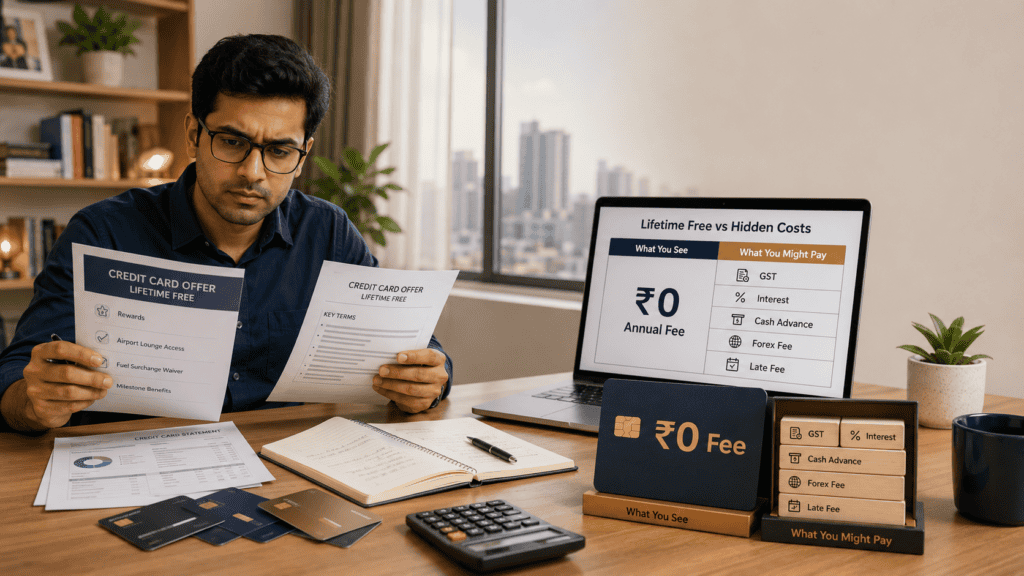
Joining fees (sometimes equal to the annual fee), 18% GST on every fee, late payment charges, over-limit fees, cash advance fees, and reward redemption fees can each add meaningfully to the annual cost of using a card. A card with a ₹500 annual fee can still cost ₹3,000–₹5,000 in a year if these charges apply.
Read the Schedule of Charges in the MITC document before applying — not after.
Paying Only the Minimum Amount Due
Paying the minimum due amount each month may prevent a late payment mark, but it does not stop interest from accruing on the unpaid balance.
Credit card interest in India is typically charged at very high annual rates — often 36%–52% per annum depending on the issuer — and in many card MITC documents, interest can apply from the transaction date on outstanding amounts once a full payment is missed. Carrying even a ₹10,000 balance for a year at these rates can cost ₹3,600–₹5,200 in interest alone.
Set up autopay for the full statement balance where possible. Understand your billing cycle basics to never miss the payment due date.
Treating Reward Value as Guaranteed Savings
A card’s advertised cashback or reward rate is a headline number — not your actual savings.
Monthly cashback caps, category exclusions (utilities, insurance, rent payments, and fuel are often excluded or earn at lower rates), minimum redemption thresholds, and point expiry can all reduce the actual annual benefit significantly. Counting full-rate rewards on all your spends before reading the exclusion list is one of the most common first-timer mistakes.
Calculate only on eligible spend, after monthly caps and exclusions.
Overusing the Credit Limit
Even if you pay your bills on time, using 80%–90% of your credit limit consistently can hurt your CIBIL score.
Credit bureaus factor in your credit utilisation ratio — the proportion of available limit you use. High utilisation signals credit dependency. A ₹1 lakh credit limit with ₹85,000 regularly used looks very different to a lender than the same limit used at ₹20,000.
Keep utilisation below 30% of your total available limit as a starting target.
Ignoring the Waiver Spend Threshold
Many cards waive the annual fee if you spend above a defined annual amount. Applicants often assume the waiver will apply without checking the threshold or tracking spending.
If you spend ₹95,000 against a ₹1,00,000 waiver threshold, the full annual fee plus GST is charged. Missing the waiver by a small amount costs you the entire fee for the year.
Check the waiver threshold in the MITC before applying and compare it honestly against your likely annual spend.
Not Reading the Fine Print on Lounge Access
Complimentary airport lounge access is one of the most-marketed benefits on mid-tier and travel cards. Most applicants do not check that lounge access is capped — typically 2–4 visits per quarter across all domestic lounges — and that the cap resets each quarter regardless of unused visits.
If you travel once a month, your lounge visits may be absorbed by the quarterly cap quickly. If you travel twice a year, the lounge access benefit may not justify the card’s annual fee on its own.
Count lounge access at the number of trips you actually take, not the theoretical annual cap.
Applying Without Knowing Your Credit Score
Applying for a card without knowing your credit score means you may apply for a card you will not qualify for — generating a hard inquiry that stays on your bureau report without any approval benefit.
Check your CIBIL or Experian credit report (free once a year from official bureau websites) before applying. A score below 650–700 may result in rejection or a secured card offer instead.
If your score is low, work on improving it before applying for a new unsecured card.
When This May Not Be the Right Choice
If your EMI obligations already consume a significant share of your take-home salary — a credit card adds another payment commitment and increases the risk of missing due dates under cash flow pressure. Adding credit card debt on top of existing EMIs can quickly become difficult to manage.
If you have previously carried unpaid credit card balances — the high interest rate environment on credit cards in India (often 36%–52% per annum) means that even a short period of carrying a balance can create a debt spiral that is hard to reverse on a ₹10 LPA salary.
If you cannot reliably track monthly due dates and statement cycles — late payment charges, loss of the interest-free grace period, and the negative impact on your credit score from missed payments make credit cards a liability rather than a tool. A debit card or UPI is a safer option until a tracking system is in place. Your credit utilisation ratio and repayment history together determine a large share of your credit score.
If you are applying primarily to access a welcome offer or sign-up bonus — and do not have a genuine ongoing use case for the card — the annual fee and usage risk typically outweigh a one-time joining benefit.
If any of these apply to your situation, it may be worth exploring alternatives before committing.
Official Rules and Where to Verify
Credit card terms — including fees, interest rates, reward structures, eligibility criteria, and waiver conditions — are set by individual issuers and can change at any time. Before applying for any card, verify the following directly from official sources:
- RBI (Reserve Bank of India) — rbi.org.in: RBI issues guidelines on credit card interest rates, billing practices, customer protection, and fair lending. Its Master Directions on Credit and Debit Cards provide regulatory context for how issuers must treat cardholders.
- NPCI (National Payments Corporation of India) — npci.org.in: Relevant for RuPay credit cards, their features, and network-specific benefits.
- Issuing bank or NBFC’s official website: The most current eligibility criteria, fees, reward programme terms, and application process are published here. Never rely on third-party comparison sites for definitive figures.
- MITC (Most Important Terms and Conditions) document: Every credit card issuer is required to provide an MITC — this is the document that contains the Schedule of Charges, interest rate, reward programme rules, exclusions, and waiver conditions in plain language. Download and read it before applying.
Rules, limits, and rates on this topic can change with each Budget or regulatory update. Always verify current figures directly from the official source before making any financial decision.
Expert Tips
- Start with one card and measure real spending behaviour for 3–6 months. Many applicants overestimate how much they will spend in the card’s bonus categories. One card used well is better than three cards used inconsistently — it also keeps your credit profile clean while you build history.
- Keep credit utilisation below 30% of your total credit limit. If your approved limit is ₹1.5 lakh, aim to keep outstanding usage below ₹45,000 at any given time. A consistently low utilisation ratio supports a healthier CIBIL score over time and improves your chances of limit upgrades or future loan approvals.
- Count only the benefits you will actually use — not the benefits list on the card page. If a card offers 8 lounge visits per year but you fly twice, count 2. If milestone vouchers require spending ₹3 lakh annually but your realistic spend is ₹1.5 lakh, count ₹0 from that benefit. Honest counting almost always changes the comparison outcome.
- Set up full statement balance autopay wherever the option exists. Interest charges at 36%–52% per annum erode any cashback or reward benefit within weeks if even one bill goes partially unpaid. Autopay for the full amount — not the minimum — is the single most important credit card habit to build early.
- Read the reward programme exclusion list before applying, not after. The most common spending categories for middle-income salaried users — utility bills, insurance premiums, rent payments, fuel, and wallet loads — are frequently excluded from earning the headline reward rate on many cards. Verify whether your top spending categories are eligible before the card becomes your go-to payment method.
- If you are in the 30% tax bracket and spend heavily on fuel, compare cards specifically on the fuel surcharge waiver. Fuel surcharges (typically 1% of the transaction amount) are charged by most issuers on fuel transactions, and some cards offer a waiver beyond a minimum monthly fuel spend. For someone refuelling ₹5,000–₹8,000/month, this is a concrete ₹600–₹960 annual saving that many reward cards do not match.
- Request a credit limit increase only after 6–12 months of on-time, full bill payments. A proactive limit review request after a clean repayment history is more likely to succeed — and having a higher limit while keeping the same spend pattern improves your utilisation ratio without increasing debt risk.
Frequently Asked Questions
Can I get a credit card with a ₹10 LPA salary?
Yes, a ₹10 LPA salary typically meets the income eligibility threshold for many entry-level and mid-tier credit cards in India. However, approval is not guaranteed on salary alone. Banks also evaluate your credit score, credit history, existing loan and EMI obligations, employer profile, and internal risk criteria. Meeting the income bar is the starting point — not the finish line.
What credit limit can I expect on a ₹10 LPA salary?
There is no fixed credit limit for any income level. Issuers determine credit limits based on income, credit score, existing obligations, and their internal policies. First-time applicants often receive lower limits regardless of salary. The offered limit is stated in the approval communication — it cannot be guaranteed in advance. After 6–12 months of responsible usage and full repayments, you can request a limit review.
Is a lifetime-free card better than a paid card?
Not universally — it depends on your spending pattern and whether the paid card’s benefits exceed its annual cost. For first-time users or those with irregular spending, a lifetime-free card is lower risk: no fee to justify, no minimum spend pressure. A paid card makes sense only when the annual net benefit — cashback, rewards, or other perks you actually use — clearly exceeds the annual fee including 18% GST. Calculate before you apply.
Should I choose cashback or reward points?
Cashback is typically simpler — it credits back a percentage of your spend in usable money, subject to monthly caps and eligible categories. Reward points vary more in value depending on the redemption option — flight miles, product catalogue, and statement credit often carry different per-point values. If you will not actively manage a rewards account or if your spending does not align with the card’s partner merchants, cashback is usually the more straightforward choice for a ₹10 LPA salary profile.
Does applying for a credit card affect my CIBIL score?
Yes. Each credit card application triggers a hard inquiry on your credit bureau report. A single inquiry has a small, temporary effect. Multiple applications within a short period can have a more noticeable impact and signal credit-seeking behaviour to future lenders. Apply only when you have researched the card and are reasonably confident of meeting the eligibility criteria.
What documents are typically needed for a salaried employee?
Most issuers require: PAN card, address proof (Aadhaar card, passport, or a recent utility bill), income proof (last 3 months’ salary slips or Form 16 for the most recent year), and a recent bank statement (typically 3 months). Some banks may ask for the latest ITR. Requirements vary by issuer — check the official application checklist before submitting.
What is the MITC and why does it matter?
MITC stands for Most Important Terms and Conditions — it is a document every credit card issuer is required to provide that outlines the Schedule of Charges, interest rates, reward rules and exclusions, billing cycle, due date, and default consequences in plain language. Reading the MITC before applying is the single most important step most applicants skip. It tells you the actual cost of using the card, not just the marketing summary.
Can I get a credit card without any credit history?
It is possible but more difficult. With no credit history, lenders have no repayment track record to assess. Some issuers offer entry-level cards to salaried employees with no history, or offer a secured credit card issued against a fixed deposit as a starting point. Starting with a secured card and using it responsibly for 6–12 months is a practical way to build a credit record before applying for an unsecured card.
What happens if I miss a credit card payment due date?
Missing the payment due date typically results in: a late payment fee as per the card’s Schedule of Charges, loss of the interest-free grace period on new purchases (in many card MITC documents), and interest charges on the outstanding balance from the transaction date. Repeated late payments are reported to credit bureaus and can lower your CIBIL score significantly over time. Setting up autopay or a calendar reminder for the due date is the most effective way to avoid this.
Is it worth applying for a credit card just for a welcome offer or joining bonus?
Generally, no. Welcome offers — bonus points, cashback, or vouchers on first use — are one-time benefits. If the card carries an annual fee, GST, and features you will not regularly use, the welcome bonus is unlikely to offset the ongoing cost. Apply for a card based on its annual utility for your regular spending pattern, not its sign-up incentive.
Final Verdict
Credit cards for 10 LPA salary holders are not a one-size comparison. Your salary may qualify you for many card options — but the right choice depends on how you actually spend, whether you will pay the full bill each month, and whether the annual cost of a paid card is genuinely recovered through benefits you use. For most beginners and moderate spenders, a lifetime-free or low-fee cashback card is a lower-risk starting point than a premium card loaded with perks that require high spending to unlock. Paid cards with annual fees make sense only when your honest annual-value calculation shows a clear surplus after fees, GST, caps, and redemption rules. Responsible repayment behaviour — paying the full statement balance, tracking due dates, and keeping utilisation low — will do more for your financial position than any reward optimisation strategy. Always verify the latest rules from official sources or consult a qualified professional before making any financial decision.
This article is for educational purposes only and should not be treated as personalised financial, tax, investment, insurance, or legal advice. Tax rules, interest rates, regulatory limits, and product features can change with each Budget or policy update. Please verify current rules from official government sources or consult a qualified and registered professional before making any financial decision.

Nikhil Bansal writes about credit cards, billing cycles, card charges, rewards, cashback, credit utilisation, card EMI, BNPL, and responsible credit usage in India. His content is designed for readers who want to use credit cards wisely without falling into expensive repayment mistakes.
He covers topics such as how to choose a first credit card, credit card billing cycle, due date, grace period, minimum amount due, credit utilisation ratio, reward points vs cashback, lifetime free credit cards, annual fee waivers, credit card statement reading, add-on cards, cash advance charges, EMI on credit cards, credit card fraud reporting, BNPL vs credit card, and foreign transaction fees.
Nikhil’s writing is beginner-friendly, direct, and risk-aware. He explains how small mistakes such as paying only the minimum due, withdrawing cash from a credit card, missing due dates, or overusing credit limits can become costly. Since card fees, interest rates, reward rules, waiver conditions, and bank offers change often, readers should verify the latest Most Important Terms and Conditions from the card issuer.