
If you have ever opened a mutual fund app or checked your SIP statement, you have seen a number labelled NAV. For most beginners, it looks like a price tag — and that creates a very common mistake: assuming a fund with NAV ₹25 is cheaper, safer, or better value than one with NAV ₹250. It is not. Mutual fund NAV meaning is something every investor in India should understand before putting a single rupee into a scheme.
This guide explains what NAV is in plain language, shows you the formula with real numbers, walks through how NAV works in a ₹10,000 SIP investment, and — most importantly — clarifies what NAV does not tell you. No fund recommendations. Just the clarity you need to read your statement with confidence.
Quick Answer: Mutual Fund NAV Meaning
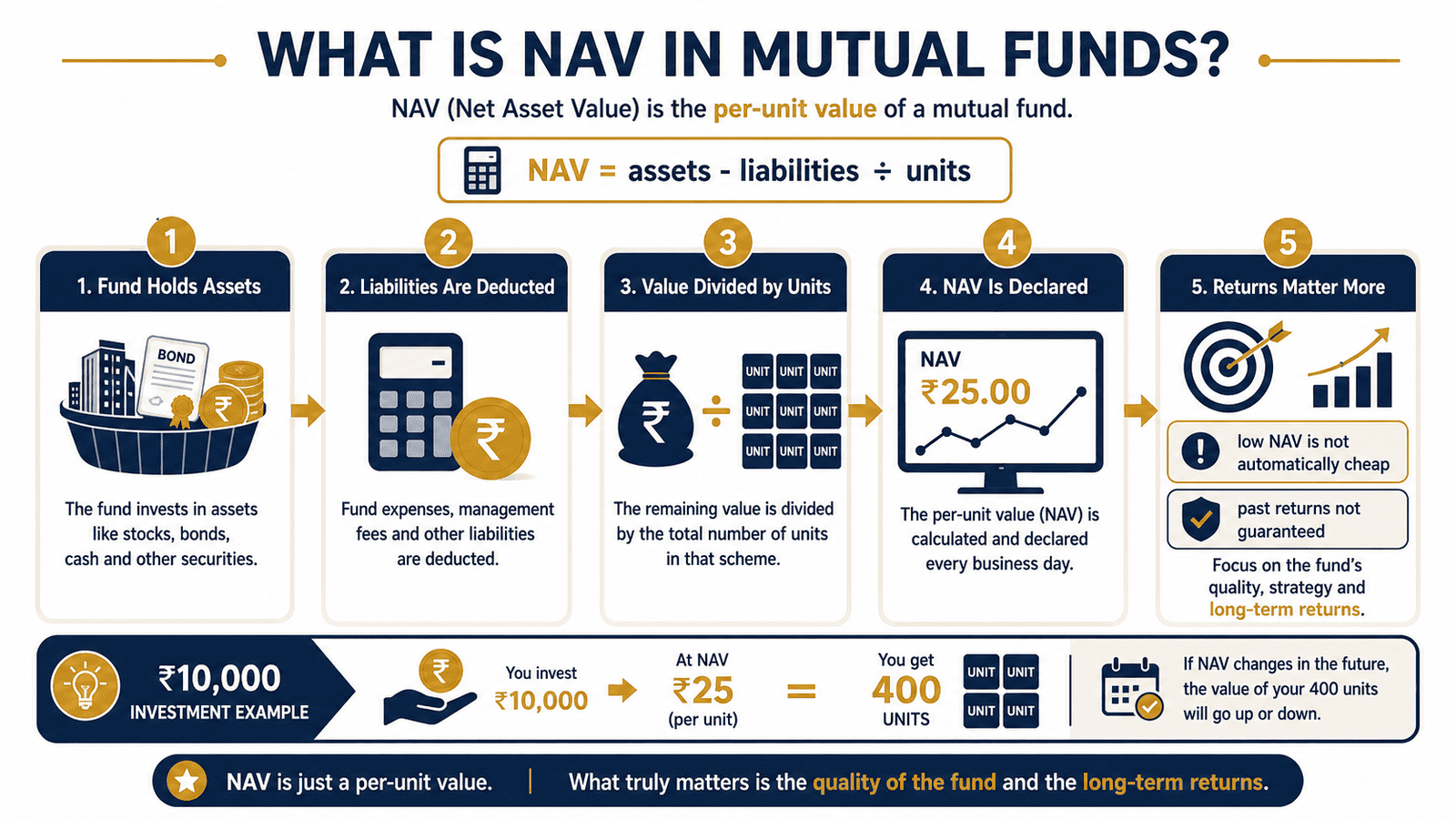
Mutual fund NAV meaning is the per-unit value of a scheme, calculated as total assets minus liabilities divided by outstanding units. It tells you the price used to buy or redeem units, not whether a fund is cheap or expensive. For example, ₹10,000 at NAV ₹25 buys 400 units.
Key Takeaways
- NAV full form is Net Asset Value — the per-unit value of a mutual fund scheme after adjusting for assets and liabilities.
- The NAV formula is: (Total Assets − Total Liabilities) ÷ Total Outstanding Units. At ₹1,000 crore assets, ₹10 crore liabilities, and 39.6 crore units, NAV = ₹25.
- A fund at NAV ₹25 and a fund at NAV ₹100 can produce identical returns if their portfolios perform the same — the number alone tells you nothing about quality.
- For a ₹10,000 SIP instalment, NAV on the date of unit allotment determines how many units you receive — lower NAV means more units, higher NAV means fewer, but your wealth outcome depends on NAV growth over time.
- Applicable NAV — the specific NAV used for your transaction — depends on when your payment is realised, not just when you click “invest.”
- Returns, risk, expense ratio, fund category, and portfolio quality matter far more than the NAV level when evaluating a mutual fund.
- An NFO starting at NAV ₹10 is not automatically a better deal than a seasoned fund at NAV ₹500 — this is one of the most persistent myths in Indian mutual fund investing.
Key Facts at a Glance
| Parameter | Detail | Where to Verify |
|---|---|---|
| Full Form | Net Asset Value | SEBI — sebi.gov.in |
| Formula | (Total Assets − Total Liabilities) ÷ Outstanding Units | Scheme Information Document (SID) |
| Declared | Every business day after market close for open-ended funds | AMC / fund house website |
| Where Seen | Fund factsheet, AMC page, investment app, account statement | AMFI — amfiindia.com |
| Used For | Unit allotment (purchase) and redemption value calculation | Fund house / platform |
| Does Not Show | Future returns, fund quality, cheapness, or safety by itself | — |
| Applicable NAV Rule | Based on payment realisation time and SEBI cut-off guidelines | SEBI — sebi.gov.in |
What Is Mutual Fund NAV Meaning — Explained Simply
A mutual fund pools money from thousands of investors and uses it to buy a basket of securities — stocks, bonds, government securities, cash, or a mix depending on the scheme. Every investor owns a share of this pool in the form of units. NAV is the value of one such unit on any given business day.
Think of it this way. Imagine a fund that holds ₹1,000 crore worth of securities and has liabilities of ₹10 crore — think unpaid fees, accrued expenses, and similar obligations. After subtracting liabilities, the net assets are ₹990 crore. If this scheme has 39.6 crore units outstanding, each unit is worth ₹25. That ₹25 is the NAV.
To get a solid foundation on how mutual funds work before diving deeper into NAV mechanics, read our beginner mutual fund guide.
Why NAV Is Not Like a Share Price
This is where many first-time investors get confused. A stock price moves every second based on buyers and sellers in the market. NAV is different — it is calculated once per business day, typically after the stock markets close, by the fund house (also called the Asset Management Company, or AMC). The NAV you see in the morning is yesterday’s declared value. Today’s NAV will be published after today’s market close.
According to SEBI guidelines, open-ended mutual funds are required to declare NAV on every business day. This makes NAV a transparent, daily-updated measure of scheme value — but it is not a live ticker. You cannot watch it move minute to minute the way you would watch a Nifty stock.
What Goes Into the NAV Calculation
The total assets of a scheme include the market value of all securities held, dividends receivable, interest accrued, and any other income. Liabilities include management fees, administrative expenses, audit fees, and other payables. The expense ratio — the annual cost of running the fund — is reflected in the NAV on an accrual basis, meaning it is deducted gradually across the year rather than in one lump sum.
This is important: two schemes can hold identical portfolios but have different NAVs simply because one has been running longer and has compounded more. It does not make either “cheaper” or “more expensive” — which leads us directly to the most important NAV myth to bust.
NAV Is a Measurement Tool, Not a Buy Signal
NAV tells you the current per-unit value of a scheme. It does not tell you whether the fund’s portfolio is good, whether the fund manager has a strong track record, or whether the scheme suits your financial goal. A scheme with NAV ₹500 that has consistently delivered strong risk-adjusted returns over 10 years may be a far better fit for a long-term equity goal than a newer scheme at NAV ₹12 with no performance track record.
As SEBI’s investor education materials make clear, evaluating a mutual fund requires looking at category, portfolio, risk metrics, expense ratio, and the fund manager’s investment process — not the NAV level alone.
Real Example: Rohan’s ₹10,000 SIP Investment
Rohan, 29, is a software engineer in Bengaluru earning ₹90,000 per month. He starts a ₹10,000 monthly SIP and notices two funds on his app. Fund A has NAV ₹25. Fund B has NAV ₹100. He wonders whether Fund A is the smarter pick because it “costs less.”
Here is what actually happens. Rohan invests ₹10,000 in Fund A at NAV ₹25 — he receives 400 units. His colleague invests ₹10,000 in Fund B at NAV ₹100 — he receives 100 units. Six months later, both funds rise 10%. Fund A NAV is now ₹27.50, Fund B NAV is now ₹110. Rohan’s holding: 400 × ₹27.50 = ₹11,000. His colleague’s holding: 100 × ₹110 = ₹11,000. Identical outcomes.
The number of units is different. The NAV is different. The rupee return is the same — because both portfolios grew by 10%. This is the core insight: fewer units at a higher NAV does not mean lower wealth creation. What matters is how much the NAV grows over time, which reflects the performance of the underlying portfolio.
If you are setting up a monthly SIP and want to understand how unit allotment works each month, read our guide on how SIP works before your next instalment date.
How to Calculate NAV in a Mutual Fund
NAV = (Total Assets − Total Liabilities) ÷ Total Outstanding Units
Step-by-step example using illustrative figures:
- Total assets of the scheme (market value of securities + receivables): ₹1,000 crore
- Total liabilities (accrued expenses, management fees payable): ₹10 crore
- Net assets: ₹1,000 crore − ₹10 crore = ₹990 crore
- Total outstanding units: 39.6 crore
- NAV = ₹990 crore ÷ 39.6 crore = ₹25 per unit
Unit allotment formula:
Units Allotted = Investment Amount ÷ Applicable NAV
Example: ₹10,000 ÷ ₹25 = 400 units allotted.
One note on applicable NAV: the NAV used for your transaction is not always the NAV of the day you click “invest.” It depends on when your payment is actually realised by the fund. For equity funds, if your funds are credited before the SEBI-specified cut-off time on a business day, you generally get that day’s NAV. If credited after the cut-off, the next business day’s NAV applies. These rules are set by SEBI and should be verified at sebi.gov.in or with your fund house before making time-sensitive transactions.
| Scenario | Key Inputs | Result |
|---|---|---|
| Base calculation (illustrative) | Assets ₹1,000 Cr, Liabilities ₹10 Cr, Units 39.6 Cr | NAV = ₹25 |
| SIP unit allotment | ₹10,000 investment, NAV ₹25 | 400 units allotted |
| Higher NAV scenario | ₹10,000 investment, NAV ₹100 | 100 units allotted |
Note: All figures above are illustrative examples only and do not represent any real mutual fund scheme.
NAV vs Related Concepts: What Beginners Confuse
| Concept | What It Measures | What It Does Not Tell You |
|---|---|---|
| NAV | Per-unit value of the scheme on a given day | Whether the fund is cheap, expensive, or good |
| Returns (CAGR / XIRR) | Percentage growth of NAV over a period | Future performance or scheme quality in isolation |
| Low NAV vs High NAV | Earlier vs later stage of the fund’s life (roughly) | Value for money — both can deliver same returns |
| NAV vs Stock Price | End-of-day scheme valuation | Live market demand; NAV is not traded like a share |
| NAV vs AUM | Per-unit value vs total money managed by the scheme | Either metric alone reflects full fund health |
| NAV vs Expense Ratio | Per-unit value (after expenses) vs ongoing cost ratio | NAV does not reveal the cost drag; check expense ratio separately |
To understand the percentage gains and losses you are actually earning on your mutual fund, read our explainer on understanding fund returns — CAGR, absolute, and XIRR methods explained.
How to Decide What’s Right for You
NAV is a useful piece of information — but knowing how to use it correctly is what separates an informed investor from one chasing myths. Here are the actual decision rules:
You want to know how many units you will receive for your investment — THEN divide your investment amount by the applicable NAV. That is the only question NAV directly answers.
You want to check your current investment value — THEN multiply your total units by the current NAV. This gives you the present value before exit load and tax adjustments.
You are comparing two funds in the same category — THEN look at rolling returns over 3 and 5 years, expense ratio, portfolio quality, and risk metrics. Do not use NAV level as a comparison point.
You are running a monthly SIP — THEN focus on goal discipline and scheme suitability. Use our estimate SIP growth tool to see how consistent investing compounds over time.
The fund category, risk profile, and time horizon align with your financial goal — THEN NAV level is largely irrelevant to your entry decision. Start and stay consistent.
Do not use NAV level as your primary reason to choose between two funds. If you are picking a scheme because its NAV is ₹12 instead of ₹120, you are using the wrong data point entirely.
Do not delay starting your SIP while waiting for NAV to fall. For long-term equity SIPs, the compounding benefit of starting earlier almost always outweighs short-term NAV timing.
Common Mistakes to Avoid
Thinking Low NAV Means a Fund Is Cheap
A fund at NAV ₹12 is not “cheaper” than one at NAV ₹500 in any meaningful sense.
The NAV reflects how long the scheme has been running and how its portfolio has performed, not a price you are paying relative to some fair value. Buying a fund because its NAV is low is like choosing a company because its share price is low — without checking what you are actually getting.
Focus on portfolio quality, returns history, and expense ratio instead of the NAV number.
Thinking High NAV Means a Fund Is Too Expensive
A scheme with NAV ₹800 is not overpriced — it has likely been compounding your money for many years.
This perception causes investors to skip well-established funds with proven track records in favour of newer, cheaper-looking NFOs. The ₹10,000 you invest at NAV ₹800 still buys exactly ₹10,000 worth of the portfolio. What matters is what happens to that portfolio from here.
Never reject a fund because its NAV looks “too high” for your budget.
Comparing NAV Across Unrelated Categories
Comparing the NAV of a large-cap equity fund with a liquid fund or a debt fund is meaningless.
Different fund categories hold entirely different assets with different risk profiles and return histories. A liquid fund might have NAV ₹3,200 while a new equity fund sits at ₹15 — this comparison tells you nothing useful about which is better.
Always compare funds within the same SEBI-defined category.
Timing Your SIP Around NAV Movements
Some investors try to pause or time their SIP instalments because “NAV has risen too much.”
The entire purpose of a SIP is rupee-cost averaging — you buy more units when NAV is low and fewer when it is high, automatically. Manually timing NAV defeats this benefit and adds decision fatigue. Consistency over many years is what creates the compounding effect, not clever entry points.
Ignoring Expense Ratio Because NAV Looks Attractive
A fund with NAV ₹20 but an expense ratio of 2.2% will erode your returns far more than a direct plan at NAV ₹22 with an expense ratio of 0.8% — over a 10-year SIP horizon.
Read how direct and regular plans differ in cost and long-term impact before choosing your investment route.
Assuming NFO NAV of ₹10 Is Always Better
New Fund Offers start at ₹10 by convention — it is not a discounted entry price.
An NFO at ₹10 offers no proven track record, no performance data, and no NAV history to evaluate. An experienced fund in the same category with 10 years of data at NAV ₹450 gives you far more to work with. Do not treat ₹10 as a bargain.
When This May Not Be the Right Choice
NAV-based thinking should not be the lens through which you evaluate any of the following situations:
You are switching funds purely because another scheme has a lower NAV. A switch is a redemption and a fresh purchase — it may trigger capital gains tax, exit loads, and a reset of your investment timeline. Lower NAV at the destination is not a financial justification on its own.
You are choosing between an NFO and an established fund. The ₹10 NFO NAV does not give you an advantage over a scheme that has already compounded for years. The underlying portfolio and fund manager capability matter infinitely more.
You are using NAV movement to predict short-term market direction. NAV reflects the previous day’s market close. It is not a leading indicator and cannot tell you whether tomorrow’s NAV will be higher or lower.
You are comparing two funds in different categories. A debt fund and a mid-cap equity fund will have very different NAVs for structural reasons. Using NAV to compare them is not a valid evaluation method.
If any of these apply to your situation, it may be worth exploring alternatives before committing.
Official Rules and Where to Verify
Mutual funds in India are regulated by the Securities and Exchange Board of India (SEBI). The rules governing NAV calculation, declaration timelines, applicable NAV cut-off timing, and scheme-level disclosures are set by SEBI and implemented by the Association of Mutual Funds in India (AMFI).
- SEBI — sebi.gov.in (regulator; master circulars on NAV, cut-off timing, and scheme documentation)
- AMFI — amfiindia.com (daily NAV publication for all registered mutual fund schemes)
- Your fund’s AMC website — Scheme Information Document (SID) and Key Information Memorandum (KIM) contain the fund-specific NAV rules
- Your investment platform — Check the displayed applicable NAV and transaction confirmation carefully after every purchase or redemption
Rules, limits, and rates on this topic can change with each Budget or regulatory update. Always verify current figures directly from the official source before making any financial decision.
Expert Tips
- Track NAV growth percentage, not NAV level. A scheme that moved from ₹25 to ₹75 over five years has tripled your investment regardless of where it started. Always look at NAV growth rate, not the absolute number.
- Use NAV × units to reconcile your statement. Your investment’s current value is simply your total units multiplied by the latest NAV — check this against your statement value. Differences may reflect exit loads, pending transactions, or processing lags.
- Compare within category only. Ridhi’s rule of thumb: if two funds are not in the same SEBI-defined category, their NAVs are not comparable. A multi-cap fund and a gilt fund are different animals entirely.
- Check applicable NAV rules for large transactions. For purchases above ₹2 lakh (check current SEBI threshold before acting), realisation-based NAV rules may apply — meaning your units are allotted at the NAV of the day your funds actually reach the scheme, not the day you placed the order. Verify the current threshold at sebi.gov.in before any large-value transaction.
- For your SIP, focus on units accumulated, not today’s NAV. During a market fall, your SIP buys more units at lower NAV. That is not a loss — it is rupee-cost averaging working exactly as designed. Check how the expense ratio impact on your scheme compounds over years — it is a far more important number to monitor than today’s NAV.
- Read the fund factsheet monthly. NAV is one line on the factsheet. The portfolio composition, top holdings, sector allocation, and rolling return data on the same document give you a far richer picture of whether your fund is doing what it promised.
- Never invest in an NFO just because NAV is ₹10. An established scheme at NAV ₹300 in the same category has a performance track record you can analyse. An NFO has none. The ₹10 is convention, not a discount.
Frequently Asked Questions
What is the NAV full form in finance?
NAV stands for Net Asset Value. In the context of mutual funds, it refers to the per-unit value of a scheme calculated by subtracting total liabilities from total assets and dividing the result by the total number of outstanding units.
Is low NAV better than high NAV in a mutual fund?
No. A low NAV does not make a fund cheaper or better. Both low-NAV and high-NAV funds deliver identical returns if their portfolios perform the same. A scheme with NAV ₹25 that grows 12% and a scheme with NAV ₹250 that grows 12% will both turn ₹10,000 into ₹11,200. The starting NAV is irrelevant to your returns.
How is NAV calculated in a mutual fund?
NAV = (Total Assets − Total Liabilities) ÷ Total Outstanding Units. Total assets include the market value of securities, accrued income, and receivables. Total liabilities include management fees, expenses payable, and other dues. This is calculated by the AMC after market close on every business day.
How does NAV affect SIP?
When your SIP instalment is processed, your units are allotted at the applicable NAV of that business day. A lower NAV on that day means you get more units; a higher NAV means fewer units. Over many months, you accumulate units at varying NAVs — this is rupee-cost averaging. Your total return depends on NAV growth over your entire investment period, not on any single day’s NAV.
Is NAV the same as mutual fund return?
No. NAV is the current per-unit value. Returns are the percentage by which NAV has grown over a period. A fund with NAV ₹50 today that was ₹25 three years ago has delivered 100% absolute returns — but the NAV number alone tells you nothing about the return without the starting value and time period.
Which NAV applies when I buy or redeem mutual fund units?
The applicable NAV depends on the time your payment is realised, not just when you click “invest.” For most equity fund purchases, if your funds reach the scheme before the SEBI-specified cut-off time on a business day, you receive that day’s NAV. Payments received after the cut-off get the next business day’s NAV. These rules can vary for debt funds and large-value transactions — check the current cut-off rules at sebi.gov.in or your fund house before transacting.
Does NAV change daily?
Yes, for open-ended mutual funds. NAV is calculated and declared every business day after market close, based on the closing market value of the scheme’s portfolio. It does not change on market holidays or weekends. Closed-ended funds also declare NAV periodically but are traded on exchanges at market price, which may differ from NAV.
Should I invest in a New Fund Offer (NFO) only because the NAV is ₹10?
No. An NFO starts at ₹10 by convention — it is not a discounted or bargain price. You are simply getting units at a base value with no performance track record attached. An established fund in the same category with 5–10 years of returns data, consistent fund management, and a proven risk profile is usually a more informed choice for most investors. The ₹10 NAV should never be the primary reason to invest in an NFO.
Can I use NAV to compare two different mutual funds?
Not directly. Comparing NAV levels across funds — especially across different categories — is not meaningful. A liquid fund with NAV ₹3,000 and an equity fund with NAV ₹40 are structurally different products. Even within the same category, comparing NAV levels is less useful than comparing returns, expense ratio, risk-adjusted performance, and portfolio composition.
What is applicable NAV in a mutual fund?
Applicable NAV is the specific NAV at which your transaction — purchase or redemption — is processed. It is determined by the time your fund reaches the scheme (for purchases) or when your redemption request is received (for redemptions), in relation to the SEBI-specified cut-off time for that fund type. The applicable NAV may be today’s or the next business day’s, depending on timing. Always confirm with your fund house or platform for time-sensitive transactions.
Final Verdict
Mutual fund NAV meaning is straightforward once you strip away the myths: it is the per-unit value of a scheme, updated daily, used to calculate how many units you buy and what your holding is worth at any point. That is its job — and it does that job well.
What NAV does not do is tell you whether a fund is cheap, expensive, safe, or worth investing in. A scheme at NAV ₹10 and one at NAV ₹1,000 can both be excellent or both be poor choices — the NAV level alone tells you nothing. The meaningful signals are portfolio quality, rolling returns, expense ratio, fund category, and alignment with your financial goal and time horizon.
For Rohan — and for every beginner investor — the right approach is to understand NAV as a measurement tool, not a decision signal. Use it to track your holding value and verify unit allotments. Use returns, risk, and cost data to evaluate the fund itself. Always verify the latest rules from official sources or consult a qualified professional before making any financial decision.
This article is for educational purposes only and should not be treated as personalised financial, tax, investment, insurance, or legal advice. Tax rules, interest rates, regulatory limits, and product features can change with each Budget or policy update. Please verify current rules from official government sources or consult a qualified and registered professional before making any financial decision.

Arjun Kapoor writes about mutual funds, SIPs, ELSS, fund categories, investment returns, and beginner investing concepts for Indian readers. His focus is on education, not product promotion or fund recommendations. He helps readers understand how mutual funds work before they start investing or comparing schemes.
He covers topics such as mutual fund meaning, SIP meaning, SIP calculator, direct mutual funds vs regular plans, NAV, ELSS tax-saving funds, CAGR, absolute returns, XIRR, expense ratio, large cap vs mid cap vs small cap funds, flexi cap funds, index funds vs active funds, liquid funds, debt mutual funds, SIP pause vs SIP stop, lumpsum vs SIP, and how to start SIP in India.
Arjun’s writing is simple, risk-aware, and long-term oriented. He avoids guaranteed-return language and explains investment concepts using examples, timelines, and comparison tables. His articles remind readers that mutual fund investments are subject to market risks, and past performance does not guarantee future returns. Readers should verify scheme details from SEBI, AMFI, fund houses, and official scheme documents.