

When Ankit paid the token money for his resale flat in Pune, the seller mentioned “some pending dues.” Three weeks later, Ankit discovered the previous owner owed ₹47,000 in outstanding maintenance and a special repair levy that the society had approved six months earlier — and the society would not transfer membership until every rupee was cleared. Nobody had told him about the society’s power to block a flat transfer, or that buyers are expected to check dues before signing. This is the kind of thing that catches new flat owners off-guard every single day.
A co-operative housing society controls far more than the whitewash on the staircase. It issues your share certificate, approves your resale transfer, decides how much you pay every month, and holds the power to escalate disputes to a government registrar. Understanding how it works — before you buy, before you rent out, before you pay a disputed charge — can save you a significant amount of money and frustration.
This guide explains co-operative housing society rules, charges, member rights and dispute steps in plain language. Rules and charges vary by state, registered bye-laws and society resolutions, so treat everything here as a starting framework and always verify current figures from official sources.
Quick Answer: Co-operative Housing Society
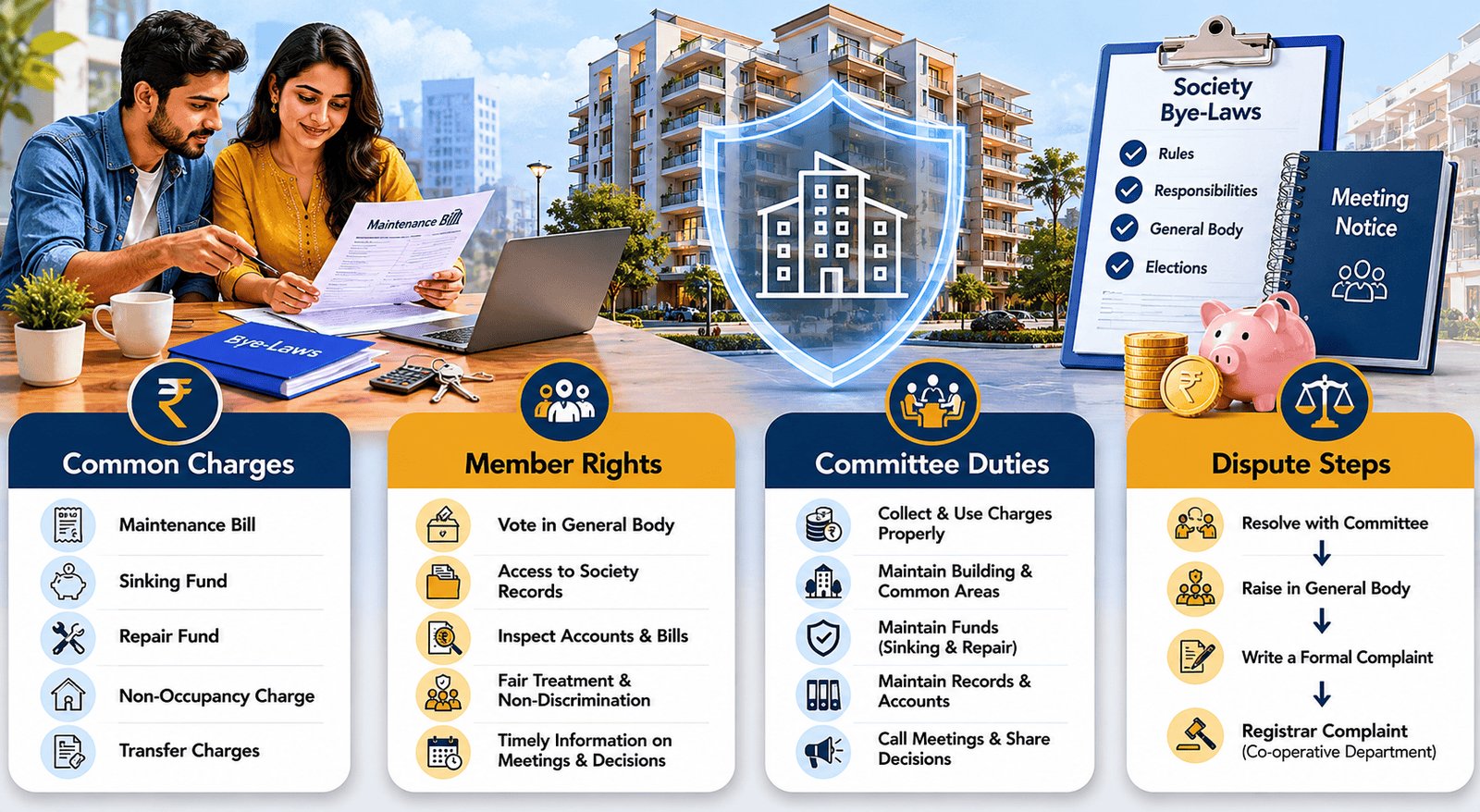
A co-operative housing society is a registered body of flat owners that manages common areas, maintenance bills, repairs, records and member issues. Members usually pay monthly maintenance, sinking fund, repair fund and approved special charges, while rights and limits depend on state bye-laws and society resolutions.
Key Takeaways
- A society can collect only charges that are backed by registered bye-laws, a general body resolution, an approved budget, or applicable state law — no other basis is valid.
- Every member is entitled to an itemised bill, an official receipt, audited accounts and copies of general body meeting resolutions on request.
- Transfer charges and non-occupancy charges are subject to state-specific caps — verify the current limit under your state’s co-operative act or model bye-laws before paying.
- Disputes should always be raised in writing with dates; verbal or WhatsApp complaints often carry no formal weight in a registrar proceeding.
- Before closing on a resale flat, check outstanding dues, the share certificate, NOC status and transfer-approval process — an unpaid dues block is common and entirely legal.
- Sinking fund contributions are for major structural repairs and cannot be used for routine maintenance; confusing the two is a frequent source of committee disputes.
- Society rules in Maharashtra, Karnataka, Telangana, Delhi and other states differ significantly — what applies in Mumbai may not apply in Bengaluru.
Key Facts at a Glance
| Aspect | What It Means | Where to Verify |
|---|---|---|
| Registration body | Registrar of Co-operative Societies under state co-operative act | State co-operative department website |
| Governing document | Registered bye-laws (society-specific) and state model bye-laws | Society office / registrar office |
| Monthly maintenance | Covers common electricity, security, housekeeping, lift, water and administration | Society budget and AGM resolution |
| Sinking fund | Long-term fund for major structural repairs — collected monthly, held separately | Audited accounts; state model bye-laws |
| Repair fund | Fund for general annual repairs — separate from sinking fund | Audited accounts; society budget |
| Non-occupancy charge | Extra charge when a member rents out the flat — percentage of maintenance; state cap applies | State co-operative act / model bye-laws |
| Transfer premium | One-time charge on resale of flat — state-specific cap | State co-operative act / model bye-laws |
| Share certificate | Document proving society membership — required for resale and loan NOC | Society records |
| Dispute route | Written complaint → managing committee → registrar / co-operative court | State co-operative department |
| GST applicability | GST may apply on maintenance above a monthly threshold — verify current threshold | cbic.gov.in / gst.gov.in |
How a Co-operative Housing Society Works in India
A co-operative housing society is registered under the relevant state co-operative societies act — Maharashtra Co-operative Societies Act, 1960, for example, or the Karnataka Co-operative Societies Act, 1959. The moment a defined number of flat owners apply, pay an admission fee and submit the required documents to the Registrar of Co-operative Societies, the society gets a registration number and a legal identity. It can then open a bank account, collect charges, hold property records and file cases.
Members, Managing Committee and General Body
Every flat owner in the building is typically a member of the society. Members collectively form the general body, which is the highest decision-making authority. The general body elects a managing committee — usually 5 to 9 members — that handles day-to-day operations: collecting dues, appointing staff, approving repair contracts, filing returns and maintaining records. The managing committee must hold a general body meeting at least once a year (the Annual General Meeting or AGM) where accounts are presented, budgets are approved and major decisions are put to vote.
Society Bye-Laws and Why They Matter
Every registered society has a set of bye-laws — specific rules that govern everything from the admission process to how disputes are handled. Bye-laws are registered with the Registrar of Co-operative Societies and can only be amended through a special resolution at the general body. State governments also publish model bye-laws that societies can adopt. If a committee charges you for something not in the bye-laws or an approved resolution, that charge has a weak legal basis.
Before buying a flat, ask the seller for a copy of the registered bye-laws. Before challenging a charge, read the relevant clause. This simple step resolves most disputes before they escalate.
Share Certificate, Membership and Records
When you become a member of a co-operative housing society, you are issued a share certificate — a document that shows how many shares of the society you hold (typically nominal in value, like 5 shares of ₹50 each). The share certificate is not the same as the title deed of your flat, but it is the proof of your society membership. Banks require it when you apply for a home loan or need an NOC for resale. When a flat is sold, the seller’s shares are transferred to the buyer after the society formally approves the transfer.
For proper documentation when purchasing a resale flat, the buying property checklist can help you track every document the society and registrar’s office will need.
Society vs Apartment Association vs Builder Maintenance
Not all residential complexes are co-operative housing societies. Newer large-format projects often run as apartment owners’ associations (AOA) or resident welfare associations (RWA), which are registered under the state’s apartment ownership act or societies registration act rather than the co-operative societies act. Some buildings still under developer control have builder-managed maintenance without a formal registered body. The legal rights, dispute routes and charge limits are different in each case.
Real Example: Ankit’s Monthly Bill in Pune
Ankit, 36, a senior software engineer in Pune earning ₹28 lakh per year, recently bought a 2BHK resale flat. His first monthly maintenance bill from the society showed several line items he had not expected. Here is how each component worked.
The bill showed ₹2,200 for common area maintenance (security, housekeeping, electricity in lobby and stairwell), ₹400 for water charges, ₹300 for lift maintenance, ₹500 for sinking fund, ₹200 for repair fund, ₹250 for parking and a ₹180 administration charge. The total before any GST applicability came to ₹4,030. Ankit’s society charged him GST on the total because his monthly maintenance exceeded the applicable threshold — but he was advised to verify the current GST threshold from cbic.gov.in before concluding anything.
When Ankit noticed a ₹12,000 special levy on his bill, he asked the committee for the general body resolution approving it. A well-run society will provide this document on request. Ankit compared the resolution, the approved budget and his own bill before paying — a simple step that also confirmed the levy was genuinely approved. When understanding what documents are required for a resale transfer, it also helps to know the sale deed difference between a society transfer record and the legal title documents.
How to Review a Society Maintenance Bill
Annual housing cost from society = (Monthly maintenance × 12) + Special levies approved in the year
Using Ankit’s example: ₹4,030 × 12 = ₹48,360 per year in recurring maintenance, before any special levy. A single ₹12,000 special repair levy pushes annual housing cost to ₹60,360 — a 25% increase over the budgeted figure. This is why buyers should ask for the last two years of audited accounts to check how frequently special levies were raised.
When reviewing a bill, work through this checklist:
| Check | What to Ask For | Why It Matters |
|---|---|---|
| Is each line item named? | Itemised bill from society | Vague “miscellaneous” charges are a red flag |
| Is the amount based on an approved budget? | AGM resolution / approved budget | Unbudgeted charges are contestable |
| Is GST shown separately? | Bill with GST breakup | Verify applicability at cbic.gov.in / gst.gov.in |
| Is there a receipt for payment? | Official receipt with date and signature | Cash without receipt is a serious risk |
| Are special levies separately approved? | Specific general body resolution | Not all committees call a meeting before levying |
Comparison: Co-operative Society vs Apartment Association vs Builder Maintenance
| Parameter | Co-operative Housing Society | Apartment Association / RWA |
|---|---|---|
| Registration act | State co-operative societies act | State apartment ownership / societies registration act |
| Who collects charges | Managing committee elected by members | Committee elected by flat owners |
| Member voting rights | One vote per member at general body; share-based in some states | Usually one vote per flat |
| Dispute route | Registrar of Co-operative Societies / Co-operative court | Civil court / consumer forum / RERA (for project issues) |
| Share certificate issued | Yes | No |
| Transfer charge cap | State-regulated cap under co-operative act | No statutory cap; governed by association rules |
| Audit requirement | Mandatory annual audit by co-operative auditor | Varies; internal audit or CA audit common |
| Record transparency | Member right to inspect registers and accounts | Varies by association rules |
How to Decide What’s Right for You
You are buying a resale flat — THEN ask for the last two years of audited accounts, all outstanding dues, the share certificate status and the society’s transfer process before paying any token money.
You plan to rent out your flat after purchase — THEN verify the non-occupancy charge applicable in your state, the society’s tenant registration requirement and any restrictions on the type of tenants allowed under the bye-laws. Also review renting versus buying to see whether rental yield after society charges makes the numbers work for you.
You receive a charge you have never seen before on your bill — THEN do not pay in cash without a receipt; write to the managing committee requesting the specific general body resolution or budget line that authorises it.
You want to renovate your flat — THEN check whether the society bye-laws require prior written permission for structural or external changes, and whether a deposit is required before work begins.
You want to join the managing committee — THEN understand that committee members have fiduciary duties: they must maintain records, get accounts audited and follow the proper resolution process; failure to do so can lead to a registrar inspection.
You are not ready to attend general body meetings or engage with society governance — the consequences include unapproved charges going unchallenged, adverse resolutions passed in your absence, and a weaker position in any future dispute.
Common Mistakes to Avoid
Paying disputed charges in cash without a receipt
Some committees informally collect cash “advance maintenance” or charge for services without issuing receipts.
Without a receipt, you have no proof of payment. If the committee later claims dues, you cannot counter it. Courts and registrar offices treat receipts as primary evidence. A ₹5,000 cash payment without a receipt can become a ₹5,000 disputed dues notice later.
Always insist on an official receipt with the society seal, date and signature before paying any amount.
Ignoring outstanding dues before buying a resale flat
Transfer of membership in a co-operative housing society requires a no-dues certificate from the outgoing member.
If unpaid dues exist — maintenance arrears, water charges, sinking fund, repair fund or a special levy — the society can hold up the transfer process entirely. Buyers who discover this after paying the stamp duty and registration fee face real delays. Verify dues before signing anything.
Ask the seller for a written dues certificate from the managing committee before the sale agreement is executed.
Treating WhatsApp messages as official notices
Many committees now communicate via WhatsApp groups, which is convenient but not always legally valid.
For official matters — notices of general body meetings, resolution communications, dispute responses — the registered bye-laws typically require written notice sent to the registered address. A WhatsApp message from a committee member is not an official notice.
If the society raises a serious charge or issue, request a formal written communication and keep your own written replies with dates.
Not attending the Annual General Meeting
The AGM is where maintenance budgets, special levies and major decisions are formally approved.
Members who do not attend cannot vote against charges they later find unreasonable. Resolutions passed at a properly constituted AGM with quorum are binding on all members, including absentees. Attending — or sending a proxy where rules permit — is the most effective way to shape the society’s financial decisions.
Mark your AGM date and attend, or review the minutes afterwards and raise objections in writing if needed.
Assuming the society has no right over your flat’s use
Registered bye-laws can restrict commercial use, restrict types of tenants, require prior permission for renovation and regulate parking.
Violating these without realising it can lead to formal notices, penalty charges and — in extreme cases — suspension of certain member privileges until compliance. Read the bye-laws when you first join the society, not after receiving a notice.
Not reading the bye-laws before objecting to a charge
Members sometimes object to charges that are, in fact, properly authorised in the registered bye-laws or an AGM resolution.
An objection without basis puts the member on the back foot and wastes goodwill. Conversely, a well-supported written objection — citing the specific bye-law clause or pointing to the absence of a resolution — has a much stronger chance of being addressed by the committee or the registrar.
Confusing sinking fund with repair fund
These are two separate mandatory funds with different purposes and rules.
The sinking fund is for major structural repairs — like re-doing the building’s waterproofing, structural rehabilitation or redevelopment costs. The repair fund covers routine annual repairs. Using sinking fund money for day-to-day maintenance without a proper resolution is a misapplication of funds and can be flagged in a co-operative audit.
If your bill shows only one combined fund contribution, ask the committee how it is classified and maintained.
When This May Not Be the Right Choice
Society living is not always friction-free. If the society you are considering has a history of repeated, unplanned special levies with no supporting resolution, the annual housing cost becomes unpredictable — a serious concern for salaried buyers on a fixed budget.
A society with ongoing internal disputes, poor audit records or a managing committee that ignores written complaints is a genuine red flag. Disputes in co-operative housing can take months or years to resolve through the registrar or co-operative court, during which your money may be locked or your transfer blocked.
If the society has very restrictive rental rules — tenant type restrictions, short-tenancy prohibitions or high non-occupancy charges — and your plan involves renting out the flat, the net rental yield will be lower than expected. Review the rental income rules alongside the society’s non-occupancy charge before finalising your investment calculation.
High transfer premiums or a lengthy, opaque transfer approval process can also reduce resale liquidity for investor-buyers. If any of these apply to your situation, it may be worth exploring alternatives before committing.
Official Rules and Where to Verify
Co-operative housing society rules are governed by state law — not a single central act. Here are the key sources to consult before making any financial or legal decision related to a society:
- State Registrar of Co-operative Societies / State Co-operative Department — The primary authority for registration, bye-laws, dispute complaints and audits. Each state has its own website. Maharashtra’s is mahacoop.maharashtra.gov.in; other states have equivalent portals.
- Registered Society Bye-Laws — Available at the society office. Members have a right to a copy. This is the single most important document for understanding what a particular society can and cannot charge.
- General Body Resolutions and AGM Minutes — Must be maintained by the managing committee and made available to members on request. Approved budgets and special levy resolutions should all be documented here.
- State RERA Authority — Relevant for builder-related issues in projects still under construction or recently handed over. Find your state RERA portal through rera.gov.in or your state’s housing department website.
- CBIC / GST Portal — cbic.gov.in and gst.gov.in for verifying current GST applicability on housing society maintenance charges and the monthly threshold above which GST applies.
- Income Tax Department — incometax.gov.in for questions related to the tax treatment of society receipts, the doctrine of mutuality, and any TDS applicability on large contracts the society enters.
Rules, limits, and rates on this topic can change with each Budget or regulatory update. Always verify current figures directly from the official source before making any financial decision.
For home buyer protection under active projects, understanding home buyer protection under RERA will clarify where the builder’s obligations end and the society’s responsibilities begin.
State-specific note: Maharashtra, Karnataka, Telangana, Delhi, Gujarat and other states each operate under their own co-operative societies act and model bye-laws. A charge cap that applies in Maharashtra may not apply in Telangana. Always check your specific state’s rules.
Expert Tips
- When you move into a new society or buy a resale flat, request the full registered bye-laws in writing from the managing committee on day one — most members never read them and that is exactly why disputes catch them off-guard.
- Before attending or skipping any AGM, note the agenda items: if a special levy, maintenance increase or major contract is on the agenda, your vote or proxy matters. Decisions made at a properly constituted AGM with quorum bind every member, including those absent.
- Keep a folder — physical or digital — with your share certificate, past maintenance receipts for at least two years, all written correspondence with the society, and AGM minutes. In any registrar complaint, these documents are your foundation.
- If you are planning major repairs or renovation inside your flat and need funding, a home improvement loan is entirely separate from the society’s sinking or repair fund — the society’s funds cover common areas and structure, not the interior of individual flats.
- If a committee member asks you to pay in cash for any society-related charge, always insist on an official receipt before handing over any money. No legitimate managing committee should have a problem with this.
- For resale buyers: get a written no-dues certificate from the current committee on the society’s letterhead, dated within the last 30 days, before the sale agreement is signed — not after.
- If you raise a complaint with the managing committee and get no satisfactory response within a reasonable time, escalate in writing to the Registrar of Co-operative Societies. The complaint should state the bye-law or resolution that was violated, the date of the issue, the date of your first written complaint and any response received.
Frequently Asked Questions
What is a co-operative housing society?
A co-operative housing society is a legal entity registered under the state co-operative societies act. It is formed by flat owners in a building to collectively manage common areas, maintenance, records and member issues. Once registered, it can open a bank account, hire staff, collect charges and resolve disputes — all on behalf of its members.
Can a society increase maintenance charges without notice?
A maintenance charge increase must be approved by the general body — typically at the Annual General Meeting — through a proper resolution. A managing committee cannot unilaterally raise charges without such approval. If your charges went up without an AGM resolution, ask the committee for the specific resolution authorising the increase. If none exists, that charge may be contestable under your state’s co-operative act.
What are sinking fund and repair fund? Are they mandatory?
Yes, both are generally mandatory for registered societies under state model bye-laws. The sinking fund is collected monthly and kept separately for major structural repairs like building rehabilitation or redevelopment. The repair fund is for routine annual repairs to common areas. The contribution rate is usually specified in the model bye-laws but verify the current rate under your state’s rules before relying on any figure.
What is a non-occupancy charge and how much can it be?
When a member rents out a flat — that is, the flat is occupied by someone other than the member — the society charges a non-occupancy charge as an additional levy on top of regular maintenance. This is because non-occupying members use fewer common services. The charge is typically expressed as a percentage of the maintenance amount. State co-operative acts or model bye-laws usually cap this percentage; verify the current cap applicable in your state from the relevant state co-operative department or model bye-laws.
What are transfer charges when selling a flat in a co-operative society?
When a flat in a co-operative housing society changes hands, the seller’s membership and shares are transferred to the buyer. The society collects a transfer premium or transfer charges for processing this. Most states cap the amount the society can collect for this. Verify the current cap in your state’s model bye-laws or from the Registrar of Co-operative Societies before paying.
Can a society deny the transfer of flat membership to a buyer?
A society can hold up or deny a transfer if the seller has outstanding dues, if the buyer does not meet eligibility criteria specified in the bye-laws, or if required documents are not submitted. However, a society cannot arbitrarily refuse a transfer without a valid reason supported by the bye-laws. If you believe a refusal is unjustified, you can file a complaint with the Registrar of Co-operative Societies.
Does GST apply on housing society maintenance charges?
GST applicability on housing society maintenance depends on the monthly maintenance amount per flat. Above a prescribed monthly threshold, GST applies on the full maintenance amount. The threshold and rate should be verified from cbic.gov.in or gst.gov.in as these figures are subject to change through notifications.
Where can a member complain about a society issue?
The first step is a written complaint to the managing committee with a date and specific issue. If unresolved, the matter can be escalated to the Registrar of Co-operative Societies (or the Co-operative Court in states that have one). For issues related to a builder or an under-construction project, the State RERA Authority may also have jurisdiction. For matters involving significant amounts or fraud, consulting a qualified lawyer is advisable.
Is a WhatsApp message from the committee an official notice?
Not necessarily. Registered bye-laws typically specify how formal notices must be delivered — usually in writing to the registered address of the member. A WhatsApp message from a committee member is not a substitute for a formal written notice for matters like AGM notices, penalty charges or dispute communications. Always request a formal written record for anything significant.
What documents should I check before buying a resale flat in a society?
At a minimum: the share certificate (current status), a no-dues certificate dated within the last 30 days, the registered bye-laws, the last two AGM minutes and audited accounts, and confirmation that the transfer process and any transfer premium applicable have been clearly discussed. Separately, the property registration documents also need to be reviewed — the overall checklist for this is detailed in the property documents guide on Ridhi.
Final Verdict
A co-operative housing society, when run with transparency, makes apartment living more organised and gives residents genuine collective power over common areas, charges and repairs. Most charges are not inherently wrong — they fund real services and long-term structural needs. The problem arises when charges are raised without resolutions, paid without receipts, and disputed without documentation.
For Ankit — and for any family buying into a society — the right approach is straightforward: read the bye-laws, attend or review AGM minutes, verify dues before purchase, demand itemised bills and keep all correspondence in writing. A society that resists these basic requests is a warning sign worth taking seriously.
The co-operative housing society model gives members real rights: to inspect records, to vote at general body meetings, to challenge unapproved charges, and to escalate to the Registrar of Co-operative Societies when things go wrong. Use those rights proactively rather than only after a dispute has already become costly. Always verify the latest rules from official sources or consult a qualified professional before making any financial decision.
This article is for educational purposes only and should not be treated as personalised financial, tax, investment, insurance, or legal advice. Tax rules, interest rates, regulatory limits, and product features can change with each Budget or policy update. Please verify current rules from official government sources or consult a qualified and registered professional before making any financial decision.

Neha Kulkarni writes about the financial side of home buying, renting, property decisions, and real estate costs in India. Her content helps readers think beyond the EMI and understand the total cost of owning or buying a home.
She covers topics such as rent vs buy, home loan planning, down payment, stamp duty, registration charges, brokerage, maintenance cost, property tax, furnishing cost, home insurance, builder payment plans, resale property checks, home loan affordability, total cost of ownership, and hidden costs in property decisions.
Neha’s writing is practical, family-focused, and cost-conscious. She uses Indian city examples, ₹ calculations, and decision checklists to help readers evaluate whether a property decision fits their income, savings, loan eligibility, and long-term plans. Her articles are useful for first-time home buyers, salaried couples, families, and people comparing rent with home ownership. Since property rules, stamp duty, registration charges, local taxes, home loan rates, and legal requirements vary by state and city, readers should verify current details from official state, lender, and legal sources.