

If you have ₹5 lakh sitting in a savings account earning under 4%, both FMPs and debt mutual funds will look attractive. They both invest in bonds, corporate paper and government securities. Neither gives equity-level risk. Yet these two products work very differently — and choosing the wrong one for your situation can leave you stuck without access to your own money, or paying more tax than you expected.
The core confusion among Indian investors is straightforward: FMPs are marketed with a fixed tenure that sounds comfortably like a bank FD. Debt mutual funds are open-ended and sound more flexible. But the full picture — covering lock-in, liquidity, NAV movement, credit risk and taxation — is more nuanced than either label suggests. This article compares FMPs and debt mutual funds on every dimension that actually matters before you invest. Scheme terms and tax rules must always be verified from official sources before you act.
Quick Answer: FMP vs Debt Mutual Funds
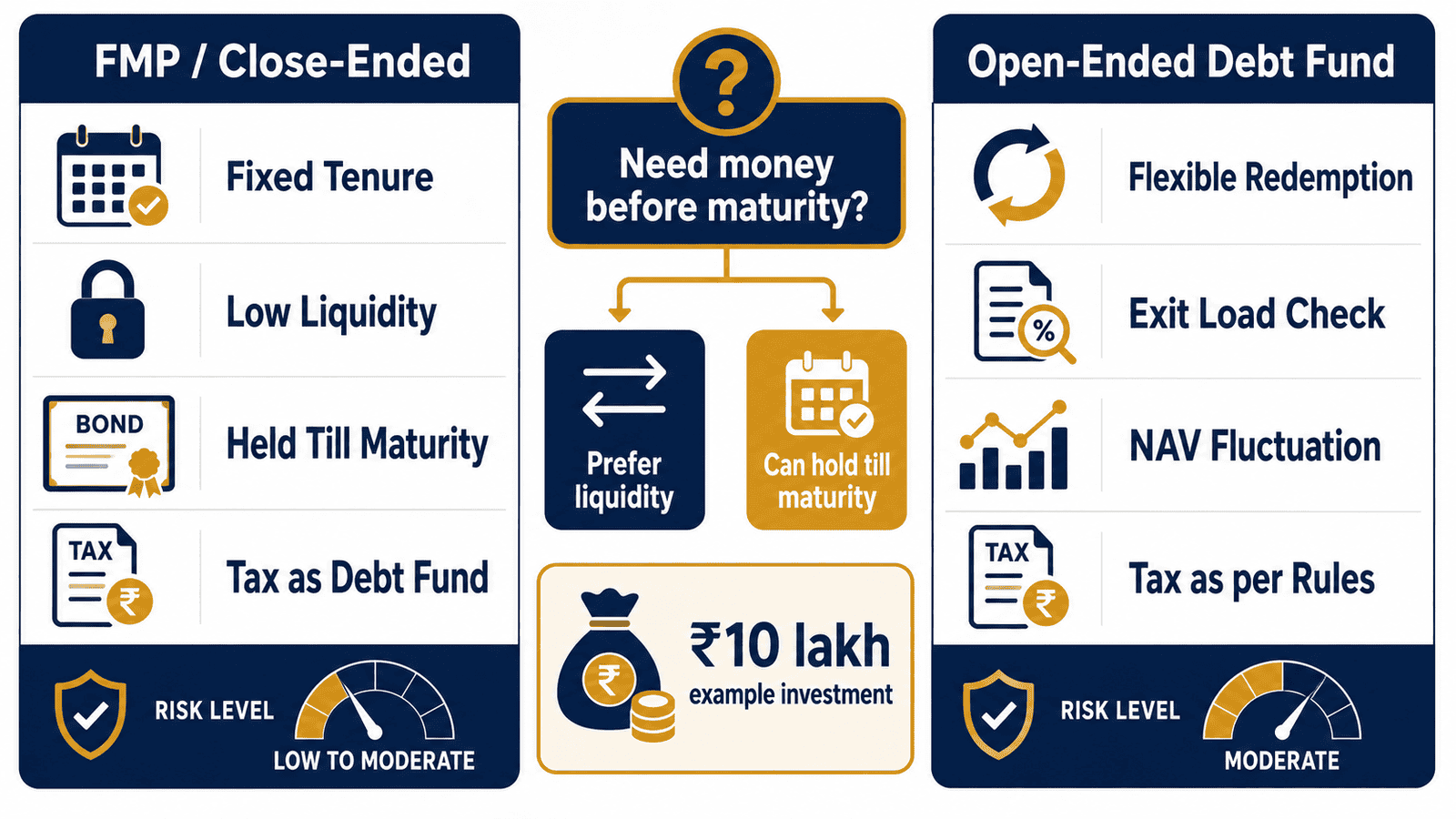
FMP vs debt mutual funds compares a close-ended fixed-tenure debt scheme with open-ended debt funds that usually allow easier redemption. FMPs suit investors who can lock ₹1 lakh or more until maturity and accept liquidity limits, while debt mutual funds suit investors wanting flexibility, though tax, exit load and interest-rate risk must be checked.
Key Takeaways
- FMPs are close-ended schemes — your money is locked in until the scheme matures, which is usually 1 to 5 years from the date of investment.
- Open-ended debt mutual funds allow redemption on any business day, but exit loads (typically 0.5%–1% within a specified period) and tax implications apply — verify the current scheme terms before investing.
- Neither FMPs nor debt mutual funds guarantee returns. Both carry credit risk if the underlying portfolio holds lower-quality paper, and debt fund NAVs can fall when interest rates rise.
- Tax rules on debt mutual funds have changed in recent years. The applicable capital gains tax rate and holding period must be verified from incometax.gov.in before you invest or compare outcomes.
- FMPs are not a risk-free substitute for bank FDs. They have no deposit insurance (DICGC cover does not apply), no guaranteed maturity value, and their NAV can move before and after maturity.
- Target maturity funds are a third category — passive, index-tracking, open-ended debt funds with a defined maturity — and are distinct from both traditional FMPs and actively managed debt funds.
Comparison: FMP vs Debt Mutual Funds
| Parameter | FMP (Fixed Maturity Plan) | Debt Mutual Fund (Open-Ended) |
|---|---|---|
| Structure | Close-ended scheme — NFO window only | Open-ended — buy or redeem anytime |
| Liquidity | Limited — listed on exchange but trading volumes may be low; no guaranteed exit before maturity | Redemption on any business day, subject to exit load and scheme terms |
| Lock-in | Fixed tenure (typically 1–5 years) must be held until maturity for intended outcome | No mandatory lock-in; exit load window typically 30–180 days |
| Returns | Indicative at launch based on portfolio YTM — not guaranteed | Market-linked; NAV moves daily with interest rates and credit events |
| Credit Risk | Present — depends on portfolio quality chosen by the AMC | Present — depends on fund category and portfolio quality |
| Interest-Rate Risk | Lower for buy-and-hold investors who stay until maturity | Higher for longer-duration funds; lower for liquid and short-duration funds |
| Taxation | Capital gains taxation applies — verify current rate at incometax.gov.in | Capital gains taxation applies — verify current rate at incometax.gov.in |
| Best Use Case | Fixed goal with a defined date — when money is definitely not needed before maturity | Flexible parking — when access to money may be required |
Source: SEBI (sebi.gov.in). Always verify scheme-specific terms in the Scheme Information Document before investing. Mutual fund investments are subject to market risks. Past performance does not guarantee future returns.
Key Facts at a Glance
| Feature | FMP | Open-Ended Debt Fund |
|---|---|---|
| Fund type | Close-ended debt-oriented scheme | Open-ended debt-oriented scheme |
| Entry | NFO (New Fund Offer) window only | Any business day at prevailing NAV |
| Exit | At maturity (or via exchange, where liquidity may be thin) | Any business day, exit load may apply |
| Portfolio duration | Fixed — matches scheme tenure | Varies by fund category (liquid, short, medium, long) |
| Deposit insurance | Not applicable | Not applicable |
| Taxation | Capital gains — verify at incometax.gov.in | Capital gains — verify at incometax.gov.in |
| Regulated by | SEBI | SEBI |
Note: Verify current tax rates and scheme features in the Scheme Information Document and the latest guidelines from SEBI and the Income Tax Department before investing.
What Is an FMP and How Does It Work?
A Fixed Maturity Plan is a close-ended debt-oriented mutual fund scheme. When an AMC launches an FMP, it opens a New Fund Offer (NFO) window — usually a few days — during which investors can subscribe. After the NFO closes, no fresh units can be purchased at NAV. The scheme then runs for a fixed tenure, investing the pooled money in bonds, commercial paper, certificates of deposit and other debt instruments with maturities broadly aligned to the scheme’s end date.
For a beginner, this means two things. First, the AMC’s fund manager aims to hold the portfolio largely to maturity, which reduces the reinvestment uncertainty compared to an actively traded debt fund. Second, because the scheme is close-ended, you cannot redeem units directly with the AMC before the scheme matures. FMPs are listed on stock exchanges, and in theory you can sell your units there — but trading volumes for most FMPs are very thin, and you may find no buyer at a fair price when you need one.
This is the liquidity risk specific to FMPs: you are committed until maturity, and the exchange exit is not a reliable alternative. If you understand how mutual funds work for beginners in India, you will recognise that the NAV-based redemption facility that makes open-ended funds accessible is simply not available in a close-ended structure.
What Are Debt Mutual Funds?
Debt mutual funds are open-ended schemes that invest primarily in debt and money market instruments. According to SEBI’s mutual fund categorisation, debt funds span multiple categories — liquid funds, overnight funds, ultra short-duration funds, short-duration funds, medium-duration funds, long-duration funds, corporate bond funds, credit risk funds, gilt funds and more. Each category has defined portfolio duration parameters.
Being open-ended means you can invest on any business day at the fund’s prevailing NAV and redeem on any business day. This structure gives you flexibility that an FMP cannot match. However, flexibility comes with its own risk: debt mutual funds carry real risks that many investors underestimate.
When interest rates rise in the economy, the market value of bonds held by the fund falls. This causes the fund’s NAV to drop — even though the fund holds only “safe” bonds. Longer the portfolio duration, larger the potential NAV fall. This is interest-rate risk, and it affects open-ended debt funds far more visibly than FMPs where the fund manager holds bonds to maturity.
Credit risk is present in both products. If a bond issuer in the portfolio defaults or gets downgraded, the NAV of both an FMP and a debt fund can fall sharply. Portfolio quality — tracked via credit ratings of individual holdings — matters enormously.
Real Example: Rohit’s ₹5 Lakh Parking Decision
Rohit, 34, is a senior software developer in Pune earning ₹18 lakh per year. He has ₹5 lakh he does not need for his monthly expenses. He is weighing whether to park it in an FMP or an open-ended short-duration debt fund for roughly 3 years.
Scenario A — Money definitely not needed before maturity: Rohit is confident the ₹5 lakh is earmarked for a specific goal — say, a foreign trip in exactly 3 years. He has no other use for this money in the interim. An FMP with a 3-year maturity may align well with his horizon, because the portfolio duration matches his goal date and he avoids NAV volatility that comes with an open-ended fund.
Scenario B — Money may be needed earlier: Rohit is also eyeing a home down payment within 2–3 years, but is not 100% certain of timing. If property prices drop and he wants to act in 18 months, his FMP money is locked. Redeeming via the stock exchange may fetch him a worse price. In this case, an open-ended short-duration debt fund gives him redemption flexibility — though the NAV may have moved up or down since he invested.
The key insight here: it is not which product is “better” in isolation, but whether Rohit’s investment horizon is certain or flexible. Understanding how NAV moves in a mutual fund will help Rohit see why even “safe” debt funds can show negative returns in certain interest-rate environments.
How to Calculate the Impact of Tax and Exit Load
Both FMPs and debt mutual funds generate capital gains when you redeem your units for more than you paid. The tax treatment depends on the holding period and the current provisions of the Income Tax Act. Important: debt mutual fund taxation rules have changed in recent years. Always verify the applicable capital gains tax rate and holding period threshold at incometax.gov.in before making any investment or redemption decision.
Capital Gain = Redemption Value − Purchase Cost (adjusted for any applicable rules)
To illustrate the concept — not as a guaranteed or current outcome — consider a ₹1,00,000 investment in a debt mutual fund or FMP:
| Scenario | Key Variable | Illustrative Impact |
|---|---|---|
| Held 3 years, no exit load | Applicable tax rate per current law | Tax on gain — verify current rate at incometax.gov.in |
| Redeemed within exit load window | Exit load of ~0.5–1% on redemption amount | Reduces realised proceeds — check scheme document for current rate |
| FMP — held to maturity | No exit load; tax on capital gain applies | Tax on gain — verify current rate at incometax.gov.in |
The exact post-tax amount depends on your income tax slab, the applicable capital gains rate under current law, and any scheme-specific exit load. Consult a qualified tax professional for your specific situation. Source: Income Tax Department — incometax.gov.in.
How to Decide What’s Right for You
Your investment horizon is fixed and certain — say, exactly 2 or 3 years for a specific financial goal — and you do not need access to the money before that date, THEN an FMP whose maturity aligns with your goal date may be worth evaluating.
You may need the money before a fixed date — for a home down payment, medical need, or business requirement — THEN an open-ended debt fund with daily redemption facility may suit you better than a locked FMP.
You are comfortable with NAV moving slightly up and down between investment and redemption, THEN open-ended short-duration or corporate bond funds allow flexible exits at market NAV.
You want a passive, index-tracking, open-ended debt product with a defined maturity date, THEN target maturity funds are a separate category worth comparing — they are not the same as an FMP and have their own risk profile.
Credit quality of the portfolio matters most to you and you want to verify holdings independently, THEN review the Scheme Information Document and AMC factsheet for both the FMP and any debt fund before investing.
You cannot commit to the FMP’s full tenure without certainty — THEN do not invest in an FMP expecting the exchange listing to give you a reliable exit. Thin trading volumes mean liquidity risk is real.
Common Mistakes to Avoid
Treating FMPs Like Bank Fixed Deposits
Many investors assume FMPs work exactly like FDs — a fixed return, a guaranteed maturity value and deposit insurance.
FMPs are mutual fund schemes. Returns are not guaranteed. There is no DICGC insurance. If the underlying bonds face default or rating downgrades, the NAV — and your maturity amount — can be lower than expected. The AMC’s indicated YTM at launch is a portfolio yield estimate, not a contractual promise.
Always read the Scheme Information Document and treat the indicated yield as an estimate only.
Ignoring Credit Quality in the Portfolio
Both FMPs and debt funds can hold lower-rated corporate bonds or commercial paper to boost returns.
A higher yield in the portfolio often signals higher credit risk. If a bond issuer defaults, your NAV can fall by 2%–5% in a single day — erasing months of accrued returns. Several debt fund schemes, including FMPs, have seen this happen when portfolio companies faced repayment stress.
Check the portfolio’s credit rating breakdown in the factsheet before investing. Avoid schemes where a large portion is held in sub-AA rated paper unless you understand and accept that risk.
Assuming Debt Funds Cannot Fall in Value
Debt funds are not capital-protected products. Their NAV moves daily based on bond prices in the market.
When the Reserve Bank of India raises interest rates, bond prices fall and debt fund NAVs — especially in longer-duration categories — decline visibly. Investors who exit during such periods can book losses even on conservative debt fund investments.
Match the fund’s duration to your own investment horizon to reduce this risk.
Forgetting Exit Load and Its Tax Impact
Exiting an open-ended debt fund within the exit load window costs you a percentage of the redemption amount — typically 0.5%–1%, depending on the scheme. This directly reduces your realised return.
On top of exit load, capital gains tax applies on the profit. Understand how fund costs affect your actual returns before comparing the stated yield of a debt fund with a guaranteed FD rate.
Always model the post-exit-load, post-tax return — not the gross yield — when comparing options.
Parking Emergency Money in a Fixed-Tenure Scheme
Emergency funds need to be accessible within 24–48 hours. An FMP’s maturity may be 2–3 years away, and the exchange exit may yield a poor price.
Even open-ended debt funds can take 1–3 business days to credit redemption proceeds. Emergencies do not wait for settlement cycles.
Keep emergency money in a savings account or liquid fund — never in an FMP or a long-duration debt fund.
Investing Without Reading the Scheme Information Document
The Scheme Information Document (SID) contains critical information: the exact maturity date, portfolio strategy, exit load structure, benchmark, risk factors and the fund manager’s investment mandate.
Skipping the SID and investing based on a distributor’s summary or a return estimate from an app can lead to surprises at redemption. SEBI mandates that the SID is publicly available on the AMC’s website before you invest.
When This May Not Be the Right Choice
Neither FMPs nor open-ended debt mutual funds may be appropriate if your situation matches any of the following:
You need the money within weeks or a few months. For very short parking needs, both products carry unnecessary complexity, exit load risk and settlement delay. A liquid fund or a savings account is generally a more appropriate category to consider — though liquid funds are also not risk-free and carry their own credit and interest-rate exposure.
You cannot tolerate even small NAV fluctuations. If seeing your ₹5 lakh show ₹4,92,000 on screen for a few weeks would cause anxiety or a premature exit, debt mutual funds may not suit your risk temperament.
You want deposit insurance-like comfort. DICGC covers bank deposits up to ₹5 lakh per bank per depositor. Mutual funds — including FMPs and debt funds — carry no such cover. If regulatory protection of principal is important to you, a bank FD may better fit your requirement.
You want a guaranteed maturity value. If an exact, guaranteed return matters — for a specific expense like school admission fees or a loan instalment — neither product can provide that certainty. Only bank FDs and certain government savings schemes offer contractually fixed maturity amounts.
If any of these apply to your situation, it may be worth exploring alternatives before committing.
Official Rules and Where to Verify
Mutual fund regulations, debt fund categorisation, disclosure norms, and investor protection rules are governed by SEBI. Tax treatment of capital gains from mutual funds — including applicable rates and holding period thresholds — is governed by the Income Tax Act and notified by the Income Tax Department.
Rules, limits, and rates on this topic can change with each Budget or regulatory update. Always verify current figures directly from the official source before making any financial decision.
- SEBI — sebi.gov.in (mutual fund regulations, scheme categorisation, investor education)
- Income Tax Department — incometax.gov.in (capital gains taxation, applicable rates, holding period rules)
- Scheme Information Document (SID) — available on the AMC’s website; contains maturity date, portfolio strategy, exit load, risk factors and investment objective
- Key Information Memorandum (KIM) — scheme-level summary available alongside the SID
- AMC Factsheet — monthly portfolio, credit rating breakdown, modified duration, yield to maturity and risk metrics
Expert Tips
- Match your horizon before anything else. If the FMP matures in March 2027 and your goal is December 2026, the mismatch creates reinvestment uncertainty. Only invest in an FMP when the maturity date genuinely aligns with your goal date.
- Check portfolio credit quality — not just the indicated yield. A portfolio yielding 8.5% may hold 25% in A-rated or below paper. The extra yield is compensation for extra credit risk. Download the AMC factsheet and look at the rating-wise portfolio breakup before investing.
- Understand modified duration before choosing a debt fund category. A fund with a modified duration of 5 years will lose roughly 5% in NAV for every 1% rise in interest rates. For shorter parking goals, stick to funds with lower duration — ideally matching your investment period.
- Model the post-tax return, not the portfolio yield. Compare FMP and debt fund outcomes after applying the applicable capital gains tax rate from incometax.gov.in and any exit load. The pre-tax yield difference between two products can shrink or reverse once taxes are applied to your specific slab.
- Understand what a switch or redemption actually triggers. Switching between debt fund schemes or redeeming early counts as a taxable redemption. Before moving money between funds, check how mutual fund switches work and their tax timing implications to avoid an unexpected tax bill.
- Past portfolio yield does not guarantee future return. According to SEBI’s investor education guidelines, mutual fund investments are subject to market risks. An FMP’s indicated YTM at NFO is based on the portfolio built at that time; credit events or early bond calls can change the actual outcome.
Frequently Asked Questions
Is an FMP safer than a debt mutual fund?
Not necessarily. Both carry credit risk and are subject to market conditions. FMPs hold the portfolio largely to maturity, which reduces visible NAV volatility for a buy-and-hold investor. However, if the underlying bonds default, both FMPs and debt funds can lose value. Neither is risk-free and neither offers deposit insurance.
Can I withdraw from an FMP before maturity?
Not directly. FMPs are close-ended schemes — there is no AMC redemption facility before maturity. They are listed on stock exchanges, so you can attempt to sell your units there. In practice, FMP exchange liquidity is thin and you may not find a buyer at a fair price. Plan to stay until maturity when you invest in an FMP.
Are FMP returns guaranteed?
No. FMP returns are not guaranteed. The AMC indicates a portfolio yield to maturity at the time of the NFO, but this is an estimate based on the initial portfolio. Credit events, early redemptions by underlying bond issuers, or portfolio changes can alter the actual maturity amount. SEBI prohibits mutual funds from guaranteeing returns.
How are FMPs taxed in India?
FMPs generate capital gains at redemption or maturity. The applicable tax rate depends on the holding period and the current provisions of the Income Tax Act. Debt mutual fund taxation rules have been revised in recent years and can change again with future Budgets. Always verify the current rate and applicable holding period threshold at incometax.gov.in before investing.
Is a debt fund better than an FD?
They serve different purposes. A bank FD offers a guaranteed interest rate, fixed maturity value and DICGC deposit insurance up to ₹5 lakh per bank. A debt mutual fund offers no guaranteed return, no deposit insurance and daily NAV fluctuation — but may offer better liquidity, potentially higher post-tax returns in certain interest-rate conditions, and more flexibility. The comparison depends heavily on current FD rates, applicable debt fund taxation and your investment horizon.
What is the difference between an FMP and a target maturity fund?
Both have a defined maturity date, but their structure differs. An FMP is a close-ended actively managed scheme available only during the NFO window. A target maturity fund is an open-ended passively managed index fund that you can invest in or redeem from at any time. Target maturity funds track a specific bond index; FMPs invest based on the fund manager’s portfolio construction at launch. Both carry duration and credit risk aligned to their respective portfolios.
What happens if the bonds in an FMP default?
If a bond in the FMP’s portfolio defaults, the AMC marks down that holding’s value — reducing the scheme’s NAV. The extent of loss depends on how large that bond’s weight was in the portfolio and whether any recovery is made. Your maturity amount will be lower than the originally indicated yield suggested. This is why credit quality review before investing is essential.
Can I invest in an FMP via a SIP?
No. FMPs are close-ended schemes that accept investment only during the NFO window. Systematic Investment Plans are applicable only to open-ended mutual fund schemes. If you want a disciplined, regular investment approach in debt, an open-ended debt fund or short-duration fund allows SIP investment.
What is exit load in a debt mutual fund and how much is it?
Exit load is a fee deducted from your redemption proceeds when you exit a mutual fund within a specified period after investment. For debt mutual funds, exit loads vary by scheme and category — many liquid funds and overnight funds charge zero exit load, while some short-duration and credit risk funds charge 0.5%–1% within 30–180 days. Always check the specific scheme’s exit load in the SID or factsheet before investing.
Is it better to invest in an FMP or a target maturity fund right now?
This depends on your horizon, available NFO windows, yield environment and the specific portfolio of each scheme. FMPs are only available during NFO periods; target maturity funds can be invested in anytime. Both carry credit and duration risk. Evaluate the portfolio quality, expense ratio, maturity date alignment and post-tax return for your specific situation — and verify current tax rules from incometax.gov.in before deciding.
Final Verdict
FMP vs debt mutual funds is ultimately a question of how certain your investment horizon is. If you have a fixed goal date — say, 2 or 3 years away — and you are confident you will not need the money before then, an FMP with a matching maturity may offer a cleaner, lower-volatility path through that period. If flexibility matters and you may need access before a fixed date, an open-ended debt fund gives you that option, at the cost of NAV movement and exit load risk.
What neither product gives you is a guaranteed return, deposit insurance, or freedom from credit risk. Treating an FMP like an FD is the most common and costly mistake Indian investors make in this space. Both products sit on the debt side of the risk spectrum but they are not identical — and the right choice depends on your specific horizon, liquidity needs, tax position and comfort with NAV fluctuation.
Before you invest, read the Scheme Information Document, check the portfolio credit quality in the AMC factsheet and verify current capital gains tax rates at incometax.gov.in. Always verify the latest rules from official sources or consult a qualified professional before making any financial decision.
This article is for educational purposes only and should not be treated as personalised financial, tax, investment, insurance, or legal advice. Tax rules, interest rates, regulatory limits, and product features can change with each Budget or policy update. Please verify current rules from official government sources or consult a qualified and registered professional before making any financial decision.

Arjun Kapoor writes about mutual funds, SIPs, ELSS, fund categories, investment returns, and beginner investing concepts for Indian readers. His focus is on education, not product promotion or fund recommendations. He helps readers understand how mutual funds work before they start investing or comparing schemes.
He covers topics such as mutual fund meaning, SIP meaning, SIP calculator, direct mutual funds vs regular plans, NAV, ELSS tax-saving funds, CAGR, absolute returns, XIRR, expense ratio, large cap vs mid cap vs small cap funds, flexi cap funds, index funds vs active funds, liquid funds, debt mutual funds, SIP pause vs SIP stop, lumpsum vs SIP, and how to start SIP in India.
Arjun’s writing is simple, risk-aware, and long-term oriented. He avoids guaranteed-return language and explains investment concepts using examples, timelines, and comparison tables. His articles remind readers that mutual fund investments are subject to market risks, and past performance does not guarantee future returns. Readers should verify scheme details from SEBI, AMFI, fund houses, and official scheme documents.