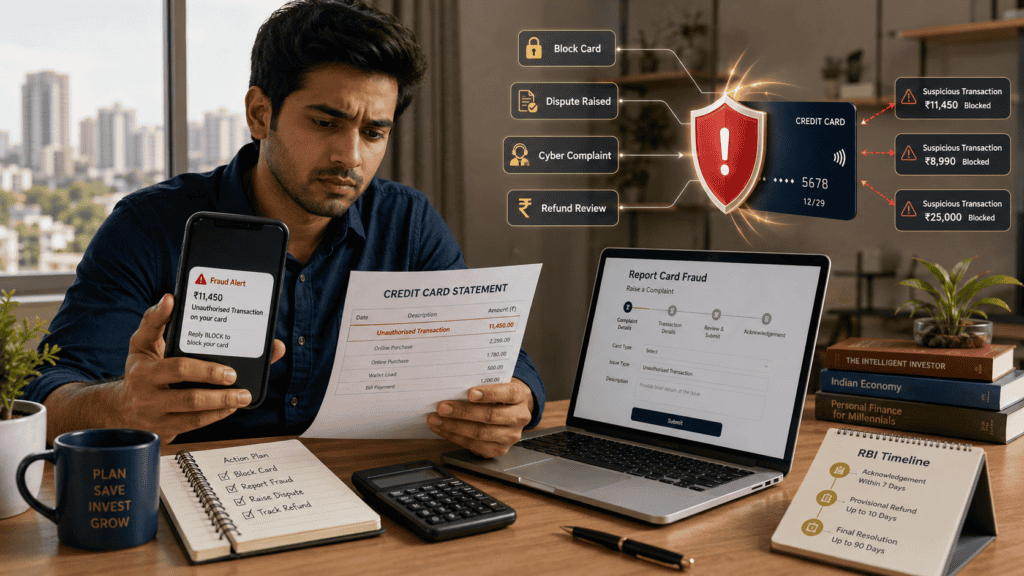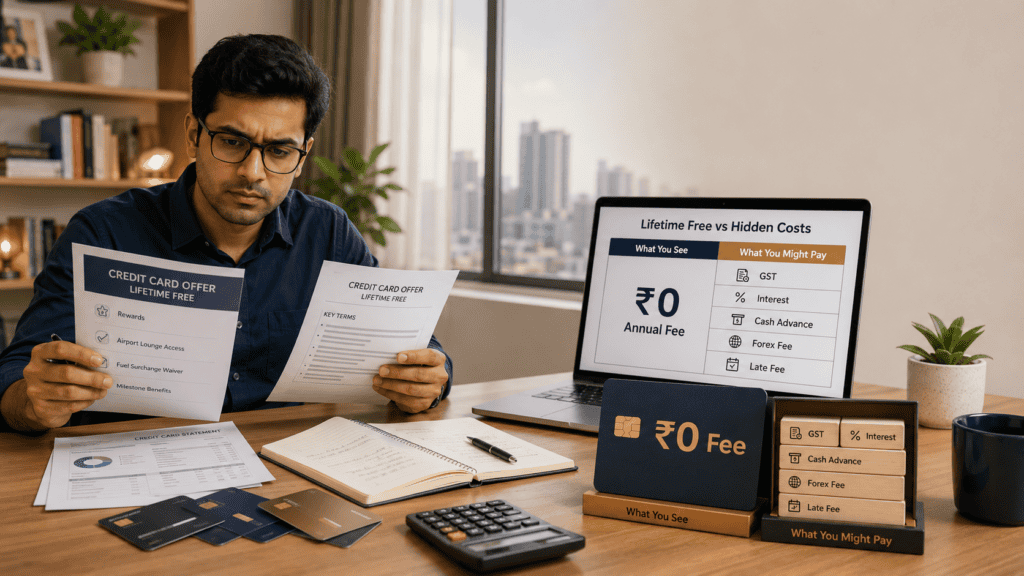

The phrase “lifetime free” is one of the most clicked terms in Indian credit card marketing — and one of the most misunderstood. For a first-time applicant, it sounds like the card will cost absolutely nothing, ever. No joining fee, no annual fee, no renewal charge. Done.
The reality is different. A lifetime free credit card in India typically means ₹0 on two specific line items: the joining fee and the annual renewal fee. Every other charge on the card — interest on unpaid balances, late payment fees, cash withdrawal charges, forex markup, GST, EMI conversion fees — can still apply, depending entirely on how you use the card.
If you are a salaried beginner evaluating your first or second credit card, this guide gives you a complete hidden-charges checklist, a real-numbers example, and a clear decision framework — so you know exactly what “free” covers and what it does not.
Quick Answer: Lifetime Free Credit Cards in India
Lifetime free credit cards in India usually mean ₹0 joining fee and ₹0 annual renewal fee, but other charges can still apply. Check late payment fees, interest on unpaid balances, cash withdrawal charges, forex markup, GST, EMI conversion fees, and reward exclusions before applying.
Key Takeaways
- Lifetime free refers specifically to joining and annual fees — it does not mean all credit card usage is free.
- Interest (finance charges) is the single largest hidden cost: missing a full payment on a ₹25,000 balance can trigger monthly interest that adds up to thousands of rupees over time.
- Cash withdrawals from an ATM using a credit card attract both a flat cash advance fee and interest from day one — there is no grace period.
- GST at 18% applies on top of most credit card fees and charges, including late payment fees and finance charges.
- Reward points on lifetime free cards often come with caps, excluded merchant categories, or redemption fees — check before assuming value.
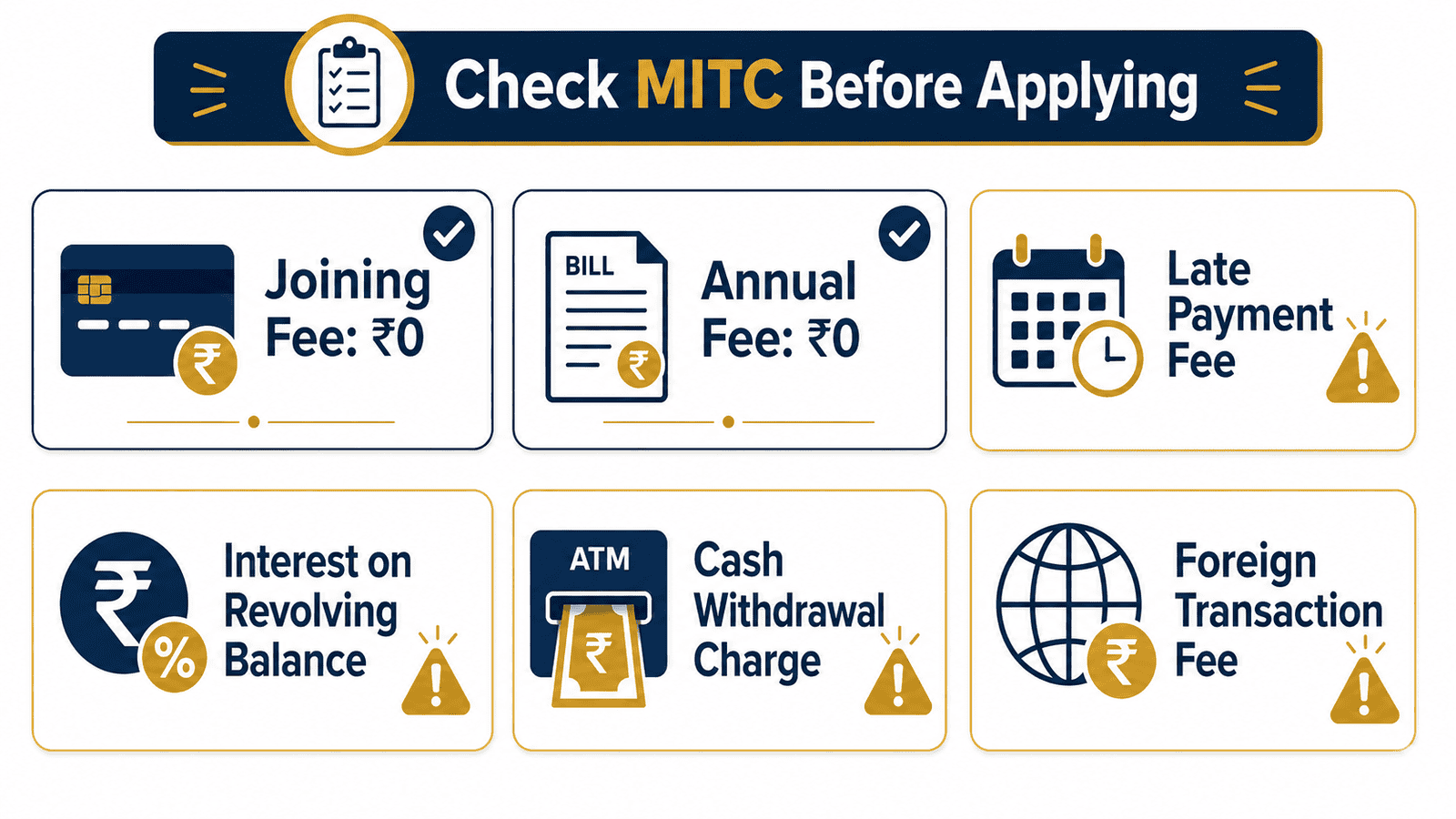
- Always read the Most Important Terms and Conditions (MITC) document before applying, not after receiving the card.
- A waiver-based card is not the same as a lifetime free card — if you miss the annual spend threshold, the fee is charged.
Key Facts at a Glance
| Charge Type | Lifetime Free Card — Typical Status | What to Check |
|---|---|---|
| Joining fee | Usually ₹0 | Confirm in MITC — some cards waive only on first year |
| Annual renewal fee | Usually ₹0 | Confirm “lifetime” specifically; check bank’s Schedule of Charges |
| Late payment fee | Can apply — slab-based | Verify current slabs from issuer’s Schedule of Charges |
| Interest / finance charge | Can apply on unpaid balance | Check monthly rate; verify at issuer’s official site |
| Cash advance / ATM withdrawal | Can apply — flat fee + interest | Verify flat fee percentage and per-transaction cap |
| Forex markup | Can apply on foreign currency spends | Check % markup; compare before using abroad |
| GST on fees/charges | 18% applies on applicable charges | Confirm current GST rate from official sources |
| EMI conversion fee | Can apply — flat or percentage | Check MITC before converting any purchase to EMI |
| Reward redemption fee | Can apply — varies by issuer | Check reward T&Cs and redemption charges separately |
What “Lifetime Free” Actually Means — and What It Does Not
When a bank markets a credit card as lifetime free, the term usually refers to two specific fees: the one-time joining fee charged when you first receive the card, and the annual renewal fee charged every subsequent year. On a genuine lifetime free credit card, both of these are permanently ₹0 — no conditions attached.
That is different from two other common types of cards that get confused with truly free cards.
Lifetime Free vs Annual Fee Waiver Cards
An annual fee waiver card charges an annual fee by default, but waives it if you spend above a stated threshold — say, ₹1 lakh per year. Miss that threshold in any given year, and the fee gets charged to your account. This is not the same as a lifetime free card, even though both may appear to cost nothing in a good year.
Always check the Schedule of Charges before applying. A card marketed as “free for life” should explicitly state ₹0 joining fee and ₹0 annual fee in its MITC — not a waiver condition.
What Is the MITC and Where to Find It
The Most Important Terms and Conditions (MITC) is a standardised disclosure document that every credit card issuer in India is required to provide, as per RBI guidelines. It covers interest rates, all applicable fees, billing cycle details, and grievance redressal information. You can usually find the MITC as a downloadable PDF on the bank’s credit card product page — look for a link labelled “Most Important Terms and Conditions” or “Schedule of Charges.”
If you are evaluating your first credit card in India, downloading and reading the MITC before submitting your application is the single most important step you can take. Most applicants skip it and discover charges only after the first statement.
Why Card Benefits Can Change Over Time
A card’s reward structure, lounge access, cashback rates, and partner merchant offers are not necessarily permanent. Banks and NBFCs can revise benefits with advance notice — typically via email or SMS. The fee waiver on a card being “lifetime free” refers to the stated card fees, not to the associated benefits. Reward programmes can be scaled back even on a genuinely fee-free card.
This is why reading the MITC once is not enough. Reviewing annual updates — especially emails titled “revision of credit card features” — keeps you informed before you lose value without realising it.
The “Free” Label Does Not Remove Repayment Responsibility
Perhaps the most important clarification for a first-time cardholder: having a lifetime free credit card does not mean spending on it is free. The card allows you to borrow money from the bank up to your credit limit. Every rupee spent must be repaid. If you repay the full outstanding amount before the due date, your cost of using the card that month is ₹0 in most scenarios. If you do not, finance charges begin — and that is where the real cost of any credit card, free or paid, shows up.
Real Example: Aarav’s ₹25,000 Month
Aarav, 27, is a software analyst in Bengaluru earning ₹75,000 per month. He applies for a lifetime free credit card — ₹0 joining fee, ₹0 annual fee. In his first full month, he spends ₹25,000 on groceries, online shopping, and a few restaurant bills.
His billing cycle rules work like this: the statement is generated on the 5th of the month. The total due is ₹25,000. The payment due date is the 25th — giving him a 20-day window after the statement date.
Scenario A: Aarav pays the full ₹25,000 on or before the 25th. Interest: ₹0. Late fee: ₹0. His cost for the month is ₹0 despite spending ₹25,000. The card is genuinely free for him this month.
Scenario B: Aarav pays only the minimum amount due — say, ₹1,250 (a common 5% minimum). The unpaid balance of ₹23,750 begins attracting finance charges from the statement date. At a typical monthly interest rate (verify current rate from your issuer before applying), this amount compounds every month until fully paid. GST at 18% applies on top of the finance charges. Additionally, if Aarav is late by even one day, a late payment fee — slab-based and linked to the outstanding amount — is also charged.
The key insight: the card’s ₹0 annual fee made no difference. It was Aarav’s repayment behaviour that determined his actual cost.
How to Calculate the Real Cost of Unpaid Credit Card Debt
Monthly Finance Charge = (Outstanding Balance × Monthly Interest Rate) + GST @ 18% on the charge
Using Aarav’s Scenario B as an illustration — with ₹23,750 unpaid after minimum payment:
| Scenario | Key Inputs | Approximate Monthly Cost |
|---|---|---|
| Full payment by due date | ₹25,000 spend, paid in full | ₹0 interest or fees |
| Minimum payment only | ₹23,750 carried forward; interest rate as per issuer (verify before applying) | Finance charges + GST apply — check issuer MITC for exact rate |
| Late payment (1–5 days) | Full amount paid, but after due date | Late payment fee (slab-based) + GST — verify current slabs from issuer |
For a detailed breakdown of how revolving credit interest is calculated — including how the interest-free period works and why partial payments do not protect you — see card interest calculation.
The core point: a lifetime free credit card’s ₹0 annual fee saves you the annual charge. But a single month of unpaid balance can generate finance charges that exceed what a paid card’s annual fee would have cost. The fee line is not where the money is lost — the repayment line is.
Comparison: Lifetime Free vs Paid vs Waiver-Based Cards
| Card Type | Annual Cost Structure | Best Suited For |
|---|---|---|
| Lifetime free card | ₹0 joining and annual fee permanently | Beginners, low spenders, credit history builders |
| Paid rewards card | Annual fee of ₹500–₹5,000+ (verify per issuer); justified only if benefits used consistently | Frequent spenders who use lounge, travel, or cashback benefits |
| Annual fee waiver card | Fee waived on meeting spend threshold (verify threshold per issuer); charged otherwise | Moderate spenders who can predictably meet the threshold every year |
| Secured card (against FD) | Usually low or no annual fee; linked to fixed deposit | Applicants with no credit history or low CIBIL score |
| RuPay lifetime free card | ₹0 joining and annual fee; may support UPI linkage depending on issuer and network rules | UPI users who want a single payment instrument; verify issuer support via NPCI |
Per NPCI guidelines, RuPay credit cards may be linked to UPI for payments — however, availability depends on the specific issuer and their implementation. Check with your bank whether UPI-linked credit card transactions are supported on your card before assuming this feature is available.
How to Decide What’s Right for You
You are applying for your first credit card and want to build a credit history without committing to any fixed annual cost — a lifetime free card is likely the right starting point.
You can pay the full outstanding balance before every due date without fail — the card’s ₹0 annual fee means your cost of ownership stays near ₹0, making a lifetime free card genuinely cost-free for you.
You spend above ₹15,000–₹20,000 per month consistently on categories like travel, dining, or fuel — a paid rewards card may return more value than a lifetime free card, but only after you verify that the annual fee is lower than the benefits you actually use.
Your credit utilisation ratio discipline is strong — you use less than 30% of your credit limit — a lifetime free card helps build CIBIL score efficiently without paying for the privilege.
You want premium travel lounge access or high reward acceleration — most lifetime free cards do not offer these benefits consistently; a paid card with verified benefits may be a better fit.
You have a history of carrying unpaid balances or paying only the minimum amount due — a lifetime free card will still generate significant finance charges; the ₹0 annual fee does not offset revolving credit interest. Consider a secured card or prepaid solution first.
Common Mistakes to Avoid
Paying Only the Minimum Amount Due
The minimum amount due is typically 5% of the total outstanding or a flat minimum — whichever is higher. Paying only this amount keeps your account in good standing but does not stop interest from accruing on the remaining balance. Finance charges apply from the statement date on the unpaid portion, compounding monthly. Over several months, a ₹25,000 carry-forward can cost more than the card’s rewards ever return. Always aim to pay the total amount due.
Withdrawing Cash from an ATM Using Your Credit Card
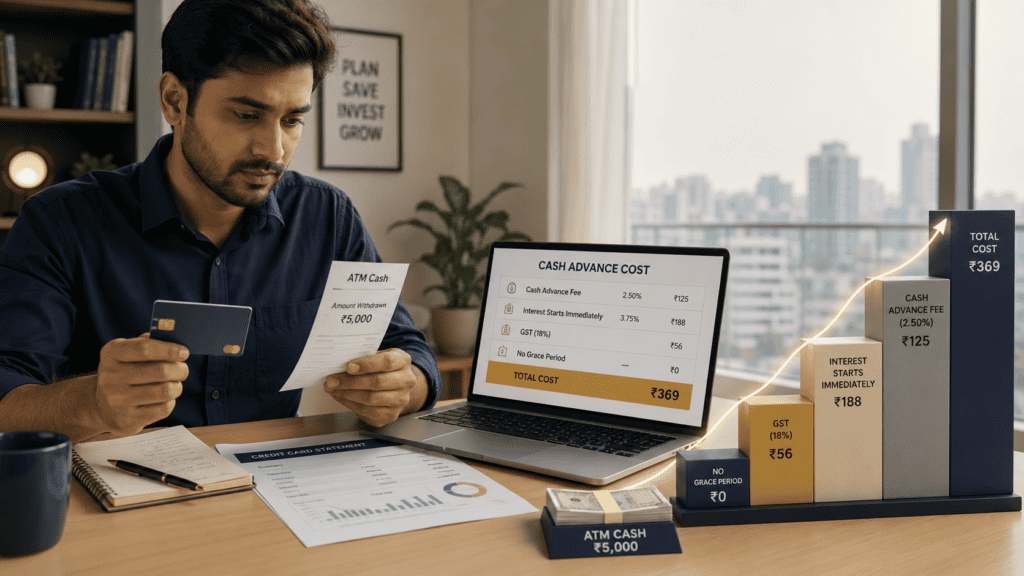
Credit card cash advances carry a flat fee — typically a percentage of the amount withdrawn — plus interest that begins accruing immediately, with no grace period. Even on a lifetime free card, an ATM withdrawal of ₹5,000 can attract a cash advance fee and daily interest from transaction date. For a full breakdown of why this is one of the most expensive credit card behaviours, see cash advance charges. Avoid this entirely unless it is a genuine emergency.
Missing the Due Date by Even One Day
Late payment fees are slab-based and applied to the total outstanding amount — not just what was unpaid. Missing the due date by a single day triggers the fee. Additionally, the interest-free grace period resets only when the full amount is paid. A late payment can cascade into two months of finance charges. Set a calendar reminder or activate autopay for at least the minimum amount to protect your credit score and avoid the fee.
Ignoring Forex Markup on International Spends
Using your lifetime free credit card abroad or on foreign-currency websites triggers a forex markup fee — typically 1.5% to 3.5% of the transaction value, plus GST. On a ₹50,000 international purchase, this can mean ₹750–₹1,750 in additional charges that do not appear in the card’s headline fee table. Always check the forex markup percentage in the MITC before using your card internationally. Verify current rates from your issuer.
Assuming Reward Points Are Worth Face Value
Many lifetime free credit cards offer reward points as their primary benefit. But reward points often have a redemption rate lower than ₹1 per point, exclude certain categories like fuel or utility bills, have expiry dates, or charge a fee for catalogue redemptions. A card advertising “5X rewards” may effectively deliver less than 1% return once exclusions and redemption terms are applied. Read the reward T&Cs as carefully as the fee schedule.
Not Updating Your Nominee or Communication Details
Statements, fee revision notices, and reward expiry alerts are sent to the email and mobile number registered at the time of application. If these are outdated, you may miss a due-date reminder, a reward expiry notice, or a critical fee revision. Verify your registered contact details immediately after card activation.
Treating a Waiver-Based Card as Lifetime Free
If your card’s annual fee is waived upon meeting a spend threshold, it is a conditional waiver — not a lifetime free card. In any year you do not meet the threshold, the full annual fee is charged. Verify the card type explicitly in your MITC. Verify current waiver conditions and fee amounts from your issuer’s Schedule of Charges.
When This May Not Be the Right Choice
A lifetime free credit card may not suit every user, despite its zero-fee appeal.
If you regularly carry an unpaid balance from month to month — revolving credit — the finance charges on a lifetime free card are identical to those on a paid card. The ₹0 annual fee saves you nothing against recurring interest costs; managing your repayment behaviour matters far more than the card type.
If you are a frequent traveller who values airport lounge access, travel insurance, or premium reward acceleration on hotel and airline spends, most lifetime free cards do not offer these benefits at a competitive level. A paid card where verified annual benefits outweigh the fee may deliver more value.
If your primary spending is in categories that many lifetime free cards exclude from rewards — such as fuel, utility bills, rent, or wallet loads — the reward proposition may be weaker than it appears at first glance.
If you struggle to track payment due dates and tend to pay late, the late payment fees and finance charges on any credit card — free or paid — can make credit cards an expensive borrowing tool compared to alternatives.
If any of these apply to your situation, it may be worth exploring alternatives before committing.
Official Rules and Where to Verify
Credit card fees, interest rates, and terms in India are governed by RBI guidelines on credit cards and can change with regulatory updates or bank policy revisions. Before applying for any card — lifetime free or otherwise — verify the following from official sources:
- RBI (rbi.org.in) — Master Directions on Credit Cards and consumer protection guidelines. The authoritative source for understanding cardholder rights, billing dispute processes, and maximum interest rate disclosures.
- NPCI (npci.org.in) — For RuPay credit card network rules, UPI-linked credit card eligibility, and network-level guidelines.
- Your issuer’s official website — The MITC and Schedule of Charges for your specific card. These are the only documents that reflect your card’s actual fees and current benefit structure.
- Your welcome kit and first statement — Confirm all fees, limits, and terms once the card is issued.
Rules, limits, and rates on this topic can change with each Budget or regulatory update. Always verify current figures directly from the official source before making any financial decision.
Expert Tips
- Before submitting your application, download the MITC PDF from the bank’s product page and save it. This is your contractual reference document — it contains the exact interest rate, late payment fee slabs, cash advance charges, and forex markup applicable to your specific card variant.
- Activate autopay for the total amount due — not just the minimum — on the day you receive the card. This single action eliminates late payment fees and finance charges for the majority of standard purchase transactions.
- Never use your credit card for ATM cash withdrawals unless it is a genuine emergency with no alternative. The cash advance fee plus no-grace-period interest makes ATM credit card use one of the most expensive borrowing options available to a salaried professional in India.
- Review the reward points terms specifically: check the per-point redemption value, monthly earn caps, excluded merchant categories, points expiry period, and whether a fee applies for catalogue redemptions. A card with “10X rewards” on a single category may earn at 1X on everything else.
- After your first statement is generated, read every line — the opening balance, all transactions, interest charges if any, the total amount due, and the minimum amount due. Understanding how to read a credit card statement in the first month will prevent misreading charges in every subsequent month.
- Set a six-monthly calendar reminder to review your card’s current benefit structure. Banks notify feature revisions via email — but these emails are easy to miss. Proactively checking your card’s product page ensures you are not earning rewards on an updated structure that is less favourable than when you applied.
- If you are choosing between two lifetime free cards, compare the forex markup percentage, not just the annual fee. If you shop on international e-commerce platforms or travel abroad even occasionally, the forex markup difference between two cards can cost more per year than a modest paid card’s annual fee.
Frequently Asked Questions
Are lifetime free credit cards in India really free to use?
The joining fee and annual renewal fee are ₹0 on a genuine lifetime free card — that part is accurate. However, other charges apply depending on how you use the card: interest on unpaid balances, late payment fees, cash advance charges, forex markup, and GST on applicable fees. The card is free to hold; it is not necessarily free to use carelessly.
Can a lifetime free credit card charge interest?
Yes. Interest (finance charges) applies whenever the full outstanding amount is not paid by the due date. The interest-free period — typically up to 45–50 days — applies only when you pay the total amount due in full. Paying the minimum amount due or any partial amount does not preserve the interest-free benefit. Verify the exact monthly interest rate from your issuer’s MITC before applying.
Is GST charged on credit card fees?
GST at 18% applies on most credit card fees and finance charges — including annual fees (if applicable), late payment fees, interest charges, cash advance fees, and forex markup. This is in addition to the fee itself, not included within it. Verify the current GST rate from official sources before applying.
Is a RuPay lifetime free credit card useful for UPI payments?
RuPay credit cards may support UPI linkage depending on the specific issuer and their implementation of NPCI guidelines. If UPI payments are important to you, verify with your issuer whether their RuPay credit card supports UPI-linked transactions and whether those transactions earn reward points. Not all issuers have enabled this feature. Check npci.org.in and your issuer’s product page for current status.
Can a bank change the terms of a lifetime free card after I apply?
Yes. Banks can revise benefits, reward structures, and interest rates with advance notice — typically 30 days via email or SMS as per RBI guidelines. The “lifetime free” commitment generally applies to the joining and annual fee specifically. Reward programmes, lounge access, and cashback rates are subject to periodic revision. This is why saving your MITC and monitoring update emails matters.
Is a paid credit card better than a lifetime free card?
It depends on your spending pattern and whether you actually use the benefits a paid card offers. A paid card with ₹2,000 annual fee that returns ₹6,000 in lounge access, cashback, and rewards may deliver better value than a free card with negligible rewards — but only if you use those benefits consistently. For a first-time cardholder with moderate spending, a lifetime free card is usually the lower-risk starting point.
What is the MITC and why does it matter?
MITC stands for Most Important Terms and Conditions. It is a standardised document that every card issuer is required to provide under RBI guidelines. It contains the card’s interest rate, all fee schedules, billing cycle details, and dispute resolution process. The MITC is the only document that accurately reflects your card’s actual costs — not the marketing page or the welcome email.
Can I get a lifetime free credit card if I have a low CIBIL score?
Most lifetime free credit cards still require a minimum CIBIL score for approval — typically 700 or above, though this varies by issuer. Applicants with no credit history may be offered a secured credit card (against a fixed deposit) as an alternative path to building credit before qualifying for an unsecured lifetime free card. Verify eligibility criteria from the issuer directly.
What happens if I miss the due date on a lifetime free card?
A late payment fee is charged — this is a slab-based fee linked to the outstanding amount, applied even if you miss by one day. Additionally, the grace period (interest-free window) resets only after the full amount is paid, meaning the next billing cycle may not have an interest-free period if the previous balance was not fully cleared. Late payments also affect your CIBIL score. Verify current fee slabs from your issuer.
Does converting a purchase to EMI on a lifetime free card attract extra charges?
Yes. EMI conversion on a credit card — whether initiated by you or by the bank — typically attracts a processing fee and interest on the instalment amount. The effective cost depends on the EMI tenure and the rate offered at the time of conversion. Always calculate the total EMI cost before converting a purchase, and verify the current processing fee and interest rate from your issuer’s MITC.
Final Verdict
Lifetime free credit cards in India are a genuinely good starting point for salaried beginners and first-time cardholders who want credit access without a fixed annual cost. For Aarav — and for anyone who can pay their full outstanding balance before every due date — a lifetime free credit card in India can legitimately cost ₹0 per year to hold and use.
But “free” applies only to the two fee lines it promises. Finance charges, late payment fees, cash advance costs, forex markup, and GST on applicable charges are all live on every credit card, regardless of whether the annual fee is zero or two thousand rupees. The difference between a free card that stays free and one that becomes expensive is almost entirely behavioural — not structural.
Read the MITC before applying. Set autopay for the total amount due. Avoid ATM withdrawals. Check reward terms before assuming value. And if you are comparing two cards and one charges 3.5% forex markup while the other charges 1.5%, that gap is worth running the numbers on — it may exceed the annual fee on a paid alternative.
Always verify the latest rules from official sources or consult a qualified professional before making any financial decision.
This article is for educational purposes only and should not be treated as personalised financial, tax, investment, insurance, or legal advice. Tax rules, interest rates, regulatory limits, and product features can change with each Budget or policy update. Please verify current rules from official government sources or consult a qualified and registered professional before making any financial decision.

Nikhil Bansal writes about credit cards, billing cycles, card charges, rewards, cashback, credit utilisation, card EMI, BNPL, and responsible credit usage in India. His content is designed for readers who want to use credit cards wisely without falling into expensive repayment mistakes.
He covers topics such as how to choose a first credit card, credit card billing cycle, due date, grace period, minimum amount due, credit utilisation ratio, reward points vs cashback, lifetime free credit cards, annual fee waivers, credit card statement reading, add-on cards, cash advance charges, EMI on credit cards, credit card fraud reporting, BNPL vs credit card, and foreign transaction fees.
Nikhil’s writing is beginner-friendly, direct, and risk-aware. He explains how small mistakes such as paying only the minimum due, withdrawing cash from a credit card, missing due dates, or overusing credit limits can become costly. Since card fees, interest rates, reward rules, waiver conditions, and bank offers change often, readers should verify the latest Most Important Terms and Conditions from the card issuer.