If you commute by car in India, petrol costs are no longer a small line item. For many salaried employees in cities like Pune, Bengaluru, or Delhi, monthly fuel bills run anywhere from ₹5,000 to ₹12,000. Fuel credit cards in India promise to cut that cost through surcharge waivers, reward points, or direct cashback — and the headline numbers look compelling. But between reward caps, ineligible petrol pumps, GST on surcharge, and annual fees, the real saving is almost always smaller than the card brochure suggests. This article breaks down exactly how fuel credit cards work, where they help, and how to calculate what you will actually keep in your pocket — not just what the bank promises.
Quick Answer: Fuel Credit Cards in India
Fuel credit cards in India can save money through a 1% fuel surcharge waiver, fuel rewards, or cashback, but real savings depend on monthly fuel spend, eligible petrol pumps, reward caps, redemption value, GST on surcharge, and annual fees. A ₹8,000 monthly fuel user may save less than headline rates suggest.
Key Takeaways
- The fuel surcharge waiver is typically 1% but is usually capped at a monthly maximum — for example, ₹50 to ₹250 per month depending on the card — so a high spender does not save proportionally more.
- GST at 18% is charged on the fuel surcharge amount; some cards do not refund this GST component, so the actual waiver is less than 1% of the transaction value.
- Co-branded fuel cards, such as those issued in partnership with IndianOil or HPCL, typically earn accelerated rewards only at partner pumps — random petrol stops will earn lower or standard rates.
- Reward points must be converted to a rupee value before comparing cards: 1 reward point is not always worth ₹0.25 or ₹1; check the redemption rate in the card’s MITC document.
- An annual fee of ₹500–₹1,000 can cancel out several months of fuel savings for a low-to-moderate fuel spender; always calculate net annual benefit, not just gross reward value.
- Paying the full outstanding amount every month is non-negotiable — a single month of revolving credit at 3–4% monthly interest will wipe out an entire year of fuel savings.
- The right fuel card depends on which fuel brand you use, your monthly spend, your typical transaction size, and whether you can hit the annual fee waiver threshold.
Comparison: Fuel Credit Card Benefit Types
| Benefit Type | How It Works / Where It Helps | Where It Fails / What to Verify |
|---|---|---|
| Fuel surcharge waiver | Bank credits back the 1% surcharge levied at petrol pumps on card transactions. Useful for anyone who fills fuel regularly at any pump within the eligible range. | Capped monthly (verify current cap in MITC). GST on surcharge may not be refunded. Minimum and maximum transaction limits apply. Verify eligible amount range on official card page. |
| Fuel reward points | Earn accelerated points (e.g. 4x–10x) on fuel spends. Useful for loyal users of one fuel brand who redeem points for fuel vouchers or statement credit. Understand how reward points differ from cashback before choosing. | Points expire. Redemption value varies by method. Partner-pump restriction limits usefulness for multi-brand users. Verify point-to-rupee conversion in reward programme terms. |
| Direct cashback on fuel | A percentage of every fuel transaction is credited directly to the statement. Simpler to track than points; no redemption step required. | Cashback rate is usually lower than equivalent reward-point headline. Monthly cashback cap applies. Verify whether cashback applies to all pumps or select brands only. |
| Co-branded partner-pump card | Highest savings per litre when you use one brand consistently (IndianOil, HPCL, BPCL). Often includes bonus fuel points or free fuel vouchers as a joining benefit. | Low or no benefit at non-partner pumps. Joining bonus is one-time. Annual fee applies. Value drops significantly if the partner brand is not near your commute route. |
| General cashback card used at fuel pumps | A good flat-rate cashback card may earn 1–2% on all spends including fuel. Offers flexibility — every petrol pump qualifies. | Fuel may be excluded from accelerated cashback category. Cashback rate likely lower than a dedicated fuel card at partner pumps. Check the card’s category exclusion list. |
| Debit card / UPI alternative | No credit risk. Some RuPay debit cards offer a 1% surcharge waiver on fuel. No annual fee concern. | No credit-building benefit. Reward rates typically lower than credit cards. No interest-free credit period on debit transactions. |
Key Facts at a Glance
| Term | What It Means | What to Verify |
|---|---|---|
| Fuel surcharge | A levy applied to card transactions at petrol pumps — typically 1% of the transaction value, charged by the merchant acquirer | RBI — rbi.org.in; card MITC document |
| Surcharge waiver | Bank credits back the fuel surcharge to your statement so you effectively pay no surcharge on eligible transactions | Official card page — verify current waiver rate |
| GST on surcharge | 18% GST is levied on the surcharge amount; the waiver may or may not include this GST component — confirm in MITC | Card MITC / fees and charges schedule |
| Eligible transaction range | Waiver typically applies only to fuel transactions between a minimum (e.g. ₹400) and maximum (e.g. ₹4,000) amount — illustrative figures; verify with issuer | Official card page / MITC document |
| Monthly waiver cap | Maximum surcharge waiver credited per month — commonly in the range of ₹50–₹250 depending on the card; illustrative figures only | Official card page / MITC document |
| Annual fee | Charged once a year; may be waived if total annual spend exceeds a threshold — verify spend condition | Official card page / fees and charges schedule |
| MITC | Most Important Terms and Conditions document — the binding legal document that governs all card terms; download it from the issuer’s website before applying | Bank’s official card page |
How Fuel Credit Cards Actually Work in India
Most Indian credit cards charge a fuel surcharge when you swipe at a petrol pump. This surcharge — typically around 1% of the transaction — is collected by the payment network and passed on by the petrol pump. It is not the same as the fuel price itself; it is an additional levy on the card transaction.
The Surcharge Waiver Mechanism
A fuel credit card’s most visible benefit is the surcharge waiver: the bank credits back this 1% to your statement, so you do not pay the surcharge on eligible transactions. But three conditions limit what you actually receive.
First, the transaction must fall within the card’s eligible range — typically a minimum of around ₹400 and a maximum of around ₹4,000, though these figures vary by card and should be verified in the MITC. A ₹5,000 fill-up may not qualify. Second, a monthly cap applies — once you have recovered, say, ₹100 in waiver that month, further fuel transactions generate no additional waiver credit. Third, GST at 18% is charged on the surcharge amount itself. If a card waives the surcharge but not the GST on it, your effective saving is less than 1%.
Reward Points vs. Direct Cashback
Beyond the surcharge waiver, fuel cards earn either reward points or direct cashback on fuel spends. These sound similar but work very differently. Reward points must be redeemed — and the rupee value of a point depends entirely on what you redeem it for. Points used for fuel vouchers at partner stations may be worth more per point than points used for merchandise. Points also expire if unused within a certain period. Direct cashback, by contrast, is credited to your statement automatically and reduces your outstanding balance — no action required.
If you are new to credit cards and comparing your first options, read our beginner’s guide to choosing your first credit card in India before narrowing down to a fuel-focused card.
Co-Branded Cards and Partner Pump Networks
Co-branded fuel cards — issued jointly by a bank and a fuel retailer like IndianOil, HPCL, or BPCL — offer the highest per-litre reward rates, but only at that brand’s petrol stations. If you always fill up at IndianOil pumps, an IndianOil co-branded card is likely your most efficient option. If your commute takes you to whichever pump is closest, the co-branding advantage disappears quickly.
Why Bill Discipline Matters More Than Reward Rate
The single biggest variable in fuel card economics is not the reward rate — it is whether you pay the full outstanding balance every month. Credit card interest in India typically runs at 3–4% per month, or roughly 36–48% per annum. Earning ₹80–₹100 in surcharge waiver and then paying ₹300 in interest on a partially paid balance means the card costs you money, not saves it. According to RBI’s credit card directions, cardholders have the right to know the total cost of credit — use that right by reading the MITC before applying.
Real Example: Rohit’s Monthly Petrol Calculation
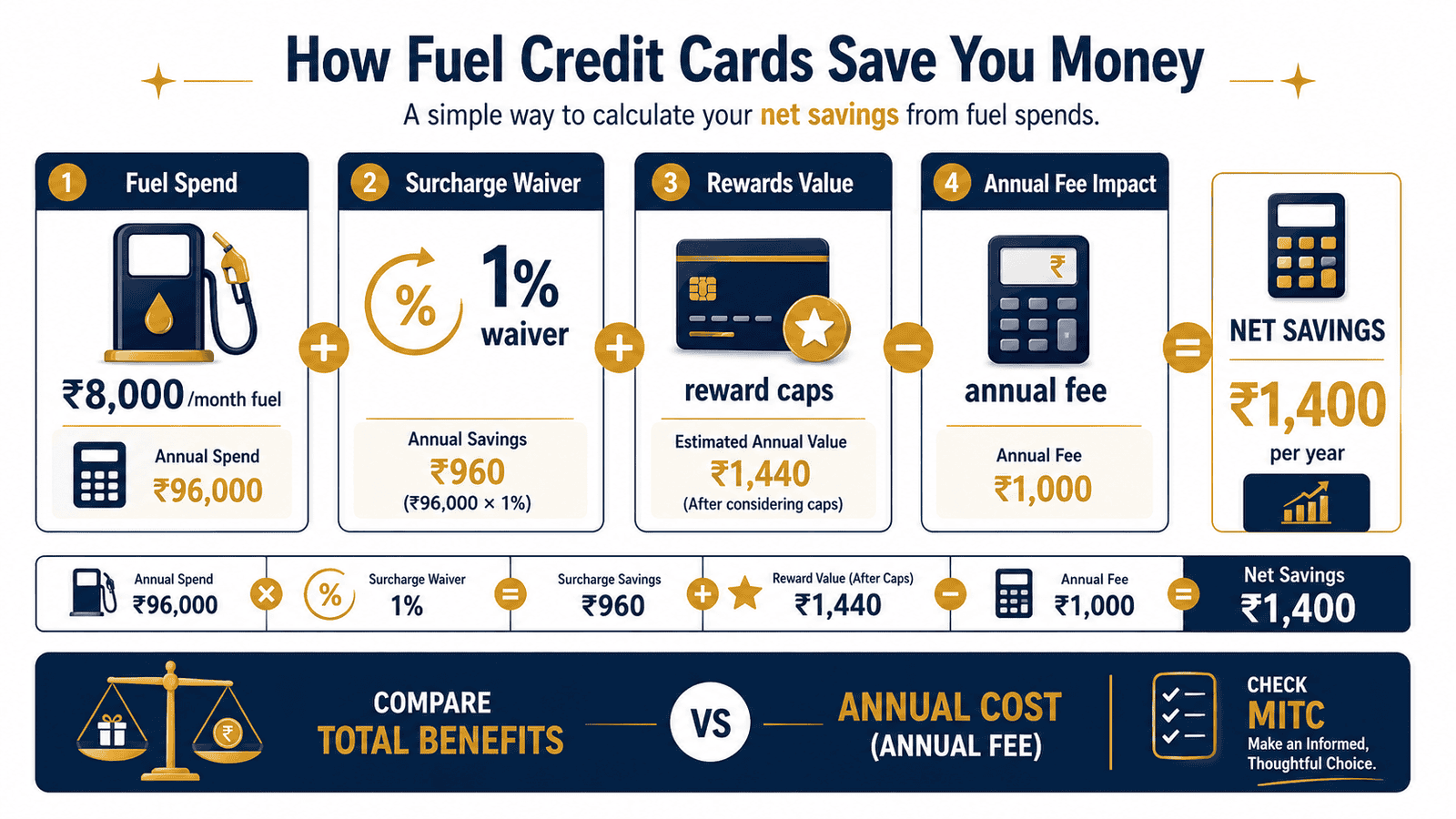
Rohit is 34 years old, works as an IT professional in Pune, and spends approximately ₹8,000 per month on petrol — around ₹96,000 per year. He fills up at a mix of pumps, not always the same brand. He holds a fuel credit card with a 1% surcharge waiver and accelerated reward points at partner pumps.
In a month where he fills up four times at ₹2,000 each, all transactions fall within the eligible range. The gross surcharge waiver is 1% of ₹8,000 = ₹80. However, his card’s monthly waiver cap is ₹100, so the full ₹80 is credited — no cap issue this month. GST on the surcharge (18% of ₹80) = ₹14.40 is charged separately; his card does not waive this component. Net waiver saving this month: ₹80 − ₹14.40 = ₹65.60.
On reward points: two of his four fill-ups were at partner pumps and earned 5x points. The other two were at non-partner stations earning 1x. Assuming 1 reward point = ₹0.25 at redemption, his monthly point value is modest — and points accumulate only if he remembers to redeem them before expiry.
Annualised, his surcharge waiver is roughly ₹787. After deducting an annual fee of ₹500 (assuming no fee waiver threshold is met), his net saving from waiver alone is approximately ₹287 per year. This example is illustrative only and does not reflect any specific card’s current terms.
How to Calculate Real Annual Savings
Net Annual Saving = (Surcharge Waiver − GST on Waiver) + Redeemable Reward Value − Annual Fee − Other Charges
Using Rohit’s figures: annual fuel spend = ₹96,000. Gross surcharge waiver at 1% = ₹960. GST on surcharge at 18% (if not waived) = ₹172.80. Net waiver = ₹787.20 — but only if the monthly cap is never hit and all transactions are within the eligible range. In practice, some months will hit the cap and reduce this figure.
| Scenario | Annual Fuel Spend / Monthly Cap | Estimated Net Saving After Fee |
|---|---|---|
| Low spender, ₹3,000/month | ₹36,000 / cap rarely hit | Close to zero or negative after ₹500 annual fee |
| Moderate spender, ₹8,000/month | ₹96,000 / cap hit some months | ₹200–₹600 net, depending on card terms and fee waiver |
| High spender, ₹15,000/month | ₹1,80,000 / cap hit most months | Diminishing returns — cap limits savings despite high spend |
All figures above are illustrative. Actual savings depend on each card’s specific waiver rate, cap, GST treatment, reward rate, redemption value, and annual fee — verify all figures from the official MITC before applying.
How to Decide What’s Right for You
You consistently use one fuel brand (IndianOil, HPCL, or BPCL) and spend ₹6,000 or more per month — THEN a co-branded card from that brand’s banking partner is likely your most rewarding option; verify current reward rates and partner pump availability in your city before applying.
You fill up at whichever pump is nearest and do not stick to one brand — THEN a general flat-rate cashback card that does not restrict fuel rewards to a partner network may deliver more consistent savings.
Your typical fuel transaction is below ₹400 or regularly above ₹4,000 (illustrative range — verify with issuer) — THEN check whether your transactions actually fall within the eligible range; if not, you may earn no surcharge waiver at all.
Your monthly fuel spend is below ₹4,000 — THEN the gross annual waiver may not exceed the card’s annual fee; run the net savings calculation before applying.
You spend enough to meet the annual fee waiver threshold — THEN factor in whether that extra spend is genuinely needed, or whether you are buying things you would not otherwise buy just to avoid a ₹500–₹1,000 fee. Understanding the billing cycle helps you plan payments so fuel savings are not lost to interest.
You cannot pay the full credit card bill every month — THEN a fuel credit card will almost certainly cost you more in interest than it saves in surcharge waiver or rewards; do not apply until you have consistent full-payment discipline.
Common Mistakes to Avoid
Ignoring the Monthly Reward or Waiver Cap
Most fuel credit cards limit the surcharge waiver or reward points earned on fuel to a monthly maximum. Many applicants read the headline “1% surcharge waiver” without noticing the ₹100/month ceiling buried in the MITC.
If you spend ₹10,000/month on fuel and the cap is ₹100, your maximum annual waiver is ₹1,200 — not 1% of ₹1,20,000 = ₹1,200. In this case they match, but if the cap is ₹50/month, your actual maximum is ₹600/year regardless of how much you spend.
Always read the MITC cap figure and multiply by 12 to get maximum annual waiver value.
Forgetting GST on the Surcharge
The 1% fuel surcharge has 18% GST charged on top of it. If your card waives the surcharge but not the GST on the surcharge, your effective saving is 1% minus 18% of 1% — approximately 0.82% of the transaction, not 1%.
Some cards explicitly refund both components; others do not. Check the fees and charges schedule before applying.
Assuming All Petrol Pumps Qualify
Co-branded cards earn accelerated rewards only at partner network pumps. Swiping an IndianOil co-branded card at an HPCL station may earn base points only — or no waiver at all, depending on the card’s terms.
Map your regular fuel stops against the card’s partner network before choosing a co-branded card.
Not Converting Reward Points to a Rupee Value
A card that earns 10x reward points on fuel sounds excellent until you discover that 1 point = ₹0.15 at the redemption options available to you. The effective earn rate is 10 × ₹0.15 = ₹1.50 per ₹100 spent — or 1.5% cashback equivalent.
Always check the point-to-rupee conversion for the specific redemption method you plan to use before comparing cards. Also review annual fee waiver conditions to understand whether the card is truly cost-free for your spend level.
Taking a Card Only for the Joining Bonus
Many fuel cards offer free fuel vouchers or bonus points on joining. These are one-time benefits, not a recurring saving. Once the bonus is used, the card must justify itself through ongoing rewards and waiver value minus the annual fee.
Evaluate the card on its steady-state annual value, not the joining bonus.
Missing the Annual Fee Waiver Spend Threshold
Cards that offer annual fee waiver typically require a minimum total spend (illustrative example: ₹50,000/year or ₹3,50,000/year — verify the actual threshold for your specific card from the official card page) before the following year’s fee is waived. If your annual spend falls short by even ₹1, the fee is charged in full.
Track cumulative spend 2–3 months before the anniversary date to avoid a surprise deduction.
Carrying a Balance While Chasing Fuel Rewards
Credit card interest in India typically runs at 3–4% per month. Earning ₹100 in surcharge waiver and then paying ₹400 in interest on a carried balance means the card has cost you ₹300 net in that month alone.
Set up an auto-debit for the full outstanding amount on or before the due date every month without exception.
When This May Not Be the Right Choice
A fuel credit card may not be worth it if your monthly petrol spend is consistently below ₹3,000–₹4,000 — at that level, the annual surcharge waiver value is unlikely to exceed a standard annual fee, and the net saving is zero or negative.
If your commute is irregular — using a mix of petrol, metro, or rideshare depending on the week — a co-branded fuel card will underperform because too many months will see low or zero fuel transactions.
If you already hold a well-structured general cashback card earning 1.5–2% on all spends, switching to a fuel-only card may reduce your overall reward earnings outside of fuel purchases. Run the full-portfolio calculation before switching. If you ever carry a balance, understand exactly how credit card interest is calculated in India — the cost will almost certainly exceed your fuel savings.
If any of these apply to your situation, it may be worth exploring alternatives before committing.
Official Rules and Where to Verify
Fuel surcharge, waiver terms, reward rates, redemption values, and annual fees for any credit card in India can change without prior notice. The only authoritative source for current terms is the issuer’s official documentation. Before applying for or renewing any fuel credit card, verify the following:
- The card’s official product page on the bank’s website (axisbank.com, hdfcbank.com, sbicard.com, icicibank.com, or the relevant issuer)
- The Most Important Terms and Conditions (MITC) document — download it from the official card page before applying
- The fees and charges schedule, which separately lists surcharge treatment and GST handling
- The reward programme terms document, which specifies point-to-rupee conversion rates and expiry rules
- Your credit card statement after the first fuel transaction — this confirms whether surcharge, waiver, rewards, and GST are being processed as expected. Learn how to read every line of your credit card statement so you can verify this yourself.
- RBI’s credit card directions for broad cardholder rights and issuer obligations — rbi.org.in
Rules, limits, and rates on this topic can change with each Budget or regulatory update. Always verify current figures directly from the official source before making any financial decision.
Expert Tips
- Use your fuel card only at pumps where the accelerated reward rate applies. Swiping it at a non-partner pump for the convenience may earn you base points only — the same as using any other card. Keep a note of which pump brands qualify under your card’s terms.
- Keep your transaction amount within the eligible range for each fill-up. If your card’s surcharge waiver applies to transactions between ₹400 and ₹4,000, consider splitting a very large fill-up into two separate transactions — but only if your card’s terms do not prohibit this; check the MITC first.
- Redeem reward points before they expire. Set a calendar reminder six weeks before expiry to redeem or at least check your balance. Points that lapse represent real money lost.
- Review your monthly statement for the surcharge and waiver entries after every billing cycle. If the waiver is not appearing, raise a service request with the bank immediately rather than waiting for it to accumulate as a dispute.
- Compare your net annual benefit every 12 months. Card terms change, annual fees increase, and reward structures get revised. What was a good deal when you applied may no longer be optimal — run the net savings calculation again using the updated MITC each anniversary.
- Do not inflate your fuel spend or add unnecessary purchases just to hit the annual fee waiver threshold unless the spending is genuinely needed. The cost of unnecessary purchases always exceeds the annual fee you are trying to avoid.
- If your card offers a statement credit redemption option (reward points converted to a direct statement credit), this is usually the most transparent and instantly useful redemption method — check whether your card offers it and at what conversion rate.
Frequently Asked Questions
Are fuel credit cards in India worth it?
They can be, for regular fuel spenders who pay their bill in full every month. The key is to calculate net annual savings — surcharge waiver plus reward value minus annual fee minus GST on surcharge — rather than relying on headline rates. For someone spending ₹8,000/month, net savings may range from ₹200 to ₹800 per year depending on the card; for a ₹3,000/month spender, the card may break even or cost money after the annual fee.
What exactly is a fuel surcharge waiver?
Petrol pumps in India levy a surcharge — typically around 1% — on credit and debit card transactions. A fuel surcharge waiver means the bank credits this charge back to your statement on eligible transactions. The waiver applies only to transactions within a specified amount range and up to a monthly cap — both figures vary by card and must be verified in the MITC.
Is the GST on fuel surcharge also refunded?
Not always. GST at 18% is charged on the surcharge amount. Some cards waive the surcharge but not the GST on it; others waive both. This distinction is important — if GST is not refunded, your effective saving is approximately 0.82% of the transaction amount, not 1%. Check the fees and charges schedule of your specific card to confirm which components are waived.
Which is better: fuel reward points or direct cashback on fuel?
Direct cashback is simpler — it reduces your statement balance automatically with no action required and no expiry risk. Reward points can be worth more per rupee spent if you redeem them for the right option (typically fuel vouchers at partner stations), but they require active management. If you are likely to forget to redeem or your points expire before use, direct cashback is the safer choice. See a full breakdown in our guide on reward points vs cashback credit cards.
Do fuel credit cards work at all petrol pumps in India?
The surcharge waiver typically applies at all petrol pumps, but the accelerated reward rate on co-branded cards applies only at partner network stations. A card co-branded with IndianOil will earn its highest reward rate at IndianOil pumps only. Non-partner pumps earn base reward rates. Always confirm the partner pump network before applying if you intend to use the accelerated rate as a primary reason for the card.
Can using a fuel credit card affect my CIBIL score?
Yes — in both directions. Using the card regularly and paying the full outstanding amount on time every month will build a positive payment history and help your CIBIL score over time. Missing payments, paying only the minimum amount due, or using a large proportion of your credit limit will hurt your score. The credit card’s impact on your CIBIL score depends on your repayment behaviour, not the fact that it is a fuel card.
What monthly fuel spend makes a fuel credit card worthwhile?
There is no universal threshold, as it depends on the specific card’s annual fee, waiver cap, and reward rate. As a starting check: multiply the monthly waiver cap by 12 and compare it to the annual fee. If the maximum possible annual waiver is less than the annual fee, the card cannot pay for itself on waiver alone — you need reward points or cashback to bridge the gap. For most cards as of recent data, a monthly fuel spend of ₹5,000–₹6,000 or more makes a dedicated fuel card more likely to deliver net positive value.
What is an MITC document and why does it matter for fuel cards?
MITC stands for Most Important Terms and Conditions. It is the binding legal document that governs all card terms, including surcharge waiver eligibility, transaction limits, reward rates, caps, expiry rules, and fees. Every card issuer is required to provide this document. Before applying for any fuel credit card, download and read the MITC from the bank’s official website — it is the only source that overrides brochure claims or verbal promises.
What happens if I do not pay my fuel credit card bill in full?
If you carry a balance, the bank charges interest on the outstanding amount — typically at 3–4% per month. On a ₹10,000 outstanding balance, this is ₹300–₹400 in interest for one month alone. This will erase several months of surcharge waiver savings in a single cycle. There is no fuel reward or surcharge waiver that offsets credit card interest at these rates. Set up an auto-debit for the full outstanding amount to avoid this entirely.
Can I get a fuel credit card as my first credit card?
It depends on your income, credit profile, and the issuer’s eligibility criteria. Some fuel co-branded cards require a minimum income or an existing credit history. If you are applying for your first credit card, a broader entry-level card that also offers fuel benefits may be easier to obtain than a specialist co-branded card. Before narrowing your choice to a fuel-focused card, read our guide to choosing your first credit card in India.
Final Verdict
Fuel credit cards in India are genuinely useful for salaried employees who spend ₹5,000 or more per month on petrol, consistently use one or two fuel brands, and pay their credit card bill in full every month. For this profile, the combination of surcharge waiver, accelerated reward points or cashback, and a waived annual fee can produce a net annual saving of several hundred to over ₹1,000 — modest, but real. The savings are not guaranteed at headline rates: the monthly cap, GST treatment, non-partner pump restrictions, and annual fee all reduce the net figure.
For irregular fuel users, low spenders, or anyone who sometimes carries a credit card balance, a general cashback card may serve better. Before applying, shortlist two or three cards, download their MITC documents, run the net savings formula with your actual monthly fuel spend, and compare. Always verify the latest rules from official sources or consult a qualified professional before making any financial decision.
This article is for educational purposes only and should not be treated as personalised financial, tax, investment, insurance, or legal advice. Tax rules, interest rates, regulatory limits, and product features can change with each Budget or policy update. Please verify current rules from official government sources or consult a qualified and registered professional before making any financial decision.

Nikhil Bansal writes about credit cards, billing cycles, card charges, rewards, cashback, credit utilisation, card EMI, BNPL, and responsible credit usage in India. His content is designed for readers who want to use credit cards wisely without falling into expensive repayment mistakes.
He covers topics such as how to choose a first credit card, credit card billing cycle, due date, grace period, minimum amount due, credit utilisation ratio, reward points vs cashback, lifetime free credit cards, annual fee waivers, credit card statement reading, add-on cards, cash advance charges, EMI on credit cards, credit card fraud reporting, BNPL vs credit card, and foreign transaction fees.
Nikhil’s writing is beginner-friendly, direct, and risk-aware. He explains how small mistakes such as paying only the minimum due, withdrawing cash from a credit card, missing due dates, or overusing credit limits can become costly. Since card fees, interest rates, reward rules, waiver conditions, and bank offers change often, readers should verify the latest Most Important Terms and Conditions from the card issuer.