

Most women searching for term insurance start with one question: which plan has the lowest premium? That is a reasonable starting point — but it is not the right ending point. If you are a salaried woman with a home loan, a child, and parents who depend partly on your income, the cheapest ₹50 lakh policy may leave your family with a fraction of what they actually need. According to IRDAI, term insurance is a pure risk product — the payout reaches your family only if you pass away during the policy term. Getting that cover amount right matters more than saving ₹500 a year in premium. This article explains exactly how to think about term insurance as a working woman, homemaker, single mother, or loan co-borrower — without ranking insurers on data that changes every quarter.
Quick Answer: Best Term Insurance for Women
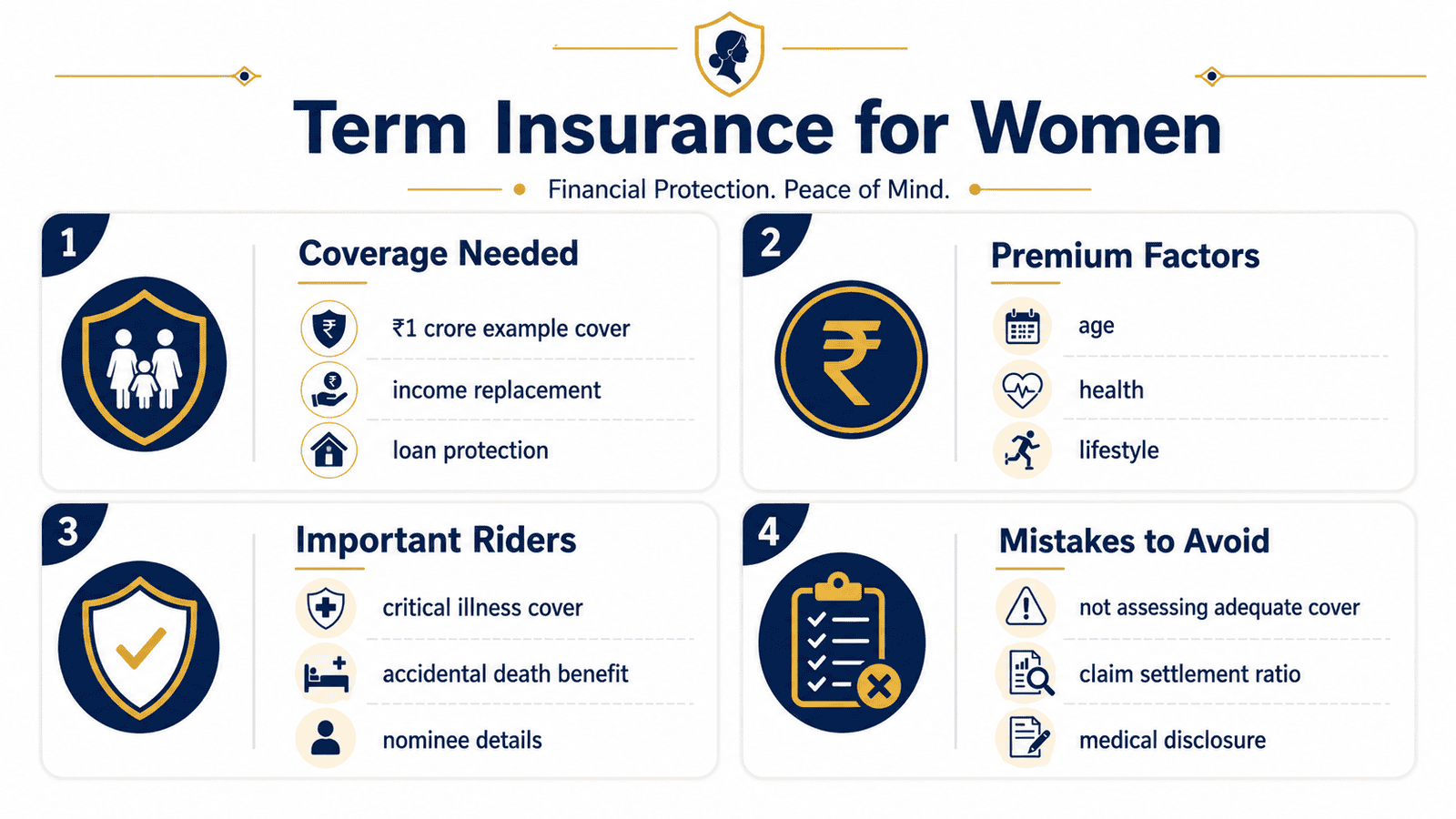
Best term insurance for women should offer enough life cover to replace income, repay loans and protect dependants, not just the lowest premium. A working woman or homemaker may need ₹1 crore or more depending on income, liabilities, children, spouse dependency and existing assets. Premiums vary by age, health, smoking status, sum assured, policy term and insurer — so no single plan is universally best. Compare cover adequacy, insurer claim settlement ratio, policy exclusions, rider terms and affordability together before deciding.
Key Takeaways
- Term insurance is relevant for any woman whose death would create financial stress — not just for the primary earner in a household.
- Homemakers also need cover because unpaid household work — cooking, childcare, caregiving — has a real replacement cost that a surviving spouse would need to fund.
- Cover amount should be calculated using income, outstanding loans, child education costs and dependant expenses — not selected arbitrarily as ₹50 lakh or ₹1 crore.
- Non-disclosure of medical history, past surgeries, smoking, or pregnancy-related conditions is one of the most common reasons term insurance claims are rejected.
- Claim settlement ratio is one useful data point when evaluating insurers, but solvency ratio, exclusions and policy wording matter equally.
- Riders such as critical illness and waiver of premium can strengthen a policy — but they should complement adequate base cover, not replace it.
- Premium, rider terms and tax treatment change with IRDAI updates and annual Budgets — always verify current figures before purchasing.
Comparison: Term Insurance Scenarios for Women
| Who She Is | Cover Logic and Riders to Consider | Mistake to Avoid |
|---|---|---|
| Working woman with dependants (salaried, spouse and children rely on income) | Income replacement for remaining working years + outstanding loans + child education + dependant expenses. Consider critical illness rider and accidental death rider. Endowment policy comparison helps if you are weighing a savings-linked plan. | Underinsuring because husband also has a policy. Both incomes typically fund household expenses — losing either one creates a gap. |
| Homemaker (no direct income, manages household and childcare full-time) | Cover should reflect annual replacement cost of household services × years until children are financially independent. Add childcare, domestic help, elder care costs. Waiver of premium rider is worth examining. | Assuming no cover is needed because there is no salary. Household services have a market replacement cost that can run ₹3–6 lakh per year in urban India. |
| Single mother (sole earning parent with children) | Full income replacement + child education fund + outstanding loans. Longer policy term until youngest child is financially independent. Critical illness rider is particularly relevant given single-income risk. | Choosing a short policy term to reduce premium. A 20-year policy may be necessary if children are young. |
| Woman with home loan (co-borrower or sole borrower) | Outstanding loan amount must be part of the cover calculation — not optional. If the loan is joint, check whether spouse’s policy also covers the liability. Decreasing term rider or level cover are both options to understand. | Buying only ₹50 lakh cover on a ₹60 lakh outstanding loan. The mismatch leaves family with unserviceable debt. |
| Working woman with no dependants and no loans | Cover need is lower. Consider whether ageing parents are dependent on your income even partially. If not, health insurance and an emergency fund may be higher priority right now. | Buying a large policy out of social pressure without examining actual dependency. Use the cover calculator before deciding. |
Key Facts at a Glance
| Parameter | Detail |
|---|---|
| Product type | Pure life cover — no maturity payout if you survive the term |
| Payout type | Lump sum, monthly income, or combination — varies by insurer and plan |
| Common premium factors | Age, health status, smoking, sum assured, policy term, occupation, premium payment option |
| Common riders | Accidental death benefit, critical illness, waiver of premium, terminal illness |
| Minimum entry age | Typically 18 years (verify with insurer) |
| Policy term | Typically 5–40 years or up to age 99 — varies by insurer |
| Regulatory body | IRDAI — irdai.gov.in |
| Tax deduction on premium | Section 80C of the Income Tax Act — subject to current rules and income tax regime chosen |
For the basics of how pure protection works before comparing plans, read: Term cover basics.
How Term Insurance for Women Actually Works — And Why It Is Not Optional
Term insurance pays a death benefit to your nominee if you pass away during the policy term. That is the entire product. There is no investment component, no maturity payout and no savings element. According to IRDAI guidelines, this makes it the most efficient pure protection instrument — the premium buys only risk cover, which is why premiums are significantly lower than endowment or ULIP products for the same sum assured.
Why Women’s Cover Is Often Underestimated
A common pattern in Indian families: the husband has a ₹1 crore policy and the household believes it is “covered.” This logic has a gap. If the wife earns ₹14 lakh a year and also manages the household, her absence creates two simultaneous financial shocks — loss of income and the cost of replacing unpaid work. Neither gap is addressed by the husband’s policy.
For a homemaker, the financial impact is less visible but equally real. Urban households where a homemaker manages childcare, elder care, and household operations would typically need ₹3–6 lakh per year to replace those services in the market. Over a 15-year period, that is a ₹45–90 lakh liability that a surviving spouse must either absorb alone or fund externally.
Underwriting Factors That Affect Premium
Insurers assess risk using medical underwriting at the time of application. Your premium is influenced by age, body mass index, existing health conditions, family medical history, smoking status, occupation, and the sum assured you apply for. A 28-year-old non-smoker in good health will pay significantly less than a 42-year-old with diabetes applying for the same ₹1 crore cover.
Women are sometimes offered marginally different premium structures by some insurers based on mortality data — but this varies across companies and is not universal. What matters more is accurate disclosure. Any suppression of medical facts during application is grounds for claim rejection, regardless of gender.
Policy Term, Premium Payment Term and Sum Assured
Policy term is the period during which you are covered. Premium payment term is how long you pay. These are not always the same. A 30-year policy with a 15-year limited premium payment option means you pay for 15 years but remain covered for 30. Limited pay options reduce the risk of policy lapse due to missed premiums in later years — a practical concern for women who may take career breaks.
Sum assured is the most important decision. The Human Life Value method estimates your cover as a multiple of your annual income adjusted for liabilities and dependants. A simpler income replacement method uses: annual family expenses × years of support needed + outstanding loans − existing assets. Use whichever approach gives you a number that genuinely protects your family, not whichever justifies a smaller premium.
Real Example: Priya in Pune
Priya is 34 years old, a marketing manager in Pune earning ₹14 lakh per year. She has a home loan with ₹35 lakh outstanding, one child aged 6, and parents who depend on approximately ₹3 lakh per year from her income. Her husband is salaried but his income alone would not comfortably cover all household obligations.
Priya’s family needs: annual household expenses of roughly ₹7 lakh × 20 years = ₹1.4 crore in income replacement. Add ₹35 lakh for the home loan and ₹15 lakh as an estimate for the child’s higher education funding. That totals approximately ₹1.9 crore before subtracting any existing savings or her husband’s income contribution.
After accounting for her husband’s income and their savings of roughly ₹20 lakh, a reasonable base cover estimate would be ₹1.2–1.5 crore. A ₹50 lakh policy — which may look attractive because it has the lowest visible premium — would leave her family ₹65–100 lakh short of genuine financial security. Calculate your cover using a proper framework before selecting a sum assured.
How to Calculate the Cover You Actually Need
Cover Needed = (Annual Family Expenses × Years of Support) + Outstanding Loans + Future Goals − Existing Liquid Assets − Existing Life Cover
Step-by-step using Priya’s numbers above:
| Step | Calculation | Amount |
|---|---|---|
| Annual expenses × 20 years | ₹7 lakh × 20 | ₹1,40,00,000 |
| Add home loan outstanding | ₹35 lakh | ₹35,00,000 |
| Add child education goal | ₹15 lakh (illustrative) | ₹15,00,000 |
| Subtract existing savings | −₹20 lakh | −₹20,00,000 |
| Estimated cover needed | ≈ ₹1.70 crore |
These are illustrative figures only. Your actual calculation will differ based on your income, liabilities, dependants, assets and risk tolerance. Use the term insurance cover calculator to run your own numbers with current inputs.
How to Decide What’s Right for You
you earn an income and have dependants — spouse, children, or parents — who rely on you financially, THEN you almost certainly need term cover, and the sum assured should reflect the full income replacement need, not a round number.
you are a homemaker with young children and an employed spouse, THEN cover is still worth evaluating — because childcare, household management and elder care are financial costs if you are not there to provide them unpaid.
you are a single mother, THEN a longer policy term — typically until your youngest child reaches financial independence — and a higher sum assured are both more important than minimising premium.
you have an outstanding home loan and are either the sole borrower or a co-borrower, THEN your cover should include the outstanding principal — because your family would face that liability regardless of the loan’s purpose.
you are considering a critical illness rider, THEN read the specific conditions covered, waiting periods, and survival clause in the insurer’s policy wording — not just the brochure. See critical illness protection for a detailed breakdown of what these riders actually cover.
you are planning a career break for maternity or caregiving, THEN choose a limited premium payment option carefully — or ensure the annual premium is affordable even on a reduced income, to avoid lapse risk.
you have no dependants, no loans, no parents relying on your income, and strong household assets — then a large term cover may not be your most urgent financial priority right now. Health insurance and an emergency fund may deserve your attention first.
Common Mistakes to Avoid
Choosing the Cheapest Policy Without Checking Insurer Quality
A low premium from an insurer with weak claim settlement history can result in a rejected or delayed claim when your family needs it most.
Premium is one variable. Claim settlement ratio, solvency ratio, and the insurer’s reputation for handling disputes are equally important inputs. A ₹300 annual difference in premium is not worth compromising on claim reliability.
Before shortlisting an insurer, check their claim settlement data published by IRDAI, and read about insurer claim ratio evaluation.
Underinsuring Because the Woman’s Income Is Seen as Secondary
Many women — and their families — treat the woman’s income as supplementary and buy a token ₹25–50 lakh policy as a result.
If your income services any loan, funds any household expense, or supports any dependant, its loss creates a real financial gap. A ₹25 lakh payout on a ₹35 lakh outstanding loan is not protection — it is a partial buffer. Calculate the actual shortfall before deciding on sum assured.
Use the Human Life Value method or income replacement method to anchor your cover decision in numbers, not assumptions.
Not Disclosing Medical History at the Time of Application
This is the single most common reason term insurance claims are rejected.
Non-disclosure of diabetes, hypertension, thyroid conditions, PCOD, past surgeries, mental health treatment, or smoking status during application gives the insurer legal grounds to repudiate a claim — even years later. The insured’s family receives nothing.
Disclose everything accurately, even if it increases your premium. The premium increase is always smaller than the risk of a rejected claim.
Choosing a Very Short Policy Term to Save Premium
A 20-year policy expiring at age 54 may seem long enough — but if you have a 6-year-old child and a home loan that matures at age 58, your coverage gap could span four years of significant financial exposure.
Map the policy term against your longest outstanding financial obligation or your youngest dependant’s expected financial independence date, whichever is later.
Not Updating Nominee Details After Major Life Events
Marriage, childbirth, divorce, and the death of a nominee are all events that require nominee updates. An outdated nominee on record means the death benefit may be paid to the wrong person — or may face legal dispute.
Review and update nominee details with your insurer after every major life event. This takes one visit or one online form — do not defer it.
Buying Riders Without Understanding Their Terms
A critical illness rider sounds comprehensive, but the list of covered conditions, waiting periods, and survival clauses vary significantly across insurers and policy wordings.
Some riders cover 10 conditions; others cover 36. Some require survival for 30 days post-diagnosis; others differ. Read the specific policy schedule, not the sales brochure, before deciding whether a rider adds genuine value for your health risk profile.
When This May Not Be the Right Choice
Term insurance is not automatically the right first purchase in every situation.
If you have no dependants, no outstanding loans, and your parents are financially independent — your immediate priority may be a good health insurance policy and a six-month emergency fund rather than a large term cover.
If your employer already provides group life cover and your personal obligations are low, verify the exact sum assured in that group policy before purchasing additional cover. Many employer-provided policies cover only two to three times annual salary — often insufficient for women with significant loans or dependants, but adequate for those with minimal obligations.
At advanced ages or with serious pre-existing conditions, term insurance premiums can become unaffordable. In such cases, professional financial and medical advice is important before applying, as the policy may be declined or loaded significantly by the insurer.
If any of these apply to your situation, it may be worth exploring alternatives before committing.
Official Rules and Where to Verify
Term insurance in India is regulated by the Insurance Regulatory and Development Authority of India. Before purchasing any policy, verify the following directly from official sources:
- IRDAI — irdai.gov.in: Insurer registration status, grievance redressal channels, claim settlement data published annually, and consumer education resources.
- Your insurer’s policy document: Benefit illustration, policy bond, exclusion list, rider terms, waiting periods, and claim process. Do not rely on the sales brochure alone.
- Income Tax Department — incometax.gov.in: Current rules for Section 80C deduction on premiums and Section 10(10D) on death benefit — both are subject to change with each Budget and depend on the income tax regime you have chosen.
Rules, limits, and rates on this topic can change with each Budget or regulatory update. Always verify current figures directly from the official source before making any financial decision.
Expert Tips
- Buy cover while you are young and healthy — premium increases with age and any new health diagnosis. A ₹1 crore policy at age 28 typically costs significantly less than the same cover at age 38, all else being equal.
- Calculate your cover first, then shop for premium. Selecting a sum assured because the premium looks affordable is the reverse of the correct process.
- If you plan a career break, opt for a limited premium payment term or confirm that the annual premium is affordable even at reduced income — a lapsed policy provides zero cover.
- Store policy documents, policy number, insurer’s claim helpline, and nominee details in a place your family can access without you. A policy that exists but cannot be found at claim time creates unnecessary delays and legal complications.
- Revisit your cover after every major financial event: new home loan, salary increase by more than 30%, new child, career change or retirement of a dependant parent. Your cover need changes with your life — set a calendar reminder to review every two to three years.
- Do not conflate group health insurance from your employer with life insurance. They are different products covering different risks. For broader family financial planning, see the family insurance checklist.
- If a rider’s annual premium exceeds 20–25% of your base premium, evaluate whether a standalone policy for that risk (such as a separate critical illness policy) is more cost-effective. Riders are priced differently across insurers.
Frequently Asked Questions
Is term insurance cheaper for women?
Some insurers have historically offered marginally lower premiums to women based on actuarial data showing longer average life expectancy. However, this varies by insurer and policy, and the difference is not consistent across all products. The more important variables are age, health status, sum assured and policy term — not gender alone. Always compare quotes for your specific profile.
Can a housewife buy term insurance in India?
Yes, a homemaker can buy term insurance, though insurer requirements vary. Some insurers require proof of the spouse’s income and may cap the sum assured as a proportion of household income. The rationale is that the household has a financial interest in the homemaker’s life — childcare, caregiving and household management all carry a replacement cost. Check the specific insurer’s underwriting guidelines before applying.
How much term insurance should a working woman buy?
There is no universal number. The cover should reflect your annual income, outstanding loans, years until dependants are financially independent, and existing assets. A rough starting point: 10–15 times your annual income, adjusted upward for significant loans or multiple dependants, and downward for substantial existing assets or other life cover. Use the cover calculation guide for a structured approach.
Is ₹1 crore term insurance enough for women in all cases?
Not necessarily. For a 28-year-old earning ₹8 lakh with minimal loans and one dependant, ₹1 crore may be adequate. For a 34-year-old earning ₹14 lakh with a ₹35 lakh home loan, two dependants and ageing parents, ₹1 crore may fall short. The only reliable way to answer this question is to run the cover calculation for your specific situation — not to use a generic benchmark.
Which riders are most useful for women?
Critical illness rider, accidental death benefit rider, and waiver of premium rider are the three most commonly relevant for women. Critical illness is worth examining if you want financial support upon diagnosis of specified conditions — but read the exact list of conditions covered and the survival clause before purchasing. Waiver of premium can be valuable if you are a single earner or plan a career break. Rider terms vary across insurers and policies.
Should a woman buy term insurance if her husband already has a policy?
Yes, if she earns income that funds household expenses, services loans, or supports dependants — because her husband’s policy covers his life, not hers. If she passes away, her income stops and her family faces that financial gap regardless of what the husband’s policy covers. Each earning adult in a household with dependants should have independent cover sized to their own income contribution and liabilities.
What documents are typically needed to apply for term insurance?
Standard requirements typically include identity proof, address proof, age proof, income proof (salary slips, Form 16 or ITR for working women), recent photographs, and medical reports if required by the insurer based on age and sum assured. Homemakers may need to provide the spouse’s income documents as well. The exact list varies by insurer and product — confirm with the insurer before applying.
Can a woman with a pre-existing health condition buy term insurance?
Yes, in most cases — but the insurer will assess the condition during medical underwriting. The policy may be issued at a higher premium (called a “loading”), with specific exclusions, or in some cases declined. The critical point is to disclose all conditions accurately. Non-disclosure of a known condition is grounds for claim rejection, which is far worse than a loaded premium. Consult the insurer’s underwriting team or a licensed insurance advisor for your specific health profile.
What happens if I miss premium payments on my term policy?
Most policies offer a grace period — typically 30 days for annual premium payment and 15 days for monthly — during which you can pay without losing cover. If you miss the grace period, the policy lapses and provides no cover. Some policies allow revival within a specified period upon payment of arrears and a health declaration. Check your specific policy’s revival terms. A lapsed policy during a period of high financial risk — active loans, young children — can leave your family completely unprotected.
Final Verdict
The best term insurance for women is not the cheapest policy available today — it is the policy that genuinely protects your family if you are no longer there. For a working woman with loans, dependants and financial obligations, that means calculating actual cover need, choosing an insurer with a credible claim record, disclosing all medical history accurately, and selecting riders only after the base cover is adequate. Homemakers should not dismiss the need for cover simply because there is no salary — household and caregiving services have real replacement value. Single mothers, loan co-borrowers and women supporting ageing parents all have distinct cover requirements that a generic cheapest-plan search will not address. Compare policy wording and official data from IRDAI before purchase. Always verify the latest rules from official sources or consult a qualified professional before making any financial decision.
This article is for educational purposes only and should not be treated as personalised financial, tax, investment, insurance, or legal advice. Tax rules, interest rates, regulatory limits, and product features can change with each Budget or policy update. Please verify current rules from official government sources or consult a qualified and registered professional before making any financial decision. Insurance is a subject matter of solicitation. Please read the policy document carefully before purchasing.

Priya Nambiar writes about insurance concepts for Indian families, salaried employees, self-employed professionals, and first-time policy buyers. Her content focuses on helping readers understand coverage, exclusions, claim conditions, premiums, riders, and policy documents before buying or renewing insurance.
She covers topics such as term insurance, health insurance, family floater plans, riders, critical illness cover, employer insurance vs personal insurance, waiting periods, exclusions, deductibles, co-payment, no-claim bonus, claim settlement, premium comparison, renewal rules, and tax benefits linked to insurance.
Priya’s writing is careful, consumer-focused, and policy-document oriented. She explains why insurance should be understood as financial protection, not just a tax-saving tool or investment substitute. Her articles encourage readers to compare coverage, understand limitations, and ask better questions before buying a policy. Premiums, exclusions, claim rules, and benefits vary by insurer, age, health, sum insured, and product type. Insurance is a subject matter of solicitation, and readers should read the official policy document carefully before purchasing.