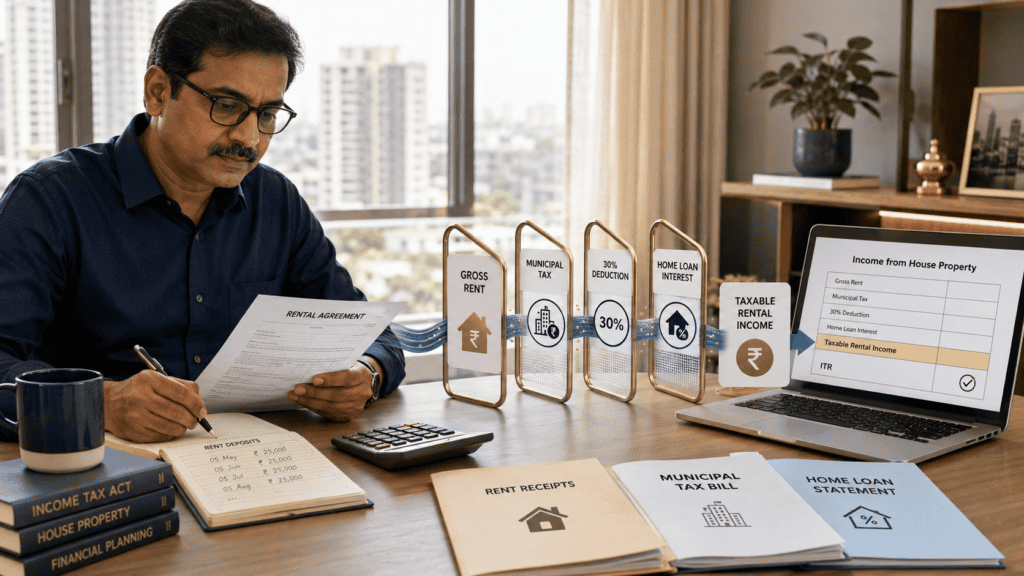

You’re standing at a site visit, and the sales executive says: “Don’t worry, the project is RERA registered.” Most home buyers nod and move on. But what does RERA registration actually mean for you — and what doesn’t it protect you from? Before you pay a rupee of booking money, you need to understand RERA in buyer language, not legal jargon. This article explains RERA meaning, what it protects, what it doesn’t guarantee, and the exact checks you must run on the relevant state RERA portal before committing to any project. If you’re buying your first home or planning a large under-construction purchase, start with our home buying guide for the full picture — then return here to understand RERA’s specific role.
Quick Answer: RERA Meaning
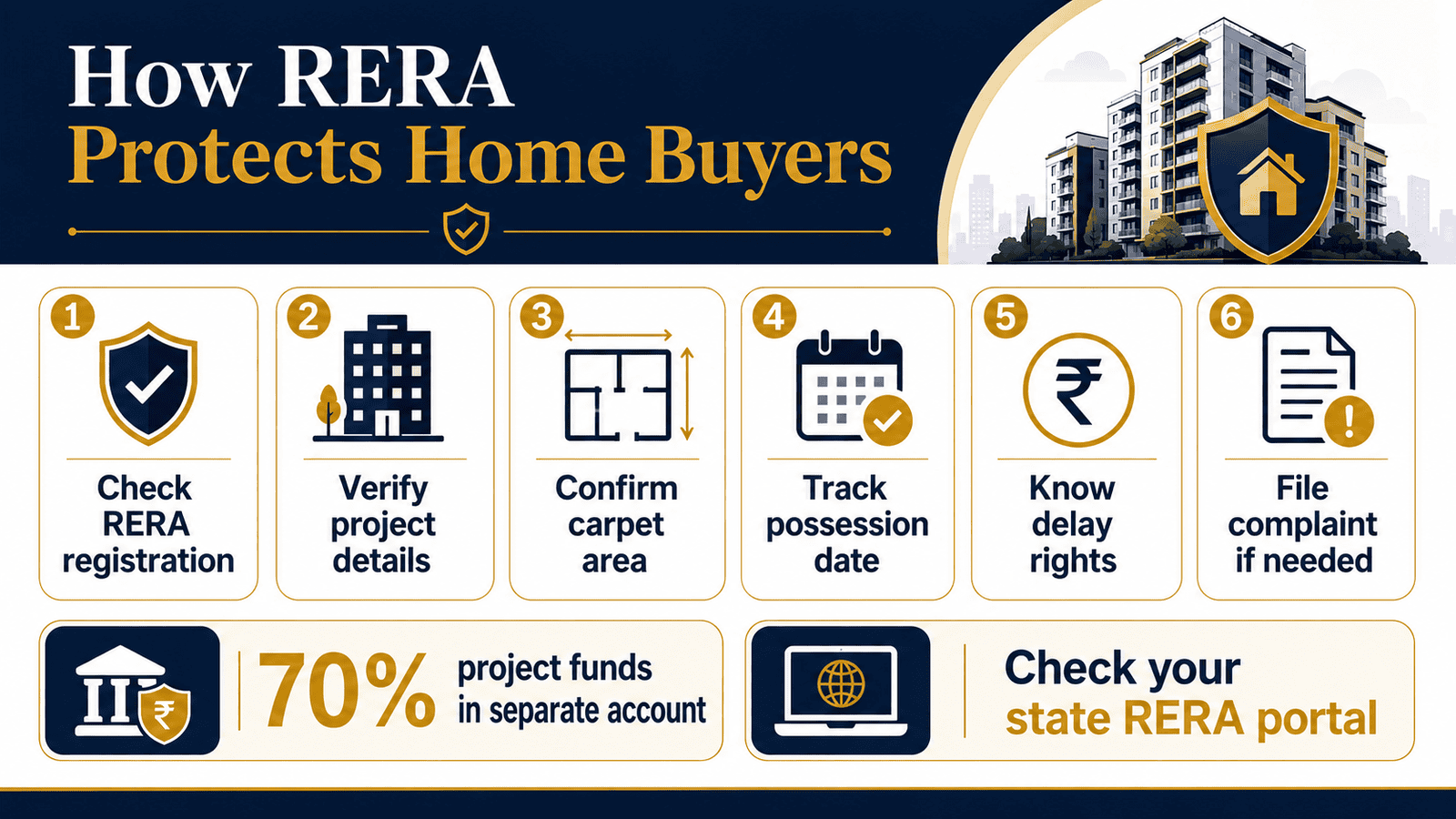
RERA meaning refers to the Real Estate Regulatory Authority framework under India’s Real Estate Act, 2016. It protects home buyers by requiring eligible projects to register, disclose key details, follow declared timelines, use 70% buyer collections in a separate project account, and provide a complaint mechanism.
Key Takeaways
- RERA full form is Real Estate Regulatory Authority — established under the Real Estate (Regulation and Development) Act, 2016 to bring transparency and accountability to Indian real estate.
- RERA protects buyers through mandatory project registration, carpet area disclosure, timeline commitments, promoter obligations, and a structured complaint route — not through a guarantee of project completion.
- RERA does not guarantee title clearance, construction quality, bank loan eligibility, or zero financial risk — buyers still need independent legal and financial due diligence.
- Always search the RERA registration number yourself on the relevant state RERA portal before paying any booking amount — do not rely on screenshots or brochures from the sales team.
- Under-construction buyers face more risk than ready-to-move buyers: RERA reduces that risk through disclosure requirements and complaint mechanisms, but does not eliminate it.
- State-level RERA rules and portal processes vary — thresholds, penalties, complaint formats, and registered project lists must be verified on the relevant state portal before taking action.
- RERA is the first gate in your buying checklist — not the final guarantee. Combine it with title verification, legal review, builder track record assessment, and EMI affordability planning.
Key Facts at a Glance
| Parameter | Detail |
|---|---|
| RERA Full Form | Real Estate Regulatory Authority |
| Governing Law | Real Estate (Regulation and Development) Act, 2016 |
| Applicable To | Eligible real estate projects and agents as per Act provisions and state rules — thresholds vary by state |
| Promoter Obligations | Register project, disclose details, maintain separate bank account, update portal, honour timelines |
| Buyer Rights | Access project disclosures, demand possession, claim compensation for delay, file complaint |
| Complaint Route | State RERA Authority → RERA Appellate Tribunal → High Court |
| Key Buyer Check | RERA registration number, promoter name, possession date, approvals, carpet area, updates |
| Central Resource | rera.mohua.gov.in |
RERA Meaning: What the Real Estate Act, 2016 Actually Does
Before 2016, Indian home buyers had almost no formal recourse when a builder missed possession dates by years, changed floor plans without notice, or sold the same unit to multiple buyers. Delays of three to five years were common. Buyers had paid in full — and had nothing to show for it.
The Real Estate (Regulation and Development) Act, 2016 changed that. RERA meaning, at its core, is a regulatory framework that shifts the balance between promoters and buyers — making it harder for builders to mislead, delay, or disappear.
Why India Needed a Real Estate Regulator
Before RERA, there was no single law governing real estate projects at a national level. Builders could advertise super built-up area as the sale area — hiding that your actual usable flat might be 30% smaller. Possession timelines were soft commitments. Buyer collections for one project could be quietly diverted to fund another. Complaints took years to resolve in civil courts.
According to provisions under the Real Estate (Regulation and Development) Act, 2016 — available on indiacode.nic.in — the law addresses these gaps through mandatory registration, disclosures, ring-fenced accounts, and a dedicated complaint mechanism.
How RERA Works at the State Level
RERA is a central law but implemented by each state and union territory through its own Real Estate Regulatory Authority. States like Maharashtra (MahaRERA), Karnataka, Telangana, and Tamil Nadu have active portals where buyers can search project details, check promoter history, and file complaints. Some states moved faster; others are still building full capacity. This means your rights and the specific procedures available to you depend on which state’s authority covers the project you are buying in.
The central Ministry of Housing and Urban Affairs maintains a RERA resources hub at rera.mohua.gov.in, but for project searches and complaint filing, you must go to the relevant state portal.
What Promoters Must Do Under RERA
Under Section 3 of the Act, promoters of eligible projects must register with the state RERA before advertising or selling units. Under Section 4, they must submit detailed declarations — project layout, approvals obtained, timeline, land title details, architect and engineer details, and the promoter’s own track record.
Under Section 4(2)(l)(D), promoters are required to deposit a specified percentage of buyer collections into a dedicated bank account to be used only for construction and land costs of that project — preventing funds from being diverted to other ventures. The Act specifies 70% as the floor; state rules may vary.
Allottee Rights in Practical Language
As an allottee — the legal term for a buyer — you have the right to receive all information disclosed by the promoter. You have the right to be informed of any change to the project. You have the right to demand possession on the date specified in the agreement. If the promoter fails, you can claim compensation or opt for a refund with interest, depending on circumstances. And you have the right to file a complaint with the state RERA authority if any of these rights are violated.
These are meaningful protections. But they are protections within the RERA system — they do not resolve pre-existing title disputes, construction defects, or insolvency proceedings, which fall under different legal frameworks.
Real Example: How Rohit Verifies a Project in Pune
Rohit Sharma, 34, a senior software engineer in Bengaluru earning ₹28 lakh per year, is planning to book an under-construction flat in Pune priced at around ₹90 lakh. The builder’s sales team shows him a glossy brochure with “RERA Registered” printed prominently and a WhatsApp message containing a RERA registration number.
Rohit does not take the number at face value. He opens the Maharashtra RERA portal himself and searches for the project by name. He verifies that the registration number matches the correct project, phase, and tower — not a different phase of the same project with a different promoter. He checks the declared possession date on the portal against what the brochure promises. He compares the carpet area mentioned in the project registration with what the sales team quoted him as the sale area. He looks at the approvals section to see which permissions have been obtained and which are still pending.
When he sees that the brochure possession date is six months earlier than what is declared on the portal, he asks for written clarification before paying any booking amount. He also reads through our guide on the home loan process in India to understand what happens between signing and taking possession.
Key insight: RERA gave Rohit the portal and the data. But it was his decision to check — and to pause — that protected him.
Comparison: RERA-Registered vs Unregistered vs Other Property Types
| Property Type | RERA Protection Level | Key Risks Remaining |
|---|---|---|
| RERA-registered under-construction project | Higher disclosure | Title, construction quality, builder financial health, legal approvals still need independent checks |
| Unregistered project (registration required by law) | Major red flag | No mandatory disclosures, no portal updates, complaint route weaker — avoid until verified |
| Ready-to-move completed property | Lower delay risk | Title, OC/CC (Occupancy/Completion Certificate), society formation, registration charges still apply |
| Pre-launch offer (before registration) | High caution | No RERA protections in place — do not pay until project is registered and documents verified |
For a detailed comparison of what these property types mean for your purchase decision and tax position, see our article on under-construction vs ready-to-move property.
How to Decide What’s Right for You
the project is an eligible under-construction property and you cannot find a valid RERA registration number on the state portal — THEN do not pay any booking amount until the promoter shows you the registration certificate directly from the official portal.
the RERA registration number checks out on the portal AND the possession date, carpet area, and approvals match the brochure and draft agreement — THEN proceed to the next layer of due diligence: legal title check, home loan eligibility, and builder track record.
you are buying a ready-to-move flat from a second owner — THEN RERA may have limited direct applicability; focus on title verification, outstanding dues, Occupancy Certificate, and property registration.
the project is being sold as a “pre-launch” with no RERA number yet — THEN treat the payment as high-risk; wait for registration before booking.
your monthly loan EMI on a ₹90 lakh home loan will exceed 40% of your take-home salary — THEN test your affordability first using our EMI planning tool before committing to the agreement for sale.
the builder is offering significant discounts for “immediate booking” before you have reviewed RERA disclosures, the agreement, or title documents — THEN slow down; urgency pressure is a common sales tactic.
you have not yet done a legal title check, reviewed the agreement for sale in full, and verified the RERA portal details independently — THEN RERA registration alone is not sufficient reason to proceed.
Common Mistakes to Avoid
Treating RERA Registration as a Safety Certificate
RERA registration means the promoter has declared certain details and complied with registration requirements — not that the project is financially sound, legally clean, or guaranteed to complete.
Buyers who skip title checks and legal review on the assumption that “RERA registered means safe” have found themselves in serious disputes. RERA registration is the starting point, not the finish line.
Always combine a RERA check with a title search report from a qualified lawyer before signing any agreement.
Not Verifying Whether the RERA Number Belongs to Your Specific Unit
Large projects are sometimes registered phase by phase or tower by tower, with different registration numbers for each phase. A sales team may show you one valid RERA number while the tower you are actually buying in has a separate — or pending — registration.
Go to the state portal yourself. Search by project name and verify that the registration covers the specific tower, phase, and type of unit being sold to you.
Never rely on a screenshot or a PDF shared by the builder. Search the portal directly.
Ignoring the Agreement for Sale Before Signing
The agreement for sale is the legally binding document. It must match the RERA portal disclosures on possession date, carpet area, payment milestones, and penalty terms. Many buyers sign without reading it fully — or after reading only the payment schedule.
Discrepancies between the brochure, the portal, and the agreement are red flags. A property lawyer reviewing the agreement before signing is money well spent. See our article on agreement to sale vs sale deed to understand the legal difference.
If the builder insists the agreement “cannot be modified,” that is still not a reason to skip reading it.
Relying Solely on Sales Team Claims or WhatsApp Brochures
Verbal promises about amenities, specifications, timelines, and added features have no legal standing unless they are in the registered agreement for sale.
If a sales executive promises early possession, a free car park, or upgraded fittings — get it in writing and verify whether it is reflected in the RERA disclosure and the agreement. What is not documented does not legally exist.
Not Keeping Documentation of Payments and Builder Communication
In the event of a RERA complaint or dispute, your case depends on evidence: receipts, allotment letters, demand notices, email confirmations, and payment records.
Buyers who paid by cash or cheque without retaining copies, or who lost email correspondence, have struggled to prove the timeline of payments in complaints. Keep a dedicated folder — physical and digital — for every document from booking to possession.
Paying Booking Money Before Seeing the Draft Agreement
Some builders collect booking amounts — often ₹1–5 lakh — before sharing the draft agreement. Once paid, buyers feel committed and are less likely to negotiate or walk away from unfavourable terms.
Ask for the draft agreement before paying booking money. Review it fully or have a lawyer review it. Only pay after you are comfortable with every clause.
When This May Not Be the Right Choice
Land title disputes or unclear ownership history: If the project land has unresolved disputes, RERA registration does not resolve them. Title verification by a qualified property lawyer is separate from — and prior to — RERA compliance checks.
Builder under financial stress: RERA mandates a separate account for buyer collections, but if a builder is already in financial distress or facing insolvency proceedings under the Insolvency and Bankruptcy Code, the RERA framework may interact with IBC proceedings in complex ways that require legal guidance — not just a portal check.
Pre-launch projects without registration: If the project is being marketed before obtaining RERA registration, the regulatory protections do not yet apply. Relying on RERA in this scenario offers no actual protection at the time of booking.
Resale flats from individual sellers: RERA primarily governs promoters (builders and developers). For resale transactions from an individual owner, the relevant checks are title, outstanding dues, OC/CC, and property registration — not RERA registration.
Expecting RERA to replace professional advisers: RERA provides a complaint forum and a disclosure framework. It does not replace the need for a property lawyer for title review, a banker for home loan structuring, or a tax professional for stamp duty and capital gains planning.
If any of these apply to your situation, it may be worth exploring alternatives before committing.
Official Rules and Where to Verify
RERA rules, thresholds, fees, complaint formats, and state portal processes can change. Always verify current figures and procedures from official sources before making any financial decision.
- India Code — indiacode.nic.in: Full text of the Real Estate (Regulation and Development) Act, 2016, including all sections and amendments.
- MoHUA RERA Portal — rera.mohua.gov.in: Central Ministry of Housing and Urban Affairs resources on RERA, FAQs, and links to state RERA authorities.
- State RERA Portals: Each state has its own authority — for example, MahaRERA for Maharashtra, Karnataka RERA, TG-RERA for Telangana. Verify current official domain names from the state government website or via rera.mohua.gov.in before using any portal. Use the state portal to search project registration status, promoter details, agent registration, complaint orders, and updates.
- State Registration Department: For stamp duty rates, property registration procedures, and encumbrance certificate details. See our guide on the property registration process.
- Income Tax Department — incometax.gov.in: Relevant where TDS on property purchase (above ₹50 lakh) or capital gains tax implications are applicable to your transaction.
Rules, limits, and rates on this topic can change with each Budget or regulatory update. Always verify current figures directly from the official source before making any financial decision.
Expert Tips
- Search the RERA number yourself on the state portal — not through a screenshot or PDF sent by the sales team. Sales material can be outdated, altered, or refer to a different phase. It takes under two minutes to search the official portal directly.
- Match the portal to the brochure, point by point — carpet area, possession date, approved plan, promoter name, and list of approvals. If any detail differs, ask for a written explanation before proceeding.
- Check whether your specific tower or phase is registered — in phased projects, RERA registrations can be separate. A valid number for Phase 1 Tower A does not cover Phase 2 Tower C.
- For purchases above ₹50 lakh, budget for TDS at 1% of the purchase price under Section 194-IA — this is a buyer obligation, not optional. Missing it creates a compliance issue even if RERA checks are clean.
- Before signing the agreement, have a property lawyer review it — especially the possession date, penalty clause, force majeure clause, payment milestones, and specifications. Legal review for a ₹90 lakh purchase typically costs ₹5,000–₹25,000 — a small fraction of what a bad clause can cost you.
- Keep a dedicated folder for all documents — allotment letter, agreement copy, payment receipts, demand letters, email chains. In any RERA complaint, your evidence is your case.
- Do not pay booking money based on urgency pressure — builders occasionally tell buyers the unit will be “blocked for someone else” within hours. RERA registration does not expire based on how fast you pay. Take the time you need.
Frequently Asked Questions
What is RERA full form?
RERA full form is Real Estate Regulatory Authority. It was established under the Real Estate (Regulation and Development) Act, 2016, which is the central law governing real estate project registration, promoter disclosures, and buyer rights in India.
Is RERA registration mandatory for every real estate project in India?
Not every project is required to register — the Act sets out thresholds based on land area and number of apartments, and state rules may apply additional criteria. Projects below the threshold may be exempt. However, if a project that meets the threshold is being marketed without RERA registration, that is a serious red flag. Always check the current thresholds applicable in the relevant state before relying on any exemption claim.
Does RERA registration mean the project is safe to buy?
No. RERA registration means the promoter has registered the project and submitted the required declarations. It does not mean the project has clear land title, all approvals in place, strong builder finances, or guaranteed completion. Registration improves transparency and gives you a complaint mechanism — it does not remove the need for legal due diligence.
How do I check RERA registration online?
Go to the relevant state RERA portal — for example, the MahaRERA portal for Maharashtra or the Karnataka RERA portal for Karnataka. Use the project search function and enter the project name or RERA registration number. Verify that the project name, promoter name, possession date, and carpet area match what you have been told. Do not rely on a screenshot shared by the builder — search the portal directly.
Can I file a complaint for possession delay under RERA?
Yes. If the promoter delays possession beyond the date specified in the agreement for sale, you can file a complaint with the state RERA authority. You may be entitled to compensation or a refund with interest, depending on circumstances and the state’s provisions. Procedures, timelines, and complaint formats vary by state — check the relevant state RERA portal for current instructions.
What is the RERA carpet area rule?
Under RERA, all sales must be based on carpet area — the actual usable floor area within the walls — rather than super built-up area, which includes common areas, walls, and passages. This prevents builders from quoting an inflated area that makes the per-square-foot price appear lower than it actually is. The carpet area must be disclosed in the agreement for sale.
What is the 70% separate account rule under RERA?
Section 4(2)(l)(D) of the Real Estate Act requires promoters to deposit a specified percentage of the amounts realised from allottees into a separate designated bank account, to be used only for that project’s construction and land costs. The central Act specifies 70% as the applicable share. State rules may vary. This rule is designed to prevent builders from diverting buyer collections from one project to fund another. Verify the current requirement for the relevant state from the state RERA portal or the Act text on indiacode.nic.in.
Is RERA applicable to resale flats?
RERA primarily governs promoters — builders and developers selling new or under-construction units. Resale transactions between individual sellers and buyers are generally not covered by RERA in the same way. For resale flats, focus on title verification, encumbrance certificate, outstanding society dues, OC/CC availability, and property registration procedures instead.
What happens if a builder violates RERA rules?
A promoter who violates RERA provisions — such as failing to register an eligible project, making false disclosures, or diverting funds — can face penalties under the Act. The state RERA authority has powers to impose monetary penalties and, in certain cases, imprisonment for repeat or serious violations. The specific penalty amounts and processes are set under the Act and state rules, which should be verified from the relevant state RERA portal.
Can RERA help me if a project gets stuck midway?
RERA gives you a complaint mechanism and the right to seek compensation or a refund if the promoter defaults on the agreed possession date. However, if a project stalls due to builder insolvency, the matter may enter IBC (Insolvency and Bankruptcy Code) proceedings, which operate separately. RERA and IBC may interact in complex ways in such scenarios — consult a property lawyer if your project is stuck for an extended period.
Final Verdict
RERA meaning, at its most practical, is this: it is India’s most significant buyer-protection framework in real estate, but it is a starting gate — not a finishing guarantee. For any under-construction purchase, RERA registration is non-negotiable: it gives you access to project disclosures, a complaint mechanism, timeline commitments, and a mandatory separate account for your funds. Buyers who skip the RERA portal check before paying are leaving themselves exposed.
At the same time, RERA does not clear title, guarantee construction quality, or protect you from builder insolvency. The buyers who get the best outcomes combine a RERA portal check with a legal title search, a thorough reading of the agreement for sale, an honest EMI affordability check, and a look at the builder’s track record on past projects.
Use RERA as your first layer of due diligence — then add the other layers on top. Always verify the latest rules from official sources or consult a qualified professional before making any financial decision.
This article is for educational purposes only and should not be treated as personalised financial, tax, investment, insurance, or legal advice. Tax rules, interest rates, regulatory limits, and product features can change with each Budget or policy update. Please verify current rules from official government sources or consult a qualified and registered professional before making any financial decision.

Neha Kulkarni writes about the financial side of home buying, renting, property decisions, and real estate costs in India. Her content helps readers think beyond the EMI and understand the total cost of owning or buying a home.
She covers topics such as rent vs buy, home loan planning, down payment, stamp duty, registration charges, brokerage, maintenance cost, property tax, furnishing cost, home insurance, builder payment plans, resale property checks, home loan affordability, total cost of ownership, and hidden costs in property decisions.
Neha’s writing is practical, family-focused, and cost-conscious. She uses Indian city examples, ₹ calculations, and decision checklists to help readers evaluate whether a property decision fits their income, savings, loan eligibility, and long-term plans. Her articles are useful for first-time home buyers, salaried couples, families, and people comparing rent with home ownership. Since property rules, stamp duty, registration charges, local taxes, home loan rates, and legal requirements vary by state and city, readers should verify current details from official state, lender, and legal sources.