

You open a mutual fund factsheet, scroll past the fund name and NAV, and spot a line that says “Total Expense Ratio: 1.82%.” It looks harmless. Less than 2%, right? How much damage can that actually do over time?
More than most investors realise. That annual percentage is not a one-time entry or exit fee — it is a recurring cost charged every year, built quietly into your returns. Over a 15-year SIP, even a 1% annual gap between two similar funds can leave a meaningful difference in final corpus.
The trouble is that expense ratio does not show up as a separate deduction on your statement. It is adjusted into the fund’s NAV, which means you never see it leave your account. You just see slightly lower returns — and often do not connect the two.
This article explains what mutual fund expense ratio is, how it is calculated and charged, how it affects a ₹5,000 monthly SIP over the long term, what the direct vs regular plan difference means for your costs, and how to use expense ratio sensibly — without making it the only thing you look at.
Quick Answer: What Is Mutual Fund Expense Ratio?
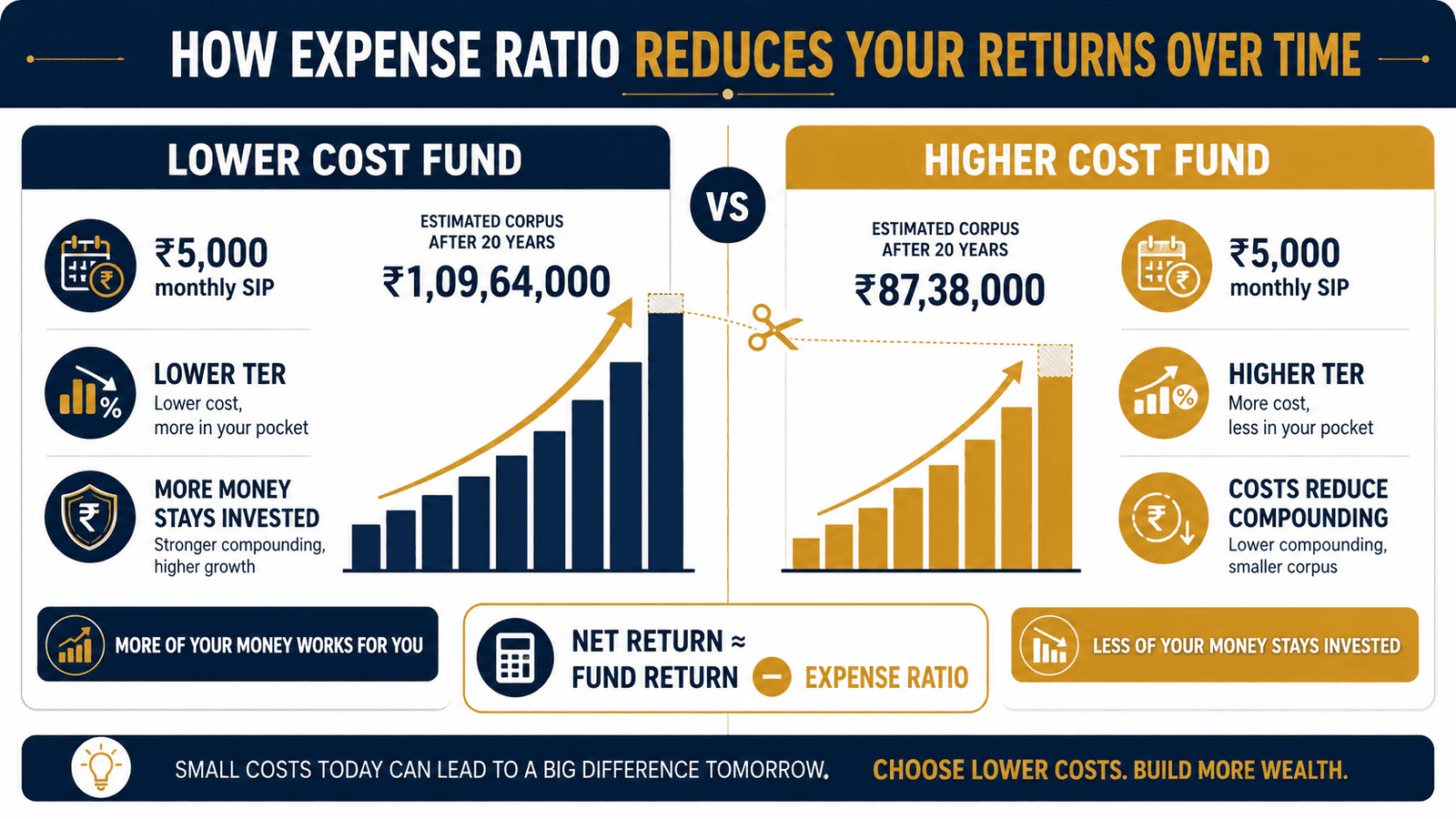
Mutual fund expense ratio is the annual cost a fund charges to manage your money. It is adjusted in NAV, not usually deducted separately. For example, on a ₹5,000 monthly SIP, even a 1% yearly cost difference can reduce long-term compounding noticeably over many years.
Key Takeaways
- Expense ratio is the annual cost a mutual fund charges to manage its scheme — expressed as a percentage of daily average net assets.
- It is not deducted from your account separately. It is factored into the fund’s NAV each day, so it reduces your net returns silently.
- Direct plans of the same fund consistently carry lower expense ratios than regular plans because no distributor commission is paid.
- For index funds, expense ratio is especially critical — two Nifty 50 index funds tracking the same benchmark can have noticeably different net returns purely due to TER differences.
- For active funds, a higher expense ratio can still make sense if the fund consistently delivers returns that outperform its benchmark after costs — but this must be verified, not assumed.
- SEBI mandates TER disclosure in fund factsheets and scheme documents. Investors can check the current expense ratio on the AMC’s official website before investing.
- Expense ratio matters most when comparing two similar funds in the same category. Do not compare equity fund TER with debt or index fund TER — different categories have different cost structures.
Key Facts at a Glance
| Concept | What It Means | Where to Find It |
|---|---|---|
| Expense Ratio / TER | Annual percentage of fund assets deducted as operating cost | AMC website, fund factsheet, SID |
| How It Is Charged | Adjusted into daily NAV — not a separate bank deduction | Visible through NAV movement |
| Direct vs Regular Plan | Direct plans have no distributor commission — lower TER | Plan name on factsheet or SID |
| Who Regulates It | SEBI sets category-wise TER limits for all mutual funds | sebi.gov.in |
| Index Fund TER | Generally lower than active funds due to passive management | Fund factsheet or AMC page |
| TER Disclosure | Mandatory — AMCs must publish TER for all schemes daily | AMC website and SEBI filings |
What Is Mutual Fund Expense Ratio — And How Does It Work?
Every mutual fund scheme has operating costs: paying the fund manager, maintaining records, custody of securities, auditing, compliance, and in regular plans, distributor commissions. The Total Expense Ratio (TER) bundles these costs into a single annual percentage and charges it against the scheme’s assets. If a fund’s TER is 1.5%, it means ₹1.50 per year is deducted for every ₹100 of assets under management.
What makes this easy to miss is how it is charged. You do not receive a deduction notice. There is no line item on your account statement that says “expense ratio deducted: ₹240.” Instead, the cost is built into the fund’s NAV calculation every single day.
What Is NAV and Why Does Expense Ratio Live Inside It?
NAV — Net Asset Value — is the per-unit value of a mutual fund scheme. It is calculated by dividing the total market value of the fund’s portfolio by the number of outstanding units. Every day, the fund’s assets are valued, and the daily portion of the annual TER is subtracted before the NAV is published. So the NAV you see is already net of fees. This is why investors often say the expense ratio is “built into returns” — because it literally is. For a deeper understanding of how mutual fund basics and fund structures work, that grounding helps before diving into cost comparisons.
Why Two Funds with Similar Portfolios Can Give Different Returns
Imagine two large-cap equity funds. Both invest in similar Nifty 100 stocks. Both produce a gross return of 13% in a year. Fund A charges a TER of 1%, Fund B charges 2%. Fund A’s investors receive approximately 12% net. Fund B’s investors receive approximately 11% net. Over one year on ₹1 lakh, that is a ₹1,000 gap. Over 15 years on a growing SIP corpus, the gap becomes substantially larger — because every year, the compounding base of Fund A’s investors is slightly higher.
According to SEBI guidelines, AMCs must disclose the TER of each scheme daily on their websites. This transparency exists precisely because SEBI recognises that TER directly affects investor returns. The Scheme Information Document (SID) and Key Information Memorandum (KIM) for every fund also carry the expense ratio — investors are entitled to this information before committing any money.
What Does TER Actually Cover?
The TER typically includes fund management fees paid to the fund manager, administrative and operational costs, registrar and transfer agent fees, custodian charges, audit fees, and in regular plans, distributor commissions. Direct plans eliminate the distributor commission component entirely — which is why direct plans of the same fund always carry a lower TER than the regular plan of that same fund.
SEBI caps TER at different levels for different fund categories. Equity funds generally have higher permissible TER ceilings than debt or liquid funds. Larger funds — those with higher AUM — are required to charge lower TER because the fixed costs are spread across a bigger asset base. Always check sebi.gov.in or the fund’s official SID for the current applicable limits.
Real Example: Rohit’s ₹5,000 SIP and the Hidden Cost Gap
Rohit is 31, a software engineer in Pune, earning ₹1.2 lakh per month. He invests ₹5,000 every month in mutual funds through SIPs. He is comparing two large-cap equity funds in the same category. Both have strong track records. The key difference: one is a direct plan with a TER of around 1%, and the other is a regular plan with a TER of around 1.7%.
Rohit assumes his money is working the same way in both funds — the underlying portfolio is nearly identical. What he does not immediately see is that the regular plan is giving 0.7% less return every year before any market difference comes into play. That 0.7% sounds small. But on a starting a SIP of ₹5,000 per month held for 20 years, even a 0.5% annual return difference can change the final corpus by lakhs.
The point is not that Rohit made a bad choice. It is that he was not comparing apples to apples. When he moves to the direct plan of the same fund, he keeps that 0.7% compounding in his favour every single year. This is the real cost of ignoring TER when two funds are otherwise similar.
All return figures above are illustrative examples only. Actual mutual fund returns depend on market conditions and are not guaranteed.
How to Calculate Expense Ratio Impact
Approximate Net Return = Gross Fund Return − Total Expense Ratio
This is a teaching simplification. In practice, mutual fund returns are calculated through daily NAV movement, and TER is factored in each day. But this formula helps you understand the direction of the impact: every percentage point of TER reduces your net return by roughly that amount.
Example: A fund earns 12% gross. TER is 1%. Your approximate net return is 11%. If TER were 2%, your net return drops to around 10%. The gross return is the same — only your share of it changes.
Now look at what this means over time for a ₹5,000 monthly SIP. The table below uses assumed returns for illustration. Actual results will differ based on market performance.
| Scenario | Assumed Net Return | Estimated Corpus After 15 Years |
|---|---|---|
| Low TER (approx. 11% net) | 11% p.a. | ≈ ₹23.9 lakh |
| High TER (approx. 10% net) | 10% p.a. | ≈ ₹20.9 lakh |
| Very High TER (approx. 9% net) | 9% p.a. | ≈ ₹18.3 lakh |
A 1% difference in annual net return — purely from TER — can reduce a 15-year SIP corpus by roughly ₹3 lakh on a ₹5,000 monthly investment. That is money that never left your bank account as a visible fee. It simply compounded for someone else instead of you. To understand how these return figures connect to CAGR and XIRR, it helps to understand fund returns across different calculation methods.
All corpus figures are illustrative, calculated using standard SIP compounding assumptions. They do not account for taxes, exit load, or market volatility. Actual returns will vary.
Comparison: Direct Plan vs Regular Plan — And Active vs Index Fund Costs
| Parameter | Direct Plan / Index Fund | Regular Plan / Active Fund |
|---|---|---|
| Expense Ratio Level | Lower | Higher |
| Distributor Commission Included | No | Yes |
| Fund Manager Role | Passive (tracks index) or self-managed direct | Active stock selection and rebalancing |
| Long-Term Return Impact | Higher net return if gross return is similar | May justify cost if alpha is consistent |
| Tracking Error / Difference | Key metric for index funds — check before investing | Not applicable |
| Investor Responsibility | Must choose and monitor independently | Advisor or distributor provides guidance |
| Typical TER Range (verify current caps) | 0.1–1.0% (direct/index) | 1.0–2.5% (regular equity active) |
To go deeper on the direct vs regular plan trade-off beyond just expense ratio, the full breakdown is available when you compare plan costs across all relevant dimensions.
How to Decide What’s Right for You
You are comparing two funds in the same category with similar long-term performance records — THEN check TER first; the lower-cost fund is likely the better choice, all else equal.
You are comfortable researching, selecting, and monitoring your own funds without a distributor — THEN direct plans will save you 0.5–1.5% per year in most equity categories.
You invest in index funds — THEN TER and tracking error are the two most important metrics; even a 0.2% TER difference matters significantly over 15–20 years on a passively managed fund.
You are invested in an active fund with a higher TER — THEN check whether the fund has consistently delivered returns above its benchmark and category average after costs before deciding to switch.
You need guidance from a registered advisor or distributor — THEN the regular plan TER may be worthwhile if they provide genuine ongoing advice and rebalancing support.
Do not choose a fund solely because it has the lowest TER in a category — if the fund has high tracking error, inconsistent returns, or is in the wrong category for your goal, low cost alone will not serve you well.
Common Mistakes to Avoid
Choosing Only the Lowest Expense Ratio Fund
Cost is one factor — not the only one.
A fund with a TER of 0.3% but poor tracking of its benchmark or inconsistent returns will underserve you even though it looks cheap. On a ₹10,000 monthly SIP, picking a consistently well-managed fund with 0.5% higher TER could still result in a larger corpus after 15 years if its actual returns are even 1% higher annually.
Compare TER only within the same category and plan type. Then look at performance consistency.
Not Checking the Direct vs Regular Plan Label
Many investors invest in a regular plan without realising it — simply because they used a third-party app or distributor portal.
Regular plans of the same fund can cost 0.5–1.5% more per year than the direct plan. Over 20 years of SIP investing at ₹10,000 per month, that cost difference runs into lakhs of rupees in foregone compounding — with no difference in the underlying portfolio.
Before investing, check whether the plan is labelled “Direct” or “Regular” on the transaction confirmation.
Comparing Equity Fund TER with Debt or Index Fund TER
These categories have different SEBI-mandated TER ceilings and very different cost structures.
An equity fund at 1.5% TER and an index fund at 1.5% TER are not equivalent — the index fund is expensive for its category; the equity fund may be at or below category average. Cross-category comparisons mislead.
Always compare within the same fund category.
Ignoring Exit Load and Tax Impact When Switching for Lower TER
A lower expense ratio looks attractive, but switching funds mid-investment triggers redemption tax and potentially exit load.
On equity funds, switching within one year triggers short-term capital gains tax. Switching after one year still triggers long-term capital gains tax above ₹1 lakh of gains. These switching costs can wipe out the TER saving you expected for several years.
Calculate total switching cost before moving to a lower-TER fund.
Treating TER as a Fixed Permanent Number
TER is not locked in forever. AMCs can revise it within SEBI-permitted limits.
A fund you entered at 1.2% TER may now charge 1.6% if the AMC has revised it upward. Many investors do not check this after their initial investment.
Review the current TER of your funds at least once a year through the AMC’s official website or factsheet.
Assuming Expense Ratio Is the Only Mutual Fund Cost
TER is the main ongoing cost, but not the only one.
Exit load, transaction charges on SIP (applicable in some platforms), stamp duty, and capital gains tax also affect your effective returns. A fund with a low TER but a 2% exit load within the first year can end up costlier than a slightly higher-TER fund with no exit load if you redeem early.
Look at the full cost picture — not just one number.
When This May Not Be the Right Choice
Prioritising expense ratio above all else can lead to poor fund decisions in certain situations.
If a fund is in a category or risk level that does not match your investment goal — for example, a small-cap fund when you need capital safety in three years — no level of low TER fixes that mismatch. Suitability comes before cost.
If a low-cost index fund has high tracking error or tracking difference relative to its benchmark, investors may actually get worse net results than a slightly higher-TER fund that executes cleanly. Before selecting an index fund based on cost, also check its choosing index funds criteria — tracking error, AUM stability, and liquidity.
If you are a first-time investor who genuinely needs ongoing guidance on fund selection, asset allocation, and rebalancing, switching to a direct plan purely to save TER — while losing the advisor relationship — can cost more in bad decisions than the TER saving is worth.
Finally, if switching to a lower TER fund triggers significant exit load or capital gains tax in the current financial year, the switching cost may outweigh years of TER savings. Run the numbers before acting.
If any of these apply to your situation, it may be worth exploring alternatives before committing.
Official Rules and Where to Verify
Expense ratio rules and TER limits for mutual funds in India are set and updated by SEBI. Before investing or switching funds, verify current figures directly from official sources:
- SEBI (Securities and Exchange Board of India) — sebi.gov.in — for current TER limits by fund category, regulatory circulars, and investor guidelines
- AMC official website — each fund house publishes daily TER for all schemes on its website, as mandated by SEBI
- Scheme Information Document (SID) and Key Information Memorandum (KIM) — available on the AMC website and SEBI’s MFSS portal — contain the expense ratio and all applicable charges
- AMFI (Association of Mutual Funds in India) — amfiindia.com — for fund-level data including NAV history and scheme details
Rules, limits, and rates on this topic can change with each Budget or regulatory update. Always verify current figures directly from the official source before making any financial decision.
Expert Tips
- Compare TER only within the same category and plan type. An equity active fund at 1.6% and an index fund at 1.6% are very different situations — the index fund is expensive relative to its category peers. Category context is essential.
- For index funds, check tracking difference — not just TER. Two Nifty 50 index funds may have similar TERs but different actual return gaps versus the index due to execution quality. Tracking difference over 1–3 years tells you the real cost story.
- Prefer direct plans if you are confident in independent fund selection. The TER saving in direct plans — often 0.5–1% per year on equity funds — compounds significantly over a 10–15 year SIP. But do not switch if it means losing qualified advisor support you genuinely rely on.
- Use a SIP calculator to test return sensitivity. Plug in different net return assumptions — 10%, 11%, 12% — to see how a 1% annual TER difference affects your corpus over your actual investment horizon. You can use SIP calculator to test these scenarios before making a fund decision.
- Review the TER of your existing funds once a year. AMCs can change TER within SEBI limits. Your fund’s TER when you first invested may not be the same today. Check the AMC’s official factsheet or website annually.
- Focus on net returns and consistency over claimed gross performance. Advertisements may reference gross or benchmark-relative returns. What matters is what reached investors after all costs over a 3–5 year period. Check fund factsheets for post-expense performance data.
Frequently Asked Questions
Is expense ratio charged separately from my investment?
No. The expense ratio is not deducted as a separate fee from your bank account or mutual fund account. It is factored into the fund’s daily NAV calculation. When you check your fund’s NAV, that figure is already net of the TER. You experience it as slightly lower returns — not as a visible deduction.
Is a lower expense ratio always better?
Not always. A lower TER is better when comparing two similar funds in the same category with comparable performance records. But if a lower-TER fund has poor tracking error, inconsistent returns, or is in the wrong category for your goal, low cost alone does not help. Within the same category and plan type — yes, lower TER is preferable, all else equal.
What is considered a good expense ratio for mutual funds in India?
This varies by fund category. For index funds and ETFs, a TER below 0.3% is generally considered competitive. For actively managed equity funds, anything in the 1–1.5% range (direct plan) is reasonable, though this depends on the fund’s category and AUM. SEBI sets category-wise TER caps — always verify current permitted limits at sebi.gov.in before comparing.
Why do direct plans have lower expense ratios than regular plans?
Regular plans include a commission paid to the distributor or broker who sold the fund to you. This commission is part of the TER. Direct plans bypass this entirely — you invest directly with the AMC without any intermediary, so no commission is paid, and the TER is lower by that amount. The underlying portfolio and fund manager are identical in both plans.
Does expense ratio affect NAV directly?
Yes. NAV is calculated after deducting the daily proportional share of the annual TER from the fund’s total assets. A fund with a higher TER will have a lower NAV — and therefore lower returns — compared to an otherwise identical fund with a lower TER. This is why direct plans of the same fund always have a higher NAV than regular plans over time.
Where can I find a fund’s current expense ratio?
The most reliable sources are the AMC’s official website (which must publish daily TER under SEBI guidelines), the fund’s Scheme Information Document (SID), and the Key Information Memorandum (KIM). You can also check fund aggregators, but always cross-verify with the official AMC page or sebi.gov.in before making a decision.
Can a mutual fund change its expense ratio after I invest?
Yes. AMCs can revise the TER within the limits set by SEBI. Your entry TER is not locked in. If an AMC increases its TER, existing investors are also affected. This is why SEBI requires AMCs to disclose TER changes transparently. Review your funds’ current TER at least once a year through the official AMC website or factsheet.
What happens if I switch from a regular plan to a direct plan of the same fund?
A switch from regular to direct is treated as a redemption followed by a fresh purchase. This means you may incur exit load (if within the exit load period) and capital gains tax on the gains realised at the time of the switch. For equity funds, short-term capital gains tax applies within one year, and long-term capital gains tax applies thereafter on gains above ₹1 lakh. Calculate the full switching cost before acting.
Is expense ratio the same as brokerage or transaction charges?
No. Expense ratio is an ongoing annual fund management cost reflected in NAV. Brokerage and transaction charges, if any, are separate and depend on the platform you use to transact. Some platforms charge a transaction fee on SIPs or lump sum purchases. Read the platform’s fee schedule separately from the fund’s TER. According to SEBI guidelines, AMCs cannot charge more than the permitted TER under any circumstances.
Final Verdict
Mutual fund expense ratio is one of the most underappreciated factors in long-term investing — not because it is complicated, but because it is invisible. It never shows up as a deduction. It simply reduces the return that compounds in your favour every year.
For most Indian investors comparing similar funds in the same category, lower TER is a meaningful advantage — especially over a 10–20 year SIP horizon. Direct plans are the simplest way to reduce this cost if you are comfortable managing your investments independently.
But expense ratio should not be your only lens. Category fit, risk alignment, performance consistency after costs, and tracking error (for index funds) all matter. A cheap fund in the wrong category, or a low-cost fund with poor execution, will not serve your financial goals.
Use TER as one rigorous input in your fund selection process — not as a shortcut. The practical goal is straightforward: for the same category, same risk level, and similar performance record, pay less. Every rupee you save in annual costs stays in your corpus and compounds over decades.
Always verify the latest rules from official sources or consult a qualified professional before making any financial decision.
This article is for educational purposes only and should not be treated as personalised financial, tax, investment, insurance, or legal advice. Tax rules, interest rates, regulatory limits, and product features can change with each Budget or policy update. Please verify current rules from official government sources or consult a qualified and registered professional before making any financial decision.

Arjun Kapoor writes about mutual funds, SIPs, ELSS, fund categories, investment returns, and beginner investing concepts for Indian readers. His focus is on education, not product promotion or fund recommendations. He helps readers understand how mutual funds work before they start investing or comparing schemes.
He covers topics such as mutual fund meaning, SIP meaning, SIP calculator, direct mutual funds vs regular plans, NAV, ELSS tax-saving funds, CAGR, absolute returns, XIRR, expense ratio, large cap vs mid cap vs small cap funds, flexi cap funds, index funds vs active funds, liquid funds, debt mutual funds, SIP pause vs SIP stop, lumpsum vs SIP, and how to start SIP in India.
Arjun’s writing is simple, risk-aware, and long-term oriented. He avoids guaranteed-return language and explains investment concepts using examples, timelines, and comparison tables. His articles remind readers that mutual fund investments are subject to market risks, and past performance does not guarantee future returns. Readers should verify scheme details from SEBI, AMFI, fund houses, and official scheme documents.