

Your employer’s health insurance covers the hospital bill. But what about the six months you cannot work at full capacity? The EMI that does not pause because you had a heart attack. The school fees still due while you are recovering. The travel costs for a second specialist opinion in another city. Normal health insurance was never designed to replace your income or cover every cost that follows a serious diagnosis — and that gap is exactly what critical illness insurance is built for. If you are a salaried earner with dependents and financial commitments, understanding this product is worth your time. This article covers what is included in critical illness insurance, what the exclusions are, how the survival period works, and whether you actually need it alongside your existing cover. Start with the bigger picture of family insurance basics if you are building your protection plan from scratch.
Quick Answer: Critical Illness Insurance
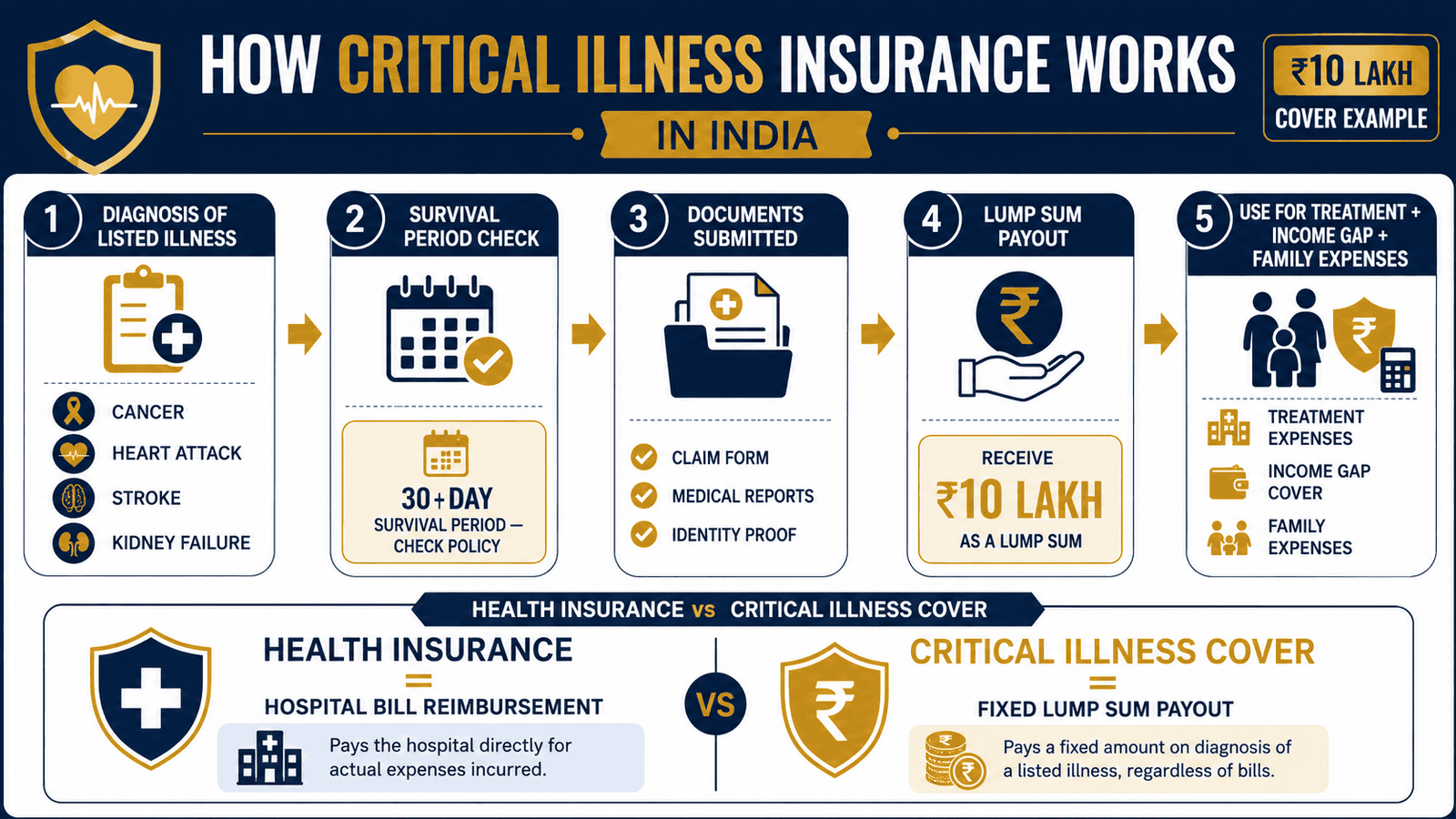
Critical illness insurance pays a fixed lump sum — for example, ₹10 lakh — if the insured survives a listed major illness like cancer, heart attack, stroke, or kidney failure, subject to policy terms. It is useful for salaried earners and families who need money beyond hospital bills, such as EMI, income loss, and recovery expenses. It is not a replacement for regular health insurance or term insurance.
Key Takeaways
- Critical illness insurance pays a fixed lump sum on diagnosis of a listed illness — it does not reimburse hospital bills the way a standard mediclaim policy does.
- The number of covered illnesses in a policy brochure means little without reading the actual disease definitions — a heart attack under one policy may require stricter clinical criteria than another.
- Most policies include a survival period — typically 30 days after diagnosis, though this varies — meaning the insured must survive that period before the claim is paid; always verify the exact term in your policy document.
- Waiting periods of 90 days or more are common for critical illness policies, so buying after a diagnosis or symptom onset will likely disqualify the claim.
- A ₹50 lakh critical illness cover costs significantly less in annual premium at age 30 than at age 45 — buying early locks in lower rates in most policies.
- This cover is most useful if you are the primary earner with EMIs, dependent family members, limited emergency savings, or a family history of listed conditions.
- If you do not yet have adequate base health insurance or term insurance, prioritise those first — critical illness cover fills a gap, not a foundation.
Key Facts at a Glance
| Parameter | What to Know |
|---|---|
| Policy type | Fixed benefit — pays lump sum, not reimbursement |
| Payout trigger | Diagnosis of a listed critical illness + survival period |
| Common covered illnesses | Cancer, heart attack, stroke, kidney failure, major organ transplant, paralysis, coronary artery bypass — verify each policy’s exact list |
| Survival period | Often 30 days after diagnosis; varies by insurer and plan — verify in policy document |
| Waiting period | Typically 90 days from policy start; pre-existing disease exclusions apply — verify in policy document |
| Common exclusions | Pre-existing conditions, early-stage cancers, excluded disease variants, non-disclosure, claims during waiting period |
| Useful for | Income gap, EMI continuity, second opinion travel, home care, recovery expenses, family support |
| Tax treatment | Premium may be eligible under Section 80D — verify current limits at incometax.gov.in |
| Regulator | IRDAI — irdai.gov.in |
How Critical Illness Insurance Works
Most Indians are familiar with a mediclaim or floater health insurance policy — you get hospitalised, the insurer pays the bill directly or reimburses you. Critical illness insurance works completely differently. It is a fixed benefit policy. When you are diagnosed with a listed illness and meet the policy conditions, the insurer pays you a pre-agreed lump sum. What you do with that money is your choice — it does not need to match a hospital invoice.
This matters because serious illness creates costs that no hospital bill captures. Consider a salaried employee who is diagnosed with a major cardiac event. The hospital bill may be largely covered by standard regular health cover. But the next six months of reduced income, the home loan EMI, the children’s school fees, the flights to a specialist in another city, the home nursing care — none of that appears on any hospitalisation claim. That is the gap critical illness cover is designed to address.
What “Listed Illness” Actually Means
Every critical illness policy covers a defined list of diseases. Common ones include cancer of specified severity, first heart attack meeting specific clinical criteria, stroke with permanent neurological deficit, kidney failure requiring dialysis, major organ transplant, paralysis of limbs, and coronary artery bypass surgery. But the headline disease count — “covers 36 critical illnesses” — tells you very little. What matters is the exact clinical definition in the policy wording. A “heart attack” under one policy may require a specific level of cardiac enzyme elevation that not every cardiac event will meet. An “early-stage cancer” may be explicitly excluded. Always read the policy document, not just the brochure.
Waiting Period and Survival Period: Two Separate Clocks
These two terms confuse most buyers, and both can affect whether a claim is paid. Understanding waiting period rules is essential before you buy.
The waiting period runs from the policy start date. Most critical illness policies do not cover any claim for the first 90 days or more. If you experience symptoms or receive a diagnosis within this window, the claim will likely be rejected. Pre-existing conditions typically have longer exclusion periods — sometimes several years. This is why buying when you are healthy and young matters.
The survival period is different. It is the minimum number of days the insured must survive after the qualifying diagnosis before the insurer releases the lump sum. A common example used in industry literature is 30 days, though this varies significantly across insurers and products — some policies use 14 days, others use longer periods. The survival period exists because the product is designed to help people live with and recover from a serious illness, not as a death benefit. Verify the exact survival period in your specific policy document before purchasing.
Standalone Policy vs Critical Illness Rider
You can buy critical illness cover in two ways. A standalone critical illness policy is a separate health insurance product. It typically covers more illnesses, offers higher sum insured options, may be renewed independently, and gives you more flexibility to compare insurers. A critical illness rider is an add-on to a term insurance or health insurance base policy — usually cheaper as an add-on, but the coverage breadth, definition quality, and claim conditions may be more limited. If your primary concern is maximising the disease list and claim flexibility, a standalone policy generally gives more room. If affordability is the constraint and you already have a term policy, a rider may be a practical starting point. Compare the actual disease definitions and claim conditions, not just the price.
Real Example: Rahul’s Diagnosis and the Cash-Flow Gap
Rahul is 36 years old, works as a software project manager in Pune, and earns ₹1.5 lakh per month. He has employer group health insurance of ₹5 lakh, a family floater for his wife and two children, a home loan EMI of ₹42,000 per month, and school fees of ₹8,000 per month. His emergency fund covers about two months of expenses.
He is diagnosed with a listed critical illness — a cardiac event requiring a specific procedure. His employer health insurance and family floater together cover most of the hospitalisation cost. But Rahul needs four months of reduced work before he can return to full capacity. His monthly income drops significantly during recovery. His EMI does not pause. His school fees continue. He needs a second specialist opinion in Mumbai, costing ₹25,000 in travel and consultation fees. Home nursing for six weeks adds another ₹40,000.
A critical illness policy with a ₹25 lakh sum insured — if he had bought one — would have paid him a lump sum after diagnosis and survival of the policy’s required period, subject to the disease definition and claim documentation matching. That amount would cover EMI continuity, income shortfall, specialist travel, and recovery care without liquidating savings or taking a personal loan. His hospital bill would still be handled by his health insurance separately.
This is illustrative only. Actual claim eligibility depends entirely on the policy document, the clinical diagnosis meeting the policy’s exact disease definition, and the insurer’s claim assessment.
How to Estimate Whether You Need Critical Illness Cover
There is no universal formula, but a structured estimate helps. Think in terms of cash-flow disruption, not just treatment cost.
Estimated Need = (Monthly household expenses × 6 to 12 months) + Total EMIs for recovery period + Non-hospital medical costs − Emergency fund available for illness disruption
Work through each component for your own situation.
| Component | Example (Rahul) | Your Estimate |
|---|---|---|
| Monthly household expenses × 6 months | ₹90,000 × 6 = ₹5.4 lakh | — |
| EMI commitments for 4-month recovery | ₹42,000 × 4 = ₹1.68 lakh | — |
| Non-hospital costs (travel, care, diagnostics) | ₹65,000 estimated | — |
| Less: Emergency fund available | ₹1.8 lakh (2 months) | — |
| Approximate gap | ~₹5.9 lakh | — |
Cover amounts of ₹10 lakh, ₹25 lakh, or ₹50 lakh are common in the market — treat those as reference ranges only. Your actual need depends on your income, liabilities, dependents, recovery scenario, and existing savings. Use this estimate as a starting point when comparing policies, not as a recommendation. The term insurance cover calculator can help you cross-check your broader income protection needs alongside this exercise.
Comparison: Critical Illness vs Other Insurance Products
| Product | Payout Trigger | Best Use Case |
|---|---|---|
| Critical illness insurance | Diagnosis of listed illness + survival period | Income gap, EMI, recovery costs beyond hospitalisation |
| Standard health insurance | Hospitalisation or specified medical event | Hospital bills, surgery, treatment costs; reimburses actuals |
| Term insurance | Death of insured during policy term | Family income replacement after death; not triggered by illness alone |
| Accidental disability insurance | Accident causing disability as defined | Income loss from accident-related disability; does not cover illness |
| Standalone CI policy | As above; broader disease list typically | More flexibility, more diseases, independent renewal |
| CI rider on term plan | As above; rider-specific conditions apply | Lower cost add-on; disease list and definitions may be narrower |
How to Decide What’s Right for You
You are the primary earner and your family’s monthly expenses, EMIs, and commitments depend on your income — THEN critical illness cover may be worth evaluating alongside your existing health and term insurance.
You have a home loan, car loan, or other large EMI commitments that cannot pause during a 3–6 month recovery — THEN a lump sum illness payout could prevent a debt stress situation.
Your only health cover is an employer group policy that does not travel with you if you change jobs or are laid off — THEN building personal portable cover that includes critical illness protection may reduce future exposure. See why employer health cover is often not enough on its own.
You have a family history of cancer, cardiac disease, or kidney conditions — THEN buying early while healthy may improve eligibility and keep premiums lower over time.
You are comparing a standalone policy versus a rider — THEN compare the actual disease definitions, survival period, claim process, and renewability terms, not just the annual premium difference.
You do not yet have adequate base health insurance, a term policy with adequate cover for dependents, or a minimum emergency fund — THEN critical illness insurance should not be your first purchase. Build the foundation first.
The listed diseases in your shortlisted policy have definitions that are unlikely to match your specific risk profile due to exclusions or clinical criteria — THEN the policy may provide less real cover than the brochure suggests.
Common Mistakes to Avoid
Counting Diseases Instead of Reading Definitions
A policy that covers 40 illnesses is not automatically better than one covering 20, if the definitions for critical conditions like heart attack or cancer are written with stricter clinical criteria that fewer real-world cases will meet.
Read the actual disease definition in the policy document — not just the brochure headline. A “heart attack” may require specific enzyme markers and ECG findings above a threshold. Early-stage cancers are commonly excluded.
Ask the insurer or agent to show you the policy wording for your highest-risk conditions before purchasing.
Ignoring the Survival Period
Many buyers assume the lump sum is paid immediately on diagnosis. Most critical illness policies require the insured to survive a specified period — often cited as 30 days in industry examples, though this varies — after a qualifying diagnosis before releasing the payout.
This affects whether family members receive funds during the most critical phase. Verify the exact survival period clause in the policy document, not in sales material.
If the survival period is a concern, compare policies where this period is shorter or absent for specific conditions.
Treating It as a Substitute for Health Insurance
Critical illness insurance pays a lump sum — it does not cover hospital bills, day-care procedures, surgery costs, or doctor fees the way a standard health insurance policy does.
Without base health cover, a serious illness could wipe out the lump sum on hospitalisation costs alone, leaving nothing for the income gap it was meant to fill.
Always maintain adequate health insurance first. Critical illness cover fills the gap above and beyond it.
Choosing the Lowest Premium Without Checking the Insurer’s Claim Record
A cheaper policy from an insurer with a poor claim settlement history for critical illness products may cost more in the end if your claim is disputed or delayed.
Check the insurer’s claim settlement record — look specifically at health or critical illness products, not just overall ratio. Read consumer grievance data available via IRDAI’s annual report at irdai.gov.in.
A difference of ₹1,500 in annual premium is not worth buying from an insurer with a contested claim process.
Not Disclosing Medical History Accurately
This is the most expensive mistake. If you have a pre-existing condition — hypertension, diabetes, a prior cardiac episode, or any known health issue — and do not disclose it accurately at proposal, the insurer may reject your claim citing material non-disclosure, regardless of whether the non-disclosed condition caused the illness claimed.
Disclose everything accurately. Let the insurer decide what to exclude. A policy with an exclusion for a known condition is still useful for all other listed illnesses.
Non-disclosure that leads to claim rejection cannot be reversed after the fact.
Buying Without Understanding Exclusions for Your Risk Profile
Common exclusions include pre-existing diseases within the exclusion period, congenital conditions, self-inflicted injuries, specific cancer types or stages, and illnesses caused by substance abuse.
If your highest personal risk — based on family history or existing health — falls into an excluded category under the policy you are considering, compare alternatives before buying.
Ask for the full exclusions list in writing before signing the proposal.
When This May Not Be the Right Choice
Critical illness insurance is not the right next purchase for everyone. If your base health insurance cover is inadequate — meaning your family floater or individual policy sum insured would not cover a major hospitalisation — fix that first. A serious illness that exhausts your health insurance and then your critical illness lump sum leaves you in a worse position than one layer of solid health cover would.
If you have dependents but no term insurance, the priority order is generally: health insurance, term insurance, emergency fund — and then supplementary products like critical illness cover. Buying a critical illness rider to feel covered while skipping term insurance is a misallocation of limited premium budget.
If the premiums for adequate critical illness cover — say ₹25 lakh or more of sum insured — would require you to reduce your health insurance or term insurance cover to afford it, do not make that trade.
If your medical history means that most of the high-value conditions in the policy are already excluded for you, the actual cover you are buying may be far narrower than the price implies.
If any of these apply to your situation, it may be worth exploring alternatives before committing.
Official Rules and Where to Verify
Critical illness insurance products in India are regulated by the Insurance Regulatory and Development Authority of India. Rules, limits, and rates on this topic can change with each Budget or regulatory update. Always verify current figures directly from the official source before making any financial decision.
- IRDAI (Insurance Regulatory and Development Authority of India) — irdai.gov.in: Regulatory guidelines for health and critical illness products, consumer education, grievance redressal, and insurer-level data.
- Your insurer’s official policy document: The Customer Information Sheet (CIS) and full policy wording are the only authoritative sources for your specific covered diseases, exclusions, survival period, waiting period, claim process, and renewability terms. Do not rely on aggregator comparison tables or sales brochures.
- Income Tax Department — incometax.gov.in: For current Section 80D deduction limits applicable to health insurance premiums, including critical illness policies. Verify the applicable limit for your age and family composition before claiming. See current health premium deduction rules and examples for context.
Expert Tips
- Secure adequate base health insurance and a term policy with sufficient cover for your dependents before evaluating critical illness insurance — these are foundational, not optional. Check waiting period rules early so you buy well before you need the cover.
- When comparing policies, open the actual policy wording document and read the disease definitions for your top three risk concerns — cancer, cardiac, and stroke. Do not compare brochure headlines.
- Buy when you are young and healthy. A ₹25 lakh critical illness policy purchased at age 30 will typically carry a significantly lower annual premium than the same cover purchased at 42, and you are more likely to qualify without exclusions while healthy.
- For salaried earners with a home loan, size your critical illness cover to cover at least 12 months of EMI plus 6 months of household expenses. This is a practical anchor — it tells you whether ₹10 lakh cover is actually adequate for your cash-flow risk or whether ₹25–50 lakh makes more sense.
- If buying a rider to a term plan, verify independently whether the rider can be claimed simultaneously with your term policy if both conditions are met — and whether the base sum insured of the term plan is reduced after a rider claim. Read the rider conditions, not just the base policy.
- Keep a digital folder with your policy document, Customer Information Sheet, and all medical disclosure records made at proposal time. If a claim is ever disputed on non-disclosure grounds, having your original proposal form and what was disclosed is your primary defence.
- After buying, check the renewal process and premium revision terms. Some critical illness policies revise premiums substantially at renewal after a certain age or after a claim. Know this before you lock in a long-term financial commitment.
Frequently Asked Questions
Is critical illness insurance worth buying in India?
It can be — but only after base health insurance and term insurance are in place. For salaried earners with dependents, EMIs, and limited emergency savings, a critical illness diagnosis without this cover can create severe cash-flow pressure beyond hospital costs. Whether it is worth it for you depends on your income structure, liabilities, family health history, and what your existing insurance already covers.
What diseases are usually covered under a critical illness insurance policy?
Most policies include cancer of specified severity, first heart attack meeting specific clinical criteria, stroke with permanent neurological deficit, kidney failure requiring dialysis, major organ transplant, coronary artery bypass surgery, and paralysis of limbs. The exact list and clinical definitions vary by insurer and product. Always verify the full disease list and the specific clinical definition for each illness in the policy document — the brochure list is not the binding source.
Is cancer always covered under critical illness insurance?
Not always in full. Many policies exclude early-stage cancers, carcinoma-in-situ, skin cancers of specified types, and cancers below a defined staging threshold. The policy may cover only cancers of a “specified severity.” Before buying, check whether the cancers most relevant to your family history meet the policy’s definition of a qualifying diagnosis.
What is the survival period in critical illness insurance?
The survival period is the minimum number of days the insured must survive after a qualifying diagnosis before the insurer pays the lump sum. A commonly cited example is 30 days, though this varies across insurers and products — some use 14 days, some use longer periods. This is different from the waiting period (which applies at policy start). Verify the exact survival period in your specific policy document before purchasing.
Is critical illness insurance different from regular health insurance?
Yes, fundamentally. Standard health insurance reimburses hospitalisation and treatment costs — it pays the hospital or pays you back for bills. Critical illness insurance pays a fixed lump sum on diagnosis of a listed illness, regardless of actual medical expenses. You can use the lump sum for anything: income replacement, EMI, recovery costs, travel, or household expenses. Both serve different purposes and are not substitutes for each other.
Should I buy a standalone critical illness policy or a rider on my term plan?
A standalone policy typically covers more illnesses, allows higher sum insured, and can be renewed independently. A rider is usually cheaper as an add-on but may have a narrower disease list, stricter definitions, and claim conditions tied to the base policy terms. If income protection against illness is a serious concern, a standalone policy generally gives more flexibility. If affordability is the constraint and you already have a term plan, a rider is a reasonable starting point — but read the rider’s conditions carefully before assuming it equals standalone cover.
Can I claim both my health insurance and critical illness insurance for the same illness?
Generally yes — critical illness insurance pays on diagnosis (a fixed benefit), while health insurance pays for hospitalisation costs (reimbursement). They are different products with different payout triggers, so a qualifying diagnosis can trigger both. However, always verify with your specific insurers and read both policy documents to confirm there are no exclusions or conditions that affect simultaneous claims.
Is the premium for critical illness insurance eligible for deduction under Section 80D?
Premiums paid for health insurance policies, including critical illness policies classified as health insurance under the Income Tax Act, may be eligible for deduction under Section 80D. The deduction limit depends on your age, the age of covered family members, and the current rules applicable for the financial year. Verify the current 80D limits and eligibility conditions at incometax.gov.in before claiming this deduction — limits can change with each Budget.
What happens if I am diagnosed during the waiting period?
If a diagnosis occurs within the policy’s initial waiting period — typically 90 days from the policy start date, though this varies — the claim will almost certainly be rejected. Pre-existing conditions have separate and often longer exclusion periods. This is why purchasing well before any symptoms or health concerns arise is essential. A policy purchased after symptoms have appeared is unlikely to cover the resulting claim.
Final Verdict
Critical illness insurance addresses a real and underappreciated risk for Indian salaried families: the financial disruption that follows a serious illness, beyond what hospital insurance covers. If you are the primary earner, carry EMIs, have dependents, and would face serious cash-flow strain during a 3–6 month recovery — this product is worth evaluating seriously.
It is not a replacement for base health insurance, term insurance, or an emergency fund. Buy those first. Critical illness insurance fills the layer above them — income protection and non-medical recovery costs — not the foundation beneath them.
The right policy depends on the actual disease definitions, exclusions, survival period, waiting period, claim process, and renewal terms — not the headline illness count or the lowest premium. Compare policy documents, not brochures. Check the insurer’s claim record. Disclose your medical history accurately. And verify current tax treatment and regulatory rules from IRDAI and the Income Tax Department before purchasing. Always verify the latest rules from official sources or consult a qualified professional before making any financial decision.
This article is for educational purposes only and should not be treated as personalised financial, tax, investment, insurance, or legal advice. Tax rules, interest rates, regulatory limits, and product features can change with each Budget or policy update. Please verify current rules from official government sources or consult a qualified and registered professional before making any financial decision. Insurance is a subject matter of solicitation. Please read the policy document carefully before purchasing.

Priya Nambiar writes about insurance concepts for Indian families, salaried employees, self-employed professionals, and first-time policy buyers. Her content focuses on helping readers understand coverage, exclusions, claim conditions, premiums, riders, and policy documents before buying or renewing insurance.
She covers topics such as term insurance, health insurance, family floater plans, riders, critical illness cover, employer insurance vs personal insurance, waiting periods, exclusions, deductibles, co-payment, no-claim bonus, claim settlement, premium comparison, renewal rules, and tax benefits linked to insurance.
Priya’s writing is careful, consumer-focused, and policy-document oriented. She explains why insurance should be understood as financial protection, not just a tax-saving tool or investment substitute. Her articles encourage readers to compare coverage, understand limitations, and ask better questions before buying a policy. Premiums, exclusions, claim rules, and benefits vary by insurer, age, health, sum insured, and product type. Insurance is a subject matter of solicitation, and readers should read the official policy document carefully before purchasing.