

If you earn a salary and have a family depending on you, a term insurance calculator India should be your starting point — not your finishing line. Most people open one, pick the cheapest premium, and assume they are covered. They are not.
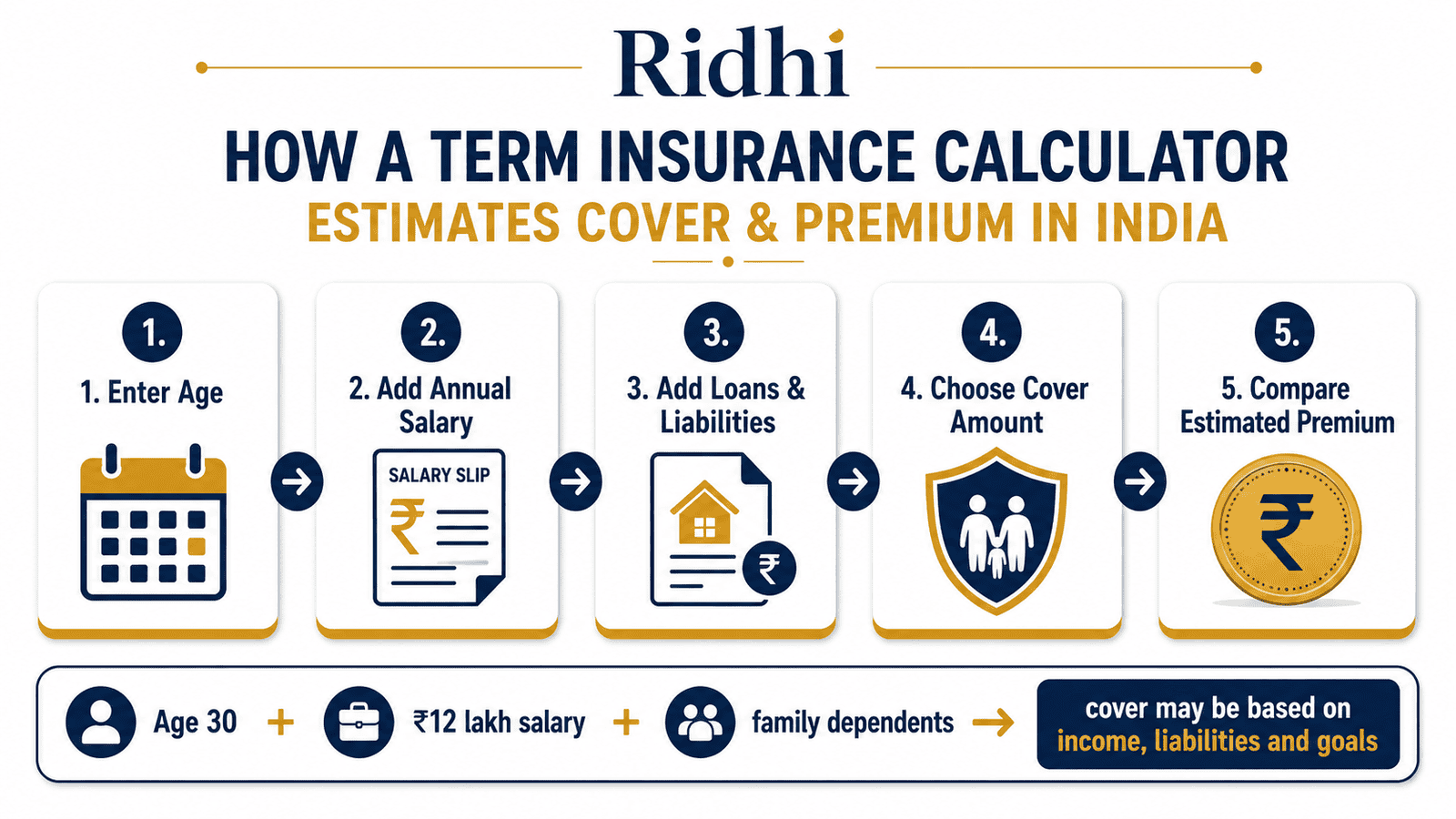
The main inputs — age, annual income, dependents, outstanding loans and policy term — shape both the cover you need and the premium an insurer may charge. But a calculator only returns an estimate. According to IRDAI, the final premium depends on the insurer’s underwriting process, which reviews your health history, occupation and other disclosures before issuing a policy.
This guide explains how to calculate the right cover amount before you compare premiums, what each calculator input actually does, and where to verify the official rules before you buy.
Quick Answer: Term Insurance Calculator India
A term insurance calculator India helps estimate life cover and premium using age, annual income, dependents, liabilities and policy term. For example, a ₹1 crore cover for a 30-year-old salaried person may show a different premium than the same cover at age 40. Final premium depends on the insurer’s underwriting — a calculator output is not a guaranteed quote.
How to Calculate the Right Term Insurance Cover
Before you compare premiums, you need a cover figure that actually protects your family. Two widely used methods help with this.
Method 1: Income Replacement Method
Multiply your annual income by the number of years your family would need financial support if you were no longer earning. Most financial planners use 10 to 20 times annual income, depending on age, dependents and obligations.
Estimated Cover (Method 1) = Annual Income × Income Multiple (10–20)
Method 2: Liabilities + Goals − Existing Assets
This approach is more detailed. Add your income replacement need, all outstanding liabilities and foreseeable family goals. Then subtract the assets your family could realistically use. The right cover amount guide walks through this formula in detail for different salary and loan combinations.
Required Cover = Income Replacement Need + Outstanding Loans + Future Goals − Existing Assets
The table below shows how these methods produce different cover estimates for a 32-year-old earning ₹18 lakh per year, with a ₹45 lakh home loan and a child education goal of ₹20 lakh. All figures are illustrative examples only.
| Scenario | Key Assumptions | Estimated Cover |
|---|---|---|
| Income only (conservative) | ₹18L income × 10 | ₹1.8 crore |
| Income + home loan | ₹18L × 10 + ₹45L loan | ₹2.25 crore |
| Full family needs (comprehensive) | ₹18L × 15 + ₹45L loan + ₹20L education goal − ₹10L existing assets | ₹3.25 crore |
Key Takeaways
- Your required cover should account for income replacement, outstanding loans, children’s education and family goals — a round number that sounds large is not the same as the right number.
- A term insurance calculator India gives you an estimate, not a guaranteed premium — the insurer sets the final figure after underwriting and disclosure review.
- For a 32-year-old with ₹18 lakh annual income and a ₹45 lakh home loan, a thorough cover calculation typically points to ₹1.8 crore–₹3.25 crore, depending on method and assumptions.
- Age at entry is one of the most significant pricing factors — buying earlier typically means lower annual premium for the same cover, subject to underwriting.
- Riders such as critical illness or accidental death benefit add meaningful protection but also increase total premium — understand the conditions before opting in.
- Hiding smoking status, medical history or a high-risk occupation can lead to claim rejection — full disclosure at the time of application is essential.
- Employer-provided group insurance is not a substitute for a personal term plan — it typically ends when you change jobs.
Key Facts at a Glance
| Input | What It Affects | Practical Note |
|---|---|---|
| Age at entry | Premium level and available policy term | Earlier entry typically means lower premium for the same cover |
| Annual income | Estimated income replacement need | Most methods use 10–20× annual income as a starting range |
| Outstanding loans | Additional cover required beyond income replacement | Include home loan, car loan and personal loans |
| Policy term | Duration of life cover | Should cover earning years and major family obligations |
| Health and smoking status | Premium rate and underwriting outcome | Must be declared accurately — non-disclosure risks claim rejection |
| Riders selected | Total premium payable | Each rider adds cost; review conditions before adding any |
| Dependents | Income replacement adequacy | More dependents generally means a higher cover requirement |
How a Term Insurance Calculator India Works
A term insurance calculator is a tool that estimates premium based on the inputs you provide. It does not search insurer systems in real time — it applies standardised assumptions about age bands, standard mortality rates and a basic rider selection to produce a starting number.
Before you use one, understand the core concepts it is built around.
Sum Assured: Start Here, Not at Premium
The sum assured is the amount your family receives as a death claim. It is what you should calculate first. A ₹50 lakh sum assured on a 30-year plan leaves a very different position than a ₹2 crore policy. Determine what your family actually needs — then see what it costs.
For an introduction to how term insurance works as a product, see our guide on term cover basics.
Premium: What the Calculator Estimates
Premium is the annual or monthly amount paid to keep the policy active. Age, cover amount, policy term, health status, gender and smoking status all influence it. A calculator uses generalised health assumptions. The insurer’s underwriting process — which reviews your actual medical profile — may produce a different figure.
Policy Term vs Premium Payment Term
Policy term is how long your cover lasts — typically 20 to 40 years for salaried buyers. Premium payment term is how long you pay. Limited-pay options mean higher annual premiums but a shorter payment period. Compare total outflow across the full policy term, not just the annual figure.
Why Calculators Ask for Salary and Dependents
Salary feeds the income replacement calculation. Dependents help the calculator check whether your family has other earners or income sources. A dual-income household with one child has a different cover need than a single-income family with three children and ageing parents.
Medical Underwriting: Where the Estimate Ends
According to IRDAI, insurers have the right to request medical examination, income proof and additional disclosures before issuing a policy — particularly for large cover amounts. Calculator output does not account for BMI, existing conditions or family medical history. Any of these can affect the final premium or result in a loading charge on the base rate.
Real Example: Rohit’s Cover Calculation in Pune
Rohit, 32, works as an IT project manager in Pune earning ₹18 lakh per year. His spouse is currently not working; he has one child aged 3, a ₹45 lakh home loan outstanding and monthly household expenses of around ₹70,000. He also has ₹10 lakh in savings and mutual funds combined.
Using Method 2 — liabilities plus goals minus assets — step by step:
Step 1 — Income replacement: ₹18L × 15 years = ₹2.7 crore
Step 2 — Add home loan: ₹2.7 crore + ₹45 lakh = ₹3.15 crore
Step 3 — Add child’s education goal: ₹3.15 crore + ₹20 lakh = ₹3.35 crore
Step 4 — Subtract existing assets: ₹3.35 crore − ₹10 lakh = ₹3.25 crore
Under these assumptions, Rohit’s calculation points to a cover need of approximately ₹3.25 crore. A ₹1 crore policy would leave a ₹2.25 crore gap. These are illustrative figures — your actual numbers will differ based on your income, liabilities, goals and assets. This is not personalised financial advice.
Comparison: Cover Estimation Methods and Product Types
How you estimate cover matters as much as which insurer you compare. The first table compares the three most common estimation approaches.
| Method | Approach | Best For |
|---|---|---|
| Salary multiple (10–20×) | Quick multiplier on annual income | Fast sanity check; quick starting point |
| Expense replacement | Monthly expenses × cover years needed | Families with well-defined fixed costs |
| Liabilities + goals − assets | Adds loans and goals; subtracts assets | Most realistic for salaried families |
Many salaried buyers also confuse pure term plans with bundled insurance-investment products. The table below shows the key differences. For a deeper look, see our article on endowment policy differences.
| Parameter | Term Insurance | Endowment / ULIP |
|---|---|---|
| Primary purpose | Pure life protection | Life cover + savings element |
| Premium for same cover | Generally lower | Generally higher |
| Maturity benefit | None — pure risk cover | Yes — survival benefit paid out |
| Charge transparency | High | Lower — multiple charges apply |
| Best suited for | Primary income earners with dependents | Specific savings goals — review carefully |
How to Decide What’s Right for You
Your calculated cover need using Method 2 is ₹2 crore or more and your family has no other income — choose cover at or above that figure, even if it is not the cheapest option the calculator shows.
You have an outstanding home loan — add its remaining balance to your cover amount, not just your income multiple. The loan does not disappear if the earning member does.
You are between 25 and 35 with young dependents — a longer policy term of 30 to 35 years covers the years when your family’s financial dependence is highest. Compare total premium outflow, not just the annual figure.
Your spouse also earns a significant income — you may need slightly less cover than a single-income family, but do not eliminate personal cover entirely. Income, expenses and responsibilities can change.
The calculator shows a premium that feels unaffordable — recalculate using a slightly longer premium payment term before reducing cover. Under-insuring your family defeats the entire purpose of the plan.
You have no dependents, no outstanding liabilities and your parents are financially independent — you may not need a large term cover immediately. Review this position when your responsibilities change.
Common Mistakes to Avoid
Choosing the Lowest Premium Without Checking Exclusions
Some policies carry broader exclusions than others for certain causes of death. Buying purely on premium means you may not discover what is excluded until a claim is filed.
Compare claim settlement history, policy exclusions and the insurer’s claim process — not just the annual premium figure.
Ignoring Loans and Children’s Education
Many buyers calculate income replacement but forget to add the ₹45 lakh home loan or a ₹20 lakh education goal. These obligations do not end when the earning member does. Leaving them out creates a significant shortfall that the surviving family must fund from elsewhere.
Always include all outstanding liabilities and foreseeable goals when estimating cover.
Treating Employer Group Insurance as a Substitute
Group insurance provided by your employer typically covers 1–3× your annual CTC and ends the moment you change jobs or are retrenched. For more on this, see our article on employer health cover limitations.
Personal term insurance must be independent of your employer and must not be counted as part of your family’s core protection.
Hiding Smoking Status or Medical Conditions
Non-disclosure of smoking, pre-existing conditions or a high-risk occupation can result in claim rejection. Insurers have the right to investigate disclosures during claim processing.
Declare everything accurately. If a condition increases your premium, that is a cost your family can plan for — a rejected claim is not recoverable.
Assuming the Calculator Premium Is Final
A calculator uses standardised assumptions. Your actual premium may differ after medical tests, income verification and the insurer’s underwriting assessment. Always get a formal offer from the insurer — not just a calculator estimate.
Adding Riders Without Understanding the Conditions
Riders such as critical illness benefit or waiver of premium come with specific conditions for triggering the benefit. Adding multiple riders without reviewing their terms increases cost and may still leave gaps. Evaluate each rider against your actual risk before opting in.
Not Reviewing Cover After Major Life Events
A cover amount right for you at 30 may be insufficient at 38 — after a salary increase, a second child, a larger home loan or a parent becoming financially dependent on you. Set a reminder to review cover after any major life change.
When This May Not Be the Right Choice
A standard term plan calculated using a generic calculator may not be the right starting point in every situation.
If you have a serious pre-existing medical condition — such as a heart condition, diabetes with complications or a recent critical illness — insurers may decline coverage, apply a premium loading or add specific exclusions. A standard calculator output will not reflect any of this. You may need to approach insurers directly for underwriting decisions.
If your required cover is very large — above ₹5 crore — most insurers will require formal income proof, multiple medical tests and detailed health disclosures before issuing a policy. Calculator output at this scale is particularly unreliable as a premium estimate.
If you are a business owner or freelancer with irregular income, the income replacement method based on a fixed annual salary figure does not apply directly. Your cover calculation needs to account for business liabilities and income variability.
If any of these apply to your situation, it may be worth exploring alternatives before committing.
Official Rules and Where to Verify
Term insurance in India is regulated by the Insurance Regulatory and Development Authority of India. Before purchasing any policy, verify the following from official sources:
- Insurer registration and policyholder guidelines: IRDAI — irdai.gov.in. Confirm the insurer is registered and review the consumer awareness materials published on the site.
- Tax treatment of premiums and death benefit: Income Tax Department — incometax.gov.in. Term insurance premium may be eligible for deduction under Section 80C and the death claim may be tax-exempt under Section 10(10D) — verify current limits and conditions before assuming any deductibility.
- Claim settlement ratio context: Use our guide on claim ratio meaning to understand how to interpret this metric when comparing insurers.
Rules, limits, and rates on this topic can change with each Budget or regulatory update. Always verify current figures directly from the official source before making any financial decision.
Read the benefit illustration, free-look period terms, exclusions and claim process in the policy document before committing to any plan. Do not rely on marketing material or calculator estimates alone.
Expert Tips
- Calculate your cover amount using the liabilities-plus-goals-minus-assets method before you open a single premium calculator. Knowing the right cover first prevents you from comparing premiums for a policy that will not protect your family.
- If you are in your late 20s or early 30s with a growing family, purchasing term insurance earlier rather than later can affect your entry premium — age at entry is a significant factor in the underwriting process.
- Keep your nominee, policy documents and premium payment details in a location your family knows about and can access. A valid policy that the nominee cannot locate after your death provides no benefit.
- Review your sum assured every two to three years — or immediately after a salary increase above 30%, a new home loan, a new child or a parent becoming financially dependent on you. The family money checklist covers a full life-stage review framework for salaried employees.
- Complete every disclosure field accurately when you apply — occupation, travel history, smoking status and existing health conditions. Accurate disclosure is the single most reliable way to protect your family’s claim when it is eventually needed.
- If the annual premium is straining your budget, explore a limited-pay structure. Paying over 10 or 15 years while the policy covers you for 30 can reduce the financial pressure in your later working years.
Frequently Asked Questions
What is a term insurance calculator India?
A term insurance calculator is an online tool that estimates life cover requirement and likely premium based on inputs such as age, annual income, policy term, cover amount and health profile. It uses standardised assumptions — the actual premium is set by the insurer after underwriting your full application.
How much term insurance do I need in India?
A common starting point is 10 to 20 times your annual income. A more reliable method adds income replacement need, outstanding loans and future goals, then subtracts existing assets. For a 32-year-old earning ₹18 lakh with a ₹45 lakh home loan and a young child, this often points to ₹2.25 crore–₹3.25 crore or more, depending on assumptions.
Does age affect term insurance premium?
Yes. Age at entry is one of the most significant underwriting factors. Younger applicants are generally offered lower premiums for the same cover and policy term, because the insurer’s risk exposure is statistically different over a longer period. This is a general principle — actual premium depends on full medical and occupational underwriting.
Does salary affect term insurance cover?
Yes. Most insurers set an upper limit on sum assured based on income proof — typically expressed as a multiple of annual income. Very high cover amounts require documented income verification. Salary also directly feeds the income replacement calculation when you estimate your cover need.
Is ₹1 crore term insurance enough in India?
It depends on your income, liabilities and dependents. For someone earning ₹18 lakh per year with a ₹45 lakh home loan and a young child, ₹1 crore would likely be insufficient under the liabilities-plus-goals method. Do not default to a round number — calculate based on your specific situation.
Is the calculator premium the final amount I will pay?
No. A calculator uses standardised health and age assumptions. The insurer may ask for medical tests, income proof or detailed disclosures before finalising the premium. The actual offer may match the estimate or vary based on your risk profile — always get a formal quote from the insurer before deciding.
Should I add riders to my term insurance plan?
Riders such as critical illness benefit, accidental death benefit and waiver of premium add specific protection layers. Whether they are right for you depends on your existing health cover, income sources and risk profile. Review each rider’s payout conditions carefully — each one increases the total annual premium.
Can I claim a tax deduction on term insurance premium?
Term insurance premiums may be eligible for deduction under Section 80C of the Income Tax Act, subject to applicable limits and conditions. The death benefit received by the nominee may also be tax-exempt under Section 10(10D), subject to conditions. Verify current limits and eligibility from incometax.gov.in before assuming any deductibility.
What happens if I miss a term insurance premium payment?
If you miss payments beyond the grace period, most term policies lapse — the cover ends and the insurer has no further payout obligation. Some policies offer a revival facility within a specified period. Check your specific policy document for grace period duration, lapse conditions and revival terms.
Final Verdict
A term insurance calculator India is a useful starting point — not a substitute for a proper cover calculation. Use it to get a broad premium range after you have first worked out the cover your family genuinely needs using the income replacement or liabilities-plus-goals method.
Start with your protection need. Factor in your home loan, your child’s education goals, your dependents’ income requirements and your existing assets. Then compare premiums across insurers — reviewing claim settlement history, exclusions and the policy document, not just the annual premium figure.
Recalculate after every major life change: a new loan, a salary jump, a new child or a change in dependents. The cover figure that was right at 30 is unlikely to be right at 38.
Always verify the latest rules from official sources or consult a qualified professional before making any financial decision.
Insurance is a subject matter of solicitation. Please read the policy document carefully before purchasing.
This article is for educational purposes only and should not be treated as personalised financial, tax, investment, insurance, or legal advice. Tax rules, interest rates, regulatory limits, and product features can change with each Budget or policy update. Please verify current rules from official government sources or consult a qualified and registered professional before making any financial decision.

Priya Nambiar writes about insurance concepts for Indian families, salaried employees, self-employed professionals, and first-time policy buyers. Her content focuses on helping readers understand coverage, exclusions, claim conditions, premiums, riders, and policy documents before buying or renewing insurance.
She covers topics such as term insurance, health insurance, family floater plans, riders, critical illness cover, employer insurance vs personal insurance, waiting periods, exclusions, deductibles, co-payment, no-claim bonus, claim settlement, premium comparison, renewal rules, and tax benefits linked to insurance.
Priya’s writing is careful, consumer-focused, and policy-document oriented. She explains why insurance should be understood as financial protection, not just a tax-saving tool or investment substitute. Her articles encourage readers to compare coverage, understand limitations, and ask better questions before buying a policy. Premiums, exclusions, claim rules, and benefits vary by insurer, age, health, sum insured, and product type. Insurance is a subject matter of solicitation, and readers should read the official policy document carefully before purchasing.