
You earn ₹85,000 a month. The salary hits your account. You buy the phone upgrade you have been eyeing, book a weekend trip, and pay the new car EMI. The numbers add up — the budget is technically intact. And yet, three months later, you have no emergency fund, your SIP has been paused, and the health insurance renewal is overdue. Nothing you spent on was unreasonable. So what went wrong?
Nothing went wrong with the spending. What went wrong was not asking a single question first: what else could this money have done? That question is the heart of opportunity cost in personal finance — and it is one of the most useful thinking tools you can build as a salaried employee or a family managing a monthly budget. This article explains the concept simply, through Indian examples, without any economic jargon. For a broader foundation on managing money, start with personal finance basics.
Quick Answer: Opportunity Cost in Personal Finance
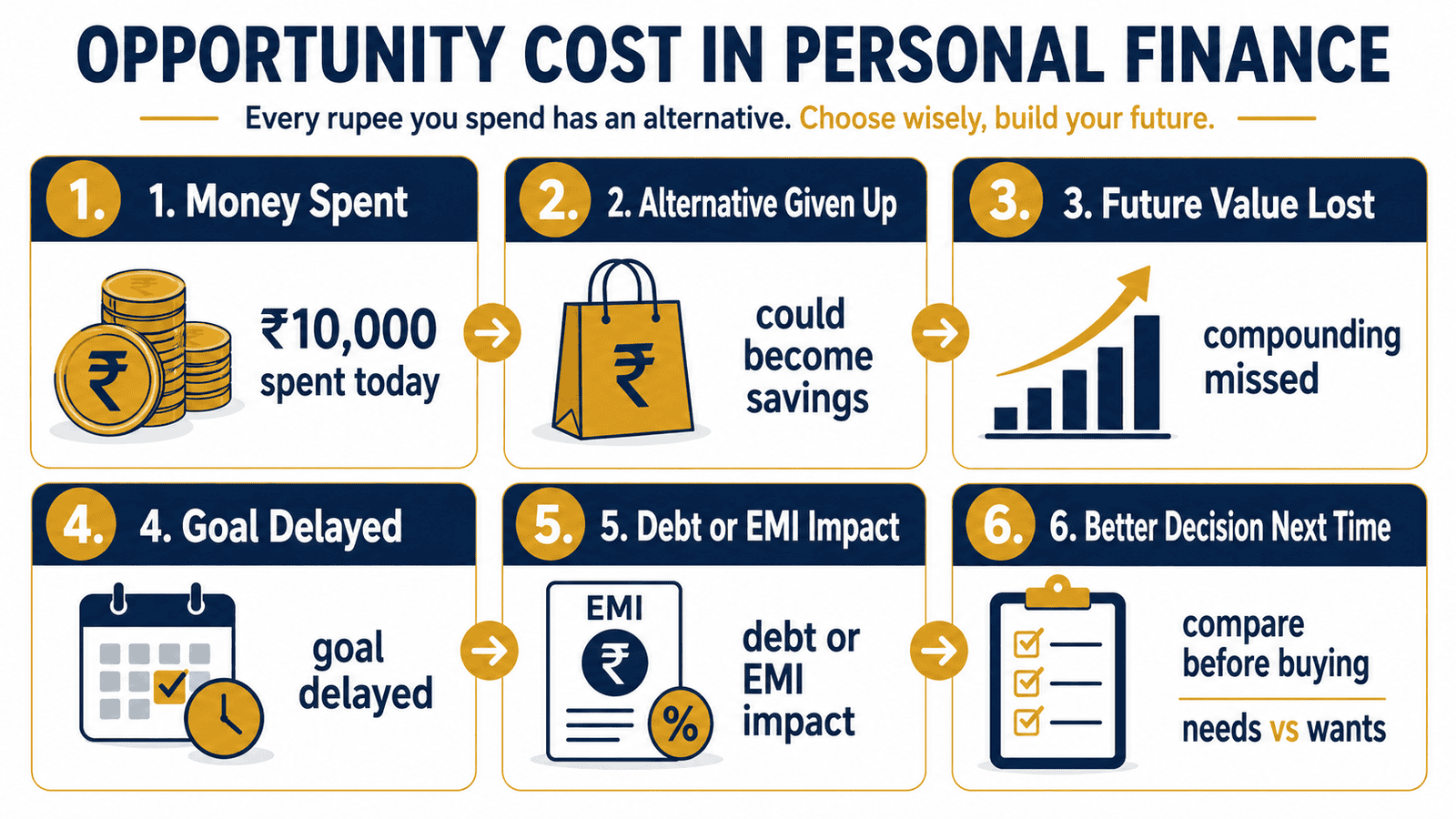
Opportunity cost in personal finance means the value of the best alternative you give up when you spend money. If you spend ₹10,000 on a phone upgrade, the opportunity cost could be an emergency fund deposit, debt repayment, SIP contribution, insurance premium or another goal that now gets delayed.
Key Takeaways
- Every rupee can usually be used in more than one way — spending it on one thing means it cannot go to something else.
- The real cost of a ₹15,000 car EMI is not just the monthly payment — it is also the emergency fund, SIP or insurance premium that gets crowded out.
- Small recurring lifestyle upgrades — a streaming plan here, a gym membership there — can collectively delay a financial goal by months or years.
- Opportunity cost is not a reason to feel guilty about spending; it is a tool for comparing choices before you commit, especially for EMIs and big-ticket decisions.
- A ₹5,000 monthly discretionary spend, redirected into a SIP, could grow significantly over a decade — the difference is the opportunity cost of the recurring choice.
- “I can afford this EMI” and “this is the best use of my money right now” are two very different statements.
- The concept applies to time and attention too — not just rupees — but in personal finance, the money angle is where most Indians feel the impact first.
Key Facts at a Glance
| Aspect | What It Means | Simple Example |
|---|---|---|
| Definition | Value of the best alternative you give up when spending | Spending ₹10,000 on a gadget vs. adding it to an emergency fund |
| Where it applies | Every spending, saving, investing or borrowing decision | EMI choice, SIP pause, lifestyle upgrade, lump-sum spend |
| Common mistake | Judging a purchase only by whether you can afford the EMI | ₹12,000/month EMI that crowds out health insurance renewal |
| Best use case | Recurring expenses and large one-time decisions | Deciding between a car upgrade and a home down payment fund |
| Not the same as | Regret or guilt over past spending | It is a forward-looking decision tool, not a backward judgment |
What Opportunity Cost Actually Means — and Why It Matters
Most people think about money in terms of price. A phone costs ₹18,000. A dinner out costs ₹2,500. A car EMI costs ₹14,000 a month. Price is what you pay. Opportunity cost is what you give up — and those two are often very different numbers.
When you spend ₹18,000 on a phone, the price is ₹18,000. But the opportunity cost is the best alternative use of that money. If you had no emergency fund, the opportunity cost might be three months of progress toward a ₹60,000 safety net. If you had a high-interest personal loan outstanding, the opportunity cost is the interest saved by paying it down. The phone is the visible transaction. The opportunity cost is the invisible one.
Why “I Can Afford It” Is Not Enough
Affordability and optimality are not the same thing. If your salary is ₹85,000 and your fixed expenses are ₹55,000, you technically have ₹30,000 of discretionary room. Spending ₹15,000 of it on a car upgrade is affordable. But affordable does not mean it is the best use of that ₹15,000 right now — especially if you have no term insurance, no SIP running, and a credit card balance rolling over each month.
This is exactly where opportunity cost thinking becomes useful. It does not tell you what to do. It forces you to see the real trade-off before you decide.
How Budgeting Makes Trade-Offs Visible
A well-structured monthly budget does not just track where money goes — it shows you where money cannot go once you have committed it elsewhere. If you follow the monthly budget rule for Indian families, you already allocate income into needs, wants and savings. Opportunity cost is what makes that allocation meaningful: every rupee placed in one bucket is a rupee that cannot grow in another.
Money, Time and Attention All Have Opportunity Costs
In personal finance, money is the most tangible resource — but time is not far behind. A ₹2,000 monthly subscription you barely use is not just ₹2,000 — it is ₹24,000 a year that could have gone toward a vacation, a child’s educational investment or a one-time health check-up. When these small recurring costs multiply across a household — OTT platforms, unused gym memberships, forgotten app subscriptions — the aggregate opportunity cost becomes surprisingly large.
Lifestyle Spending and the Invisible Delay
Every upgrade in lifestyle spending — a bigger flat, a newer car, a premium phone plan — comes with a visible price tag and an invisible one. The invisible tag is the financial goal it delays. A higher monthly rent in a premium locality might be worth the convenience, but the opportunity cost is a smaller home down payment fund, a delayed SIP start or a thinner emergency cushion. Naming that trade-off before spending is the entire point of this concept.
Real Example: Rohan’s Car EMI Decision
Rohan is 29 years old, lives in Pune and works as a software employee earning ₹85,000 a month. His take-home after PF deduction is approximately ₹78,000. His fixed expenses — rent, groceries, household bills and school fees for his younger sibling — come to about ₹48,000. That leaves him roughly ₹30,000 a month.
Rohan is considering a car. The EMI works out to ₹15,000 a month for 5 years, plus insurance of around ₹12,000 a year and fuel and maintenance of roughly ₹5,000 a month. After the car, his discretionary room shrinks to about ₹10,000 a month. Here is what gets delayed or dropped: his emergency fund (currently at ₹40,000, target ₹2.5 lakh), a ₹5,000 monthly SIP he had planned to start, and his term insurance premium of ₹1,100 a month which he has been deferring.
The car is not wrong. The car might genuinely improve his quality of life and save him commute stress. But the opportunity cost is real: the emergency fund delay means 18–24 more months without a financial safety net. The SIP delay means years of compounding lost. The insurance gap means a coverage risk that costs very little to fix. Before signing the loan, Rohan should ask — not whether he can afford the EMI, but which of these alternatives he is consciously choosing to delay. Read more on emergency fund first to understand why the safety net often deserves priority over other goals.
How to Calculate the Opportunity Cost of a Spending Decision
You do not need a spreadsheet to estimate opportunity cost. A simple comparison works well enough for most personal finance decisions.
Opportunity Cost = Value of the Best Alternative You Did Not Choose
For a one-time spend: if you spend ₹10,000 today instead of investing it, the opportunity cost is the future value of that ₹10,000 over your intended time horizon. Assuming an illustrative 10% annual return (this is an example only — actual returns are not guaranteed and depend on the product and market conditions), ₹10,000 invested today could grow to approximately ₹25,900 in 10 years.
For a recurring spend: if you redirect ₹5,000 a month away from a lifestyle upgrade and into a SIP, the opportunity cost of that lifestyle spend compounds over time. At an assumed 10% annual return (illustrative, not guaranteed), ₹5,000 a month over 10 years could grow to approximately ₹10.3 lakh. SEBI-registered advisers and mutual fund platforms can help you model actual projections for specific products — visit sebi.gov.in to verify registered intermediaries.
The compounding effect makes recurring opportunity costs particularly important to recognise early. For a deeper look at how compounding works, see the guide on power of compounding.
| Scenario | Amount | Illustrative 10-Year Outcome (Assumed 10% p.a.) |
|---|---|---|
| One-time spend of ₹10,000 today | ₹10,000 | ~₹25,900 not earned (illustrative only) |
| Monthly lifestyle upgrade of ₹5,000 | ₹5,000/month | ~₹10.3 lakh not accumulated (illustrative only) |
| Car EMI redirect of ₹15,000/month | ₹15,000/month | ~₹30.9 lakh not accumulated (illustrative only) |
All return figures above are illustrative. Actual returns depend on the product chosen, market conditions and time horizon. They are not guaranteed.
Comparison: Spending Choice vs. Opportunity Cost
| Spending Choice | Immediate Benefit | Opportunity Cost |
|---|---|---|
| Phone upgrade (₹18,000) | Better camera, faster performance | 3–4 months of emergency fund progress delayed |
| Car EMI (₹15,000/month) | Convenience, commute comfort | SIP paused, insurance deferred, emergency gap persists |
| Eating out 8× a month (₹6,000 extra) | Social connection, convenience | ₹72,000/year that could go toward a vacation or goal |
| Premium apartment rent (₹8,000 extra/month) | Comfort, location advantage | ₹96,000/year less toward home down payment fund |
| Delaying SIP by 12 months | More cash flow now | Lost compounding on early contributions — largest long-term cost |
| Vacation (₹50,000 lump sum) | Rest, experiences, memories | Could fund 10 months of ₹5,000 SIP or half an emergency fund |
Spending on experiences can be entirely valid — the point is not to stop living but to see each trade-off clearly. Inflation also plays a role: goals you delay today will cost more tomorrow. For context on how purchasing power erodes, see money value over time.
How to Decide What’s Right for You
you have no emergency fund yet — THEN prioritise building it before any discretionary upgrade, regardless of how affordable the upgrade seems.
the spending creates a recurring monthly cost (EMI, subscription, rent upgrade) — THEN calculate the annual total and compare it with one meaningful financial goal before committing.
the purchase is a genuine need — safety, health, work requirement — THEN the opportunity cost conversation changes; essential spending is not the same as discretionary spending.
you have received a salary hike and are planning to upgrade your lifestyle — THEN ask which financial goal gets the first share of the increment before the lifestyle expenses expand.
the purchase will still feel worth it one month later — THEN it likely aligns with your real priorities and is a conscious choice rather than an impulse.
the spending would delay a time-sensitive goal — a term insurance renewal, a loan pre-payment window, a SIP top-up before March 31 — THEN delay the discretionary spend instead.
you cannot clearly name what financial goal is being delayed by this spend — THEN you do not yet have enough information to make the decision; pause and map your current priorities first.
Common Mistakes to Avoid
Judging an EMI Only by Monthly Affordability
The most common mistake is deciding on a loan by asking: “Can I pay this every month?” A ₹12,000 EMI is affordable on ₹85,000 — but affordability is not the question. The real question is: what does this ₹12,000 displace every month for the next 3–5 years? If it delays a SIP, insurance or emergency fund, the true cost is far higher than the EMI figure suggests.
Before taking any EMI, list what will be crowded out and decide if you are consciously willing to delay those goals.
Ignoring Small Recurring Expenses
A ₹199 streaming plan, a ₹499 app subscription and a ₹799 premium plan each sound trivial. Together, that is ₹17,868 a year — a full SIP instalment for three months. The opportunity cost of multiple small recurring expenses tends to be invisible because no single item looks significant. A quarterly audit of subscriptions and recurring charges often reveals ₹1,500–₹3,000 a month of forgotten spending. See how lifestyle spending creep compounds this problem over time.
Cancel at least one subscription this week that you have not actively used in 30 days.
Treating Discounts as Savings
Spending ₹4,000 on a ₹6,000 item because it is on sale is spending ₹4,000 — not saving ₹2,000. The discount framing reverses the opportunity cost logic entirely. You did not save money; you spent money you may not have spent otherwise. The ₹4,000 still has an opportunity cost — it is just smaller than it would have been at full price.
Ask: “Would I have bought this at full price?” If no, the discount is not a saving.
Delaying Investment Starts Indefinitely
Every month a SIP is not running is a month of compounding lost. Starting a ₹3,000 SIP at age 25 versus age 30 — assuming an illustrative 10% annual return — can result in a meaningfully larger corpus by retirement, purely because of the five additional years of compounding. The opportunity cost of “I will start next month” is compounding lost on early contributions, which cannot be recovered by contributing more later.
Start with whatever amount you can commit to today, and increase it with each salary revision.
Upgrading Lifestyle After Every Salary Hike
When income rises, spending tends to rise proportionally — new car, bigger flat, premium phone, dining upgrade. If every increment goes into lifestyle, no increment ever reaches a financial goal. The opportunity cost of permanent lifestyle inflation is the entire wealth-building potential of your career’s income growth. A useful rule: allocate at least half of every salary hike to a financial goal before expanding lifestyle costs.
Automating savings before discretionary spending removes this decision from willpower entirely.
Comparing With the Worst Alternative, Not the Best
Opportunity cost is measured against the best alternative, not any alternative. If you spend ₹20,000 on a vacation and tell yourself “it is fine, I was not going to invest anyway,” you are measuring against a zero — not against what the money could genuinely have done. The correct question is: what is the single best use of this ₹20,000 right now? That is the opportunity cost.
Name the best alternative before you approve the spend.
Ignoring the Opportunity Cost of Waiting on Insurance
Term insurance and health insurance premiums are relatively small monthly costs. Deferring them to “next month” has an invisible but serious opportunity cost: the coverage gap itself. If something happens during the deferral period, the financial cost of not having cover far exceeds any amount saved by the delay. Insurance is one category where the opportunity cost of not acting is asymmetric — the downside of waiting is far larger than the upside of deferring the premium.
Treat insurance premiums as a fixed cost, not a discretionary one.
When This May Not Be the Right Choice
Opportunity cost is a useful framework — but applying it too rigidly can distort real-life priorities. There are situations where spending more, even at the cost of a financial goal, is entirely reasonable.
Essential health spending — a specialist consultation, a dental procedure, a child’s medicine — should never be deferred purely to protect a savings target. Your health and your family’s health are not opportunity costs to be managed; they are non-negotiables.
Family situations can require spending that no spreadsheet formula justifies: supporting ageing parents, funding a sibling’s education, covering an emergency repair. These are real priorities that may temporarily crowd out investment goals — and that is acceptable.
Mental well-being and meaningful experiences — a family holiday, a course you have wanted to do, a celebration — carry genuine value. Reducing every experience to its opportunity cost can produce financial paralysis and resentment rather than clarity. The goal of opportunity cost thinking is better decisions, not a joyless life.
If any of these apply to your situation, it may be worth exploring alternatives before committing.
Official Rules and Where to Verify
Opportunity cost as a concept has no government regulation — it is a thinking framework, not a product or scheme. However, the financial products and decisions connected to it do have regulated parameters that can and do change.
- SEBI (Securities and Exchange Board of India) — sebi.gov.in: For mutual fund returns, SIP product terms, fund house registration and investor grievance mechanisms.
- RBI (Reserve Bank of India) — rbi.org.in: For bank deposit rates, loan terms, EMI regulations and consumer banking guidelines.
Rules, limits, and rates on this topic can change with each Budget or regulatory update. Always verify current figures directly from the official source before making any financial decision.
Expert Tips
- Apply a 48-hour pause rule for non-essential purchases above ₹2,000. Most impulse buys lose their urgency within two days. If you still want it after 48 hours and can name the trade-off, proceed with confidence.
- Before any large spending decision, write down the single best alternative use of that money. Not a list — one thing. This exercise makes the opportunity cost concrete rather than abstract, and it only takes 30 seconds.
- Separate the one-time cost from the recurring cost when evaluating a purchase. A car is not just the down payment and EMI — it is also the insurance, fuel, parking and maintenance. The true monthly cost is often 30–40% higher than the EMI alone.
- Automate your savings before your salary hits your spending account. When savings are automatic, the opportunity cost calculus happens before lifestyle spending rather than after. What remains is genuinely discretionary.
- Every time you receive a salary hike or annual bonus, allocate the first portion to a financial goal before expanding lifestyle. Even a small increment — ₹2,000 a month added to your SIP — compounds meaningfully over a decade.
- Run a quarterly subscription audit. List every recurring digital and physical subscription. Cancel anything unused for 30 days. Redirect that amount — even ₹500 — to an existing goal.
- Use the retirement corpus calculator to model what delayed investing actually costs you. Seeing a number — not a concept — tends to make the opportunity cost of postponing SIPs feel real. Visit the retirement corpus calculator to run the numbers for your own situation.
Frequently Asked Questions
What is opportunity cost meaning in simple words?
Opportunity cost is the value of the best option you give up when you choose something else. In personal finance, it means: every time you spend ₹10,000, that ₹10,000 can no longer do the next best thing it could have done — whether that is building your emergency fund, paying off a loan, or growing as an investment.
What is an example of opportunity cost in India?
If a salaried employee in Bengaluru spends ₹15,000 a month on a car EMI, the opportunity cost could be ₹15,000 not going into a SIP each month. Over five years at an assumed 10% annual return, that is roughly ₹11.6 lakh not accumulated — purely from the monthly trade-off. The car itself is not the problem; the unexamined trade-off is.
Is opportunity cost always about money?
No — it applies to time and attention too. Spending two hours watching content on a weeknight has an opportunity cost in terms of sleep, skill development or exercise. In personal finance, however, the money dimension is where most households feel the impact most directly and where small decisions compound into large outcomes over time.
How does an EMI have opportunity cost?
An EMI commits a fixed amount of your monthly income for a set period — typically 12 to 84 months. Every month that EMI is running, that same amount cannot go toward a SIP, insurance premium, emergency fund contribution or debt pre-payment. The opportunity cost of an EMI is the sum of all those displaced goals across the entire loan tenure, not just the interest paid to the lender.
How is opportunity cost linked to compounding?
Compounding means money grows on its own growth over time. The earlier you invest, the longer compounding works. When you delay a ₹5,000 SIP by 12 months, you do not just lose 12 months of contributions — you lose 12 months of compounding on those contributions plus all the compounding those early contributions would have generated in future years. This makes the opportunity cost of delaying investment larger than it first appears.
Does opportunity cost mean I should never spend?
No. Opportunity cost is a tool for seeing trade-offs clearly, not a reason to avoid all spending. A well-planned vacation, a quality purchase, or an experience that matters to your family can be entirely worth the opportunity cost. The goal is to make the trade-off visible before committing — not to eliminate discretionary spending from your life.
Can opportunity cost help me decide between two financial products?
Yes — this is one of its most practical uses. If you are choosing between prepaying a home loan (saving, say, 8.5% interest) and investing in an equity SIP (targeting a higher but uncertain return), the opportunity cost of each choice is the benefit you give up by not picking the other. The decision depends on your risk tolerance, tax situation and time horizon — but framing it as an opportunity cost comparison makes the trade-off explicit.
What happens if I keep ignoring opportunity cost in everyday decisions?
Small unexamined spending decisions add up. If ₹3,000 a month goes to subscriptions, dining upgrades and impulse buys that you would not have made with a moment’s pause, that is ₹36,000 a year — a full year of SIP contributions or half an emergency fund. Over five years, repeatedly ignoring opportunity cost can result in reaching your mid-thirties with no investment corpus, an underfunded emergency fund and term insurance still unpurchased.
Final Verdict
Opportunity cost in personal finance is not a complicated economics concept — it is a single, powerful question: what is the best thing this money could do that it will not do if I spend it here? For salaried employees and families managing a monthly budget, this question is most useful when evaluating recurring expenses, EMI commitments and the repeated temptation to delay SIPs or insurance.
The goal is not to stop spending. It is to spend consciously — knowing what you are choosing and what you are giving up. Rohan’s car may well be worth the trade-off. But if he never asked the question, the emergency fund gap and the SIP delay were invisible costs he never chose. They just happened.
Use this framework especially when income rises: a salary hike is where opportunity cost decisions have the most leverage. The increment can go toward long-term wealth or toward lifestyle expansion — and both are valid, as long as the choice is deliberate. Always verify the latest rules from official sources or consult a qualified professional before making any financial decision.
This article is for educational purposes only and should not be treated as personalised financial, tax, investment, insurance, or legal advice. Tax rules, interest rates, regulatory limits, and product features can change with each Budget or policy update. Please verify current rules from official government sources or consult a qualified and registered professional before making any financial decision.

Sanya Malhotra writes about everyday personal finance for Indian individuals and families. Her content focuses on budgeting, saving, emergency funds, debt control, net worth tracking, family money decisions, and practical habits that help readers manage money with more confidence.
She covers topics such as monthly budgeting, expense planning, saving habits, emergency fund behaviour, debt repayment, household financial planning, family discussions about money, financial mistakes, net worth tracking, short-term vs long-term goals, and beginner personal finance concepts.
Sanya’s writing style is warm, simple, and realistic. She avoids making personal finance feel intimidating and instead explains money decisions through relatable Indian examples, ₹ budgets, checklists, and step-by-step frameworks. Her articles are useful for students, freshers, couples, parents, and families who want to improve daily money habits. Her content is educational and does not provide personalised financial advice. Readers should adapt examples to their own income, family responsibilities, city, debt level, risk comfort, and financial goals.