

Every year, thousands of Indian families face the same question: should the family savings go into a post office time deposit or a bank FD? Both are fixed-income products. Both promise predictable returns. But the backing, the safety framework, the interest calculation method, and the withdrawal rules are genuinely different — and getting this wrong can cost you money or lock up funds when you need them most.
The post office fd vs bank fd debate is not about one being universally better. It is about which one fits your amount, your tenure, your tax bracket, and your liquidity need. This article breaks down every dimension — interest rates, safety, tax, premature withdrawal, and convenience — so you can make an informed decision. Rates and rules on both sides change regularly, so verify current figures before investing.
Quick Answer: Post Office FD vs Bank FD
Post office fd vs bank fd depends on whether you value government-backed simplicity or bank flexibility. Post Office Time Deposits suit conservative savers seeking fixed, government-backed returns, while bank FDs may offer wider tenure choices, senior citizen benefits and easier digital access. Bank deposits are generally insured up to ₹5 lakh per depositor per bank under the DICGC framework — verify the current limit at rbi.org.in before investing.
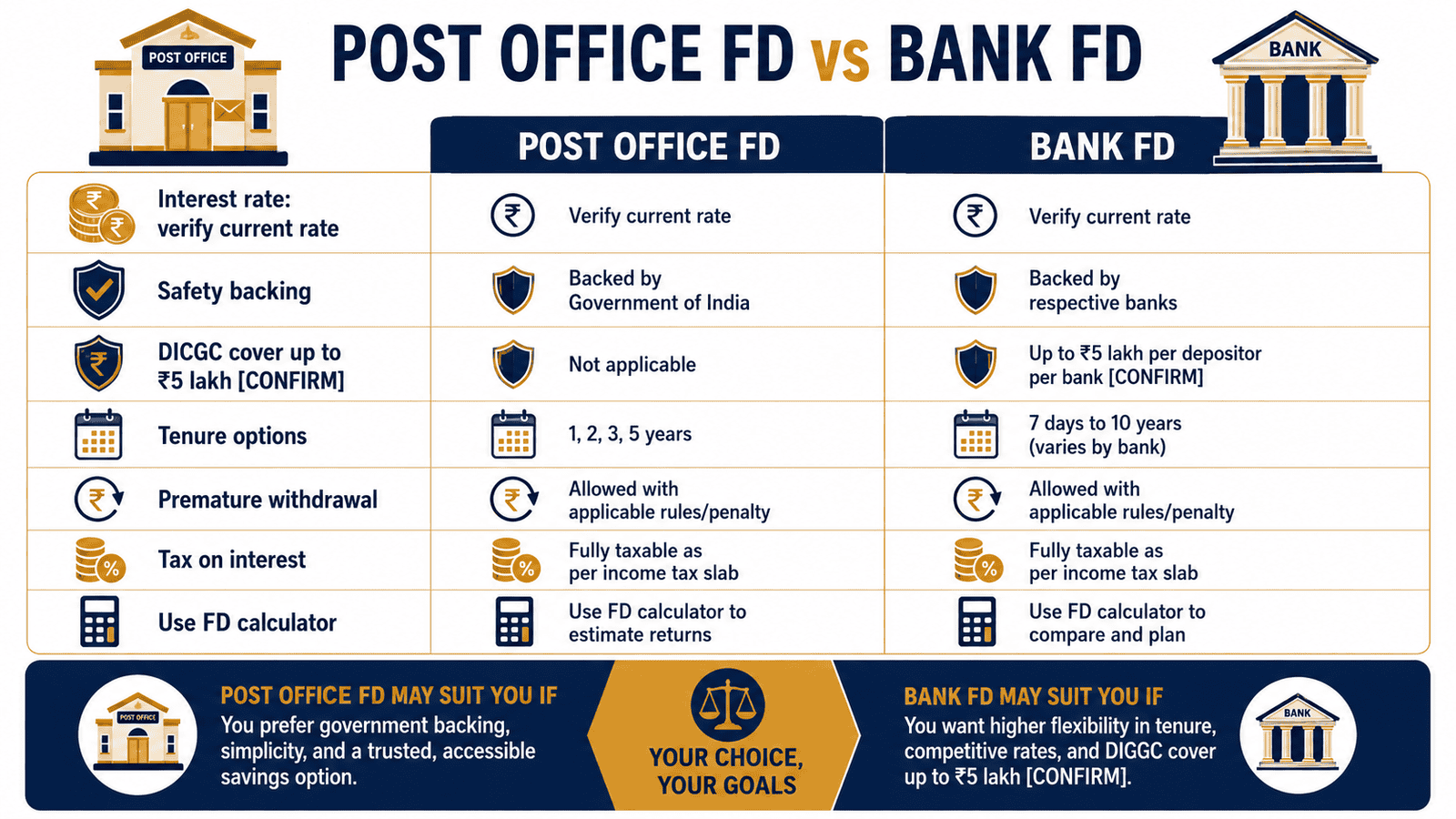
Key Takeaways
- Post Office Time Deposits (National Savings Time Deposit Account) are sovereign-backed schemes — your principal and interest carry the backing of the Government of India, not a private insurance pool.
- Bank FDs are insured under the DICGC framework up to ₹5 lakh per depositor per bank — deposits above this limit in a single bank carry higher risk if the bank faces stress.
- A headline rate difference of even 0.25% on ₹3 lakh over three years can change your maturity amount by ₹2,000–₹3,000 — always compare maturity value, not just the interest rate.
- FD interest from both post office and bank deposits is fully taxable as “Income from Other Sources” — your post-tax return depends on your income tax slab.
- Premature withdrawal from a Post Office Time Deposit attracts specific penalty rules that differ from bank FD premature closure terms — check both before locking in funds.
- A five-year Post Office Time Deposit qualifies for Section 80C deduction — most bank FDs qualify only if they are specifically designated as tax-saving FDs with a five-year lock-in.
- Bank FDs typically offer online opening, auto-renewal, and multiple tenure options ranging from 7 days to 10 years; Post Office Time Deposits currently offer tenures of 1, 2, 3, and 5 years.
Post Office FD vs Bank FD: Full Comparison
| Parameter | Post Office Time Deposit | Bank Fixed Deposit |
|---|---|---|
| Safety framework | Government of India backed — sovereign guarantee on principal and interest | DICGC deposit insurance up to ₹5 lakh per depositor per bank (verify at rbi.org.in) |
| Interest rate | Fixed by government each quarter — verify current rate at indiapost.gov.in | Varies by bank, tenure, and customer type — public, private, small finance banks differ |
| Available tenures | 1 year, 2 years, 3 years, 5 years | 7 days to 10 years — wide range depending on bank |
| Interest payout | Annual payout; interest calculated quarterly and paid annually | Monthly, quarterly, half-yearly, annually or on maturity — bank-specific |
| Minimum deposit | ₹1,000 (verify current minimum at indiapost.gov.in) | Typically ₹1,000–₹10,000 depending on bank; some banks accept ₹500 |
| Section 80C benefit | Yes — 5-year deposit qualifies | Conditional — only designated 5-year tax-saving FD |
| TDS on interest | No TDS — interest is taxable but no TDS deducted by post office | TDS applies — deducted if annual interest exceeds threshold (verify at incometax.gov.in) |
| Premature withdrawal | Allowed after 6 months with penalty — check current rules at indiapost.gov.in | Generally allowed with penalty of 0.5%–1% below applicable rate — bank-specific |
| Online access | Limited — India Post Payments Bank integration; branch-dependent for many | Full — net banking, mobile app, auto-renewal widely available |
| Nomination facility | Yes | Yes |
| Best suited for | Conservative savers, families wanting sovereign backing, 80C tax savers | Rate shoppers, senior citizens, digital-first users, short-tenure needs |
Key Facts at a Glance
| Fact | Post Office Time Deposit | Bank FD |
|---|---|---|
| Full product name | National Savings Time Deposit Account | Fixed Deposit / Term Deposit |
| Governing authority | Ministry of Finance / India Post | Individual banks regulated by RBI |
| Rate revision frequency | Quarterly — announced by government | Bank discretion — can change anytime |
| Deposit insurance | Not applicable — sovereign backing | DICGC covers up to ₹5 lakh (verify at rbi.org.in) |
| Tax on interest | Fully taxable — no TDS deducted by post office | Fully taxable — TDS deducted above threshold |
| Joint account | Allowed | Allowed |
How Post Office FD and Bank FD Actually Work
Before comparing the two, it helps to understand what makes them structurally different. If you are new to fixed deposits, FD basics explained covers the fundamentals — what a fixed deposit is, how interest accrues, and what to check before opening one.
What Is a Post Office Time Deposit?
The Post Office Time Deposit is officially called the National Savings Time Deposit Account. It is a small savings scheme operated by India Post under the National Savings Institute, governed by the Ministry of Finance. Unlike a bank product, this is a government savings scheme — meaning the sovereign backing of the Government of India applies to your deposit.
Interest rates for Post Office Time Deposits are revised quarterly by the government and are the same across every post office branch in India. There is no negotiation, no relationship pricing, and no promotional rate. What the government announces is what you get, regardless of whether you walk into a post office in Mumbai or a small town in Rajasthan.
Interest on Post Office Time Deposits is calculated quarterly but paid annually — a distinction that matters when you compare it with bank FDs that may compound quarterly and pay on maturity. According to the Ministry of Finance guidelines, the five-year Post Office Time Deposit is eligible for deduction under Section 80C of the Income Tax Act — a benefit not available with most standard bank FDs.
What Is a Bank FD and Why Do Rates Vary So Much?
A bank fixed deposit is a term deposit product offered by any RBI-regulated bank — public sector banks (like SBI, Bank of Baroda), private banks (like HDFC, ICICI, Axis), small finance banks (like AU, Equitas, ESAF), and cooperative banks. Each bank sets its own interest rates based on its cost of funds, liquidity needs, and competitive positioning.
This is why bank FD rates can vary by 1%–3% across institutions for the same tenure. A large public sector bank may offer a lower rate than a small finance bank — but the safety profile also differs. According to RBI guidelines, eligible bank deposits are insured under the Deposit Insurance and Credit Guarantee Corporation (DICGC) framework up to ₹5 lakh per depositor per bank. This limit covers principal and interest combined. Deposits above ₹5 lakh in a single bank are not covered by deposit insurance.
The Core Trade-Off: Sovereign Backing vs. Deposit Insurance
This is the most misunderstood aspect of the post office fd vs bank fd comparison. Post Office Time Deposits carry the full backing of the Government of India — there is no insurance pool or coverage limit. If you deposit ₹20 lakh in a Post Office Time Deposit, all ₹20 lakh is backed by the sovereign.
Bank FDs work differently. They are insured — not government-guaranteed. DICGC insurance covers up to ₹5 lakh per depositor per bank. For most Indians who deposit under ₹5 lakh in a single bank, this coverage is adequate. But for deposits significantly above ₹5 lakh in a single bank — particularly a smaller or financially stressed bank — the safety comparison shifts decisively toward the post office option.
Convenience and Access
Bank FDs have a clear advantage in digital convenience. Net banking, mobile apps, auto-renewal, partial withdrawal facilities, and loan against FD are standard across most banks. Post offices have been expanding digital access through India Post Payments Bank integration, but the experience varies significantly between urban branches and rural ones. For a salaried professional managing finances online, bank FDs are considerably more convenient.
Real Example: Ramesh’s ₹3 Lakh Decision in Pune
Ramesh, 39, works as a private-sector manager in Pune earning ₹95,000 per month. He wants to invest ₹3 lakh of family savings for three years and is deciding between a Post Office Time Deposit and a bank FD at two different banks.
He checks current rates and finds: the Post Office 3-year Time Deposit rate is X% (verify current rate at indiapost.gov.in before investing). A mid-sized public sector bank is offering 6.8% for 3 years. A small finance bank is offering 8.25% for 3 years.
His entire ₹3 lakh is well within the ₹5 lakh DICGC cover at either bank. But Ramesh is in the 30% tax bracket. He calculates that on ₹3 lakh at 7% for 3 years, he earns roughly ₹63,000 in interest — and pays about ₹19,000 in tax. His post-tax return is closer to ₹44,000. If the small finance bank’s 8.25% rate is verified and stable, the higher gross return becomes attractive — but Ramesh needs to check whether that bank is financially sound before investing.
His key insight: the post office option gives him sovereign peace of mind with no TDS deducted at source (though he still must report interest in his ITR). The bank option gives him digital convenience and potentially a higher rate — but he must compare post-tax maturity values, not just headline rates.
How to Calculate Your Maturity Value
FD Maturity Value = P × (1 + r/n)^(n×t)
Where: P = Principal | r = Annual interest rate (decimal) | n = Compounding frequency per year | t = Tenure in years
Post Office Time Deposits compound quarterly (n=4) and pay annually. Bank FDs typically compound quarterly as well, but payout frequency varies. A difference in compounding or payout structure can change effective yield even if the stated annual rate is the same.
| Scenario | Key Inputs | Approximate Gross Maturity (₹1 lakh) |
|---|---|---|
| Post Office TD — 3 yr | Rate: verify at indiapost.gov.in | Quarterly compounding | Annual payout | Verify using current official rate |
| Bank FD — 3 yr at 6.8% | Quarterly compounding | ₹1 lakh | ≈ ₹1,22,300 (indicative — verify with bank) |
| Small Finance Bank — 3 yr at 8.25% | Quarterly compounding | ₹1 lakh | ≈ ₹1,27,400 (indicative — verify with bank) |
Rather than calculating manually, use the FD calculator to compare maturity values side by side with current rates. Enter your principal, the verified interest rate, tenure, and compounding frequency to see the exact maturity amount before you commit.
How to Decide What’s Right for You
Your deposit is above ₹5 lakh and you want no coverage limit concern — THEN Post Office Time Deposit may suit you better, since sovereign backing has no upper cap.
You are a senior citizen and a bank is offering a special senior citizen rate of 0.25%–0.50% above the regular rate — THEN a bank FD with senior citizen benefits may give you a meaningfully higher post-tax return than the post office option.
You want to save tax under Section 80C and your investment horizon is exactly five years — THEN the 5-year Post Office Time Deposit and a 5-year tax-saving bank FD both qualify; compare current rates at indiapost.gov.in and your bank’s official site before choosing.
You need tenure flexibility shorter than one year — THEN Post Office Time Deposit cannot help you, as minimum tenure is one year; a bank FD with 7-day tenures may be more appropriate.
You prefer fully online management — net banking, auto-renewal, instant closure — THEN a bank FD at a reputable bank is considerably more convenient than a post office deposit today.
You are parking a large family corpus and safety perception matters most — THEN splitting across a Post Office Time Deposit and one or two DICGC-covered bank FDs may give you the best combination of sovereign backing and rate flexibility.
You should not use either a Post Office FD or a standard bank FD if your goal requires liquidity within six months — premature closure rules and penalties on both products can reduce your effective return significantly compared to a liquid fund or savings account.
Common Mistakes to Avoid
Comparing Only Headline Interest Rates
Looking at the stated annual rate without checking compounding frequency, payout method, and post-tax return is the most common mistake.
A bank offering 7.5% with annual compounding gives you less than a bank offering 7.3% with quarterly compounding over the same period. Post office and bank FDs may state the same rate but deliver different effective yields.
Always compare maturity values using a calculator with verified rates — not just the headline number on a brochure.
Ignoring Premature Withdrawal Penalties
Both products penalise early withdrawal, but the rules differ.
Many investors lock emergency savings into a 3-year or 5-year FD, then face a penalty of 1%–2% below the applicable rate when they need funds urgently. On ₹3 lakh, a 1% penalty for one year of early closure can cost you ₹3,000.
Read the withdrawal penalty rules for your specific product before committing. Keep emergency funds in a shorter-tenure or liquid product.
Assuming All Banks Have the Same Safety Profile
DICGC covers up to ₹5 lakh per depositor per bank — but not all banks carry the same financial health.
A small finance bank offering 9% may be attracting deposits partly because it needs funds. If the bank faces stress, deposits above ₹5 lakh are not insured. Past incidents in Indian banking show that depositors in cooperative and smaller banks have faced delays even within the DICGC framework.
Verify the bank’s RBI regulatory standing and stay within deposit insurance limits when investing at smaller banks.
Forgetting to Report Post Office FD Interest in Your ITR
Post offices do not deduct TDS on interest — but the interest is still fully taxable.
If you are in the 30% tax bracket and earn ₹30,000 in post office FD interest, you owe ₹9,000 in tax, payable at the time of filing your ITR. Many investors forget this and face a tax demand with interest under Section 234B.
Declare post office FD interest every year in your ITR under “Income from Other Sources.”
Locking Emergency Money in a Single Long-Tenure FD
A five-year post office or bank FD should not hold money you may need in year two or three.
Premature closure on a five-year deposit not only reduces your rate — it can also negate the Section 80C benefit you claimed on a tax-saving FD if withdrawn before lock-in completion.
Ladder your deposits: keep some in one-year FDs and the rest in longer tenures depending on your goal timeline.
Not Checking Rate Revisions Before Reinvesting
Post Office Time Deposit rates change quarterly. Bank FD rates change at bank discretion.
Auto-renewal at a lower rate without checking can quietly reduce your returns. A 0.5% drop on a ₹5 lakh deposit over three years reduces your interest income by approximately ₹7,500.
Always check the current rate at the time of renewal — do not assume your rate has stayed the same.
Comparing Post Office FD Only Against Large Banks
Many readers compare Post Office rates only with SBI or HDFC — and conclude one is universally better. The comparison changes if you include small finance banks, which often offer rates 1%–2% higher than large banks.
Widen your comparison before deciding — but factor in both safety and verified current rates across product types.
When This May Not Be the Right Choice
If you need money back within six months, neither a Post Office Time Deposit nor a standard bank FD is ideal. Post Office Time Deposits cannot be closed before six months at all under normal rules. Bank FDs allow premature closure but penalise you — the return on a six-month-old two-year FD may be lower than a savings account rate after the penalty is applied.
If your investment horizon is five years or longer and you are in a moderate-to-high income bracket, inflation erosion on fixed-income products deserves serious consideration. FD interest is taxable and often does not significantly outpace inflation after tax — particularly for investors in the 20%–30% slab.
If you are chasing very high rates — above 9%–9.5% — from a bank you have not verified, you may be taking on risk that is not reflected in the headline rate. Higher-rate institutions sometimes carry higher credit risk.
If tax drag makes your post-tax return unattractive, it may be worth exploring other fixed-income instruments. For reference on how higher-rate small bank FDs stack up on safety, see small bank FD safety.
If any of these apply to your situation, it may be worth exploring alternatives before committing.
Official Rules and Where to Verify
Interest rates, deposit insurance limits, premature withdrawal terms, and tax rules for both Post Office FDs and bank FDs change regularly. Always verify current figures directly before investing.
- Post Office Time Deposit rates and rules: India Post — indiapost.gov.in; Ministry of Finance National Savings Institute
- Bank FD rates: The official website of your specific bank — rates are bank-specific and change frequently
- DICGC deposit insurance rules and current limit: Reserve Bank of India — rbi.org.in; DICGC — dicgc.org.in
- Tax on FD interest, TDS thresholds, Form 15G/15H: Income Tax Department — incometax.gov.in. For a full guide, see tax on FD interest.
Rules, limits, and rates on this topic can change with each Budget or regulatory update. Always verify current figures directly from the official source before making any financial decision.
Expert Tips
- Ladder your FDs across 1-year, 2-year, and 3-year tenures. Instead of locking ₹3 lakh into one 3-year FD, split it into ₹1 lakh each across three tenures. This way, part of your money matures every year, reducing the risk of premature closure and giving you the chance to reinvest at better rates as they become available.
- Calculate post-tax return, not gross return. If you are in the 30% tax bracket and a bank FD offers 7.5%, your effective post-tax yield is approximately 5.25%. If the Post Office rate is 7.1%, your post-tax yield is also around 4.97%. The gap is much smaller than the headline rate difference — and in some slabs, the post office option may actually win after tax.
- Stay within DICGC limits per bank. If you are investing more than ₹5 lakh in fixed deposits at any single bank, consider splitting deposits across two or more banks to keep each holding within the insured limit. Verify the current DICGC limit at rbi.org.in before structuring your deposits.
- Do not auto-renew without checking rates first. Post Office Time Deposit rates change quarterly. Bank FD rates can change anytime. If your FD matures and auto-renews, it locks in at the current rate — which may be lower than when you first invested. Set a reminder two weeks before maturity and compare rates actively.
- Use the 5-year Post Office Time Deposit specifically for 80C savings. If you have not exhausted your ₹1.5 lakh Section 80C limit and you want a fixed-income, government-backed option, the 5-year Post Office Time Deposit is worth comparing with ELSS and PPF — factoring in your liquidity need and tax slab.
- Declare post office FD interest in your ITR every year. There is no TDS on post office FD interest, but it is taxable. If you wait until maturity to report it, you may face a large tax demand in a single year and potential interest under Section 234B for under-payment of advance tax.
Frequently Asked Questions
Is Post Office FD safer than Bank FD?
Post Office Time Deposits carry the backing of the Government of India — there is no upper limit on this coverage. Bank FDs are insured under the DICGC framework up to ₹5 lakh per depositor per bank (verify the current limit at rbi.org.in). For deposits under ₹5 lakh at a reputable, RBI-regulated bank, both options are generally considered very safe. For larger amounts, the sovereign backing of the post office option is a meaningful structural advantage.
Is bank FD covered by DICGC?
Eligible deposits at DICGC-member banks are insured up to ₹5 lakh per depositor per bank — this limit covers both principal and interest combined. Most commercial banks and small finance banks are DICGC members. Cooperative banks have a separate registration status — verify before depositing. Confirm current coverage details at dicgc.org.in or rbi.org.in.
Which gives higher interest: Post Office FD or Bank FD?
This depends on the current rates at the time you invest. Post Office Time Deposit rates are fixed quarterly by the government and are the same across all post offices. Bank FD rates vary by bank and tenure — small finance banks often offer higher rates than post offices or large banks, but with a different safety profile. Always compare verified current rates before deciding — and compare post-tax maturity values, not just headline rates.
Is Post Office FD good for senior citizens?
Post Office Time Deposits do not currently offer a separate enhanced rate for senior citizens — the rate is uniform for all depositors. Many banks, on the other hand, offer senior citizens an additional 0.25%–0.50% above the regular FD rate. If you are a senior citizen, compare both options at current verified rates. Bank senior citizen FD rates may offer a better gross return in certain tenures.
Is FD interest taxable?
Yes. Interest from both Post Office Time Deposits and bank FDs is fully taxable as “Income from Other Sources” under the Income Tax Act. Your tax liability depends on your income tax slab. Banks deduct TDS above the applicable threshold; post offices do not deduct TDS — but the interest is still taxable and must be declared in your ITR. Verify current TDS thresholds and Form 15G/15H eligibility at incometax.gov.in.
Can I withdraw Post Office FD before maturity?
Yes, but with conditions. A Post Office Time Deposit cannot be closed before six months under normal rules. After six months, premature closure is permitted with a penalty — the applicable rate is reduced. The exact penalty terms depend on how long the deposit has been held. Verify current premature withdrawal rules at indiapost.gov.in before investing, especially if there is any chance you may need the funds before maturity.
Should I split FDs across banks and post office?
If your total FD investment exceeds ₹5 lakh, splitting across a Post Office Time Deposit and one or more DICGC-covered bank FDs can give you a combination of sovereign backing and deposit insurance. This keeps each bank holding within the insured limit while diversifying your exposure. It is a practical approach for families parking large savings in fixed income.
Does the 5-year Post Office Time Deposit qualify for Section 80C?
Yes. The 5-year Post Office Time Deposit qualifies for deduction under Section 80C of the Income Tax Act, up to the overall ₹1.5 lakh annual 80C limit. The 1-year, 2-year, and 3-year Post Office Time Deposits do not qualify for 80C. For bank FDs, only specifically designated 5-year tax-saving FDs qualify — regular FDs of any tenure do not, regardless of how long you hold them.
Can I open a Post Office Time Deposit online?
Digital access to Post Office savings schemes has been improving through India Post Payments Bank and the DOP (Department of Posts) mobile app. However, the experience varies by location and account type. Many investors still open post office deposits at their nearest post office branch. Check the current digital availability at indiapost.gov.in or your nearest India Post Payments Bank branch for the most up-to-date process.
Final Verdict
The post office fd vs bank fd choice comes down to three factors: how much you are investing, how much sovereignty of backing matters to you, and how important digital convenience and rate flexibility are.
Post Office Time Deposits are a strong choice for conservative savers and families who value the simplicity of a government-backed scheme with no deposit insurance cap. The 5-year variant adds Section 80C benefits. The absence of TDS means simpler cash flow — but you must report interest in your ITR every year.
Bank FDs give you rate flexibility, digital ease, multiple tenure choices, and senior citizen rate advantages. For deposits under ₹5 lakh at a reputable RBI-regulated bank, the DICGC insurance framework provides meaningful protection. For larger amounts, splitting across both products is a practical approach many Indian families use.
Neither option is universally superior. Match your choice to your amount, tenure, liquidity need, and tax position — and verify current rates at the official sources listed in this article. Always verify the latest rules from official sources or consult a qualified professional before making any financial decision.
This article is for educational purposes only and should not be treated as personalised financial, tax, investment, insurance, or legal advice. Tax rules, interest rates, regulatory limits, and product features can change with each Budget or policy update. Please verify current rules from official government sources or consult a qualified and registered professional before making any financial decision.

Meera Iyer writes about banking, fixed deposits, recurring deposits, savings accounts, emergency funds, senior citizen deposits, and safe cash management for Indian readers. Her work is especially useful for families, retirees, conservative savers, and beginners who want to understand where to keep short-term or low-risk money.
She covers topics such as FD meaning, FD calculator, RD calculator, FD vs RD, simple interest vs compound interest, savings account interest, sweep-in FD, premature FD withdrawal, senior citizen FD rules, TDS on FD interest, Form 15G, Form 15H, joint account rules, zero balance accounts, minimum balance charges, small finance bank FDs, post office FD vs bank FD, and emergency fund planning.
Meera’s content focuses on safety, liquidity, taxation, and practical decision-making. She avoids hype and explains both benefits and limitations of banking products. Since deposit interest rates, TDS rules, penalty charges, DICGC coverage, and bank policies can change, readers should always confirm the latest details from their bank, RBI, DICGC, India Post, or relevant official sources before making decisions.