

Turning 30 as a salaried employee in India means your salary is real, your responsibilities are growing, and your financial decisions are starting to have long-term consequences. Rent, family support, a possible home loan on the horizon, wedding costs, children, and tax planning — all of it lands in the same decade. The problem is not a shortage of financial advice. The problem is the noise: SIP apps want you to invest, insurance agents want you to buy a policy, and your colleague swears a crypto allocation is the move. A financial planning checklist for 30 year old salaried employee cuts through all of that by telling you what to do first, second, and third — not what sells the most commission. This article gives you that priority order in plain terms, with an example built around ₹90,000 monthly take-home pay.
Quick Answer: Financial Planning Checklist for a 30-Year-Old Salaried Employee
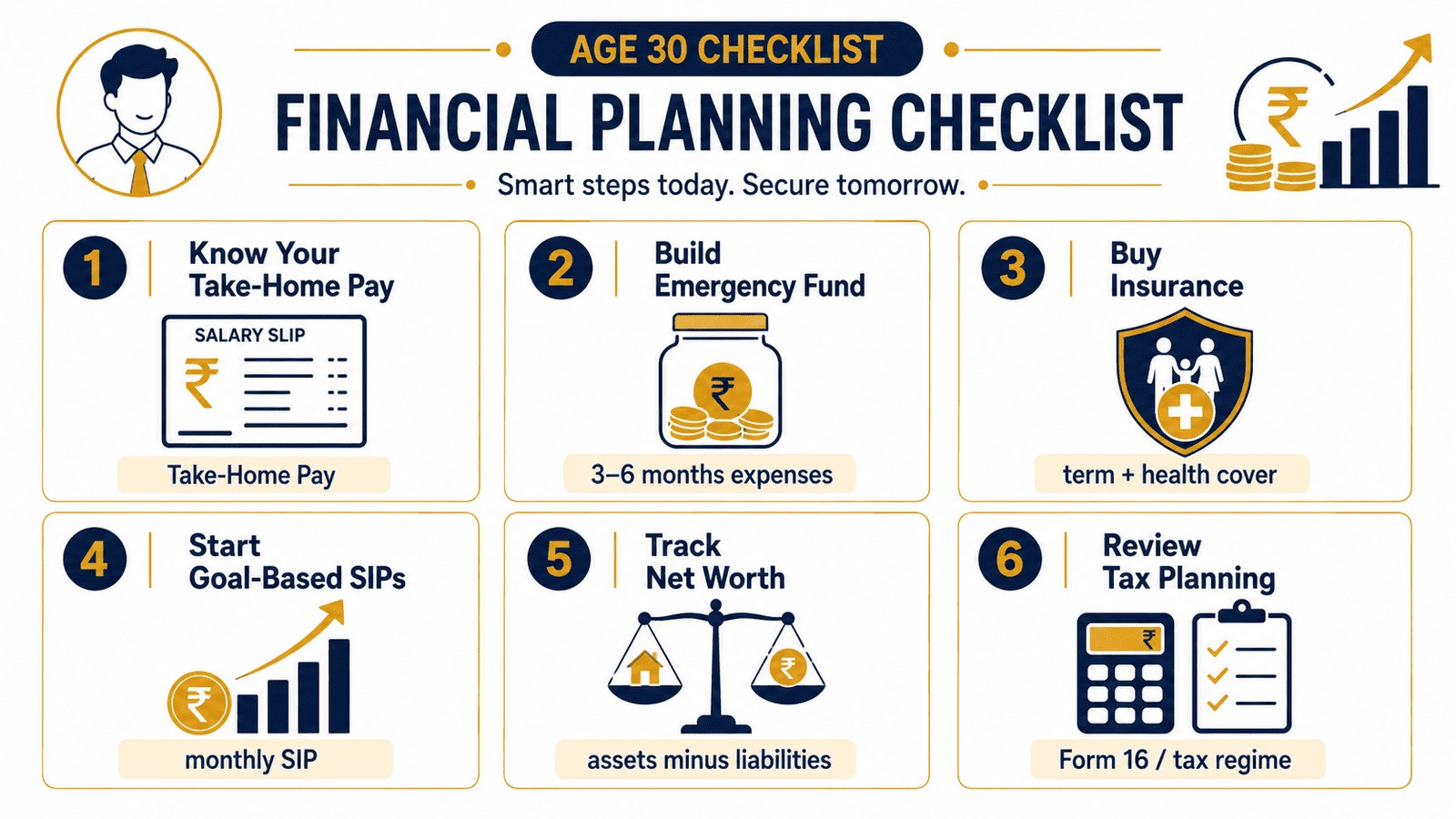
A financial planning checklist for 30 year old salaried employee should start with a monthly budget, 3–6 months of emergency expenses, adequate health and term insurance, debt control, SIPs for long-term goals, tax planning, and annual net-worth tracking. For example, someone earning ₹90,000 monthly should first secure basics before chasing returns.
Priority order at a glance:
- Monthly budget and cash flow clarity
- Emergency fund (3–6 months of essential expenses)
- Health and term insurance review
- Debt control and EMI management
- SIPs for retirement and long-term goals
- Tax planning and 80C optimisation
- Annual net-worth tracking
This checklist is educational and not personalised financial advice. Verify current tax rules, insurance limits, and investment terms from official sources before acting.
Key Takeaways
- Build a budget first: someone earning ₹90,000 monthly who has no written budget often loses ₹10,000–₹15,000 per month to untracked lifestyle spending before any savings happen.
- Your emergency fund target is your monthly essential expenses multiplied by 3 to 6 — for a ₹90,000 earner with ₹50,000 in essentials, that is ₹1.5 lakh to ₹3 lakh in liquid savings.
- Employer health insurance is not enough on its own — a basic group cover of ₹3–₹5 lakh often does not cover serious illness, parental hospitalisation, or post-employment gaps.
- Term insurance at 30 is significantly cheaper than at 35 — delay by five years and your annual premium can increase by 30–50% for the same cover amount.
- Starting a ₹5,000 monthly SIP at 30 gives your money roughly 30 years to compound before a typical retirement age — the same amount started at 40 has only 20 years. Mutual fund investments carry market risk; past returns are not guaranteed.
- Your debt-to-income ratio — total monthly EMIs divided by take-home pay — should ideally stay below 40% to leave room for savings and emergencies.
- Track your net worth once a year: total assets minus total liabilities. If the number grows, you are making progress regardless of short-term market noise.
Key Facts at a Glance
| Checklist Item | Why It Matters at 30 | Review Frequency |
|---|---|---|
| Monthly budget | Controls spending before it controls you | Monthly |
| Emergency fund | Prevents forced loan or investment withdrawal during crisis | Every 6 months |
| Health insurance | Employer cover may not be sufficient for family or serious illness | Annually |
| Term insurance | Cheapest income protection when you have dependents | At life events |
| Debt and EMI check | High EMI-to-income ratio blocks savings capacity | Monthly |
| SIP / retirement planning | Compounding works best with a long time horizon | Annually |
| Tax planning (80C, NPS) | Reduces tax outflow legally before March 31 | Annually |
| Nominations update | Ensures assets reach intended beneficiaries | At life events |
| Net-worth statement | Measures actual financial progress year on year | Annually |
The Financial Planning Checklist for 30-Year-Old Salaried Employees — In Priority Order
Step 1: Know Your Take-Home Salary and Fixed Outflows
Before you plan anything, you need to know what actually lands in your bank account each month — not your CTC, not your gross salary, but your actual in-hand amount after EPF deductions and TDS. Many salaried employees in India confuse CTC with take-home and end up over-committing to EMIs or SIPs they cannot sustain. Write down your take-home, then list every fixed expense: rent, home loan EMI if any, utility bills, parental support transfers, insurance premiums, and any existing SIP or loan EMI.
Step 2: Build a Monthly Budget with Spending Guardrails
Once you know your take-home and fixed costs, build a monthly budget that decides where the rest goes before you spend it — not after. The monthly budget rule for Indian families gives you a framework: allocate percentages to needs, wants, and savings rather than winging it each month. The goal is to prevent lifestyle creep from consuming every salary hike before it contributes to your financial goals. A 30-year-old who starts budgeting at this stage has at least 25–30 years to benefit from that discipline.
Step 3: Build an Emergency Fund Before Aggressive Investing
Your emergency fund is not an investment — it is a buffer that prevents you from liquidating SIPs, breaking FDs, or taking personal loans when a genuine crisis hits. In Indian households, where job loss, medical expenses, parental health emergencies, or sudden home repairs are real risks, this buffer is non-negotiable. Keep it in a savings account, liquid mutual fund, or short-term FD — wherever you can access the full amount within 24–48 hours without penalty. Only once this buffer is in place should you increase equity exposure aggressively.
Step 4: Check Health Insurance and Term Insurance Coverage
At 30, if you have dependents — parents, a spouse, or children — your income is someone else’s lifeline. Two insurance gaps are very common at this life stage. First, many employees rely entirely on employer group health cover, which typically lapses the day you resign or are laid off. According to guidelines from IRDAI (irdai.gov.in), a personal health insurance policy — either individual or a family floater — is the recommended way to ensure continuity of cover. Second, term life insurance at 30 costs significantly less than at 35 or 40, because insurers price premiums on life expectancy and health risk at the time of purchase. Read more about why term insurance matters for every earning person with dependents before deciding on a cover amount.
Step 5: Start SIPs and Retirement Planning Gradually
Only after your emergency fund is in place and your insurance is reviewed should you accelerate equity investments. Start with a manageable SIP amount — even ₹3,000–₹5,000 a month — and increase it every year as salary grows. If your employer offers NPS (National Pension System) as a benefit under Section 80CCD, explore whether contributing makes tax sense for you. Your EPF contribution already provides a fixed-income base; SIPs in diversified equity funds can complement it for long-term growth. Mutual fund investments are subject to market risk; historical returns should not be treated as guaranteed future performance, as confirmed by SEBI (sebi.gov.in).
Real Example: Ankit’s Age-30 Financial Review in Pune
Ankit is 30, works as a software engineer in Pune, and earns ₹90,000 per month as take-home pay after EPF and TDS deductions. Here is how his checklist plays out:
Monthly cash flow breakdown: Rent: ₹18,000. Parental support: ₹10,000. Groceries and utilities: ₹8,000. Transport: ₹4,000. Total essentials: ₹40,000. Discretionary spending (dining, subscriptions, clothing): ₹12,000. Total monthly outflow: ₹52,000. Monthly surplus: ₹38,000.
Emergency fund target: Ankit’s essential monthly expenses are ₹40,000. A 3-month buffer requires ₹1,20,000; a 6-month buffer requires ₹2,40,000. He currently has ₹80,000 in a savings account — enough for 2 months. His first goal is to top this up to at least ₹1,20,000 before increasing SIPs. Use the emergency fund calculator to find your own target based on your monthly expenses.
Insurance review: Ankit has ₹5 lakh group health cover from his employer and no personal term plan. His parents are dependents. He decides to buy a ₹50 lakh term plan and a ₹10 lakh family floater. Both purchases happen before increasing his SIP amount.
SIPs after basics: Once emergency fund and insurance are set, Ankit redirects ₹10,000 per month into a combination of diversified equity and index funds via SIP. This is illustrative — it is not a product recommendation. Actual SIP allocation depends on individual goals, risk tolerance, and financial position.
How to Calculate Your Starting Financial Position at 30
Monthly Surplus = Take-home Income − (Essential Expenses + Lifestyle Expenses)
Using Ankit’s numbers: ₹90,000 − ₹52,000 = ₹38,000 monthly surplus available for savings and investments.
Emergency Fund Target = Monthly Essential Expenses × 3 (minimum) to 6 (recommended)
₹40,000 × 3 = ₹1,20,000 | ₹40,000 × 6 = ₹2,40,000
Net Worth = Total Assets − Total Liabilities
Assets include EPF balance, savings, FDs, mutual fund value, and any property. Liabilities include home loan outstanding, personal loan, and credit card balance. A positive and growing net worth — tracked annually — is the clearest signal of real financial progress. Use the net worth calculator and guide to run this number for the first time.
Debt-to-Income Ratio = Total Monthly EMIs ÷ Monthly Take-home Pay × 100
If Ankit pays ₹15,000 in EMIs: ₹15,000 ÷ ₹90,000 × 100 = 16.7% — well within a manageable range. A ratio above 40% signals that debt is crowding out savings capacity.
| Calculation | Ankit’s Figures | Result |
|---|---|---|
| Monthly surplus | ₹90,000 − ₹52,000 | ₹38,000 |
| Emergency fund (3 months) | ₹40,000 × 3 | ₹1,20,000 |
| Emergency fund (6 months) | ₹40,000 × 6 | ₹2,40,000 |
| Debt-to-income ratio | ₹15,000 ÷ ₹90,000 | 16.7% |
Comparison: What to Do Now vs Later vs After Stability
| Priority | Action Item | Risk If Ignored |
|---|---|---|
| Must Do Now | Monthly budget and cash flow tracking | Surplus disappears without accountability |
| Must Do Now | Build 3-month emergency fund | Any crisis forces loan or investment liquidation |
| Must Do Now | Review health and term insurance | A single hospitalisation can wipe out savings |
| Must Do Now | Control debt and EMI load | High EMI ratio blocks future savings room |
| Do Next | Start SIPs and retirement planning | Loses compounding years if deferred past 35 |
| Do Next | Tax planning: 80C, NPS, HRA optimisation | Pays more tax than legally required |
| Do Next | Update nominations across all accounts | Assets may not reach intended beneficiaries |
| After Stability | Increase equity allocation aggressively | Premature aggression creates portfolio anxiety |
| After Stability | Plan home purchase with full cost clarity | Underprepared EMI commitment strains budget |
How to Decide What’s Right for You
You have dependents (parents, spouse, or children) and no personal term insurance — THEN buy term cover before increasing any investment amount. Income replacement for dependents cannot wait.
Your total monthly EMIs exceed 40% of take-home pay — THEN prioritise reducing high-interest debt (credit cards, personal loans) before starting new SIPs. Paying 18–24% on a credit card balance while earning 12% notionally from equity makes no financial sense.
You are on a variable income or in a sector with high job-change risk — THEN build a 6-month emergency fund rather than 3 months, and keep a larger share in liquid savings before locking into long-term SIPs. The guide to building a six-month emergency fund in India walks you through this step by step.
Your employer provides group health cover but you are considering marriage or planning a child — THEN add a personal family floater policy now, while you are young and healthy, to lock in lower premiums before the family situation changes.
You are single with no dependents, a stable job, a 3-month emergency fund already in place, and basic insurance sorted — THEN accelerating SIPs and maximising EPF/NPS contributions makes clear sense at this stage.
You do not yet have a written budget, a liquid emergency fund, or working health insurance — THEN do not chase aggressive investment returns first. Getting the basics in place takes priority over optimising returns by a few percentage points.
Common Mistakes to Avoid
Investing Aggressively Without an Emergency Fund
Many 30-year-olds start large SIPs before keeping any liquid buffer in place.
When a job loss, medical bill, or urgent home repair hits, they are forced to redeem mutual fund units — often at a loss during a market downturn — or take a personal loan at 14–18% interest. The cost of not having ₹1–₹2 lakh liquid can easily exceed any SIP gain in the short run.
Build a 3-month emergency fund first. Then increase SIP amounts steadily.
Treating Employer Health Insurance as Complete Coverage
Group health policies offered by employers are group cover — they typically lapse the day you leave the job.
Between jobs, or after a layoff, you could be uninsured for weeks or months. A single hospitalisation during that window can cost ₹2–₹5 lakh or more, wiping out savings built over years. If you take a career break, the gap is even longer.
Buy a personal health policy while you are young and healthy. Premiums are lower at 30 than at 35 or 40.
Buying Insurance as an Investment Product
Endowment plans, money-back policies, and traditional LIC products are often sold as “insurance plus savings” — but the returns are typically low and the cover is inadequate relative to actual income replacement needs.
A ₹10 lakh endowment policy gives your family ₹10 lakh at death — which may not even cover one year of your income. A term insurance plan at 30 can offer ₹50–₹1 crore cover for the same or lower annual premium.
Keep insurance and investment separate. Term plans for protection; mutual funds or NPS for growth.
Ignoring Lifestyle Inflation After Every Salary Hike
A salary increase of ₹10,000 per month that flows entirely into upgraded subscriptions, a new car loan, and dining habits adds zero to net worth.
This pattern — spending rises as fast as income — is one of the most common reasons that salaried employees in their 30s find themselves earning well but saving little. Over a 5-year period, ₹5,000 per month redirected to a SIP instead of lifestyle can grow meaningfully.
Automate a savings step-up every time your salary increases, before the lifestyle adjustment happens.
Delaying Retirement Planning Because 30 Feels Young
Retirement at 60 is 30 years away from age 30 — which makes it the single longest compounding horizon you will ever have. According to SEBI’s investor education materials at sebi.gov.in, the power of long-term compounding in equity markets is directly tied to time in the market. Delaying by 5–7 years can substantially reduce your final corpus for the same monthly contribution. See how to estimate your retirement corpus to understand how much you may need and what monthly SIP can get you there.
Start small if needed. ₹3,000 a month now beats ₹6,000 a month from age 37.
Not Updating Nominations After Major Life Events
Nominations on bank accounts, EPF accounts, insurance policies, and mutual funds often go untouched for years.
If you get married, have a child, or lose a family member and your nominations are still in the name of an outdated beneficiary, the claim process becomes legally complicated for your family.
Update nominations across all accounts — bank, EPF at epfindia.gov.in, insurance, and mutual funds — at every major life event.
Skipping Tax Planning Until March
Waiting until February or March to plan 80C investments leads to rushed decisions — often into insurance products or FDs chosen for speed rather than value.
The income tax rules for deductions under Section 80C, 80D, and NPS contributions are available at incometax.gov.in. Plan your tax-saving investments at the start of the financial year — April — and automate them so you do not face a last-minute scramble.
Year-round planning means better product choices and no cash flow disruption in March.
When This May Not Be the Right Choice
The standard age-30 financial planning checklist assumes a reasonably stable income and manageable existing debt. It needs adjustment in these situations:
Serious outstanding debt: If you are carrying unpaid credit card dues above ₹1–₹2 lakh at 18–24% interest, or an unsecured personal loan taken for consumption, that debt costs more than almost any investment can earn. Clearing high-interest debt should come before SIP targets.
Near-term major expense: If a marriage, childbirth, relocation, or home down payment is 6–12 months away, locking money into 3-year ELSS or illiquid instruments right now reduces your flexibility at a critical moment. Prioritise liquid savings until the event passes.
Supporting multiple dependents with an uncertain income: If you are the sole earner for parents and a spouse on a variable or commission-based income, a larger emergency buffer and simpler insurance take priority over complex investment portfolios.
Recent career break or income disruption: If you have taken a break in the last 6–12 months and are rebuilding income, stabilise your monthly cash flow and restore your emergency fund before committing to new long-term products. As per RBI guidance available at rbi.org.in, financial commitments should be proportional to verified current income, not projected future earnings.
If any of these apply to your situation, it may be worth exploring alternatives before committing.
Official Rules and Where to Verify
Tax slabs, deduction limits, EPF contribution rates, NPS rules, and insurance regulations can change with each Union Budget or regulatory update. The figures used in this article reflect the writer’s knowledge at time of publication and should be verified from official sources before making any decision.
- Income Tax Department — incometax.gov.in (80C limits, tax slabs, Form 16 details, TDS rules)
- EPFO — epfindia.gov.in (EPF contribution rates, withdrawal rules, UAN and nomination updates)
- IRDAI — irdai.gov.in (insurance regulations, insurer verification, health policy guidelines)
- PFRDA — pfrda.org.in (NPS contribution rules, tax benefits, withdrawal norms)
- SEBI — sebi.gov.in (mutual fund regulations, investor education, SIP guidelines)
- RBI — rbi.org.in (savings account rates, FD norms, lending and EMI guidelines)
Rules, limits, and rates on this topic can change with each Budget or regulatory update. Always verify current figures directly from the official source before making any financial decision.
Expert Tips
- Automate savings on salary day, not at month end: Set up a standing instruction on your bank account to move a fixed amount to your emergency fund or SIP account on the same day your salary credits. What you do not see in your spending account, you do not spend.
- Review insurance before any salary increment investment: Every time you get a hike, check your insurance cover before deciding where to invest the extra. A cover amount of ₹50 lakh may have been adequate at your previous salary but may no longer reflect your actual income replacement need after a promotion.
- Increase your SIP by 10% every year — not your lifestyle: If you are saving ₹5,000 per month in SIPs today, try to step it up by ₹500 every April. Over 10 years, this step-up approach can add meaningfully to your corpus compared to a flat SIP, assuming returns over the long term.
- Track net worth every 6 months with a simple spreadsheet: List all assets (EPF balance, savings, mutual funds, FDs, property if any) and all liabilities (home loan outstanding, personal loan, credit card dues). Subtract liabilities from assets. A growing number tells you the checklist is working — independent of what markets are doing this month.
- Update nominations immediately after marriage, childbirth, or bereavement: Log in to your EPF account at epfindia.gov.in, your insurance portal, and your mutual fund accounts within 30 days of any major life event. This one administrative step prevents months of legal complications for your family later.
- Use Form 16 to verify TDS and plan taxes early: Your employer issues Form 16 by mid-June each year. Use it in April of the following year to plan your 80C, 80D, and HRA claims systematically rather than guessing at year-end. The Income Tax Department’s portal at incometax.gov.in has a tax calculator to help you compare old and new regime tax liability.
Frequently Asked Questions
How much emergency fund should a 30-year-old salaried employee keep?
Multiply your monthly essential expenses — rent, groceries, utilities, EMIs, parental support — by 3 for a minimum buffer and by 6 for a recommended buffer. If your essential expenses are ₹40,000 per month, your target range is ₹1,20,000 to ₹2,40,000 in a liquid savings account or liquid fund. Keep this amount entirely separate from your investment portfolio.
Should I buy term insurance at 30?
Yes, if you have financial dependents — parents, a spouse, or children. Term insurance at 30 is significantly cheaper than at 35 or 40, because premium calculations are based on life expectancy and health status at the time of purchase. A ₹1 crore cover may cost ₹8,000–₹12,000 per year at 30 but considerably more at 35. Verify current premium rates and insurer credentials at irdai.gov.in before purchasing.
Is SIP better than FD for a salaried employee at 30?
They serve different purposes. An FD is for capital preservation and guaranteed returns — suitable for your emergency fund or a goal that is 1–2 years away. A SIP in equity mutual funds is for long-term wealth creation over 7 years or more — but returns are not guaranteed and carry market risk. SEBI at sebi.gov.in regulates mutual funds and publishes investor education material on this difference. The right answer depends on your time horizon, risk tolerance, and goal.
Should I invest before repaying loans?
It depends on the interest rate of your loan. High-interest debt — credit cards at 18–24%, personal loans at 14–18% — should be repaid before increasing equity investments, because no investment consistently beats 18% after tax. Home loan interest, however, may be partially offset by tax deductions, making it a different calculation. Low-cost debt and high-cost debt require different strategies.
How often should I review my financial plan?
At minimum, once a year — ideally in April at the start of the financial year. Additionally, review after any major life event: a salary change, marriage, birth of a child, new home loan, job change, or family medical event. The checklist items that matter most (insurance cover, emergency fund adequacy, SIP amounts) all shift with life stage and income.
Is employer health insurance enough for a 30-year-old?
Usually not as a standalone cover. Most employer group policies lapse when you leave the company, do not cover parents automatically, and may have sublimits or room-rent restrictions that reduce payouts on serious claims. IRDAI at irdai.gov.in recommends that individuals maintain a personal health policy separate from employer cover to ensure continuity. A family floater of ₹10–₹15 lakh is a commonly discussed starting point for a young family, though you should assess your own needs and insurer terms before buying.
What is a good debt-to-income ratio for a salaried employee?
Total monthly EMIs — home loan, car loan, personal loan combined — should ideally stay below 40% of take-home pay. Above 50%, your financial flexibility shrinks significantly and building savings becomes very difficult. If you are above 40%, prioritise not taking on new loans and use any surplus cash flow to prepay the highest-interest loan first.
Can I start retirement planning with just ₹2,000 per month at 30?
Yes — the key variable is time, not starting amount. A small SIP started at 30 benefits from 30 years of potential compounding before age 60. The most important thing is to start and to increase the amount every year as income grows. Mutual fund investments carry market risk and historical returns should not be treated as guaranteed. Use the retirement planning guide at retirement corpus planning to estimate whether your current SIP trajectory aligns with your retirement goal.
What is the 80C deduction limit for salaried employees?
Under the old income tax regime, Section 80C allows a deduction of up to ₹1.5 lakh per financial year on qualifying investments and payments such as EPF contribution, ELSS, PPF, life insurance premiums, home loan principal, and children’s tuition fees. This limit applies per taxpayer, not per family. Verify the current limit and eligible instruments at incometax.gov.in, as these can change with each Budget.
What happens if I miss my SIP payment for a month?
Missing one or two SIP instalments typically does not cancel or penalise the SIP. Most fund houses allow a few missed payments before pausing the mandate. However, consistent gaps can affect your long-term corpus simply because those months of investment — and the compounding on them — are lost. If you are tight on cash in a particular month, it is better to reduce the SIP amount temporarily than to skip and forget to resume.
Final Verdict
A financial planning checklist for 30 year old salaried employee is not about finding the best investment product — it is about building financial systems that protect and grow your income over the next three decades. Start with a written budget and a liquid emergency fund. Get your insurance in order — health and term — before adding equity risk. Control your EMI load. Then invest systematically in SIPs and retirement accounts while reviewing your plan every year. The 30-year-old who gets the basics right has a structural advantage over someone who chases returns without foundations. Wealth at this age is built through consistency, not through finding the perfect scheme. Always verify the latest rules from official sources or consult a qualified professional before making any financial decision.
This article is for educational purposes only and should not be treated as personalised financial, tax, investment, insurance, or legal advice. Tax rules, interest rates, regulatory limits, and product features can change with each Budget or policy update. Please verify current rules from official government sources or consult a qualified and registered professional before making any financial decision.

Sanya Malhotra writes about everyday personal finance for Indian individuals and families. Her content focuses on budgeting, saving, emergency funds, debt control, net worth tracking, family money decisions, and practical habits that help readers manage money with more confidence.
She covers topics such as monthly budgeting, expense planning, saving habits, emergency fund behaviour, debt repayment, household financial planning, family discussions about money, financial mistakes, net worth tracking, short-term vs long-term goals, and beginner personal finance concepts.
Sanya’s writing style is warm, simple, and realistic. She avoids making personal finance feel intimidating and instead explains money decisions through relatable Indian examples, ₹ budgets, checklists, and step-by-step frameworks. Her articles are useful for students, freshers, couples, parents, and families who want to improve daily money habits. Her content is educational and does not provide personalised financial advice. Readers should adapt examples to their own income, family responsibilities, city, debt level, risk comfort, and financial goals.