

You open your broker app, tap on Infosys or Reliance, and see two options side by side — NSE and BSE. Both show slightly different prices. One shows higher volume. Your finger hovers. Which do you pick? Most beginners freeze here. A few just guess. The truth is that for most large-cap stock orders in India, the difference is smaller than you think — but for some orders, it can cost you real money. This article gives you a practical framework so you always pick the right exchange, not a random one.
Quick Answer: NSE vs BSE
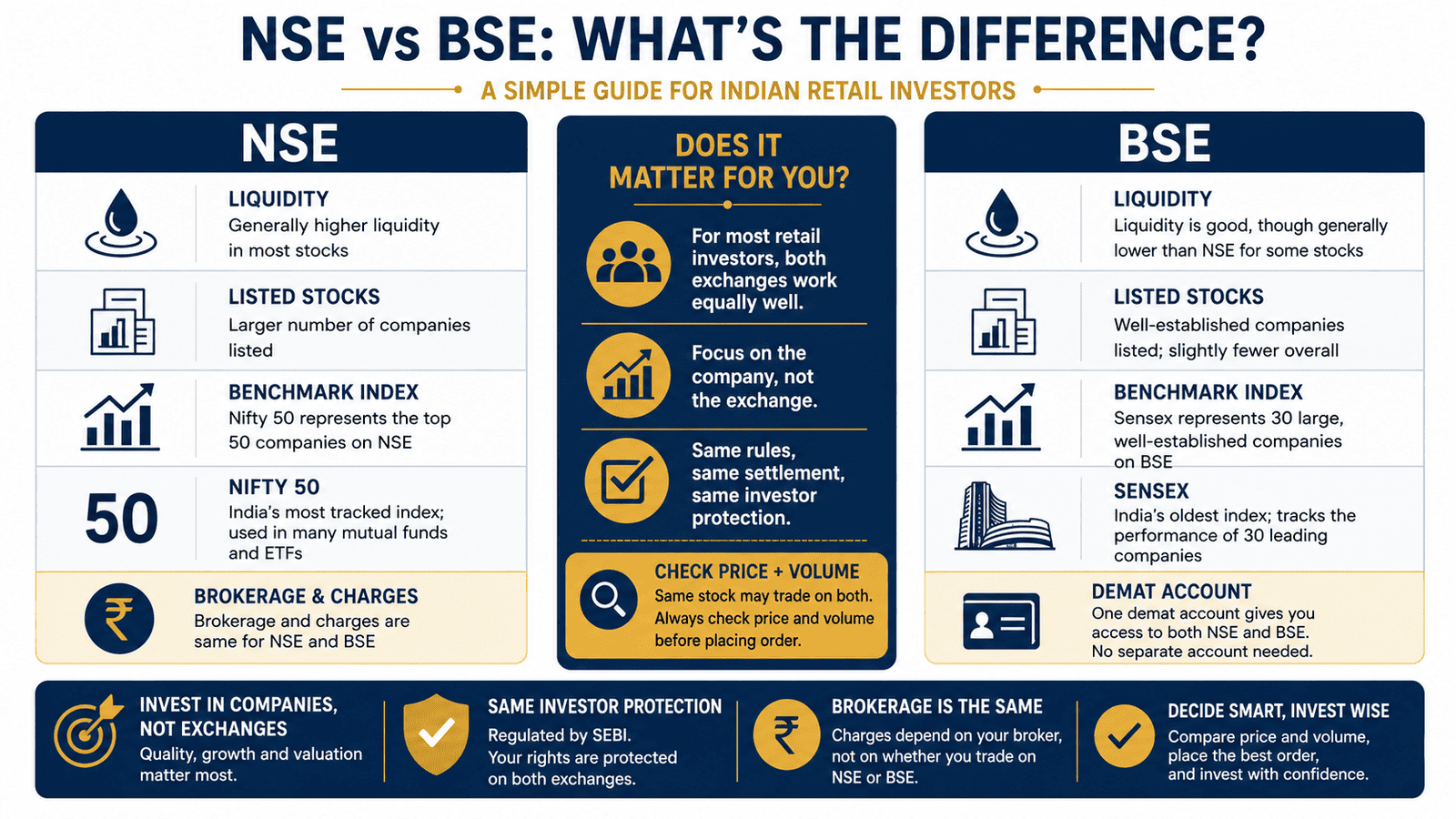
NSE vs BSE compares India’s two main stock exchanges. For most retail investors buying liquid large-cap stocks, the choice usually matters less than price, volume, bid-ask spread, and brokerage. For a ₹1 lakh share order, check where execution is better before placing the trade.
Key Takeaways
- NSE has higher daily trading volumes in the equity segment — making it the default choice for most retail stock orders where liquidity matters.
- BSE is the older exchange (est. 1875) and lists more companies — over 5,000 — versus NSE’s roughly 2,000 listed stocks.
- Both exchanges use the same T+1 settlement cycle and are regulated by SEBI, so your money and shares arrive on the same timeline regardless of which exchange you trade on.
- The benchmark index for NSE is Nifty 50; for BSE it is Sensex (30 stocks). Neither index is “better” — they track different baskets of blue-chip stocks.
- For mid-cap and small-cap stocks, liquidity can differ sharply between exchanges. A stock with low volume on one exchange may have better depth on the other — always check before buying.
- Your demat account holds shares by ISIN number, not by exchange. Shares bought on NSE and shares bought on BSE for the same company are identical once settled.
- The exchange choice does not change your tax liability. Short-term capital gains, long-term capital gains, and STT rules apply identically on both NSE and BSE.
NSE vs BSE: Head-to-Head Comparison
| Parameter | NSE (National Stock Exchange) | BSE (Bombay Stock Exchange) |
|---|---|---|
| Founded | 1992 | 1875 |
| Headquarters | Mumbai | Mumbai |
| Benchmark Index | Nifty 50 | Sensex (S&P BSE Sensex) |
| Number of Listed Companies | ~2,000+ | ~5,000+ |
| Daily Equity Turnover | Higher (dominant in cash equities) | Lower (but comparable in some segments) |
| Derivatives (F&O) | Dominant — highest F&O volumes globally | Available but lower volumes |
| Settlement Cycle | T+1 | T+1 |
| Regulator | SEBI | SEBI |
| Clearing Corporation | NSE Clearing Ltd (NCL) | Indian Clearing Corporation Ltd (ICCL) |
| Index used in mutual funds | Nifty 50 (most index funds) | Sensex (some index funds and ETFs) |
| SME Platform | NSE Emerge | BSE SME |
| Investor Safety | SEBI-regulated | SEBI-regulated |
For a deeper look at how Nifty 50 and Sensex actually measure market health, see our guide on Nifty and Sensex.
Key Facts at a Glance
| Fact | NSE | BSE |
|---|---|---|
| Incorporated | 1992; began trading 1994 | 1875; Asia’s oldest exchange |
| Listing code format | Symbol (e.g. INFY) | Scrip code (e.g. 500209) |
| ISIN for same company | Identical across both exchanges | Identical across both exchanges |
| Transaction charges (approx.) | ~₹3.25 per ₹1 lakh turnover (equity) | ~₹3.00 per ₹1 lakh turnover (equity) |
| STT (Securities Transaction Tax) | Same rate on both exchanges | Same rate on both exchanges |
| Demat settlement | Via CDSL or NSDL | Via CDSL or NSDL |
NSE vs BSE Explained: What Actually Matters When You Trade
Both NSE and BSE are SEBI-regulated stock exchanges in India. Both let you buy and sell shares, bonds, ETFs, and derivatives. For the average retail investor buying shares of a large-cap company — say HDFC Bank or TCS — the practical experience on either exchange is almost identical. But “almost” carries a cost, and it is worth understanding why.
What is NSE?
The National Stock Exchange was incorporated in 1992 and launched equity trading in 1994. It was India’s first fully electronic, screen-based trading exchange — meaning no open-outcry floor trading. According to NSE (nseindia.com), it is now one of the largest derivatives exchanges in the world by contract volume. Its benchmark index, the Nifty 50, tracks 50 large-cap companies across 13 sectors. Most equity index mutual funds in India track the Nifty 50.
If you are new to investing, understanding how the stock market basics work will help you see why NSE’s electronic architecture made India’s equity market far more accessible than it was before 1994.
What is BSE?
The Bombay Stock Exchange, established in 1875, is Asia’s oldest stock exchange and among the oldest in the world. It lists over 5,000 companies — far more than NSE — making it an important platform for smaller companies, SME listings, and regional businesses that do not meet NSE’s listing requirements. BSE’s benchmark is the Sensex, which tracks 30 of India’s largest and most liquid stocks. BSE is also the primary platform for India’s currency and interest rate derivatives in some segments.
Why NSE Dominates Retail Trading Volume
For the equity cash segment — the segment where most retail investors buy and sell shares — NSE consistently handles higher daily trading volumes than BSE. Higher volume means more buyers and sellers active at any given moment, which translates directly into tighter bid-ask spreads. A tight spread means you lose less money between the price you see and the price you actually get.
Consider this: on NSE, the bid-ask spread for Reliance Industries during peak trading hours might be ₹0.05 to ₹0.20. On BSE for the same stock, it could be slightly wider at quieter moments. For a ₹1 lakh order that is a visible but manageable difference. For a ₹10 lakh order, it can mean hundreds of rupees in effective cost even before brokerage is counted.
When BSE Has an Edge
BSE lists thousands of companies that NSE does not. If you want to buy shares of a smaller regional company, an SME stock, or a bond listed only on BSE, you have no choice. BSE’s SME platform also gives retail investors access to early-stage companies that graduate to the main board later. For debt instruments — corporate bonds, government securities — BSE’s bond platform (BSE Bond) is often the more active marketplace. Always check which exchange actually lists the instrument before assuming NSE is the default.
The ISIN Rule: Your Shares Are the Same Either Way
Every listed company has a unique ISIN (International Securities Identification Number). Whether you buy Infosys shares on NSE or BSE, the ISIN is identical: INE009A01021. Once the trade settles in your demat account, there is no tag saying “bought on NSE” or “bought on BSE.” The shares are fungible. You can even buy on one exchange and sell on the other within the same broker platform, as long as the settlement timelines align. Understanding owning one share — including how settlement and dematerialisation work — makes this clearer.
F&O Trading: NSE Is the Only Practical Choice
If you trade Futures and Options (F&O), there is no meaningful debate. NSE’s derivatives segment handles the overwhelming majority of F&O volumes in India. Liquidity in BSE F&O contracts is thin by comparison, which means wide spreads and higher impact costs on most instruments. For derivative traders, NSE is the standard.
Transaction Charges: A Real But Small Difference
NSE and BSE charge slightly different transaction fees per ₹1 lakh of turnover. These charges appear in your contract note and are in addition to brokerage, STT, GST, and SEBI turnover fees. As of recent published schedules, NSE’s equity transaction charge is approximately ₹3.25 per ₹1 lakh and BSE’s is approximately ₹3.00 per ₹1 lakh. The difference is small — under ₹1 on a ₹1 lakh trade — and rarely the deciding factor. Verify current transaction charges directly on nseindia.com and bseindia.com, as these can be revised. When you open a demat account, your broker’s fee schedule will show the full breakdown of these charges.
Real Example: Rohan’s First Share Purchase in Pune
Rohan is 28, a software engineer in Pune earning ₹85,000 per month. He has just opened a demat account and wants to buy 20 shares of Wipro. In his broker app, he sees Wipro on both NSE and BSE.
On NSE at 11:30 AM: Wipro is quoted at ₹450.15 (ask), with 1,42,000 shares available at or near that price. The bid-ask spread is ₹0.10.
On BSE at the same moment: Wipro is quoted at ₹450.25 (ask), with 18,000 shares available. The spread is ₹0.30.
Rohan’s order is for 20 shares — a total of roughly ₹9,000. The price difference is ₹0.10 per share, or ₹2 total. Transaction charges differ by less than ₹0.30. In this case, NSE wins on both price and depth, so Rohan correctly picks NSE.
Had Rohan been looking at a smaller company listed only on BSE — say an SME stock — NSE would not even appear as an option. The key insight: the owning one share outcome is identical either way once settled. The exchange choice affects cost and execution, not what you actually own.
How to Decide What’s Right for You
You are buying a large-cap Nifty 50 or Sensex stock — THEN check NSE first. It almost always has tighter spreads and deeper order books for these stocks.
You are buying an F&O contract (futures or options) — THEN always use NSE. BSE F&O volumes are too thin to guarantee good execution for most retail traders.
The company you want is only listed on BSE — THEN BSE is your only option; there is nothing to decide. Check bseindia.com to confirm listing status.
You are comparing both exchanges and BSE shows a meaningfully lower ask price with sufficient volume for your order size — THEN BSE gives you a better deal on that trade.
You trade intraday and delivery regularly — THEN build the habit of checking bid-ask spread and order depth on both exchanges before placing larger orders, not just the last traded price.
You invest in index mutual funds or ETFs — THEN the exchange does not matter for mutual fund transactions, but for ETFs, check which exchange the ETF is more liquid on before buying.
You are not an active trader comparing execution quality — then do not overthink exchange selection. Pick NSE as the default for listed equity shares and move on. For most long-term investors, exchange choice is the least important variable in building wealth.
Common Mistakes to Avoid
Picking an Exchange Based on the Last Traded Price Alone
The last traded price on NSE and BSE can differ by ₹0.05 to ₹1 or more for the same stock at the same moment.
Looking only at the last traded price ignores the ask price (what you will actually pay), the available volume at that price, and the bid-ask spread. A ₹5 lower “last price” on BSE means nothing if the actual ask is ₹8 higher with thin volume — you could end up paying more.
Always look at the ask price and order depth, not the last traded price, before placing your order.
Assuming NSE Is Always Better
NSE leads in volume for large-cap equities and derivatives, but BSE lists thousands of companies NSE does not.
If a stock you want is only on BSE — especially SME stocks, certain bonds, or regional companies — NSE is not an option. Assuming NSE is universally better means missing investment opportunities that exist only on BSE.
Always verify listing status on both exchanges before concluding you have no choice.
Not Checking Liquidity for Mid-Cap and Small-Cap Stocks
For small-cap or mid-cap stocks, trading volumes can vary significantly between NSE and BSE on the same day.
Placing a market order in a low-volume stock on the wrong exchange can result in partial fills or price slippage — where your buy order pushes the price up because there are too few sellers at the quoted price. On a ₹50,000 small-cap order, slippage of even 0.5% costs ₹250, far more than any difference in transaction charges.
Check the market depth (Level 2 data, if your broker provides it) on both exchanges before placing orders in any stock with daily volume under ₹10 crore.
Confusing Nifty 50 and Sensex with Exchange Quality
Beginners often assume NSE is “better” because Nifty 50 is more widely tracked in news and mutual funds, or that BSE is “worse” because Sensex has fewer stocks.
Both indices are legitimate benchmarks tracking different baskets of top Indian companies. A mutual fund that tracks Sensex is not inferior to one that tracks Nifty 50 — the long-term returns are closely correlated. Exchange quality and index composition are separate questions entirely.
Evaluate mutual fund index choices based on tracking error, expense ratio, and fund size — not by which exchange the index belongs to.
Ignoring Transaction Charge Differences on High-Frequency Trades
For a single ₹10,000 delivery trade, the difference in transaction charges between NSE and BSE is less than ₹0.30. Easy to ignore.
But for an active trader doing ₹5 lakh of daily turnover, those small differences compound across hundreds of trades per month. Over a year, the cost gap can cross ₹1,000–₹2,000 even before brokerage.
If you trade frequently, compare your broker’s full contract note breakdown — transaction charges, STT, GST, SEBI fees — on both exchanges. Use our brokerage calculator to model the actual cost difference for your typical order size.
Thinking Different Exchanges Means Different Tax Rules
Some beginners believe that trading on BSE versus NSE attracts different tax treatment.
STT (Securities Transaction Tax), short-term capital gains tax (STCG), and long-term capital gains tax (LTCG) rates are identical on both exchanges. Your tax liability is determined by how long you held the stock and what gain you made — not which exchange you used. See our complete guide on stock market tax for full details.
Never delay or change a trade decision based on which exchange you are using, expecting a different tax outcome.
Using a Broker That Only Offers One Exchange
Most full-service and discount brokers in India give you access to both NSE and BSE. Some older or regional platforms may offer only one.
If your broker platform does not show both NSE and BSE options for a listed stock, you cannot compare execution quality. This limits your ability to get the best price.
When choosing a broker, confirm that your platform gives access to both exchanges for equity and the instruments you plan to trade.
Placing a Large Order Without Checking Order Depth
For small orders — say 5 shares of a large-cap stock — exchange choice barely matters. For larger orders, it can.
A ₹2 lakh order in a stock with only ₹80,000 of available depth at the quoted price on one exchange will move the price against you. On the other exchange, depth might be ₹5 lakh, giving you clean execution at the quoted price.
For any equity order above ₹50,000, take 60 seconds to compare order depth on both exchanges before clicking buy or sell.
When This May Not Be the Right Choice
The NSE-first default does not fit every investor or situation.
If you are investing in SME stocks, regional companies, or certain bonds available only on BSE, defaulting to NSE means you simply cannot trade what you want. BSE’s broader listing base is a genuine advantage here, not a consolation prize.
If you are building a portfolio of debt instruments, corporate bonds, or sovereign gold bonds, BSE’s bond platform often has more active listings and better pricing than NSE for the same instruments.
If your investing horizon is very long-term — buying large-cap stocks and holding for five or more years — the exchange choice at the point of purchase has almost no bearing on your eventual returns. A ₹5 execution saving on entry does not move the needle over a decade of compounding.
If any of these apply to your situation, it may be worth exploring alternatives before committing.
Official Rules and Where to Verify
Both NSE and BSE are regulated by SEBI under the Securities Contracts (Regulation) Act, 1956. Transaction charges, listing requirements, circuit breaker rules, and settlement procedures are governed by SEBI circulars and exchange-specific notifications. These can change with regulatory updates or budget announcements.
Rules, limits, and rates on this topic can change with each Budget or regulatory update. Always verify current figures directly from the official source before making any financial decision.
- SEBI — sebi.gov.in (exchange regulation, investor protection, circulars)
- NSE — nseindia.com (listed companies, transaction charges, Nifty index rules)
- BSE — bseindia.com (listed companies, transaction charges, Sensex rules)
- Income Tax Department — incometax.gov.in (STT, capital gains tax rules)
For a full breakdown of how taxes apply to your stock trades regardless of exchange, see our guide on stock market tax.
Expert Tips
- Before placing any equity order above ₹25,000, open the stock on both NSE and BSE in your broker app and compare the actual ask price — not just the last traded price. A ₹0.50 difference per share on a 100-share order is ₹50 saved in under 30 seconds.
- For Nifty 50 index ETF trading, check the NSE order book. Nifty ETFs are predominantly listed and traded on NSE, giving you tighter spreads and better execution than BSE counterparts for the same ETF in most cases.
- If you want exposure to India’s broader market including smaller companies, BSE’s universe of 5,000+ stocks is your starting point for discovery — even if you eventually buy on NSE for some names that list on both.
- When evaluating index mutual funds, check the tracking error and expense ratio — not whether the fund benchmarks Nifty (NSE) or Sensex (BSE). A Sensex fund with a 0.10% expense ratio can outperform a Nifty fund with a 0.20% expense ratio over the long run, simply due to lower costs.
- For delivery-based long-term investing — buying and holding for years — set NSE as default for large-caps but always check BSE if a stock appears to have thin NSE volume. A 30-second check can save you meaningful slippage on entry.
- If you trade F&O even occasionally, use NSE exclusively for those contracts. Attempting to trade BSE F&O contracts on illiquid instruments increases your risk of unfavourable fills, which compounds into larger losses than any transaction charge saving.
- Request a contract note from your broker after your first few trades and read every charge line: brokerage, STT, transaction charges (NSE or BSE), GST, SEBI fees. Understanding each line makes you a sharper cost-conscious investor and prevents surprise deductions from your account.
Frequently Asked Questions
Is NSE better than BSE for retail investors?
For most retail investors buying large-cap or Nifty 50 stocks, NSE offers higher liquidity and tighter bid-ask spreads — making it the practical default. But “better” depends on what you are buying. BSE lists over 5,000 companies versus NSE’s ~2,000, so for smaller companies or certain bonds, BSE may be your only option or the better-priced one.
Can I buy on NSE and sell on BSE for the same stock?
Yes, in principle. Since the same company has an identical ISIN on both exchanges, shares are fungible once settled in your demat account. However, timing matters: you cannot buy and sell the same shares intraday across different exchanges (that would require the shares to already be in your demat). For delivery trades, you can sell on a different exchange from where you bought, as long as the shares have settled.
Do NSE and BSE show different prices for the same stock?
Yes, prices can differ slightly at any given moment — typically by ₹0.05 to ₹2 for liquid stocks — due to differences in order flow, timing, and market depth. For very liquid large-cap stocks, arbitrageurs keep prices tightly aligned. For mid-cap or small-cap stocks, differences can be wider and persist longer.
Is there a difference in taxes when trading on NSE versus BSE?
No. STT (Securities Transaction Tax), STCG, and LTCG tax rates are identical on both exchanges. Your tax liability is based on your holding period and gain, not the exchange you used. Transaction charges differ slightly, but these are costs, not taxes.
What is the difference between Nifty 50 and Sensex?
Nifty 50 is NSE’s benchmark index, tracking 50 large-cap companies across 13 sectors. Sensex is BSE’s benchmark, tracking 30 of India’s largest companies. Both are free-float market-cap weighted. Nifty covers more companies and sectors; Sensex has a longer history. Long-term return correlation between the two is high. Neither is definitively “better” as a wealth-building benchmark.
What happens if the stock I want is only on BSE?
You simply buy it on BSE. Many smaller companies, SME listings, and regional businesses are listed only on BSE. Always check the exchange listing status on bseindia.com before assuming a stock trades on both exchanges. If you cannot find a stock on NSE, it does not mean the company does not exist — check BSE.
Is it safe to trade on BSE? Is it regulated?
Yes. BSE is fully regulated by SEBI, India’s capital market regulator, under the Securities Contracts (Regulation) Act, 1956. SEBI oversight, investor protection fund, clearing corporation guarantees, and dispute resolution mechanisms apply equally to BSE and NSE. Both are safe, SEBI-regulated exchanges.
Can I trade F&O on BSE?
BSE does offer Futures and Options contracts, but volumes are significantly lower than NSE for most equity derivatives. NSE dominates India’s F&O market with the highest derivative volumes globally on many contracts. For F&O trading, NSE is the standard choice for most retail participants — BSE F&O is best left to specialists who need its specific instruments.
Does my broker charge differently for NSE versus BSE?
Brokerage is usually the same across exchanges — set by your broker as a flat fee or percentage. The difference lies in exchange transaction charges: NSE charges approximately ₹3.25 per ₹1 lakh equity turnover and BSE approximately ₹3.00 per ₹1 lakh. On a ₹1 lakh order, that is a ₹0.25 difference — marginal for most investors but relevant for high-frequency traders. Verify current charges at nseindia.com and bseindia.com.
What is the settlement cycle on NSE and BSE?
Both NSE and BSE operate on a T+1 settlement cycle for equity trades. This means if you buy shares on Monday, they arrive in your demat account by Tuesday. The cycle is identical on both exchanges following SEBI’s phased T+1 rollout, which was fully implemented across Indian equity markets.
Final Verdict
For the vast majority of retail investors in India, NSE is the practical default for equity trading — especially for Nifty 50 large-caps, ETFs, and F&O contracts — because it offers deeper liquidity and tighter spreads. But NSE vs BSE is not a permanent preference; it is a per-trade check. BSE matters when a company is only listed there, when BSE depth is superior for a specific stock on a specific day, or when you are trading debt instruments and bonds. Your shares are identical once settled. Your taxes are identical. The exchange you pick affects execution cost and order quality — not what you own. For long-term investors, the decision is worth 30 seconds of comparison before each trade, not hours of analysis. For a clear picture of how intraday and delivery trades differ in cost and risk, see our guide on intraday and delivery. Always verify the latest rules from official sources or consult a qualified professional before making any financial decision.
This article is for educational purposes only and should not be treated as personalised financial, tax, investment, insurance, or legal advice. Tax rules, interest rates, regulatory limits, and product features can change with each Budget or policy update. Please verify current rules from official government sources or consult a qualified and registered professional before making any financial decision.

Devika Shah writes about stock market basics for Indian beginners who want to understand equity investing before taking financial risk. Her content is educational and does not provide stock tips, trading calls, price predictions, or personalised investment advice.
She covers topics such as demat account meaning, trading account basics, IPOs, dividends, brokerage charges, delivery vs intraday trading, market orders, limit orders, stock indices, blue-chip stocks, capital gains tax, stock market terminology, risk management, and the difference between long-term investing and short-term speculation.
Devika’s writing is clear, balanced, and risk-conscious. She helps readers understand how the stock market works, what accounts and documents are needed, what charges may apply, and what mistakes beginners should avoid. Her articles are suitable for students, salaried employees, and first-time investors who want a foundation before investing. Since market rules, tax treatment, brokerage fees, IPO processes, and regulatory requirements can change, readers should verify current information from SEBI, exchanges, brokers, and official tax sources.