

Rohit earns ₹14 lakh a year. He has a decent flat in Pune, a car, mutual funds, and an EPF account. He also has a home loan, a car loan, and a credit card balance that crept up over the last year. So — is Rohit building real wealth, or is he simply earning and spending more each year? The answer is not in his salary slip. It is in his net worth. Understanding net worth meaning is the first step toward seeing your true financial position — not the number on your payslip, but the number that remains after everything you owe is subtracted from everything you own. If you are part of personal finance basics, this is one of the most important calculations you will ever do. This article explains the formula, what to include, what to skip, and how to track it practically.
Quick Answer: Net Worth Meaning
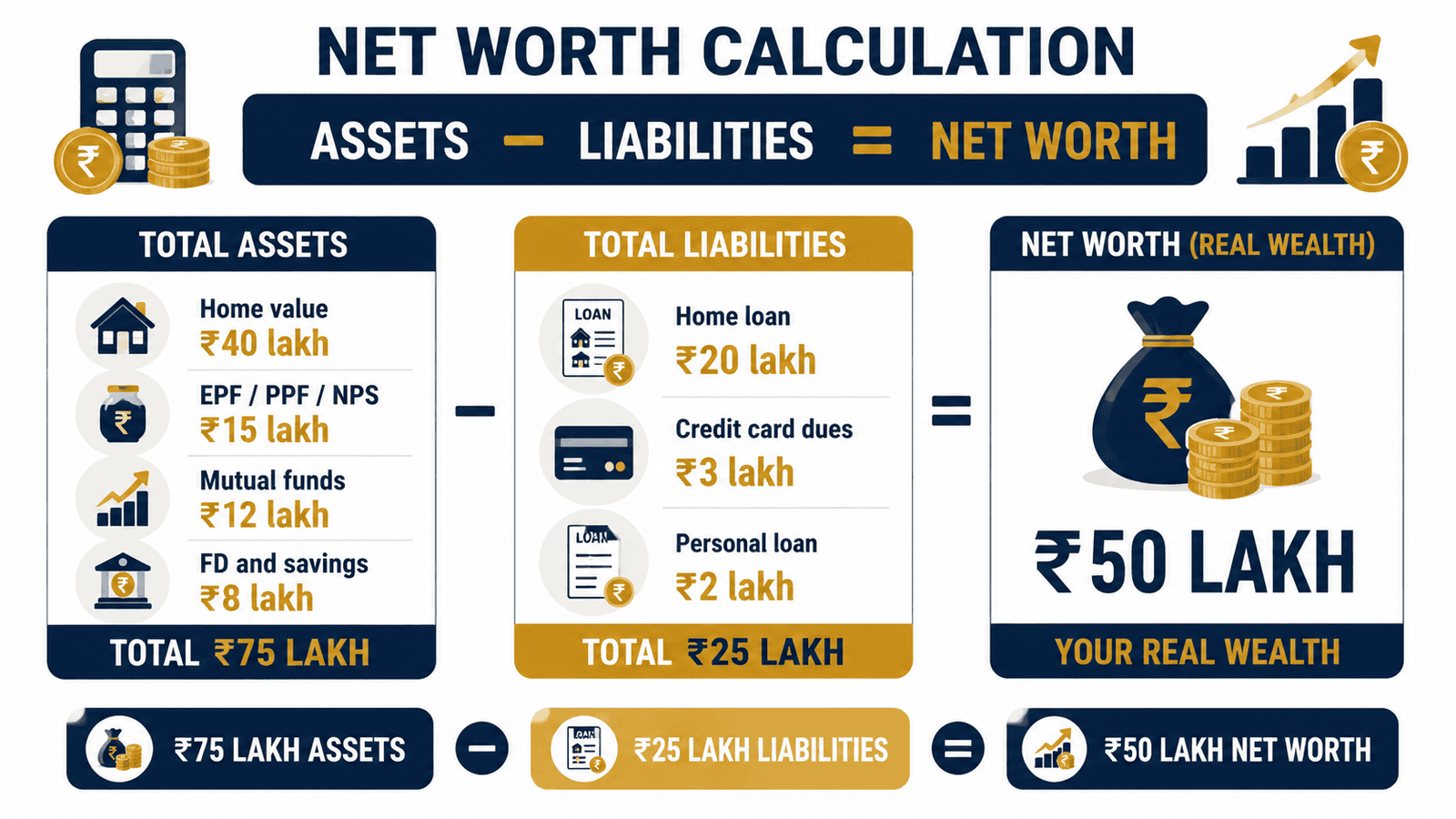
Net worth meaning is the value of everything you own minus everything you owe. For example, if your total assets are ₹75 lakh and your total liabilities are ₹25 lakh, your net worth is ₹50 lakh. It helps you measure real wealth beyond salary, lifestyle or property value.
Formula: Net Worth = Total Assets − Total Liabilities
A positive net worth means your assets exceed your debts. A negative net worth means you owe more than you own — common in early earning years with an education loan or fresh home loan. Zero net worth simply means they are equal. Note: your monthly salary is not counted directly in net worth unless it has already been saved or invested and shows up as an asset.
How to Calculate Your Net Worth
Net worth calculation is a five-step process. It takes 20–30 minutes if you have your statements handy.
Net Worth = Total Assets − Total Liabilities
Debt-to-Asset Ratio = Total Liabilities ÷ Total Assets
Step 1 — List All Assets at Current Realistic Value
Use current market value or resale value — not the price you paid. Your flat bought for ₹40 lakh eight years ago may be worth ₹70 lakh today. Your car bought for ₹9 lakh in 2021 may fetch ₹4.5 lakh resale now. Use the realistic figure, not the sentimental one.
| Asset Category | Value (Illustrative) | Liquidity Type |
|---|---|---|
| Savings account + FD | ₹7 lakh | Liquid |
| Mutual funds (equity + debt) | ₹12 lakh | Partially liquid |
| EPF balance | ₹9 lakh | Partially liquid |
| PPF balance | ₹3 lakh | Partially liquid |
| Gold (jewellery + SGB) | ₹5 lakh | Partially liquid |
| Home (current market value) | ₹70 lakh | Illiquid |
| Car (resale value) | ₹4 lakh | Partially liquid |
| Total Assets | ₹1,10,00,000 | — |
Step 2 — List All Liabilities Using Outstanding Balances
Do not use the original loan amount. Use the outstanding principal you still owe today — available from your loan statement or net banking dashboard.
| Liability | Outstanding Balance | Notes |
|---|---|---|
| Home loan principal | ₹42 lakh | Use amortisation schedule |
| Car loan principal | ₹2 lakh | Check latest statement |
| Credit card dues | ₹80,000 | Include unpaid balance |
| Total Liabilities | ₹44,80,000 | — |
Step 3 — Apply the Formula
Net Worth = ₹1,10,00,000 − ₹44,80,000 = ₹65,20,000
Step 4 — Calculate Debt-to-Asset Ratio
₹44,80,000 ÷ ₹1,10,00,000 = 0.41 (41%). This means 41 paise of every ₹1 of assets is funded by debt. According to SEBI investor education guidance, tracking this ratio alongside net worth gives a more complete financial health snapshot. Use the net worth calculator on Ridhi to do this automatically.
Step 5 — Repeat Every 6 or 12 Months
Net worth is only useful as a trend. A single snapshot tells you where you are. Comparing two snapshots 12 months apart tells you whether you are moving forward. Set a calendar reminder for the same date every year.
Key Takeaways
- Net worth is total assets minus total liabilities — your real wealth calculation, not your salary figure.
- Always use current market or resale value for assets, not purchase price or emotional value.
- A salaried employee earning ₹14 lakh per year can still have a low or negative net worth if liabilities are rising faster than savings.
- Liquid assets (savings, FD) and illiquid assets (property, EPF) behave very differently in an emergency — both count in net worth, but separately matter for financial safety.
- Tracking net worth every 6–12 months is more useful than monitoring it daily; what matters is the direction of change.
- The debt-to-asset ratio (total liabilities ÷ total assets) tells you how debt-heavy your balance sheet is — not just the net number.
- Negative net worth in your 20s or early 30s due to an education or home loan is not a red flag if your earning and saving trajectory is positive.
Key Facts at a Glance
| Parameter | Detail | Source / Notes |
|---|---|---|
| Net worth meaning | Total assets minus total liabilities | SEBI — sebi.gov.in |
| Formula | Net Worth = Total Assets − Total Liabilities | — |
| Common assets | Savings, FD, EPF, PPF, mutual funds, stocks, gold, property | Use current realistic value |
| Common liabilities | Home loan, car loan, personal loan, credit card dues | Use outstanding balance, not original amount |
| Debt-to-asset ratio | Total liabilities ÷ total assets | Lower is better; SEBI calculator tracks this |
| Recommended tracking frequency | Every 6–12 months | Same date each year for consistency |
| Asset valuation rule | Use current market or resale value | Not cost price or sentimental value |
Net Worth Meaning: What It Really Measures
Net worth is a financial health snapshot — a single number that captures where you stand after accounting for everything you own and everything you owe. It is not a performance score. It does not tell you whether you are a good or bad person with money. It simply tells you reality.
What Counts as an Asset
An asset is anything of financial value that you own. For an Indian salaried household, this typically includes: savings account balances, fixed deposits, EPF and PPF balances, mutual fund portfolio value, direct equity holdings, gold (jewellery, coins, Sovereign Gold Bonds), the current market value of property you own, and the resale value of a vehicle. For a deeper breakdown of what qualifies, see assets and liabilities explained with Indian examples.
One important distinction: your monthly salary is not an asset until you save or invest it. The moment it reaches your bank account and you keep it there, it becomes a liquid asset. Until then, it is just expected income — and expected income does not count in a net worth calculation.
What Counts as a Liability
A liability is any financial obligation you owe to someone else. Common liabilities for Indian families include: the outstanding principal on a home loan, car loan balance, personal loan balance, credit card dues (the unpaid amount, not the limit), and any informal borrowings from family or friends that you intend to repay. Use the outstanding balance — not the original loan amount. If you borrowed ₹30 lakh for a home loan five years ago and have repaid ₹8 lakh of principal, your liability is ₹22 lakh, not ₹30 lakh.
Liquid, Partially Liquid and Illiquid Assets
Not all assets are equal when it comes to emergencies. SEBI’s investor education tools use a three-way classification that is very practical for Indian households:
- Liquid assets — savings accounts, current accounts, liquid mutual funds. Accessible within 1–3 days.
- Partially liquid assets — FDs (breakable with a penalty), EPF (withdrawable in specific conditions), equity mutual funds (subject to exit load, T+2/T+3 settlement), gold ETFs/SGBs. Accessible within days to weeks, with some conditions.
- Illiquid assets — residential property, land, locked-in insurance plans, PPF (during the 15-year lock-in). May take months or years to convert to cash.
All three contribute to your total net worth, but only liquid and partially liquid assets help in a cash crunch. A household with ₹1 crore in net worth but ₹90 lakh tied up in one flat and ₹10 lakh in EPF may still struggle to pay ₹2 lakh in a medical emergency.
Positive, Negative and Near-Zero Net Worth
Your net worth can be positive (assets exceed liabilities), negative (liabilities exceed assets), or near zero. Negative net worth is not automatically alarming. A 26-year-old who took a ₹20 lakh education loan to study abroad and has ₹4 lakh in savings has a net worth of −₹16 lakh — but a high-paying job that is likely to change that within a few years. Net worth must always be read in the context of age, earning stage, and trajectory.
Real Example: Rohit and Sneha’s Net Worth Calculation
Rohit, 32, and Sneha, 30, are a working couple in Pune. Rohit is a salaried IT professional earning ₹14 lakh per year. Sneha works in marketing and earns ₹9 lakh per year. Here is their net worth as of today (figures are illustrative):
Total Assets: Savings account ₹4 lakh + FD ₹3 lakh + Mutual funds ₹12 lakh + EPF ₹9 lakh + Gold ₹5 lakh + Home market value ₹70 lakh + Car resale ₹4 lakh = ₹1,07,00,000
Total Liabilities: Home loan outstanding ₹42 lakh + Car loan ₹2 lakh + Credit card dues ₹80,000 = ₹44,80,000
Net Worth: ₹1,07,00,000 − ₹44,80,000 = ₹62,20,000
Their debt-to-asset ratio is 44,80,000 ÷ 1,07,00,000 = 0.42, meaning roughly 42% of their assets are debt-funded. The ₹62.2 lakh net worth sounds healthy — but ₹70 lakh of it is tied up in their home. Their liquid and partially liquid assets total only ₹33 lakh, which is what actually matters for emergencies and short-term decisions. The key insight: a high net worth figure needs to be read alongside liquidity, not just the total.
Comparison: Net Worth vs Other Financial Metrics
| Metric | What It Measures | What It Misses |
|---|---|---|
| Net worth | Total owned minus total owed — real wealth snapshot | Monthly cash flow; liquidity breakdown |
| Salary / income | Earning capacity in a period | Whether any of it is being saved or building wealth |
| Monthly savings | How much is being set aside now | Past wealth accumulated; existing debt burden |
| Investment portfolio value | Market value of investments only | Liabilities; non-investment assets like home or car |
| Home value | One illiquid asset’s worth | Loans against it; other assets; overall financial health |
| Debt-to-asset ratio | What fraction of assets is debt-funded | Cash flow; asset type; earning trajectory |
Note: the debt-to-asset ratio and debt-to-income ratio are different metrics. For understanding how much EMI burden is safe relative to your monthly salary, see debt-to-income ratio explained separately.
How to Decide What’s Right for You
You are just starting out and have no savings yet — THEN focus first on building an emergency fund planning baseline before worrying about a low or negative net worth number.
You are a salaried employee with EPF, a home loan, and mutual funds — THEN track all three together; EPF and mutual fund growth should be outpacing your loan principal paydown each year for net worth to rise.
Your family’s net worth is largely tied up in one property — THEN consider whether your liquid and partially liquid assets are sufficient to cover 6 months of expenses separately; net worth and liquidity are not the same thing.
Your liabilities are growing faster than your assets year on year — THEN it may be worth reviewing whether new loans or credit card spending are being taken on faster than savings are accumulating.
You have strong investment returns but your net worth is not rising much — THEN check whether high EMIs are consuming the gains; total financial picture matters more than portfolio returns alone.
If you have high-interest debt (credit card dues above ₹1 lakh, or a personal loan above 14% interest) that you have not addressed — net worth tracking alone will not improve your situation; reducing that debt typically improves net worth faster than new investments at this stage.
Common Mistakes to Avoid
Counting Your Monthly Salary as Net Worth
Salary is income, not wealth — until it is saved or invested.
Many beginners confuse earning capacity with financial position. A ₹2 lakh monthly salary that is fully spent leaves zero addition to net worth each month. Net worth only grows when income becomes an asset.
Track what you save and invest, not what you earn.
Using Purchase Price Instead of Current Value
Valuing your car at ₹9 lakh (what you paid in 2021) instead of ₹4.5 lakh (what it would fetch today) overstates your assets by ₹4.5 lakh.
This inflates your net worth figure and gives you a false sense of security. The same applies to jewellery, electronics, and even property in a falling market.
Use realistic current resale value — not cost price, not emotional value.
Forgetting Credit Card Dues and Informal Loans
A ₹95,000 credit card balance that carries over month to month is a real liability. So is ₹2 lakh borrowed from a relative that you intend to repay.
Excluding these makes your net worth appear higher than it actually is — sometimes by several lakh rupees across multiple small dues.
List every amount you owe, regardless of who it is owed to.
Valuing Gold at Jewellery-Shop Price
Gold jewellery resale value is typically 15–20% below the market price of gold because of making charges that are not recovered when selling.
Counting ₹6 lakh of jewellery at full market value rather than realistic resale value of ₹5 lakh overstates your assets. Sovereign Gold Bonds and gold ETFs are closer to market value.
Apply a realistic haircut to physical jewellery when calculating.
Ignoring Tax Impact and Exit Loads on Investments
Your equity mutual fund portfolio showing ₹15 lakh is not fully ₹15 lakh in hand. Long-term capital gains tax at 12.5% (above the ₹1.25 lakh exemption threshold) and any applicable exit load reduce the actual realised value.
For a rough estimate, the post-tax, post-exit value is what counts in net worth — not the gross NAV-based figure shown on your app.
Factor in realistic exit costs, especially for large investment holdings.
Treating Net Worth as a One-Time Exercise
Calculating net worth once and never updating it is like checking your health once at 30 and assuming nothing has changed by 40.
Loan balances change, investment values fluctuate, new assets get added, and liabilities are added or paid off. An outdated figure gives false confidence or false alarm.
Set a reminder to recalculate on the same date every 6–12 months.
When This May Not Be the Right Choice
Net worth is a useful starting point, but it is not a complete picture of your financial health on its own.
If you are retired or approaching retirement, a high net worth in illiquid property tells you little about whether you can fund monthly expenses. Cash flow, annuity income, and liquid reserves matter more at this stage. For a fuller picture of what you may need, see retirement corpus planning.
If you are a young professional with an education loan, negative net worth in your mid-20s is not a failure marker. Your earning trajectory and ability to repay debt may be stronger than the negative number suggests.
If your insurance coverage is inadequate, even a solid net worth can be wiped out by a single large medical event or loss of income. Net worth does not measure whether your family is protected.
If you are in a high cash-flow business or freelance situation, net worth may understate or overstate your position depending on receivables, inventory, and seasonal income patterns that a simple personal balance sheet will not capture cleanly.
If any of these apply to your situation, it may be worth exploring alternatives before committing.
Official Rules and Where to Verify
Net worth is a personal calculation — there is no government-mandated formula for individuals. However, several components of your net worth require verification from official or institutional sources:
- EPFO — epfindia.gov.in: For your current EPF balance, account details and withdrawal eligibility.
- SEBI — sebi.gov.in: For investor education tools, including the net worth and debt-to-asset calculator on the SEBI investor portal.
- Income Tax Department — incometax.gov.in: For any outstanding tax dues or refunds that may act as a liability or receivable in your balance sheet.
- RBI — rbi.org.in: For general guidelines on consumer debt, lending practices, and financial literacy resources.
- Your bank or NBFC statement: For the outstanding principal balance on any active loan.
- Your broker or depository statement (CDSL/NSDL): For current market value of equity holdings and mutual funds.
Rules, limits, and rates on this topic can change with each Budget or regulatory update. Always verify current figures directly from the official source before making any financial decision.
Expert Tips
- Calculate net worth on the same calendar date every year — 1 January or the first day of April works well — so year-on-year comparisons are clean and consistent.
- Keep a separate column for liquid, partially liquid and illiquid assets when you build your net worth table. The total matters — but the liquidity breakdown tells you whether you are actually prepared for a financial disruption.
- Track both net worth and monthly cash flow. A growing net worth alongside tight monthly cash flow may mean your wealth is locked in assets you cannot access easily. Use your monthly budget method as the companion tool.
- If you have high-cost credit card debt or a personal loan above 14% interest, reducing that debt typically improves net worth faster than making equivalent new investments at 10–12% returns. The math is straightforward: pay 16% to avoid losing, rather than earn 12%.
- Investment values fluctuate with markets. Do not celebrate a net worth jump driven entirely by a bull market — and do not panic when a correction trims the number. The underlying savings rate and debt repayment discipline matter more over the long term.
- If you receive a bonus or increment, run a quick net worth update to see whether it actually moved the number. This is a powerful motivator and a reality check at the same time.
- Do not count your provident fund or PPF as fully accessible in emergencies — partial withdrawal rules and lock-in periods apply. Keep your liquid asset column honest.
Frequently Asked Questions
What is net worth in simple words?
Net worth is the total value of everything you own minus the total of everything you owe. If your assets are worth ₹80 lakh and your debts total ₹30 lakh, your net worth is ₹50 lakh. It is the most straightforward way to measure real personal wealth.
How do I calculate my net worth in India?
List all your assets — savings, FDs, EPF, PPF, mutual funds, gold, property, and vehicle resale value — at their current realistic value. Then list all your liabilities — home loan outstanding, car loan balance, personal loan, and credit card dues. Subtract total liabilities from total assets. The result is your net worth.
Is my salary included in net worth?
No. Salary is income — it only becomes part of your net worth once it is saved, invested, or used to repay a liability. Your ₹1.2 lakh monthly salary that gets spent entirely each month adds nothing to your net worth that month.
Is my house value included in net worth?
Yes — but use the current market value, not what you paid for it. And subtract any outstanding home loan principal from your liabilities. The difference is your home equity, which is what actually contributes to your net worth.
Should gold jewellery be included in net worth?
Yes, but apply a realistic valuation. Physical jewellery typically fetches 15–20% less than the prevailing gold rate due to making charges that are not recovered on resale. Sovereign Gold Bonds and gold ETFs can be valued closer to the current gold price.
What is negative net worth and is it a problem?
Negative net worth means your liabilities exceed your assets — for example, a ₹25 lakh education loan and ₹3 lakh in savings gives a net worth of −₹22 lakh. This is very common in early earning years. It is not automatically a crisis if your income and savings are growing and the debt is being systematically repaid.
How often should I track my net worth?
Every 6 to 12 months is practical for most salaried individuals and families. More frequent tracking rarely adds insight and can cause unnecessary anxiety if investment values have fluctuated short-term. Pick one consistent date each year and stick to it.
What is a good net worth by age in India?
There is no universal benchmark, and any fixed number is misleading. Net worth varies significantly based on your city, income level, number of dependents, existing debt, and financial goals. A 35-year-old in Mumbai with a home loan will have a very different picture from one in a smaller city with no loans. Focus on whether your net worth is growing year on year, whether your liquidity is adequate, and whether your debt-to-asset ratio is improving — those trends matter more than hitting a particular number.
Can my net worth be growing even if I don’t feel rich?
Yes. Most of your net worth may be in illiquid assets like a property or EPF. These are real and valuable, but they do not help with day-to-day expenses or emergencies. A rising net worth alongside limited liquid savings is a signal to check whether your asset mix suits your actual financial needs.
What is the debt-to-asset ratio and how is it different from net worth?
The debt-to-asset ratio divides your total liabilities by your total assets to give a proportion — for example, 0.40 means 40% of your assets are debt-funded. Net worth gives you an absolute number (assets minus liabilities). Both are useful: net worth tells you the total picture, while the ratio tells you how leveraged you are. SEBI’s investor education portal includes a calculator that tracks both.
Final Verdict
Net worth meaning is simple: it is what remains when you subtract everything you owe from everything you own. But what it reveals is powerful. Rohit earning ₹14 lakh a year may have a net worth of ₹62 lakh — or ₹6 lakh — depending entirely on how much he has saved, invested and repaid over the years. The salary is not the story. The net worth is. Calculate yours honestly using current asset values and outstanding loan balances, not what you paid or what you hope things are worth. Classify your assets by liquidity. Track the debt-to-asset ratio alongside the headline number. And revisit it every year on the same date. If you want to do this calculation quickly and systematically, use the net worth calculator on Ridhi. Always verify the latest rules from official sources or consult a qualified professional before making any financial decision.
This article is for educational purposes only and should not be treated as personalised financial, tax, investment, insurance, or legal advice. Tax rules, interest rates, regulatory limits, and product features can change with each Budget or policy update. Please verify current rules from official government sources or consult a qualified and registered professional before making any financial decision.

Sanya Malhotra writes about everyday personal finance for Indian individuals and families. Her content focuses on budgeting, saving, emergency funds, debt control, net worth tracking, family money decisions, and practical habits that help readers manage money with more confidence.
She covers topics such as monthly budgeting, expense planning, saving habits, emergency fund behaviour, debt repayment, household financial planning, family discussions about money, financial mistakes, net worth tracking, short-term vs long-term goals, and beginner personal finance concepts.
Sanya’s writing style is warm, simple, and realistic. She avoids making personal finance feel intimidating and instead explains money decisions through relatable Indian examples, ₹ budgets, checklists, and step-by-step frameworks. Her articles are useful for students, freshers, couples, parents, and families who want to improve daily money habits. Her content is educational and does not provide personalised financial advice. Readers should adapt examples to their own income, family responsibilities, city, debt level, risk comfort, and financial goals.