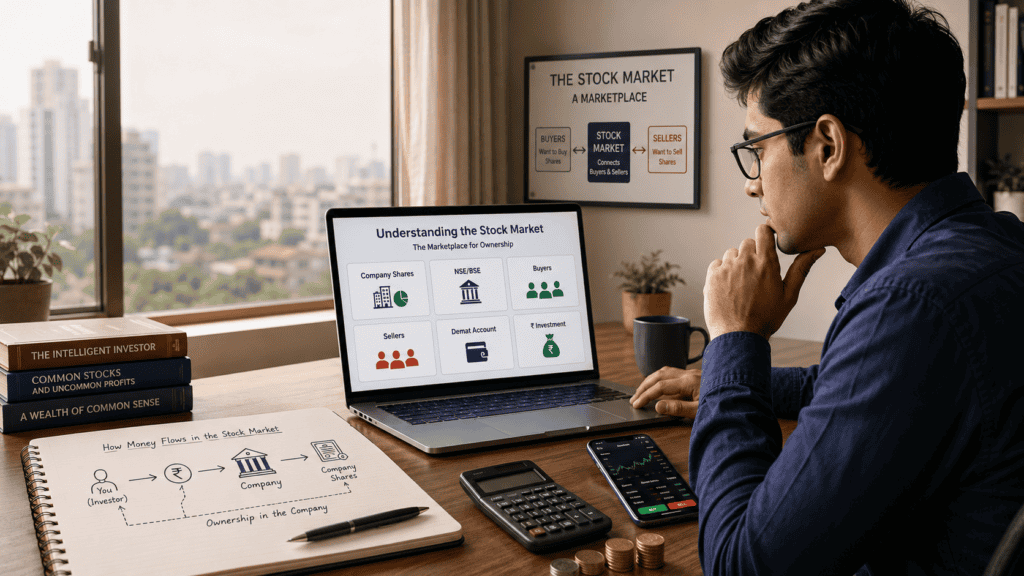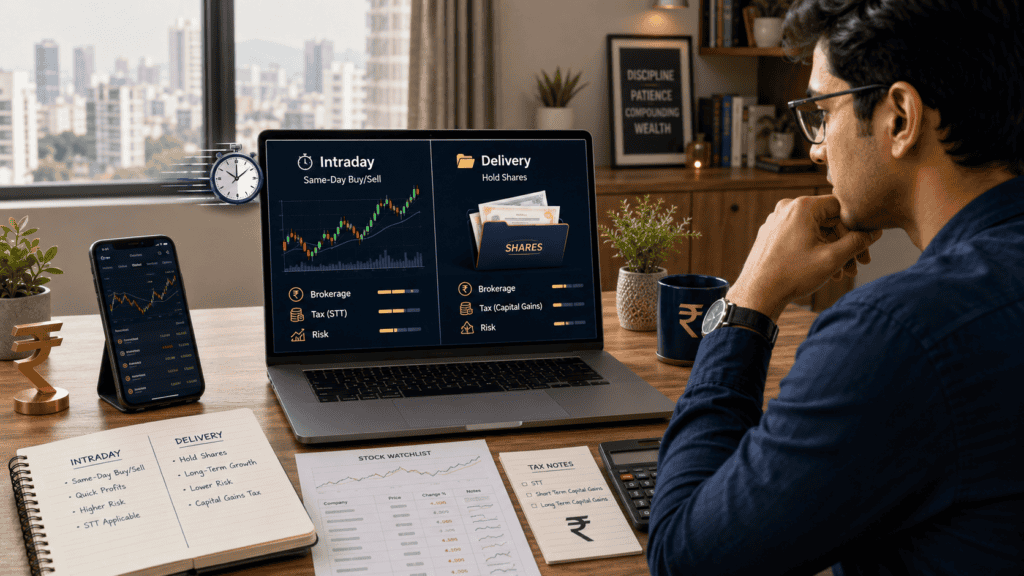

You have opened a Demat app, seen company names flashing on NSE and BSE, and heard colleagues talk about IPOs and stocks — but when someone says “I bought 50 shares of that company,” you are not entirely sure what they actually own. Is it a number on a screen? A contract? A share of the profits? Understanding stock market basics starts with understanding what a share is — not what it costs today, but what ownership it represents. This article explains share meaning in plain terms: what you own when you buy one, the different types of shares in India, what rights (and risks) come with them, and how the whole thing is held in your Demat account. No hype, no stock recommendations — just a clear foundation before you invest a single rupee.
Quick Answer: What Is a Share?
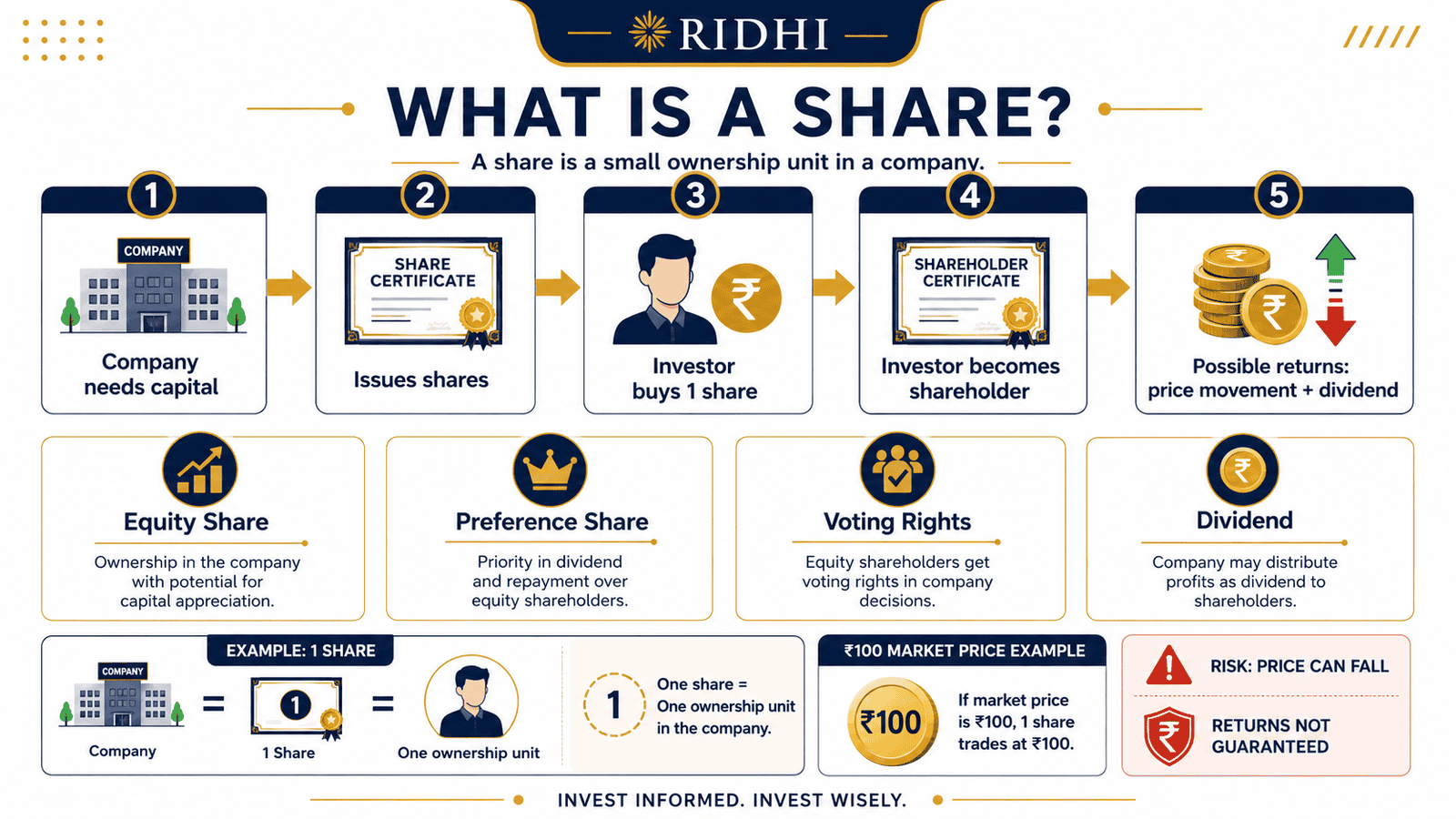
What is a share? A share is one small unit of ownership in a company. If a company has 10 lakh shares and you own 1 share, you own a tiny part of that company. Shareholders may benefit from price growth, dividends, and voting rights, but returns are never guaranteed.
Key Takeaways
- A share is a unit of ownership in a company — buying 100 shares of a company with 10 lakh total shares means you own 0.01% of that company.
- Most retail investors in India buy equity shares, which carry voting rights and the possibility of dividends — but no fixed returns.
- Share price can rise or fall based on buyer and seller demand on the exchange; there is no floor on how low it can go.
- Dividends are a possible benefit of share ownership, but companies are not required to declare them every year.
- All shares bought through the stock exchange in India are held electronically in a Demat account — there are no physical share certificates for most investors today.
- Equity shares and preference shares differ significantly in voting rights, dividend treatment, and risk profile.
- SEBI regulates listed companies and investor protection — always verify current rules at sebi.gov.in before making any investment decision.
Key Facts at a Glance
| Term | What It Means | Quick Fact |
|---|---|---|
| Share | One unit of ownership in a company | Ownership is proportional to shares held |
| Shareholder | A person or entity that owns one or more shares | Rights depend on share type |
| Equity Share | Most common share type; carries voting rights | Dividend not guaranteed |
| Preference Share | Fixed dividend priority, usually no voting rights | Still carries company risk |
| Face Value | Original value assigned at the time of issue | Often ₹1 or ₹10 per share |
| Market Price | Current price at which shares trade on NSE or BSE | Changes every second during market hours |
| Dividend | A share of company profits paid to shareholders | Not compulsory; decided by company board |
| Demat Account | Electronic account where shares are held in India | Mandatory for buying shares on Indian exchanges |
What Is a Share — And How Does Share Ownership Actually Work?
When a company is founded, it has owners — typically promoters or founders who put in capital. As the company grows and needs more money, it can raise funds from the public by dividing its total ownership into small units. Each of these units is called a share. The total value of all issued shares together forms the company’s equity share capital or paid-up capital.
Think of it this way: if you own a pizza and cut it into 10 lakh slices, one slice is roughly what a single share represents. You own that slice. Its value depends on how well the pizzeria is doing — not on any guarantee that the slice will be worth more tomorrow.
How shares reach investors
A company can issue shares to investors through two main routes:
- Primary market: The company offers shares directly to investors for the first time — typically through an Initial Public Offering (IPO). The money raised goes to the company.
- Secondary market: After listing, shares are traded between buyers and sellers on stock exchanges like NSE and BSE. The company does not receive any money from these trades — only the seller does.
Most retail investors in India buy shares through the secondary market using a broker’s app. To do this, you need to open a Demat account, which is an electronic account that holds your shares — similar to how a savings account holds money. Your Demat account is maintained by a Depository Participant (DP), which is usually your broker. The two depositories in India — NSDL and CDSL — store records of all share ownership across the country, under SEBI oversight.
What is face value vs market price?
The face value of a share is the nominal value printed when the company originally issues the shares. Many Indian companies have a face value of ₹1 or ₹10 per share. The market price is what buyers and sellers agree to on the exchange right now — and it has nothing to do with face value. A share with a face value of ₹1 might trade at ₹2,400 on NSE today if the company is profitable and in demand.
What does being a shareholder actually mean?
A shareholder is a part-owner of the company. For equity shareholders, this typically includes:
- Voting rights: You can vote on major company decisions at Annual General Meetings (AGMs) — such as approving the board of directors or major acquisitions.
- Dividend rights: If the company declares a dividend, you receive a proportional payment per share held.
- Capital appreciation: If the share price rises and you sell, you earn a profit. If it falls and you sell, you book a loss.
- Residual claim: In the very unlikely event of company liquidation, equity shareholders are paid last — after all debts and preference shareholders are settled.
SEBI’s investor protection framework ensures that listed companies follow disclosure norms and report financials regularly, so shareholders can make informed decisions. According to SEBI guidelines, material information that can affect share price must be disclosed on the exchange platform without delay.
Real Example: Rohan Buys Shares for the First Time
Rohan, 27, is a software engineer in Bengaluru earning ₹85,000 per month. He opens a Demat account and decides to buy shares of a hypothetical company — let’s call it SunTech Ltd — which has 10 lakh total shares outstanding and is currently trading at ₹200 per share.
Rohan buys 10 shares at ₹200 each, spending ₹2,000. His ownership fraction is 10 ÷ 10,00,000 = 0.001% of SunTech Ltd. He does not control the company. He cannot walk into SunTech’s office and make decisions. But he is a legitimate part-owner, listed in the depository’s records via his Demat account.
Three months later, SunTech’s quarterly results are strong and the share price rises to ₹240. Rohan’s 10 shares are now worth ₹2,400 — a gain of ₹400 on paper. At the same time, SunTech’s board declares a dividend of ₹5 per share. Rohan receives ₹50 (10 shares × ₹5). To understand how dividends work in more detail, you need to know that this ₹50 is taxable as income in Rohan’s hands as per current tax rules.
But suppose results disappoint the next quarter. The share price drops to ₹160. Rohan’s holding is now worth ₹1,600 — a notional loss of ₹400. He has not lost anything unless he sells. This is the core of share ownership: the outcome is never certain.
How to Calculate Share Ownership and Returns
Ownership % = (Shares Owned ÷ Total Shares of Company) × 100
Investment Value = Number of Shares × Current Market Price
Profit / Loss = (Selling Price − Buying Price) × Shares Sold
Using Rohan’s example:
- Ownership: (10 ÷ 10,00,000) × 100 = 0.001%
- Investment value at ₹200: 10 × ₹200 = ₹2,000
- Value at ₹240: 10 × ₹240 = ₹2,400 | Gain = ₹400
- Value at ₹160: 10 × ₹160 = ₹1,600 | Loss = ₹400
| Scenario | Share Price | Value of 10 Shares |
|---|---|---|
| Buy price | ₹200 | ₹2,000 |
| Price rises | ₹240 | ₹2,400 (+₹400) |
| Price falls | ₹160 | ₹1,600 (−₹400) |
Note: When you buy or sell shares, you will incur brokerage charges, Securities Transaction Tax (STT), and exchange transaction charges. Capital gains tax also applies when you sell shares at a profit. Tax rates vary based on your holding period. Verify current rates at incometax.gov.in before calculating actual returns.
Comparison: Equity Shares vs Preference Shares
Most Indian retail investors deal exclusively with equity shares. But it helps to understand that companies can also issue preference shares. Listed on NSE and BSE, equity shares dominate retail investor participation.
| Feature | Equity Shares | Preference Shares |
|---|---|---|
| Ownership nature | Direct ownership stake | Ownership stake with priority rights |
| Voting rights | Yes — typically one vote per share | Usually no voting rights |
| Dividend | Not guaranteed; declared by board | Fixed dividend, paid before equity holders |
| Dividend guarantee | Not guaranteed | Priority but still not risk-free |
| In case of liquidation | Paid last, after all debts and preference holders | Paid before equity holders |
| Risk level | Higher — price can fall to near zero | Moderate — still subject to company risk |
| Retail investor relevance | Primary instrument for retail investors | Rare on retail exchanges; mostly institutional |
Preference shares should not be confused with a fixed deposit or a guaranteed instrument. If the company runs into serious trouble, preference shareholders can lose money too — they simply rank ahead of equity shareholders in the queue.
How to Decide What’s Right for You
Buying shares directly is not automatically the right step for every beginner. Use these if/then guides to assess your readiness.
You understand that share prices can fall significantly and you will not need this money for at least 3–5 years — THEN direct equity investing may be worth exploring after basic research.
You can read a company’s basic financials — revenue, profit, and debt — and want to understand what you own — THEN start with a small amount, track your holding, and learn from it.
You are still building an emergency fund or have high-interest debt — THEN settle those first before putting any discretionary money into individual shares.
You want to understand company sizes and market capitalisation before picking any share — THEN read up on market cap basics to understand why large-cap companies behave differently from small-cap ones.
You are relying on social media tips, friend recommendations, or influencers for stock picks — THEN stop. This is one of the most common ways beginners lose money.
You are not comfortable with the idea that your ₹10,000 investment could become ₹6,000 within weeks — then direct share investing is not the right starting point. Consider index mutual funds or other options better suited to your risk tolerance.
Common Mistakes to Avoid
Thinking a low share price means the stock is cheap
A share trading at ₹15 is not necessarily cheaper than one at ₹1,500.
Cheapness in shares is measured by valuation — earnings, growth, and the price-to-earnings ratio — not by the rupee price per share. A ₹15 share from a loss-making company can destroy more wealth than a ₹1,500 share of a fundamentally strong business.
Always compare valuation metrics, not rupee prices.
Buying based on tips from friends, influencers, or social media
Someone says “this stock will double in 3 months” on a WhatsApp group or YouTube channel.
SEBI regularly issues warnings about unregistered investment advisors and pump-and-dump schemes. A beginner acting on such tips is often the last buyer before a crash. The person who tipped you may have already exited at a profit.
Never act on a tip without reading the company’s exchange filings yourself.
Ignoring the total cost of buying and selling shares
Beginners often calculate profit purely as selling price minus buying price.
The actual cost includes brokerage, STT, exchange charges, GST on brokerage, and stamp duty — all on both legs of the trade. On a small trade of ₹2,000, these costs can eat a significant percentage of any gain, especially on short-term trades.
Always calculate your break-even price, not just your target price.
Treating dividends as guaranteed income
A company paid ₹10 dividend per share last year, so you expect ₹10 this year too.
Dividends are declared at the discretion of the company board and depend on profitability, cash position, and reinvestment plans. A company can reduce or skip dividends entirely without warning. Treating dividend history as guaranteed future income is a planning error.
Use dividends as a bonus, not as a fixed income source.
Confusing share ownership with company control
Owning 100 shares of a large company does not give you meaningful influence over its decisions.
Promoters and large institutional investors hold the bulk of voting shares. Retail investors with small holdings have negligible voting impact at AGMs, though they do have the right to vote and attend. Real control requires significant promoter-level holding.
Understand the difference between being an owner in principle and having operational influence.
Selling the moment the share price dips
A beginner buys at ₹200, the price drops to ₹185, and they panic-sell.
Short-term price movement is normal and often irrelevant if the underlying company is sound. Panic-selling locks in a loss and often happens right before a recovery. Without a clear investment thesis — why you bought and what would change your view — decisions become emotional.
Write down your reason for buying before you invest, so dips do not make you act without logic.
Investing money you cannot afford to lose
Putting rent money, emergency savings, or borrowed money into shares is one of the highest-risk financial mistakes a beginner can make.
Share prices can fall 40–60% in a market downturn and may take years to recover. If you need that money within 12 months, the market may not co-operate. A ₹1,00,000 investment in volatile small-cap shares could be worth ₹50,000 when you urgently need the full amount.
Only invest money you would not miss for at least three to five years.
When This May Not Be the Right Choice
If you need the money within the next one to two years — do not put it into individual shares. Short-term price swings can wipe out capital precisely when you need it most.
If you have not built an emergency fund covering at least three to six months of expenses — shares should not be your first investment. Market timing can force you to sell at a loss during a personal financial crisis.
If you are investing borrowed money — loans, credit cards, or borrowed funds amplify losses and create a debt spiral that direct share gains may not cover, especially if the market turns against you.
If you are hoping for quick profits to solve a financial problem — share markets reward patience and research over months and years, not weeks. The probability of consistent short-term gains for a beginner is very low, and SEBI data consistently shows that a majority of active short-term retail traders lose money.
If any of these apply to your situation, it may be worth exploring alternatives before committing.
Official Rules and Where to Verify
Share markets in India are regulated and investor information is publicly available. Always verify current rules before investing:
- SEBI (sebi.gov.in) — Market regulator for listed companies, brokers, and investor protection. SEBI’s investor education section covers shareholder rights, disclosure norms, and complaint mechanisms.
- NSE (nseindia.com) and BSE (bseindia.com) — Exchange platforms where listed company filings, financials, and announcements are publicly available.
- Income Tax Department (incometax.gov.in) — For current rules on capital gains tax on share sales and tax treatment of dividends. Learn more about stock market taxes before selling any shares.
- Your broker’s contract note — For the exact breakdown of brokerage, STT, exchange charges, GST, and stamp duty on each trade.
Rules, limits, and rates on this topic can change with each Budget or regulatory update. Always verify current figures directly from the official source before making any financial decision.
Expert Tips
- Before buying any share, read at least one annual report or exchange filing of that company. It takes less than 30 minutes and tells you more than any tip ever will.
- Track your total cost of ownership — buy price plus all charges on both legs. On a ₹5,000 trade, brokerage, STT, and transaction charges can add up to ₹50–₹150 depending on your broker and trade type. Your actual break-even is higher than your buy price.
- Do not judge a company by its share price alone. A ₹50 share is not automatically more affordable or riskier than a ₹500 share — it is the underlying business quality and valuation that matters. Understand market capitalisation before comparing companies.
- If you earn dividends from shares, remember they are taxable as income in your hands at your applicable income tax slab rate — not tax-free, as many beginners assume. Verify current dividend tax rules at incometax.gov.in before assuming your dividend income is free.
- Start your share investing journey with a small amount — say ₹5,000 to ₹10,000 — to experience buying, holding, and tracking a position without significant financial pressure. Treat it as paid tuition.
- Separate learning from investing. You can open a Demat account, read company filings, and track share prices for months before committing any money. SEBI’s investor education portal offers free resources specifically for new investors.
- If a stock tip arrives on WhatsApp, Telegram, or from an unregistered source — pause. SEBI has issued repeated advisories on unauthorised investment advice. You can verify if an advisor is registered at sebi.gov.in before taking any action.
Frequently Asked Questions
Is a share the same as a stock?
In everyday Indian usage, “share” and “stock” are used interchangeably. Technically, “stock” refers to ownership in a company broadly, while “share” refers to a specific unit of that ownership. When you buy 10 shares of SunTech Ltd, you own 10 units of SunTech’s stock.
Can I buy only one share of a company?
Yes. Most listed companies in India allow you to buy even a single share through your broker. There is no minimum quantity requirement for delivery-based purchases, though very low-value trades may not be practical after accounting for brokerage and transaction charges.
Do shareholders always receive dividends?
No. Dividends are declared by the company’s board of directors and depend on profitability, cash availability, and the board’s decision on reinvestment. A company can choose not to pay any dividend in a given year, even if it made a profit. There is no regulatory obligation to declare dividends.
Do all shares come with voting rights?
Equity shares in India typically carry voting rights — one vote per share for most listed companies. Preference shares usually do not carry voting rights under normal circumstances. A company may also issue shares with differential voting rights in certain cases, as permitted under the Companies Act, 2013.
What happens to my shares if the share price falls to zero?
If a company’s share price falls to zero — which happens when the company fails or is delisted — your investment in those shares becomes effectively worthless. This is called capital loss. Equity shareholders are the last to be paid in a liquidation, after secured creditors and preference shareholders. This is a real risk, not a theoretical one, and it reinforces why diversification matters.
Are shares safe for a beginner?
Direct share investing carries significant risk, particularly for beginners who do not yet understand company financials, valuation, and market behaviour. Share prices can fall sharply and stay low for years. SEBI’s investor education materials recommend that new investors understand risk fully before entering the market. Shares can be part of a long-term wealth-building plan — but they are not a safe or guaranteed instrument.
What is the difference between face value and market price of a share?
Face value is the original nominal value assigned to a share when the company is incorporated — commonly ₹1 or ₹10 per share in India. Market price is the price at which the share is currently trading on the stock exchange, driven entirely by supply and demand. The two are unrelated after listing; a ₹1 face-value share can trade at ₹3,500 in the market.
Can I lose more money than I invested in shares?
In straightforward delivery-based share buying, the maximum you can lose is the amount you invested — the value cannot go below zero. However, if you use margin, leverage, or futures and options, losses can exceed your initial investment significantly. For a beginner buying shares directly, stick to delivery-based investing to limit your downside to the amount you put in.
How are shares held in India after I buy them?
After you buy shares through a registered broker in India, they are credited to your Demat account within T+1 settlement days. Your Demat account is maintained by a Depository Participant linked to either NSDL or CDSL — India’s two central depositories. You can check your holdings in your broker app or directly on NSDL or CDSL’s websites using your Demat account number.
Final Verdict
A share is a genuine, legally recognised unit of ownership in a company — not a lottery ticket or a trading number. When you buy equity shares, you become a part-owner of that business, with rights to vote at AGMs, receive dividends if declared, and benefit from price appreciation. But you also bear proportional risk: if the company struggles, your investment can fall — and there is no guarantee it will recover. Beginners who understand this trade-off and commit to learning about what is a share, how share ownership works, and what they are actually buying are far better positioned than those chasing quick profits on tips. Start with foundational knowledge — company fundamentals, market structure, and your own risk tolerance — before putting meaningful money into individual shares. Always verify the latest rules from official sources or consult a qualified professional before making any financial decision.
This article is for educational purposes only and should not be treated as personalised financial, tax, investment, insurance, or legal advice. Tax rules, interest rates, regulatory limits, and product features can change with each Budget or policy update. Please verify current rules from official government sources or consult a qualified and registered professional before making any financial decision.

Devika Shah writes about stock market basics for Indian beginners who want to understand equity investing before taking financial risk. Her content is educational and does not provide stock tips, trading calls, price predictions, or personalised investment advice.
She covers topics such as demat account meaning, trading account basics, IPOs, dividends, brokerage charges, delivery vs intraday trading, market orders, limit orders, stock indices, blue-chip stocks, capital gains tax, stock market terminology, risk management, and the difference between long-term investing and short-term speculation.
Devika’s writing is clear, balanced, and risk-conscious. She helps readers understand how the stock market works, what accounts and documents are needed, what charges may apply, and what mistakes beginners should avoid. Her articles are suitable for students, salaried employees, and first-time investors who want a foundation before investing. Since market rules, tax treatment, brokerage fees, IPO processes, and regulatory requirements can change, readers should verify current information from SEBI, exchanges, brokers, and official tax sources.