

Your NRI family has planned a 5-week India trip. Flights are booked, relatives are excited, and itineraries are sorted. What most families skip — until something goes wrong — is checking whether anyone is actually covered if there is a sudden hospitalisation in India.
Your overseas health plan may not work in India. The local relative’s family floater policy does not extend to visiting NRIs. And a travel insurance policy you bought last year may have exclusions that quietly rule out the one scenario you actually need covered.
Travel insurance for NRI family visiting India works differently from regular health insurance. The cover is tied to your trip, your disclosures, the policy wording, and how quickly you act when something happens. This article explains what is usually covered, what is excluded, how claims work, and what to check before you travel — not after you land at the airport.
Quick Answer: Travel Insurance for NRI Family Visiting India
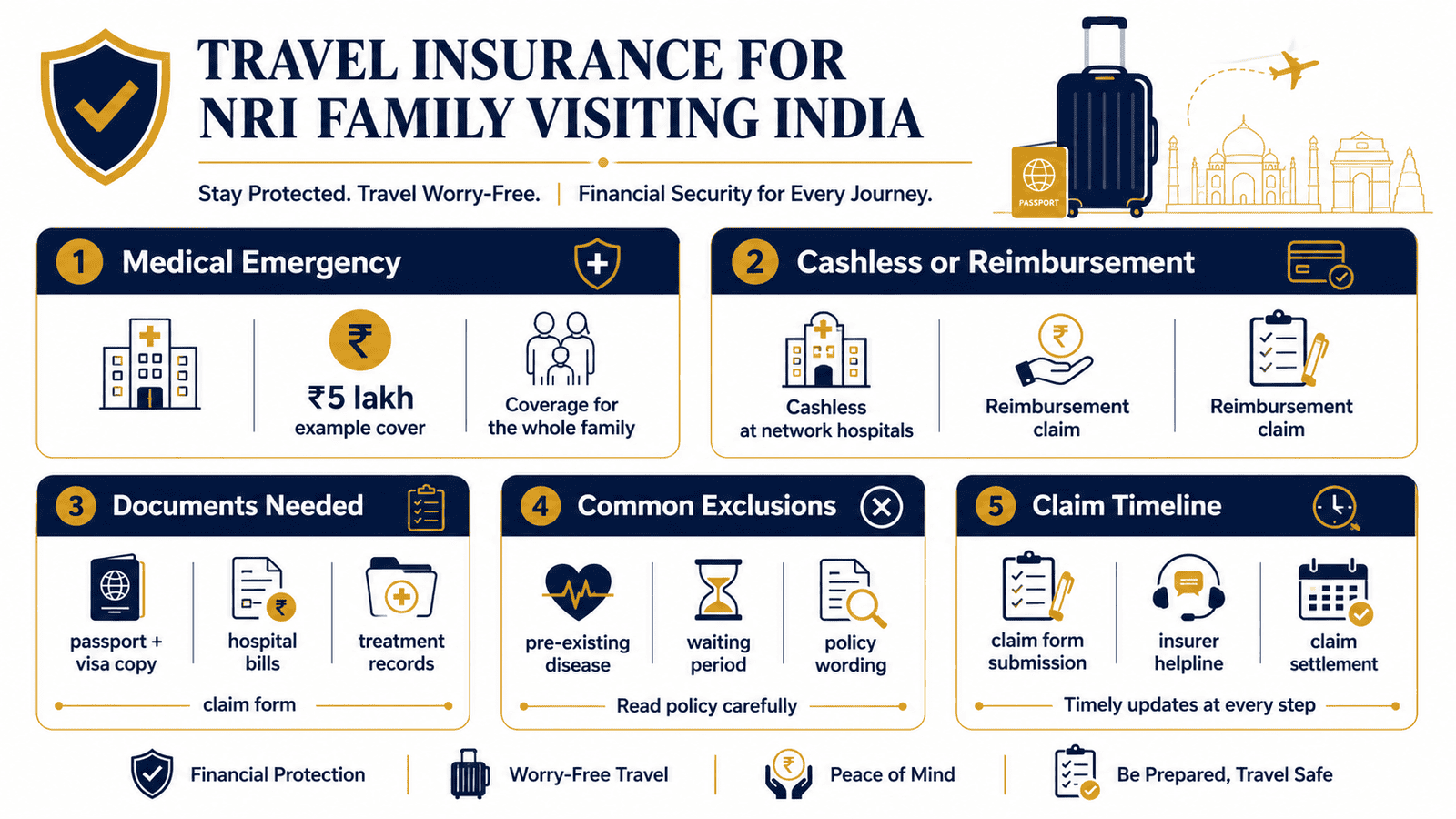
Travel insurance for NRI family visiting India can cover emergency medical costs, hospitalisation, travel delay, baggage loss and evacuation, depending on the policy. For example, a ₹5 lakh medical cover may help with sudden hospitalisation, but pre-existing diseases, routine treatment and late claims may be excluded. Coverage depends on policy type, sum insured, age, disclosures, and exclusions. Emergency medical care is not the same as routine healthcare — always read the policy document before purchasing.
Key Takeaways
- Buy travel insurance before the trip departs — policies purchased after arrival in India, or after symptoms appear, are generally invalid for that illness or event.
- Pre-existing diseases are commonly excluded from travel insurance emergency claims unless the policy specifically covers acute onset of a pre-existing condition — check the exact wording.
- A policy with cashless hospitalisation is easier to manage during a short India visit, but cashless approval depends on the hospital being in the insurer’s network and pre-authorisation being granted.
- Reimbursement claims require original bills, prescriptions, discharge summaries, and timely claim intimation — missing even one document can delay or reduce your payout.
- Elderly visitors above 70 or 75 years may face sub-limits, higher premiums, or stricter exclusions — compare age-band terms carefully before buying for senior parents.
- The cheapest policy often has the lowest sum insured and the most exclusions. A ₹10 lakh medical cover costs more upfront but can matter significantly at a metro private hospital.
- Travel insurance does not replace life, disability, or critical illness protection — it is designed for emergency and trip-related events during the visit period only.
Key Facts at a Glance
| Parameter | Detail |
|---|---|
| Who should consider it | NRIs visiting India with spouse, children, parents, or elderly relatives |
| Main coverage areas | Emergency medical expenses, hospitalisation, baggage loss, trip delay, medical evacuation |
| Key exclusions | Pre-existing diseases (unless acute onset covered), routine treatment, non-disclosure, high-risk activities |
| Claim modes | Cashless (at network hospital with pre-authorisation) or reimbursement (pay first, claim later) |
| Documents needed | Policy copy, passport, air tickets, original bills, prescriptions, discharge summary, claim form |
| When to buy | Before the trip departs — not after arriving in India |
| Regulatory body | Insurance Regulatory and Development Authority of India (IRDAI) — irdai.gov.in |
How Travel Insurance for NRI Families Visiting India Actually Works
The term “travel insurance” covers a wide range of products, and the differences matter more than most families realise. For an NRI family visiting India, there are broadly three types of cover to understand before deciding what to buy.
Travel Medical Insurance
This is a short-duration policy designed for emergencies during a specific trip — hospitalisation due to sudden illness, accident treatment, medical evacuation, or emergency dental treatment in some plans. It is not designed for routine health management. The moment a treatment is planned, elective, or connected to a condition you already have, the policy wording begins to apply, and claims can get complicated. According to what health cover means, knowing the boundary between covered and excluded treatment is the starting point for any policy decision.
Visitor Insurance
Some insurers offer visitor insurance specifically for NRIs and their relatives visiting India from abroad. These may be structured differently from standard domestic travel policies and can have wider or narrower coverage depending on the insurer. Some visitor plans are purchased in India, some abroad. The key question is whether India is listed as the country of coverage in the policy schedule — not assumed, but explicitly stated.
Why Regular Health Insurance May Not Apply
If you hold an international health policy from your country of residence, it may exclude India as a country of coverage, or limit India-based treatment to emergencies only. Your Indian relatives’ family floater health insurance does not extend to visiting NRI family members. A domestic Indian health insurance policy can be purchased by NRIs, but it operates under different terms and is not the same as a short-visit travel policy. Understanding family floater basics is useful when evaluating whether one combined policy can realistically serve every family member’s health profile equally.
Why Policy Wording Decides Everything
Marketing materials from insurers emphasise coverage highlights. The policy wording — the actual document — contains the exclusions, definitions, claim conditions, intimation timelines, and sub-limits. Two policies may both claim to cover “emergency medical expenses” but define that phrase differently. IRDAI requires insurers to provide a Customer Information Sheet summarising key terms, and this is worth reading before you pay the premium. Per IRDAI guidelines at irdai.gov.in, insurance buyers have the right to read the complete policy document before finalising the purchase.
Each family member needs a separate eligibility check. A 72-year-old parent may face different premium bands, age-specific sub-limits, or stricter pre-existing disease clauses than a 40-year-old adult or a child. Never assume one policy terms applies uniformly across a family of different ages and health backgrounds.
Real Example: The Mehta Family’s Ahmedabad Visit
Rohan Mehta, 39, is an NRI software manager in Dubai. He visits Ahmedabad for 5 weeks with his wife Priya, 36, their 8-year-old son, and his mother Savitaben, 68. Before departure, Rohan buys a travel insurance policy with ₹5 lakh medical cover for each family member.
In week three, Savitaben develops sudden chest pain and is rushed to a private hospital in Ahmedabad. The hospitalisation bill reaches approximately ₹1.8 lakh over four days.
Scenario A — Pre-existing condition disclosed: Rohan had declared that Savitaben has hypertension, managed with medication. The insurer’s policy covers acute onset of a pre-existing condition during travel. The family calls the emergency assistance helpline within 24 hours, gets pre-authorisation for a network hospital, and the cashless claim is processed. Savitaben’s chest pain is treated as a cardiac emergency. The ₹1.8 lakh bill is largely covered, with a co-payment applicable as per the policy terms.
Scenario B — Pre-existing condition not disclosed: Rohan had not mentioned Savitaben’s hypertension when filling the policy form. When the hospital submits medical records showing a history of hypertension, the insurer investigates the claim. Non-disclosure of a material fact gives the insurer grounds to reject or reduce the claim. The family ends up paying the bill out of pocket.
The ₹1.8 lakh difference comes entirely from one line in the proposal form — and from reading the policy wording before purchasing, not after hospitalisation.
How to Think About Adequate Medical Cover
There is no universal “right” sum insured for an NRI family visiting India. But there is a practical way to estimate what may be insufficient.
Cover Adequacy Check = Trip Length × Age Profile × City of Stay × Health History × Hospital Type
Work through each factor before buying:
| Factor | Lower Cover May Suffice | Higher Cover Worth Considering |
|---|---|---|
| Trip length | Under 2 weeks | 4 weeks or more |
| Age of visitors | All adults under 50 | One or more visitors above 60 |
| City of stay | Smaller town, government hospital accessible | Mumbai, Delhi, Bengaluru — metro private hospital costs |
| Health history | No significant conditions | Hypertension, diabetes, cardiac history, mobility issues |
At a metro private hospital in India, a 4-day cardiac hospitalisation can cost between ₹1.5 lakh and ₹4 lakh depending on the procedure, room type, and hospital tier. A ₹5 lakh cover may be adequate for a young, healthy family on a short trip. For a senior parent on a 5-week visit, a ₹10 lakh cover may be worth comparing against the incremental premium. Premium should not be the deciding factor — the gap between what the policy pays and what the hospital bill is, is the real cost of under-insurance.
Comparison: Cashless vs Reimbursement for NRI Families in India
| Parameter | Cashless Hospitalisation | Reimbursement Claim |
|---|---|---|
| How it works | Insurer/TPA settles bill directly with network hospital | Family pays hospital, submits documents to insurer afterwards |
| Pre-condition | Hospital must be in insurer’s network; pre-authorisation required | Any hospital; no pre-authorisation needed |
| Cash outflow at hospital | Minimal — co-payment or non-admissible items only | Full bill paid upfront by family |
| Documents at hospital | Policy copy, ID, pre-auth form | All original bills, prescriptions, discharge summary, claim form |
| Ease during short India visit | Easier | More effort |
| Risk of claim failure | Late intimation, non-network hospital, pre-auth denial | Missing documents, late submission, unclear bills |
| Suitable when | Planned network hospital, enough time to call insurer | Emergency, remote location, or non-network hospital |
Understanding how cashless claim process works in advance — before an emergency — can save a family significant stress and money during a hospital admission. Cashless is not guaranteed even at a network hospital. Pre-authorisation can be denied if the insurer determines the treatment falls under an exclusion.
How to Decide What’s Right for You
Your family includes a visitor above 65 with a known health condition — THEN compare whether the policy covers acute onset of pre-existing conditions, and check the age-band sub-limits before buying.
Your India visit is longer than 4 weeks — THEN check the maximum trip duration the policy covers; some travel policies cap at 30 or 45 days and may not extend to longer visits.
You are staying in a metro city and plan to use private hospitals — THEN a higher sum insured of ₹10 lakh or above may be more appropriate than the entry-level plan given metro private hospital costs.
You want cashless claim convenience — THEN confirm the insurer’s cashless hospital network in the specific city where you will be staying, not just the general network count.
You are evaluating two policies at similar premiums — THEN use the claim settlement ratio as one factor, alongside exclusion lists and claim intimation timelines.
You are visiting India for planned medical treatment or elective surgery — THEN travel insurance is not designed for this scenario; it covers emergencies, not pre-planned procedures.
Your travel insurance from your country of residence does not list India as a covered destination — THEN do not assume it applies; verify the policy schedule explicitly before assuming coverage.
Common Mistakes to Avoid
Buying After Arriving in India
Some families buy travel insurance after they have already landed in India, sometimes after feeling unwell.
Most travel insurance policies require purchase before the trip departs or within the first day of travel. Buying after arrival — especially after symptoms appear — typically invalidates the policy for that condition entirely. The insurer can reject the claim on the basis that the illness or event was already in progress when coverage began.
Buy before departure from your country of residence.
Not Disclosing Pre-Existing Diseases
Skipping the pre-existing disease section on the proposal form to avoid higher premium or rejection is one of the most costly mistakes in travel insurance.
Non-disclosure of a material health fact — diabetes, hypertension, cardiac history, prior surgery — gives the insurer the right to reject the claim entirely, even for a condition apparently unrelated to the undisclosed disease. A ₹2 lakh hospitalisation claim can be denied over an undisclosed blood pressure condition. The short-term premium saving results in full out-of-pocket loss at the worst possible time.
Disclose every pre-existing condition accurately at the time of buying the policy.
Assuming Routine Treatment or Planned Surgery Is Covered
Travel insurance is not a substitute for health insurance. It covers emergencies.
If a family member has a knee replacement scheduled during the India trip, or plans a dental procedure, a routine health check-up, or a follow-up consultation for a known condition — these are not emergency medical expenses. Claiming for these will result in rejection. Understanding waiting period rules in health insurance gives useful context for why planned treatment and insurance coverage operate on different tracks.
Use travel insurance only for emergencies. For planned treatment, explore appropriate medical coverage separately.
Missing the Claim Intimation Timeline
Most travel insurance policies require you to inform the insurer or TPA within a specific number of hours of hospitalisation — sometimes 24 hours for planned admission, sometimes within a few hours for an emergency.
Missing this window gives the insurer a contractual basis to reduce or reject the claim, even if the hospitalisation itself was fully covered under the policy terms. Many families in a medical emergency forget to call the insurer helpline while managing the situation at the hospital.
Save the insurer’s emergency helpline number offline, on your phone and on paper, before you travel.
Losing Original Bills, Prescriptions, and Discharge Papers
Reimbursement claims require original documents — not photocopies, not WhatsApp photos, not emailed scans unless specifically accepted by the insurer.
A ₹1.5 lakh hospitalisation with missing pharmacy receipts or a missing discharge summary can result in a partial or fully rejected claim. Hospitals may charge for duplicate discharge summaries and some items cannot be reconstructed at all.
Collect and safeguard every original bill, prescription slip, and discharge paper from the first day of hospitalisation. Do not discharge from the hospital without the complete documentation set.
Choosing a Policy by Premium Alone
A ₹1,200 premium policy and a ₹3,500 premium policy may look comparable on the insurer’s website summary. The exclusion list, sub-limits, pre-existing disease terms, and claim intimation conditions can be entirely different.
The cheapest policy is the costliest when it fails to pay at the time of a claim. Compare exclusion lists and claim conditions, not just premium and sum insured headline figures.
Not Confirming India as a Covered Destination
Some NRI travel insurance policies are structured for travel away from the country of residence and may list covered destinations specifically. An NRI in the US visiting India needs to confirm India is in the list of covered countries, not assume it is.
Read the policy schedule and coverage geography section before purchasing. If India is not listed, the policy will not pay a single claim during the India visit.
When This May Not Be the Right Choice
Long stays in India: If you are spending 3 months or more in India, a short-duration travel insurance policy may not be the most suitable coverage. Some policies cap trip duration at 30, 45, or 90 days. For extended stays, a domestic Indian health insurance policy may provide more comprehensive and sustainable coverage.
Planned or elective treatment: If the primary purpose of the India visit includes a scheduled surgery, cancer treatment, fertility procedure, or elective dental work, travel insurance will not cover it. These require specific medical travel arrangements or appropriate health insurance, not a trip-based emergency policy.
Serious pre-existing illness with limited emergency-only cover: If a family member has an advanced cardiac condition, active cancer treatment, or recent major surgery, the emergency-only cover offered by travel insurance may be too narrow. The policy may exclude acute-onset emergencies arising from that condition, leaving the family significantly exposed. Separately exploring critical illness cover or broader health coverage may be more appropriate for high-risk health profiles.
Elderly visitors needing continuous care: Travel insurance is designed for episodic emergencies, not ongoing or chronic care management. An elderly parent needing regular specialist visits, physiotherapy, or ongoing medication adjustment during a long visit may need a different type of coverage.
If any of these apply to your situation, it may be worth exploring alternatives before committing.
Official Rules and Where to Verify
Travel insurance for NRI families visiting India is regulated by the Insurance Regulatory and Development Authority of India. Policy terms, exclusions, claim conditions, premium bands, and coverage limits vary by insurer and policy version. No article — including this one — can substitute for reading the current policy document from the insurer directly.
Rules, limits, and rates on this topic can change with each Budget or regulatory update. Always verify current figures directly from the official source before making any financial decision.
- IRDAI (Insurance Regulatory and Development Authority of India) — irdai.gov.in — for insurance consumer rights, grievance redressal, and regulatory guidelines.
- Your insurer’s official website — insurer’s official domain — for the current policy wording, Customer Information Sheet, exclusion list, claim form, and TPA / emergency assistance contact details.
- Policy schedule and benefit table — the specific document issued to you at purchase — to confirm your actual sum insured, covered destinations, age limits, and claim conditions.
Expert Tips
- Save the insurer’s emergency helpline number, claim email address, and TPA contact in your phone before the flight departs — not after you reach India. A missed intimation call during a hospitalisation can cost you the claim.
- Share the policy PDF and emergency contacts with a trusted family member or friend in India before you travel. If you or your parents are hospitalised, someone locally should be able to call the insurer immediately on your behalf.
- Before buying, confirm the cashless hospital network specifically in the city where you are staying — not the total national network. A large overall network may have very few empanelled hospitals in a smaller Indian city or town.
- If you are buying travel insurance for a parent above 65, ask the insurer specifically how acute-onset emergencies from a pre-existing condition are handled under that policy. Get the answer in writing or from the policy document — not from a sales call.
- Carry printed or offline copies of medical history, current prescriptions, and recent test reports for any elderly visitor. Indian hospitals will ask for this during admission and it can directly affect diagnosis speed and claim documentation completeness.
- If you are unsure whether a treatment is claimable before it happens — for example, a sudden fever that may require hospitalisation — call the insurer’s helpline first and ask. A pre-authorisation inquiry costs nothing and protects your claim.
- Do not discharge from the hospital without collecting the complete document set: original bills, itemised pharmacy receipts, discharge summary, doctor’s prescription at discharge, and the diagnosis code if provided. Collecting these after the fact is difficult and sometimes impossible.
Frequently Asked Questions
Is travel insurance mandatory for NRIs visiting India?
No, travel insurance is not legally mandatory for NRIs visiting India. India does not require visitors to show proof of insurance at entry. However, given that overseas health plans often do not cover treatment in India, and Indian public or private hospital costs can be significant, travel insurance is strongly worth considering — especially for elderly visitors or longer stays.
Does travel insurance cover parents visiting India from abroad?
Yes, most travel insurance policies allow you to include parents as insured members. However, elderly parents may be subject to age-band premium differences, higher co-payments, sub-limits on specific conditions, or stricter pre-existing disease terms. Always check the policy terms for each family member individually, not as a group.
Are pre-existing diseases covered under travel insurance for India?
Standard travel insurance policies exclude pre-existing diseases. Some policies cover acute onset of a pre-existing condition — meaning a sudden, unexpected flare-up requiring emergency treatment — but this is not universal. The policy document will define “acute onset” and “pre-existing condition” precisely. Read that definition carefully before assuming coverage.
Can claims be cashless at Indian hospitals?
Cashless claims are possible if the hospital is in the insurer’s empanelled network and the insurer or TPA grants pre-authorisation. Cashless is not automatic. If the hospital is not in the network, or if pre-authorisation is denied, the family must pay the bill first and submit a reimbursement claim with full documentation.
What documents are needed for a reimbursement claim?
Typically: original hospitalisation bills, original pharmacy receipts, doctor prescriptions, discharge summary, completed claim form, copy of the policy, passport copy, proof of travel (air tickets), and diagnosis details. Some insurers may ask for additional documents. Check the insurer’s claim requirements in the policy document before travel, not during hospitalisation.
Can NRIs buy Indian health insurance instead of travel insurance for India visits?
NRIs can buy certain Indian domestic health insurance policies, but these operate differently from trip-specific travel insurance. A domestic Indian health insurance policy may have waiting periods for pre-existing diseases, separate claim processes, and different coverage terms. It may suit NRIs who visit India regularly or for longer periods. For a short, specific trip, a dedicated travel insurance policy designed for the visit duration may be more straightforward — but compare both options for your situation.
Does travel insurance cover planned treatment or surgery in India?
No. Travel insurance covers emergency medical expenses during the trip. Planned treatment, elective surgery, scheduled procedures, and routine consultations are excluded. If you are visiting India specifically for medical treatment, travel insurance is not the right product. You would need a separate arrangement appropriate to that medical purpose.
What happens if we claim after the policy has expired?
Claims must relate to events that occurred during the active policy period. If hospitalisation started before the policy expired but treatment continued after, some policies allow claims for the event but not for post-expiry treatment. If the event itself happened after the policy expired, there is no valid claim. Always check the exact validity dates on your policy schedule before travel.
Can I extend travel insurance if our India trip gets extended?
Some insurers allow policy extensions, subject to conditions — no active claim in progress, extension request made before the original policy expires, and medical fitness at the time of extension. Extension is not guaranteed and is at the insurer’s discretion. Check the policy terms for extension conditions before you travel, not during the trip.
Final Verdict
Travel insurance for NRI family visiting India is a practical safeguard for sudden hospitalisation, emergency travel costs, and trip disruptions. It is not a guarantee of payment — it is a contract governed by policy wording, accurate disclosures, and timely claims. Families with elderly members, long trip durations, or visitors with known health conditions should compare exclusions and age-band terms as carefully as they compare premiums. The right policy is not the cheapest one — it is the one that matches your actual trip risk and covers what you genuinely need. Always verify the latest rules from official sources or consult a qualified professional before making any financial decision.
This article is for educational purposes only and should not be treated as personalised financial, tax, investment, insurance, or legal advice. Tax rules, interest rates, regulatory limits, and product features can change with each Budget or policy update. Please verify current rules from official government sources or consult a qualified and registered professional before making any financial decision. Insurance is a subject matter of solicitation. Please read the policy document carefully before purchasing.

Priya Nambiar writes about insurance concepts for Indian families, salaried employees, self-employed professionals, and first-time policy buyers. Her content focuses on helping readers understand coverage, exclusions, claim conditions, premiums, riders, and policy documents before buying or renewing insurance.
She covers topics such as term insurance, health insurance, family floater plans, riders, critical illness cover, employer insurance vs personal insurance, waiting periods, exclusions, deductibles, co-payment, no-claim bonus, claim settlement, premium comparison, renewal rules, and tax benefits linked to insurance.
Priya’s writing is careful, consumer-focused, and policy-document oriented. She explains why insurance should be understood as financial protection, not just a tax-saving tool or investment substitute. Her articles encourage readers to compare coverage, understand limitations, and ask better questions before buying a policy. Premiums, exclusions, claim rules, and benefits vary by insurer, age, health, sum insured, and product type. Insurance is a subject matter of solicitation, and readers should read the official policy document carefully before purchasing.