

Every time you renew car insurance, the insurer or broker asks whether you want zero depreciation, engine protect, consumables cover, roadside assistance, and a handful of other add-ons. Most people either say yes to everything — which inflates the premium — or say no to everything — which can mean a large out-of-pocket bill after a claim. Neither approach is useful. Add-ons are worth buying when the specific risk they cover is real for your car, your location, and your driving pattern. When they are not, you are paying extra premium for cover you are unlikely to use.
Two add-ons come up in almost every renewal conversation in India: zero depreciation and engine protect. They are different in what they cover, who benefits, and when they actually change your claim outcome. If you are buying or renewing a policy — especially for a newer car — this guide will help you decide which one to pay for, which to skip, and when both are worth it. Before committing to a policy, it also helps to understand the full cost of car ownership, including first car costs and true ownership expenses beyond just the sticker price.
Quick Answer: Car Insurance Add-Ons Worth Paying
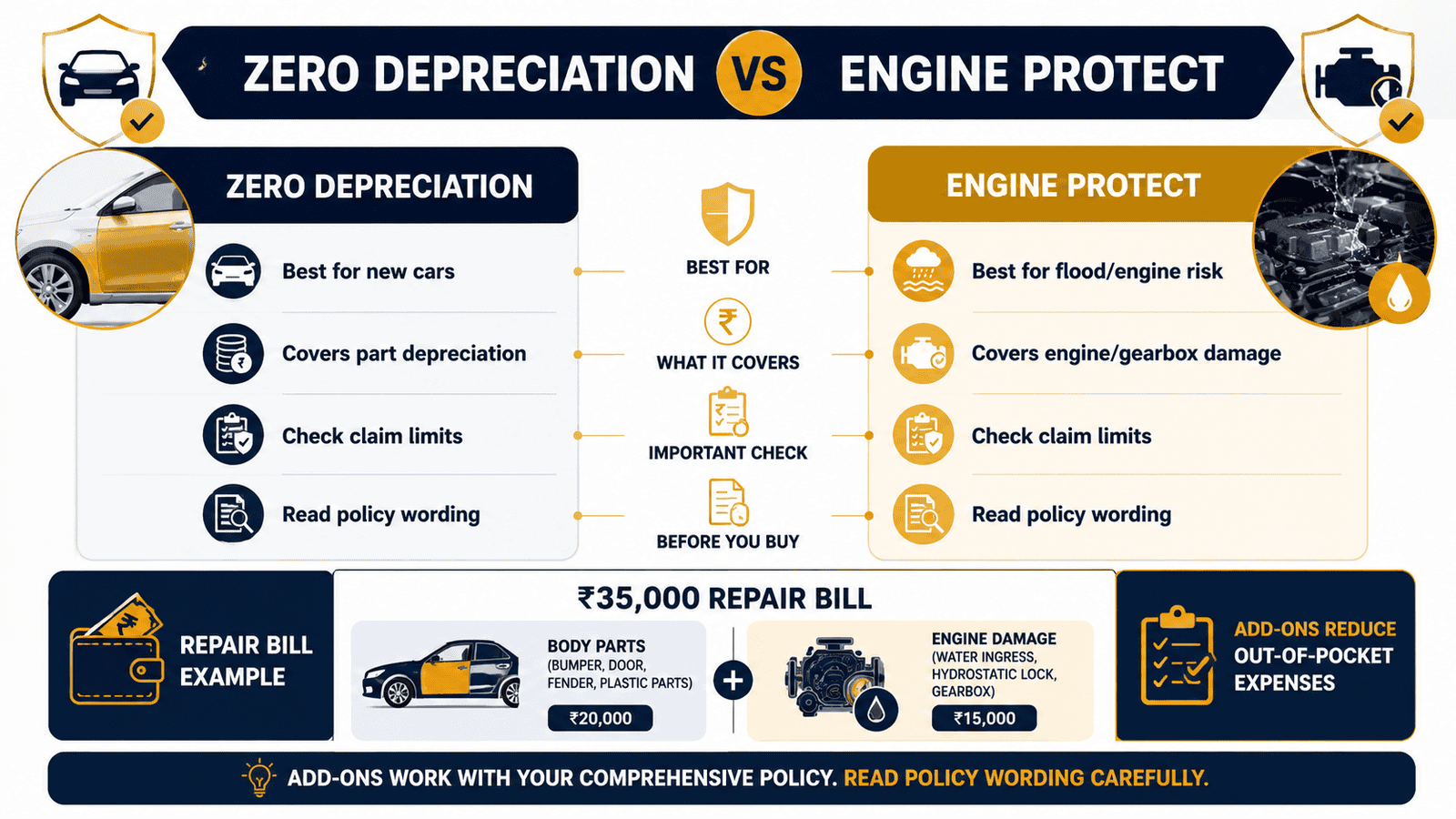
Car insurance add-ons are worth paying for when they reduce likely repair bills more than their extra premium. Zero depreciation is usually stronger for new cars and city drivers because it reduces depreciation deductions, while engine protect matters more for flood-prone areas or costly engine damage risk. Buy zero depreciation first if your car is new or expensive. Consider engine protect if you park in waterlogging-prone areas or drive a car with a low ground clearance. Always check insurer-specific exclusions before buying either add-on — policy wording decides what is actually covered.
Key Takeaways
- Zero depreciation reduces the depreciation deduction applied to car parts at claim time — without it, you may pay 30–50% of part cost out of pocket on a 2–3 year old car.
- Engine protect covers specific engine and gearbox damage situations — primarily water ingress, hydrostatic lock, and oil leakage — that standard comprehensive policies typically exclude.
- A car under 3 years old in dense city traffic almost always benefits more from zero dep than engine protect, because bumper and body repairs are the more frequent claim type.
- Flood-prone locations, basement parking, or monsoon driving with low ground clearance make engine protect relevant — engine repairs can run ₹50,000 to several lakhs on mid-range and premium cars.
- Both add-ons still have exclusions: zero dep does not cover engine damage; engine protect does not eliminate the standard deductible or cover wear and tear.
- Most insurers restrict zero depreciation to cars up to 3–5 years old — check availability and claim-count limits before renewing on an older car.
- Adding both can make sense for a high-value SUV or luxury car in a flood-risk city — compare the combined premium increase against the likely repair cost you would otherwise bear.
Zero Depreciation vs Engine Protect: Side-by-Side Comparison
| Parameter | Zero Depreciation Cover | Engine Protect Cover |
|---|---|---|
| What it covers | Reduces or eliminates depreciation deduction on replaced car parts (metal, plastic, rubber, fibre, glass) at claim time | Covers engine and gearbox damage due to water ingress, hydrostatic lock, oil leakage, and related failures not caused by accident alone |
| What it usually does NOT cover | Engine damage, tyre and battery wear, mechanical/electrical breakdown, consumables (unless separate add-on) | Mechanical or electrical breakdown, wear and tear, damage caused by continued driving after warning, consequential loss |
| Best suited for | New cars (0–3 years), expensive cars, city driving with frequent minor dents and bumper damage | Flood-prone areas, waterlogging risk, basement parking, low-clearance cars, monsoon-heavy regions |
| Main weakness | Does not help when the car is old (high base depreciation reduces IDV anyway); most insurers cap availability at 3–5 years | Limited use in dry regions; exclusions for driver negligence (e.g. driving through deep water) can reduce payout |
| Claim-time check | Confirm the garage charges actual part price; insurer reimburses without depreciation cut under zero dep | Confirm trigger event (water entry, oil leak, etc.) is documented; surveyor assessment required |
| Can both be used together? | Yes — they cover different risks and complement each other on high-value cars in flood-risk cities |
Key Facts at a Glance
| Factor | Detail |
|---|---|
| Base policy required | Comprehensive or own-damage policy — add-ons cannot be attached to a third-party only policy |
| Zero depreciation meaning | At claim settlement, the insurer does not deduct depreciation on replaced parts — you receive the full part cost (minus deductible) |
| Engine protect meaning | Covers specific engine and gearbox damage from water ingress, oil leakage, or hydrostatic lock that a standard policy excludes |
| Typical car age eligibility — zero dep | Most insurers offer it for cars up to 3–5 years old — verify with your insurer before renewal |
| Typical car age eligibility — engine protect | Available for most car ages — check insurer-specific terms; older cars may face additional exclusions |
| Main exclusions — zero dep | Tyres, tubes, batteries, mechanical/electrical parts, and engine damage remain excluded |
| Main exclusions — engine protect | Consequential damage, wear and tear, driving through water despite warning, and breakdown not linked to listed triggers |
| Regulator | Insurance Regulatory and Development Authority of India — irdai.gov.in |
How Car Insurance Add-Ons Actually Work
Add-ons are optional riders that you attach to a comprehensive or own-damage car insurance policy. They are not standalone products — you cannot buy zero depreciation or engine protect without a base policy. Third-party only policies do not qualify. According to IRDAI guidelines, add-ons are offered by insurers as extensions that modify how specific claim scenarios are settled, and their terms, premium, and availability vary by insurer.
Add-ons change claims — they do not replace the base policy
A standard comprehensive policy covers own damage and third-party liability. When you make a claim, the insurer applies depreciation rates to replaced parts — these rates increase with car age. On a 2-year-old car, plastic and rubber parts may attract a 25–30% depreciation deduction. On a 5-year-old car, that figure can exceed 50%. This means a ₹20,000 bumper replacement may result in you paying ₹6,000–₹10,000 out of pocket even after a valid claim — before adding the compulsory deductible. Zero depreciation eliminates or reduces this deduction on covered parts.
Engine protect works differently. A standard comprehensive policy covers accidental damage to the engine — if you hit a pothole and damage a sump, that may be covered. But if your engine suffers water ingress during a flood, or develops a hydrostatic lock because water entered the air intake while driving through a waterlogged road, a standard policy typically treats this as consequential damage and excludes it. Engine protect specifically extends cover to these situations.
Premium impact varies — get actual quotes
Neither add-on has a universal price. Premium for each add-on depends on the insurer, the car’s make and model, the IDV (Insured Declared Value), the car’s age, your city, and your claim history. A zero depreciation add-on might cost ₹2,000 on a small hatchback and ₹8,000–₹12,000 on an SUV. Engine protect is typically less expensive than zero dep but the gap varies widely. Always ask for the policy premium with and without each add-on separately — the insurer or broker is required to provide this.
Policy wording is the final authority
No add-on name guarantees specific coverage. “Zero depreciation” at one insurer may cover glass, fibre, and plastic; at another, glass may be excluded. “Engine protect” at one insurer may cover gearbox damage; at another, gearbox is a separate rider. Just as health insurance coverage depends on what is written in the policy document, not what the product is called, the same applies to motor insurance add-ons. Read the policy schedule and the add-on endorsement — not just the product brochure.
Voluntary and compulsory deductibles still apply
Add-ons do not remove deductibles. Every car insurance policy has a compulsory deductible — a fixed amount the policyholder must pay per claim. If you have also opted for a voluntary deductible to reduce premium, that applies on top. Zero dep reduces the depreciation deduction but does not remove these. Always factor in your deductible when estimating out-of-pocket claim cost.
Real Example: How Add-Ons Change the Claim Bill for Different Indian Drivers
Example 1 — New hatchback in Pune, dense traffic: Priya, 29, has a 14-month-old hatchback. She has zero depreciation. After a rear-end scrape in traffic, her repair includes a plastic bumper replacement (₹9,000), a tail lamp (₹4,500), and panel work (₹7,000). Without zero dep, she would pay roughly ₹2,500–₹3,500 as depreciation deduction on the plastic parts plus the compulsory deductible. With zero dep, she pays only the deductible. Engine protect would have added no value here — there was no engine-related damage.
Example 2 — SUV in Bengaluru, basement parking, monsoon: Rohit, 36, drives a 2-year-old mid-size SUV with basement parking in a Bengaluru apartment. During a heavy monsoon, water entered the basement and reached the engine air intake. The insurer’s surveyor diagnosed hydrostatic lock — estimated repair cost ₹80,000 (illustrative; actual cost depends on car model and garage). Without engine protect, this would be excluded under the standard policy as consequential damage. With engine protect, this would likely be covered subject to policy terms and surveyor approval. Zero dep alone would not have helped here. If you are also managing a car loan, understanding how car loan versus paying with cash affects your total car cost is useful context when budgeting for add-ons.
Example 3 — 7-year-old budget car, low resale value: Suresh, 48, drives a 7-year-old small car with an IDV of ₹2.8 lakh. Zero dep is likely unavailable from most insurers at this car age. Even if available, the IDV is low enough that the premium increase may not justify the benefit. Engine protect for an older petrol engine in a dry, low-flood-risk city adds marginal value. Suresh may be better served by a clean base policy with a voluntary deductible, keeping add-on premium low.
Example 4 — Luxury car, expensive parts: Ananya, 42, drives a luxury crossover. A minor side-swipe causes a headlamp replacement (₹45,000) and a plastic trim panel (₹18,000). Without zero dep, she pays the depreciation portion on each part — potentially ₹15,000–₹25,000 out of pocket. With zero dep, she pays only the deductible. Here, the add-on clearly earns back its annual premium in a single claim.
How to Calculate Whether an Add-On Is Worth It
Add-On Breakeven Check = Add-On Annual Premium ÷ Expected Depreciation Saving Per Claim × Estimated Claim Frequency
This is a simplified estimate — not a guaranteed figure. Actual claim outcomes depend on policy wording, garage repair estimates, the surveyor’s assessment, and your specific deductible. Use this only as a starting framework.
Illustrative scenario — Zero Depreciation: Suppose the zero dep add-on costs ₹4,500 per year on your car. In a typical bumper and panel repair claim of ₹35,000 (illustrative), the depreciation deduction on plastic and rubber parts at year 2 might be around ₹4,000–₹7,000. If you expect to make at least one such claim every 2–3 years, the add-on roughly pays for itself. On a more expensive car with costlier parts, the saving per claim is higher and the breakeven is faster.
Illustrative scenario — Engine Protect: Engine protect might cost ₹1,500–₹3,000 per year (illustrative; varies by insurer and car). Engine repair from water ingress on a mid-range car could run ₹50,000–₹1,50,000 (illustrative). If you park in a flood-risk area, even a single event in five years can justify several years of add-on premium.
| Scenario | Without Add-On (Illustrative) | With Add-On (Illustrative) |
|---|---|---|
| Bumper + panel repair, 2-yr old car, ₹35,000 total bill | You pay ₹5,000–₹8,000 as depreciation on plastic/rubber parts + compulsory deductible | You pay compulsory deductible only (zero dep reduces part depreciation to nil) |
| Engine hydrostatic lock, water ingress, ₹80,000 repair | Typically excluded — you pay full ₹80,000 | Engine protect may cover this — subject to policy terms and surveyor report |
| Engine wear and tear failure, no water event | Excluded under base policy | Also excluded — engine protect does not cover mechanical breakdown |
All ₹ repair figures above are illustrative. Actual repair costs depend on the car model, part prices, and authorised garage rates at the time of the claim.
How to Decide What’s Right for You
Your car is less than 3 years old and you drive regularly in city traffic — consider zero depreciation as your first add-on. Minor dents, bumper scrapes, and panel damage are frequent in urban conditions, and the depreciation saving per claim is highest in the early years of ownership.
You park in a basement, live in a flood-prone city such as Chennai, Mumbai, or Hyderabad, or drive a car with low ground clearance during the monsoon — engine protect cover is worth evaluating. Engine damage from water ingress is expensive and is typically excluded from a standard comprehensive policy.
Your car is high-value (SUV, luxury segment, or a car with costly imported parts) and you live in a flood-risk area — consider adding both zero depreciation and engine protect. The combined premium increase on a costly car is usually justified by the repair cost exposure.
Your car is 4–5 years old and the IDV has dropped significantly — compare the add-on premium increase against the maximum likely claim benefit. On a car with an IDV of ₹3–4 lakh, paying ₹5,000–₹8,000 extra in add-on premiums may not offer proportionate benefit.
You drive fewer than 5,000 km per year and mostly in low-risk conditions — your likelihood of making a claim is lower. A clean base policy with a voluntary deductible and no add-ons may save you more overall than paying for add-ons you rarely use.
Your insurer’s engine protect policy excludes gearbox damage, oil leakage damage, or has a strict “no driving through water” clause without independent proof of flood event — the add-on may provide far less benefit than the name suggests. Check the exclusions list before buying, not after a claim.
Common Mistakes to Avoid
Assuming Zero Dep Covers Engine Damage
Zero depreciation applies to body parts — bumpers, panels, glass, plastic, rubber, and fibre — not to engine components.
If your engine is damaged in a flood or by oil leakage, zero depreciation does nothing. You would still pay the full engine repair bill — which can run ₹50,000 to several lakhs on a mid-range car — out of pocket.
If engine risk is relevant for your location or parking situation, check whether engine protect is separately available and what it actually covers.
Assuming Engine Protect Covers All Engine Problems
Engine protect is not a mechanical warranty. It covers specific listed triggers — typically water ingress, hydrostatic lock, and oil leakage — not general mechanical breakdown or wear and tear.
If your engine fails due to a manufacturing defect, a missed service interval, or normal wear, engine protect will not apply. Manufacturer warranty covers the first scenario; neither insurance nor engine protect covers the second.
Read the list of covered perils in your policy endorsement before assuming engine protect is a comprehensive repair guarantee.
Ignoring Deductibles and Their Impact on Small Claims
Add-ons reduce depreciation deductions and extend coverage — they do not remove deductibles. Every claim still has a compulsory deductible, and if you have opted for a voluntary deductible for premium discount, that applies too.
On a small repair claim of ₹8,000, a combined deductible of ₹3,000–₹5,000 may make the effective payout very low. Filing a claim in this situation also affects your No Claim Bonus (NCB), which discounts future premiums. Calculate whether claiming is actually worth it before filing.
Reserve claims for larger repairs where the net benefit — after deductibles and NCB impact — is meaningful.
Not Checking Claim-Count Limits on Zero Dep
Many insurers cap the number of zero depreciation claims you can make in a policy year — commonly two claims per year. A third claim in the same year may be settled without the zero dep benefit.
If you are involved in multiple minor incidents, your third repair bill could include the depreciation deduction you thought you were protected from. Ask your insurer specifically about the claim-count limit before you renew.
Choosing the Cheapest Premium Without Checking Claim Service
A lower add-on premium at an unfamiliar insurer may come with slower claim processing, fewer network garages near your home or office, or stricter exclusion interpretation.
Claim settlement ratio is one indicator — but check also the insurer’s cashless garage network in your city and how they handle engine damage surveys. You can review how to use claim settlement ratio to evaluate an insurer before committing to a renewal premium.
The cheapest policy that pays out slowly or disputes your claim is more expensive than a slightly costlier policy with better service.
Skipping Policy Wording and Relying on the Agent’s Summary
Add-on coverage is defined by the policy endorsement — not by what the agent says over the phone or in a brochure summary.
Two insurers may both offer “engine protect” but cover completely different triggers and exclude different situations. Always download the policy document, find the add-on endorsement section, and read the covered perils and exclusions yourself before buying.
When This May Not Be the Right Choice
Your car is more than 5 years old with a low IDV. On an older car, the IDV is already substantially reduced — paying ₹4,000–₹8,000 in additional add-on premium for a car worth ₹2–3 lakh in IDV terms may not give you proportionate benefit. Most insurers also stop offering zero dep beyond a certain car age — check availability before factoring it into your decision.
You drive very little and park in a low-risk location. If your annual mileage is under 5,000 km, you park in a dry elevated garage, and you drive mostly on highways rather than congested city roads, your actual claim probability is low enough that the add-on premium may cost more than the expected average saving per year.
The add-on exclusions make the cover too narrow for your situation. If engine protect at your insurer excludes gearbox damage and oil leakage events, and covers only one narrowly defined flooding trigger, it may not address your actual risk. Paying for an add-on that excludes the most likely damage scenario you face is not useful insurance. Consider whether an emergency repair fund could instead cover smaller, excluded repairs more efficiently.
The premium increase strains your monthly budget meaningfully. If both add-ons together push your total car insurance cost significantly higher and you are already managing a car loan or other EMI commitments, the marginal protection may not be worth the cash flow impact in the early months of ownership.
If any of these apply to your situation, it may be worth exploring alternatives before committing.
Official Rules and Where to Verify
Car insurance add-ons in India are regulated by the Insurance Regulatory and Development Authority of India. Insurers must file add-on products with IRDAI, and add-on terms — including covered perils, exclusions, and claim conditions — must be disclosed in the policy document. According to IRDAI, policyholders are entitled to a Customer Information Sheet or Key Features Document that summarises coverage. Ask your insurer for this document before buying.
To verify rules and current terms before purchasing any add-on, refer to:
- IRDAI — irdai.gov.in — the insurance regulator for all motor add-on product approvals and consumer grievance processes
- Your insurer’s policy document — the base policy schedule and the specific add-on endorsement or certificate attached to it
- Customer Information Sheet — a plain-language summary of coverage and exclusions, available from your insurer on request
- Network garage list — verify cashless garage availability in your city and the surveyor process for engine damage claims
Rules, limits, and rates on this topic can change with each Budget or regulatory update. Always verify current figures directly from the official source before making any financial decision. Just as health insurance coverage is defined by policy wording rather than product names, motor insurance add-ons are governed entirely by what is written in your policy document.
Expert Tips
- Get the premium separately for each add-on. Ask your insurer or broker to quote the base premium, then premium with zero dep only, then premium with engine protect only, then both together. This lets you see the exact cost of each add-on rather than accepting a bundle price.
- Check what zero dep actually covers at your insurer. Confirm in writing whether it covers plastic, rubber, fibre, paint, glass, and headlamp lenses — or whether some of these are excluded. The covered parts list varies by insurer and directly affects which claims benefit from the add-on.
- Check engine protect triggers before buying. Ask specifically whether water ingress, oil leakage, gearbox damage, and hydrostatic lock are all covered. If your insurer’s policy excludes gearbox and oil leakage events, the engine protect cover is narrower than it sounds.
- Map the nearest cashless garage before renewing. A zero dep claim is most useful in a cashless setup where the insurer pays the garage directly at the approved rate. Check whether the insurer has a cashless garage within 10–15 km of your home or office — not just in the broader city.
- Do not let add-on premiums push your total car cost past a safe level. If you are already managing a car loan EMI, check that the total monthly outflow — EMI plus insurance — stays within a healthy range. Review how much EMI is safe for your salary before adding multiple riders to an already stretched budget.
- Review add-ons every year at renewal — not just when buying. As a car ages, zero dep may become unavailable or less valuable. Engine protect may become more relevant as the car ages and repair costs rise. The right add-on combination at year 1 may not be right at year 4.
- Do not skip No Claim Bonus protection if you plan to add zero dep. NCB protection add-on preserves your NCB discount even after one claim. If you have zero dep and are more likely to file minor claims, NCB protection prevents you from losing your earned discount on the next renewal.
Frequently Asked Questions
Is zero depreciation the same as bumper-to-bumper car insurance?
The terms are often used interchangeably in marketing, but they are not always the same. “Bumper to bumper” typically implies a broader zero depreciation cover that includes most plastic, rubber, and fibre parts across the entire car. “Zero depreciation” as a named add-on may have exclusions for specific components such as tyres, tubes, or batteries. Check the policy endorsement to confirm exactly which parts are covered at your insurer before assuming they are identical.
Does zero depreciation include engine protect?
No. Zero depreciation reduces or eliminates depreciation deductions on replaced body parts — it does not extend cover to engine damage scenarios that are excluded under the standard policy. Engine water ingress, hydrostatic lock, and oil leakage related failures require a separate engine protect add-on. If you expect benefit from both, you need to buy both separately.
Is engine protect needed for a new car?
It depends on where you park and drive, not just how new the car is. Even a brand-new car can suffer engine damage from water ingress in a waterlogging event. If you park in a flood-prone basement, drive through areas that routinely flood during the monsoon, or own a car with low ground clearance, engine protect is worth considering from year one. If you park on an elevated, dry surface and drive in low-risk conditions, the urgency is lower. Verify with your insurer whether their engine protect terms cover the specific risk scenarios you actually face.
Can I buy both zero depreciation and engine protect together?
Yes. The two add-ons cover different risk categories and can be combined on the same comprehensive policy. Many insurers offer both as part of an add-on package or allow you to select them individually. For a high-value car in a flood-risk city, having both can make sense — zero dep handles body and panel repairs while engine protect handles engine and gearbox damage from water events. Compare the combined premium increase against your repair cost exposure before deciding.
Is zero depreciation still useful after 5 years?
Most insurers stop offering zero depreciation after a car is 3–5 years old — check with your insurer for their specific age cut-off. Even if it is available, the IDV of a 5-year-old car is substantially lower than when new, which reduces the maximum possible claim benefit. The premium you pay for zero dep on an older car may not offer the same value it did in the first two years. Review whether the add-on cost is justified at each annual renewal, rather than auto-renewing it every year.
Does adding zero dep or engine protect guarantee full claim payment?
No. Add-ons change specific aspects of how claims are settled — they do not guarantee full reimbursement of every repair bill. Compulsory and voluntary deductibles still apply. The insurer’s surveyor assesses the damage and approves the repair estimate. Exclusions in the policy wording still hold. A claim outcome depends on the nature of damage, the garage’s repair estimate, the surveyor’s assessment, and whether the event falls within the covered perils. Add-ons reduce your out-of-pocket cost in qualifying scenarios — they do not eliminate all costs or guarantee specific payout amounts.
Which add-on is better for flood-prone areas?
Engine protect is generally more relevant for flood-prone areas because it specifically covers engine and gearbox damage from water ingress and hydrostatic lock — scenarios that standard comprehensive policies typically exclude. Zero depreciation handles depreciation on body parts, which is useful after physical collision damage, but does not address flood-related engine failure. If you live in a city with a known history of waterlogging during the monsoon, engine protect should be on your evaluation list regardless of your car’s age. That said, zero dep may still be useful in the same policy for collision-related claims — both can coexist.
What should I check in the policy document before buying an add-on?
Check the following before buying any car insurance add-on: the specific list of covered perils, the exclusions list (often more informative than the covered perils list), the claim-count limit per policy year, whether the add-on applies to cashless claims only or also to reimbursement claims, the compulsory deductible amount, and whether any parts or damage types are categorically excluded. If any of these are unclear in the document, ask the insurer in writing before purchasing — not after a claim event.
Final Verdict
For most car owners in India, zero depreciation is the first car insurance add-on worth evaluating — particularly if the car is new, expensive, or driven frequently in city traffic where bumper and panel repairs are routine. The depreciation saving per claim is highest in the early years of a car’s life, and the add-on typically pays for itself within one or two moderate repair claims.
Engine protect is more situational, but it can be critical for the right driver profile. If you park in a flood-prone basement, live in a city with waterlogging risk, or drive a car with low ground clearance, a single engine damage event can cost far more than several years of add-on premium. In that context, it is not optional — it is a specific risk gap that the base policy does not fill.
Buying both can make sense for high-value cars in high-risk locations. What does not make sense is auto-renewing both without reviewing exclusions, checking claim-count limits, and confirming whether the add-on remains available and useful as the car ages. The right set of car insurance add-ons is one that matches your actual exposure — not the most complete or the cheapest list on a renewal form.
Always verify the latest rules from official sources or consult a qualified professional before making any financial decision.
This article is for educational purposes only and should not be treated as personalised financial, tax, investment, insurance, or legal advice. Tax rules, interest rates, regulatory limits, and product features can change with each Budget or policy update. Please verify current rules from official government sources or consult a qualified and registered professional before making any financial decision.
Insurance is a subject matter of solicitation. Please read the policy document carefully before purchasing. Premiums and add-on terms vary by insurer, car model, age, IDV, city, and individual risk profile. Refer to IRDAI at irdai.gov.in for regulatory information.

Priya Nambiar writes about insurance concepts for Indian families, salaried employees, self-employed professionals, and first-time policy buyers. Her content focuses on helping readers understand coverage, exclusions, claim conditions, premiums, riders, and policy documents before buying or renewing insurance.
She covers topics such as term insurance, health insurance, family floater plans, riders, critical illness cover, employer insurance vs personal insurance, waiting periods, exclusions, deductibles, co-payment, no-claim bonus, claim settlement, premium comparison, renewal rules, and tax benefits linked to insurance.
Priya’s writing is careful, consumer-focused, and policy-document oriented. She explains why insurance should be understood as financial protection, not just a tax-saving tool or investment substitute. Her articles encourage readers to compare coverage, understand limitations, and ask better questions before buying a policy. Premiums, exclusions, claim rules, and benefits vary by insurer, age, health, sum insured, and product type. Insurance is a subject matter of solicitation, and readers should read the official policy document carefully before purchasing.