

You open your stock broker app one morning and see a notification: “TCS has declared a dividend of ₹28 per share.” If you hold TCS shares, that means money is on its way to your bank account — no selling required. If you are new to stock market basics, this can feel like a pleasant surprise. But dividend income is not free money, not guaranteed, and not as simple as it first appears. There are specific dates you must respect, tax rules that apply, and common mistakes that trip up beginners every year. This guide explains dividend meaning from scratch — what it is, how it reaches your bank account, which dates matter, and what you must never confuse it with.
Quick Answer: Dividend Meaning
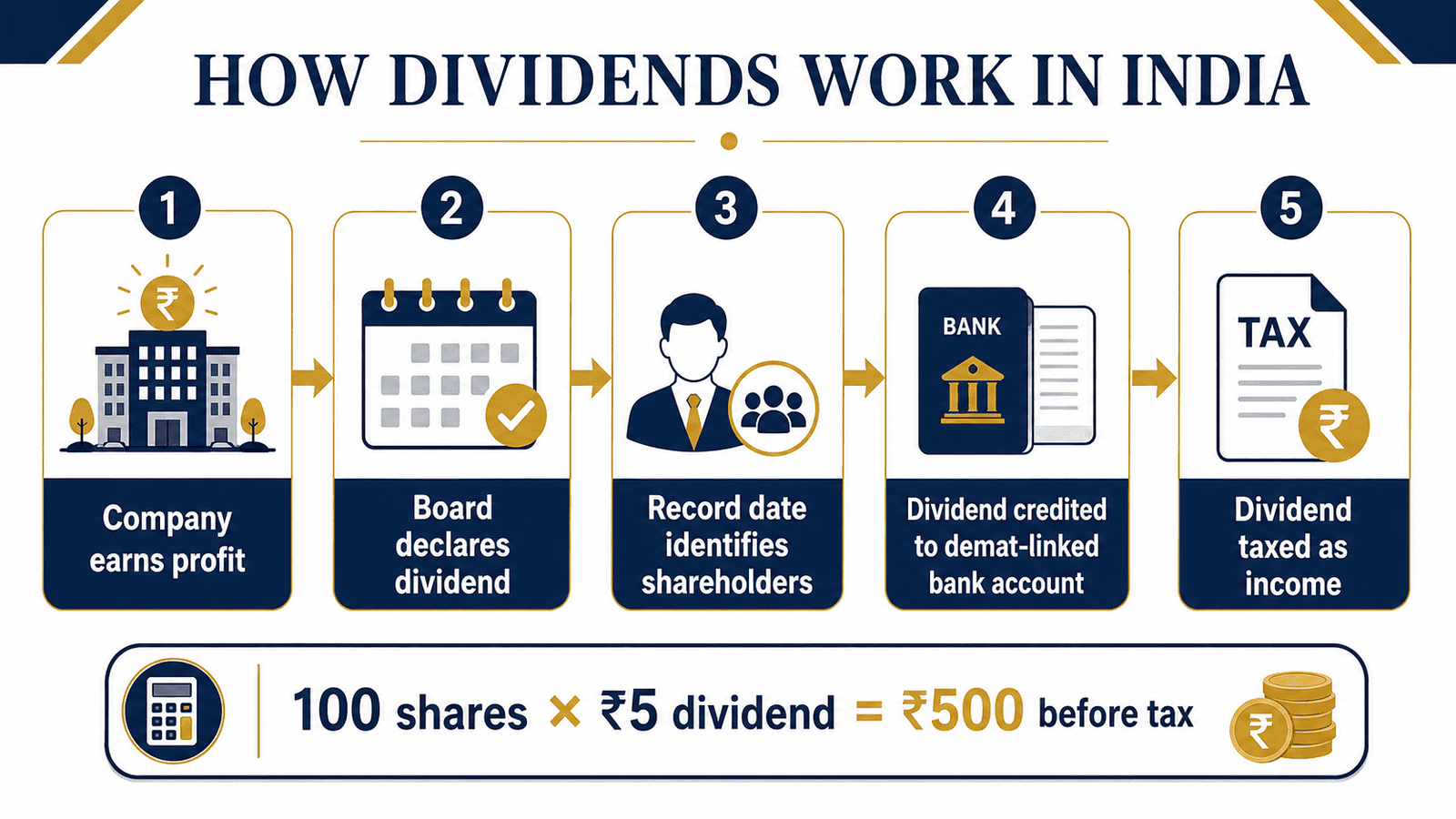
Dividend meaning is the share of company profit paid to eligible shareholders, usually as cash credited to the bank account linked with their demat account. For example, if you hold 100 shares and a company declares ₹5 per share dividend, you receive ₹500 before any applicable tax or TDS. Note: TDS rate and dividend tax treatment should be verified from incometax.gov.in before publishing, as these figures can change.
Key Takeaways
- A dividend is a company’s way of distributing part of its profit to eligible shareholders — usually as cash per share held.
- Dividends can be interim (paid mid-year, before final accounts) or final (declared at the annual general meeting after audited results).
- Your eligibility depends entirely on whether you hold shares before the ex-dividend date — buying on or after that date means you miss the payout.
- Dividend income is taxable in India and added to your income from other sources — TDS may apply above a threshold; verify current rates at incometax.gov.in before filing.
- A high dividend yield does not mean a stock is safe or a good buy — it can simply mean the share price has fallen sharply.
- Companies are not legally required to pay dividends every year — a profitable company can choose to reinvest instead.
Key Facts at a Glance
| Term | What It Means | Why It Matters |
|---|---|---|
| Dividend | Share of company profit paid per share held | Core definition — not guaranteed income |
| Declaration Date | Date the board announces the dividend amount | Triggers ex-date and record-date calculation |
| Ex-Dividend Date | First date on which new buyers are NOT eligible for the declared dividend | You must own shares before this date to receive payout |
| Record Date | Date the company checks its shareholder register for eligibility | Typically one trading day after ex-date in India |
| Payment Date | Date dividend is credited to your demat-linked bank account | Usually within 30 days of record date as per SEBI guidelines |
| Interim Dividend | Dividend declared before year-end financial results | Board decision only — AGM approval not required |
| Final Dividend | Dividend declared at AGM after audited annual results | Requires shareholder approval at the AGM |
| Cash Dividend | Payout in cash per share | Most common form in India |
| Stock Dividend | Additional shares instead of cash | Less common; dilutes existing shares |
| Dividend Yield | Annual dividend ÷ share price × 100 | Useful comparison metric — not a return guarantee |
| Tax Treatment | Added to income from other sources — TDS may apply | Verify current rate at incometax.gov.in |
What Dividend Meaning Really Is — And How It Works in India
You Own a Piece of the Company
When you buy shares of a listed Indian company, you become a part-owner. If the company earns a profit, the board of directors decides what to do with that money. There are broadly four options: retain it as reserves, reinvest it in business growth, use it to repay debt, or distribute a portion to shareholders as a dividend. Understanding owning company shares is the first step to understanding why dividends exist at all.
How a Dividend Is Declared
The company’s board of directors meets and approves a dividend amount, usually stated as a fixed rupee amount per share — for example, ₹5 per share. This is called the declaration. The board also sets the record date, which is the cut-off date for determining which shareholders are eligible to receive the dividend. According to SEBI guidelines, companies must pay dividends within 30 days of the declaration date for listed companies.
Record Date and Ex-Dividend Date: The Two Dates That Decide Everything
This is where most beginners get confused — and where money is lost by buying at the wrong time.
The record date is the date on which the company looks at its official register of shareholders. Only shareholders listed in that register on that date receive the dividend. In India, stock-market settlement follows a T+1 settlement cycle, meaning a trade you execute today reflects in the company’s register the next trading day. This is why the ex-dividend date matters: it is set one trading day before the record date.
The ex-dividend date is the first date on which a new buyer does NOT qualify for the upcoming dividend. If you buy shares on the ex-date or after, your name will not appear in the register on the record date — so you miss the payout. To be eligible, you must own the shares before the ex-dividend date. This is not a loophole you can time at the last minute — the price typically adjusts downward by approximately the dividend amount on the ex-date itself.
How the Dividend Reaches Your Account
Once the record date passes, the company processes the payout and credits the dividend directly to the bank account linked to your demat account setup. You do not need to do anything — no form to submit, no claim to file. The amount typically appears within a few working days of the payment date. If your bank account is not correctly linked to your demat account, the dividend may be delayed or go into an unclaimed dividend account held by the company.
Interim Dividend vs Final Dividend
A company can declare a dividend at any point during the financial year — this is called an interim dividend. It is approved solely by the board and paid before the annual results are audited. A final dividend, by contrast, is declared at the Annual General Meeting after the audited annual results are approved. Many large Indian companies — particularly PSUs and blue-chip firms — pay both: an interim dividend mid-year and a final dividend at year-end.
Cash Dividend vs Stock Dividend
The most common form of dividend in India is a cash dividend — a fixed rupee amount per share credited to your bank account. A stock dividend (sometimes called a scrip dividend) distributes additional shares instead of cash. This is rarer in Indian markets and is different from a bonus share issue, though the two are sometimes confused. A stock dividend increases the number of shares you hold but does not change the total company value — your ownership percentage stays roughly the same.
Real Example: How Rahul Received His First Dividend
Rahul, 29, a software engineer in Bengaluru earning ₹95,000 per month, purchased 100 shares of a fictional listed company, Bharat Industries Ltd., at ₹200 per share through his discount broker app. Three months later, Bharat Industries declared an interim dividend of ₹5 per share. The record date was set for 15 August.
Rahul had purchased his shares on 10 July — well before the ex-date of 14 August. His name was in the company’s register on 15 August. On 28 August, ₹500 (100 shares × ₹5) was credited to his bank account linked to his demat account. He noticed the amount was slightly less than ₹500 — this was because TDS had been deducted at source. The actual net credit depends on current TDS rules, which Rahul was advised to verify at incometax.gov.in before filing his return.
Key insight: Rahul received this money without selling a single share. But had he bought just one day later — on or after the ex-date — he would have received nothing from this particular dividend cycle.
How to Calculate Dividend Income
Dividend Income = Number of Eligible Shares × Dividend Per Share Declared
The calculation itself is straightforward. What makes a difference is how many shares you hold on the record date and what the company declares per share.
Example 1: 100 shares × ₹5 per share = ₹500 gross dividend income.
Example 2: 250 shares × ₹2 per share = ₹500 gross dividend income.
Both result in the same ₹500, but through different combinations. Gross dividend is what the company declares. Net credit to your account may be lower after TDS deduction — verify the current applicable TDS threshold and rate at incometax.gov.in, as these figures are subject to change with each Budget.
A related metric is dividend yield: Annual Dividend Per Share ÷ Current Share Price × 100. For example, if a company pays ₹10 per share annually and the share price is ₹200, dividend yield is 5%. But if the share price drops to ₹100, the yield appears to be 10% — not because the company became more generous, but because the price fell. This is a crucial distinction that confuses many beginners.
| Scenario | Shares × Dividend Per Share | Gross Payout |
|---|---|---|
| Small holding | 100 × ₹5 | ₹500 |
| Medium holding | 250 × ₹2 | ₹500 |
| Larger holding | 500 × ₹10 | ₹5,000 |
Comparison: Dividend vs Similar Corporate Actions
| Item | What It Is | What the Investor Receives |
|---|---|---|
| Cash Dividend | Company pays profit share per share held | Cash credited to bank account |
| Stock Dividend | Additional shares issued instead of cash | More shares, no cash inflow |
| Interim Dividend | Declared mid-year by board, before audited results | Cash or stock — same process as final |
| Final Dividend | Declared at AGM after audited annual results | Cash or stock — approved by shareholders |
| Bonus Share Impact | Free additional shares issued from reserves — not from profit distribution | More shares, no cash, no tax event (typically) |
| Stock Split | Share price reduced, quantity increased proportionally | More shares at lower face value — same total value |
| Dividend Income | Periodic cash from profit distribution | Cash — taxable as income from other sources |
| Capital Gain | Profit from selling shares at a higher price | Cash on sale — taxed as STCG or LTCG |
How to Decide What’s Right for You
You want periodic cash flow from your stock investments and are comfortable with the fact that dividends are not guaranteed — THEN dividend-paying stocks from stable, profitable companies may be worth including in your portfolio alongside growth stocks.
You are young, have a long investment horizon, and are focused on wealth creation — THEN total return (share price appreciation + dividends) matters more than dividend income alone. Companies that reinvest profits rather than paying dividends can grow faster over time.
You are evaluating a stock purely because its dividend yield looks high — THEN check whether the high yield is due to a falling share price or unsustainable payout. Reading company valuation basics alongside dividend data gives a more complete picture.
You are in a higher income tax bracket — THEN your post-tax dividend income could be significantly less than the headline amount. Total return after tax should be the comparison benchmark, not gross dividend yield.
You need guaranteed income every month — THEN dividend-paying stocks are not the right tool. Dividends are discretionary, variable, and may be skipped entirely in a loss-making year.
You do not understand the company’s business or financial position — THEN chasing dividend announcements is likely to lead to poor investment decisions. A company can declare a large dividend even while its core business is weakening.
Common Mistakes to Avoid
Buying Shares After the Ex-Date and Expecting Payout
Many beginners see a dividend announcement and immediately buy the stock, not realising the ex-date has already passed.
If you purchase shares on or after the ex-dividend date, your name will not appear on the record date register — you will not receive the dividend. Worse, the share price typically drops by roughly the dividend amount on the ex-date, so you pay a higher price and get nothing for it.
Always check the ex-date before buying a stock specifically for dividend eligibility.
Treating Dividend Yield as a Guaranteed Return
A 6% dividend yield sounds attractive — but it is not a fixed deposit.
Dividend yields can appear high simply because the share price has collapsed. If a company that paid ₹10 per share last year now trades at ₹80 instead of ₹200, the yield looks high — but it may signal serious business trouble, not generosity. Historical yield is no guarantee of future payout.
Compare dividend consistency over 5–7 years alongside earnings and debt levels before drawing conclusions.
Ignoring Tax on Dividend Income
Dividend income is not tax-free in India — it is added to your total income and taxed at your applicable slab rate.
TDS is deducted at source above a threshold — verify the current rate and threshold at incometax.gov.in, as these can change with each Budget. Beginners who do not account for this are often surprised at tax time when their dividend income increases their total taxable income.
Track all dividend credits through the year and report them under income from other sources in your ITR.
Confusing Bonus Shares with Dividends
A bonus share issue gives you additional shares from the company’s reserves — no cash is paid. A cash dividend credits money to your bank account from the company’s distributable profits.
These are completely different corporate actions with different tax and accounting treatment. Mixing them up leads to incorrect tax filing and wrong return expectations.
Assuming High Dividend Means a Strong Company
Some companies pay high dividends even when their core business is shrinking or taking on debt to fund the payout. This is called an unsustainable dividend.
A high dividend payout ratio (dividends ÷ net profit) combined with weak cash flow is a warning sign, not a quality signal. Always look at whether the company is generating enough free cash flow to support the dividend over time.
Missing the Bank Account Link to Demat
If the bank account linked to your demat account is outdated, closed, or incorrectly mapped, your dividend credit will fail. The company will transfer the amount to an unclaimed dividend account.
Verify your demat-linked bank account details with your broker at least once a year — especially if you have changed banks or accounts.
When This May Not Be the Right Choice
Dividend-focused investing may not suit you if you need a fixed, predictable monthly income. Dividends are discretionary — a company facing a difficult year can reduce or skip the payout entirely, and there is no regulatory obligation to maintain a consistent dividend.
If you do not yet understand stock market volatility — specifically that the share price can fall by more than the dividend you receive — dividend stocks can produce a false sense of income security. You may receive ₹500 in dividends while the underlying share value drops by ₹5,000.
Dividend-focused investing also makes less sense if the company is paying dividends despite weak profitability, high debt, or declining cash flow. A high-dividend, financially stressed company is not a bond substitute.
Finally, if your income tax bracket means that post-tax dividend income produces a net return lower than safer alternatives, the trade-off may not be worth the equity risk involved.
If any of these apply to your situation, it may be worth exploring alternatives before committing.
Official Rules and Where to Verify
Dividend announcements, eligibility rules, and payout timelines for listed companies are regulated in India. Here are the primary sources to verify current rules:
- SEBI (Securities and Exchange Board of India) — sebi.gov.in: Governs listed company obligations, payout timelines, and investor-protection guidelines for dividend distribution.
- Income Tax Department — incometax.gov.in: Current rules on dividend taxation, TDS thresholds, applicable slab rates, and how to report dividend income in your ITR. Verify before each filing season, as rates can change with each Union Budget. For broader context on stock tax basics, including how dividend income fits alongside STCG and LTCG, refer to the official portal.
- Company Investor Relations Pages and Exchange Filings: NSE (nseindia.com) and BSE (bseindia.com) publish all corporate action announcements including record dates, ex-dates, and dividend amounts for listed companies.
- Your Broker / Demat Account: Dividend credit status and historical payouts are visible in your account statement or the corporate actions section of your broker platform.
Rules, limits, and rates on this topic can change with each Budget or regulatory update. Always verify current figures directly from the official source before making any financial decision.
Expert Tips
- Track dividend consistency over at least 5 years — not just last year’s payout. A company that has consistently paid and grown its dividend for five or more years in varied economic conditions is a more credible dividend payer than one with a single large recent payout.
- Calculate the payout ratio before getting excited. Divide the annual dividend per share by the earnings per share. A payout ratio above 80–90% is usually unsustainable unless the company generates exceptional cash flow. High ratio + low growth = potential dividend cut risk.
- Do not confuse a rising dividend yield with a rising dividend. If a company has paid ₹10 per share for three years and the stock price has dropped from ₹300 to ₹150, the yield has doubled — but the payout is flat. Falling price driving up yield is often a warning signal, not an opportunity.
- Set a calendar reminder 2–3 weeks before the record date if you want to be eligible. Settlement in India is now T+1 — but waiting until one day before the ex-date is still risky due to execution delays or system issues. Buffer time is wise.
- Report every dividend credit in your ITR — even small amounts. Many salaried employees receive small dividends from a handful of stocks and assume amounts under ₹1,000 need not be declared. All dividend income must be reported under income from other sources, regardless of amount. Verify current TDS threshold at incometax.gov.in.
- Avoid judging a company’s financial health by dividend alone. Reading company valuation basics alongside its dividend history gives a far more complete picture of whether a payout is supported by real business strength or by depleting reserves.
Frequently Asked Questions
What is dividend in simple words?
A dividend is a company’s way of sharing part of its profit with the people who own its shares. If you hold shares of a company and it declares a dividend of ₹5 per share, you receive ₹5 for every share you own — credited directly to your bank account, no selling required.
Who gets dividend in India?
Any shareholder whose name appears in the company’s official register on the record date is eligible to receive the dividend. This means you must have purchased and held the shares before the ex-dividend date — buying on or after the ex-date disqualifies you from that particular payout cycle.
What is the ex-dividend date?
The ex-dividend date is the first trading day on which a new buyer of the stock is no longer entitled to the declared dividend. If the ex-date is 14 August, you must own shares as of 13 August or earlier to qualify. The share price typically falls by approximately the dividend amount on the ex-date as the entitlement is removed from the stock’s price.
What is the record date for dividend?
The record date is the cut-off date when the company checks its shareholder register to determine who qualifies for the dividend. Because India’s stock market follows a T+1 settlement cycle, the record date is typically one trading day after the ex-dividend date. Shareholders on the register that day receive the payout.
Is dividend taxable in India?
Yes. Dividend income in India is taxable in the hands of the recipient and is added to your total income under the head “income from other sources.” It is taxed at your applicable income tax slab rate. TDS may be deducted at source above a prescribed threshold. Verify the current TDS rate and threshold at incometax.gov.in, as these can change with each Budget.
Is dividend income better than capital gain?
They serve different purposes and are taxed differently. Dividend income is regular cash from profit distribution — taxed at your slab rate. Capital gain is profit from selling shares at a higher price — taxed at STCG or LTCG rates depending on holding period. Neither is universally better; the right comparison depends on your tax bracket, investment horizon, and financial goals.
Can I buy shares one day before the dividend and receive it?
No. You must buy before the ex-dividend date, not one day before the payment date. The ex-date is what matters, and it is typically set one trading day before the record date. If the ex-date is tomorrow, buying today does not guarantee eligibility — you needed to hold before today. Always confirm the ex-date from the exchange’s corporate actions page before making any purchase for dividend eligibility.
Where is dividend credited in India?
Dividends are credited directly to the bank account linked to your demat account. The company processes the payment after the record date and the funds typically appear within a few working days of the stated payment date. Ensure your bank account details in your demat account are current and correctly mapped — outdated account details lead to failed or unclaimed credits.
What is the difference between interim and final dividend?
An interim dividend is declared by the board of directors mid-year, before the annual results are audited — no shareholder approval at an AGM is required. A final dividend is declared at the Annual General Meeting after audited results are approved by shareholders. Many large Indian companies pay both in the same financial year.
Can a company skip dividend in a bad year?
Yes, absolutely. Dividends are not legally mandatory for listed companies unless the company has specific obligations (such as preference shares). A company can reduce, defer, or skip dividends entirely if profits fall, cash flow is tight, or the board decides to reinvest. This is one of the fundamental reasons why dividend income from stocks should never be treated like fixed-income interest.
Final Verdict
Dividend meaning is simple at its core: a company earns profit, the board decides to share part of it with shareholders, and eligible investors receive a fixed amount per share in their bank account. But the details — record date, ex-date, tax treatment, payout consistency — are what beginner investors often miss. Dividend income is not guaranteed, not tax-free, and not a reliable signal that a stock is financially strong.
For an investor like Rahul — early in his investment journey, building a stock portfolio alongside a salaried income — understanding dividend meaning is a foundational step. Dividends can supplement returns, but total return, business quality, and post-tax income matter far more than a headline payout. Do not chase dividends without understanding the company behind them. Always verify the latest rules from official sources or consult a qualified professional before making any financial decision.
This article is for educational purposes only and should not be treated as personalised financial, tax, investment, insurance, or legal advice. Tax rules, interest rates, regulatory limits, and product features can change with each Budget or policy update. Please verify current rules from official government sources or consult a qualified and registered professional before making any financial decision.

Devika Shah writes about stock market basics for Indian beginners who want to understand equity investing before taking financial risk. Her content is educational and does not provide stock tips, trading calls, price predictions, or personalised investment advice.
She covers topics such as demat account meaning, trading account basics, IPOs, dividends, brokerage charges, delivery vs intraday trading, market orders, limit orders, stock indices, blue-chip stocks, capital gains tax, stock market terminology, risk management, and the difference between long-term investing and short-term speculation.
Devika’s writing is clear, balanced, and risk-conscious. She helps readers understand how the stock market works, what accounts and documents are needed, what charges may apply, and what mistakes beginners should avoid. Her articles are suitable for students, salaried employees, and first-time investors who want a foundation before investing. Since market rules, tax treatment, brokerage fees, IPO processes, and regulatory requirements can change, readers should verify current information from SEBI, exchanges, brokers, and official tax sources.