
Small finance bank FDs have started appearing on every rate-comparison website — and for good reason. Several small finance banks in India regularly offer fixed deposit rates that are 0.5% to 1.5% higher than what large public and private sector banks pay. For someone parking ₹5–10 lakh in a fixed deposit, that difference can mean thousands of rupees in extra interest every year.
But the question most depositors end up asking is not “which rate is highest?” It is: “Is this bank safe enough for my money?” That is a sharper question, and it deserves a careful answer — not a one-line reassurance.
Small finance banks are regulated by the Reserve Bank of India and their eligible deposits are covered by DICGC insurance. But being regulated and being risk-identical to the country’s largest banks are not the same thing. This article breaks down exactly what protection you have, how to keep your deposit within that protection, and when the higher rate is worth pursuing — and when it is not.
Quick Answer: Are Small Finance Bank FDs Safe?
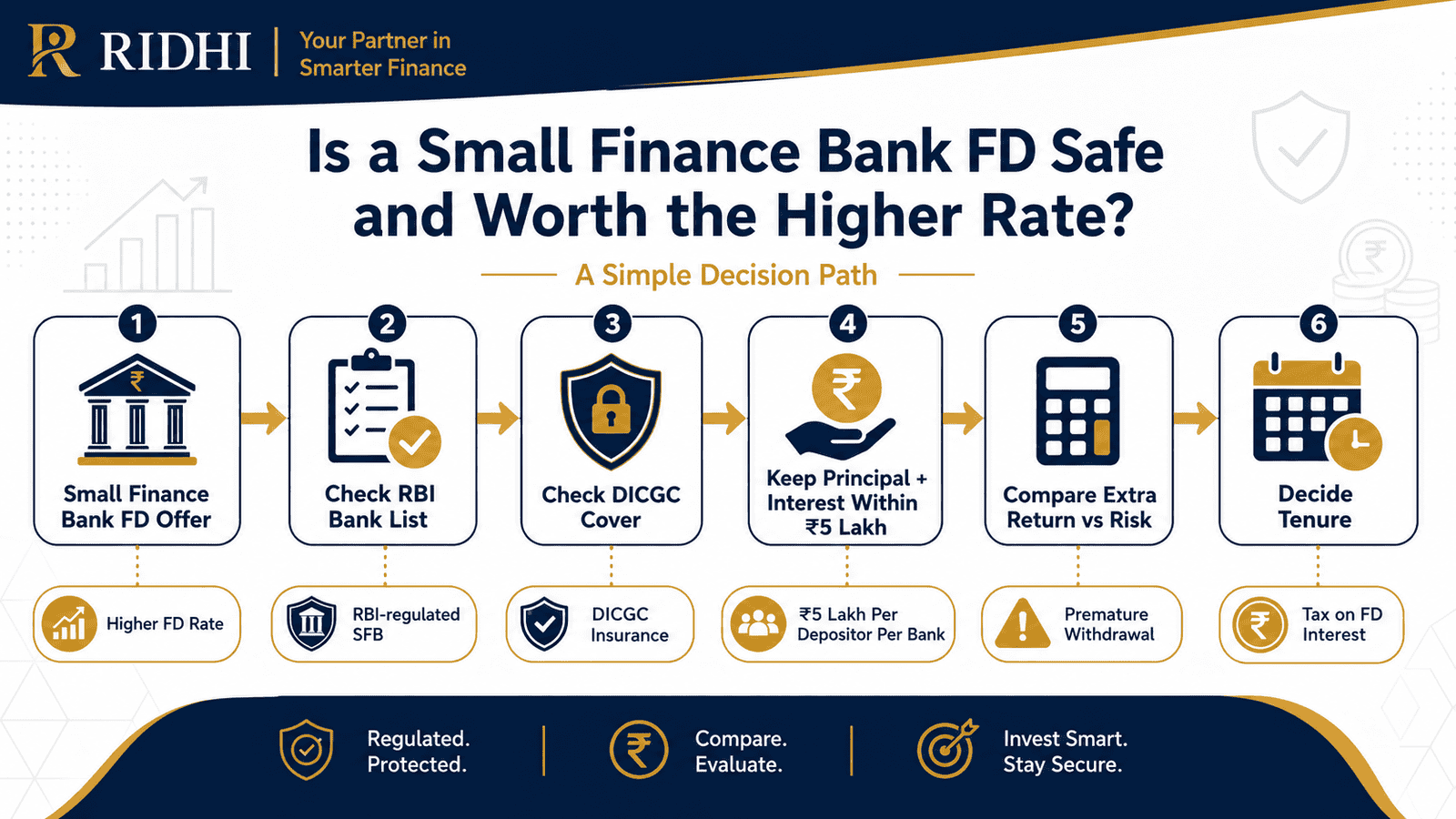
A small finance bank FD can be worth considering for higher interest, but safety depends on the bank, deposit size, tenure, and DICGC cover. In India, eligible bank deposits are insured up to ₹5 lakh per depositor per bank, including principal and interest. Keep liquidity and concentration risk in mind before depositing a large lump sum in a single small finance bank.
Key Takeaways
- Small finance banks are RBI-regulated scheduled commercial banks — but their risk profile is not identical to the country’s largest PSU or private sector banks.
- DICGC deposit insurance covers up to ₹5 lakh per depositor per bank, counting both principal and accrued interest together — not ₹5 lakh of principal separately.
- If you deposit ₹5 lakh principal at a higher rate, accrued interest will push the total above the insured limit before maturity — meaning a portion of your money sits outside DICGC cover.
- Higher rates should be evaluated after tax: if you are in the 30% bracket, a 1% rate advantage shrinks to roughly 0.7% post-tax — sometimes less than it looks on a comparison page.
- Never park your full emergency fund in a single small finance bank FD; keep at least a portion in a highly liquid account for immediate access.
- FD laddering — splitting the deposit across multiple banks and tenures — reduces both concentration risk and reinvestment risk.
Small Finance Bank FD vs Other Fixed-Return Options: A Comparison
| Parameter | Small Finance Bank FD | Large Bank FD (PSU / Private) | Post Office FD | Debt Mutual Fund |
|---|---|---|---|---|
| Typical Rate Advantage | Often 0.5%–1.5% higher than large banks | Benchmark rate; generally lower than SFBs | Fixed by government; competitive for 1–5 yr | Market-linked; no fixed rate |
| Regulator | RBI | RBI | Ministry of Finance / India Post | SEBI |
| Deposit Insurance | DICGC — up to ₹5 lakh per depositor per bank | DICGC — up to ₹5 lakh per depositor per bank | Sovereign guarantee (government-backed) | Not a deposit; no DICGC cover |
| Principal Safety | Within insured limit: protected. Above: bank-risk dependent | Within insured limit: protected. Large banks: stronger perceived stability | Sovereign-backed; considered very high safety | NAV-linked; can fall in adverse credit conditions |
| Liquidity | Premature withdrawal usually allowed; penalty applies | Premature withdrawal usually allowed; penalty applies | Premature exit rules differ by scheme and tenure | Open-ended: redemption in 1–3 business days |
| Tax on Returns | Interest taxable as income per slab | Interest taxable as income per slab | Interest taxable as income per slab | LTCG/STCG rules apply; differs from FD taxation |
| Best Suited For | Yield seekers with deposit-size discipline | Safety-first depositors; emergency fund base | Very conservative; sovereign safety priority | Investors comfortable with NAV fluctuation |
| May Not Suit | Depositors above insured comfort, or needing urgent liquidity | Those needing the highest possible fixed rate | Those needing flexible premature exit | Anyone needing capital protection with certainty |
For a detailed head-to-head on post office versus bank deposits, see post office comparison.
Key Facts at a Glance
| Feature | Detail |
|---|---|
| What is a small finance bank FD? | A fixed deposit held at an RBI-licensed small finance bank |
| Regulator | Reserve Bank of India (rbi.org.in) |
| Deposit insurance body | Deposit Insurance and Credit Guarantee Corporation (DICGC) |
| Maximum DICGC cover | Up to ₹5 lakh per depositor per bank (principal + interest combined) |
| Interest taxability | Fully taxable as per income tax slab; TDS if annual interest exceeds threshold |
| Suitable use case | Surplus money beyond emergency fund; within DICGC insured limit |
| Unsuitable use case | Full emergency fund; deposits well above insured limit at one bank; low risk-tolerance investors |
| Key risk to watch | Concentration risk: all deposits in one small finance bank above insurance limit |
What Is a Small Finance Bank FD and Why Are Rates Higher?
Small finance banks (SFBs) are a specific category of scheduled commercial banks licensed by the Reserve Bank of India. According to RBI guidelines, they are required to extend at least 75% of their loans to priority sectors — which includes small businesses, microfinance borrowers, and unserved communities. This lending focus means their borrower base is different from that of large universal banks, and their cost of funds often needs to be managed more actively.
Because SFBs compete for deposits in a market dominated by large, established banks with enormous branch networks and brand recognition, they frequently offer higher FD interest rates to attract depositors. This is not a sign of distress — it is a deliberate pricing strategy to build a deposit base. But it does mean the depositor is choosing a bank with a different risk-return profile than a State Bank of India or HDFC Bank.
A small finance bank FD works the same way as any other fixed deposit. You place a lump sum for a fixed tenure — say, one year or three years — and earn interest at the agreed rate. The bank pays interest either at maturity, quarterly, or monthly depending on the product chosen. If you need your money earlier, premature withdrawal is generally allowed, but a penalty on the applicable rate usually applies.
To understand how FDs work more broadly before comparing small finance bank options, start with FD basics explained.
The core difference between a small finance bank and a large bank is not regulation — both are regulated by RBI — but balance-sheet scale, depositor diversification, and historical track record. A bank with a smaller deposit base, a concentrated geographic presence, or a younger operating history may carry different risk characteristics. This does not make it unsafe within the insured limit. It does mean the DICGC cover matters more as a practical protection tool than it does when you park money with a bank that has operated for decades with a multi-lakh crore deposit base.
Real Example: Rohit’s ₹4.5 Lakh FD Decision in Pune
Rohit, 38, is an IT manager in Pune earning ₹22 lakh per year. He has ₹8 lakh of surplus savings — money beyond his emergency fund — and wants to park part of it in an FD to earn better than savings account rates. A small finance bank is offering 8.5% per annum on a 2-year cumulative FD, compared to 7.0% at his primary bank.
Rohit decides to place ₹4.5 lakh in the small finance bank FD. At 8.5% compounded quarterly for 24 months, the estimated maturity value is approximately ₹5.30 lakh. This means the total principal plus accrued interest at maturity is above ₹5 lakh — a portion of around ₹30,000 would sit outside the DICGC insured limit if the bank were to face a crisis at or near maturity.
He considers two options: reduce the principal to approximately ₹4.2 lakh so the maturity value stays within ₹5 lakh, or split the remaining surplus across a second bank. He also keeps his emergency fund — ₹3 lakh — entirely in his large bank savings account and a liquid fund, not in this FD.
The key insight: the DICGC limit applies to principal and accrued interest together — not just to the amount you deposit on day one. Planning backwards from the limit is smarter than planning forward from the principal.
How to Calculate Whether Your FD Stays Within the Insured Limit
Insured Cover Check = Principal + Expected Interest at Maturity ≤ ₹5 lakh (per depositor per bank)
Step 1: Decide your principal amount — say, ₹4.75 lakh.
Step 2: Use the FD maturity calculator to estimate the maturity value at the rate and tenure you are considering.
Step 3: Compare the maturity value against the DICGC cover limit. If the maturity value exceeds the limit, either reduce the principal or split across two different banks.
Step 4: Note that tax deducted at source does not reduce the deposit insurance calculation — DICGC cover is on the gross deposit amount including accrued interest, not your post-tax payout.
| Scenario | Principal + Assumed Interest | Within ₹5 Lakh Cover? |
|---|---|---|
| ₹4.2 lakh at 8.5% for 2 years (cumulative) | Approx. ₹4.95 lakh | Yes |
| ₹4.5 lakh at 8.5% for 2 years (cumulative) | Approx. ₹5.30 lakh | Partially outside |
| ₹5 lakh at 8.5% for 2 years (cumulative) | Approx. ₹5.90 lakh | ₹90,000 outside cover |
Note: interest figures above are illustrative only. Use the calculator with the actual rate quoted by the bank before deciding.
How to Decide What’s Right for You
your deposit amount plus estimated interest at maturity stays within ₹5 lakh at a single small finance bank — THEN the DICGC cover applies fully and the higher rate can be worth considering.
you want to deposit more than ₹4–4.5 lakh — THEN split across two different small finance banks or between a small finance bank and a large bank so each deposit stays within the insured limit.
this money is your emergency fund or will be needed at short notice — THEN prioritise a large bank or a liquid fund over a higher-rate FD with premature withdrawal penalties.
you are in the 30% tax bracket — THEN calculate the post-tax rate difference before deciding: a 1% gross rate advantage may narrow to 0.7% or less after tax, which may or may not be worth the additional due diligence.
you are comparing a small finance bank FD with a recurring deposit for monthly savings — THEN read monthly savings choice to understand which structure suits your cash flow better.
you are a senior citizen needing predictable monthly or quarterly income — THEN check whether the bank offers a monthly payout FD option and confirm premature exit rules before committing.
you are comfortable with the bank’s size, track record, or service quality after checking the RBI small finance bank list — do not proceed purely because the rate is the highest on a comparison website.
Common Mistakes to Avoid
Assuming DICGC covers the entire deposit regardless of amount
DICGC insurance is capped — not unlimited. Many depositors assume their entire balance is protected simply because the bank is RBI-regulated.
If your principal plus accrued interest at any point during the FD tenure exceeds ₹5 lakh at one bank, the amount above the limit is not covered by DICGC insurance.
Calculate your estimated maturity value before depositing, not after.
Depositing ₹5 lakh principal without accounting for interest
The DICGC limit covers principal and accrued interest together — not ₹5 lakh of principal plus interest on top.
A ₹5 lakh deposit at 8.5% for two years will grow to roughly ₹5.90 lakh. That means around ₹90,000 sits outside the insured limit for most of the tenure. This is a significant and widely misunderstood risk.
Work backwards: decide the maximum maturity value you are comfortable with and compute the principal that reaches that amount.
Choosing the highest rate without checking premature withdrawal rules
Some small finance banks impose higher premature withdrawal penalties — typically 0.5% to 1% reduction on the applicable rate — on longer-tenure FDs.
If you need the money six months into a two-year FD, the effective rate you actually earn may be well below what attracted you. Check the premature withdrawal terms before locking in. For full details, see premature withdrawal rules.
Always read the bank’s FD terms on their official website — not just a third-party comparison page.
Ignoring TDS and taxable interest income
Interest from small finance bank FDs is fully taxable as income in your hands. If your annual interest income from a single bank exceeds the applicable threshold, the bank deducts TDS.
If you are in the 30% bracket and earn ₹50,000 in interest, your post-tax interest is around ₹35,000 — which may make the net advantage over a large bank smaller than it appeared on the rate card.
Submit Form 15G (or 15H for senior citizens) if eligible to avoid unnecessary TDS deductions.
Parking your entire emergency fund in a higher-rate FD
Emergency funds must be accessible within hours, not days. Premature FD withdrawal takes time and incurs a penalty. Your full emergency reserve should not be locked into any single FD — especially not one at a smaller bank.
Keep at least three months of expenses in a liquid savings account or liquid mutual fund before using an FD for additional savings.
Not verifying the bank’s RBI registration
Before opening any FD, confirm the bank appears on RBI’s official list of small finance banks at rbi.org.in and on DICGC’s list of insured banks at dicgc.org.in. Do not rely solely on a rate aggregator website to confirm legitimacy.
Fraudulent or unregistered deposit schemes occasionally use similar-sounding names. A two-minute check on official sources eliminates this risk entirely.
Concentrating all surplus money in one small finance bank
Even within the insured limit at one bank, placing all your savings at a single institution increases concentration risk. If the bank faces operational issues — even temporarily — access to your funds may be delayed.
Diversifying across at least two institutions — one larger, one smaller — gives you rate advantage on part of your savings without full dependence on any single bank.
When This May Not Be the Right Choice
A small finance bank FD may not suit you if the total amount you want to deposit — including what you expect to earn in interest — is well above ₹5 lakh at a single bank and you are not comfortable with the uninsured portion.
If you are a senior citizen who depends on monthly interest payouts for living expenses and values predictable service and branch access, a well-established large bank or post office deposit may provide more peace of mind than a marginally higher rate at a newer institution. For senior-specific considerations, read senior citizen deposits.
If this money needs to be available at very short notice — within a day or two — an FD of any kind adds friction. A liquid savings account or liquid mutual fund is a better fit for genuine emergency or near-term liquidity needs.
If the after-tax rate difference between the small finance bank and your primary bank is less than 0.5%, the additional due diligence, account opening process, and concentration discomfort may simply not be worth it for the extra return.
If any of these apply to your situation, it may be worth exploring alternatives before committing.
Official Rules and Where to Verify
Before placing a fixed deposit at any small finance bank, verify the following directly from official sources. Rules, limits, and rates on this topic can change with each Budget or regulatory update. Always verify current figures directly from the official source before making any financial decision.
- RBI — rbi.org.in: Confirm the bank appears on RBI’s official list of licensed small finance banks. The list is updated periodically and is the authoritative source for bank registration status.
- DICGC — dicgc.org.in: Confirm the bank is on DICGC’s list of insured banks. Check the current deposit insurance limit, what is covered, and what “same capacity and same right” means for joint accounts. DICGC’s FAQ section explains how the limit applies to different account types held at the same bank.
- Bank’s official website: Verify the current FD interest rate, tenure options, premature withdrawal penalty, and interest payout frequency directly from the bank — not from a third-party aggregator. Rates on comparison sites may be delayed by days or weeks.
Expert Tips
- Plan your deposit principal backwards from the DICGC cover limit. If the cover is ₹5 lakh including interest, work out what principal, at the offered rate and tenure, will produce a maturity value just below that limit. Do not start with a round principal figure and hope for the best.
- Use FD laddering: instead of placing ₹4 lakh in one two-year FD, consider splitting into two ₹2 lakh FDs at different tenures — say, one year and two years. This reduces reinvestment risk and gives you a liquidity window at the one-year mark without triggering a premature withdrawal penalty.
- Compare the extra return after tax, not before. If you are in the 20% tax bracket, a 1% gross rate difference adds about ₹800 per year on a ₹1 lakh deposit. That is meaningful at scale, but not always worth opening a new bank account if your surplus is small.
- Never rely only on rate aggregator websites to choose a small finance bank FD. Confirm the rate on the bank’s official FD page and check whether it is a special promotional rate (which may have tighter premature withdrawal conditions) or a standard standing rate.
- Keep your primary emergency fund — at least three to six months of expenses — in your main savings account or a liquid fund before investing any surplus in a small finance bank FD. Rate optimisation is for money you will not need urgently.
- If you are investing near the end of a financial year, check whether the FD interest accrual will push your total income above a tax slab threshold. A tenure that crosses April 1 splits interest across two financial years, which can reduce your tax liability in a high-income year.
Frequently Asked Questions
Are small finance bank FDs safe?
Small finance banks are licensed and regulated by the Reserve Bank of India, and their eligible deposits are covered by DICGC insurance up to ₹5 lakh per depositor per bank (principal plus interest combined). Within that limit, they carry the same deposit insurance protection as a large scheduled commercial bank. Above the limit, safety depends on the bank’s financial health — which is why deposit-size discipline matters.
Are small finance banks covered by DICGC?
Yes. All licensed small finance banks that are members of DICGC are covered. You can confirm a specific bank’s DICGC membership by checking the list of insured banks on dicgc.org.in before depositing.
Is DICGC cover per FD or per bank?
DICGC cover is per depositor per bank — not per FD. If you hold two FDs at the same small finance bank, the total of both (principal plus accrued interest across all deposits) is combined when calculating your insured amount. Splitting your money into multiple FDs at the same bank does not increase your cover. Opening FDs at two different banks does.
Does the ₹5 lakh DICGC limit include interest?
Yes. The DICGC cover limit applies to principal and accrued interest together. If you deposit ₹4.8 lakh and the bank accrues ₹30,000 in interest before a claim event, the total of ₹5.1 lakh would only be covered up to ₹5 lakh — meaning ₹10,000 would be outside the insured limit. This is one of the most commonly misunderstood aspects of deposit insurance.
Should I put more than ₹5 lakh in one small finance bank?
You can — but the amount above ₹5 lakh (counting principal plus interest) would not be covered by DICGC insurance. Whether this is acceptable depends on your risk comfort and the bank’s financial standing. As a practical rule, if safety is a priority, keep each bank’s FD maturity value within the insured limit and spread larger amounts across multiple institutions.
Are senior citizen FDs in small finance banks safe?
Senior citizens can consider small finance bank FDs, and many SFBs offer an additional 0.25%–0.50% rate for senior citizens on top of their regular rates. The DICGC insurance rules are the same regardless of age. However, senior citizens relying on monthly payouts for living expenses should also factor in the bank’s service reliability, branch access, and premature withdrawal flexibility — not just the rate.
Can I withdraw a small finance bank FD before maturity?
Most small finance banks allow premature FD withdrawal, but a penalty on the applicable interest rate usually applies — typically 0.5% to 1% reduction. The exact terms vary by bank and product. Check the bank’s FD terms before investing, especially if there is a chance you will need the money before the tenure ends.
What does “same capacity and same right” mean for DICGC cover?
DICGC cover is calculated separately for deposits held in different legal capacities — for example, a sole account, a joint account, and an account held as a trustee are treated as separate depositors. However, all your individually held accounts at the same bank — savings, FD, RD — are combined when computing your individual cover. Understanding this distinction matters if you hold multiple account types at the same bank.
Is FD interest from a small finance bank taxable?
Yes. Interest earned on a small finance bank FD is fully taxable as income in your hands, at your applicable income tax slab rate. The bank deducts TDS if your annual interest income from that bank exceeds the applicable threshold. If your total income is below the taxable limit, you can submit Form 15G (or Form 15H if you are a senior citizen) to the bank to avoid TDS deduction.
How do I confirm a small finance bank is genuine?
Check the bank on RBI’s official list of small finance banks at rbi.org.in and on DICGC’s list of insured banks at dicgc.org.in before opening any account or FD. Do not rely solely on a rate comparison website or a referral. The official lists are updated by the regulator and are the authoritative source.
Final Verdict
A small finance bank FD can be a sensible choice for depositors who want higher fixed returns on surplus money — provided they apply three checks: confirm the bank is RBI-licensed and DICGC-insured, keep the deposit principal sized so that maturity value (including interest) stays within the insured limit, and avoid concentrating all savings at a single institution. For depositors parking ₹2–4 lakh of surplus money beyond their emergency fund, the rate advantage can genuinely add up after tax. For depositors considering large lump sums or putting emergency money into a higher-rate FD, the trade-off is less clear. Always verify the latest rules from official sources or consult a qualified professional before making any financial decision.
This article is for educational purposes only and should not be treated as personalised financial, tax, investment, insurance, or legal advice. Tax rules, interest rates, regulatory limits, and product features can change with each Budget or policy update. Please verify current rules from official government sources or consult a qualified and registered professional before making any financial decision.

Meera Iyer writes about banking, fixed deposits, recurring deposits, savings accounts, emergency funds, senior citizen deposits, and safe cash management for Indian readers. Her work is especially useful for families, retirees, conservative savers, and beginners who want to understand where to keep short-term or low-risk money.
She covers topics such as FD meaning, FD calculator, RD calculator, FD vs RD, simple interest vs compound interest, savings account interest, sweep-in FD, premature FD withdrawal, senior citizen FD rules, TDS on FD interest, Form 15G, Form 15H, joint account rules, zero balance accounts, minimum balance charges, small finance bank FDs, post office FD vs bank FD, and emergency fund planning.
Meera’s content focuses on safety, liquidity, taxation, and practical decision-making. She avoids hype and explains both benefits and limitations of banking products. Since deposit interest rates, TDS rules, penalty charges, DICGC coverage, and bank policies can change, readers should always confirm the latest details from their bank, RBI, DICGC, India Post, or relevant official sources before making decisions.