

Most salaried families in India think about retirement the wrong way. They assume a rough number — ₹1 crore, ₹2 crore, maybe ₹5 crore — without calculating whether that number actually covers 30 years of real-life expenses after inflation. The result is a gap that shows up too late to fix. Using a retirement calculator India families can actually trust starts with one honest question: how much do you spend today, and how much will that cost in 20 or 25 years? If you are not sure where to start, the basic money planning guide for Indian beginners explains the broader financial context before you dive into numbers. This article walks you through the exact calculation, the assumptions that drive it, and how to use the output as a planning tool — not a guarantee.
Quick Answer: Retirement Calculator India
Retirement calculator India helps estimate how much corpus you may need to fund post-retirement expenses. For example, ₹1 lakh monthly expenses today can require a much larger corpus after inflation, especially for 30 years of retirement. The result depends on retirement age, inflation, expected returns, existing savings, and withdrawal pattern.
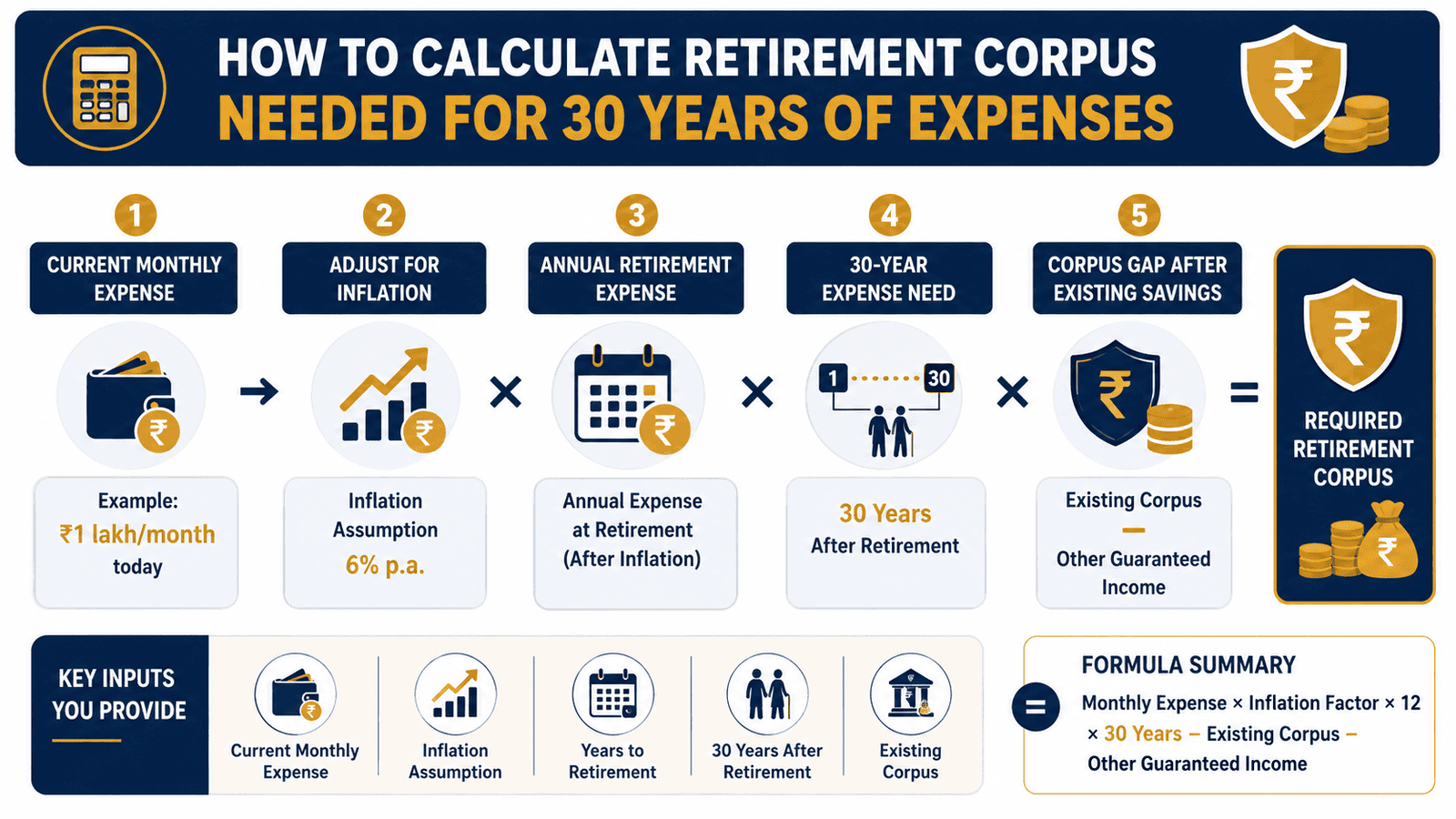
How to Calculate Your Retirement Corpus: Step by Step
This is the core of what a retirement calculator India does for you — it takes your current expenses and projects them forward using inflation and return assumptions. Here is how the calculation works, step by step.
Step 1: Start with Current Monthly Expenses
Use your actual household spending — not income, not a guess. If your family spends ₹1,00,000 per month today on rent, groceries, utilities, school fees, and discretionary spending, that is your base. If you are unsure what you actually spend, reviewing your expenses using the monthly budget method for Indian families is a good first step before running any retirement calculation.
Step 2: Adjust Expenses for Inflation Until Retirement
If you are 38 today and plan to retire at 60, you have 22 years until retirement. Your ₹1,00,000 monthly expense will not stay at ₹1,00,000. At a 6% inflation assumption, future monthly expenses at retirement can be estimated using the compound growth formula:
Future Monthly Expense = Current Monthly Expense × (1 + Inflation Rate)^Years to Retirement
= ₹1,00,000 × (1.06)^22 ≈ ₹1,00,000 × 3.60 ≈ ₹3,60,000 per month
At retirement, your household may need approximately ₹3,60,000 per month — in today’s money terms, that is the same lifestyle as ₹1,00,000 today.
Step 3: Convert to Annual Retirement Expenses
Annual Expense at Retirement = ₹3,60,000 × 12 = ₹43,20,000 per year
Step 4: Estimate Corpus for 30 Years of Retirement
The simplest approach is the present value of an annuity — how much corpus you need on Day 1 of retirement to withdraw ₹43,20,000 per year for 30 years, assuming your corpus earns a post-retirement return (say 7%) while you withdraw from it.
Real Return = [(1 + Post-Retirement Return) ÷ (1 + Inflation During Retirement)] − 1
= [(1.07) ÷ (1.06)] − 1 ≈ 0.94% real return per year
Corpus Needed ≈ Annual Expense ÷ Real Return × [1 − (1 + Real Return)^(−N)]
≈ ₹43,20,000 ÷ 0.0094 × [1 − (1.0094)^(−30)] ≈ ₹11.5 crore (approximate)
This is an illustration using specific assumptions. Changing the inflation rate to 5% or the post-retirement return to 8% will shift this number meaningfully — which is why assumptions matter far more than the formula itself.
Step 5: Subtract Existing Retirement Assets
Your EPF balance, NPS corpus, mutual fund investments earmarked for retirement, and any property rental income already work toward this target. If your existing retirement corpus is, say, ₹30 lakh today and expected to grow to ₹2.2 crore by retirement at the same return rate, your remaining gap is approximately ₹9.3 crore — the amount you still need to build.
| Step | What You Calculate | Example Output |
|---|---|---|
| 1 — Current expense | Actual household monthly spend | ₹1,00,000/month |
| 2 — Inflation-adjusted expense | Future monthly need at retirement | ₹3,60,000/month at 6% for 22 yrs |
| 3 — Annual retirement expense | Annual spend in retirement year 1 | ₹43,20,000/year |
| 4 — Corpus needed | Lump sum required at retirement | ≈₹11.5 crore (7% return, 6% inflation) |
| 5 — Corpus gap | After subtracting existing savings | Varies by current assets |
Key Takeaways
- ₹1 lakh/month in today’s money may require ₹3.5–₹4 lakh/month by retirement at 60 if inflation runs at 6% for 22 years — the corpus need is not ₹1.2 crore but potentially ₹10–₹12 crore under common assumptions.
- The two inputs that drive your number the most are current monthly expenses and inflation assumption — not your income or your desired corpus figure.
- Existing EPF, NPS, long-term mutual funds, and rental income reduce the gap — but only if they are liquid and accessible at retirement.
- A shorter retirement duration of 20 years vs 30 years can reduce the corpus requirement by 25–30% under the same return and inflation assumptions.
- Unrealistic return assumptions — assuming 12–15% post-retirement returns — make the corpus look smaller than it actually needs to be; use 6–8% for post-retirement planning.
- Every five years of delay in starting retirement savings can roughly double the monthly amount you need to invest to reach the same corpus target.
- A retirement corpus calculator is a planning estimate — not a guarantee or a financial plan.
Key Facts at a Glance
| Input | Meaning | Why It Matters |
|---|---|---|
| Current monthly expense | What your household spends today | Base for all future projections — small errors compound over 20+ years |
| Years left to retirement | How long your corpus has to grow | More years = more compounding = lower monthly savings needed |
| Retirement duration | How many years post-retirement | 30 years needs ~25–30% more corpus than 20 years under similar assumptions |
| Inflation assumption | Rate at which expenses grow | Changing from 5% to 6% can increase required corpus by ₹1–₹2 crore |
| Post-retirement return | What your corpus earns while you withdraw | Higher return = smaller corpus needed, but higher risk post-retirement |
| Existing retirement corpus | EPF, NPS, MFs earmarked for retirement | Reduces the gap — but check liquidity and tax treatment before counting |
Why Expenses Drive Your Retirement Number More Than Income
Most people think retirement planning is about saving a percentage of their salary. It is not. The correct anchor is your expense level — because that is what your corpus must replace. Your salary stops at retirement; your expenses do not.
How Inflation Changes Your Future Expense Needs
India’s consumer price inflation has historically ranged between 4% and 7% depending on the period and basket of goods measured. According to RBI data at rbi.org.in, CPI inflation has been a persistent planning variable for Indian households. For retirement planning, most planners use a 5–6% inflation assumption for general household expenses, and a higher figure — often 8–10% — for medical costs specifically.
To understand how inflation silently erodes your purchasing power over time, the article on how inflation reduces your money value in India explains this clearly with everyday examples.
The practical implication: if you plan on ₹1,00,000/month at today’s prices, your retirement budget in 22 years at 6% inflation is roughly ₹3,60,000/month. If inflation runs at 7%, that number becomes approximately ₹4,74,000/month. The difference between a 6% and 7% inflation assumption — just one percentage point — changes your monthly retirement budget by over ₹1,14,000. Over 30 years of retirement, that is a difference of several crore rupees in corpus.
Real Return Matters More Than Headline Return
When your retirement corpus is invested in FDs, debt mutual funds, or a balanced portfolio, the return your corpus earns post-retirement needs to be compared against the inflation rate — not evaluated in isolation. If your corpus earns 8% post-retirement but inflation is 6%, your real return is approximately 1.9%. This is what actually extends your corpus over 30 years.
If someone assumes 12% post-retirement returns — which is aggressive for a retirement-phase portfolio — the required corpus looks significantly smaller on paper. But a 70-year-old’s portfolio cannot carry the same equity risk as a 30-year-old’s. Conservative post-retirement return assumptions of 6–8% are more realistic for most Indian households.
Health Costs and Family Responsibilities Need a Buffer
Retirement expenses in India frequently include costs that working-age budgets do not carry at the same level: medical treatment, hospitalisation, long-term medication, and in many households, financial support to adult children or ageing parents. These are not optional line items. A retirement corpus calculation that uses today’s household budget without a margin for health inflation will underestimate the need. Many planners add 15–20% above the base expense estimate as a health and contingency buffer.
Real Example: Amit, 38, Pune — ₹1 Lakh Monthly Expenses
Amit is a 38-year-old IT manager in Pune earning ₹24 lakh per year. His household spends ₹1,00,000 per month — rent, groceries, EMIs, school fees, and discretionary. He plans to retire at 60, which gives him 22 years to build his corpus. He wants to estimate what corpus he needs to fund 30 years of retirement. To understand what assets he already has working toward this, the article on how to calculate your real net worth is a helpful starting point.
Assumptions used: 6% pre-retirement inflation, 7% post-retirement return, 6% inflation during retirement, 30-year retirement duration.
Step 1: Current monthly expense = ₹1,00,000. Annual = ₹12,00,000.
Step 2: Inflation-adjusted monthly expense at 60 = ₹1,00,000 × (1.06)^22 ≈ ₹3,60,354. Annual = ₹43,24,248.
Step 3: Real return post-retirement = (1.07 ÷ 1.06) − 1 ≈ 0.943% per year.
Step 4: Corpus needed at retirement ≈ ₹43,24,248 ÷ 0.00943 × [1 − (1.00943)^(−30)] ≈ ₹11.5 crore (approximate).
Step 5: Amit currently has ₹15 lakh in EPF and ₹5 lakh in NPS — a combined ₹20 lakh today. Assuming this grows at 8% over 22 years: ₹20,00,000 × (1.08)^22 ≈ ₹1,07,00,000 (approximately ₹1.07 crore). Amit’s remaining corpus gap is approximately ₹11.5 − ₹1.07 crore = ₹10.4 crore.
Key insight: Amit cannot simply count years and multiply. His ₹1 lakh monthly expense becomes a ₹3.6 lakh monthly need at retirement — and that requires a corpus nearly 12 times his current annual income.
Comparison: Corpus Needed Under Different Scenarios
| Scenario | Assumptions | Approximate Corpus Needed at Retirement |
|---|---|---|
| ₹50,000/month, retire at 60, 20-yr retirement | 6% inflation, 7% return, 22 yrs to retire | ≈ ₹4.3 crore |
| ₹50,000/month, retire at 60, 30-yr retirement | 6% inflation, 7% return, 22 yrs to retire | ≈ ₹5.75 crore |
| ₹1,00,000/month, retire at 60, 20-yr retirement | 6% inflation, 7% return, 22 yrs to retire | ≈ ₹8.6 crore |
| ₹1,00,000/month, retire at 60, 30-yr retirement | 6% inflation, 7% return, 22 yrs to retire | ≈ ₹11.5 crore |
| ₹2,00,000/month, retire at 60, 30-yr retirement | 6% inflation, 7% return, 22 yrs to retire | ≈ ₹23 crore |
| ₹1,00,000/month, retire at 60, 30-yr retirement | 5% inflation, 8% return, 22 yrs to retire | ≈ ₹9.2 crore |
Note: All figures are illustrative estimates based on stated assumptions. Actual corpus needs will vary. This table is not a financial plan or a guarantee of any outcome.
How to Decide What’s Right for You
you have 20+ years to retirement — THEN start with a conservative 6% inflation and 7% post-retirement return assumption; you can refine later, but starting too optimistic is the costlier error.
you have existing EPF, NPS, or mutual fund investments earmarked for retirement — THEN subtract their projected value at retirement from your corpus target; but first check their liquidity and any tax implications on withdrawal.
your household has significant healthcare needs or you plan to support family members post-retirement — THEN add 15–20% to your base expense figure before calculating; do not rely on the base household budget alone.
your income has recently increased — THEN run the retirement calculator again; a ₹20,000/month salary hike invested immediately can reduce your corpus gap by ₹50–₹80 lakh over 20 years at moderate return assumptions.
you have a pension (government job) or rental income that will continue post-retirement — THEN treat these as income streams that reduce your corpus drawdown; convert them to a lump sum equivalent and subtract from the target.
you have not yet built a 6-month emergency fund — THEN prioritise that before increasing retirement investments; the article on emergency fund vs investment explains why retirement investing without a safety net creates a different kind of financial risk.
you are not able to estimate your actual household expenses with reasonable accuracy — THEN do not run a retirement calculator yet; a number built on a guess produces a plan built on a guess. Track expenses for two months first.
Common Mistakes to Avoid
Using Income Instead of Expenses as the Base
The retirement calculator needs your spending number, not your salary. Using ₹24 lakh annual income as the base instead of ₹12 lakh annual expenses can double the calculated corpus requirement — or worse, using income makes the calculation meaningless because income includes taxes and savings that stop at retirement.
Use your actual household outflow each month. Salary is irrelevant to this calculation.
Ignoring Inflation Completely
Assuming ₹1,00,000/month today means ₹1,00,000/month at retirement is the single most common and costliest planning error. At 6% inflation over 22 years, that ₹1 lakh becomes a ₹3.6 lakh need. Under-planning by a factor of 3 leads to a corpus shortfall in the very early years of retirement.
Always run your retirement calculation with an inflation assumption — even if you use a conservative 5%.
Using Unrealistic Post-Retirement Return Assumptions
Assuming 12–15% post-retirement returns makes the corpus look smaller and more achievable. But a retired household cannot afford the volatility of a 100% equity portfolio. If the market drops 40% in year two of retirement and you are drawing ₹43 lakh per year, the damage is severe and permanent.
Use 6–8% for post-retirement planning. Build scenarios at both ends.
Counting Your Emergency Fund as Retirement Corpus
An emergency fund covers 3–6 months of expenses and must stay liquid in a savings account or liquid fund. It is not retirement savings. Merging these two creates a false sense of corpus adequacy and leaves you exposed to both short-term shocks and long-term shortfalls.
Keep emergency savings and retirement savings in separate buckets — literally separate accounts.
Ignoring Medical Inflation
Medical costs in India have historically inflated faster than general CPI. Hospital treatment, diagnostics, and chronic medication costs can consume ₹3–₹8 lakh per year in the later decades of retirement for many urban households. Ignoring this or using general inflation for medical costs will leave your corpus dangerously underfunded after age 75.
Add a dedicated health buffer or assume 8–10% medical inflation separately.
Assuming Children Will Fund Your Retirement
This is a deeply embedded assumption in many Indian families — that children will support parents financially. Even where children intend to, migration, job changes, and their own financial obligations make this unreliable as a planning pillar. Treating children’s future support as a corpus substitute is a risk that cannot be modelled or guaranteed.
Build your retirement corpus as if no external support is available. Any support that does arrive is a bonus.
Not Updating the Calculation After Major Life Changes
A retirement number calculated at 35 is probably not accurate at 45. Salary hikes, children’s education costs coming off, a house purchase, or an inheritance all shift your inputs. Running the calculator once and forgetting it is almost as bad as not running it at all.
Recalculate at least once every two to three years, or after any major income or expense event.
When This May Not Be the Right Choice
A standard retirement corpus calculator works well for salaried employees with predictable expenses and regular investment capacity. It may be insufficient in several specific situations:
If you have irregular income — freelance, business, or commission-based earnings — the year-on-year investment amount cannot be modelled cleanly using standard calculator inputs. A qualified financial planner can build a more robust scenario.
If you carry significant debt close to retirement — a large home loan EMI running into your late 50s, for example — the calculator’s expense figure will change materially once the EMI ends. This requires a two-phase model, not a single calculation.
If you have dependents with long-term care needs, such as a child with disability or an elderly parent requiring permanent support, standard retirement models do not capture these costs adequately. These require dedicated financial modelling.
If your net worth is heavily concentrated in illiquid real estate, the calculator may show a large total asset base that cannot actually fund retirement withdrawals when needed. Liquidity matters as much as absolute corpus size.
If any of these apply to your situation, it may be worth exploring alternatives before committing.
Official Rules and Where to Verify
Retirement planning in India involves several regulated schemes and instruments. Rules, limits, and rates on this topic can change with each Budget or regulatory update. Always verify current figures directly from the official source before making any financial decision.
- EPFO (epfindia.gov.in) — For EPF contribution rates, withdrawal rules, UAN-based balance queries, and EPS pension information.
- PFRDA (pfrda.org.in) — For NPS contribution rules, tier-1 and tier-2 details, annuity purchase requirements, and pension fund regulatory context.
- SEBI (sebi.gov.in) — For mutual fund regulations, registered investment adviser requirements, and investor protection guidelines relevant to retirement savings instruments.
- Income Tax Department (incometax.gov.in) — For tax treatment of EPF withdrawals, NPS partial and full withdrawal taxation, Section 80C and 80CCD deduction limits, and retirement income taxation.
- RBI (rbi.org.in) — For inflation data, fixed deposit regulatory context, and broader macroeconomic context relevant to return assumptions.
Expert Tips
- Start the calculation with your actual monthly expenses — not a round number you feel comfortable with. The discomfort of seeing the real corpus requirement is the point: it shows you how much time pressure you are actually under.
- Run at least two scenarios: one conservative (5% return gap between post-retirement return and inflation) and one moderate (2–3% real return). The gap between outcomes shows you your planning risk.
- Every time your salary increases, direct at least 30–50% of the take-home increment toward retirement savings before it gets absorbed into lifestyle costs. The power of compounding is most effective when applied consistently over decades — a ₹5,000/month increase in SIP at 38 can add ₹60–₹80 lakh to your retirement corpus by 60 at 10–12% assumed returns.
- Keep your retirement corpus investment separate from your general wealth. A dedicated retirement portfolio — EPF, NPS, and a long-term equity mutual fund SIP earmarked explicitly for retirement — prevents you from raiding it for car loans or renovations.
- Do not use your retirement corpus calculation to decide investment products. Use it only to determine the target number and monthly investment required. Product selection — equity funds, debt funds, NPS, EPF — is a separate decision that depends on your risk profile and time horizon. SEBI guidelines at sebi.gov.in govern registered investment advisers who can help with product-level decisions.
- Revisit the calculation every year in March, when you have your full year’s income and expense picture and can make rational top-up decisions before the financial year closes.
Frequently Asked Questions
How much retirement corpus is needed for ₹1 lakh monthly expenses?
There is no single answer — it depends on inflation, retirement duration, and post-retirement return assumptions. As an illustration: if you retire at 60 with ₹1 lakh/month in today’s money, that expense inflates to approximately ₹3.6 lakh/month at 6% inflation over 22 years. To fund 30 years of such expenses at a 7% post-retirement return with 6% inflation, the required corpus is approximately ₹11–₹12 crore under these specific assumptions. Change the assumptions and the number changes. This is why a calculator is a tool, not a fixed answer.
Is planning for 30 years of retirement enough?
It depends on when you retire and how long you live. If you retire at 60 and live to 90, you need exactly 30 years. If you live to 95, you need 35. Most financial planners in India now recommend planning for at least 25–30 years to reduce the risk of outliving your corpus. Planning for 30 years at a conservative real return assumption is a reasonable baseline for most people.
Should EPF and NPS be included in retirement corpus calculations?
Yes — they are legitimate retirement assets and should be included in Step 5 (corpus gap calculation). According to EPFO guidelines at epfindia.gov.in, EPF balances are available for withdrawal at retirement. NPS rules at pfrda.org.in govern when and how much of the NPS corpus can be withdrawn as a lump sum versus annuity. Both are retirement assets but have different liquidity and tax rules. Count them, but understand the rules before treating them as freely available cash.
What inflation rate should I use for retirement planning?
There is no officially mandated rate — it is an assumption. Most Indian financial planners use 5–6% for general household expenses and 8–10% for medical expenses. RBI’s CPI inflation data at rbi.org.in provides historical context. Using a rate below 5% for long-term planning is considered optimistic; using above 7% for general expenses may overstate the need but provides a safety buffer.
Is the safe withdrawal rate concept reliable for Indian retirees?
The “4% safe withdrawal rate” was developed in the US context and is not directly applicable to Indian retirees. India has higher inflation, different fixed income yields, and most retirees rely more on fixed deposits and debt instruments than equity-heavy portfolios. For Indian household planning, a 3–4% real withdrawal rate (i.e., withdrawal rate adjusted for inflation) with conservative assumptions is more commonly used. No withdrawal rate is guaranteed — it depends on market conditions and actual returns over the retirement period.
Can I use a retirement calculator if I have a pension?
Yes. Convert the pension into its equivalent annual income and subtract it from your estimated annual retirement expense. The remaining gap is what your personal corpus must fund. For government employees with defined pension entitlements, the corpus needed from personal savings is correspondingly lower. EPFO’s EPS scheme provides a pension component to eligible members — check epfindia.gov.in for current eligibility and benefit rules.
What happens if my expenses change significantly after retirement?
A retirement calculator assumes expenses follow a predictable inflation path. In reality, expenses often drop in the early retirement years (no commuting, no EMIs, reduced school costs) and rise again in later years (medical, nursing, care costs). A phase-based model — lower expenses from 60–70, normal from 70–80, higher medical from 80 onward — is more accurate but also more complex. Run a simple calculator first to get the baseline, then adjust for phases if the numbers warrant it.
How do I account for rental income in retirement corpus planning?
Treat rental income as a regular income stream that reduces your annual corpus drawdown. If your property generates ₹25,000/month in retirement, that is ₹3 lakh/year you do not need to draw from the corpus. Convert this to a lump sum equivalent by dividing by a conservative withdrawal rate (e.g., ₹3,00,000 ÷ 0.04 = ₹75 lakh equivalent) and subtract from the required corpus — or simply subtract ₹3 lakh from the annual retirement expense before running the calculation. Both methods are approximations; the second is simpler and sufficiently accurate for planning.
Is a retirement calculator useful if I am already 50?
Absolutely — perhaps more urgently than at 38. With 10 years to retirement, you have less compounding time but more clarity on your actual expenses and existing assets. Run the calculator with conservative assumptions to understand your gap. The required monthly investment may be higher, but you also likely have a higher income and lower family obligations (school fees reducing, loans ending) that free up investable surplus. Starting at 50 is not ideal, but it is far better than not starting at all.
How often should I recalculate my retirement corpus target?
At minimum, recalculate every two to three years or after any major life event: salary hike, house purchase completion, child’s education costs starting or ending, medical diagnosis, or significant change in family structure. A retirement corpus number calculated in 2020 is probably not accurate in 2025 — your expenses, income, and asset values have all changed.
Final Verdict
A retirement calculator India guide is most useful when you treat it as a planning compass, not a financial GPS. The number it produces is an estimate — built on assumptions about inflation, returns, expenses, and retirement duration that will change over the years. What the calculation does reliably is show you the direction and scale of your planning need. For most Indian salaried families, the retirement corpus required is significantly larger than intuition suggests — because inflation over 20–25 years multiplies today’s expenses by 3 to 5 times. Start with honest expense data, use conservative assumptions, count your existing EPF and NPS balances but understand their liquidity rules, and recalculate regularly. If your situation involves complex income, large debts, or dependents with long-term needs, the calculation is a starting point — not a substitute for professional advice. Always verify the latest rules from official sources or consult a qualified professional before making any financial decision.
This article is for educational purposes only and should not be treated as personalised financial, tax, investment, insurance, or legal advice. Tax rules, interest rates, regulatory limits, and product features can change with each Budget or policy update. Please verify current rules from official government sources or consult a qualified and registered professional before making any financial decision.

Sanya Malhotra writes about everyday personal finance for Indian individuals and families. Her content focuses on budgeting, saving, emergency funds, debt control, net worth tracking, family money decisions, and practical habits that help readers manage money with more confidence.
She covers topics such as monthly budgeting, expense planning, saving habits, emergency fund behaviour, debt repayment, household financial planning, family discussions about money, financial mistakes, net worth tracking, short-term vs long-term goals, and beginner personal finance concepts.
Sanya’s writing style is warm, simple, and realistic. She avoids making personal finance feel intimidating and instead explains money decisions through relatable Indian examples, ₹ budgets, checklists, and step-by-step frameworks. Her articles are useful for students, freshers, couples, parents, and families who want to improve daily money habits. Her content is educational and does not provide personalised financial advice. Readers should adapt examples to their own income, family responsibilities, city, debt level, risk comfort, and financial goals.