

Most Indian families own gold in some form — jewellery locked in a cabinet, coins bought on Dhanteras, or a digital unit sitting in a demat account. But when it comes to deliberately investing in gold as part of a portfolio, the decision between gold ETF vs SGB vs physical gold is genuinely confusing. All three give you exposure to gold prices. They differ completely on costs, tax, liquidity, safety, and whether you can actually wear or gift the gold at the end. Getting this comparison wrong before you invest can mean losing ₹10,000–₹20,000 in upfront charges you never recover, or locking yourself into an 8-year instrument when you need money in two years.
This guide breaks down all three options specifically for Indian investors — covering returns, tax treatment, costs, practical suitability, and the exact rules you need to verify before acting. Gold prices can rise or fall. Rates, tax rules, SGB availability, GST, and ETF costs must be confirmed from official sources before you invest.
Quick Answer: Gold ETF vs SGB vs Physical Gold
Gold ETF vs SGB vs physical gold depends on liquidity, holding period and purpose. Gold ETFs suit demat-based liquidity, SGBs suit long-term investors because they offer 2.5% annual interest and an 8-year maturity, while physical gold is better mainly for jewellery, gifting or personal use. Use this rule: ETF for liquidity, SGB for long-term holding, physical gold for actual use. SGB interest rate and maturity rules must be verified at rbi.org.in before investing. Physical gold typically attracts 3% GST and making charges that reduce your effective return significantly.
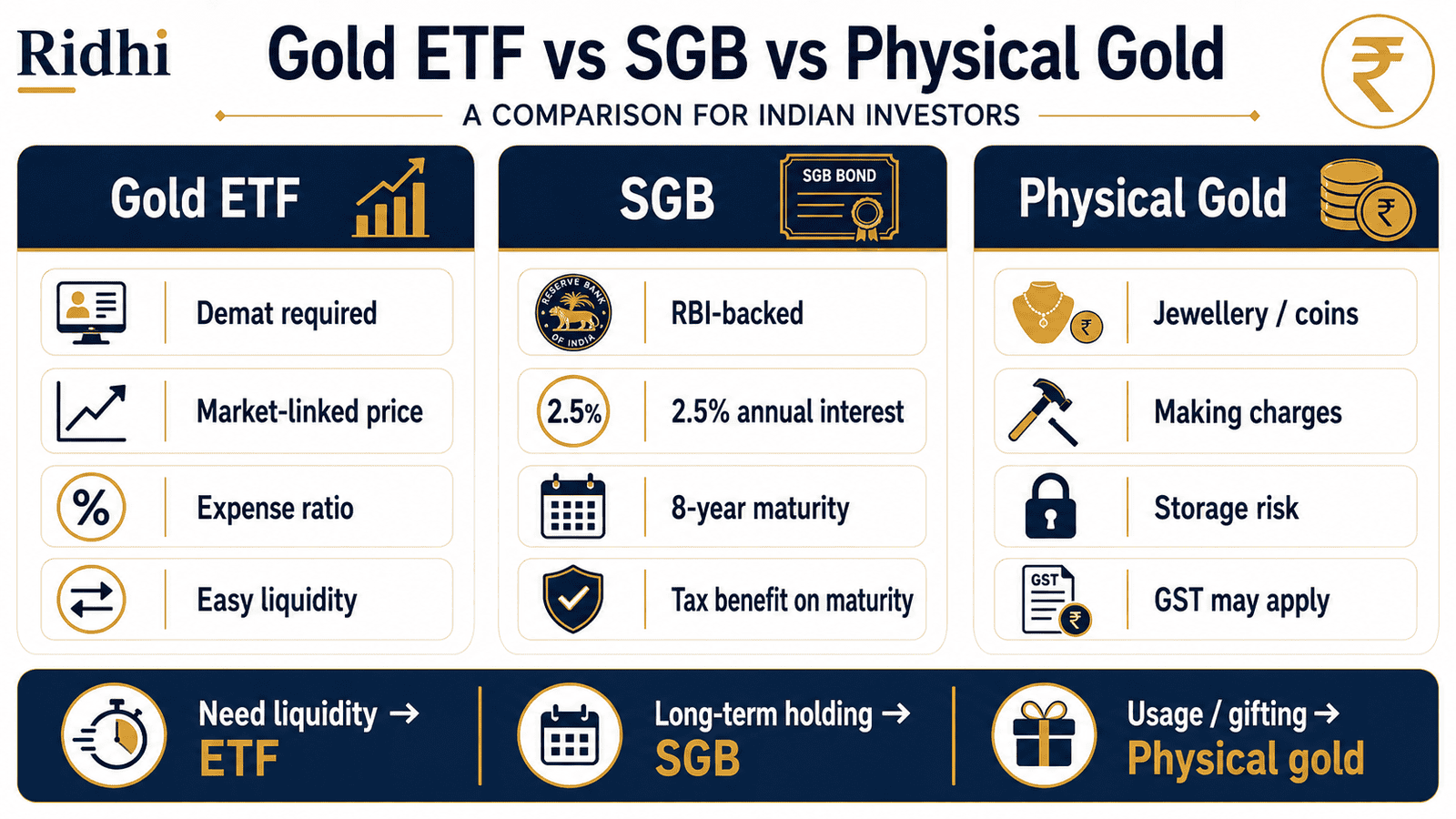
Key Takeaways
- Gold ETFs trade on stock exchanges like shares — you need a demat and trading account, can buy or sell on any trading day, and pay an annual expense ratio that compounds over time.
- Sovereign Gold Bonds are RBI-issued government securities that pay 2.5% annual interest on the issue price and carry an 8-year maturity; capital gains at maturity may be exempt from capital gains tax — verify current rules at rbi.org.in and incometax.gov.in before investing.
- Physical gold (jewellery, coins, bars) attracts 3% GST on purchase and often making charges of 10–25% of gold value — charges you do not recover on resale, making it the least efficient option for pure investment purposes.
- For a ₹1,00,000 physical gold purchase with 15% making charges, you need the gold price to rise by roughly 18% before you break even — without accounting for storage costs or resale deductions.
- Tax treatment for Gold ETF and physical gold capital gains changes with Budget updates — always verify current short-term and long-term capital gains rules from incometax.gov.in before buying or selling.
- None of the three options replaces an emergency fund or a diversified portfolio — gold is a hedge and an allocation tool, not a primary wealth-building strategy.
Comparison: Gold ETF vs SGB vs Physical Gold
The two tables below compare all three options across investment characteristics and practical ownership factors. Read both before making a decision.
Investment Characteristics: Gold ETF vs Sovereign Gold Bond
| Feature | Gold ETF | Sovereign Gold Bond |
|---|---|---|
| Best for | Short to medium-term; demat-comfortable investors | Long-term investors who can hold 8 years |
| Structure | SEBI-regulated exchange-traded fund tracking gold price | RBI-issued government security linked to gold price |
| Liquidity | High — sell on exchange any trading day | Medium — secondary market or wait for maturity/premature redemption |
| Lock-in / Maturity | No lock-in | 8-year maturity; premature redemption possible from year 5 on RBI-specified interest dates |
| Interest Income | None | 2.5% p.a. on issue price, paid semi-annually — taxable as income at your slab rate |
| Ongoing Cost | Expense ratio (approx. 0.5%–1% p.a. depending on fund) plus brokerage | No ongoing charges |
| Capital Gains Tax | STCG or LTCG as per holding period and current tax rules — verify at incometax.gov.in | Potentially exempt at maturity; taxable if sold in secondary market before maturity — verify at incometax.gov.in |
| Demat Required | Yes — mandatory for most fund houses | No — can hold as certificate; demat optional |
| Minimum Investment | 1 unit ≈ price of 1 gram gold (market-linked) | 1 gram gold at RBI issue price (maximum 4 kg per financial year for individuals) |
| Issuer Safety | SEBI-regulated fund house; gold price risk remains | RBI and Government of India backing |
Practical Ownership: Physical Gold vs Digital Gold Options
| Feature | Physical Gold | Gold ETF / SGB |
|---|---|---|
| Best for | Jewellery, gifting, rituals, personal possession, family occasions | Portfolio investment and gold price exposure |
| GST on Purchase | 3% GST applies | Not applicable |
| Making Charges | 10%–25% of gold value (varies by jeweller, design, and city) | Not applicable |
| Purity Risk | Varies — BIS hallmark is essential for resale value; non-hallmarked gold may be discounted | No purity risk — electronic holding |
| Storage | Home (theft/loss risk) or bank locker (annual charges apply) | Electronic — no storage cost |
| Resale Ease | Medium — deductions likely; depends on jeweller and purity certificate | Easy — exchange for ETF; RBI redemption or secondary market for SGB |
| Physical Possession | Yes — can be worn, gifted, and used in ceremonies | No — electronic units only |
Before choosing a Gold ETF, read how expense ratio eats into your mutual fund and ETF returns — the same logic applies to every Gold ETF you evaluate.
Key Facts at a Glance
| Option | Key Fact to Know | Verify At |
|---|---|---|
| Gold ETF | SEBI-regulated fund; 1 unit ≈ 1 gram gold price; expense ratio varies by fund house; capital gains tax applies on sale | sebi.gov.in; fund house scheme document |
| Sovereign Gold Bond | RBI-issued; 2.5% p.a. interest on issue price; 8-year maturity; capital gains may be exempt at maturity; interest is taxable income | rbi.org.in; incometax.gov.in |
| Physical Gold | 3% GST + making charges on purchase; BIS hallmark critical for resale; storage risk; capital gains tax on sale | incometax.gov.in; bis.gov.in for hallmarking |
| Capital Gains (ETF and Physical) | STCG and LTCG rates and holding periods may have changed — always verify current rules before selling | incometax.gov.in |
How Each Option Actually Works
What Is a Gold ETF?
A Gold ETF is a mutual fund that issues units backed by physical gold held in custody — but you never see or touch that gold. Each unit represents approximately 1 gram of 99.5% purity gold. The units trade on NSE and BSE like shares, so you can buy or sell during market hours at the prevailing market price. To invest in a Gold ETF, you need a demat account and a trading account with a registered stockbroker.
The price of a Gold ETF unit tracks the domestic gold price closely — but not perfectly. Two concepts matter here: the Net Asset Value (NAV) is the per-unit value of the fund’s gold holdings calculated at the end of each day, and the market price is what you actually pay when you buy on the exchange. There is often a small gap called the tracking difference or bid-ask spread. Understanding what NAV means and what it tells you helps you evaluate whether a Gold ETF is trading at a fair price. Every Gold ETF also charges an expense ratio — an annual percentage of your investment deducted from the fund’s assets. Over 5–10 years, even a 0.5% annual drag compounds into a meaningful reduction in effective returns. Learn more about how mutual funds work before you invest in any fund-based gold product.
What Is a Sovereign Gold Bond?
A Sovereign Gold Bond is a government security issued by the Reserve Bank of India on behalf of the Government of India. It is denominated in grams of gold — so if you buy 10 grams worth of SGB, your investment value moves with the price of 10 grams of domestic gold. On top of gold price returns, you also receive 2.5% interest per year on the issue price, paid semi-annually directly to your bank account. This interest is taxable as income under your applicable slab rate.
The SGB has an 8-year maturity period. At maturity, you receive the prevailing gold price for your holdings in cash — no physical gold is delivered. According to RBI guidelines, capital gains arising on redemption at maturity may be exempt from capital gains tax for individual investors, which is a significant advantage over other gold formats. Premature redemption is allowed from the 5th year onward on RBI-specified interest payment dates. SGBs are issued in specific subscription windows — they are not always available for purchase. You can also buy and sell SGBs on the secondary market through exchanges, but liquidity there is limited.
What Is Physical Gold?
Physical gold covers jewellery bought from jewellers, gold coins and bars from banks or dealers, and bullion purchased from licensed dealers. It is the only format that gives you actual possession — you can wear it, gift it, store it, or use it in family ceremonies. That tangibility comes at a steep financial cost for investment purposes. Every physical gold purchase attracts 3% GST. Jewellery also carries making charges — typically 10–25% of the gold value, depending on the jeweller, the design complexity, and your city. These costs are permanent: a jeweller buying back your gold will not pay you those making charges back.
Purity is another concern. For investment-grade physical gold, BIS hallmarking (Bureau of Indian Standards) is essential — non-hallmarked gold often fetches lower resale prices or is outright rejected. Storage adds ongoing cost: a bank locker charges ₹1,500–₹5,000 or more per year depending on the bank and locker size. Capital gains tax applies when you sell physical gold, and the applicable rates depend on your holding period — check current rules from incometax.gov.in before selling.
Real Example: The Sharma Family’s ₹2 Lakh Gold Decision
Rohit, 34, senior software engineer in Bengaluru earning ₹24 lakh per year, and Priya, 32, a schoolteacher, want to allocate ₹2 lakh to gold. They have three routes.
Route 1 — Gold ETF: Rohit already has a demat account. He buys 26 units of a Gold ETF at approximately ₹7,700 per unit (market price varies). No GST. No making charges. He can sell any day the market is open. Cost: expense ratio of roughly 0.5% p.a. — about ₹1,000 in year one. Highly flexible.
Route 2 — SGB: Priya prefers SGB because of the interest income and RBI backing. They invest ₹2 lakh in the next available subscription window at the RBI issue price. They receive approximately ₹5,000 in interest income over the year (2.5% of ₹2,00,000). They cannot exit freely — they plan to hold to maturity for the potential capital gains tax benefit.
Route 3 — Physical Gold Coins: Rohit’s mother wants gold coins for gifting at an upcoming wedding. They spend ₹2 lakh on hallmarked coins. After 3% GST (₹6,000) and the bank’s coin premium (approximately 5%), the effective purchase cost is closer to ₹2,16,000 worth of gold value at spot price. The coins serve their family purpose — but as a portfolio investment, the entry cost is a real drag.
The takeaway: all three routes reach the same gold price exposure, but the family’s purpose — investment versus gifting — determines which one makes financial sense. This example is illustrative, not financial advice.
How to Calculate Gold Investment Costs
Physical Gold Effective Cost = Purchase Amount + 3% GST + Making Charges (% of gold value)
Using a ₹1,00,000 investment as the base, here is how the upfront and ongoing cost picture differs across the three options:
| Cost Item | Physical Gold | Gold ETF |
|---|---|---|
| GST on purchase | ₹3,000 (3% — verify at cbic.gov.in) | Nil |
| Making charges (jewellery; 15% example) | ₹15,000 (rate varies widely) | Nil |
| Year 1 expense ratio (~0.5% example) | Nil | ₹500 (verify at fund document) |
| Interest income received | Nil | Nil |
| Break-even price rise needed | ~18% (to recover GST + making charges) | ~0.5% per year (expense ratio only) |
For the SGB route, a ₹1,00,000 investment at 2.5% p.a. earns ₹2,500 in year one as interest income — partially offsetting any price stagnation. Over 8 years, cumulative interest on ₹1,00,000 would be ₹20,000 at 2.5% p.a. on the issue price, before accounting for gold price movement and taxation. Note that all rates, charges, and tax treatment above must be verified from official sources before investing. Actual returns depend on gold price movement, holding period, and applicable tax rules at the time of sale.
How to Decide What’s Right for You
you want to buy and sell gold flexibly, already have or can open a demat account, and do not need physical possession — a Gold ETF may suit you. Consider opening one if you don’t have a demat account yet: here is a step-by-step guide to opening a demat account in India.
you can commit to an 8-year holding period, want RBI-backed security, and prefer earning interest on your gold allocation alongside price returns — an SGB may be the most efficient digital gold option for you.
you need gold for a wedding, family occasion, gifting, or religious ceremony — physical gold is the appropriate format. Just do not treat the making charges and GST as an investment cost you will recover.
you are investing for a 3–5 year goal and do not know your exit date precisely — a Gold ETF offers more flexibility than an SGB, which ties you to specific exit windows.
you are in the 30% tax slab, can hold SGB to maturity, and are concerned about capital gains tax — an SGB may be worth the illiquidity if the capital gains exemption at maturity remains in force. Verify this rule from incometax.gov.in before acting on it.
you cannot commit capital for 8 years, need emergency-access liquidity, or plan to exit before year 5 — do not choose SGB as your primary gold allocation. The secondary market for SGBs has limited liquidity and may require selling at a discount.
Common Mistakes to Avoid
Treating Jewellery as an Investment
Jewellery is not a financial investment — it is a purchase with personal value. Making charges of 10–25% are non-recoverable on resale: a jeweller buying back ₹1 lakh worth of jewellery will typically deduct those charges, the GST, and a purity adjustment before offering you a price. Buying jewellery expecting portfolio-level returns is almost always a disappointment.
Buy jewellery when you need jewellery. Invest in Gold ETF or SGB when you want gold exposure.
Choosing SGB When You Need Money in 1–3 Years
SGB has an 8-year maturity. Premature redemption is only possible from year 5 onward, on specific RBI-designated interest payment dates. If you choose SGB with money you may need in 2 years, your only exit before year 5 is the secondary market — where spreads can be wide and volumes thin. You may not get the price you expect.
If your horizon is under 5 years, a Gold ETF gives you far more flexibility.
Ignoring the Gold ETF Expense Ratio
A 0.5% annual expense ratio looks small. Over 10 years on ₹2 lakh, the compounding cost drag can meaningfully erode your effective gold return. Different Gold ETFs charge different expense ratios — check the Scheme Information Document before investing, and compare fund houses. Some ETFs also have wider bid-ask spreads on the exchange, adding a hidden transaction cost.
Assuming All Gold Has the Same Tax Treatment
It does not. SGB interest is taxable as income. SGB maturity gains may be capital-gains exempt — but secondary-market SGB gains are not. Gold ETF and physical gold gains are taxable under capital gains rules that depend on holding period. The 2024 Union Budget changed some of these rules — always verify current treatment from incometax.gov.in before you sell.
Missing SGB Subscription Windows
RBI does not issue SGBs continuously. Subscription windows open periodically — typically a few times a year — and close within a few days. If you miss the window, your only option is the secondary market, where SGBs often trade at a premium or discount to NAV. Monitor rbi.org.in for upcoming issue dates.
Over-Allocating to Gold
Gold is a hedge and a store of value — not a return-generating engine like equities over long periods. Putting a disproportionate share of your portfolio into gold (in any form) risks underperforming inflation-beating assets. Gold should complement a diversified portfolio, not replace it. Mutual fund investments are subject to market risks. Past performance does not guarantee future returns.
When This May Not Be the Right Choice
You need emergency money: Gold is not an emergency fund — gold prices can fall sharply, and physical gold and SGBs cannot be liquidated instantly without friction. Keep your emergency fund in a liquid instrument, not in gold.
Your goal is short-term (under 2 years): Both SGBs and physical gold have significant entry and exit costs that require a longer holding period to overcome. Even Gold ETF returns over very short periods are volatile and unpredictable.
You are already heavily allocated to gold jewellery: Many Indian families unknowingly hold 30–50% of their net worth in family jewellery. Adding more gold to a portfolio that already skews heavily toward the asset makes limited diversification sense.
You have high-interest debt: A 12–18% personal loan or credit card outstanding costs more in interest than gold is likely to return. Paying down high-cost debt typically creates more financial security than buying gold.
If any of these apply to your situation, it may be worth exploring alternatives before committing.
Official Rules and Where to Verify
Gold investment rules, tax rates, SGB availability, GST on physical gold, and ETF regulations all change — sometimes with each Union Budget or RBI notification. Before you invest, verify current rules directly from these official sources:
- RBI — rbi.org.in: Sovereign Gold Bond scheme details, current and upcoming issue windows, issue price, interest rate, redemption rules, premature exit conditions, and maturity guidelines.
- SEBI — sebi.gov.in: Gold ETF regulatory framework, fund house disclosures, and investor protection rules. Also check each fund’s Scheme Information Document for expense ratios and tracking error.
- Income Tax Department — incometax.gov.in: Capital gains tax on Gold ETF, physical gold, and SGB secondary-market transactions; interest income treatment; short-term and long-term holding period definitions. See also our guide on STCG, LTCG, and STT explained for Indian investors.
- Bureau of Indian Standards — bis.gov.in: Hallmarking rules for physical gold — important for resale value verification.
Rules, limits, and rates on this topic can change with each Budget or regulatory update. Always verify current figures directly from the official source before making any financial decision.
Expert Tips
- Match the gold format to your actual goal. ETF for liquidity and portfolio flexibility, SGB for long-term holding with interest income, physical gold for personal and family use. Mixing purposes leads to expensive mistakes — such as buying jewellery expecting investment returns.
- Check SGB exit rules before buying, not after you need money. Read the RBI notification for the specific tranche: note the maturity date, premature redemption dates from year 5, and secondary-market liquidity. Do not assume you can exit freely when you need to.
- Compare Gold ETF expense ratios across fund houses before investing. A difference of even 0.3% p.a. in expense ratio becomes meaningful over 10 years. Some AMCs offer Gold ETFs with lower expense ratios than others — check current figures in the scheme documents at amfiindia.com and the fund house’s website.
- Always buy BIS-hallmarked physical gold. Non-hallmarked gold is difficult to resell at a fair price. Insist on a proper invoice showing purity, weight, making charges, and GST breakdown — this document is essential for capital gains tax computation later.
- Think of gold as an inflation hedge, not a return generator. Over long periods, gold broadly tracks inflation. Families who use it as a diversifier and wealth-preservation tool — not a primary return source — tend to allocate to it more rationally. Read more about how inflation reduces your money’s value over time and where gold fits in that picture.
- Do not invest in gold before building your emergency fund. Gold, in any form, is not a substitute for liquid emergency savings. Establish 3–6 months of expenses in a liquid instrument first — then consider your gold allocation.
- Avoid unregulated digital gold platforms as a substitute for Gold ETFs or SGBs. Some apps offer digital gold that is not regulated by SEBI or backed by RBI. Gold ETFs and SGBs operate under clear regulatory frameworks — prefer these for investment purposes.
Frequently Asked Questions
Is SGB better than Gold ETF?
For long-term investors who can hold for 8 years, SGB may be better because it adds 2.5% annual interest income on top of gold price returns and may offer a capital gains tax exemption at maturity — both advantages that Gold ETFs do not offer. For investors who need liquidity, a shorter horizon, or the ability to exit on any day, Gold ETF is more practical. The right answer depends on your holding period and liquidity needs, not on a universal ranking. Verify current SGB interest rates and tax rules from rbi.org.in and incometax.gov.in.
Is Gold ETF safe in India?
Gold ETFs are regulated by SEBI, and the underlying physical gold is held in custody by approved custodians. The fund-house risk is mitigated by regulation, but gold price risk remains fully — if gold prices fall, your ETF value falls. You can check fund-house disclosures and custodian details in each scheme’s information document at sebi.gov.in or the fund house’s website.
Can I sell my SGB before the 8-year maturity?
Yes, in two ways. From the 5th year onward, you can submit a premature redemption request on RBI-specified interest payment dates — RBI pays you the prevailing gold price at redemption. You can also sell your SGB on the secondary market (NSE or BSE) any time, but secondary-market liquidity for SGBs is limited and you may get a price below the current gold NAV. Check the specific tranche rules at rbi.org.in before investing.
Do Gold ETFs pay any interest or dividend?
No. Gold ETFs give you pure gold price exposure — there is no interest income or dividend. Your return comes entirely from the appreciation (or depreciation) in gold prices, minus the fund’s expense ratio. This is a key difference from SGBs, which pay 2.5% annual interest on the issue price regardless of gold price movement.
Is SGB capital gains tax-free at maturity?
According to the original SGB scheme conditions, capital gains arising on redemption at maturity for individual investors are exempt from capital gains tax. This is one of the most attractive features of SGBs compared to Gold ETFs and physical gold. However, tax rules can change — always verify current treatment from incometax.gov.in or consult a qualified tax professional before making this a key part of your decision. Interest income from SGBs is taxable at your slab rate regardless.
Is jewellery a good investment?
For most investors, no — not as a financial investment. Jewellery carries making charges of 10–25% and 3% GST on purchase. On resale, a jeweller typically deducts these costs plus any purity or wear-related adjustments, meaning you often recover only the scrap gold value. If you are buying jewellery for personal use, occasions, or family tradition, that is a perfectly valid reason — just do not expect portfolio-level returns from it. For gold as a portfolio tool, Gold ETF or SGB is more cost-efficient. Check the meaning of NAV to understand how ETF pricing is calculated before making the comparison.
Which gold option is better for a 1-year holding period?
For just 1 year, Gold ETF is the most practical option — no lock-in, no GST, low entry cost, and easy exit on the exchange. SGB is unsuitable for a 1-year horizon because you cannot exit freely until year 5. Physical gold is unsuitable because GST and making charges would take years to recover through gold price appreciation.
Which gold option is better for an 8-year holding period?
For an 8-year horizon, SGB is generally the most efficient option if you can hold to maturity — you receive 2.5% annual interest, no expense ratio drag, and a potential capital gains tax exemption at maturity. Gold ETF is also viable over 8 years but accumulates expense ratio costs and does not pay interest. Verify current SGB interest rates and tax rules from rbi.org.in and incometax.gov.in before investing, as these rules may have changed.
What is the minimum investment in a Sovereign Gold Bond?
The minimum investment in an SGB is 1 gram of gold, priced at the RBI’s issue price for that tranche. For individual investors, the maximum is 4 kilograms per financial year. SGB units can be purchased through scheduled commercial banks, Stock Holding Corporation of India (SHCIL), designated post offices, and stock exchanges. Check rbi.org.in for current subscription windows and issue prices.
What happens if the gold price falls after I buy an SGB?
Your SGB value at maturity is linked to the prevailing gold price on the redemption date — if gold prices have fallen over 8 years, you will receive less than your principal in terms of gold price value (though the 2.5% annual interest partially cushions the loss). This is the same gold price risk that applies to Gold ETFs and physical gold as investments. Gold is not a capital-protected instrument in any of its forms.
Final Verdict
For pure long-term gold exposure, SGB may be the most efficient option available to Indian investors — if you can hold for 8 years, the combination of gold price return, 2.5% annual interest, and potential capital gains exemption at maturity is difficult to match. Verify current rules before acting, as these benefits depend on tax rules staying in place. For liquidity, demat convenience, and a flexible exit, Gold ETF is the better choice — just factor in the expense ratio over your holding period. Physical gold has an important and legitimate role in Indian family life — for jewellery, gifting, rituals, and personal possession — but it is the least efficient option for pure investment purposes, given GST, making charges, storage costs, and resale friction. Buy the gold format that matches your use case, not just the one with the highest headline benefit. Mutual fund investments are subject to market risks. Past performance does not guarantee future returns. Always verify the latest rules from official sources or consult a qualified professional before making any financial decision.
This article is for educational purposes only and should not be treated as personalised financial, tax, investment, insurance, or legal advice. Tax rules, interest rates, regulatory limits, and product features can change with each Budget or policy update. Please verify current rules from official government sources or consult a qualified and registered professional before making any financial decision.

Arjun Kapoor writes about mutual funds, SIPs, ELSS, fund categories, investment returns, and beginner investing concepts for Indian readers. His focus is on education, not product promotion or fund recommendations. He helps readers understand how mutual funds work before they start investing or comparing schemes.
He covers topics such as mutual fund meaning, SIP meaning, SIP calculator, direct mutual funds vs regular plans, NAV, ELSS tax-saving funds, CAGR, absolute returns, XIRR, expense ratio, large cap vs mid cap vs small cap funds, flexi cap funds, index funds vs active funds, liquid funds, debt mutual funds, SIP pause vs SIP stop, lumpsum vs SIP, and how to start SIP in India.
Arjun’s writing is simple, risk-aware, and long-term oriented. He avoids guaranteed-return language and explains investment concepts using examples, timelines, and comparison tables. His articles remind readers that mutual fund investments are subject to market risks, and past performance does not guarantee future returns. Readers should verify scheme details from SEBI, AMFI, fund houses, and official scheme documents.