

If you save ₹5,000 every month in a recurring deposit, how much will you actually receive at the end of two years? That is exactly what an RD calculator India tool is built to answer — and it takes less than a minute. A recurring deposit is a disciplined, low-risk savings product offered by banks and the post office where you deposit a fixed amount every month and receive a lump sum at maturity. The maturity amount depends on your monthly instalment, the tenure, the interest rate, and how frequently the bank compounds interest. Rates and product terms are not fixed forever — they change with market conditions and regulatory updates, so any calculator result is an estimate until you confirm the current rate with your bank. For a broader view of how deposits work, the banking savings guide covers the full deposit savings landscape in plain language.
Quick Answer: RD Calculator India
RD calculator India helps estimate the maturity amount of a recurring deposit by using your monthly deposit, tenure, interest rate, and compounding frequency. For example, ₹5,000 per month for 24 months at the bank’s current RD rate will show total deposit, interest earned, and estimated maturity value. Always verify the current rate directly with your bank or post office before treating any calculator result as a confirmed return.
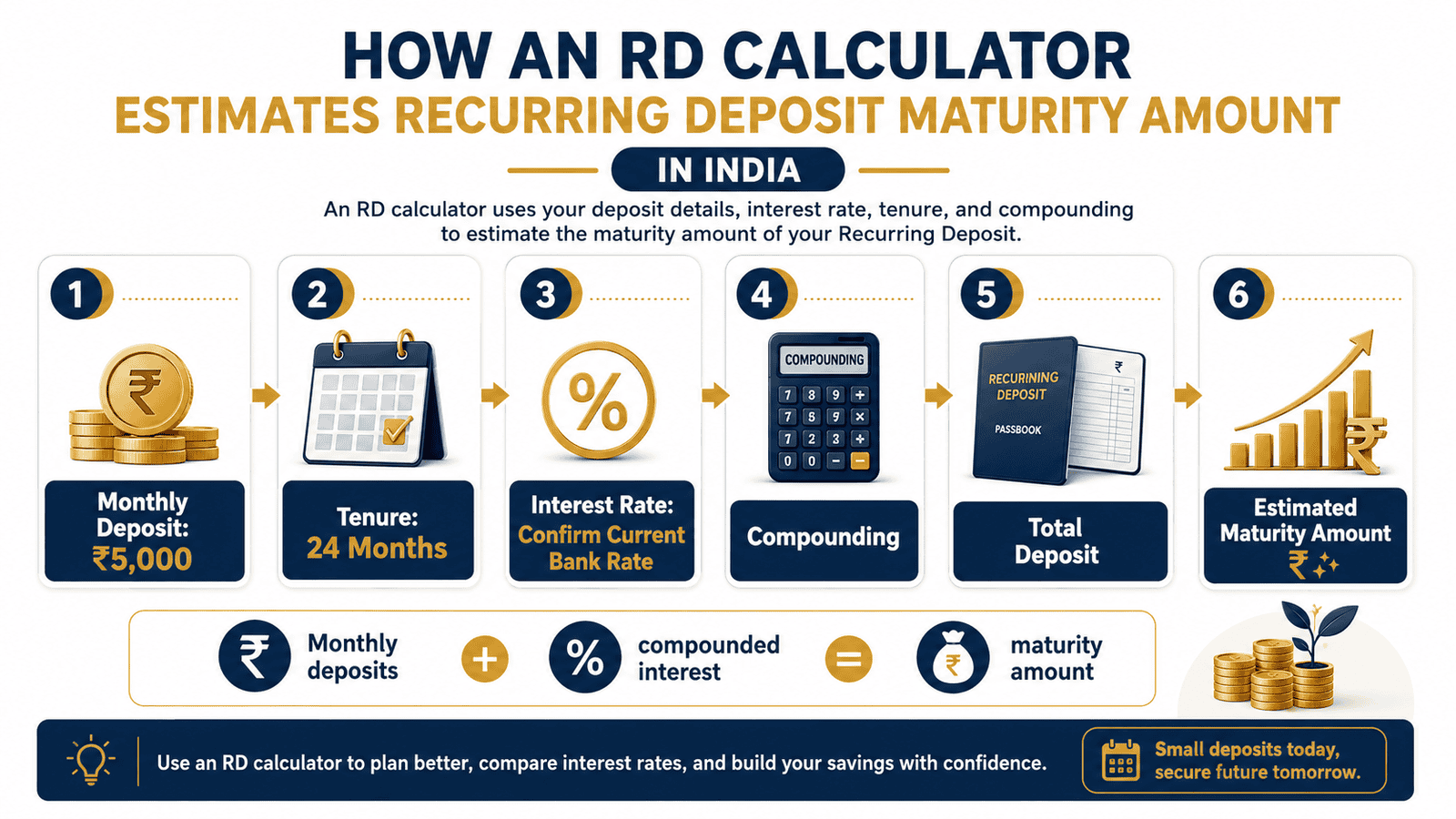
How to Calculate RD Maturity Amount
Most bank RDs in India use quarterly compounding — interest is calculated and added four times a year rather than at the end of tenure. The formula used by most bank and online RD calculators is:
M = R × [(1+i)^n − 1] ÷ [1 − (1+i)^(−1/3)]
What each variable means:
- M — Estimated maturity amount (₹)
- R — Monthly instalment (₹)
- i — Quarterly interest rate = Annual rate ÷ 400
- n — Number of quarters = Tenure in months ÷ 3
Step-by-step walkthrough — ₹5,000/month, 24 months, 6% p.a. (illustrative rate only — verify current rate with your bank before making any decision):
- Quarterly rate: i = 6 ÷ 400 = 0.015
- Number of quarters: n = 24 ÷ 3 = 8
- (1 + 0.015)^8 ≈ 1.1265
- Numerator: 1.1265 − 1 = 0.1265
- Denominator: 1 − (1.015)^(−1/3) ≈ 0.00497
- M = 5,000 × (0.1265 ÷ 0.00497) ≈ ₹1,27,200
At this illustrative rate, total deposits = ₹1,20,000 and estimated interest earned = approximately ₹7,200. Your actual figure will depend on the verified rate you lock in at account opening and your bank’s specific formula implementation. Compounding frequency can also vary by provider — always confirm before you use a calculator result for planning.
| Scenario | Key Inputs | Estimated Result |
|---|---|---|
| Base scenario | ₹5,000/month, 24 months, 6% p.a. | ~₹1,27,200 maturity |
| Longer tenure | ₹5,000/month, 36 months, 6% p.a. | ~₹1,95,500 maturity |
| Higher deposit | ₹10,000/month, 24 months, 6% p.a. | ~₹2,54,400 maturity |
All figures above use an illustrative 6% p.a. rate for comparison only. Verify current rates from your bank before making any investment decision.
Key Takeaways
- An RD calculator estimates — it does not guarantee — your maturity amount. The only confirmed figure is what your bank puts on the maturity certificate at account opening.
- At an illustrative 6% p.a., depositing ₹5,000 monthly for 24 months produces approximately ₹1,27,200 — against ₹1,20,000 in total deposits. The interest advantage grows with a longer tenure.
- Each monthly instalment earns interest for a different duration: your first ₹5,000 earns for the full 24 months; your last instalment earns for just one month. This is why total interest is lower than a simple multiplication would suggest.
- RD interest is taxable as “Income from Other Sources.” TDS is deducted by the bank if your total deposit interest in a financial year crosses the applicable threshold — verify the current limit at incometax.gov.in, as it can change with each Budget.
- Missing an RD instalment attracts a penalty, and premature closure reduces the interest rate applied for the period held. Check your bank’s specific rules before committing.
- Post Office RD rates are set by the government and revised quarterly — they move independently from bank RD rates. Never use one as a proxy for the other.
- Never lock your only savings in an RD. Build an emergency fund in a liquid account first; the restricted access of an RD makes it unsuitable as a safety net.
Key Facts at a Glance
| Input / Metric | What It Covers | Key Note |
|---|---|---|
| Monthly instalment | Fixed amount deposited each month | Typically ₹100 minimum at most banks |
| Tenure | 6 months to 10 years at most banks | Post Office RD: fixed 60 months — verify current terms |
| Interest rate | Annual rate fixed at account opening | Subject to change — verify current rate before opening |
| Compounding frequency | Quarterly at most bank RDs | Confirm with your specific bank/post office |
| Maturity amount | Total deposits plus accumulated interest | Calculator gives estimate, not a binding quote |
| TDS threshold | Applied when total deposit interest exceeds annual limit | Verify current limit at incometax.gov.in — can change each Budget |
How a Recurring Deposit Actually Works
A recurring deposit is structurally different from a fixed deposit in one fundamental way: your money goes in monthly, not all at once. This means every instalment earns interest for a different length of time — and understanding this explains why the formula looks complex.
Think of it as a series of small fixed deposits stacked on top of each other. If you open a 24-month RD today, your first ₹5,000 instalment earns interest for the full 24 months. Your second instalment — paid next month — earns for 23 months. Your last instalment, paid in month 24, earns interest for just one month. The RD calculator adds up all these individual amounts and presents a single maturity value.
Why the Formula Looks the Way It Does
The denominator — [1 − (1+i)^(−1/3)] — converts a quarterly compounding formula to handle monthly contributions. Without this adjustment, the formula would overstate returns. Understanding how compound interest examples work in full will help you see why the timing of each instalment matters, particularly when comparing RD with simple interest savings products.
What Quarterly Compounding Means for Your Returns
When a bank compounds interest quarterly, it adds the interest earned in the first quarter to your running balance, and the second quarter’s interest is calculated on that higher amount. Over 12–24 months, this effect is modest — roughly a few hundred rupees on a ₹5,000/month RD. Over longer tenures, it compounds meaningfully. According to RBI guidelines (rbi.org.in), regulated banks are required to disclose their interest calculation method in the product terms — ask for it before opening the account.
Why Your Calculator Result May Differ from the Bank’s Certificate
Several factors cause a gap between an online calculator estimate and the final amount on your maturity certificate:
- Deposit date shifts: If your instalment falls on a Sunday or public holiday, the bank credits it the next working day. Even a day’s difference changes the interest slightly.
- Rate changes at renewal: If you extend the RD after maturity, the renewed tenure is priced at the rate available on that date — not the original rate.
- Missed instalment penalties: Any penalty charged for late or missed instalments reduces your final payout.
- TDS deduction: Most online calculators show pre-TDS maturity. If TDS applies to your account, the actual receipt will be lower. You can claim the TDS as a credit when filing your income tax return.
Post Office RD vs Bank RD: A Key Structural Difference
The Post Office Recurring Deposit scheme is backed by the Government of India and has a fixed tenure — currently 60 months. The interest rate is set by the Ministry of Finance and revised on a quarterly basis, independent of what banks offer. For the current post office RD rate, visit indiapost.gov.in directly. Using your bank’s RD rate to estimate post office RD returns will give you an incorrect result.
Real Example: Neha’s 24-Month RD Plan
Neha is a 29-year-old marketing executive in Bengaluru earning ₹65,000 per month. She wants to save ₹5,000 every month for two years toward a dedicated travel fund. Before opening the RD, she checks the current rate on her salary account bank’s website, notes the compounding terms, and confirms the rate is still valid at the branch on the day she opens the account.
For this illustration, assume a 6% p.a. rate — this is for comparison only and does not represent any currently available rate:
- Monthly deposit: ₹5,000
- Tenure: 24 months
- Total invested: ₹1,20,000
- Estimated interest earned: ~₹7,200 (illustrative)
- Estimated maturity value: ~₹1,27,200 (illustrative)
Neha’s bank deducts TDS only if her total annual interest income from all bank deposits exceeds the applicable threshold. According to the Income Tax Department (incometax.gov.in), bank deposit interest is taxed under “Income from Other Sources” at the individual’s applicable slab rate. Neha checks her Form 26AS at the end of the financial year to confirm whether TDS was deducted and includes any deducted amount in her tax filing. She also keeps a separate emergency fund in a liquid savings account so that the monthly RD commitment does not strain her cash flow.
Comparison: RD vs FD vs Savings Account
| Feature | Recurring Deposit (RD) | Fixed Deposit (FD) |
|---|---|---|
| How you invest | Monthly instalments | Lump sum at start |
| Best suited for | Monthly savers building a corpus incrementally | Those with idle lump-sum cash to deploy |
| Interest rate | Fixed at account opening — verify current rate | Fixed at account opening — verify current rate |
| Liquidity | Low — premature closure penalty applies | Low — premature closure penalty applies |
| TDS on interest | Yes — above applicable annual threshold | Yes — above applicable annual threshold |
| Minimum entry | ₹100/month at most banks | Usually ₹1,000 lump sum at most banks |
For a detailed explanation of how fixed deposits are structured, see fixed deposit basics. If you want to compare what a lump sum would produce instead, use the FD maturity calculator and run the same amount and tenure side by side with the RD result.
How to Decide What’s Right for You
You receive a monthly salary and want to save a fixed amount every month automatically — THEN an RD with a standing instruction linked to your salary account is a practical, low-friction option that builds savings without any manual effort.
You have a lump sum already sitting idle in a savings account — THEN an FD will typically earn more, because the full principal earns compounding interest from day one rather than being invested gradually over the tenure.
You have a goal with a specific end date — a school fee payment, a travel fund, or an appliance purchase — THEN match the RD tenure exactly to that date. Avoid opening a shorter tenure and planning to renew, as the renewal rate may be lower.
You are a senior citizen — THEN check whether your bank offers an additional rate for senior citizen RD accounts. Many banks do. Verify the current differential directly with the bank, as it is not guaranteed and can change.
Your monthly income is irregular or project-based — THEN a fixed monthly RD commitment carries real risk. A missed instalment attracts a penalty, and consecutive misses can trigger premature closure. Consider a more flexible savings option instead.
You do not yet have an emergency fund covering 3–6 months of expenses — THEN do not lock savings into an RD. Build liquid reserves first. See FD versus RD for a full comparison of both options before committing your monthly surplus.
Common Mistakes to Avoid
Treating the Calculator Maturity as a Guaranteed Amount
An RD calculator produces an estimate — not a commitment from the bank. The only confirmed figure is what appears on the maturity certificate issued when you open the account.
Online calculators use standardised formula assumptions. Your bank may apply a different day-count convention, a slightly different rounding method, or its own compounding schedule — all of which shift the final number by a small but real margin.
Always compare the calculator estimate against the bank’s own maturity certificate before making financial plans around the expected payout.
Ignoring TDS on RD Interest
If your total annual interest income from bank deposits exceeds the applicable TDS threshold, the bank deducts tax before paying you the maturity amount. Most RD calculators display pre-TDS figures.
Many first-time savers are surprised to receive less than the calculator showed — because TDS was never factored into their estimate. If your total income is below the taxable limit, submit Form 15G (or Form 15H for senior citizens) at the beginning of the financial year to avoid unnecessary deduction. Verify current eligibility rules at incometax.gov.in before submitting.
Choosing Tenure Based Only on the Highest Rate
Banks occasionally offer slightly higher rates on specific tenures — for example, 15 months or 444 days — as promotional slabs. Locking in a long or awkward tenure purely to capture a marginally better rate can be a mistake if you need the money earlier.
Premature closure typically reduces the rate applied for the period held, often by 0.5%–1% below the applicable slab — enough to erase any rate advantage. Choose tenure based on your goal date first; rate optimisation comes second.
Missing Monthly Instalments
An RD is a monthly commitment, not a flexible piggy bank. Missing an instalment attracts a penalty that varies by bank and is not regulated at a uniform rate. Multiple consecutive missed instalments at some banks can lead to forced premature closure of the account.
Set up a standing instruction from your salary account on the day after your salary is credited. This one step eliminates almost all risk of accidental misses.
Breaking an RD Early Without Checking the Penalty First
Premature closure charges are bank-specific. Some banks reduce the applicable interest rate by 0.5%–1%; others have a different penalty schedule. The impact on a ₹5,000/month, 24-month RD broken at month 18 can be a loss of several hundred rupees in interest.
Read the premature withdrawal terms at the time of account opening — before you need to use them in an emergency.
Using Bank RD Rates to Estimate Post Office RD Returns
Post Office RD rates are set by the Ministry of Finance, reviewed quarterly, and move independently from bank rates. At any given time, the two can differ meaningfully. Using your bank’s current RD rate to calculate what you might earn from a post office RD will give you an incorrect maturity estimate — potentially off by thousands of rupees over a 60-month tenure.
Always source each rate from its own official channel before comparing.
When This May Not Be the Right Choice
An RD works well for the right saver in the right situation — but it is not appropriate for everyone. Consider these scenarios carefully:
- You carry high-interest debt. If you have outstanding personal loan or credit card balances at 14%–36% interest, depositing ₹5,000/month in an RD earning roughly 6% creates a guaranteed negative spread. Clear the high-cost debt before locking money in a deposit.
- You need liquidity. An RD cannot be partially withdrawn. If your financial situation is uncertain — job transition, health expenses, irregular income — keep savings in a more accessible form until stability returns.
- You already have a lump sum. If you have ₹1,20,000 available today, an FD on the full amount will earn more than a 24-month RD with the same final corpus — because the entire principal compounds from day one. Use the FD maturity calculator to compare before choosing.
- Your goal is long-term wealth growth. RD returns are modest and fixed. For goals ten or more years away, the inflation-adjusted real return from an RD may not be sufficient — though any move toward market-linked instruments comes with a different risk profile that must be understood before investing.
If any of these apply to your situation, it may be worth exploring alternatives before committing.
Official Rules and Where to Verify
RD interest rates, TDS thresholds, compounding conventions, and post office terms are not static. They can all change with a Budget announcement, a government quarterly review, or an RBI policy update. Before opening or comparing any recurring deposit, verify current figures from these official sources:
- Your bank’s official website or branch — for current RD interest rates, tenure options, compounding frequency, missed instalment rules, and the premature closure penalty schedule.
- India Post — indiapost.gov.in — for Post Office Recurring Deposit rate, tenure, and government-backed scheme terms. The post office RD rate is reviewed quarterly.
- Income Tax Department — incometax.gov.in — for current TDS thresholds on deposit interest, Form 15G and Form 15H eligibility conditions, and how RD interest is taxed. A detailed guide is available at TDS on deposits.
- RBI — rbi.org.in — for the regulatory framework governing bank deposits, DICGC insurance coverage applicable to your deposits, and your rights as a bank customer.
Rules, limits, and rates on this topic can change with each Budget or regulatory update. Always verify current figures directly from the official source before making any financial decision.
Expert Tips
- Match tenure to your actual goal date, not the highest rate slab. If your goal is 18 months away, open an 18-month RD — not a 12-month one you plan to renew. Renewal is at the rate available on the maturity date, which may be lower than today’s rate.
- Compare total maturity amount, not just the annual rate headline. A 6.5% rate over 24 months and a 6.75% rate over 15 months produce different total interest because the compounding periods differ. Run both tenures through the calculator using your specific deposit amount before deciding.
- Set the standing instruction date to the day after your salary credit. If your salary hits on the 1st, set the RD instalment for the 2nd or 3rd. Bank holidays on the 1st can delay credit and trigger a technical missed instalment at some banks.
- Check if a senior citizen rate differential applies. Many banks offer an additional 0.25%–0.5% on RDs for senior citizens. If a family member is opening the account, verify the current rate differential at the bank directly — it is not guaranteed and must be confirmed at the time of opening.
- Submit Form 15G or 15H at the start of each financial year. If your total income is below the taxable limit, submitting these forms in April prevents the bank from deducting TDS month by month — even though you could claim a refund, avoiding the deduction upfront is simpler and frees your cash sooner.
- Build laddered RDs for flexibility. Instead of one large RD, open two or three smaller RDs with staggered maturities — say 12, 18, and 24 months. Each maturity gives you access to a portion of your savings without breaking the full corpus and incurring a penalty.
- Never count an RD as your emergency fund. Premature closure reduces the interest earned and adds a penalty. Keep three to six months of essential expenses in a liquid savings or sweep account that you can access without any cost.
Frequently Asked Questions
How is RD maturity amount calculated?
The standard formula used by most bank RD calculators is M = R × [(1+i)^n − 1] ÷ [1 − (1+i)^(−1/3)], where M is the maturity amount, R is the monthly instalment, i is the quarterly interest rate (annual rate ÷ 400), and n is the number of quarters (tenure in months ÷ 3). Each monthly instalment earns interest for a different duration — the first earns for the full tenure and the last earns for only one month. The formula handles this staggered earning in a single calculation.
Is RD interest taxable in India?
Yes. Interest earned on a recurring deposit is taxable under “Income from Other Sources” at your applicable income tax slab rate. If your total bank deposit interest in a financial year crosses the applicable TDS threshold, the bank deducts tax at source before paying the maturity amount. You can claim the deducted TDS as credit when filing your income tax return. Verify the current TDS threshold and applicable rates at incometax.gov.in, as they can change with each Budget.
Is RD better than FD?
Neither is universally better — the right choice depends on how your money is structured. If you receive a monthly salary and want to save incrementally, an RD fits naturally. If you already have a lump sum, an FD will usually produce more total interest because the full principal earns compounding returns from day one. For a detailed side-by-side comparison with worked examples, see the FD versus RD guide linked in this article.
Can I break an RD before maturity?
Yes, most banks allow premature closure of an RD. A penalty typically applies — the most common form is a reduction in the interest rate for the period held, often 0.5% to 1% below the applicable slab rate. The exact penalty is bank-specific and is not regulated at a uniform national rate. Always read your bank’s premature withdrawal terms before opening the account, particularly if there is any possibility you may need the money before the scheduled maturity date.
Does Post Office RD work differently from bank RD?
Yes, in several important ways. Post Office RD has a fixed tenure under the current scheme — verify the exact tenure at indiapost.gov.in before opening. The interest rate is set by the Ministry of Finance and revised quarterly, independent of bank RD rates. Post Office RD also allows a loan against the deposit after a qualifying period of instalments — confirm current terms at the post office or official site. Do not use bank RD rates to estimate post office RD returns.
What happens if I miss an RD instalment?
Missing a monthly instalment attracts a late fee or penalty — the specific amount is set by the bank and is not standardised. Multiple consecutive missed instalments can lead to forced premature closure of the RD at some banks, with the applicable penalty deducted from the payout. The simplest way to avoid this entirely is to set up an automatic standing instruction from your savings account on the day after your monthly salary is credited.
What is the minimum monthly deposit for an RD?
Most banks and the post office allow an RD with a minimum monthly instalment of ₹100. Some private sector and small finance banks may have higher minimums. There is typically no cap on the maximum monthly instalment. Confirm the minimum with your specific bank or post office before opening, as terms can vary.
Can I submit Form 15G or Form 15H for my RD?
Yes. If your estimated total income for the financial year is below the basic exemption limit and your total interest income is below the applicable TDS threshold, you can submit Form 15G (for individuals below 60 years) or Form 15H (for senior citizens aged 60 and above) to request that the bank not deduct TDS. These forms must be submitted at the start of each financial year — not once for all years. Verify current eligibility conditions at incometax.gov.in before submitting, as the rules are governed by the Income Tax Act and can change.
Why does my bank’s RD maturity certificate show a different amount than the calculator?
Several factors explain the difference: the bank may apply a slightly different day-count method, your instalment dates may have shifted due to holidays, or a missed instalment penalty may have been applied. The larger gap, if any, is usually TDS — online calculators typically display pre-TDS figures. Your maturity certificate from the bank is the authoritative number; treat the calculator as a planning estimate, not a precise forecast.
Final Verdict
An RD calculator India is a practical starting point for any salaried saver who wants to see what consistent monthly saving could produce over one to three years. If you earn a regular monthly income, have a specific goal with a defined timeline, and want a low-risk product with zero market exposure, an RD with a standing instruction is worth considering — it builds savings automatically without requiring any ongoing decision-making. Monthly savers benefit more from an RD than lump-sum investors do; if you already have surplus funds, compare with an FD before committing. For a detailed breakdown of when each makes more sense, the FD versus RD comparison covers the decision thoroughly. Whatever the calculator shows, the maturity amount you actually receive depends on the verified rate at account opening, whether every instalment is paid on time, and how TDS rules apply to your income. Always verify the latest rules from official sources or consult a qualified professional before making any financial decision.
This article is for educational purposes only and should not be treated as personalised financial, tax, investment, insurance, or legal advice. Tax rules, interest rates, regulatory limits, and product features can change with each Budget or policy update. Please verify current rules from official government sources or consult a qualified and registered professional before making any financial decision.

Meera Iyer writes about banking, fixed deposits, recurring deposits, savings accounts, emergency funds, senior citizen deposits, and safe cash management for Indian readers. Her work is especially useful for families, retirees, conservative savers, and beginners who want to understand where to keep short-term or low-risk money.
She covers topics such as FD meaning, FD calculator, RD calculator, FD vs RD, simple interest vs compound interest, savings account interest, sweep-in FD, premature FD withdrawal, senior citizen FD rules, TDS on FD interest, Form 15G, Form 15H, joint account rules, zero balance accounts, minimum balance charges, small finance bank FDs, post office FD vs bank FD, and emergency fund planning.
Meera’s content focuses on safety, liquidity, taxation, and practical decision-making. She avoids hype and explains both benefits and limitations of banking products. Since deposit interest rates, TDS rules, penalty charges, DICGC coverage, and bank policies can change, readers should always confirm the latest details from their bank, RBI, DICGC, India Post, or relevant official sources before making decisions.