

When you start planning health insurance for your family — spouse, child, maybe parents — one question comes up immediately: should everyone share one policy, or should each person have their own cover? The choice between individual vs family floater health insurance is more than a premium comparison. Get it wrong, and a single large hospitalisation can wipe out the shared pool, leaving the rest of the family with no cover for the remainder of the policy year.
A family floater is not always cheaper in the long run. Individual policies are not always the safer choice either. The right structure depends on your family’s age, medical history, claim probability and how much cover you actually need — not just what fits this year’s budget.
This article explains how both structures work, what each costs and risks, and exactly how to decide for your situation. Premiums, waiting periods and policy features vary significantly by insurer, age, city and underwriting rules.
Quick Answer: Individual vs Family Floater Health Insurance
Individual vs family floater health insurance depends on family age, claim risk and budget. A family floater can suit a young couple or small family because one ₹10 lakh shared cover may cost less, while individual plans are safer for parents, senior citizens or members with medical history. Policy wording, co-pay clauses, room rent limits and waiting periods must be verified before purchasing any plan. According to IRDAI, all health insurance terms must be disclosed clearly by insurers. Insurance is a subject matter of solicitation. Please read the policy document carefully before purchasing.
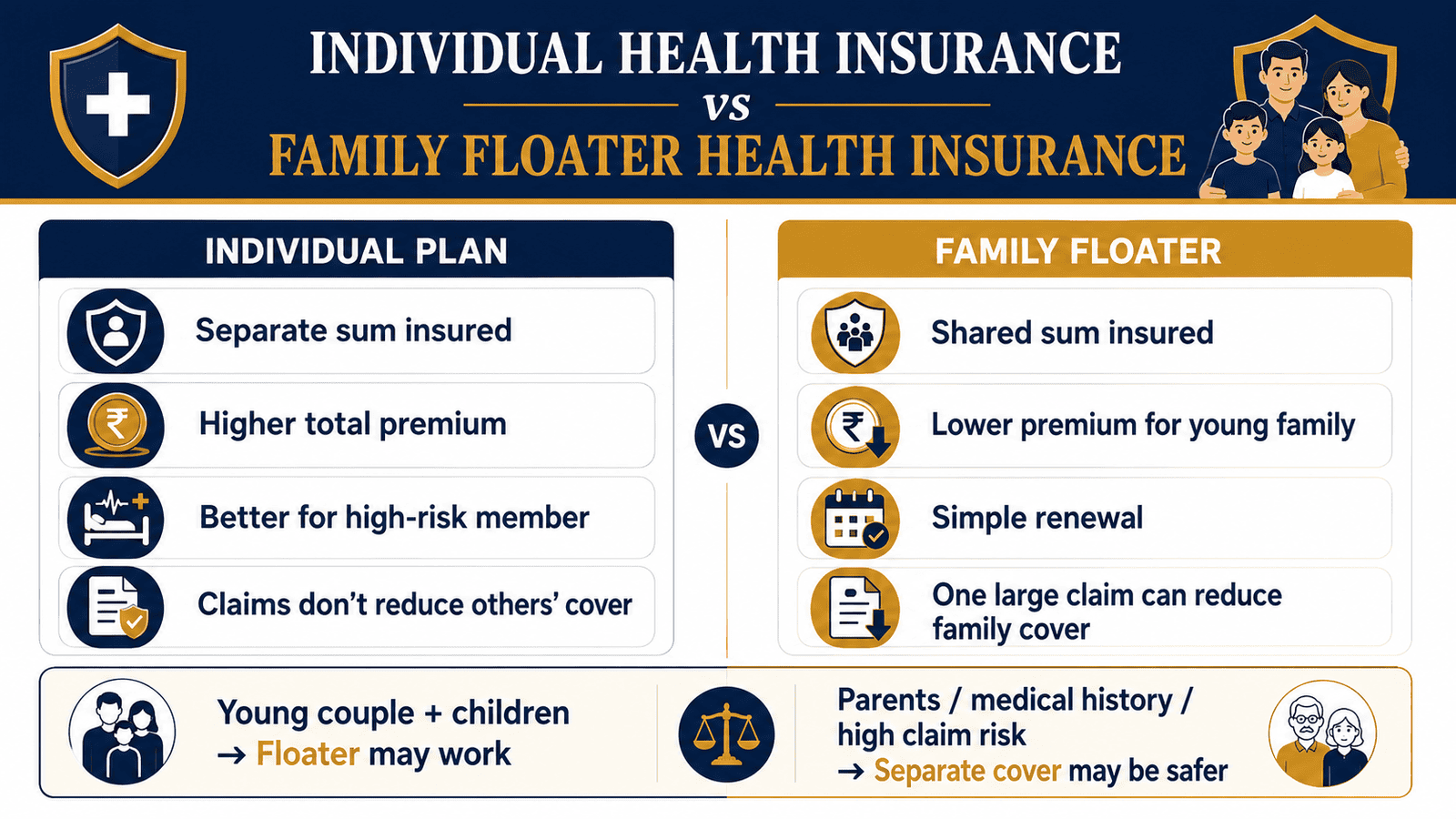
Key Takeaways
- A family floater gives one shared sum insured — say ₹10 lakh — to all covered members. One major hospitalisation can consume most or all of that pool in a single policy year.
- Individual health insurance gives each person a separate sum insured. A ₹4.5 lakh claim by your spouse does not touch your ₹5 lakh or your child’s ₹5 lakh — each cover remains independent.
- Parents and senior citizens aged 60 and above often push floater premiums into a higher age band and may trigger mandatory co-pay clauses — making separate individual evaluation important in many cases.
- A cheaper floater premium in year one can become expensive if an older member’s inclusion drives the age-band rating up sharply at renewal or attracts a 20% mandatory co-pay on every claim.
- Waiting periods for pre-existing diseases, room rent sub-limits, co-pay clauses and restore benefit conditions vary sharply by policy — these matter more than the premium headline number.
- Your employer’s group health insurance ends the day you leave the organisation or retire. It cannot substitute for a personal retail policy.
- Section 80D allows a tax deduction on premiums paid for self, family and parents — with a higher limit available if either parent is a senior citizen.
Individual vs Family Floater Health Insurance: Side-by-Side Comparison
| Parameter | Individual Health Insurance | Family Floater Health Insurance |
|---|---|---|
| Sum insured structure | Separate, dedicated sum insured per person | One shared sum insured pool for all covered members |
| Claim impact | One person’s claim does not affect other members’ cover | A large claim reduces the pool remaining for the entire family |
| Premium (indicative) | Usually higher in combined total for multiple members | May be lower for young, healthy nuclear families — varies by insurer, age and health |
| Best fit | Older adults, pre-existing conditions, high or frequent claimers | Young couples and nuclear families with low claim history and similar risk profiles |
| No-claim bonus (NCB) | Accrues independently per person | Shared — any member’s claim may reduce or reset the NCB for the whole policy |
| Adding new members | Each addition is a separate policy with its own terms | Newborns and spouses can often be added mid-term, subject to insurer conditions |
| Administration | Multiple policies, multiple renewals, multiple premium payments | Single policy, single annual premium, single renewal date |
| Parents and senior citizens | Safer — risk stays in a separate pool | Caution — raises premium for all; check mandatory co-pay before adding |
Premiums, co-pay clauses, waiting periods and policy features vary by insurer, age, city and underwriting rules. Always read the policy document before purchasing. Insurance is a subject matter of solicitation.
Key Facts at a Glance
| Fact | Individual Policy | Family Floater |
|---|---|---|
| Definition | Each insured person holds their own dedicated sum insured | All covered members share one common sum insured pool |
| Best-fit family | Older adults, high-risk members, frequent claimers | Young nuclear family — 2 adults plus young dependent children |
| Main risk | Higher combined premium when covering a large family | One major claim can exhaust cover for all members in a single policy year |
| Regulatory oversight | IRDAI — irdai.gov.in — regulates all health insurers and mandates disclosure of all terms, exclusions and waiting periods |
How Individual and Family Floater Health Insurance Actually Work
Before comparing premiums or features, it helps to understand what each structure actually does — because the mechanics are fundamentally different.
Individual Health Insurance: Dedicated Cover Per Person
An individual health insurance policy covers one person. If you buy a ₹5 lakh individual policy for yourself, a ₹5 lakh policy for your spouse and a ₹5 lakh policy for your child, each person has their own independent sum insured. A ₹4 lakh hospitalisation claim by your spouse uses ₹4 lakh from her policy. Your ₹5 lakh and your child’s ₹5 lakh remain completely untouched for the rest of the policy year.
This separation is particularly valuable when one family member is a frequent claimer — a parent with a cardiac condition, a child with a chronic illness, or any member with a known pre-existing disease. The claim risk stays contained to that individual’s pool. You can read more about basic health cover to understand what a standard health policy normally includes before comparing policy structures.
Family Floater Health Insurance: One Shared Pool
A family floater plan covers multiple members — typically the proposer, spouse and dependent children — under a single shared sum insured. If you buy a ₹10 lakh family floater, all covered members collectively draw from that ₹10 lakh in any policy year. The sum insured is not divided or allocated per person — it is a common pool available to whoever needs it first.
If your spouse is hospitalised and the bill comes to ₹7 lakh, only ₹3 lakh remains accessible to the entire family for the rest of that policy year. If you, your child or another covered member then needs hospitalisation in the same year, they can access only the residual amount — unless the policy carries a restore or reinstatement benefit, and only under the conditions that benefit specifies.
The Shared Pool in a Real Claim Year
Think of a family floater as a single water tank shared by all covered members. Every claim draws from the same tank. If one person drains most of it, the others draw from whatever is left. A restore benefit partially refills the tank — but only under specific conditions, which vary significantly across insurers and policy documents. According to IRDAI guidelines, insurers must disclose restore benefit conditions clearly. Always confirm whether the restore applies to the same illness or only a different illness, and whether it applies once or multiple times per year.
The Age-Band Premium Problem
Family floater premiums are typically rated on the age of the oldest covered member. Adding a 62-year-old parent to a young family’s floater plan can push the age band from the proposer’s mid-30s bracket to a senior citizen bracket — a significant jump in annual premium. Beyond the cost impact, many insurers impose mandatory co-pay clauses of 20% or more on all claims once the oldest member crosses 60. This co-pay generally cannot be waived, even for younger members on the same policy.
No-Claim Bonus and Its Shared Fate
In a family floater, the no-claim bonus accrues on the shared policy. One claim by any member — including a parent added to the plan — can reduce or reset the NCB for the entire policy at renewal. In individual policies, each person’s NCB moves independently. A healthy proposer who has never claimed does not lose their NCB because a parent on the same floater made a claim.
Which Structure Works for Larger or Multigenerational Families
For a household that includes senior citizens, members with pre-existing diseases or anyone with a high hospitalisation probability, a single family floater often faces structural strain. The shared pool gets diluted across higher-risk members, and the premium increases reflect the elevated combined risk. Many financial planners recommend keeping parents on separate individual policies and using a floater only for the core nuclear unit — proposer, spouse and young children — to balance cost and protection.
Real Example: Rohit’s Family Cover Decision
Rohit, 34, is a senior software engineer in Bengaluru earning ₹24 lakh per year. His wife Priya is 32, and their son Aryan is 4. Rohit is now considering whether to add his parents — aged 62 and 59 — to the family health cover.
Option A — One floater for all five: Including Rohit, Priya, Aryan and both parents under a single family floater. Because the oldest member is 62, the premium is calculated at a senior-age band. Many insurers also apply a mandatory 20% co-pay on all claims once the oldest member crosses 60. A ₹10 lakh shared cover would need to absorb claims from five members — including two elderly individuals with typical age-related health risks.
Option B — Hybrid structure: A ₹10 lakh family floater for Rohit, Priya and Aryan only — rated at Rohit’s age (34), with no mandatory co-pay. Separate individual policies for both parents, sized appropriately for their age and health status.
Now consider a real claim scenario: Rohit’s mother is hospitalised and the bill comes to ₹6.5 lakh. In Option A, only ₹3.5 lakh remains in the shared floater pool for the entire family for the rest of the year. In Option B, his mother’s claim touches only her individual policy — the family floater for Rohit, Priya and Aryan stays fully intact at ₹10 lakh.
The lesson is direct: a cheaper combined premium in year one does not mean better protection when a large claim actually arrives.
How to Calculate the Cost-vs-Cover Trade-Off
Effective cover remaining = Total sum insured − Total claims in the policy year
The table below uses illustrative figures only. These are not actual premium quotes — real premiums vary by insurer, age, city, health status and policy terms.
| Option | Structure and Indicative Annual Premium | Cover Remaining After One ₹7 Lakh Claim |
|---|---|---|
| Option A — ₹10 lakh family floater for 5 members including senior parents | Shared pool; illustrative premium ₹35,000–₹45,000/year (senior age band; indicative only) | ₹3 lakh left for all five members for the rest of the policy year |
| Option B — ₹10 lakh floater for nuclear family (3 members) + separate ₹5 lakh each for parents | Split structure; illustrative combined premium ₹38,000–₹50,000/year (indicative only) | Parents’ individual policy absorbs the claim; nuclear floater stays at ₹10 lakh untouched |
| Option C — Three separate ₹5 lakh individual covers for proposer, spouse, child | Individual pools; illustrative combined premium ₹20,000–₹28,000/year (indicative only) | The claimant’s ₹5 lakh reduces; the other two members each retain their full ₹5 lakh |
The premium difference between Option A and Option B may be modest — but the structural protection difference during a real claim year is significant. Factor in co-pay liabilities, room rent sub-limit deductions and NCB loss when comparing total annual cost over five years, not just the first-year premium.
How to Decide What’s Right for You
You, your spouse and your children are all under 45, healthy and have no significant pre-existing conditions — THEN a family floater for the nuclear unit is likely a cost-efficient starting point, provided the sum insured is adequately sized for metro hospitalisation costs.
Any covered member has a known pre-existing condition — diabetes, hypertension, heart disease, kidney issues — THEN that member should be evaluated for a separate individual policy, because their repeated claims could drain the shared floater pool across multiple policy years.
Either parent is aged 60 or above — THEN check whether the insurer applies mandatory co-pay for the entire policy once the oldest member crosses 60, compare a standalone senior citizen individual policy quote, and make an informed decision rather than defaulting to the floater for convenience.
Your base floater cover feels low relative to real hospitalisation costs in your city — THEN consider supplementing with extra medical cover through a top-up or super top-up plan, which activates beyond a deductible threshold and extends total protection at a relatively lower marginal premium.
You are comparing policies purely on year-one annual premium — THEN extend the comparison to five years, including NCB impact if a claim occurs, renewal premium increases as members age, and effective claim payout after co-pay and room rent sub-limit deductions.
Your family has two or more members with different health risk profiles — THEN a hybrid structure — floater for younger healthy members and individual policies for high-risk or older members — often balances premium efficiency and claim protection better than either structure alone.
all covered members are young and low-risk — do not stretch one family floater sum insured across a multigenerational household that includes senior citizens or chronic illness patients. The shared pool will likely be depleted in a real claim year, leaving younger healthy members with no cover for the balance of the policy period.
According to IRDAI, all health insurance plans regulated in India must disclose waiting periods, exclusions, sub-limits and co-pay clauses clearly in the policy document. Use those disclosures — not just the sales brochure — as your comparison baseline.
Common Mistakes to Avoid
Choosing Based on Premium Alone
Many buyers select the cheapest annual premium without comparing sum insured adequacy, room rent sub-limits, co-pay percentages and claim settlement quality.
A ₹10 lakh floater with a mandatory 20% co-pay means you pay ₹2 lakh out of pocket on a ₹10 lakh hospital bill. A slightly more expensive policy with no co-pay can cost significantly less in a real claim year.
Compare net claim payout scenarios across multiple hospitalisations — not just the headline annual premium.
Adding Parents to the Floater Without Checking Age-Band Impact
Including a parent aged 60 or above in a floater rated at the proposer’s mid-30s age bracket can push the premium into a much higher band immediately — in some cases doubling the renewal premium.
Some insurers also impose mandatory co-pay across the entire policy once the oldest member crosses a threshold age — meaning even the young healthy proposer bears co-pay on their claims.
Get a standalone senior citizen policy quote for parents and compare it against the floater impact in full before deciding.
Ignoring Waiting Periods for Pre-Existing Diseases
Most health policies carry a waiting period of two to four years for pre-existing diseases. Claims related to a disclosed condition — diabetes, hypertension, thyroid — will be rejected during this window.
Check the exact waiting period rules in the policy wording before purchasing. Some insurers offer a reduced waiting period as a paid add-on, but only if the condition is disclosed accurately at the proposal stage.
Ignoring Room Rent Sub-Limits
Many policies cap room rent at 1% of the sum insured per day — meaning ₹1,000 per day on a ₹1 lakh policy, or ₹10,000 per day on a ₹10 lakh policy.
If you choose a room above this limit, proportional deductions apply to the entire bill — not just the room cost. A ₹2.5 lakh surgery can have a substantial deduction applied if the room rent limit was exceeded at a private hospital.
Prefer policies with no room rent cap or with a limit sufficient for the hospitals in your city.
Assuming the Restore Benefit Fully Solves the Shared Pool Problem
Restore or reinstatement benefits replenish the sum insured after exhaustion. However, conditions vary significantly — many policies restore only for a different illness in the same year, not a recurrence of the same condition, and only once per policy year.
A restore benefit is a useful feature but not a guarantee of unlimited annual cover. Read the exact restore clause conditions before relying on it as your safety net for a shared floater.
Not Disclosing Pre-Existing Conditions at Proposal Stage
Incomplete or inaccurate disclosure at the proposal stage is one of the most common causes of claim rejection in India. Even a managed, controlled condition — stable hypertension, a past surgical procedure — must be disclosed fully.
IRDAI places the duty of disclosure squarely on the proposer. Concealment can result in claim rejection or policy cancellation — even years after the policy was purchased and premiums were paid.
Treating the First-Year Premium as the Permanent Cost
Health insurance premiums increase as members age into higher age bands at renewal. A floater bought at 34 that includes a 60-year-old parent can see material premium increases each renewal cycle.
Budget for five-year total cost — not just the introductory premium — before committing to a policy structure.
When This May Not Be the Right Choice
A family floater may not be right if your household includes parents aged 60 or above, any member with a chronic illness, or anyone with a high hospitalisation history. The shared pool faces higher drawdown risk from those members, and the floater premium is rated at the oldest member’s age — removing much of the cost advantage that makes floaters attractive for young families.
Individual policies for every family member may not be right if you have a large family of four or more adults. Combined premiums can become significant, and managing multiple renewal dates, policy documents and claim processes adds administrative complexity.
Relying solely on employer group insurance is not right for anyone who expects to change jobs, face a layoff or retire. Your employer health cover ends when employment ends — often precisely when you may face financial stress and health needs simultaneously.
A structurally correct but under-sized policy is also inadequate. A ₹3 lakh floater for a family of four in a metro city may not cover a single week of ICU hospitalisation at a private hospital. Cover adequacy matters as much as policy structure.
If any of these apply to your situation, it may be worth exploring alternatives before committing.
Official Rules and Where to Verify
Health insurance in India is regulated by the Insurance Regulatory and Development Authority of India (IRDAI). Before purchasing any policy, verify insurer registration, complaint history and all policy terms through IRDAI’s official resources.
- IRDAI — irdai.gov.in: Insurer registration list, consumer grievance portal, health insurance master circulars and policyholder protection guidelines
- Income Tax Department — incometax.gov.in: Current rules on the 80D tax benefit for health insurance premiums paid for self, spouse, children and parents — including the higher deduction limit applicable for senior citizen parents
- Confirm waiting periods, exclusions, sub-limits, co-pay obligations and restore benefit conditions directly in the insurer’s policy wording — not just the brochure, comparison website listing or agent summary
- Retain the signed proposal form, policy schedule, benefit illustration and all declarations. Accurate and complete disclosure at the proposal stage is a legal requirement under IRDAI regulations and protects your claim rights
Rules, limits, and rates on this topic can change with each Budget or regulatory update. Always verify current figures directly from the official source before making any financial decision.
Expert Tips
- Compare net claim payout scenarios before comparing annual premium. A policy with co-pay or strict room rent sub-limits can cost significantly more in a real hospitalisation than one with a slightly higher premium but fewer restrictions.
- Evaluate parents separately from spouse and children. Get a standalone senior citizen policy quote for each parent and compare it — in full — against the premium impact and co-pay consequence of adding them to your family floater.
- Check the claim settlement ratio alongside the insurer’s hospital network quality in your city and their incurred claims ratio. A high claim settlement ratio alone does not guarantee a smooth, dispute-free claim experience — the quality of the network and the insurer’s internal claims process matters equally.
- If you choose a family floater, size the sum insured to absorb at least two separate hospitalisation events in a single year — because any covered member can be hospitalised at any time, and back-to-back hospitalisations are not uncommon in multigenerational families.
- Review your policy at every renewal. A policy structure that suited a 32-year-old couple with no children may be inadequate by the time both parents are in their 60s and children have grown into adults. Risk profiles change; your cover should reflect that.
- IRDAI guarantees portability rights. If your current insurer’s terms have deteriorated, you can port to a new insurer at renewal while retaining credit for waiting periods already completed — without starting fresh waiting periods on the new policy.
- Read the exclusion list and waiting period schedule in the policy wording before signing, not after. Spending 30 minutes on this before purchase can prevent ₹2–4 lakh in disputed or rejected claims later.
Frequently Asked Questions
Is family floater better than individual health insurance?
Neither is universally better. A family floater suits young, healthy nuclear families where all members carry low claim risk. Individual policies are safer when members have different risk profiles — especially for older adults, senior citizen parents or anyone with a pre-existing condition. The right structure is the one that provides adequate, accessible cover for every covered member during a real hospitalisation year.
Should parents be included in a family floater plan?
This depends heavily on the parents’ age and health status. Including a parent aged 60 or above typically pushes the floater into a higher age band and may trigger a mandatory co-pay clause for the entire policy. In many cases, a standalone senior citizen individual policy for each parent — evaluated on its own premium, waiting periods and terms — provides better protection without affecting the premium or shared pool of the nuclear family’s floater.
What happens if one person uses the full family floater sum insured?
Once the shared sum insured is fully exhausted, all other covered members have no remaining cover under that policy for the rest of the policy year — unless the policy carries a restore or reinstatement benefit. Restore benefit conditions vary significantly: some apply only to a different illness, some apply only once per year, and some are limited to a different insured member. Read the exact restore clause before relying on it as a safety net.
Can a husband, wife and child all be covered in one family floater?
Yes. Most family floater health insurance plans in India allow the proposer, spouse and dependent children to be covered under one shared sum insured. Some plans also allow dependent parents and parents-in-law. Always check the specific eligible member list, dependent age limits and entry age restrictions in the policy you are considering.
Is an individual policy always more expensive than a family floater?
For a young nuclear family, a family floater may offer a lower combined premium than buying separate individual policies for each member. However, for a family that includes older or high-risk members, the floater’s age-band rating and co-pay clauses can make the total cost higher — especially when co-pay liabilities on every claim are included in the comparison. Always compare total out-of-pocket cost over multiple years, not just the first-year premium.
Does Section 80D apply to both individual and family floater health insurance?
Yes. Premiums paid for health insurance covering yourself, your spouse and dependent children qualify for a deduction under Section 80D of the Income Tax Act. Premiums paid for parents attract a separate, additional deduction — with a higher limit available if either parent qualifies as a senior citizen. The exact deduction limits can change with each Budget. Verify current limits at incometax.gov.in before filing your return.
Is employer health insurance enough for my family?
No, in most cases it is not sufficient as your only protection. Employer group health insurance typically ends when you leave the organisation, are laid off or retire — often with no grace period. It may also carry lower sum insured limits, restrictions on pre-existing disease coverage, and a narrower hospital network. A personal retail policy — floater or individual — is a necessary complement to any employer-provided cover, not a replacement for one.
Can I buy a top-up plan alongside a family floater?
Yes. A top-up or super top-up plan activates once your base claim exceeds a specified deductible threshold, providing additional cover at a relatively lower annual premium. This can be an efficient way to increase total family protection without significantly raising the base policy cost. Top-up plans can be structured on either an individual or a floater basis, depending on the product and insurer terms.
What is the restore benefit in a family floater and is it reliable?
A restore or reinstatement benefit replenishes the exhausted sum insured within the same policy year so that further claims can be made. Key conditions to verify: whether it restores for the same illness or only for a different one; whether it is available once or multiple times per year; and whether it applies to the same insured member or only to a different one. These conditions differ significantly across policies. Read the clause carefully — it is not a substitute for an adequately sized base sum insured.
Can I use both a family floater and individual policies together?
Yes, and many families do. A common approach is to maintain a family floater for the core nuclear unit — proposer, spouse and children — and separate individual policies for parents or high-risk members. This hybrid structure balances premium efficiency for the younger healthy members with dedicated, ring-fenced protection for those at higher hospitalisation risk.
Final Verdict
For a young, healthy nuclear family — a couple in their 30s with dependent children, no significant pre-existing conditions and a manageable claim history — a family floater is a practical and often cost-efficient way to buy personal health insurance. Sized correctly, it provides a shared pool that covers most realistic hospitalisation scenarios for a low-risk group.
For families that include senior citizen parents, members with chronic illnesses or anyone with a significant hospitalisation history, individual vs family floater health insurance is not a coin flip. A hybrid structure — floater for the nuclear unit, individual cover for high-risk members — usually provides better protection per rupee spent over a five-year horizon, especially once co-pay liabilities, NCB impacts and age-band premium increases are factored in.
There is no universal correct answer. The best structure is the one that gives every covered member adequate, accessible cover during a real claim year — not the one that looks cheapest in the first-year brochure. Always verify the latest rules from official sources or consult a qualified professional before making any financial decision.
This article is for educational purposes only and should not be treated as personalised financial, tax, investment, insurance, or legal advice. Tax rules, interest rates, regulatory limits, and product features can change with each Budget or policy update. Please verify current rules from official government sources or consult a qualified and registered professional before making any financial decision.
Insurance is a subject matter of solicitation. Please read the policy document carefully before purchasing.

Priya Nambiar writes about insurance concepts for Indian families, salaried employees, self-employed professionals, and first-time policy buyers. Her content focuses on helping readers understand coverage, exclusions, claim conditions, premiums, riders, and policy documents before buying or renewing insurance.
She covers topics such as term insurance, health insurance, family floater plans, riders, critical illness cover, employer insurance vs personal insurance, waiting periods, exclusions, deductibles, co-payment, no-claim bonus, claim settlement, premium comparison, renewal rules, and tax benefits linked to insurance.
Priya’s writing is careful, consumer-focused, and policy-document oriented. She explains why insurance should be understood as financial protection, not just a tax-saving tool or investment substitute. Her articles encourage readers to compare coverage, understand limitations, and ask better questions before buying a policy. Premiums, exclusions, claim rules, and benefits vary by insurer, age, health, sum insured, and product type. Insurance is a subject matter of solicitation, and readers should read the official policy document carefully before purchasing.