You put ₹1 lakh in a bank product. A friend puts the same amount in a different one. Same rate, same tenure — but your maturity amount is lower. The reason is almost always one thing: how interest is calculated and whether it gets added back to your principal or not.
Simple interest and compound interest are the two methods banks, NBFCs, and lenders use to calculate what you earn — or what you owe. The formulas look similar on paper, but the results diverge meaningfully over time. Before you open an FD, start an RD, compare loan offers, or use any savings calculator, understanding this difference is non-negotiable.
This article explains both methods in plain language, shows the numbers side by side using a consistent ₹1 lakh example, maps these concepts to FD, RD, savings account, and loan contexts, and flags the common mistakes that catch first-time investors off guard.
Quick Answer: Simple Interest vs Compound Interest
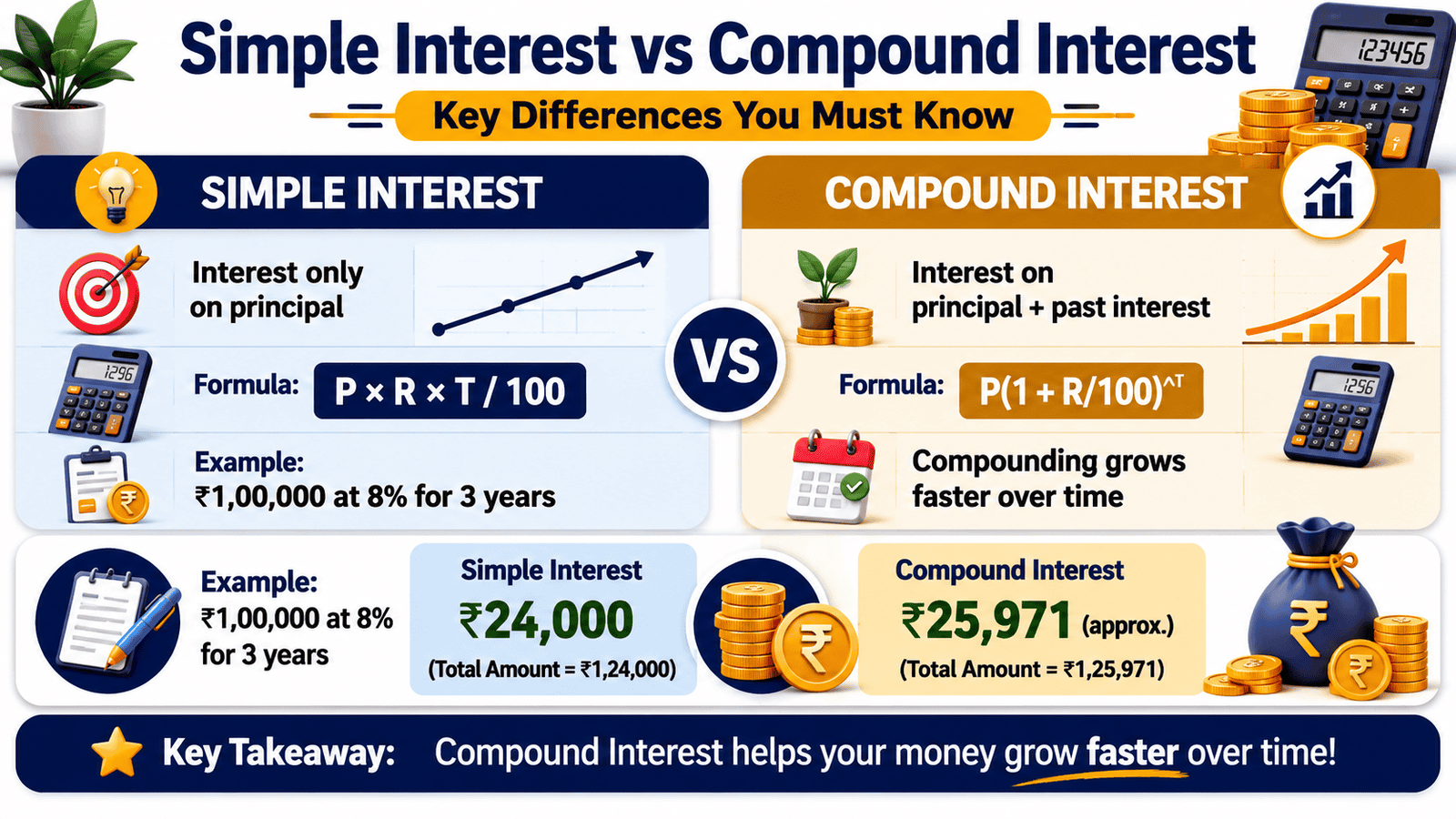
Simple interest vs compound interest compares interest calculated only on the original principal with interest calculated on principal plus accumulated interest. For example, ₹1,00,000 at 8% for 3 years earns ₹24,000 simple interest, while annual compounding gives about ₹25,971 interest. This difference grows with tenure and compounding frequency.
Key Takeaways
- Simple interest is always calculated on the original principal only — ₹1,00,000 at 8% for 3 years gives exactly ₹24,000 every time, no matter what.
- Compound interest adds earned interest back to the principal, so each period earns interest on a larger base — the same ₹1,00,000 at 8% compounded annually yields about ₹25,971 over 3 years.
- Compounding frequency is a critical variable: quarterly compounding at the same 8% annual rate produces more than annual compounding; monthly compounding produces more still.
- Most Indian FDs use quarterly compounding for cumulative (growth) options, but the exact method varies by bank — always check the product terms before comparing maturity amounts.
- For loans, if the rate is a flat rate (simple interest basis), the effective cost is much higher than it appears compared to a reducing-balance loan — the difference can be several percentage points.
- Compound interest is only powerful when interest is reinvested. If you choose a payout FD and withdraw interest every quarter, you effectively earn simple interest on your principal.
- Tenure amplifies the compounding gap: for a 1-year tenure the difference may be negligible, but over 10 years on ₹1,00,000 at 8%, compound interest adds tens of thousands of rupees more than simple interest.
Comparison: Simple Interest vs Compound Interest
| Parameter | Simple Interest | Compound Interest |
|---|---|---|
| Calculation base | Original principal only — never changes | Principal plus accumulated interest — grows each period |
| Formula | SI = P × R × T / 100 | A = P × (1 + r/n)^(n×t) |
| Growth pattern | Linear — interest amount is identical every year | Exponential — interest amount increases each period |
| Effect of tenure | Proportional — doubling tenure doubles interest | Non-proportional — doubling tenure more than doubles total interest |
| Compounding frequency | Not applicable — one flat calculation | Critical — annual, quarterly, monthly, and daily produce different maturity amounts |
| Typical Indian use case | Flat-rate personal loans, some gold loans, quick-estimate benchmarking | Cumulative FDs, RDs, savings account interest, home loan reducing balance |
| Maturity amount on ₹1,00,000 at 8% for 3 years (illustrative) | ₹1,24,000 | ₹1,25,971 (annual compounding) |
| Payout option impact | No impact — calculation is already flat | Choosing interest payout neutralises the compounding benefit |
| Complexity for the investor | Easy to calculate mentally | Requires formula or calculator for accuracy |
| Best suited for | Short tenures, flat-rate comparisons, quick estimates | Long-term savings, cumulative FD/RD, wealth-building calculations |
Key Facts at a Glance
| Term | Plain-Language Meaning | Example |
|---|---|---|
| Principal (P) | The original amount you deposit or borrow | ₹1,00,000 deposited in an FD |
| Interest rate (R or r) | The percentage of the principal charged or earned per year | 8% per annum |
| Tenure (T or t) | How long the money stays invested or the loan runs | 3 years |
| Maturity amount (A) | Principal plus all interest earned by the end of the tenure | ₹1,25,971 under annual compounding |
| Compounding frequency (n) | How many times per year interest is calculated and added back to the principal | Quarterly = 4 times a year; monthly = 12 times |
What Simple Interest and Compound Interest Actually Mean
Simple Interest: Flat, Predictable, Linear
Simple interest uses one formula: SI = P × R × T / 100. The principal (P) never changes in the calculation — you always earn the same rupee amount of interest every year. If you deposit ₹1,00,000 at 8% per annum for 3 years, the annual interest is ₹8,000 — and that stays ₹8,000 in year 2 and ₹8,000 in year 3. Total interest: ₹24,000. Maturity amount: ₹1,24,000. Simple to compute mentally, and the result is fully predictable.
In Indian banking, you will encounter simple interest most often with flat-rate loans — certain personal loans, gold loans, and some consumer finance products quote a “flat rate,” meaning the stated rate is applied to the full original principal for the full tenure. This makes the effective annual cost significantly higher than the quoted number. Always ask whether a loan rate is flat or reducing-balance before comparing.
Compound Interest: Exponential Growth Through Reinvestment
Compound interest formula: A = P × (1 + r/n)^(n×t), where A is the maturity amount, P is the principal, r is the annual rate as a decimal, n is the compounding frequency per year, and t is tenure in years. The earned interest is added to the principal at the end of each compounding period — so the next period’s interest is calculated on a larger base.
This reinvestment effect is what makes compounding powerful. The longer the tenure and the more frequent the compounding, the larger the gap versus simple interest. On ₹1,00,000 at 8%, annual compounding gives ₹1,25,971 after 3 years. Quarterly compounding (n=4) gives approximately ₹1,26,825. Monthly compounding gives approximately ₹1,27,049. The rate is identical — only the compounding frequency differs.
Where You Encounter These Concepts in Indian Banking
Understanding how FD works is essential before choosing between cumulative and non-cumulative options. Cumulative FDs reinvest interest — compound interest applies, and your maturity amount is higher. Non-cumulative or interest-payout FDs pay out interest at regular intervals, so the principal stays flat — you effectively receive simple interest on your original deposit.
Recurring deposits work differently again. Each monthly instalment is a separate deposit for a different remaining tenure, so the RD maturity formula is not a single compounding calculation — it is the sum of compound interest calculations on each instalment. This is why RD maturity values are harder to compute mentally and a calculator is essential.
Savings account interest in India is typically calculated on the daily balance and credited monthly or quarterly. This is a form of compounding, but the effect is less dramatic than an FD because the rate is lower. Savings account interest calculation follows its own methodology that differs from the standard FD formula.
According to RBI guidelines at rbi.org.in, banks are required to clearly disclose interest calculation methodology for deposits and credit products. If the information is not visible on the bank’s product page, request it in writing before investing or borrowing.
Real Example: Neha’s ₹1 Lakh — Two Methods Side by Side
Neha, 31, a project coordinator in Pune earning ₹75,000 per month, wants to understand what actually happens to ₹1,00,000 she keeps invested for 3 years. She uses an illustrative rate of 8% per annum — not tied to any current product — to compare the two methods.
Under simple interest: SI = ₹1,00,000 × 8 × 3 / 100 = ₹24,000. Maturity amount = ₹1,24,000.
Under compound interest (annual compounding):
Year 1: ₹1,00,000 × 1.08 = ₹1,08,000
Year 2: ₹1,08,000 × 1.08 = ₹1,16,640
Year 3: ₹1,16,640 × 1.08 = ₹1,25,971 (rounded)
Interest earned: ₹25,971. Maturity amount: ₹1,25,971.
The gap is ₹1,971 in favour of compound interest — modest over 3 years. But Neha runs the same numbers over 10 years: simple interest gives ₹80,000 in interest and a maturity of ₹1,80,000. Annual compound interest gives approximately ₹1,15,892 in interest and a maturity of ₹2,15,892. The gap has grown to over ₹35,000 — on the same ₹1 lakh, at the same rate. The 8% rate in this example is illustrative; check the current rates of any actual product before investing.
How to Calculate Simple and Compound Interest
Simple Interest = P × R × T / 100
Compound Interest Maturity Amount = P × (1 + r/n)^(n×t)
Where: P = Principal | R = Annual rate (%) | T = Tenure (years) | r = Annual rate as decimal | n = Compounding periods per year | t = Tenure (years)
Step-by-Step: Simple Interest on ₹1,00,000 at 8% for 3 Years
Step 1: Identify inputs — P = ₹1,00,000; R = 8; T = 3.
Step 2: Apply formula — SI = 1,00,000 × 8 × 3 / 100 = ₹24,000.
Step 3: Maturity amount = ₹1,00,000 + ₹24,000 = ₹1,24,000.
Step-by-Step: Compound Interest on ₹1,00,000 at 8% for 3 Years (Annual)
Step 1: Identify inputs — P = ₹1,00,000; r = 0.08; n = 1 (annual); t = 3.
Step 2: Apply formula — A = 1,00,000 × (1 + 0.08/1)^(1×3) = 1,00,000 × (1.08)^3 = 1,00,000 × 1.259712 = ₹1,25,971.
Step 3: Interest earned = ₹1,25,971 − ₹1,00,000 = ₹25,971.
Using a Calculator for FD and RD
For any real FD or RD, use the FD maturity calculator rather than doing the arithmetic manually — bank products often use quarterly compounding, and the numbers get unwieldy fast. Enter four inputs: principal, annual interest rate, tenure (months or years), and compounding frequency. The calculator gives you the maturity amount and interest earned instantly.
For recurring deposits, use the recurring deposit calculator — the RD formula is a sum of compound interest series for each instalment, not a single formula like FD. The monthly deposit, tenure, and compounding frequency are the key inputs.
Note that the maturity amount a calculator shows you is pre-tax. If your annual FD interest exceeds ₹40,000 (₹50,000 for senior citizens, as of recent data), TDS applies. Premature withdrawal can also change your effective return. Always factor in tax and penalty terms when comparing actual bank products.
| Scenario | Key Inputs | Result (Illustrative) |
|---|---|---|
| Simple Interest — ₹1,00,000 at 8% for 3 years | P=₹1L, R=8%, T=3 yrs | Maturity ₹1,24,000 | Interest ₹24,000 |
| Compound Interest — Annual, same inputs | P=₹1L, r=8%, n=1, t=3 yrs | Maturity ₹1,25,971 | Interest ₹25,971 |
| Compound Interest — Quarterly, same inputs | P=₹1L, r=8%, n=4, t=3 yrs | Maturity ≈₹1,26,825 | Interest ≈₹26,825 |
How to Decide What’s Right for You
You are comparing two FD options with the same stated annual rate — THEN check the compounding frequency on each product. Quarterly compounding gives a higher maturity amount than annual compounding on the same rate, and the difference widens with tenure.
You are planning to withdraw interest regularly from an FD — THEN understand that choosing the payout option means you are effectively earning simple interest on your principal, not compounding. The higher-seeming cumulative FD rate only applies when interest is reinvested.
Your investment tenure is 1 year or less — THEN the gap between simple interest and compound interest on a typical bank rate is small enough that compounding frequency matters less than the rate itself and product safety.
You are comparing a lump-sum FD against monthly RD savings — THEN use the FD and RD comparison to understand which suits your cash-flow situation, not just which earns more interest on paper.
You are evaluating a personal loan quoted at a “flat rate” — THEN convert it to an effective rate before comparing with any other loan. Flat-rate loans apply interest on the full original principal, meaning the effective annual cost is roughly double the stated flat rate for standard tenures.
You are building long-term savings over 5 years or more — THEN compounding frequency and reinvestment discipline matter significantly. The difference between annual and quarterly compounding on ₹5 lakh at 7% over 10 years runs to several thousand rupees.
You should not choose a product purely because it uses compound interest. If the compound-interest product has lower liquidity, lower DICGC safety coverage, higher premature withdrawal penalties, or is offered by an entity with a weaker regulatory standing — those factors may outweigh a marginally higher maturity amount.
Common Mistakes to Avoid
Comparing Annual Rates Without Checking Compounding Frequency
Two FDs both advertised at 7.5% per annum can produce different maturity amounts if one compounds quarterly and the other annually.
On ₹2,00,000 for 5 years at 7.5%, quarterly compounding gives a maturity of approximately ₹2,88,029 versus approximately ₹2,85,794 for annual compounding — a difference of over ₹2,200 on the same stated rate.
Always ask the bank: “What is the compounding frequency for this FD?” or look for the Effective Annual Rate (EAR) or Annual Equivalent Rate (AER) on the product page.
Confusing Interest Amount with Maturity Amount
The maturity amount is what you actually receive — principal plus all interest earned. The interest amount is only the earnings portion.
Many beginners compare “interest of ₹25,000 vs ₹24,000” and focus only on the earning difference. For a financial decision, always compare the full maturity amount — including how tax and TDS affect what you take home.
When using any calculator, note which figure is being shown — maturity amount or interest earned — before drawing conclusions.
Assuming All FDs Compound the Same Way
Different banks and NBFCs use different compounding frequencies and interest crediting cycles. Some compound quarterly, some half-yearly, and some post-office schemes use different methods entirely.
Assuming your FD works the same way as a friend’s FD from a different bank — and comparing maturity values on that basis — will give you incorrect numbers.
Check the terms and conditions of each product individually, or use the bank’s own official calculator before comparing.
Ignoring TDS on FD Interest
If your total FD interest from one bank in a financial year exceeds ₹40,000 (as of recent data; ₹50,000 for senior citizens), the bank deducts TDS at 10% (or 20% without PAN).
This reduces your post-tax return materially — a ₹26,000 gross interest becomes ₹23,400 after 10% TDS. Planning purely on the pre-tax compound interest figure without accounting for TDS will lead to a shortfall.
Use the recurring deposit calculator alongside tax planning to get a realistic picture of your net returns.
Applying the Annual Rate Directly as the Monthly Rate
An 8% annual rate is not 8% per month. The monthly equivalent is approximately 0.667% — and this must be applied to the correct compounding formula for the period.
Using 8% as the monthly rate inflates interest projections by a factor of 12, producing wildly incorrect maturity estimates that bear no resemblance to actual bank product outcomes.
Always clarify whether any quoted rate is per annum, per month, or per quarter before running calculations.
Expecting Compound Growth Even When Interest Is Paid Out
Compounding only works when the earned interest stays in the investment and earns further interest. The moment you opt for a quarterly or monthly payout FD, compounding stops applying to the interest portion.
This is not a flaw — payout options serve a genuine need for regular income. But you should not compare a cumulative FD’s maturity figure with a payout FD and treat it as an apples-to-apples comparison. They are structurally different products.
If your goal is wealth building, choose cumulative options. If your goal is regular income, choose payout and accept that the effective return will be lower.
When This May Not Be the Right Choice
Higher compounding frequency ≠ higher overall return if the product is riskier. Some small finance banks and NBFCs offer quarterly compounding at rates 1–2% above large banks. But if the product has lower liquidity, weaker credit ratings, or deposits beyond ₹5,00,000 fall outside DICGC insurance coverage, the extra interest may not compensate for the added risk.
Cumulative FDs are not ideal if you need regular income. The compound interest benefit in a cumulative FD is only realised at maturity. If you withdraw early — for any reason — the bank applies the rate applicable to the actual period held, and a premature withdrawal penalty typically reduces the rate further. You could end up with less than you expected.
For short tenures under one year, the compound vs simple interest gap is minimal. On ₹1,00,000 at 8% for 6 months, the difference between simple and quarterly compound interest is less than ₹100. Product terms, liquidity, safety, and your cash-flow needs matter far more than compounding frequency for short deposits.
Compound interest calculations do not account for inflation. A 7% compound return on your FD may result in a real return of 2–3% after accounting for inflation at 4–5% and income tax. The maturity amount will be higher, but the purchasing power of that amount may not grow as dramatically as the numbers suggest.
If any of these apply to your situation, it may be worth exploring alternatives before committing.
Official Rules and Where to Verify
Interest rates, compounding methods, TDS thresholds, and product features for FDs, RDs, and savings accounts are set by individual banks and NBFCs, not by a single central regulation. Before using any figures for financial planning, verify current terms directly from the official source.
- RBI (rbi.org.in) — Regulatory context for banking products, interest rate framework, and deposit-related guidelines.
- Your bank or NBFC’s official website — Check the product-specific FD/RD interest rate card, compounding frequency, payout options, premature withdrawal penalty, and TDS applicability. These change regularly and are not standardised across providers.
- Income Tax Department (incometax.gov.in) — For TDS thresholds on FD interest and Form 15G/15H eligibility rules.
Rules, limits, and rates on this topic can change with each Budget or regulatory update. Always verify current figures directly from the official source before making any financial decision.
For savings account interest calculation methodology, refer to savings account interest — banks calculate this on daily balance, and the crediting cycle and rate vary significantly across account types.
Expert Tips
- Compare maturity amounts, not just annual rates. Two FDs at 7.5% can produce different results depending on whether interest compounds quarterly or annually. When you compare FD options, enter all offers into a calculator and compare the final maturity value — not just the headline rate.
- Match compounding product to your time horizon. Quarterly or monthly compounding makes a meaningful difference only over longer tenures — typically 3 years or more. For a 6-month FD, focus on rate, safety, and liquidity over compounding frequency.
- Reinvestment is what makes compounding work. Opting for interest reinvestment (cumulative FD) instead of quarterly payout on ₹5,00,000 at 7% for 5 years can add approximately ₹20,000–₹25,000 to your maturity amount over the same period, at the same stated rate. Compounding is not magic — it is disciplined reinvestment.
- Use Rule of 72 only as a rough estimate. Divide 72 by your annual rate to estimate how many years it takes for your money to double: at 8%, approximately 9 years. This is a mental shortcut — not a substitute for a calculator when making an actual investment decision.
- For emergency money, liquidity beats compounding frequency. If an FD with higher compounding locks your money for 3 years with a steep premature withdrawal penalty, it is not the right vehicle for emergency funds. Keep emergency money in instruments where you can access it in 1–2 days without a penalty.
- Deepen your understanding of long-term compounding with the full explanation at power of compounding — the impact becomes even more pronounced when you add regular additional investments over time.
- Always check the effective annual rate (EAR) for loans. A personal loan at 14% flat rate has an EAR of approximately 26–28% on a 2-year tenure. When comparing loan products, ask for the reducing-balance equivalent or the APR — not just the flat rate.
Frequently Asked Questions
What is the main difference between simple and compound interest?
Simple interest is always calculated on the original principal only — the base never changes. Compound interest is calculated on the principal plus any interest already accumulated, so the base grows each compounding period. This is why compound interest produces a larger maturity amount than simple interest at the same rate, over the same tenure.
Which gives more money: simple or compound interest?
Compound interest almost always gives more money to the investor when the interest is reinvested. On ₹1,00,000 at 8% for 3 years, the difference is approximately ₹1,971 in favour of compound interest (annual compounding). Over 10 years, the gap grows to over ₹35,000 on the same principal and rate. The longer the tenure, the larger the compound interest advantage.
What is the simple interest formula?
SI = P × R × T / 100. Here, P is the principal amount, R is the annual interest rate as a percentage, and T is the tenure in years. For example, ₹50,000 at 9% for 2 years: SI = 50,000 × 9 × 2 / 100 = ₹9,000. Maturity amount = ₹59,000.
What is the compound interest formula?
A = P × (1 + r/n)^(n×t). Here, A is the maturity amount, P is the principal, r is the annual rate as a decimal (e.g., 8% = 0.08), n is the number of compounding periods per year (1 for annual, 4 for quarterly, 12 for monthly), and t is the tenure in years. Interest earned = A − P.
Does FD use simple or compound interest?
Most cumulative FDs in India use compound interest — typically compounded quarterly. This means your interest is added to the principal every three months, and the next quarter’s interest is calculated on the larger balance. Non-cumulative or interest-payout FDs distribute interest periodically, so the principal stays flat and the effective return is closer to simple interest. Check the specific product terms before investing.
What is compounding frequency and why does it matter?
Compounding frequency is how many times per year interest is calculated and added to the principal. Annual (n=1), quarterly (n=4), monthly (n=12), and daily (n=365) are the common options. More frequent compounding produces a higher maturity amount at the same stated annual rate. On ₹1,00,000 at 8% for 3 years: annual compounding gives ₹1,25,971; quarterly compounding gives approximately ₹1,26,825.
How do I calculate interest on ₹1 lakh?
For simple interest at 8% for 3 years: SI = 1,00,000 × 8 × 3 / 100 = ₹24,000. Maturity = ₹1,24,000. For compound interest (annual) at the same rate and tenure: A = 1,00,000 × (1.08)^3 = ₹1,25,971. For the most accurate FD or RD calculation with any bank’s current rate, use a dedicated calculator and verify the rate directly with the bank.
Is compound interest always better than simple interest?
For investments where interest is reinvested, yes — compound interest produces a higher maturity amount. But “better” depends on the full picture. If you opt for a payout FD and withdraw interest regularly, compounding does not apply. If the compound-interest product has higher risk, lower liquidity, or steep premature withdrawal penalties, the higher stated return may not translate into a better actual outcome for your situation.
Can I use a simple interest calculation to estimate FD returns?
You can use it as a rough lower bound, but it will understate the actual maturity amount for cumulative FDs that compound quarterly. For a 1-year FD, the difference is small. For a 3-year or 5-year FD, the simple interest estimate can be off by several thousand rupees. Use an FD calculator for accurate projections.
What happens if I withdraw an FD before maturity?
Premature withdrawal typically results in the bank applying a lower interest rate — usually the rate applicable to the period actually held, minus a penalty (often 0.5% to 1%). This changes both the effective interest rate and the compounding base, reducing your actual return from what the original maturity calculation showed. Always factor in premature withdrawal terms before comparing FD options.
Final Verdict
Simple interest and compound interest describe two fundamentally different ways of calculating returns. Simple interest is linear and predictable — the same rupee amount every period, calculated on the original principal. Compound interest grows exponentially because each period’s earnings are added to the base for the next calculation.
For most Indian savings products — cumulative FDs, RDs, savings accounts — compound interest applies, and the difference compounds meaningfully over tenures of 3 years or more. Over shorter tenures, the gap is small enough that rate, product safety, and liquidity should drive your choice more than compounding frequency. For loans, understanding whether the rate is flat or reducing-balance is critical — flat-rate loans can cost significantly more than they appear.
The simple interest vs compound interest comparison is foundational, but it is just the starting point. Always verify the latest rules from official sources or consult a qualified professional before making any financial decision.
This article is for educational purposes only and should not be treated as personalised financial, tax, investment, insurance, or legal advice. Tax rules, interest rates, regulatory limits, and product features can change with each Budget or policy update. Please verify current rules from official government sources or consult a qualified and registered professional before making any financial decision.

Meera Iyer writes about banking, fixed deposits, recurring deposits, savings accounts, emergency funds, senior citizen deposits, and safe cash management for Indian readers. Her work is especially useful for families, retirees, conservative savers, and beginners who want to understand where to keep short-term or low-risk money.
She covers topics such as FD meaning, FD calculator, RD calculator, FD vs RD, simple interest vs compound interest, savings account interest, sweep-in FD, premature FD withdrawal, senior citizen FD rules, TDS on FD interest, Form 15G, Form 15H, joint account rules, zero balance accounts, minimum balance charges, small finance bank FDs, post office FD vs bank FD, and emergency fund planning.
Meera’s content focuses on safety, liquidity, taxation, and practical decision-making. She avoids hype and explains both benefits and limitations of banking products. Since deposit interest rates, TDS rules, penalty charges, DICGC coverage, and bank policies can change, readers should always confirm the latest details from their bank, RBI, DICGC, India Post, or relevant official sources before making decisions.