You pay ₹30,000 or ₹40,000 in rent every month — one of the largest outflows in your budget. It makes sense to ask whether that amount can earn reward points, unlock an annual fee waiver milestone, or at least build credit utilisation history. Credit card rent payments promise exactly that. What they do not advertise is the processing fee, the 18% GST on that fee, and the very real possibility that your card simply does not award points on rent at all. Before you swipe or link your card to a rent payment app, this article walks you through every cost, every reward scenario, and a break-even calculation so you can decide with real numbers — not assumptions.
Quick Answer: Credit Card Rent Payments
Credit card rent payments can help earn rewards or meet spending milestones, but they are not automatically profitable. If a ₹30,000 rent payment attracts a 1% platform fee, 18% GST on the fee, and weak rewards, the cost may exceed the benefit. Run the numbers for your specific card and rent amount before committing to this method every month.
Key Takeaways
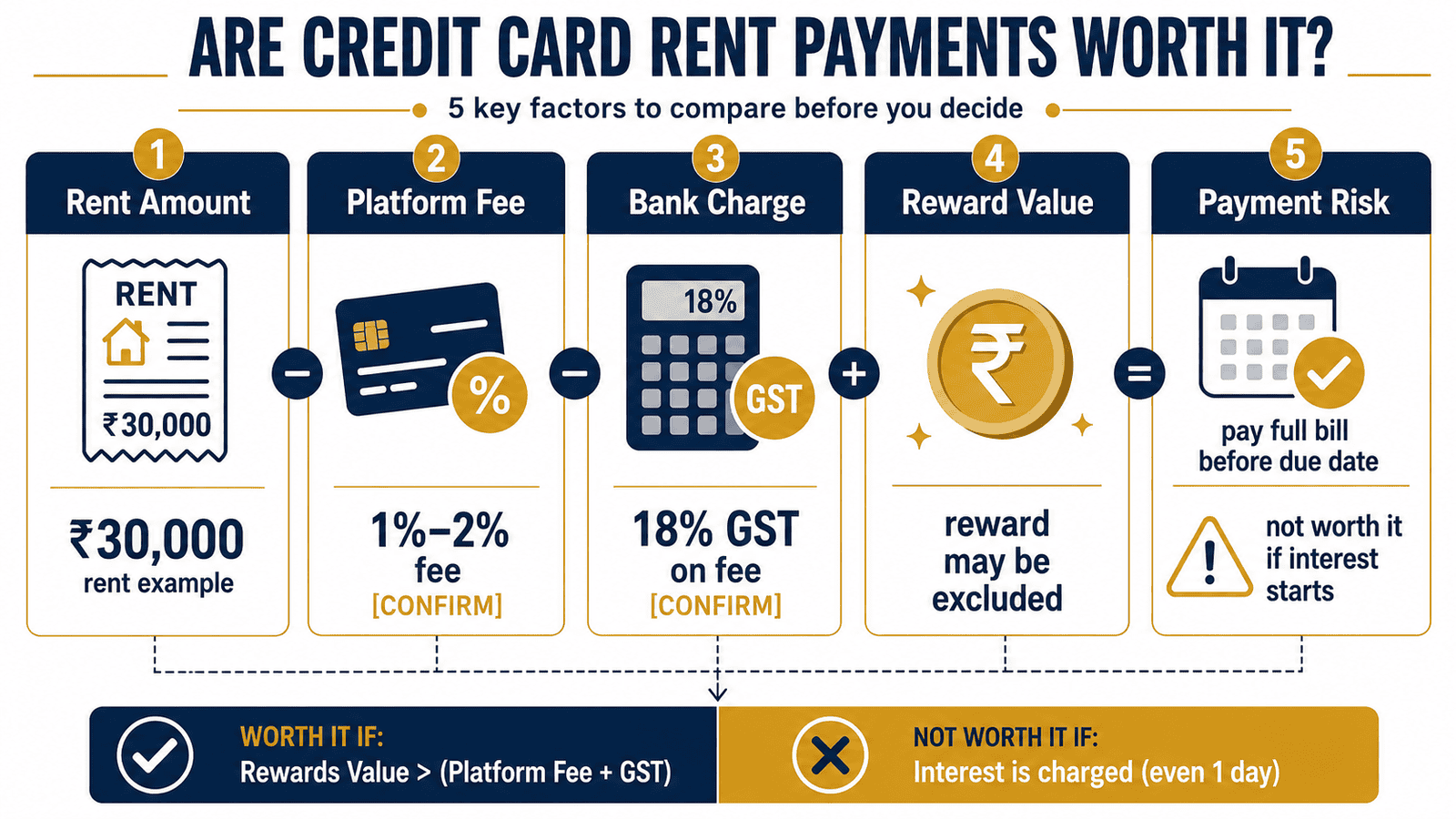
- Most rent payment platforms charge a convenience fee of 1%–2% of the rent amount, plus 18% GST on that fee — a ₹35,000 rent can cost ₹413–₹826 extra per transaction.
- Many premium cards exclude rent payments from reward point accrual entirely, or assign a lower earn rate under a separate merchant category code (MCC) for rental payments.
- The break-even point depends on three variables: your platform fee, your card’s reward earn rate on rent, and the redemption value of your reward points.
- Paying rent via credit card and not clearing the full bill by the due date triggers revolving interest of 36%–48% per annum — this instantly destroys any reward benefit.
- A ₹35,000 monthly rent adds ₹35,000 to your credit utilisation. If your credit limit is ₹1.5 lakh, that is a 23% utilisation jump — significant for your CIBIL score if left unpaid.
- Using rent payments purely to hit an annual fee waiver milestone can be mathematically sound — but only if the annual fee saved exceeds the total platform fees paid across those transactions.
- Always confirm current fee structures with your platform and card issuer before making rent payments — these change frequently and without notice.
Comparison: Paying Rent by Credit Card vs Bank Transfer
| Parameter | Credit Card Rent Payment | Bank Transfer / UPI / NEFT |
|---|---|---|
| Transaction Cost | 1%–2% fee + 18% GST | Usually free |
| Reward Points / Cashback | Card-dependent — often excluded | None |
| Annual Fee Waiver Milestone | Counts toward milestone | Does not count |
| Credit Utilisation Impact | Increases utilisation ratio | No impact on credit limit |
| Interest Risk if Bill Unpaid | 36%–48% p.a. revolving interest | No interest risk |
| Cash Flow Flexibility | Up to ~45-day interest-free period | Immediate debit from account |
| Rent Receipt / HRA Proof | Platform-generated receipt — check employer acceptance | Bank statement shows direct transfer |
| Landlord Convenience | Landlord gets bank transfer via platform; may object to method | Direct and familiar to most landlords |
Key Facts at a Glance
| Fact | Detail |
|---|---|
| Typical platform convenience fee | 1%–2% of rent amount (as of recent data — verify with your platform) |
| GST on convenience fee | 18% on the fee amount |
| Revolving interest rate on unpaid balance | 36%–48% per annum (varies by card issuer) |
| Interest-free grace period | Up to approximately 45–50 days (from billing cycle start) |
| Merchant category code for rent apps | Often coded as MCC 6513 (Real Estate Agents) or wallet/platform codes |
| Reward exclusion | Many issuers exclude rent MCCs from standard reward accrual |
| Annual fee waiver counting | Rent spends typically count toward annual fee waiver milestones |
| Landlord receives payment as | Regular NEFT/IMPS bank transfer from the platform |
How Credit Card Rent Payments Actually Work
When you pay rent through a platform such as a rent payment app, you are not swiping your card at your landlord’s terminal. The platform charges your credit card, collects the money, and sends a bank transfer — typically NEFT or IMPS — directly to your landlord’s account. Your landlord never sees the credit card involved. They receive a routine bank credit, just as if you had transferred from your savings account.
This intermediary model is what makes the transaction possible — and also what makes it expensive. The platform charges a convenience fee for processing your card payment and for routing the funds. This fee typically runs between 1% and 2% of the rent amount, as of recent data. On top of that, 18% GST applies to the convenience fee itself — not to the full rent amount.
The Merchant Category Code Problem
Here is where many tenants get a nasty surprise. Your credit card does not see this as a straightforward retail purchase. The platform’s transaction is coded with a merchant category code (MCC) — often MCC 6513 for real estate rental or a platform-specific wallet code. Many card issuers explicitly exclude certain MCCs from standard reward point accrual. If your card’s terms list rent payment platforms or wallet codes as excluded categories, you earn zero reward points on that transaction — while still paying the full convenience fee and GST.
Before setting up any rent payment on your credit card, read your card’s Most Important Terms and Conditions document carefully. The reward exclusion list is usually buried in the T&C, not on the marketing page.
The Grace Period Advantage — If Used Correctly
One legitimate benefit of credit card rent payment is the interest-free window. Most credit cards offer a grace period of up to 45–50 days from the start of the billing cycle before interest kicks in. If your rent falls early in a new billing cycle and you pay the full outstanding amount before the due date, you effectively get a short-term float — your rent is paid to the landlord now, but the money leaves your bank account only when the card bill is due.
Understanding how the billing cycle and grace period works is essential before using this strategy. Timing a large payment incorrectly — for example, transacting just after the billing date — can shrink the float window to as little as 15–20 days.
Annual Fee Waiver Milestone: The Legitimate Use Case
Some cardholders find genuine value in routing rent through a credit card purely to hit an annual fee waiver spending milestone. If your card waives a ₹999 or ₹1,499 annual fee once you spend ₹1.5 lakh per year, adding ₹35,000 monthly rent (a total of ₹4.2 lakh per year) easily clears that threshold — even if rewards are excluded or minimal.
The maths here are simple: if annual fee waiver value (₹999–₹2,999 for most cards) exceeds total convenience fees paid across 12 months, the strategy works. If it does not, it does not. We run this calculation in detail in the section below.
Reward Points on Rent: Cards That Do Credit Them
Not all issuers exclude rent. Some cards — particularly certain premium travel and lifestyle cards — do award reward points on rent payment platforms, either at the standard earn rate or at a reduced rate. Before assuming your card rewards rent transactions, call the issuer’s customer care and ask specifically whether the MCC used by your chosen platform is eligible for reward accrual. Get this confirmed in writing if possible, as policies change.
If your card does award points on rent, the value of those points depends on your redemption channel. Understanding whether reward points or cashback suits your spending pattern will help you calculate the true return before committing to monthly rent transactions.
Real Example: Rohit’s Rent Payment Decision in Bengaluru
Rohit is 31, a product manager at a Bengaluru tech firm, earning ₹1.6 lakh per month. His rent is ₹35,000 per month. He holds a rewards credit card with a credit limit of ₹2.5 lakh and is considering routing rent through a popular rent payment app.
His platform charges a 1% convenience fee. On ₹35,000, that is ₹350. GST at 18% on the fee adds ₹63. Total monthly cost: ₹413.
His card terms specify that rent payment platforms (MCC 6513) earn reward points at 0.5 reward points per ₹100 spent — half the standard earn rate. At ₹35,000 spend, he earns 175 reward points. Each point redeems at ₹0.25, giving a reward value of ₹43.75 per month.
Monthly cost: ₹413. Monthly reward value: ₹43.75. Net monthly loss: ₹369.25. Over 12 months, Rohit would lose ₹4,431 to fees while earning rewards worth only ₹525. Unless he is chasing an annual fee waiver worth more than ₹4,431 — which is uncommon — this transaction destroys value for Rohit. He switches to direct bank transfer and saves the difference.
How to Calculate Whether It Is Worth It
Net Monthly Value = Reward Value Earned − (Convenience Fee + GST on Fee)
Use these steps with your own numbers:
Step 1 — Calculate the fee: Convenience fee = Rent × Fee % (e.g. ₹35,000 × 1% = ₹350). GST on fee = ₹350 × 18% = ₹63. Total fee = ₹413.
Step 2 — Calculate reward value: Points earned = (Rent ÷ 100) × Earn rate per ₹100. Points value = Points × Redemption value per point. Example: (35,000 ÷ 100) × 0.5 = 175 points × ₹0.25 = ₹43.75.
Step 3 — Calculate net value: Net = ₹43.75 − ₹413 = −₹369.25 per month (loss).
Step 4 — Annual fee waiver adjustment: If hitting this spend milestone saves an annual fee, divide that saving by 12 and add it to monthly reward value.
| Scenario | Monthly Fee Paid | Monthly Reward Value |
|---|---|---|
| ₹35,000 rent, 1% fee, no reward points | ₹413 | ₹0 — net loss ₹413 |
| ₹35,000 rent, 1% fee, 0.5 pt per ₹100 at ₹0.25/pt | ₹413 | ₹43.75 — net loss ₹369 |
| ₹35,000 rent, 1% fee, 2 pts per ₹100 at ₹0.50/pt | ₹413 | ₹350 — net loss ₹63 |
The break-even point on a 1% fee + 18% GST model requires your card to earn rewards worth at least ₹1.18 per ₹100 spent on rent — a high bar that most standard and entry-level cards do not meet on rent transactions specifically.
How to Decide What’s Right for You
Your card confirms rent payments earn full reward points AND the reward value per ₹100 exceeds the per-₹100 cost of the convenience fee plus GST — THEN paying rent by credit card generates positive net value every month.
Your card waives an annual fee of ₹1,499 or more upon hitting a spending milestone AND rent is the easiest way to cross that milestone AND total convenience fees paid across 12 months are less than ₹1,499 — THEN using rent to hit the waiver milestone is mathematically sound.
You cannot clear the full credit card bill by the due date every month AND rent is a large portion of your credit limit — THEN do not pay rent by credit card; revolving interest at 36%–48% per annum will cost far more than any reward earned.
Your credit limit is under ₹1.5 lakh and your rent is ₹25,000 or more — THEN paying rent on card will push your credit utilisation ratio above 16%, which can negatively affect your CIBIL score if the balance is reported before you pay.
Your card’s T&C explicitly lists rent payment platforms or their MCC as excluded from reward accrual — THEN there is no reward benefit, only a recurring fee cost. Avoid this route entirely.
You need short-term cash flow flexibility and will definitely pay the full bill before the due date — THEN the 45-day interest-free grace period is a real, fee-free benefit worth using strategically.
You have confirmed your card’s specific earn rate on the platform’s MCC AND calculated actual reward value against actual fees — do not assume rent payments are profitable. Most are not. Run the numbers first.
Common Mistakes to Avoid
Assuming All Cards Reward Rent Transactions
Many tenants set up credit card rent payments assuming standard reward earn rates apply.
Reward exclusion lists vary dramatically by issuer and are regularly updated. A card that rewarded rent last year may have removed the category this year. Missing this means you pay the convenience fee every month and earn nothing in return.
Check the official T&C document or call your card issuer’s customer care before the first transaction.
Ignoring the GST on the Convenience Fee
Most comparison articles quote a “1% fee” for rent payments, which sounds small.
But the actual cost is 1% × 1.18 = 1.18% of rent because 18% GST applies to the fee. On ₹40,000 rent that is ₹472 per month, or ₹5,664 per year — a real amount that needs to appear in your calculation.
Always calculate the total cost including GST before comparing against reward value.
Carrying the Rent Balance as Credit Card Debt
Paying rent on a card and then paying only the minimum amount due converts rent into revolving debt.
At 3%–4% monthly interest (36%–48% annualised), a single ₹35,000 rent balance carried for three months accumulates ₹3,000–₹4,200 in interest — wiping out months of reward value. This also damages your credit utilisation ratio if the balance is large relative to your limit.
Only use rent payments on a card you will clear in full every cycle without fail.
Using the Wrong Platform Without Verifying MCC
Different rent payment apps may be coded under different MCCs, and your card’s exclusion list may apply to one app but not another.
Switching platforms without re-verifying your card’s earn rate on the new app’s MCC means you could move from a rewarded category to an excluded one without realising it.
Always confirm the MCC of your specific platform with your card issuer before switching.
Forgetting That Rent Spend Counts Against Your Credit Limit
A ₹35,000 rent charge on a ₹1.5 lakh limit card immediately creates 23% utilisation.
If your bill cycle closes before you pay this off, this utilisation is reported to credit bureaus. High utilisation — even if paid promptly — can temporarily reduce your CIBIL score. Tenants with modest credit limits and high rents should be particularly careful about this.
Pay the rent portion of your bill as early as possible after the transaction if utilisation is a concern.
Counting Rent Receipts from Apps Without Verifying HRA Acceptance
Some employers’ payroll teams require rent receipts in a specific format, often with landlord signatures or bank transfer proofs.
A receipt generated by a rent payment platform may or may not satisfy your employer’s HRA documentation requirement. Using an unaccepted receipt format can lead to HRA rejection at the time of investment declaration or tax filing.
Confirm the receipt format with your payroll or HR department before relying on app-generated receipts.
Treating Annual Fee Waiver Savings as Guaranteed
Card issuers can change annual fee waiver thresholds at any point during the card year.
If you have been routing rent to hit a waiver milestone and the issuer raises the threshold mid-year, you may pay fees throughout and still not qualify. Always track your spend milestone progress monthly and verify the threshold has not changed when your card anniversary approaches.
Not Timing the Transaction to Maximise the Grace Period
Paying rent on the day after your billing cycle closes gives you the shortest grace period — sometimes only 15–20 days until your bill is due.
Timing the rent payment to fall in the first few days after the billing cycle opens gives you the maximum 45–50 day float. This only matters if cash flow flexibility is your reason for using the card — but it is a simple optimisation that many miss.
When This May Not Be the Right Choice
Credit card rent payment is not right for you if your monthly rent is large relative to your credit limit. A ₹40,000 rent on a ₹1.5 lakh limit card creates 26% utilisation from a single transaction — and keeping this balance on the card even briefly can affect your CIBIL score.
It is also the wrong choice if you are not consistently clearing your credit card bill in full every month. Credit card interest accrues at 36%–48% per annum — carrying even one month’s rent as revolving debt costs more than an entire year’s reward earnings.
If your card’s terms explicitly exclude rent MCCs from reward accrual and you do not have a fee waiver milestone to hit, there is simply no financial benefit to this approach — only cost.
Finally, if your employer’s HRA documentation process requires landlord-signed receipts or direct bank transfer statements, an app-generated receipt may not be accepted. The tax implication of a rejected HRA claim is material for salaried employees in higher brackets.
If any of these apply to your situation, it may be worth exploring alternatives before committing.
Official Rules and Where to Verify
Credit card rent payment involves multiple regulatory areas: payment processing rules, GST applicability, credit reporting, and income tax documentation for HRA. The rules can and do change — especially GST rates, platform policies, and card T&C reward structures. Always verify the current position directly from the official source before making any financial decision.
- Reserve Bank of India (RBI) — rbi.org.in: Governs credit card issuance, interest rate disclosure norms, and payment system regulations in India.
- Income Tax Department — incometax.gov.in: Governs HRA exemption rules under Section 10(13A) of the Income Tax Act, and rent receipt documentation requirements for salaried employees.
- Your card issuer’s official website or Most Important Terms and Conditions (MITC) document: The definitive source for your card’s reward earn rate, exclusion categories, annual fee waiver milestones, and applicable MCC lists.
- Your rent payment platform’s official fee schedule: Convenience fee rates and GST applicability should be confirmed directly on the platform before processing any payment.
Rules, limits, and rates on this topic can change with each Budget or regulatory update. Always verify current figures directly from the official source before making any financial decision.
For HRA documentation requirements, review the rent receipt rules and common mistakes before relying on app-generated receipts for your tax declaration.
Expert Tips
- Verify the MCC before the first transaction, not after. Call your card issuer’s helpline and ask specifically: “Does MCC 6513 or [platform name]’s transactions earn reward points on my card?” Do this before your first rent payment — not when you notice points are missing after three months of fees.
- Calculate your exact break-even rate. Your break-even is: Total fee per ₹100 of rent (fee % × 1.18) ÷ Reward value per point. If your card earns 1 point per ₹100 and each point is worth ₹0.25, you need a convenience fee below 0.25% to break even — most platforms charge 4–5 times that.
- Use rent to cross annual fee waiver milestones strategically. If you are ₹30,000–₹40,000 short of your waiver threshold in March, routing one or two months of rent through the card can save a ₹1,499–₹2,499 annual fee. Calculate the fee cost of doing so — often it is still cheaper than paying the annual fee.
- Time your rent payment to the start of the billing cycle. If your billing cycle opens on the 5th of the month and your rent is due on the 1st, see if your landlord accepts a few days’ delay. Paying on the 6th gives you the full 45-day window to clear the balance before interest accrues.
- Keep a separate record of app-generated receipts alongside bank statements. For HRA purposes, having both the platform receipt and the landlord’s bank credit confirmation (via a screenshot from your landlord) strengthens your documentation if your employer questions the receipt format.
- Review your card’s T&C every April. Card issuers frequently update reward exclusion lists and annual fee waiver thresholds at the start of the financial year. A card that rewarded rent in FY24 may have removed that benefit in FY25 — a quick annual check protects you from paying fees all year for no benefit.
- Do not conflate credit card rent payment with a cash advance. Rent payment through an intermediary platform is processed as a purchase, not a cash advance — so the cash advance fee (typically 2.5%–3%) does not apply. But verify this with your issuer if your platform directs funds via a wallet, as wallet-to-bank transactions on some cards are treated differently.
Frequently Asked Questions
What is the typical convenience fee for paying rent by credit card in India?
Most rent payment platforms charge between 1% and 2% of the rent amount as a convenience fee, plus 18% GST on that fee. On a ₹35,000 rent with a 1% fee, the total extra cost is approximately ₹413 per month. These rates vary by platform and can change without notice — always confirm the current fee on the platform’s official fee schedule before transacting.
Do credit cards give reward points on rent payments?
It depends on your card’s terms. Many issuers exclude rent payment platforms from standard reward accrual by listing their merchant category codes (MCCs) in the exclusion list. Some premium cards do award points on rent, but often at a reduced earn rate. The only reliable way to confirm this is to check your card’s Most Important Terms and Conditions document or call the issuer directly.
Is GST charged on the full rent amount or only on the platform fee?
GST at 18% applies only to the convenience fee, not to the rent amount itself. If your rent is ₹35,000 and the fee is 1% (₹350), GST is charged on ₹350 — adding ₹63. Your total payment is ₹35,413, not ₹35,000 plus 18% GST on the full rent.
Can I use credit card rent payments to hit my annual fee waiver milestone?
Yes, in most cases rent spend counts toward annual fee waiver spending milestones. Whether this is worth it depends on simple maths: if 12 months of convenience fees add up to less than the annual fee you save, the strategy works. If convenience fees exceed the waiver value, you lose money. Run this calculation specifically for your card’s fee and waiver amount.
What happens if I do not pay the credit card bill in full after a rent payment?
If you carry the rent balance as revolving credit card debt, interest applies at your card’s monthly rate — typically 3%–4% per month (36%–48% annualised). On a ₹35,000 unpaid balance, that is ₹1,050–₹1,400 in interest in the first month alone. This quickly erases any reward value earned. Only pay rent on a card you can clear in full before the due date.
Does paying rent by credit card affect my CIBIL score?
Yes, it can. A large rent payment increases your credit utilisation ratio — the proportion of your credit limit currently in use. If your billing cycle closes before you pay the balance, this higher utilisation is reported to credit bureaus. High utilisation, even if later paid in full, can temporarily lower your CIBIL score. Keep your overall utilisation below 30% at the time of reporting. For a detailed explanation, see how credit utilisation ratio affects your CIBIL score.
Is it safe to use a rent payment app to pay my landlord via credit card?
Established rent payment platforms regulated under RBI payment system guidelines are generally safe for transactions. However, you should verify that the platform holds a valid Payment Aggregator or Payment Gateway licence, that your landlord’s bank details are entered correctly, and that you receive a payment confirmation. As with any financial transaction, use only platforms with verifiable credentials.
Will my landlord know I am paying rent through a credit card?
No, in most cases. Your landlord receives a regular NEFT or IMPS bank transfer from the platform — it looks identical to a direct bank transfer. The landlord does not need to have any credit card infrastructure. However, some landlords may ask questions if the sender name is a platform or company name rather than yours — clarify this with your landlord upfront.
Can rent paid by credit card be used as proof for HRA exemption?
This depends on your employer’s payroll process. The receipt generated by the rent payment platform may satisfy HRA documentation requirements in many cases, but some employers require landlord-signed receipts, cancelled cheques, or bank transfer statements. Verify the acceptable formats with your HR or payroll team before using app receipts. For the full rules on rent receipts and HRA, review the rent receipt format and common mistakes guide.
What is the break-even reward rate needed to justify credit card rent payment charges?
At a 1% convenience fee plus 18% GST, the total cost is 1.18% of rent. To break even, your card must return at least ₹1.18 in reward value per ₹100 of rent spend. If your card earns 1 reward point per ₹100 and each point is worth ₹0.25, your return is only ₹0.25 per ₹100 — far below break-even. You would need either a much higher earn rate, a high-value redemption channel, or an annual fee saving to make the numbers work.
Final Verdict
Credit card rent payments are not automatically a smart move — and for most standard cardholders paying 1%–2% in fees on cards that exclude rent from reward accrual, they are a net monthly loss. The two scenarios where they genuinely work: your card confirms reward points on rent at a rate that exceeds the fee cost after GST, or you are using rent spend to cross an annual fee waiver milestone where the fee saved exceeds total convenience fees paid. Outside these two cases, a direct bank transfer or UPI payment to your landlord is cheaper and simpler every time. If you are evaluating which card to hold before making rent a regular transaction, start with a structured guide on choosing the right card for your spending profile. Always verify the latest rules from official sources or consult a qualified professional before making any financial decision.
This article is for educational purposes only and should not be treated as personalised financial, tax, investment, insurance, or legal advice. Tax rules, interest rates, regulatory limits, and product features can change with each Budget or policy update. Please verify current rules from official government sources or consult a qualified and registered professional before making any financial decision.

Nikhil Bansal writes about credit cards, billing cycles, card charges, rewards, cashback, credit utilisation, card EMI, BNPL, and responsible credit usage in India. His content is designed for readers who want to use credit cards wisely without falling into expensive repayment mistakes.
He covers topics such as how to choose a first credit card, credit card billing cycle, due date, grace period, minimum amount due, credit utilisation ratio, reward points vs cashback, lifetime free credit cards, annual fee waivers, credit card statement reading, add-on cards, cash advance charges, EMI on credit cards, credit card fraud reporting, BNPL vs credit card, and foreign transaction fees.
Nikhil’s writing is beginner-friendly, direct, and risk-aware. He explains how small mistakes such as paying only the minimum due, withdrawing cash from a credit card, missing due dates, or overusing credit limits can become costly. Since card fees, interest rates, reward rules, waiver conditions, and bank offers change often, readers should verify the latest Most Important Terms and Conditions from the card issuer.