
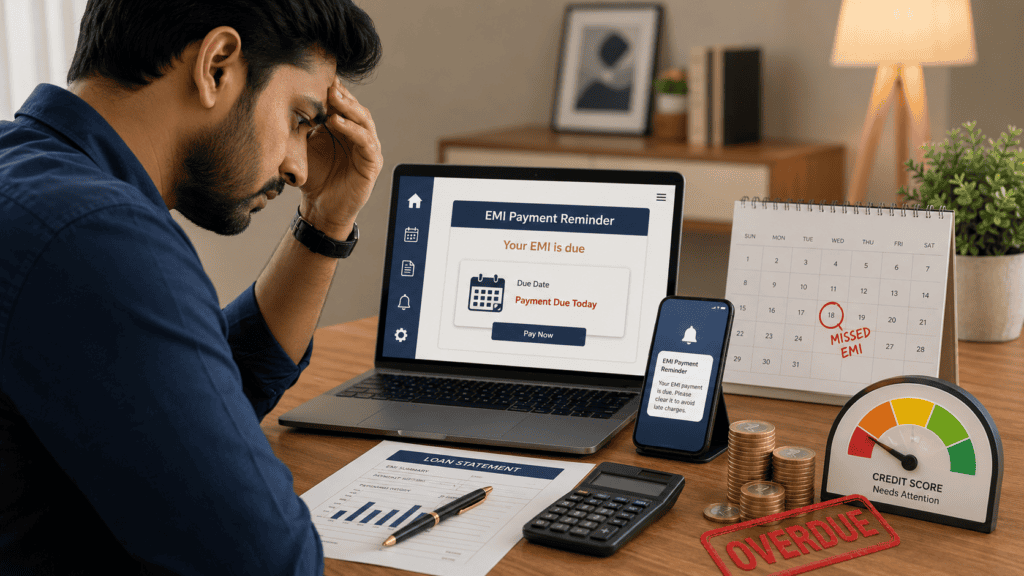
You woke up to a missed-payment SMS, or maybe your salary account ran low just before the auto-debit date. Either way, your first question is: how bad is this? One missed EMI feels minor — but lenders treat it differently depending on whether you missed it by two days or two months. Getting it wrong can mean penalty fees stacking up, a DPD entry on your CIBIL report, or recovery calls you would rather not deal with. This article walks you through exactly what happens in the first 24 hours, the first week, and beyond — so you can act quickly and limit the damage.
Quick Answer: What Happens If You Miss an EMI
What happens if you miss an EMI is usually a late fee, possible bounce charge, DPD entry, and negative CIBIL impact if the delay is reported. One missed EMI does not automatically mean legal action, but unpaid dues can escalate after reminders, recovery follow-up, and formal notices. Pay or contact the lender quickly.

Key Takeaways
- A single missed EMI can attract a bounce charge of ₹300–₹750 plus a late payment fee of 1–3% per month on the overdue amount — the exact amounts vary by lender and loan type.
- Lenders report to CIBIL after a delay of typically 30 days or more; a DPD entry stays on your credit report for up to 36 months from the date it is logged.
- RBI classifies a retail loan as a Non-Performing Asset (NPA) after 90 days of non-payment — at that point, recovery action moves to a formal stage.
- Secured loans (home loan, car loan) carry the risk of asset seizure if default continues; unsecured loans (personal loan) move toward legal recovery notices instead.
- One missed EMI that you pay within the same billing cycle, before it is reported, may not appear on your CIBIL report at all — timing matters.
- Proactively calling your lender before or immediately after a missed EMI gives you access to options: a grace period extension, EMI rescheduling, or a moratorium.
- An emergency fund covering 3–6 months of EMIs is the most effective way to prevent this situation from repeating.
Key Facts at a Glance
| Parameter | Typical Figure / Rule | Notes |
|---|---|---|
| Bounce charge (ECS/NACH dishonour) | ₹300–₹750 per bounce | Varies by bank and NBFC; verify with lender |
| Late payment penalty | 1%–3% per month on overdue EMI | Some lenders charge a flat fee instead |
| CIBIL reporting trigger | 30+ days overdue (common) | Lenders report on monthly credit-reporting cycle |
| NPA classification timeline | 90 days of non-payment | Per RBI prudential norms for retail loans |
| DPD record duration on CIBIL | Up to 36 months | From date of DPD entry |
| Recovery agent engagement | After 2–3 missed EMIs typically | Regulated under RBI Fair Practices Code |
| Legal notice / SARFAESI (secured) | Post-NPA stage | Applies to home and vehicle loans above threshold |
What Actually Happens When You Miss an EMI — Day by Day
Missing an EMI is not a single event. It is a sequence of escalating consequences, and each day you wait makes the next step more likely. Understanding the timeline is the single most useful thing you can do right now.
Day 1–2: The Bounce and Immediate Penalty
Most Indian lenders collect EMIs via NACH (National Automated Clearing House) auto-debit. If your account has insufficient funds on the due date, the debit fails. The bank charges you a bounce or ECS dishonour fee — typically ₹300–₹750, though some private-sector banks charge higher amounts. Your lender also charges a late payment fee, usually 1%–3% per month on the overdue amount, calculated from the due date. These charges begin immediately.
You will receive an SMS alert, an email, and possibly a call from the lender’s collections team within 24–48 hours. This is a routine reminder stage, not a threat. To understand how your EMI calculation breaks down between principal and interest, check the amortisation schedule — it shows how even one missed payment can increase your outstanding principal balance.
Days 3–29: The Overdue Period — Still Recoverable
If you pay the overdue EMI along with the bounce charge and late fee within roughly 30 days, your account returns to normal. Critically — if you pay before the lender’s monthly CIBIL reporting cycle closes — this missed EMI may never appear on your credit report at all. The exact reporting date varies by lender, but most report once a month.
During this window, your loan is technically “overdue” but not yet classified as a default. Interest continues to accrue. The sooner you pay, the lower the additional interest burden.
Day 30+: DPD Entry and CIBIL Impact
Once the delay crosses 30 days and falls into the lender’s next reporting cycle, a Days Past Due (DPD) entry appears on your CIBIL report. A DPD of 30 means you were 30 days late. A DPD of 60 means 60 days, and so on. Even a single 30-DPD entry can reduce your CIBIL score by 50–100 points depending on your existing score and credit history. For a borrower with a score of 750, this is a painful and visible drop. This DPD entry stays on your CIBIL report for up to 36 months from the date it is recorded.
Your credit score is primarily driven by your repayment history — which accounts for roughly 35% of your CIBIL score. A single DPD entry does not permanently destroy your score, but it does send a warning signal to every future lender who pulls your report.
Day 60–89: Recovery Follow-Up Begins
After two consecutive missed EMIs, most lenders move the account to their collections or recovery team. You will receive calls more frequently. A field executive may visit your registered address. According to the RBI Fair Practices Code, recovery agents must identify themselves, provide a notice before visiting, and are prohibited from calling before 7 a.m. or after 7 p.m. They are also prohibited from using abusive language or threats. If an agent violates these rules, you have the right to file a complaint with the lender’s grievance officer and, if unresolved, with the RBI Ombudsman.
At this stage, your future loan eligibility is already affected. Most lenders screen for DPD entries during the appraisal process, and two missed EMIs on a live loan makes fresh approvals very difficult.
Day 90+: NPA Classification and Legal Stage
Under RBI’s prudential norms for retail loans, a loan account that remains overdue for 90 days is classified as a Non-Performing Asset (NPA). This is a formal classification with serious consequences. For secured loans — a home loan or car loan — the lender gains the right to initiate recovery under the SARFAESI Act (Securitisation and Reconstruction of Financial Assets and Enforcement of Security Interest Act). This means legal notice, opportunity to repay, and eventually auction of the pledged asset if you do not respond.
For unsecured loans like personal loans, the lender cannot seize property but can initiate a civil suit or file a recovery case in the Debt Recovery Tribunal (DRT). A court order can allow attachment of your salary or bank account.
Secured vs Unsecured Loans: Different Consequences
The stakes are higher for secured loans because an asset is on the line. A home loan default that reaches the NPA stage can result in your property being auctioned. A car loan default can mean vehicle repossession. For personal loans, the recovery path is legal rather than physical — but a court judgement can still affect your income. Both categories damage your CIBIL report severely once DPD entries pile up.
Real Example: Rohit’s Missed Personal Loan EMI
Rohit, 32, works as an operations manager in Pune and earns ₹78,000 per month. He has a personal loan of ₹4,00,000 at 14% annual interest over 36 months. His EMI is approximately ₹13,670 per month.
In October, his company delayed his salary by 8 days. His NACH auto-debit failed on the 5th. The bank charged a bounce fee of ₹590 and a late payment fee of 2% on the overdue EMI — adding ₹273 in charges. Rohit paid the full overdue amount on the 11th — within 30 days and before his bank’s monthly reporting cycle. No DPD entry appeared on his CIBIL report.
Had he waited until the 35th day instead, a 30-DPD entry would have appeared on his CIBIL report, stayed there for 36 months, and made the home loan he is planning to apply for in 2025 harder to get and likely more expensive. The six-day difference between paying on Day 11 and Day 35 would have cost him far more than ₹863 in penalty charges.
How to Calculate the True Cost of One Missed EMI
Total Cost of Missing One EMI = Bounce Charge + Late Payment Fee + Additional Interest on Outstanding + CIBIL Opportunity Cost (if reported)
Using Rohit’s example:
- EMI amount: ₹13,670
- Bounce charge: ₹590
- Late payment fee at 2% of ₹13,670: ₹273
- Additional interest on overdue amount for 6 days at 14% p.a.: approximately ₹32
- Total direct cost if paid on Day 11: ₹895
If the EMI had remained unpaid past 30 days and a DPD entry had appeared, the indirect cost — higher interest rate on a future home loan, or outright rejection — could run into tens of thousands of rupees over a loan tenure.
| Scenario | Days Overdue | Estimated Direct Cost |
|---|---|---|
| Paid before CIBIL reporting cycle | 1–25 days | Bounce charge + late fee only (≈₹700–₹1,200) |
| Paid after 30 days, before 60 | 30–59 days | Above + 30-DPD on CIBIL + ongoing late interest |
| Paid after 60 days, before NPA | 60–89 days | Above + 60-DPD, collections contact, eligibility impact |
| Account crosses 90 days unpaid | 90+ days | NPA tag, legal proceedings, secured asset risk |
Comparison: Missed EMI on Home Loan vs Personal Loan vs Credit Card
| Parameter | Home Loan | Personal Loan |
|---|---|---|
| Bounce charge (approx.) | ₹500–₹750 | ₹300–₹600 |
| Late payment penalty | 2%–3% p.m. on overdue | 1%–3% p.m. on overdue |
| CIBIL impact (30+ DPD) | High | High |
| Asset seizure risk | Yes — property | No |
| NPA timeline | 90 days | 90 days |
| Legal route post-NPA | SARFAESI Act | Civil suit / DRT |
| Recovery agent rules | RBI Fair Practices Code applies | RBI Fair Practices Code applies |
How to Decide What’s Right for You
The right action after a missed EMI depends entirely on how many days have passed and whether this is a one-time or recurring problem. Use the framework below to act without wasting time.
You missed the EMI within the last 10 days and can pay now — pay the overdue EMI plus all charges immediately. Chances are high no CIBIL entry will be made.
You are between Day 11 and Day 25 — still pay immediately and call the lender to ask about the reporting cycle date for your account. Paying before that date may avoid a DPD entry.
You cannot pay the full EMI right now — call the lender before the due date. Ask about a temporary interest-only payment, grace period, or EMI restructuring. Most lenders will work with you if you proactively reach out.
You are past 30 days and a DPD entry has appeared — focus on paying the overdue amount to stop the DPD from worsening. A 30-DPD is recoverable; a 90-DPD that becomes NPA is much harder to explain to future lenders.
Your EMI-to-income ratio is consistently too high — check your safe EMI ratio against your salary before the next EMI falls due. Restructuring or prepaying one loan may be a better long-term fix.
You have a secured loan (home or car) and are approaching 90 days overdue — this is urgent. Get legal advice or contact the lender’s grievance cell immediately. SARFAESI notices follow tight timelines.
You cannot sustain the current EMI even after restructuring — loan settlement may be an option, but understand it will leave a “Settled” tag on your CIBIL report for 7 years and will make future credit difficult. Exhaust restructuring and moratorium options first.
Common Mistakes to Avoid
Ignoring the SMS or call from your lender
Many borrowers assume a collections reminder is just a routine message and delay responding.
Every day of silence moves your account closer to the next escalation stage. Even a 24-hour delay beyond the CIBIL reporting cutoff can result in a DPD entry that stays on your report for 36 months.
Reply to the lender immediately — even if you cannot pay today.
Paying only the current month’s EMI, ignoring arrears
After a missed EMI, some borrowers resume the regular monthly payment but never clear the overdue amount from the previous month.
Your account remains “overdue” and the DPD clock continues ticking. Late fees keep accumulating on the unpaid portion. Your CIBIL report will show a growing DPD even though you appear to be paying regularly.
Always confirm with the lender what the total outstanding due is — including penalties — and clear it in full.
Not keeping an emergency buffer for EMI months
A salary delay of even 7 days can cause an auto-debit to fail if the account has no buffer.
Repeatedly bouncing EMIs compounds charges quickly. Two bounces at ₹590 each plus late fees can add ₹2,500–₹3,000 to your cost in a single quarter, on top of the CIBIL damage.
Build a 6-month emergency buffer with at least 1–2 months of EMI kept aside in a separate savings account at all times.
Assuming a “settlement” clears your CIBIL record
Loan settlement — paying less than the full outstanding amount after negotiation — is often misunderstood as a clean resolution.
CIBIL marks settled accounts as “Settled” rather than “Closed.” This tag stays on your report for 7 years. Future lenders treat a settled account as a significant red flag, often equivalent to a written-off loan.
Only consider settlement as a genuine last resort after exhausting restructuring options.
Believing recovery agents have unlimited authority
Recovery calls can feel intimidating, but agents operating under the RBI Fair Practices Code have specific restrictions.
Agents cannot call before 7 a.m. or after 7 p.m. They cannot use abusive language. They must carry proper identification. Violations can be reported to the lender and the RBI Banking Ombudsman.
Know your rights. Document every interaction — date, time, name, what was said.
Not checking your CIBIL report after clearing dues
Lenders sometimes take 30–45 days to update your account status after payment. An old DPD entry may sit on your report even after you have fully cleared the overdue amount.
Pull your CIBIL report 45–60 days after clearing dues. If the entry has not been updated, raise a dispute directly on the TransUnion CIBIL website.
Taking a new loan to pay an existing overdue EMI
Borrowing fresh credit to cover an overdue EMI may seem like a quick fix but creates a larger interest burden.
If you cannot service your current EMIs, adding another loan only delays the problem while increasing total outgoing every month. A missed EMI is a signal to restructure, not to borrow more.
When This May Not Be the Right Choice
Continuing to stretch and pay an EMI at all costs may not always be the right approach. Consider these scenarios carefully.
If your total EMI outflow exceeds 50% of your take-home salary consistently, you are in a debt trap that one missed payment will only reveal — not create. Forcing payments without restructuring simply postpones a larger crisis.
If you have exhausted savings, borrowed from family, and still cannot meet the EMI, partial settlement or loan restructuring through the lender’s formal process may be less damaging than additional missed payments piling up further DPD entries on your report.
If the loan product itself was mis-sold at terms you were not clearly explained — an unusually high penalty structure or pre-payment charges that make it impossible to exit — filing a complaint with the RBI Banking Ombudsman is a legitimate step, not a last resort.
If any of these apply to your situation, it may be worth exploring alternatives before committing.
Official Rules and Where to Verify
Penalty amounts, NPA classification timelines, and recovery agent rules are set or guided by regulatory bodies and are subject to periodic revision. Do not rely on any single article — including this one — as a definitive source for current figures.
- Reserve Bank of India (RBI) — rbi.org.in — Fair Practices Code for Lenders, recovery guidelines, NPA classification norms, Banking Ombudsman Scheme
- TransUnion CIBIL — transunioncibil.com — How DPD is reported, how to raise a dispute, credit score calculation methodology
- Your lender’s official website — Most scheduled banks and registered NBFCs publish their schedule of charges, including bounce fees and late payment penalties, on their site or in the loan agreement
Rules, limits, and rates on this topic can change with each Budget or regulatory update. Always verify current figures directly from the official source before making any financial decision.
Expert Tips
- Set a calendar reminder 5 days before your EMI due date to check your account balance. If salary is delayed, transfer funds from savings to the EMI-linked account manually before the auto-debit fires.
- Ask your lender to send you the exact CIBIL reporting date for your loan account. Paying before that date — even if you are already past the due date — may prevent a DPD entry entirely.
- After clearing an overdue EMI, request a written acknowledgement or account statement from the lender confirming the account is “regular” — not just a payment receipt. This is useful if there is a future dispute about the DPD status.
- If you are expecting a cash crunch in the next 2–3 months, approach your lender now for a pre-approved moratorium or EMI deferral — before you miss anything. Lenders are far more cooperative when the borrower is proactive rather than reactive.
- Use the CIBIL score improvement steps to begin rebuilding your repayment history after clearing dues. Consistent on-time payments for 6–12 months after a DPD can meaningfully recover your score.
- Check whether your lender has a hardship clause in the loan agreement — some banks allow a one-time deferral per year without penalty for borrowers with a clean prior history.
- If you have multiple EMIs and can only pay one this month, prioritise the secured loan (home or car) — asset seizure risk is a more immediate and irreversible consequence than a civil suit on a personal loan.
Frequently Asked Questions
What happens if I miss one EMI payment in India?
A single missed EMI typically results in a bounce charge (₹300–₹750) and a late payment penalty (1%–3% per month on the overdue amount). If you pay before your lender’s CIBIL reporting cycle closes — usually within 25–30 days — no DPD entry may appear on your credit report. If you pay after that cycle, a 30-DPD entry will appear and remain for 36 months.
How much is the penalty for a missed EMI in India?
There is no single fixed penalty — it varies by lender and loan type. Most lenders charge a bounce fee of ₹300–₹750 when the auto-debit fails, plus a late payment penalty of 1%–3% per month on the unpaid EMI amount. Some lenders charge a flat late fee instead. Check your loan agreement or your lender’s schedule of charges for the exact figures that apply to you.
Does missing one EMI affect my CIBIL score?
It can — but not always immediately. Lenders report overdue accounts to CIBIL once a month. If you clear the dues before the reporting cycle closes, your score may be unaffected. If the delay crosses into the next reporting period, a DPD entry will appear and your CIBIL score can drop by 50–100 points depending on your credit profile.
What is DPD in a CIBIL report?
DPD stands for Days Past Due. It is the number of days your EMI payment was overdue when the lender reported your account to CIBIL. A DPD of 000 means no delay. A DPD of 030 means you were 30 days late. A DPD entry of 030 or higher on your CIBIL report is a red flag for future lenders and stays on your report for up to 36 months from the date it is recorded.
When does a missed EMI become an NPA?
Under RBI’s prudential norms for retail loans, a loan account is classified as a Non-Performing Asset (NPA) after 90 consecutive days of non-payment. At the NPA stage, the lender can initiate formal recovery action — including SARFAESI proceedings for secured loans or a civil suit for unsecured loans.
Can a recovery agent visit my home for a missed EMI?
Yes — but only under specific rules set by the RBI Fair Practices Code. Recovery agents must provide prior notice, carry proper identification, and can visit only between 7 a.m. and 7 p.m. They are prohibited from using abusive language or threats. If an agent violates these rules, you can file a complaint with your lender’s grievance officer and, if unresolved within 30 days, with the RBI Banking Ombudsman at rbi.org.in.
What should I do immediately after missing an EMI?
Act the same day: check the total amount due (EMI + bounce charge + late fee), ensure your account has sufficient funds, and pay immediately. If you cannot pay in full, call your lender proactively — do not wait for a collections call. Asking early gives you access to options like grace period extension, deferral, or EMI restructuring that may not be available once the account is formally overdue.
Is it better to settle a loan or keep paying after multiple missed EMIs?
Settlement should be a last resort. While settlement allows you to close the account for less than the outstanding amount, CIBIL marks the account as “Settled” — not “Closed.” This tag remains on your report for 7 years and signals a default to future lenders. If you can restructure the loan, take a moratorium, or clear dues over a revised schedule, that outcome is far better for your long-term credit health than settlement.
What happens if I miss a home loan EMI?
The immediate consequences — bounce charge, late fee, DPD entry — are the same as for any loan. The key difference is the collateral risk. A home loan default that reaches 90 days triggers NPA status, after which the lender can initiate SARFAESI Act proceedings — a formal legal notice followed by property auction if dues are not cleared. Home loan arrears must be treated as urgent.
How long does a missed EMI affect my credit score?
A DPD entry from a missed EMI remains on your CIBIL report for up to 36 months from the date it is recorded. However, the impact on your score reduces over time as you build a consistent record of on-time payments. After 12–18 months of clean repayment history following the DPD, most borrowers see a meaningful recovery in their score.
Final Verdict
What happens if you miss an EMI depends almost entirely on how quickly you act. The first 30 days are recoverable — a bounce charge and a late fee are manageable costs. Beyond 30 days, a DPD entry on your CIBIL report begins a 36-month countdown that affects every loan or credit card application you make during that period. Beyond 90 days, the account enters NPA territory and consequences become legal rather than administrative. The single most useful thing you can do — whether the missed EMI was yesterday or a week ago — is call your lender today, state your situation honestly, and ask for your options. Most lenders would rather restructure than litigate. Always verify the latest rules from official sources or consult a qualified professional before making any financial decision.
This article is for educational purposes only and should not be treated as personalised financial, tax, investment, insurance, or legal advice. Tax rules, interest rates, regulatory limits, and product features can change with each Budget or policy update. Please verify current rules from official government sources or consult a qualified and registered professional before making any financial decision.

Vikram Sethi writes about loans, EMI planning, credit score impact, borrowing costs, and repayment decisions for Indian borrowers. His content helps readers look beyond the monthly EMI and understand the full cost of borrowing, including principal, interest, processing fees, GST, insurance, prepayment charges, foreclosure fees, late payment penalties, and credit score impact.
He covers topics such as EMI calculators, home loan eligibility, personal loan eligibility, debt-to-income ratio, flat interest rate vs reducing balance, missed EMI consequences, loan prepayment vs part payment, home loan balance transfer, processing fees, gold loan vs personal loan, car loan vs cash purchase, top-up home loans, loan against PPF, and credit score basics.
Vikram’s writing style is practical, cautionary, and calculation-driven. He uses Indian examples, ₹ amounts, comparison tables, and decision frameworks to help borrowers compare options more carefully. His articles are educational and do not guarantee loan approval, interest rates, or savings. Readers should verify current rates, charges, eligibility, and terms directly with lenders before applying or refinancing.