

You earn ₹85,000 a month. You have a savings account, a few SIPs running, a car on EMI, a credit card with dues, and maybe some gold at home. So — are you building wealth, or just staying busy with money? Most salaried Indians never stop to sort their finances into two simple piles: what they own and what they owe. That single sorting exercise — understanding assets vs liabilities — changes how you see every money decision. It is not an accounting concept for businesses. It is the most practical lens a family can use to track whether they are actually getting ahead. This article covers the full picture: what each term means, real Indian household examples, how to calculate your net worth, and the mistakes that quietly keep people stuck. If you are new to managing money, start here with our guide to personal finance basics before going deeper.
Quick Answer: Assets vs Liabilities
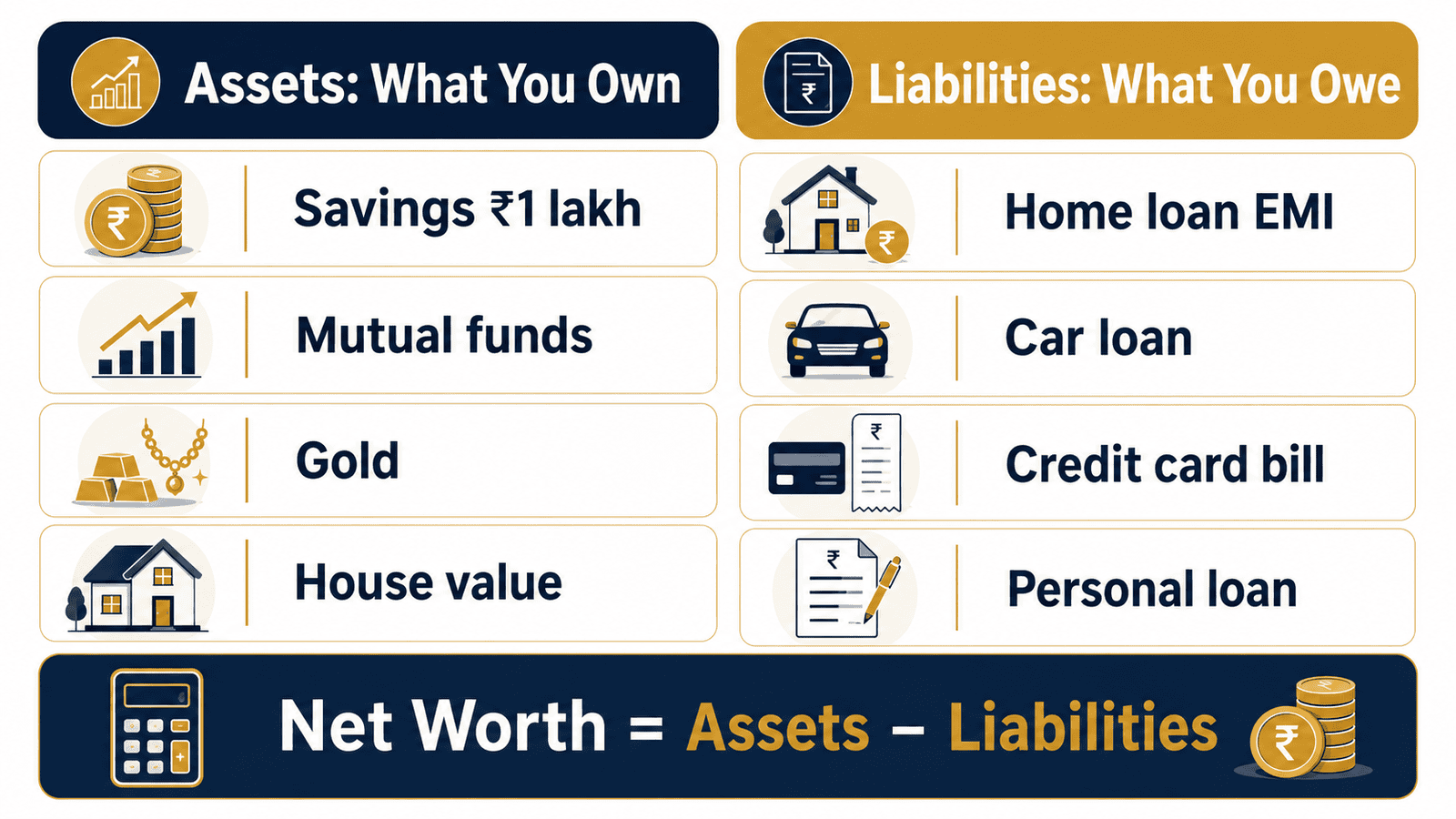
Assets vs liabilities means the difference between what you own and what you owe. In personal finance, assets include savings, investments, gold, and property value, while liabilities include home loans, car loans, credit card dues, and personal loans. Your net worth is calculated as total assets minus total liabilities.
Key Takeaways
- Assets are things you own that hold or grow in value — savings, SIPs, gold, EPF balance, and property market value all qualify.
- Liabilities are financial obligations you must repay — home loans, car loans, personal loans, and credit card outstanding dues are the most common for Indian households.
- A house can appear on both sides: its market value is an asset, while the outstanding home loan is a liability — owning a house does not instantly make you richer if the loan balance is nearly as large.
- A car is typically a depreciating asset — it loses value over time — and the car loan is a separate liability that reduces your net worth further.
- Net worth = Total Assets − Total Liabilities. If your liabilities grow faster than your assets, net worth falls even when your salary rises.
- Not all liabilities are harmful: a home loan or education loan can fund an appreciating or productive asset; it is high-interest consumer debt that erodes wealth fastest.
- The practical goal is to steadily increase useful assets — liquid savings, growing investments, income-generating property — while keeping liabilities purposeful and manageable.
Assets vs Liabilities: Direct Comparison
| Parameter | Asset | Liability |
|---|---|---|
| Definition | Something you own that has financial value | Something you owe to another party |
| Indian examples | Savings account balance, EPF corpus, SIP units, gold, FD, flat market value | Home loan outstanding, car loan EMI, credit card dues, personal loan balance |
| Effect on net worth | Increases | Decreases |
| Monthly cash flow | May generate returns, interest, or rental income | Requires monthly repayment (EMI, interest, minimum due) |
| Appreciating or depreciating? | Savings and investments typically appreciate; cars and electronics depreciate | Liability reduces as you repay; grows if unpaid due to interest |
| Goal for the household | Grow over time | Keep purposeful and manageable |
Key Facts at a Glance
| Concept | What It Means | Indian Household Example |
|---|---|---|
| Asset | Owned item with financial value you can use or convert to money | ₹2 lakh in savings account, ₹4 lakh in SIPs, 50 g gold |
| Liability | A debt or obligation that must be repaid over time | ₹18 lakh home loan outstanding, ₹3.5 lakh car loan balance |
| Net worth formula | Total Assets − Total Liabilities | ₹30 lakh assets − ₹22 lakh liabilities = ₹8 lakh net worth |
| Appreciating asset | Asset that grows in value over time | Equity mutual fund SIP held for 10+ years, flat in a growing city |
| Depreciating asset | Asset that loses value over time | Car, laptop, TV — typically worth less each year |
| Productive liability | Debt used to fund an appreciating or income-generating asset | Home loan on a flat whose value is rising over time |
| Consumption liability | Debt used to fund expenses or depreciating items | Credit card balance from a holiday; personal loan for a phone |
What Are Assets and Liabilities in Personal Finance?
Most of us learned about assets and liabilities from business textbooks — balance sheets, depreciation schedules, corporate accounts. But for a salaried family in India, the concept is simpler and far more personal. It comes down to one question: does this item add to what I own, or add to what I owe?
Asset Meaning in Personal Finance
An asset, in household terms, is anything you own that has a financial value you can use, sell, or convert into money. This includes money sitting in a savings account, units in a mutual fund, gold jewellery, a fixed deposit, your EPF balance, or the market value of a flat you own. What makes something an asset is not just that you have it — it is that you could theoretically put a rupee value on it today.
Assets can be broadly split into two types:
- Appreciating assets — These grow in value over time. Equity mutual fund SIPs held for the long term, real estate in a growing city, and gold over decades are common examples for Indian families.
- Depreciating assets — These lose value over time. A car bought for ₹8 lakh may be worth ₹4 lakh in five years. A smartphone, television, or furniture also falls into this category. They are still assets — but their value shrinks steadily.
Liquid assets are a particularly important subset. Your savings account balance, FD that matures soon, or liquid mutual fund units can be accessed quickly in an emergency. Illiquid assets — like real estate or gold locked in a bank locker — may be harder to convert to cash in a hurry. Both matter, but their roles in your household balance sheet are different.
Liability Meaning in Personal Finance
A liability is any financial obligation you owe to someone else and must repay — usually with interest. The most common liabilities in an Indian household are a home loan, car loan, personal loan, and credit card outstanding balance. Each of these creates a cash outflow every month and reduces the household’s net worth.
Not all liabilities are created equal. A home loan is what many personal finance educators call a productive liability — you took on debt to acquire an asset (the flat) whose value may rise over time. Similarly, an education loan taken to upskill and increase earning capacity can be considered a purposeful liability. These are different from consumption liabilities — credit card debt from a weekend vacation or a personal loan for a wedding expense — which fund spending rather than asset creation, leaving you with nothing of value after repayment.
Why Cash Flow Matters Alongside Net Worth
Net worth captures your financial position at a point in time. But cash flow — how money moves in and out each month — determines whether you can sustain or improve that position. A person with a ₹20 lakh flat (asset) and ₹18 lakh in combined loans (liability) may technically have a positive net worth, but if their EMIs consume 60% of take-home salary, their monthly cash flow is under severe pressure. That is why tracking both net worth and monthly obligations matters. A heavy liability burden does not just reduce net worth — it limits the ability to invest in more assets.
Owned Items vs Actual Assets: A Useful Distinction
This is where many beginners go wrong. Owning something does not automatically make it a useful financial asset. A collection of expensive clothes, a luxury watch, or a second-hand car on EMI are all “owned items” — but they may contribute little to your net worth and may not be easily sold. The question to ask is: can this item be valued and converted to money if needed? And does it grow in value or decline? That is the practical filter between an owned item and a genuine financial asset. According to SEBI’s investor education resources, understanding the nature of your financial assets is foundational to building a sound investment plan.
Real Example: Rohit and Priya’s Household Balance Sheet
Rohit, 31, is a software engineer in Pune earning ₹85,000 per month. His wife Priya earns ₹55,000 monthly. Together, they own a flat currently valued at ₹48 lakh, have ₹3.2 lakh in a joint savings account, ₹6.5 lakh in equity SIPs, ₹4.8 lakh in EPF, and 80 grams of gold currently worth approximately ₹5.6 lakh. On the other side, they have a home loan with an outstanding balance of ₹32 lakh, a car loan with ₹2.8 lakh remaining, and a credit card outstanding of ₹42,000.
| Item | Asset (₹) | Liability (₹) |
|---|---|---|
| Flat — current market value | 48,00,000 | — |
| Home loan — outstanding balance | — | 32,00,000 |
| Savings account balance | 3,20,000 | — |
| Equity SIP portfolio | 6,50,000 | — |
| EPF corpus | 4,80,000 | — |
| Gold (80 g, illustrative value) | 5,60,000 | — |
| Car loan — outstanding balance | — | 2,80,000 |
| Credit card dues | — | 42,000 |
| Total | 68,10,000 | 35,22,000 |
Rohit and Priya’s net worth: ₹68,10,000 − ₹35,22,000 = ₹32,88,000. Notice that their flat is their largest asset — but the home loan wipes out nearly two-thirds of it. Their credit card dues, though small compared to the total, carry the highest interest rate and are the most urgent item to clear. The key insight: a high combined salary does not automatically translate to high net worth — what matters is how much of what you own is offset by what you owe.
How to Calculate Your Net Worth
Net Worth = Total Assets − Total Liabilities
Calculating net worth is straightforward once you list everything honestly. Here is how to apply it step by step:
- List all assets at current market value. Use today’s balance in your savings account, current value of SIP units (check your CAMS or Kfintech statement), EPF balance from your EPFO passbook, estimated market value of gold (not purchase price), and realistic resale value — not purchase price — for property.
- List all outstanding liability balances. Not the original loan amount — the amount you still owe today. Check your home loan statement, car loan statement, and credit card statement for the actual outstanding balance.
- Subtract total liabilities from total assets. The result is your net worth — positive or negative.
Using Rohit’s numbers: Total Assets = ₹68,10,000. Total Liabilities = ₹35,22,000. Net Worth = ₹32,88,000.
| Scenario | Key Figures | Net Worth Result |
|---|---|---|
| Strong asset base, low liabilities | Assets ₹25L, Liabilities ₹5L | ₹20 lakh — healthy |
| Moderate assets, heavy EMI burden | Assets ₹25L, Liabilities ₹20L | ₹5 lakh — tight, limited room to manoeuvre |
| High earner, high spender | Assets ₹30L, Liabilities ₹28L | ₹2 lakh — salary does not reflect wealth |
Importantly, update this calculation every 3–6 months. Asset values change — SIPs grow, property prices shift, gold fluctuates. Loan balances reduce with each EMI. A static calculation from two years ago tells you nothing useful today. For a more detailed walkthrough, read our guide on how to calculate real wealth and understand what your true financial position looks like.
How to Decide What’s Right for You
An item grows in value over time or generates regular income — THEN classify it as a productive asset and prioritise building more of it. Equity SIPs, rental property, and EPF contributions fall here.
An item creates a monthly repayment obligation (EMI, credit card minimum due, interest) — THEN classify it as a liability and track the outstanding balance separately from the item it funded.
You are taking a loan to fund something that appreciates — like a home loan for a flat in a growing city — THEN this is a productive liability. It still reduces net worth today, but the asset it funds may grow over time.
You are taking a loan to fund a depreciating item or an expense — a personal loan for a holiday, a credit card purchase for electronics — THEN this is a consumption liability. It reduces net worth and leaves no growing asset behind.
Your total EMIs exceed 40–50% of your take-home salary — THEN your liability burden is likely limiting your ability to save and invest. A practical monthly budget rule can help restructure your cash flow before this worsens.
You own mostly depreciating items — car, electronics, furniture — and have few financial assets — THEN your personal balance sheet is weak even if your monthly income is comfortable.
You do not yet have an emergency fund or any liquid financial assets — THEN this is not the moment to chase aggressive returns or take on more liabilities. Liquidity protects all other assets.
Common Mistakes to Avoid
Calling Everything You Own an Asset
A wardrobe full of branded clothes or a garage of gadgets are owned items — not financial assets. They have no real resale value and cannot be converted to meaningful cash.
Overstating assets inflates your perceived net worth. If your “assets” include ₹80,000 in electronics that would fetch ₹15,000 second-hand, you are fooling your own balance sheet.
Use realistic resale values, not purchase prices, for personal use items. Most should not be counted at all.
Ignoring the Outstanding Loan Balance
Many people say “I own a flat worth ₹50 lakh” and feel wealthy — but forget the ₹35 lakh home loan still outstanding. The net position is ₹15 lakh, not ₹50 lakh.
Forgetting to subtract outstanding balances inflates your sense of financial health. Decisions like taking a new loan or stopping SIPs may be based on a false picture.
Always look at the outstanding balance on your loan statement — not the original disbursed amount.
Treating a Credit Card Limit as Available Money
A ₹1 lakh credit card limit is not ₹1 lakh in assets. It is a borrowing facility — and once used, it immediately becomes a liability.
Using credit card limits as cash flow support means living on borrowed money. Over time, revolving credit card dues at high interest rates can be more damaging than a larger but structured loan.
Clear credit card dues in full each month. Never confuse a credit limit with savings.
Buying Depreciating Items on EMI Without Checking Cash Flow
Taking a ₹60,000 laptop or ₹1.2 lakh phone on EMI means you are paying interest on something that loses value every month.
By the time the EMI is over, the item may be worth 30–40% of what you paid. The interest cost adds further to this erosion.
If you must buy a depreciating item on credit, ensure the EMI is a small fraction of your monthly income and the interest rate is known upfront.
Having No Emergency Fund While Investing Aggressively
Investing ₹15,000 per month in SIPs while keeping only ₹5,000 in savings means a single emergency — job loss, medical bill, car repair — forces you to redeem investments or take a loan.
Both outcomes are costly: early redemption of equity SIPs may mean selling at a loss, while emergency loans add to your liability pile. Build your build emergency fund before maximising investments.
Keep at least 3–6 months of expenses in a liquid, accessible account before increasing SIP amounts.
Counting Your Provident Fund Balance as Freely Available
Your EPF balance is an asset, but it is largely illiquid until retirement or specific withdrawal conditions are met.
Planning a major expense around EPF without checking withdrawal eligibility rules can create a cash crunch.
Count EPF in your long-term asset total, but do not factor it into your short-term liquidity position.
When This May Not Be the Right Choice
The assets vs liabilities framework is a powerful starting point — but it has limits. A home loan does not make your flat a bad financial decision simply because it appears as a liability. If the flat is in a location with strong demand and rising prices, the underlying asset may appreciate faster than the interest cost. The framework helps you classify — it does not replace judgement.
Similarly, a car loan is not automatically reckless if you need a vehicle for work or to transport your family in a city with unreliable public transport. The question is whether the liability is proportionate to your income and whether you are accumulating other real assets alongside it.
The framework also does not handle illiquidity well. You may have a technically positive net worth — a flat, gold, EPF — and still face a cash crisis if none of those assets can be converted quickly. Sometimes, keeping more liquid savings is more important than maximising investment returns. To understand how to balance this, read about investment comes first — or whether it should.
If any of these apply to your situation, it may be worth exploring alternatives before committing.
Official Rules and Where to Verify
The concepts in this article are broadly educational. But several related areas are governed by official rules that change over time. Always check the following sources for current, accurate information:
- RBI (Reserve Bank of India) — rbi.org.in: For rules on home loans, car loans, personal loans, credit card regulations, and consumer credit norms. RBI sets prudential norms that affect interest rates, loan eligibility, and credit practices.
- SEBI (Securities and Exchange Board of India) — sebi.gov.in: For investor education, mutual fund regulations, and rules around financial assets like equities and bonds.
- Income Tax Department — incometax.gov.in: For rules on capital gains on the sale of property or gold, tax deductions on home loan interest and principal, and the tax treatment of investment income.
Rules, limits, and rates on this topic can change with each Budget or regulatory update. Always verify current figures directly from the official source before making any financial decision.
Expert Tips
- Calculate your net worth every 3–6 months. Use a simple spreadsheet. List assets at today’s value — not the price you paid. List liabilities at the outstanding balance — not the original loan. The difference tells you whether your financial position is actually improving.
- Build liquid assets before taking large lifestyle loans. Before adding a car loan or personal loan for a renovation, check that you have at least 3 months of expenses in a savings account or liquid fund. Liabilities are manageable when you have a buffer — they become dangerous when you have none.
- Compare your total EMI burden to your take-home salary. If all your EMIs together — home loan, car loan, personal loan — exceed 40% of your monthly take-home, your household balance sheet is under strain. For practical guidance on EMI safe limit relative to salary, check our detailed breakdown.
- Separate emergency money, long-term investments, and lifestyle purchases mentally. Emergency money is a liquid asset. SIPs are long-term assets. A luxury purchase is consumption. Mixing these up — treating your emergency fund as investable, or your SIPs as accessible savings — leads to poor decisions under pressure.
- Clear high-interest liabilities before chasing complex investments. A credit card balance charging high interest annually costs more in real terms than most low-risk investments return. According to RBI guidelines on responsible lending, borrowers benefit significantly from clearing revolving credit before adding investment products. Reduce that liability first.
- Value property conservatively in your personal balance sheet. Use a realistic market estimate — not your dream selling price. Over-counting property value as an asset gives false confidence and may lead you to under-save in liquid or financial assets.
- Classify new purchases before you make them. Before any large spend, ask: is this an asset (will it hold or grow value?) or a liability trigger (will I need a loan)? One minute of classification before a decision can prevent months of regret.
Frequently Asked Questions
Is a house an asset or a liability?
A house is both. The current market value of your home is an asset on your personal balance sheet. The outstanding home loan is a liability. Your net equity in the property — market value minus loan balance — is what actually adds to your net worth. A ₹55 lakh flat with a ₹40 lakh outstanding loan gives you ₹15 lakh in net equity, not ₹55 lakh.
Is a car an asset or a liability?
A car is technically an asset — it has a market value you can sell — but it is a depreciating one. A car worth ₹8 lakh today may be worth ₹4.5 lakh in four years. If you have a car loan, the outstanding balance is a separate liability. The combination of declining value and ongoing EMI is why cars are often described as one of the most expensive items in a household balance sheet.
Is gold an asset?
Yes. Gold — whether physical jewellery, coins, gold ETFs, or Sovereign Gold Bonds — is an asset. Its value fluctuates with market prices, but it holds financial worth and can be converted to cash. For most Indian families, gold is one of the largest single assets on their household balance sheet.
Is a credit card a liability?
The credit card itself is not a liability. But any outstanding balance you carry — the amount you owe after the payment due date — is a liability. If you pay your credit card in full every month, your card balance is zero and there is no liability. The moment you carry a balance forward, it becomes a high-interest liability.
Are savings accounts assets?
Yes. The balance in your savings account is a liquid financial asset. It is money you own, it earns interest, and it can be accessed immediately. A well-funded savings account is one of the most useful assets on a personal balance sheet because it is instantly available for emergencies or opportunities.
How do I calculate my net worth?
Add up the current value of everything you own — savings, investments, EPF, gold, property market value. Then add up every outstanding debt — home loan balance, car loan balance, personal loan balance, credit card dues. Subtract the total liabilities from total assets. The result is your net worth. If it is negative, you owe more than you own; if positive, your assets exceed your debts.
Are all liabilities bad?
No. Liabilities taken to fund appreciating or productive assets — a home loan for a flat that may grow in value, an education loan that increases earning potential — can be justified. What makes a liability damaging is when it funds consumption (holidays, gadgets, clothes) or when the interest rate far outpaces any return. High-interest unsecured debt is the most harmful form. Low-interest debt linked to asset creation is manageable when cash flow supports the repayment.
Can I have a high salary and negative net worth?
Yes — and it is more common than people admit. If a high earner spends aggressively, has multiple loans, and holds few real financial assets, their liabilities can exceed their assets despite a large income. Salary is a cash flow measure. Net worth is a wealth measure. The two are connected over time only if surplus income is consistently directed into assets.
What is a personal balance sheet?
A personal balance sheet is simply a one-page summary of your total assets and total liabilities at a specific date. It shows your net worth clearly. Unlike a business balance sheet with accounting rules, a personal one can be a basic spreadsheet. Updating it regularly — once every 3–6 months — gives you an honest picture of whether your financial health is improving.
Should I count my EPF balance as an asset?
Yes, your EPF corpus is a financial asset — it belongs to you and grows over time. However, it is illiquid for most purposes until retirement or specific withdrawal conditions are met. Include it in your total asset calculation for net worth purposes, but do not count it as part of your liquid or accessible savings when planning for near-term needs.
Final Verdict
Understanding assets vs liabilities is not about memorising accounting definitions — it is about seeing your household finances clearly. Assets help build or preserve wealth: savings, SIPs, EPF, gold, and property equity all add to your financial position over time. Liabilities — loans, credit card dues, EMIs — must be repaid and reduce net worth until cleared. The goal for any salaried household is not zero liabilities; it is sensible liabilities paired with steadily growing assets.
Rohit, Priya, and millions of Indian families in similar situations can improve their financial position not just by earning more — but by ensuring each rupee either builds an asset or services a liability that itself funds something worthwhile. Track your assets, track your liabilities, and calculate your net worth at least every six months. The number matters less than the direction it is moving. Always verify the latest rules from official sources or consult a qualified professional before making any financial decision.
This article is for educational purposes only and should not be treated as personalised financial, tax, investment, insurance, or legal advice. Tax rules, interest rates, regulatory limits, and product features can change with each Budget or policy update. Please verify current rules from official government sources or consult a qualified and registered professional before making any financial decision.

Sanya Malhotra writes about everyday personal finance for Indian individuals and families. Her content focuses on budgeting, saving, emergency funds, debt control, net worth tracking, family money decisions, and practical habits that help readers manage money with more confidence.
She covers topics such as monthly budgeting, expense planning, saving habits, emergency fund behaviour, debt repayment, household financial planning, family discussions about money, financial mistakes, net worth tracking, short-term vs long-term goals, and beginner personal finance concepts.
Sanya’s writing style is warm, simple, and realistic. She avoids making personal finance feel intimidating and instead explains money decisions through relatable Indian examples, ₹ budgets, checklists, and step-by-step frameworks. Her articles are useful for students, freshers, couples, parents, and families who want to improve daily money habits. Her content is educational and does not provide personalised financial advice. Readers should adapt examples to their own income, family responsibilities, city, debt level, risk comfort, and financial goals.