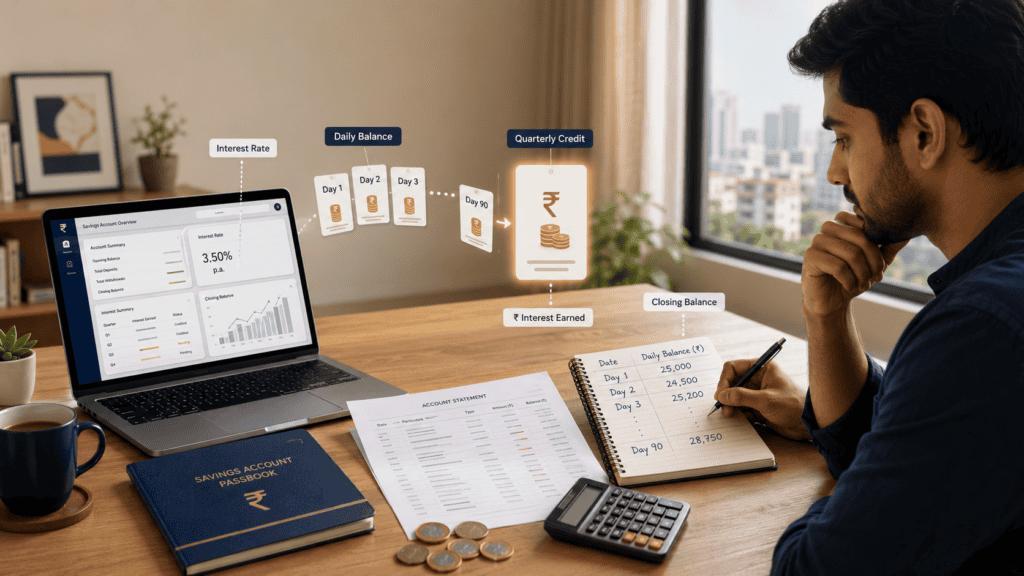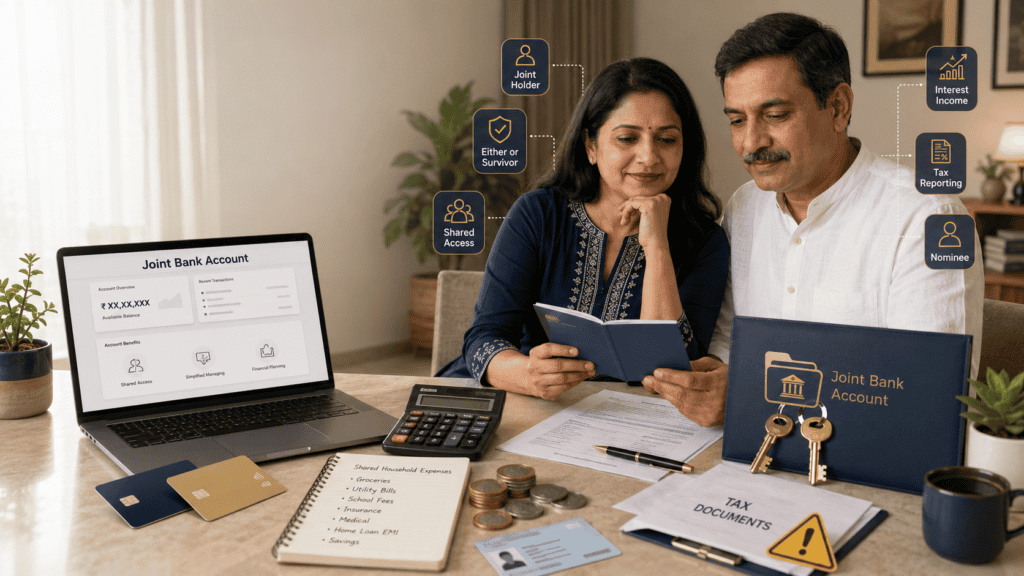

You open your first bank account. The branch executive asks whether you want a regular savings account or a zero balance account. You nod at the second option — because “zero balance” sounds like no hassle, no fees, no stress. Then, three months later, a charge shows up on your statement you never expected.
This happens to thousands of Indians every year — students, new job holders, homemakers, and salaried employees who assumed zero balance means zero cost. The truth is more nuanced. Zero balance account vs savings account is not simply a free vs paid choice. It is a choice between two different account structures with different rules, different limits, and different use cases depending on your income and banking habits.
This article breaks down exactly what each account type is, what charges can still apply, and which one actually suits your situation — whether you are receiving a salary, building an emergency fund, or just need a simple UPI-linked account.
Quick Answer: Zero Balance Account vs Savings Account
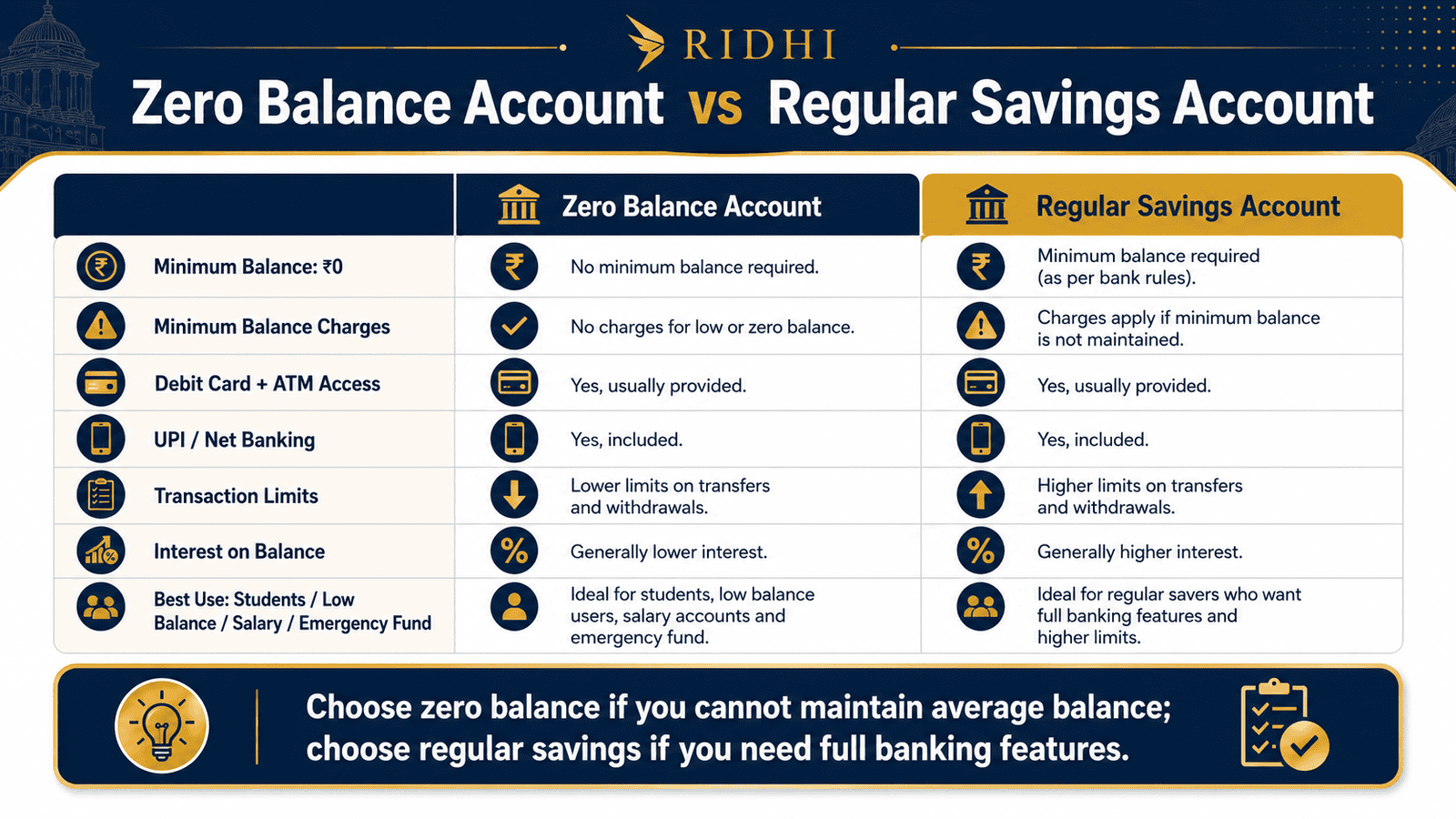
Zero balance account vs savings account mainly differs in minimum balance rules. A zero balance account allows ₹0 minimum balance, while a regular savings account may require monthly or quarterly average balance. Choose zero balance for low-balance use, and regular savings for broader banking features. Terms differ significantly by bank and account variant — always verify the current schedule of charges directly with your bank before opening.
Key Takeaways
- A zero balance account removes the minimum balance requirement — but charges for debit cards, ATM usage, SMS alerts, or account closure can still apply at many banks.
- A regular savings account typically requires a monthly or quarterly average balance (often ₹1,000–₹10,000 depending on the bank and branch type); failing to maintain it can attract penalty charges.
- BSBDA (Basic Savings Bank Deposit Account) is an RBI-mandated account type with specific restrictions — it is not the same as every bank’s promotional “zero balance” account.
- Salary accounts offered by employers are often zero balance accounts, but they may convert to regular savings accounts if salary credit stops for a defined period — check this condition with your bank.
- Both account types earn savings interest, though the rate and credit frequency vary by bank — verify current rates directly from the bank’s official site.
- Before choosing, download and read the bank’s schedule of charges — marketing terms like “free” or “zero balance” do not always mean the same thing across banks.
Zero Balance Account vs Regular Savings Account: Side-by-Side Comparison
| Parameter | Zero Balance Account | Regular Savings Account |
|---|---|---|
| Minimum Balance Required | ₹0 | ₹1,000–₹10,000+ (varies by bank and branch) |
| Non-Maintenance Penalty | None | Applicable if AMB/QAB falls short |
| Debit Card / ATM Access | Basic debit card usually provided; ATM limits may vary | Full debit card access; annual fee may apply |
| UPI and Net Banking | Available at most banks | Available |
| Transaction Limits | BSBDA: restricted (4 free withdrawals/month per RBI); promotional zero balance: varies | Higher limits; varies by bank and account tier |
| Savings Interest | Yes — rate varies by bank | Yes — rate varies by bank |
| Account Closure Charges | May apply within a certain period | May apply within a certain period |
| Best Suited For | Students, low-income earners, irregular income, first-job holders | Salaried employees with stable income, emergency fund holders, full-feature banking users |
Note: All charges, free limits, and features vary by bank, branch type (urban/rural), and account variant. Verify the current schedule of charges from your bank before opening an account.
Key Facts at a Glance
| Feature | Details | Verify At |
|---|---|---|
| Minimum Balance — Zero Balance Account | ₹0 (no penalty for low or nil balance) | Bank’s official schedule of charges |
| Minimum Balance — Regular Savings Account | Typically ₹1,000–₹10,000 AMB or QAB depending on bank and branch | Bank’s official schedule of charges |
| BSBDA Transaction Limit | 4 free withdrawals per month (including ATM); per RBI guidelines | rbi.org.in |
| Savings Interest — Both Account Types | Generally 2.5%–4% per annum as of recent data; varies by bank | Bank’s official website |
| DICGC Deposit Insurance | Up to ₹5 lakh per depositor per bank (covers savings accounts) | dicgc.org.in |
| Ideal User — Zero Balance | Students, homemakers, irregular income earners, first-job holders | — |
| Ideal User — Regular Savings | Stable-income earners, emergency fund holders, full-feature banking users | — |
What Is a Zero Balance Account and What Is a Regular Savings Account?
The confusion between these two account types is partly a marketing problem. Banks use “zero balance account” as a broad label, but the actual account structure underneath can differ significantly. Before you pick one, you need to understand what each term actually means in Indian banking practice.
What Does a Zero Balance Account Mean?
A zero balance account is a savings account where the bank does not require you to maintain any minimum balance. You will not be penalised if your account balance drops to ₹0. This is useful for users with irregular income, students receiving occasional pocket money, or people who use one account purely for UPI transactions and let another account hold savings.
However, “zero balance” is a minimum-balance rule, not a blanket guarantee of zero charges. Banks can still charge you for a physical debit card, for exceeding ATM withdrawal limits, for SMS alerts, for account closure within a certain period, or for value-added services. Always read the schedule of charges — not just the marketing headline.
What Is a Regular Savings Account?
A regular savings account is the standard bank account that requires you to maintain a minimum average balance — usually called Average Monthly Balance (AMB) or Quarterly Average Balance (QAB). The required amount varies widely: urban branches of large private banks may require ₹5,000–₹10,000, while rural or semi-urban branches of public sector banks may require ₹500–₹1,000.
If your balance falls below the required threshold, the bank charges a non-maintenance penalty. These penalties can range from ₹100 to ₹600 per quarter or more, depending on the bank. Understanding savings interest calculation can also help you evaluate how much your idle balance actually earns before deciding which account to maintain.
The Three Types You Need to Distinguish
Not all zero balance accounts are the same, and this is where most beginners get confused. There are three distinct structures you will encounter in India:
BSBDA (Basic Savings Bank Deposit Account): This is a formally defined account type under RBI guidelines. It is available to all Indian residents. It has a zero minimum balance requirement, but it also comes with specific restrictions — including a limit of four free withdrawals per month (including ATM transactions). If you hold a BSBDA, you cannot simultaneously hold another regular savings account at the same bank.
Salary Account: Many employers open salary accounts for employees with large private or public sector banks. These are typically zero balance accounts as long as salary is credited. However, if salary credit stops — usually for three consecutive months, though the exact period varies by bank — the account may automatically convert to a regular savings account, making minimum balance rules applicable. Always confirm this conversion trigger with your employer’s bank before joining.
Promotional Zero Balance Savings Account: Several banks offer zero balance accounts as part of campaigns or digital banking products. These are not BSBDA accounts, and their features, transaction limits, and charges can vary significantly. Some may offer more flexibility than BSBDA but fewer features than a full regular savings account.
How Average Monthly Balance Actually Works
AMB is not the balance you hold on a single day. It is the average of your end-of-day balances across the calendar month. So if your account holds ₹10,000 for the first 15 days of the month and ₹0 for the remaining 15 days, your AMB is ₹5,000. If your bank requires ₹5,000 AMB, you just barely passed. One more day at ₹0 and you would have fallen short and attracted a penalty charge.
QAB works similarly but averages across a full quarter (three months). Understanding this calculation matters because many account holders think they are compliant, but their end-of-month balance looks healthy while their daily average does not reflect that.
Real Example: Riya in Pune Decides Which Account to Open
Riya is 24, lives in Pune, and has just started her first job as a junior analyst earning ₹35,000 per month. Her HR team asks whether she wants the company’s default salary account or whether she has an existing account to link.
Riya currently has a zero balance account she opened as a student when her balance often dropped to ₹1,500–₹3,000. That account serves her UPI payments and monthly subscriptions. She wants to know if she should use it for salary or open the employer’s salary account.
Using the emergency fund calculator, Riya estimates she needs roughly ₹1,05,000 as a three-month emergency buffer (₹35,000 × 3). She decides she needs two accounts: one for daily transactions and UPI, and one to park her emergency fund.
Her plan: accept the employer’s salary account (zero balance, full features) for monthly salary credit, UPI, and debit card use. Open or upgrade a second regular savings account for emergency savings, where she is comfortable maintaining a ₹5,000 AMB given her ₹35,000 income. Her student zero balance account is closed to avoid maintaining idle accounts with forgotten balances.
Key insight: Riya’s decision is not about which account type is universally better — it is about matching the right account structure to each specific use case in her financial life.
How to Decide What’s Right for You
Your income is irregular or you often run a low balance — a zero balance account removes the risk of non-maintenance penalties entirely and may suit you well.
Your employer offers a salary account — accept it as your primary transaction account. It is typically zero balance with full features. Confirm the conversion rule if salary stops.
You earn a stable monthly salary and can comfortably keep ₹5,000–₹10,000 idle in an account — a regular savings account may offer broader features, fewer restrictions, and potentially better relationship benefits with the bank.
You want to park your emergency fund in a bank account — use a regular savings account with good liquidity and no access restrictions. Check ATM limits and transfer rules before committing your emergency buffer. Build your emergency savings before you need it.
You are a student or homemaker with limited and unpredictable transactions — a BSBDA or zero balance account removes minimum balance pressure and is well suited to lower-volume banking needs.
You already hold a BSBDA and want to open a regular savings account at the same bank — RBI guidelines do not permit holding both simultaneously. You will need to upgrade or close one before opening the other.
You do not use an account regularly and have left it dormant for months — neither a zero balance nor a regular savings account is ideal for parking forgotten money. Dormant accounts can still attract charges, and access may be restricted.
Common Mistakes to Avoid
Assuming Zero Balance Means Zero Charges
Zero balance removes the minimum average balance requirement — nothing more. Charges for debit card issuance, annual debit card fees, ATM withdrawals beyond free limits, SMS alert fees, and account closure within the first year can still apply.
A reader who opens a zero balance account expecting absolutely no fees can be surprised by a ₹150–₹500 annual debit card charge or a ₹23.60 per ATM withdrawal fee beyond the free limit. Read the schedule of charges before opening. Avoid balance penalties by understanding which charges are linked to balance requirements and which are not.
Download the schedule of charges from the bank’s website, not from a third-party comparison site.
Not Understanding the AMB or QAB Calculation
Many regular savings account holders believe they are compliant because their end-of-month balance looks healthy. But AMB is the average of daily end-of-day balances — not the snapshot on the last day of the month.
If you withdraw large sums mid-month and leave the account thin for 10–15 days, you can fall below the required AMB even if your balance recovers by the 30th. Some banks charge ₹200–₹600 per quarter for non-maintenance; over a year, that is ₹800–₹2,400 lost to an avoidable oversight.
Track your daily balance if you have a regular savings account with AMB requirements, especially in months with large expenses.
Ignoring the Salary Account Conversion Rule
A salary account feels like a permanently free account. But most banks convert it to a regular savings account — with minimum balance requirements — if salary is not credited for a defined period, typically two to three consecutive months.
If you change jobs, take a sabbatical, or move to a freelance arrangement, your salary account can quietly become a regular savings account. You may not receive a clear notification before the conversion, and non-maintenance charges can begin accumulating. Confirm the conversion rule with your bank when you open the account.
Opening Multiple Accounts Without a Clear Purpose
Some people open two or three accounts across banks — one for UPI, one for salary, one from a previous job — and then forget to monitor them. A dormant account can attract charges. It can also be flagged as inactive after 12–24 months of zero transactions, requiring branch visits to reactivate.
Keep the number of active accounts purposeful: one for daily transactions, one for savings or emergency funds. Close accounts you no longer use through the proper channel to avoid issues with dormancy rules or unclaimed balances.
Confusing BSBDA With a General Zero Balance Account
BSBDA is a specific account type governed by RBI guidelines. It has a formal transaction limit (four free withdrawals per month, including ATM), and you cannot hold another savings account at the same bank simultaneously.
A promotional zero balance account offered by a digital bank or a salary account with zero balance features is not a BSBDA. The features, limits, and restrictions can be very different. Do not assume the rules are the same — always confirm the account type when you open it.
Keeping a Large Idle Balance in a Low-Interest Savings Account
Savings accounts typically earn 2.5%–4% per annum as of recent data, depending on the bank. If you are consistently keeping ₹50,000 or more idle in a savings account out of habit rather than liquidity need, you may be losing the opportunity to earn more through other suitable instruments.
This is not an investment recommendation — it is a prompt to review whether your account choice is aligned with how much money you are actually keeping there and whether a different structure (such as a sweep-in FD) might be worth exploring with your bank.
When This May Not Be the Right Choice
A standard zero balance account or basic regular savings account may not be the right fit in every situation. Consider these scenarios carefully:
If you consistently hold ₹50,000 or more as idle liquid savings, a plain savings account may not offer the most efficient structure for that money. A sweep-in FD arrangement — where excess balance above a set threshold is automatically moved into a fixed deposit — may be worth discussing with your bank. It keeps your money accessible while potentially earning better returns.
If you run a small business, freelance, or receive multiple payment sources, mixing business income with a personal savings account can create complexity in tracking expenses and may attract scrutiny depending on transaction volume and source. A separate account structure may suit you better.
If you need premium banking services — relationship manager access, higher transfer limits, locker facility, or preferential loan processing — a basic zero balance account or an entry-level regular savings account may be too limited. Banks typically offer these features at higher-tier account variants with correspondingly higher minimum balance requirements.
If you make a high volume of transactions regularly and your account is a BSBDA, the four free withdrawals per month restriction may not be compatible with your actual banking habits.
If any of these apply to your situation, it may be worth exploring alternatives before committing.
Official Rules and Where to Verify
Banking rules, minimum balance requirements, transaction limits, and schedule of charges are subject to change by the RBI and by individual banks without prior public notice. Do not rely on marketing materials, comparison aggregators, or this article alone for the current terms. Always verify directly from official sources before opening or switching an account.
Key sources to check:
- Reserve Bank of India (RBI) — rbi.org.in: For BSBDA guidelines, basic savings account norms, and circulars on minimum balance charges and customer rights in banking.
- Your bank’s official website — Schedule of Charges section: For current minimum balance requirements, debit card fees, ATM withdrawal limits, SMS alert charges, and account closure fees specific to your account type and branch location.
- DICGC — dicgc.org.in: For deposit insurance coverage details. As of recent data, deposits up to ₹5 lakh per depositor per bank are covered under the DICGC scheme — verify current limits from the official site.
- Income tax angle: Savings account interest is taxable. Understanding the savings interest deduction rules under Section 80TTA and 80TTB will help you determine how much of your interest income is deductible when filing your return.
Rules, limits, and rates on this topic can change with each Budget or regulatory update. Always verify current figures directly from the official source before making any financial decision.
Expert Tips
- Before you open any account, download the bank’s Schedule of Charges document — not a summary page, the full PDF. Look specifically for: debit card annual fee, ATM free limit per month, non-maintenance penalty amount, and account closure charges within 12 months. Five minutes of reading can save you ₹500–₹2,000 per year.
- If your employer provides a salary account, find out in writing — or in the account-opening terms — what happens when salary credit stops. The conversion from zero balance to regular savings account is a known catch that many first-job employees miss.
- Run one account for daily transactions (UPI, debit card, subscriptions) and a separate account for emergency savings. This separation makes it easier to avoid accidentally spending your emergency buffer and helps you track your spending more clearly.
- If you are keeping a balance consistently above ₹1 lakh in a savings account for liquidity, consider asking your bank about a sweep-in FD arrangement. It keeps the money liquid but may earn a better rate than standard savings interest — terms vary by bank, so verify current sweep-in rates before activating.
- Review all your bank accounts once every six months. Identify accounts with no transactions in the past three months. Close the ones you no longer need — dormant accounts can attract charges and create KYC compliance complications later.
- If you travel or shop internationally, check whether your zero balance account debit card has forex markup charges. These are often higher on basic account debit cards than on premium variants. If international use is a frequent need, confirm the markup percentage from the card’s specific terms.
- For students and first-time account holders, a BSBDA is an RBI-backed option with no minimum balance and no promotional condition attached — unlike some bank-run zero balance schemes that may have limited tenure or conditions. Confirm the account type explicitly at the time of opening.
Frequently Asked Questions
Is a zero balance account the same as a regular savings account?
Both are savings accounts, but they differ in minimum balance rules. A zero balance account does not require you to maintain any average balance, while a regular savings account requires a minimum average monthly or quarterly balance. Features, transaction limits, and applicable charges can also differ depending on the bank and account type.
Is BSBDA the same as a zero balance account?
Not exactly. BSBDA (Basic Savings Bank Deposit Account) is a specific account type governed by RBI guidelines. It has a zero minimum balance requirement, but it also comes with formal restrictions — including four free withdrawals per month (including ATM). Not all zero balance accounts are BSBDA accounts. Banks also offer promotional zero balance accounts that operate under different rules. Confirm the account type when opening.
Can salary be credited to a zero balance account?
Yes. Many employers credit salaries into zero balance accounts, which are specifically designated as salary accounts. These typically offer full banking features. However, if salary credit stops, the account may convert to a regular savings account after a defined period — usually two to three months. Check this condition with your bank.
Does a zero balance account earn interest?
Yes. Zero balance savings accounts earn savings interest, just like regular savings accounts. The interest rate depends on the bank’s current offering and is applied to the daily balance. As of recent data, rates generally range from 2.5% to 4% per annum — verify the current rate from your bank’s official website before opening.
Can banks charge fees on zero balance accounts?
Yes. Zero balance removes the minimum balance requirement and its associated non-maintenance penalty. But banks can still charge for debit card issuance, annual debit card renewal, ATM withdrawals beyond the free limit, SMS alerts, account closure within a set period, and other services. Always read the schedule of charges before opening the account.
Which account is better for students?
For students with low or irregular balances, a zero balance account — including BSBDA — is generally more practical. It removes the risk of non-maintenance penalties. However, BSBDA comes with a four free withdrawal per month limit, which may be restrictive for active UPI and ATM users. Confirm the transaction limit and debit card terms before choosing.
Which account is better for holding an emergency fund?
A regular savings account with no restrictions on withdrawals is generally more suitable for an emergency fund, provided you can comfortably maintain the minimum balance. Instant access, no withdrawal caps, and UPI compatibility are what matter most for emergency money. Avoid using a BSBDA for emergency savings given its withdrawal limit. Verify the account’s ATM and transfer limits before committing your emergency buffer to it.
Can I hold a BSBDA and a regular savings account at the same bank?
No. RBI guidelines state that a customer cannot simultaneously hold a BSBDA and another savings account at the same bank. If you already have a savings account and want to open a BSBDA at the same bank, you will need to close or convert the existing one first.
What happens if I don’t maintain the minimum balance in a regular savings account?
The bank charges a non-maintenance penalty. The amount varies by bank and branch type — urban branches of private banks tend to charge more. Charges can range from ₹100 to ₹600 per quarter. Over a year, that is ₹400–₹2,400 in avoidable costs. The penalty is typically applied monthly or quarterly, and the bank is required to notify customers about such charges per RBI guidelines.
Is it safe to keep money in a zero balance account?
Yes. Both zero balance accounts and regular savings accounts at scheduled commercial banks are covered under the DICGC deposit insurance scheme up to ₹5 lakh per depositor per bank. This means even if a bank fails, deposits up to that limit are protected. Verify the current DICGC coverage limit at dicgc.org.in before relying on this figure.
Final Verdict
The zero balance account vs savings account decision is not about which one is universally better — it is about which structure matches your actual banking behaviour. If your balance drops frequently, you are new to employment, or you want a dedicated UPI transaction account without the stress of maintaining a minimum average balance, a zero balance account is a practical and sensible choice. If you earn a stable income, can comfortably maintain the required AMB, and want fuller banking features or a reliable emergency fund home, a regular savings account is likely more suitable.
Do not confuse BSBDA, salary accounts, and promotional zero balance accounts — each has different rules and restrictions. A salary account can convert to a regular savings account when salary stops. A BSBDA limits you to four free withdrawals per month. A promotional zero balance account may have conditions attached. Before opening any account, read the schedule of charges, confirm the account type, and verify the minimum balance and transaction limits from the bank directly — not from a third-party aggregator.
Always verify the latest rules from official sources or consult a qualified professional before making any financial decision.
This article is for educational purposes only and should not be treated as personalised financial, tax, investment, insurance, or legal advice. Tax rules, interest rates, regulatory limits, and product features can change with each Budget or policy update. Please verify current rules from official government sources or consult a qualified and registered professional before making any financial decision.

Meera Iyer writes about banking, fixed deposits, recurring deposits, savings accounts, emergency funds, senior citizen deposits, and safe cash management for Indian readers. Her work is especially useful for families, retirees, conservative savers, and beginners who want to understand where to keep short-term or low-risk money.
She covers topics such as FD meaning, FD calculator, RD calculator, FD vs RD, simple interest vs compound interest, savings account interest, sweep-in FD, premature FD withdrawal, senior citizen FD rules, TDS on FD interest, Form 15G, Form 15H, joint account rules, zero balance accounts, minimum balance charges, small finance bank FDs, post office FD vs bank FD, and emergency fund planning.
Meera’s content focuses on safety, liquidity, taxation, and practical decision-making. She avoids hype and explains both benefits and limitations of banking products. Since deposit interest rates, TDS rules, penalty charges, DICGC coverage, and bank policies can change, readers should always confirm the latest details from their bank, RBI, DICGC, India Post, or relevant official sources before making decisions.