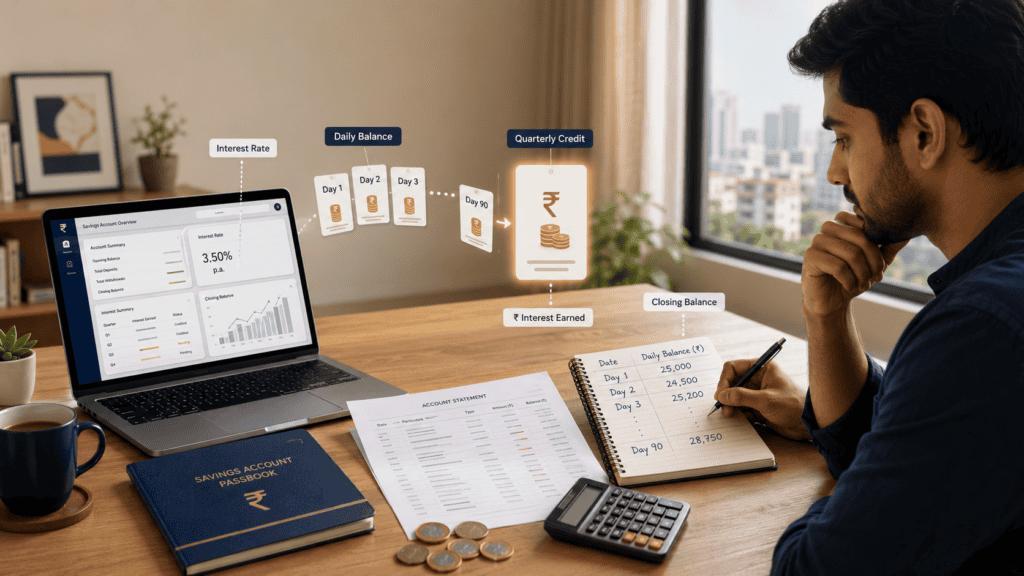

Your salary hits on the 1st. Rent goes out on the 5th. The EMI clears on the 10th. By the 15th, your savings account balance is looking thin — and by the end of the month, you notice a deduction you didn’t make. The bank has charged you a minimum balance penalty. No notification you noticed. No approval you gave. The money is simply gone.
Minimum balance charges are one of the most common — and most avoidable — bank fees for salaried employees and families in India. This article explains exactly what these charges are, how the average monthly balance calculation works, which account types are affected, and what practical steps you can take to stop the deductions. Rules differ by bank and account type, so you will also find guidance on where to verify your specific account’s terms before acting.
Quick Answer: Minimum Balance Charges
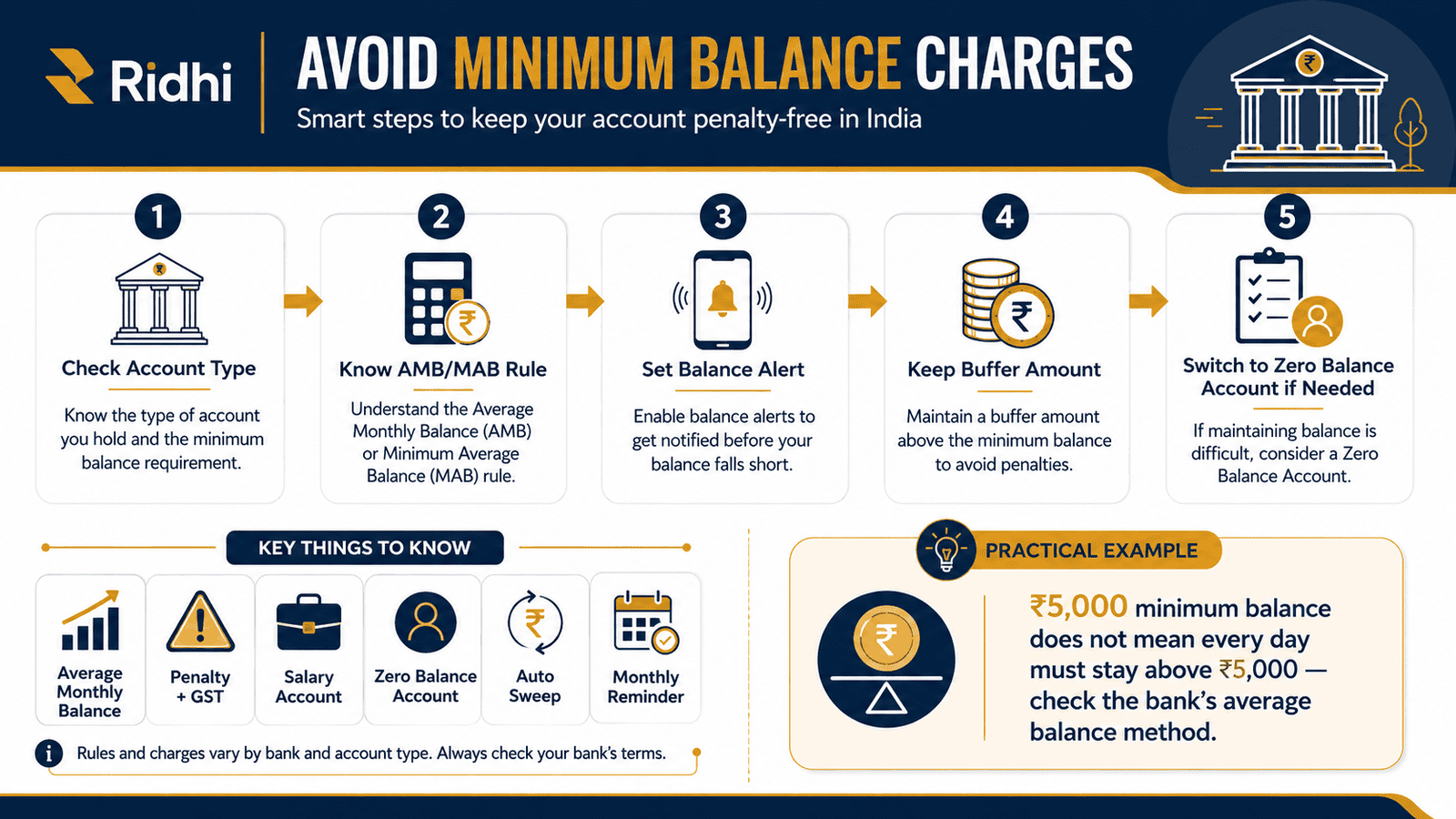
Minimum balance charges are bank penalties applied when a savings account does not meet the required average balance for the month or quarter. To avoid them, check your account’s AMB/MAB rule, keep a small buffer, set alerts, or switch to a zero balance account if your bank allows it.
Key Takeaways
- Minimum balance charges are triggered by failing to maintain an Average Monthly Balance (AMB) or Monthly Average Balance (MAB) — not just by a single low-balance day.
- The required AMB and the penalty amount vary by bank, account type, and branch location (metro, urban, semi-urban, or rural) — there is no single RBI-mandated figure for all savings accounts.
- Zero balance accounts and Basic Savings Bank Deposit Accounts (BSBDAs) are exempt from minimum balance requirements under RBI guidelines.
- Salary accounts typically have no minimum balance requirement while the employer credits salary — but many convert to regular savings accounts if salary credits stop for two or three consecutive months, depending on the bank’s terms.
- GST is added on top of the non-maintenance penalty charged by the bank, increasing your actual deduction.
- Setting a low-balance SMS or app alert costs nothing and is the single most effective daily habit to prevent surprise deductions.
Key Facts at a Glance
| Term | What It Means | Key Point |
|---|---|---|
| Minimum Balance | Lowest average balance a savings account must maintain over a period | Set by each bank, not uniformly by RBI |
| AMB / MAB | Average Monthly Balance — sum of daily closing balances ÷ days in month | Not the same as month-end balance |
| QAB | Quarterly Average Balance — used by some banks instead of monthly | Check your account terms to know which applies |
| Non-Maintenance Penalty | Charge levied when AMB/MAB falls below the required level | Varies by shortfall amount and account type |
| BSBDA | Basic Savings Bank Deposit Account — RBI-defined account with no minimum balance | Limited transactions per month; available at most banks |
| Zero Balance Account | Savings account with no minimum balance requirement | Salary accounts and Jan Dhan accounts often qualify |
| GST on Charges | Goods and Services Tax applied on top of the non-maintenance penalty | Increases total deduction beyond the stated penalty |
| Schedule of Charges | Bank-published document listing all fees, including minimum balance penalties | Available on bank website; updated periodically |
What Are Minimum Balance Charges?
When you open a savings account with a bank, the account comes with a set of terms — and one of the most important is the minimum balance requirement. This is the average balance your account must maintain over a month or a quarter. If your account falls below this average, the bank deducts a non-maintenance penalty. This deduction is called a minimum balance charge or an AMB/MAB charge.
The key word is average. Most banks do not check your balance on a single day. They calculate your Average Monthly Balance (AMB) or Monthly Average Balance (MAB) — and some banks use a Quarterly Average Balance (QAB) instead. This distinction matters enormously for anyone whose salary comes in bursts and goes out in chunks.
AMB vs MAB vs QAB — What Is the Difference?
AMB and MAB refer to the same concept: the average of your account’s daily closing balances over a calendar month. QAB does the same calculation across a full quarter (three months). If your bank uses QAB, one high-balance month can offset two low-balance months — giving you more flexibility but also making the penalty calculation harder to track manually.
To understand how your savings account earns interest while also being subject to these maintenance rules, it helps to read about savings account interest and how banks calculate it. The same daily balance figure that determines your interest also feeds into your AMB calculation.
Why Do Banks Impose Minimum Balance Charges?
Banks incur a cost for every account they maintain — transaction infrastructure, customer service, branch operations, and regulatory compliance. The minimum balance requirement is how banks recover a portion of this cost from accounts that generate low transaction revenue. According to RBI’s guidelines on customer service, banks are permitted to set their own minimum balance requirements and associated charges, provided they clearly disclose them in their schedule of charges and notify customers in advance of any changes.
Does RBI Set a Universal Minimum Balance?
No. The Reserve Bank of India does not prescribe a single minimum balance amount that applies to all savings accounts across all banks. Each bank publishes its own requirements, which vary by account type and branch classification — metro, urban, semi-urban, or rural. A savings account at a metro branch of one private sector bank may carry a significantly different AMB requirement than the same bank’s account at a rural branch. Always verify your specific account’s terms from the bank’s current schedule of charges on their official website.
Account Type Changes the Rule Entirely
Whether you face minimum balance charges at all depends heavily on what type of account you hold:
- Regular savings account: Subject to AMB/MAB requirements as published by the bank.
- Salary account: Typically has no minimum balance requirement while a qualifying employer credits salary regularly. Check conversion rules if salary credits stop.
- Zero balance account: No minimum balance required. May have transaction or feature limits.
- Basic Savings Bank Deposit Account (BSBDA): RBI-defined account type with no minimum balance requirement and a basic set of free services. Transaction limits apply.
- Premium savings account: Usually has a higher AMB requirement but may offer premium features such as complimentary lockers, airport lounge access, or higher transaction limits.
Real Example: Rohit’s Surprise Penalty in Pune
Rohit, 29, works as a private-sector executive in Pune earning ₹55,000 per month. His savings account at a private bank (metro branch) has an AMB requirement of ₹10,000. His salary is credited on the 1st of each month.
Here is what happened in October:
- 1st October: Salary credited — balance reaches ₹42,000.
- 5th October: Rent paid — balance drops to ₹18,000.
- 10th October: EMI deducted — balance drops to ₹9,500.
- 15th–31st October: Small daily spends reduce balance gradually to ₹6,200.
Rohit checked his balance on the 31st and saw ₹6,200 — well above what he thought was a ₹5,000 minimum. He assumed he was safe. But the bank calculated the AMB across all 31 days. The high opening balance of ₹42,000 in the first four days helped, but the long stretch of ₹9,500–₹6,200 over 21 days pulled the average down significantly. Rohit’s calculated AMB for October came in just below ₹10,000, and a non-maintenance penalty was deducted in November.
The lesson: checking only your month-end balance tells you almost nothing about whether you will be charged. The full month’s daily average is what counts.
How to Calculate Your Average Monthly Balance
AMB = Sum of Daily Closing Balances ÷ Number of Days in the Month
Using a simplified 30-day example with three balance periods:
| Period | Balance | Days × Balance |
|---|---|---|
| Day 1–5 (5 days) | ₹40,000 | ₹2,00,000 |
| Day 6–10 (5 days) | ₹15,000 | ₹75,000 |
| Day 11–30 (20 days) | ₹8,000 | ₹1,60,000 |
Total = ₹2,00,000 + ₹75,000 + ₹1,60,000 = ₹4,35,000
AMB = ₹4,35,000 ÷ 30 = ₹14,500
In this example, the AMB of ₹14,500 would comfortably meet a ₹10,000 requirement. But if the Day 11–30 balance had been ₹3,000 instead of ₹8,000, the AMB would drop to ₹9,167 — falling short and triggering a penalty.
Some banks calculate AMB differently — for example, using end-of-day balances versus intra-day balances, or rounding methods. Always refer to your bank’s actual schedule of charges and calculation methodology. Do not assume the formula above matches your specific account.
Comparison: Account Types and Minimum Balance Risk
| Account Type | Minimum Balance Required? | Best For |
|---|---|---|
| Regular Savings Account | Yes — varies by bank & branch | Users with stable monthly cash flow |
| Salary Account | No — while salary credited | Salaried employees with active employer link |
| Zero Balance Account | No | Users with irregular income or low cash flow |
| BSBDA | No — RBI mandated | Users needing basic banking with no fee risk |
| Premium Savings Account | Yes — higher than regular | Users who use premium features actively |
To understand the full trade-offs between regular savings and zero balance accounts, see zero balance account vs savings account: difference and best use.
How to Decide What’s Right for You
Your account is your primary salary account and your employer credits salary regularly — THEN check your bank’s conversion policy before worrying about AMB; most salary accounts carry no minimum balance requirement while salary is credited.
Your salary credits have stopped or you have changed jobs and not updated your account — THEN check immediately whether your bank has converted your account to a regular savings account with an AMB requirement.
You regularly run short of balance in the last 10 days of the month — THEN a zero balance account may eliminate penalty risk entirely, at the cost of potentially fewer free transactions or premium features. See zero balance account vs savings account to compare.
The account is secondary and you rarely use it — THEN consider either closing it properly (after clearing all UPI links, EMI mandates, and auto-debits) or downgrading to a BSBDA to eliminate maintenance charges entirely.
You need high transaction volumes, branch access, or locker facilities — THEN a premium savings account may justify its higher AMB if you actively use those features; compare the annual cost of penalties on a regular account versus the premium account’s benefits.
You cannot reliably maintain the AMB and the account’s features do not justify the risk — THEN keeping a high-AMB regular savings account is not the right choice; switching account type or bank is cheaper than recurring penalties.
Common Mistakes to Avoid
Checking Only the Month-End Balance
Looking at your balance on the last day of the month tells you nothing about your AMB. Your average is calculated across every day of the month. A high opening balance that drops quickly after salary day may still result in a low average. Check your AMB mid-month, not just at the end.
Keeping Multiple Inactive Accounts
Every dormant savings account with an AMB requirement will quietly accumulate penalties month after month. Many people open accounts for a job, a bank offer, or a loan — and forget to close them. Each inactive account is a slow drain. Review all your bank accounts once a quarter and close any you no longer need. Before closing, check for linked EMIs, UPI IDs, SIP mandates, and investments. Use the emergency fund calculator to understand how much usable cash you actually need, separate from any minimum balance.
Ignoring Bank Alerts and Notifications
Most banking apps let you set a low-balance alert for free. An SMS or push notification when your balance drops below a threshold — say, 20% above your required AMB — gives you days to act before the penalty is triggered. Not enabling this alert is simply leaving money on the table.
Treating Minimum Balance as Emergency Savings
If your required AMB is ₹10,000 and you also treat that ₹10,000 as your emergency backup, you will spend it during a genuine emergency and immediately risk a penalty. Your emergency fund and your minimum balance requirement are two separate needs. Keeping them in the same mental bucket is the surest way to trigger recurring charges.
Forgetting That Salary Account Benefits Can Lapse
Salary accounts lose their zero-balance privilege if the employer stops crediting salary. Most banks convert the account to a regular savings account after two or three consecutive months without a salary credit, depending on the bank. If you change jobs, resign, or take a break, ask your bank what happens to your account status immediately.
Not Factoring GST Into the True Cost of the Penalty
The penalty figure quoted in the schedule of charges is the base amount. GST is added on top, which means the actual deduction from your account is higher than the listed penalty. When comparing accounts, always factor in the all-inclusive cost, not just the headline penalty figure.
Assuming Rural and Metro Accounts Work the Same Way
Branch classification — metro, urban, semi-urban, rural — changes both the required AMB and the penalty amount at the same bank. If you opened your account in a metro branch and now live elsewhere, or vice versa, verify which classification governs your account’s current terms.
When This May Not Be the Right Choice
Maintaining a regular savings account with an AMB requirement may not suit your situation in several specific cases:
Irregular or variable income: Freelancers, gig workers, or anyone whose monthly income is unpredictable will struggle to maintain a consistent AMB. A zero balance account or BSBDA is a safer choice than a regular savings account that charges penalties in low-income months.
Secondary accounts you rarely use: If an account exists only as a backup and has minimal transactions, the AMB requirement creates ongoing cost for near-zero benefit. Closing or downgrading is likely the smarter decision.
Family or joint accounts where responsibility is unclear: When two or more people share a joint account, it is easy for both parties to assume the other is managing the balance. Understanding joint account rules in India helps families clarify who is responsible for ensuring the AMB is met.
High-AMB accounts with no matching benefits: Some premium savings accounts require a high AMB in exchange for features you may not use — lounge access, concierge services, or relationship manager support. If you do not use those features, you are paying for them through penalty risk rather than enjoying them.
If any of these apply to your situation, it may be worth exploring alternatives before committing.
Official Rules and Where to Verify
There is no single RBI-mandated minimum balance figure that applies to every savings account. The Reserve Bank of India has issued guidelines on customer service and deposit accounts, but the specific balance requirements and penalty amounts are set by individual banks and vary by account type and branch classification.
Rules, limits, and rates on this topic can change with each Budget or regulatory update. Always verify current figures directly from the official source before making any financial decision.
- Reserve Bank of India: rbi.org.in — for customer service guidelines, BSBDA rules, and deposit account regulations.
- Your bank’s official website: Look for “Schedule of Charges” or “Service Charges” under the savings account section. This document lists current AMB requirements, penalty amounts, and free service limits by account type and branch location.
- Your bank’s account terms and conditions: Available at account opening or on request at any branch.
- Customer grievance channel: If a penalty appears incorrect or was not disclosed in advance, raise a complaint through your bank’s grievance cell. If unresolved, the RBI Integrated Ombudsman Scheme (rbi.org.in/ombudsman) provides escalation.
Expert Tips
- Keep a buffer of at least 20–25% above the required AMB. If your account requires ₹10,000, aim to keep ₹12,000–₹12,500 as your floor. A single large debit can push you below ₹10,000 instantly; the buffer gives you a recovery window.
- Set a low-balance alert in your banking app today. Set it at your buffer level — not at the AMB requirement itself. This gives you advance warning before the penalty threshold is reached, not after.
- Audit all your bank accounts every quarter. List every account, note the AMB requirement, check whether it is active or dormant, and close any account that is costing more than it is worth. This takes 30 minutes per year and can save thousands in avoidable charges.
- If you use an auto-sweep facility, understand how it affects your minimum balance. A sweep-in FD can earn better interest on surplus funds, but it may also reduce the balance available in your savings account if the sweep threshold is set too low. Read about sweep-in FD: what it means and how it works before enabling this feature.
- Build a separate emergency fund — do not rely on your minimum balance. Your AMB is not your safety net. Building a genuine emergency fund keeps your savings account balance stable, reduces penalty risk, and gives you real financial security. Start with how to build a 6-month emergency fund in India as your first step.
- If you change jobs, call your bank on your last day. Ask whether your salary account will convert to a regular savings account and from which date. Do not assume the zero-balance privilege continues automatically after salary credits stop.
- Compare the total annual cost of penalties before switching to a premium account. If you are being charged non-maintenance penalties regularly, calculate the annual total including GST. Compare this against the AMB requirement of a different account type — sometimes a downgrade to a basic savings account saves more than switching banks entirely.
Frequently Asked Questions
What are minimum balance charges?
Minimum balance charges are penalties deducted by a bank when your savings account fails to maintain the required Average Monthly Balance (AMB) or Quarterly Average Balance (QAB) over the specified period. The amount charged varies by bank, account type, and the size of the shortfall. GST is added on top of the base penalty.
Is minimum balance checked on a single day or calculated as an average?
It is calculated as an average, not checked on a single day. Most banks use the Average Monthly Balance (AMB) — the sum of all daily closing balances in the month divided by the number of days. Some banks use a Quarterly Average Balance (QAB) instead. A high balance at month-start does not guarantee you will meet the requirement if the balance stays low for most of the month.
Does RBI decide the minimum balance for every bank?
No. RBI does not prescribe a universal minimum balance amount for all savings accounts. RBI issues guidelines on customer service and account types such as the Basic Savings Bank Deposit Account (BSBDA), but individual banks set their own AMB requirements and penalty amounts based on account type and branch classification. Always check your specific bank’s schedule of charges.
Can I avoid minimum balance charges by using a zero balance account?
Yes. Zero balance accounts — including salary accounts (while salary is credited) and Basic Savings Bank Deposit Accounts — do not have a minimum balance requirement. However, they may have limits on the number of free transactions per month or restrictions on account features. The trade-off depends on your usage pattern.
Do salary accounts have minimum balance charges?
Most salary accounts do not have a minimum balance requirement as long as the designated employer credits salary regularly. However, if salary credits stop for two or three consecutive months (the exact number depends on the bank’s policy), the account is typically converted to a regular savings account with an AMB requirement. Always check your bank’s specific conversion policy.
Can I ask the bank to reverse a minimum balance penalty?
You can raise a request. Many banks will reverse a charge on a one-time basis, especially if it is your first penalty or if you were not notified about a rule change in advance. Contact your bank’s customer care or visit the branch. If the charge was levied without adequate prior notice — as required under RBI customer service guidelines — you have a stronger case. Escalate to the bank’s grievance cell if the front-line request is denied.
Is GST added on top of the minimum balance penalty?
Yes. The penalty amount in the bank’s schedule of charges is the base figure before GST. The actual deduction from your account includes GST at the applicable rate on top of this base penalty. When comparing charges across banks or account types, always calculate the all-in amount, not just the headline penalty.
What is a Basic Savings Bank Deposit Account (BSBDA) and how is it different?
A BSBDA is an account type defined under RBI guidelines. It carries no minimum balance requirement and must offer a basic set of free services — including a certain number of free cash withdrawals and deposits per month, a RuPay debit card, and access to digital banking. The trade-off is a limit on the number of free transactions per month. Any bank offering savings accounts in India is required to offer the BSBDA option to customers who request it.
What happens if I ignore minimum balance charges for several months?
Penalties accumulate month after month. If the balance reaches zero or goes below a threshold, the account may be frozen or marked as dormant, making further transactions difficult until the outstanding charges are cleared. Some banks may also close the account after an extended period of non-maintenance. It is better to address the issue early — either by maintaining the balance, switching account type, or closing the account properly.
What should I check before closing an account to avoid future charges?
Before closing any savings account, verify that there are no linked UPI IDs, EMI mandates, SIP auto-debits, insurance premium auto-payments, or salary credits attached to that account. Failing to update these before closure can disrupt payments or create failed transaction fees. Move all active links to another account first, then request closure in writing or through the bank’s app.
Final Verdict
Minimum balance charges are entirely avoidable — but only if you understand your specific account’s AMB rule, not a general idea of what savings accounts require. The two steps that make the biggest practical difference are checking your bank’s current schedule of charges (not the internet’s version of it) and setting a low-balance alert so you get a warning before the penalty window closes.
If your balance regularly dips below the requirement, the fix is usually account type, not discipline. A zero balance account or a BSBDA eliminates the penalty risk entirely for users who cannot reliably maintain an average balance — and both are legitimate options available at most Indian banks.
Salaried employees should pay particular attention to salary account conversion rules, especially after a job change. And anyone holding multiple accounts should audit them every quarter — dormant accounts with AMB requirements are a slow, silent drain that adds up to real money over a year.
Always verify the latest rules from official sources or consult a qualified professional before making any financial decision.
This article is for educational purposes only and should not be treated as personalised financial, tax, investment, insurance, or legal advice. Tax rules, interest rates, regulatory limits, and product features can change with each Budget or policy update. Please verify current rules from official government sources or consult a qualified and registered professional before making any financial decision.

Meera Iyer writes about banking, fixed deposits, recurring deposits, savings accounts, emergency funds, senior citizen deposits, and safe cash management for Indian readers. Her work is especially useful for families, retirees, conservative savers, and beginners who want to understand where to keep short-term or low-risk money.
She covers topics such as FD meaning, FD calculator, RD calculator, FD vs RD, simple interest vs compound interest, savings account interest, sweep-in FD, premature FD withdrawal, senior citizen FD rules, TDS on FD interest, Form 15G, Form 15H, joint account rules, zero balance accounts, minimum balance charges, small finance bank FDs, post office FD vs bank FD, and emergency fund planning.
Meera’s content focuses on safety, liquidity, taxation, and practical decision-making. She avoids hype and explains both benefits and limitations of banking products. Since deposit interest rates, TDS rules, penalty charges, DICGC coverage, and bank policies can change, readers should always confirm the latest details from their bank, RBI, DICGC, India Post, or relevant official sources before making decisions.