

You are about to sign up for an EMI that will leave your account every month for the next five, ten, or twenty years. Before you do that, you need to know exactly how much you are paying — not just the monthly instalment, but the total you hand over to the lender by the time the loan closes. The EMI calculator India borrowers rely on gives you three numbers that matter: monthly EMI, total interest, and total repayment. This article explains how to use those numbers for a home loan, personal loan, or car loan — and how to decide whether the loan you are considering is actually affordable for your income and obligations.
Quick Answer: EMI Calculator India
EMI calculator India helps you estimate the monthly payment for a home loan, personal loan or car loan using loan amount, interest rate and tenure. For example, a ₹10 lakh loan over 60 months shows how EMI, total interest and total repayment change when the rate changes. Always check the total repayment figure — not just the monthly EMI — before agreeing to any loan.
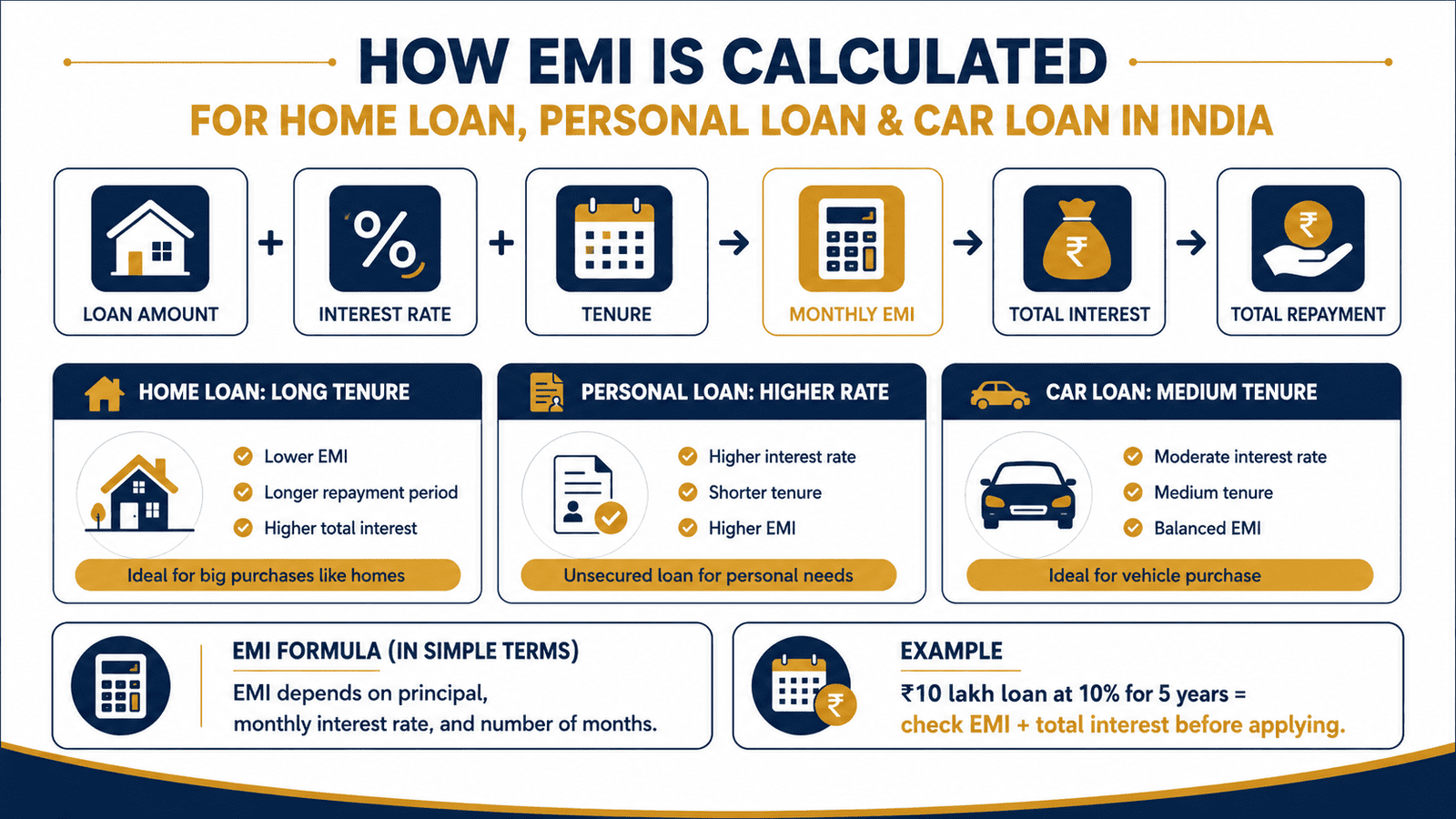
How to Calculate EMI: Formula and Worked Example
EMI Formula = P × R × (1+R)^N ÷ ((1+R)^N − 1)
Where:
- P = Principal loan amount (₹)
- R = Monthly interest rate = Annual rate ÷ 12 ÷ 100
- N = Loan tenure in months
Worked example — ₹10 lakh personal loan at 12% per annum for 60 months:
- R = 12 ÷ 12 ÷ 100 = 0.01
- N = 60
- (1+R)^N = (1.01)^60 = 1.8167
- EMI = 10,00,000 × 0.01 × 1.8167 ÷ (1.8167 − 1) = 18,167 ÷ 0.8167 = ₹22,244 per month
- Total repayment = ₹22,244 × 60 = ₹13,34,640
- Total interest = ₹13,34,640 − ₹10,00,000 = ₹3,34,640
That is ₹3.3 lakh paid in interest on top of the ₹10 lakh you borrowed. The EMI calculator on this page runs this formula automatically — but the important habit is always reading all three outputs: EMI, total interest, and total repayment.
| Scenario | Key Inputs | Result |
|---|---|---|
| Short tenure | ₹10L, 12% p.a., 36 months | EMI ₹33,214 | Total interest ₹1,95,720 |
| Medium tenure | ₹10L, 12% p.a., 60 months | EMI ₹22,244 | Total interest ₹3,34,640 |
| Long tenure | ₹10L, 12% p.a., 84 months | EMI ₹17,053 | Total interest ₹4,32,452 |
Stretching from 36 to 84 months cuts your monthly EMI by ₹16,161 — but adds ₹2,36,732 in interest. That trade-off is the central decision in all EMI planning.
Key Takeaways
- EMI is determined by three inputs — principal, interest rate, and tenure. Change any one and both your monthly payment and total interest change.
- Extending tenure from 3 years to 7 years on a ₹10 lakh loan at 12% increases total interest from roughly ₹1.96 lakh to ₹4.32 lakh — a difference of over ₹2.36 lakh.
- Personal loans typically carry higher interest rates and shorter tenures than home loans, making total repayment comparisons essential before choosing a loan type.
- Car loans are usually secured against the vehicle, with medium tenures; home loans are the longest and usually the cheapest per rupee borrowed.
- A safe EMI should generally not exceed 40–50% of your net monthly income after accounting for rent and existing EMIs — check your number before applying.
- Total repayment = principal + total interest. Always ask the lender for this figure in writing, alongside the amortisation schedule.
Key Facts at a Glance
| Input / Output | What It Means | Example Value |
|---|---|---|
| Principal (P) | Amount you borrow | ₹10,00,000 |
| Annual interest rate | Rate quoted by lender | 12% p.a. |
| Monthly interest rate (R) | Annual rate ÷ 12 ÷ 100 | 0.01 |
| Tenure (N) | Loan duration in months | 60 months |
| Monthly EMI | Fixed payment every month | ₹22,244 |
| Total interest payable | Interest over full tenure | ₹3,34,640 |
| Total repayment | Principal + total interest | ₹13,34,640 |
Understanding EMI, Reducing Balance, and Principal-Interest Split
EMI stands for Equated Monthly Instalment. Every EMI payment you make has two components — a portion that reduces your outstanding loan principal, and a portion that pays interest on the remaining balance. These two portions are not fixed; they shift over the life of the loan.
Why early EMIs are mostly interest
In the first month of a ₹10 lakh loan at 12% per annum, your interest charge is ₹10,00,000 × 1% = ₹10,000. Your EMI of ₹22,244 covers this ₹10,000 first. Only the remaining ₹12,244 reduces the principal. In month two, the outstanding balance is lower, so interest is slightly less — and slightly more of your EMI goes toward principal. This pattern continues through all 60 months. By the final months, almost the entire EMI is principal repayment.
Why total repayment matters more than EMI
Banks and NBFCs calculate EMI using the reducing balance method, which is the standard for home loans, personal loans, and most car loans in India. Some older hire-purchase car schemes used flat-rate interest, which looks cheaper but is actually more expensive. Always confirm which method your lender is using before comparing EMIs across products.
What goes beyond EMI
The EMI figure excludes processing fees, insurance premiums bundled with loans, part-prepayment charges, and late payment penalties. These can add 0.5–3% of the loan amount to your total cost. Ask for the loan Key Facts Statement and Most Important Terms and Conditions (MITC) document from the lender before signing.
Real Example: Rohit’s Three Loan Comparisons
Rohit, 32, works as a project manager in Bengaluru earning ₹1.2 lakh per month. He is considering three separate loans over the coming year: a ₹5 lakh personal loan for home renovation, a ₹7 lakh car loan, and a ₹50 lakh home loan. He runs each through an EMI calculator India tool before deciding.
Personal loan — ₹5 lakh, 14% p.a., 48 months: EMI = ₹13,659 | Total interest = ₹1,55,632 | Total repayment = ₹6,55,632.
Car loan — ₹7 lakh, 10% p.a., 60 months: EMI = ₹14,873 | Total interest = ₹1,92,380 | Total repayment = ₹8,92,380.
Home loan — ₹50 lakh, 8.5% p.a., 240 months: EMI = ₹43,391 | Total interest = ₹54,13,840 | Total repayment = ₹1,04,13,840.
Rohit’s combined EMI if he took all three loans simultaneously would be ₹71,923 — nearly 60% of his net monthly take-home. That is beyond a comfortable debt-to-income ratio for most salaried borrowers. The exercise forces him to prioritise rather than take all three at once. Note: actual lender rates vary by profile, credit score, and market conditions at the time of application.
Comparison: Home Loan vs Personal Loan vs Car Loan EMI
| Parameter | Home Loan | Personal Loan |
|---|
| Parameter | Home Loan | Car Loan |
|---|
| Parameter | Home Loan | Personal Loan | Car Loan |
|---|---|---|---|
| Typical tenure | 10–30 years | 1–5 years | 3–7 years |
| Collateral | Property | None (unsecured) | Vehicle (secured) |
| Interest rate range | Generally lower | Generally higher | Mid-range |
| EMI per ₹10L borrowed | Lowest (long tenure) | Highest (short tenure, high rate) | Mid-range |
| Total interest per ₹10L | Highest (long tenure) | Lower (short tenure) | Mid-range |
| Best use case | Property purchase | Urgent needs, renovation | Vehicle purchase |
Note: Lender rates are not listed because they change frequently. Always check the current rate sheet directly from the lender’s official website before comparing loans.
How to Decide What’s Right for You
Your calculated EMI is under 40% of your net monthly income after existing EMIs and rent — THEN the loan is likely within a manageable debt-to-income range. Check your exact number using the safe EMI limit guide before proceeding.
You are considering a home loan — THEN check salary based eligibility to see how much a lender would sanction on your income, before you decide the loan amount.
You are planning a personal loan — THEN review personal loan checks on CIBIL score, income, and documents before applying, so a rejection does not hurt your credit score.
The EMI drops significantly by extending tenure but total interest doubles — THEN try a middle tenure first. You may be able to prepay later and close the loan early if your income grows.
You have no emergency fund — THEN consider building three months of expenses in savings before committing to a large EMI. An unexpected job loss or health event will be far harder to manage with a large monthly obligation already running.
Your income is irregular, project-based, or likely to change in the next 12 months — do NOT lock into a long-tenure high-EMI home loan without a buffer. Consider a shorter loan amount or a longer tenure with prepayment flexibility instead.
Common Mistakes to Avoid
Comparing only EMI and ignoring total repayment
A ₹10 lakh loan at 12% over 84 months looks attractive at ₹17,053 per month versus ₹33,214 at 36 months. But total interest jumps from ₹1.96 lakh to ₹4.32 lakh. EMI is a monthly comfort number; total repayment is the actual cost. Always read both.
Before choosing a tenure, compare the total repayment column across at least three different tenures. The difference is often surprising.
Choosing the longest tenure to minimise monthly burden
Stretching a ₹30 lakh home loan from 15 years to 25 years drops the EMI but can add ₹10–15 lakh in total interest over the life of the loan. That extra interest buys you nothing — it only reduces your monthly cash flow pressure.
Take the shortest tenure your income can comfortably support, then use part-payments to reduce principal faster if income improves.
Forgetting processing fees, insurance, and foreclosure charges
Processing fees of 0.5–2% of the loan amount, mandatory loan insurance bundled by some lenders, and foreclosure or prepayment charges can materially increase your real cost of borrowing. On a ₹50 lakh home loan, a 1% processing fee is ₹50,000 upfront.
Always ask for the Key Facts Statement and MITC document. Read these before signing.
Not checking credit score before applying
Your CIBIL score affects the interest rate a lender offers you. A score below 700 may mean a higher rate — which means a higher EMI and higher total interest. Check your credit score before using the EMI calculator so your rate input is realistic, not optimistic.
Hard credit enquiries from multiple simultaneous applications also lower your score temporarily.
Missing EMI payments
A missed EMI triggers a late payment penalty, a negative mark on your credit report, and potentially a higher interest rate on the outstanding balance. One missed payment can follow your credit profile for years. Read about the full impact — including recovery notices — in the missed payment impact guide before you take a loan with a tight monthly budget.
If cash flow is tight, opt for a longer tenure with a lower EMI rather than a short tenure that strains your account every month.
Applying without checking existing obligations
If you already have a car loan running at ₹12,000 per month, adding a personal loan EMI of ₹13,000 and a home loan EMI of ₹43,000 may push total obligations to ₹68,000 on a ₹1.2 lakh take-home salary. That leaves only ₹52,000 for rent, food, utilities, and savings — uncomfortably tight for most Bengaluru households.
Total up all existing EMIs first. Then calculate how much headroom remains before adding a new one.
When This May Not Be the Right Choice
If your total EMI obligations — including the new loan — would cross 50% of your net monthly income, taking this loan now may be risky. A single income disruption could put you in default.
If your income is variable, freelance, or contract-based with gaps between projects, a fixed monthly EMI may create serious cash flow strain in lean months.
If the purchase driving the loan is discretionary — a lifestyle upgrade rather than an essential need — consider delaying by six to twelve months and saving toward a larger down payment. A smaller loan principal produces a smaller total interest bill.
If your emergency fund covers fewer than three months of essential expenses, taking a large EMI before building this buffer increases your financial vulnerability significantly.
If any of these apply to your situation, it may be worth exploring alternatives before committing.
Official Rules and Where to Verify
Interest rates, processing fees, prepayment charges, and loan eligibility criteria change regularly. The only reliable sources are official lender documents and RBI-regulated disclosures.
- Reserve Bank of India — rbi.org.in: Banking regulations, NBFC guidelines, Fair Practices Code for lenders, and consumer grievance processes.
- Bank and NBFC official websites: Current rate sheets, loan product terms, Key Facts Statements, and MITC documents for every loan product.
- Your loan agreement: The only document that shows your actual EMI schedule, reset clause for floating-rate loans, and applicable charges.
Rules, limits, and rates on this topic can change with each Budget or regulatory update. Always verify current figures directly from the official source before making any financial decision.
Expert Tips
- Always compare total repayment, not just EMI. Before finalising any loan, note the total repayment figure — principal plus all interest — not just the monthly instalment. A ₹500 lower EMI can cost you ₹1–2 lakh more over a longer tenure.
- Try at least three different tenures in the calculator. Run the same principal and rate at your target tenure, then five years shorter, then five years longer. The total interest difference is usually large enough to affect your decision.
- Check prepayment rules before choosing a lender. Some lenders charge 2–4% on prepaid principal; others have zero prepayment charges on floating-rate loans. If you expect income to grow, a lender with no prepayment penalty gives you flexibility to close early and save significantly. See how prepayment interest saving works before signing.
- Recalculate after every rate reset on floating loans. If your home loan is on a floating rate linked to the repo rate, a rate increase changes your EMI or extends your tenure. Run the calculator with the new rate to see the updated total interest and decide whether to prepay or accept the revised schedule.
- Do not add a long-tenure loan just before a major life expense. If you are planning a wedding, child’s education, or medical procedure in the next two years, check whether the combined EMI and that upcoming expense will fit your income before committing to a large loan now.
- Keep the loan agreement and amortisation schedule on file. Your amortisation schedule shows exactly how much principal and interest are in each EMI. It is the most useful document for planning part-payments to maximise interest savings.
Frequently Asked Questions
What is EMI in a loan?
EMI stands for Equated Monthly Instalment. It is the fixed amount you pay the lender every month on a specific date until the loan is fully repaid. Each EMI covers a portion of the outstanding principal and the interest accrued on that principal during the month.
How is EMI calculated in India?
The standard formula is: EMI = P × R × (1+R)^N ÷ ((1+R)^N − 1). Here P is the principal, R is the monthly interest rate (annual rate ÷ 12 ÷ 100), and N is the tenure in months. All bank and NBFC EMI calculations in India use the reducing balance method under this formula. Check your eligibility for a personal loan before applying at the personal loan checks page.
Is a lower EMI always better?
No. A lower EMI usually means a longer tenure, which increases total interest paid. A ₹10 lakh loan stretched from 36 to 84 months cuts the EMI by roughly ₹16,000 per month but adds over ₹2.36 lakh in total interest. Lower EMI is better only if it makes the loan genuinely affordable without overextending the loan term unnecessarily.
Why is a home loan EMI different from a personal loan EMI for the same amount?
Home loans have longer tenures (up to 30 years) and generally lower interest rates because the loan is secured against property. Personal loans are unsecured, carry higher rates, and have shorter maximum tenures. Both factors — rate and tenure — affect EMI. Even if the principal is identical, the personal loan EMI will typically be higher because you are repaying over a shorter period at a higher cost of money.
Does prepayment reduce my EMI or my loan tenure?
This depends on your lender’s policy and your request at the time of prepayment. Most lenders offer two options: reduce the tenure (keeping EMI the same) or reduce the EMI (keeping tenure the same). Reducing tenure saves more total interest and is generally the better choice for borrowers who do not need the freed-up monthly cash flow immediately.
Can my EMI change after the loan is approved?
For floating-rate loans — most home loans in India — yes. If the repo rate changes or the lender revises the spread, your EMI or tenure can change. Fixed-rate loans lock the EMI for the fixed period, after which they may convert to floating. Always check whether your loan is fixed or floating and understand the reset clause in the loan agreement.
What happens if I miss an EMI?
Missing an EMI triggers a late payment penalty (typically a percentage of the EMI or outstanding amount), a negative credit bureau record, and potential recovery action if multiple payments are missed. Even one missed payment can lower your CIBIL score significantly. Read the full rules on penalties, CIBIL impact, and recovery procedures before choosing an EMI that stretches your budget.
How much EMI can I afford on my salary?
A widely used rule of thumb is that total EMI obligations (all loans combined) should not exceed 40–50% of net monthly income. On a ₹1.2 lakh salary, that means ₹48,000–₹60,000 maximum in total EMIs. This threshold varies by city (rent is higher in metro cities), family size, and income stability. Use the calculator and then check your actual budget before deciding.
Final Verdict
An EMI calculator India tool is the first step before any loan application — not an afterthought. Run the numbers before you visit a lender, not after you receive the sanction letter. Compare EMI, total interest, and total repayment across at least two tenures. Make sure the monthly payment fits your income after rent, existing EMIs, and a reasonable saving margin. Check salary based eligibility if you are planning a home loan, and verify current interest rates from the lender’s official website before signing. A lower EMI today that costs you ₹5–10 lakh more in total interest over 20 years is not a good deal — know the full number before you commit. Always verify the latest rules from official sources or consult a qualified professional before making any financial decision.
This article is for educational purposes only and should not be treated as personalised financial, tax, investment, insurance, or legal advice. Tax rules, interest rates, regulatory limits, and product features can change with each Budget or policy update. Please verify current rules from official government sources or consult a qualified and registered professional before making any financial decision.

Vikram Sethi writes about loans, EMI planning, credit score impact, borrowing costs, and repayment decisions for Indian borrowers. His content helps readers look beyond the monthly EMI and understand the full cost of borrowing, including principal, interest, processing fees, GST, insurance, prepayment charges, foreclosure fees, late payment penalties, and credit score impact.
He covers topics such as EMI calculators, home loan eligibility, personal loan eligibility, debt-to-income ratio, flat interest rate vs reducing balance, missed EMI consequences, loan prepayment vs part payment, home loan balance transfer, processing fees, gold loan vs personal loan, car loan vs cash purchase, top-up home loans, loan against PPF, and credit score basics.
Vikram’s writing style is practical, cautionary, and calculation-driven. He uses Indian examples, ₹ amounts, comparison tables, and decision frameworks to help borrowers compare options more carefully. His articles are educational and do not guarantee loan approval, interest rates, or savings. Readers should verify current rates, charges, eligibility, and terms directly with lenders before applying or refinancing.