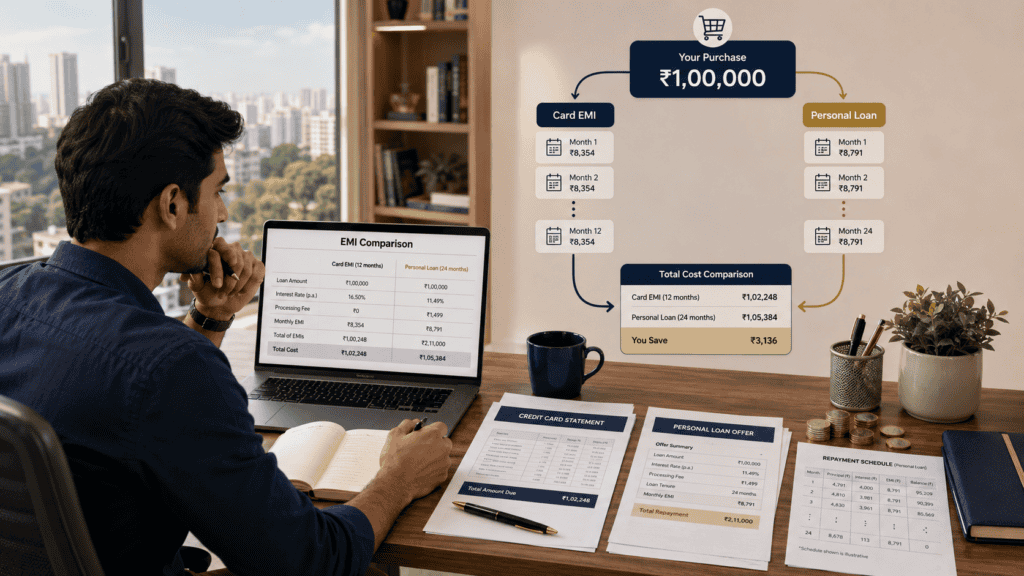

Two lenders quote you a loan. One says 10% flat rate. The other says 16% reducing balance. Which one costs more? Most borrowers guess wrong — and end up paying thousands of rupees extra because they trusted the quoted number without checking the actual total repayment. The flat interest rate vs reducing balance question is one of the most important comparisons any borrower in India needs to understand before signing a loan agreement. This article shows you how both methods work, exactly what they cost, and how to compare lenders correctly.
Quick Answer: Flat Interest Rate vs Reducing Balance
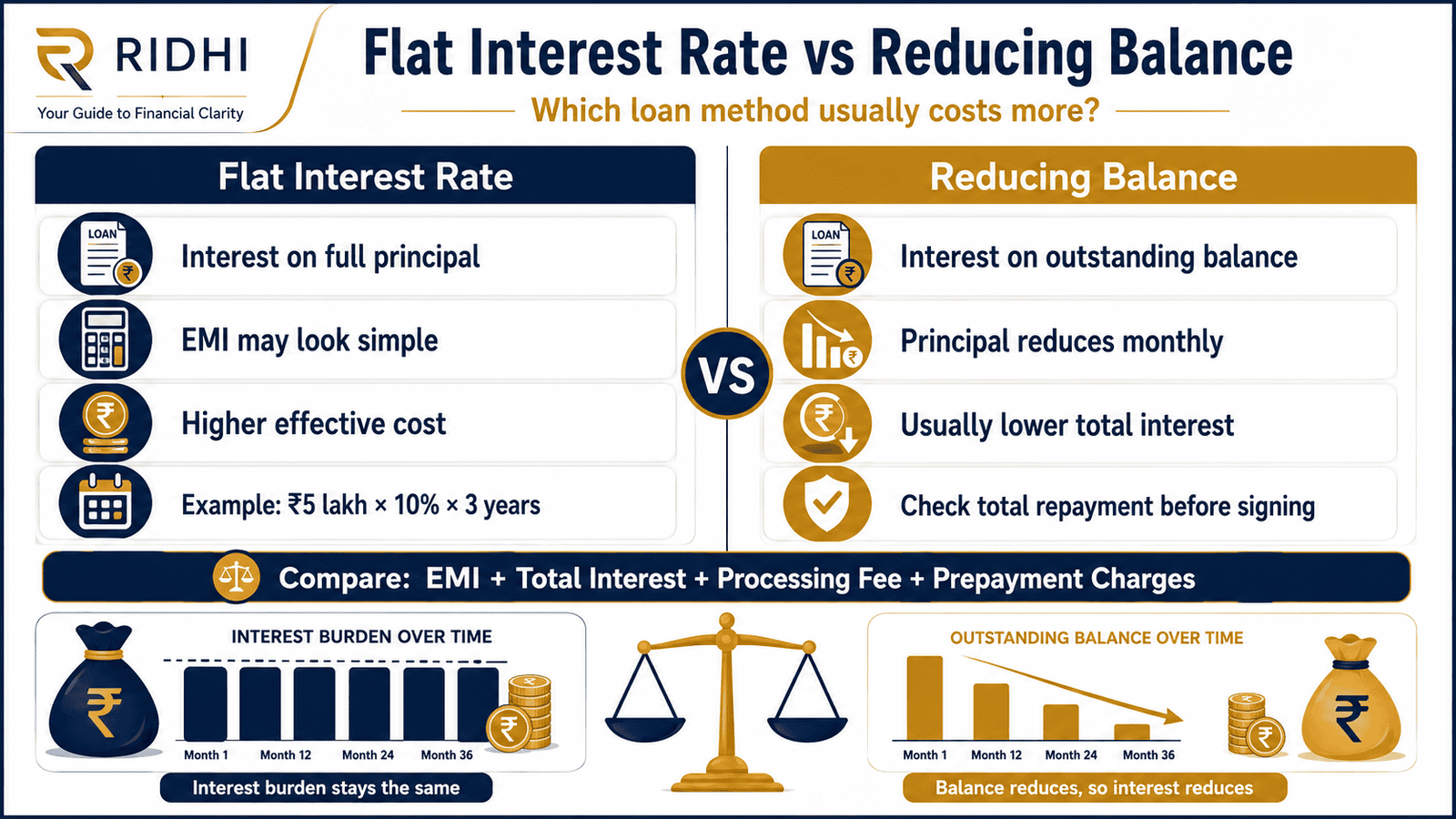
Flat interest rate vs reducing balance means comparing how loan interest is calculated. In a flat rate loan, interest is charged on the full original principal throughout the tenure. In a reducing balance loan, interest is charged only on the outstanding principal. For a ₹5 lakh loan at 10% for 3 years, flat interest usually costs more.
Key Takeaways
- A 10% flat rate loan is typically equivalent to roughly 17–18% on a reducing balance basis — the quoted rate is not the effective rate.
- For a ₹5 lakh flat rate loan at 10% over 3 years, total interest paid is ₹1,50,000 — versus approximately ₹82,000–₹85,000 under a comparable reducing balance loan.
- Flat rate loans calculate interest on the original principal for every month, even after you have repaid most of the loan — this is the core reason they cost more.
- Reducing balance loans charge interest only on the outstanding principal each month — so your interest cost falls with every EMI payment.
- The effective interest rate of a flat rate loan is approximately 1.7 to 1.9 times the stated flat rate — always convert before comparing.
- Personal loans and car loans from some NBFCs and dealers still use the flat rate method — always ask for the amortisation schedule and total repayment figure.
- A lower quoted rate does not mean a cheaper loan — total interest paid and total repayment amount are the only numbers that matter.
Comparison: Flat Rate Loan vs Reducing Balance Loan
| Parameter | Flat Rate Loan | Reducing Balance Loan |
|---|---|---|
| Interest calculated on | Original principal, every month | Outstanding principal each month |
| EMI structure | Equal EMI throughout | Equal EMI (reducing interest component) |
| Total interest paid (₹5L, 10%, 3 yr) | ₹1,50,000 | ~₹82,000–₹85,000 |
| Total repayment (₹5L, 10%, 3 yr) | ₹6,50,000 | ~₹5,82,000–₹5,85,000 |
| Effective annual rate equivalent | ~17–18% | = Quoted rate |
| Transparent cost? | No | Yes |
| Common loan types | Some personal loans, car loans (dealers), gold loans | Home loans, most bank personal loans, education loans |
| Prepayment benefit | Lower — interest already locked in | Higher — reduces outstanding principal |
Key Facts at a Glance
| Fact | Flat Rate | Reducing Balance |
|---|---|---|
| Interest base | Full original principal | Remaining principal each month |
| ₹5L at 10% for 3 years — total interest | ₹1,50,000 | ~₹82,000–₹85,000 |
| Effective rate (approx.) | ~1.75× the flat rate | = Stated rate |
| RBI disclosure norm | Lenders must disclose annualised rate (APR equivalent) under RBI Fair Practices Code | |
| Where it appears | NBFC personal loans, two-wheeler loans, some car loans | Home loans, bank personal loans, education loans |
How Flat Interest Rate and Reducing Balance Loans Actually Work
What Is a Flat Interest Rate?
In a flat rate loan, the lender calculates interest on the original loan amount — the full principal — for every single month of the tenure, regardless of how much you have already repaid. If you borrow ₹5 lakh at 10% flat for 3 years, the lender computes: ₹5,00,000 × 10% × 3 = ₹1,50,000 in interest. That ₹1,50,000 is added to the principal, the total is divided by 36 months, and you get your EMI.
The problem is obvious once you see it: in month 30 of your loan, you may have already repaid ₹4 lakh of the principal — but you are still paying interest as if ₹5 lakh is outstanding. You are being charged interest on money you no longer owe.
What Is a Reducing Balance Loan?
A reducing balance loan — also called a diminishing balance or amortising loan — works differently. Each month, the lender calculates interest only on the outstanding principal at that point. As you repay principal with each EMI, the interest component falls. The EMI stays the same, but the split between principal and interest shifts every month.
In month 1 of a ₹5 lakh reducing balance loan at 16%, your interest for the month is ₹5,00,000 × 16%/12 = ₹6,667. By month 30, your outstanding balance may be ₹1.2 lakh — and the monthly interest is just ₹1,600. The principal repayment component of your EMI grows every month. This is the standard amortisation schedule that most banks follow, and the method RBI’s Fair Practices Code expects lenders to disclose in annualised terms.
Why Flat Rate Looks Cheaper But Costs More
The flat interest rate method produces a lower headline number — 10% sounds far better than 16%. But the effective annual interest rate of a flat rate loan is much higher than the stated figure. For a typical 3-year tenure, a 10% flat rate is roughly equivalent to 17–18% on a reducing balance basis. The exact conversion depends on the loan tenure and EMI schedule, but the rule of thumb — multiply the flat rate by approximately 1.75 for 3-year loans — is widely used by finance professionals.
This gap is largest for longer tenures and smaller for very short ones. For a 1-year flat rate loan, the effective rate is closer to 1.8× the flat rate. For a 2-year loan, around 1.74×. For 5 years, around 1.83×.
Where Each Method Appears in India
Home loans in India almost universally use the reducing balance method — as do most bank personal loans and education loans. Where you most commonly encounter flat rate loans: two-wheeler financing from dealer showrooms, certain NBFC personal loans, gold loans, and older-style vehicle loans. Some cooperative banks and microfinance institutions also use flat rates. Always ask directly: “Is this a flat rate or a reducing balance rate?” before accepting any loan quote.
According to RBI guidelines under the Fair Practices Code for lenders, banks and NBFCs are required to disclose the annualised interest rate — the effective rate — to borrowers. If a lender quotes only a flat rate without converting it, ask for the annualised equivalent or use an EMI calculator India to check total interest and total repayment yourself.
Real Example: Rohit’s Loan Comparison in Pune
Rohit, 31, is a sales manager in Pune earning ₹85,000 per month. He needs a ₹5 lakh personal loan for 3 years. Two lenders approach him:
Lender A: Quotes 10% flat rate. EMI = (₹5,00,000 + ₹1,50,000) ÷ 36 = ₹6,50,000 ÷ 36 = ₹18,056 per month. Total repayment: ₹6,50,000.
Lender B: Quotes 16% reducing balance. EMI = approximately ₹17,580 per month (standard amortisation formula). Total repayment: approximately ₹5,82,880. Total interest: approximately ₹82,880.
Rohit’s first instinct is to go with Lender A — 10% sounds much better than 16%. But when he computes total repayment: Lender A costs ₹6,50,000 total; Lender B costs ₹5,82,880 total. Lender B — with the higher quoted rate — saves Rohit approximately ₹67,000 over the loan tenure.
The lesson: the quoted rate is not the cost. The total repayment amount is the cost.
How to Calculate Flat Rate vs Reducing Balance EMI
Flat Rate EMI Formula
Flat Rate EMI = (Principal + Total Interest) ÷ Tenure in Months
Total Interest (Flat) = Principal × Annual Rate × Tenure in Years
Working for Rohit’s loan (Lender A):
Total Interest = ₹5,00,000 × 10% × 3 = ₹1,50,000
Total Repayment = ₹5,00,000 + ₹1,50,000 = ₹6,50,000
EMI = ₹6,50,000 ÷ 36 = ₹18,056
Reducing Balance EMI Formula
Reducing Balance EMI = P × r × (1 + r)^n ÷ [(1 + r)^n − 1]
Where P = Principal, r = Monthly interest rate (Annual rate ÷ 12), n = Tenure in months
Working for Rohit’s loan (Lender B, 16% reducing):
r = 16% ÷ 12 = 1.333% per month = 0.01333
n = 36
EMI ≈ ₹17,580 (standard formula result)
Side-by-Side Scenario Results
| Scenario | Key Inputs | Total Interest Paid |
|---|---|---|
| Flat rate loan | ₹5L, 10% flat, 36 months | ₹1,50,000 |
| Reducing balance loan | ₹5L, 16% reducing, 36 months | ~₹82,880 |
| Reducing balance loan | ₹5L, 10% reducing, 36 months | ~₹82,000 |
To verify these numbers with your own loan amount, tenure, and rate, use Ridhi’s EMI calculator India and enter the reducing balance rate for an accurate interest breakdown.
How to Decide What’s Right for You
A lender quotes a flat rate that is significantly lower than other lenders’ reducing balance rates — THEN convert the flat rate to effective rate (multiply by ~1.75 for 3-year loans) before comparing. You may find the flat rate loan is actually costlier.
You are comparing two reducing balance loans from different lenders — THEN the lower quoted rate is genuinely the cheaper loan, assuming the same tenure and no hidden processing fees.
Your tenure is 1 year or less — THEN the difference between flat and reducing balance costs is smaller (though still real). Focus on processing fees and prepayment charges for short-tenure loans.
You plan to prepay the loan early — THEN a reducing balance loan gives you a meaningful saving because interest resets on the lower outstanding principal each month. A flat rate loan’s total interest is largely fixed upfront, so prepayment saves less.
Your lender cannot or will not give you a month-by-month amortisation schedule — THEN treat this as a red flag. Legitimate lenders following RBI Fair Practices Code must be transparent about how your EMI breaks down. Check your personal loan eligibility with another lender before proceeding.
Your EMI-to-salary ratio exceeds 40–45% — THEN do not take on any additional loan regardless of interest method. Review your safe EMI ratio first.
You have compared total repayment amounts (not just EMI or quoted rate) across both loan offers — do NOT sign any loan agreement. Total repayment is the only number that tells you the true cost of borrowing.
Common Mistakes to Avoid
Comparing Quoted Rates Without Converting
Borrowers compare a 10% flat rate with a 16% reducing balance rate and assume the flat rate loan is cheaper.
A 10% flat rate is equivalent to approximately 17–18% on a reducing balance basis for a 3-year tenure. Rohit in our example would pay ₹67,000 more by choosing the seemingly cheaper flat rate loan.
Always convert the flat rate to its effective equivalent — or simply compare total repayment amounts — before choosing.
Looking Only at the EMI Amount
A flat rate loan EMI may appear only marginally higher or even similar to a reducing balance EMI. This makes the true interest difference invisible.
What matters is not the monthly EMI but the total interest paid across the entire tenure. Two loans with similar EMIs can have total repayment differences of ₹50,000–₹1,00,000 on a ₹5 lakh loan.
Ask for the total repayment figure — principal plus total interest — before comparing any two loan offers.
Ignoring Prepayment Terms on Flat Rate Loans
On a flat rate loan, prepayment does not reduce your total interest cost as dramatically as it does on a reducing balance loan, because interest was calculated on the original principal at the start.
Many flat rate loan agreements also carry higher prepayment or foreclosure charges. Read your loan sanction letter carefully. Loan prepayment savings are significantly better on reducing balance loans.
Forgetting Processing Fees in the Cost Comparison
A lender offering a lower interest rate might charge a 2–3% processing fee, which can add ₹10,000–₹15,000 to your actual borrowing cost on a ₹5 lakh loan.
Total loan cost = Total interest + Processing fee + Any prepayment penalty. A loan with a slightly higher rate and zero processing fee can be cheaper than a lower-rate loan with a 2% upfront fee. Understand processing fee impact before comparing.
Trusting the Brochure Rate Without Reading the Sanction Letter
The rate on a loan brochure or in a verbal quote from a dealer or DSA may differ from the rate in your sanction letter or loan agreement.
The sanction letter is the only legally binding document. Read the sanction letter in full — specifically the interest calculation method, total interest, and total repayment amount — before accepting.
Assuming All Personal Loans Use Reducing Balance
Most large banks use the reducing balance method for personal loans, but many NBFCs, two-wheeler dealers, and some cooperative banks still use flat rates.
Never assume — always ask explicitly: “Is this a flat rate or a reducing balance rate?” If the lender’s response is unclear, ask for the annualised effective rate in writing.
When This May Not Be the Right Choice
If you have a very short tenure (under 12 months): The interest cost difference between flat and reducing balance narrows significantly for 6–12 month loans. In this case, processing fees and prepayment terms may matter more than the interest method.
If the flat rate loan comes with significantly better features: Occasionally, a flat rate loan may offer zero processing fees, no prepayment penalty, and a much faster disbursement — which can reduce total borrowing cost despite the higher effective rate. Always model the total cost end to end.
If your cash flow cannot support a reducing balance EMI structure: Reducing balance loans sometimes have a slightly higher initial EMI than a flat rate loan for the same principal and stated rate. If you are on a tight monthly budget, confirm the actual EMI number before committing.
If the loan is from an informal or unregulated source: Flat rate or reducing balance distinctions are irrelevant if the lender is not regulated under RBI guidelines — the real risk is unenforceable terms and aggressive recovery. Only borrow from RBI-registered banks and NBFCs.
If any of these apply to your situation, it may be worth exploring alternatives before committing.
Official Rules and Where to Verify
Interest calculation methods and disclosure requirements for lenders in India are governed by the Reserve Bank of India. Under the RBI Fair Practices Code, lenders must disclose the annualised interest rate — the effective rate — to borrowers, not just the flat rate. This requirement applies to banks and registered NBFCs.
Rules, limits, and rates on this topic can change with each Budget or regulatory update. Always verify current figures directly from the official source before making any financial decision.
- Reserve Bank of India — rbi.org.in (Fair Practices Code, lending guidelines)
- Your lender’s official website or registered branch — for current rates, processing fee schedules, and prepayment terms applicable to your loan
Expert Tips
- Always ask for the amortisation schedule — a month-by-month breakdown of principal and interest — before accepting any loan. Any lender following RBI guidelines should be able to provide this. If they refuse or cannot, reconsider the lender.
- Compare loans using total repayment amount, not quoted rate or EMI. Open a spreadsheet: enter total interest + processing fee for each offer. The lowest total is the cheapest loan.
- If a lender quotes a flat rate, use the 1.75× rule to estimate the reducing balance equivalent for a 3-year loan — then compare directly with reducing balance offers from other lenders.
- Before applying, check your good CIBIL score standing. A CIBIL score above 750 typically qualifies you for lower reducing balance rates from top banks — improving your score by 20–30 points before applying can save ₹15,000–₹25,000 in interest on a ₹5 lakh loan.
- For car loans or two-wheeler loans through dealer financing, always ask whether the dealer’s scheme is a flat rate or reducing balance — dealer-arranged loans very commonly use flat rates. A bank-issued car loan at a higher quoted rate may still be cheaper overall.
- If you are considering prepayment midway through a loan, calculate the actual interest saving under your specific loan type first. On a flat rate loan, you may still owe most of the pre-calculated interest even if you repay the principal early — check the foreclosure statement carefully.
- Use Ridhi’s free EMI calculator India to enter both the flat rate equivalent and the reducing balance rate from each lender — you will see exactly how total interest differs before you decide.
Frequently Asked Questions
What is the difference between flat interest rate and reducing balance?
A flat rate loan charges interest on the full original principal every month throughout the loan tenure. A reducing balance loan charges interest only on the outstanding principal each month. As you repay principal, the interest component in each EMI falls. For the same principal and tenure, a flat rate loan costs significantly more in total interest than a comparable reducing balance loan.
How do I convert a flat rate to a reducing balance rate?
A widely used rule of thumb: multiply the flat rate by approximately 1.75 for 3-year loans to get the rough reducing balance equivalent. For example, a 10% flat rate is approximately equal to 17–18% on a reducing balance basis. For a precise conversion, use an EMI calculator — enter the flat rate EMI amount and total repayment into a reducing balance formula to find the implied effective rate.
Is a 10% flat rate cheaper than a 16% reducing balance rate?
No — for most loan tenures, a 10% flat rate is actually more expensive than a 16% reducing balance rate. The effective rate on a 10% flat loan for 3 years is approximately 17–18%, which is comparable to or higher than 16% reducing balance. Always compare total repayment amounts to determine which offer is genuinely cheaper.
Which loan type do banks in India typically use?
Most scheduled commercial banks in India — including SBI, HDFC Bank, ICICI Bank, and Axis Bank — use the reducing balance method for home loans, personal loans, and education loans. Flat rate loans are more common with NBFCs, cooperative banks, two-wheeler dealers, and some used-car financing arrangements.
Can I request a reducing balance loan instead of a flat rate loan from the same lender?
Some lenders offer both, but not all. If a lender offers only flat rate loans, you cannot convert the structure — you can only choose whether to borrow from that lender. If your lender does offer reducing balance loans, ask explicitly and request a revised sanction letter reflecting the reduced total interest cost.
What happens if I prepay a flat rate loan early?
On a flat rate loan, the total interest is calculated upfront on the original principal. If you prepay early, you repay the outstanding principal — but many lenders have already factored most of the interest into your repayment schedule. In practice, you may save less on interest than expected when prepaying a flat rate loan compared to prepaying a reducing balance loan of equivalent size.
Is the flat interest rate method banned in India?
No — the flat rate method is not banned. However, RBI guidelines under the Fair Practices Code require lenders to disclose the annualised effective interest rate to borrowers, so you are entitled to ask for the effective rate equivalent even if the lender quotes a flat rate. The disclosure requirement exists precisely because flat rates can mislead borrowers about true loan cost.
How do I calculate the EMI for a flat rate loan?
Flat Rate EMI = (Principal + Total Interest) ÷ Tenure in Months. Total Interest = Principal × Annual Flat Rate × Tenure in Years. For a ₹5 lakh loan at 10% flat for 3 years: Total Interest = ₹1,50,000. Total Repayment = ₹6,50,000. EMI = ₹6,50,000 ÷ 36 = ₹18,056 per month.
Which is better for a home loan — flat rate or reducing balance?
Reducing balance is unambiguously better for a home loan. Home loans run for 15–30 years, and the compounding effect of interest on the full original principal under a flat rate structure would make the total interest cost extraordinarily high. All regulated housing finance companies and banks in India use the reducing balance method for home loans — if you are ever offered a flat rate home loan, treat it as a serious red flag.
Do EMI calculators online show flat rate or reducing balance calculations?
Most standard EMI calculators — including Ridhi’s — use the reducing balance formula, which is the standard for home loans, personal loans from banks, and most regulated lending. If you need to evaluate a flat rate loan, calculate the total interest manually (Principal × Rate × Tenure) and divide by the number of months to find the EMI.
Final Verdict
The flat interest rate vs reducing balance question comes down to one number: total repayment. A 10% flat rate on a ₹5 lakh, 3-year loan costs ₹1,50,000 in interest. A 16% reducing balance loan on the same amount costs approximately ₹82,880 — roughly ₹67,000 less, despite the higher quoted rate. Borrowers who compare only the headline rate consistently choose the more expensive loan. The rule is simple: always ask for the total interest paid and total repayment amount, not just the EMI or the quoted rate.
For most borrowers, reducing balance loans from regulated banks are the safer, more transparent, and ultimately cheaper choice for personal loans, car loans, and home loans. If you are offered a flat rate loan, convert it to an effective rate equivalent before comparing. Use Ridhi’s EMI calculator India to run both scenarios side by side. And check your safe EMI ratio to confirm the loan fits your monthly budget before you sign.
Always verify the latest rules from official sources or consult a qualified professional before making any financial decision.
This article is for educational purposes only and should not be treated as personalised financial, tax, investment, insurance, or legal advice. Tax rules, interest rates, regulatory limits, and product features can change with each Budget or policy update. Please verify current rules from official government sources or consult a qualified and registered professional before making any financial decision.

Vikram Sethi writes about loans, EMI planning, credit score impact, borrowing costs, and repayment decisions for Indian borrowers. His content helps readers look beyond the monthly EMI and understand the full cost of borrowing, including principal, interest, processing fees, GST, insurance, prepayment charges, foreclosure fees, late payment penalties, and credit score impact.
He covers topics such as EMI calculators, home loan eligibility, personal loan eligibility, debt-to-income ratio, flat interest rate vs reducing balance, missed EMI consequences, loan prepayment vs part payment, home loan balance transfer, processing fees, gold loan vs personal loan, car loan vs cash purchase, top-up home loans, loan against PPF, and credit score basics.
Vikram’s writing style is practical, cautionary, and calculation-driven. He uses Indian examples, ₹ amounts, comparison tables, and decision frameworks to help borrowers compare options more carefully. His articles are educational and do not guarantee loan approval, interest rates, or savings. Readers should verify current rates, charges, eligibility, and terms directly with lenders before applying or refinancing.