

If your payslip shows an EPF deduction every month, you already have retirement savings building in the background — but EPF alone may not be enough. The NPS vs PPF vs EPF question matters most in your 30s, when more than two decades of compounding still lie ahead and the choice of where to put your retirement money can shape the difference between a ₹1.5 crore and a ₹3 crore corpus at 60. All three are government-backed, all three offer Section 80C tax benefits, and all three are designed for the long run. But they work very differently in terms of returns, liquidity, and how much tax you pay on the way out. This article breaks down each scheme clearly so you can decide which combination suits your salary structure, tax situation, and retirement goal.
Quick Answer: NPS vs PPF vs EPF
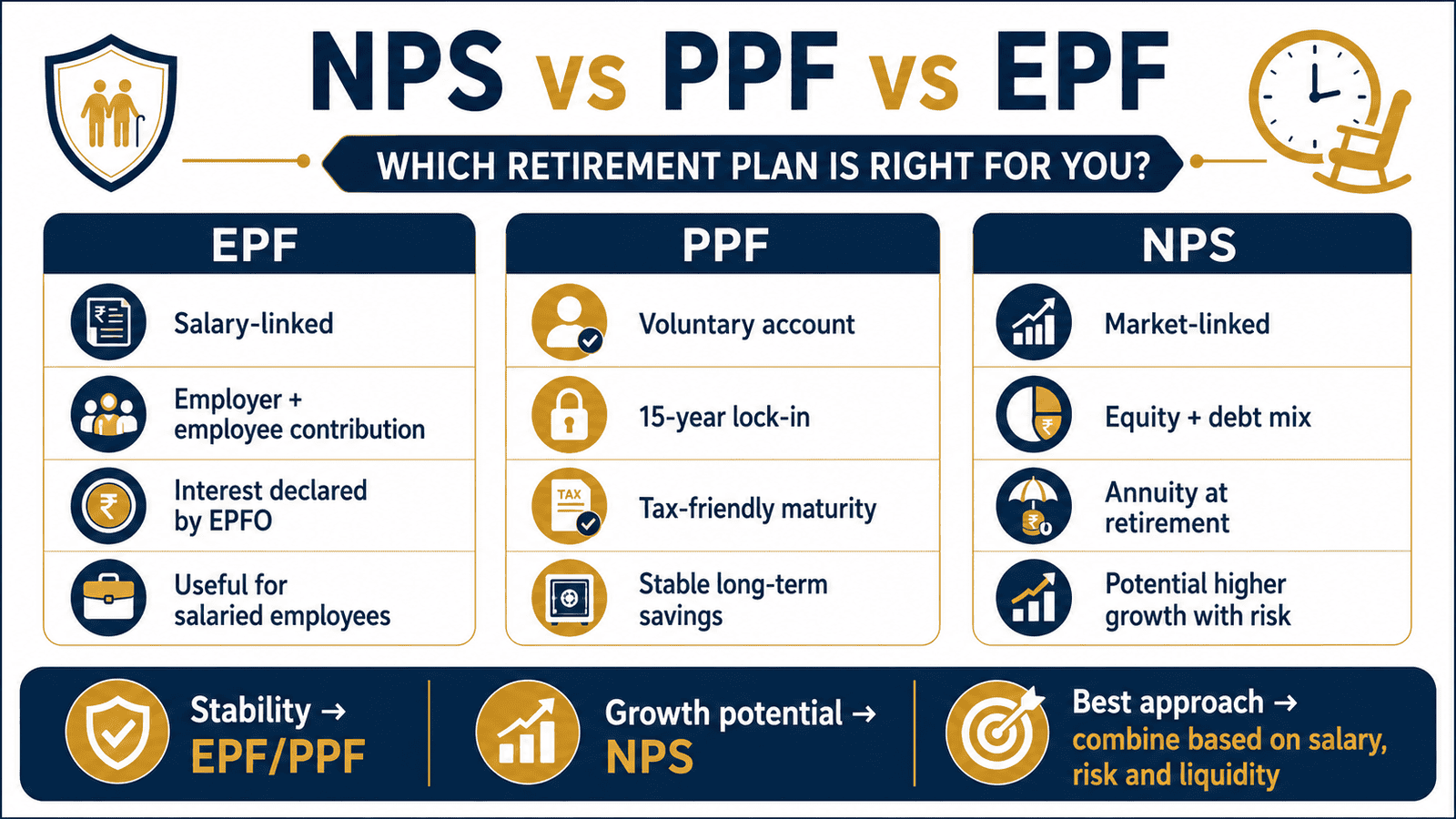
NPS vs PPF vs EPF compares three retirement-saving routes: market-linked pension investing, government-backed voluntary savings, and salary-linked provident fund savings. EPF suits salaried employees, PPF suits stable long-term saving, while NPS may build a larger corpus if equity returns perform well. Use current rates and tax rules before deciding.
Key Takeaways
- EPF is salary-linked and automatic — both you and your employer contribute 12% of your basic salary, making it the only retirement scheme where someone else directly adds to your corpus every month.
- PPF currently earns 7.1% p.a., compounded annually, with a government guarantee and full tax exemption at maturity — no tax on interest earned, no tax on withdrawal at the end of 15 years.
- NPS invests partly in equities and has historically delivered higher long-run returns than EPF or PPF, but returns are market-linked and not guaranteed — past performance varies by fund manager and asset allocation chosen.
- All three qualify for the Section 80C deduction up to ₹1.5 lakh per year. NPS Tier 1 also qualifies for an additional ₹50,000 deduction under Section 80CCD(1B) — a benefit no other retirement savings product offers.
- At retirement, EPF and PPF corpus is fully tax-free. NPS allows a 60% tax-free lump sum, but the remaining 40% must be used to buy an annuity — and that annuity income is taxed as regular income every year.
- A salaried employee in the 30% tax bracket can save up to ₹62,400 per year in combined tax by using all three — ₹46,800 under Section 80C and ₹15,600 under Section 80CCD(1B) for NPS.
Comparison: NPS vs PPF vs EPF
| Feature | NPS (Tier 1) | PPF | EPF |
|---|---|---|---|
| Who can use it | Any Indian citizen, 18–70 | Any Indian citizen (NRIs: restricted) | Salaried employees in EPFO-covered organisations |
| Returns / interest | Market-linked (equity, corporate bonds, govt. securities) | 7.1% p.a., government declared | 8.25% p.a., EPFO declared |
| Investment risk | Moderate | Very Low | Very Low |
| Section 80C benefit | Yes — up to ₹1.5L/year | Yes — up to ₹1.5L/year | Yes — employee share |
| Additional 80CCD(1B) | Yes — ₹50,000 | No | No |
| Tax at maturity | 60% lump sum tax-free; 40% annuity income taxed as income | Fully tax-free (EEE) | Tax-free after 5 years continuous service |
| Lock-in | Until age 60 (conditional early exit permitted) | 15 years (extendable in 5-year blocks) | Until resignation or retirement |
| Employer contributes | Optional — 10% of basic for eligible companies | No | Yes — 12% of basic (3.67% to EPF) |
| Regulated by | PFRDA | Government of India | EPFO (Ministry of Labour) |
Key Facts at a Glance
| Scheme | Current Rate / Return Type | Max Annual Tax Saving (30% bracket) |
|---|---|---|
| EPF | 8.25% p.a. (EPFO declared annually) | Up to ₹46,800 via Section 80C on employee share |
| PPF | 7.1% p.a. (government declared, quarterly review) | Up to ₹46,800 via Section 80C up to ₹1.5L/year |
| NPS Tier 1 | Market-linked (varies by fund and asset allocation) | Up to ₹62,400 — ₹46,800 via 80C + ₹15,600 via 80CCD(1B) |
How Each Scheme Works: NPS vs PPF vs EPF Explained
EPF: Automatic, Employer-Backed, and Salary-Linked
For most salaried employees in India, EPF begins the moment you join a company with more than 20 employees. Both you and your employer contribute 12% of your basic salary every month to your EPF account, managed by the Employees’ Provident Fund Organisation (EPFO). Your full 12% goes into your EPF balance. Your employer’s 12% is split — 8.33% flows into the Employee Pension Scheme (EPS) and only 3.67% is credited to your EPF corpus. That means if your basic salary is ₹10 lakh per year, roughly ₹1.57 lakh per year builds your EPF balance (₹1,20,000 employee contribution + ₹36,700 employer EPF share).
The interest rate is declared by EPFO each financial year — currently 8.25% p.a. EPF interest is tax-free, and the entire balance is tax-free on withdrawal provided you have completed five years of continuous service. For a complete breakdown of EPF rules, UAN management, and withdrawal eligibility, see our guide on EPF rules explained.
PPF: Voluntary, Government-Guaranteed, and Fully Tax-Free
The Public Provident Fund is a voluntary savings scheme that any Indian citizen can open at a post office or authorised bank. You can deposit anywhere from ₹500 to ₹1.5 lakh per year. The current interest rate is 7.1% p.a., compounded annually — set by the government and reviewed every quarter.
PPF has the cleanest tax structure of the three: contributions qualify under Section 80C, interest earned is tax-free, and the full maturity amount is completely tax-exempt. This is the EEE (Exempt-Exempt-Exempt) framework — you pay zero tax at any stage. The trade-off is liquidity: PPF has a 15-year lock-in, with partial withdrawals allowed only from the 7th year onward. You can extend the account in 5-year blocks beyond 15 years, indefinitely. For a full walkthrough of how PPF interest is calculated and when you can withdraw, see our PPF account basics guide.
NPS: Market-Linked, Pension-Oriented, and Tax-Advantaged
The National Pension System is regulated by the Pension Fund Regulatory and Development Authority (PFRDA). Unlike EPF or PPF, NPS invests your money across equities, corporate bonds, and government securities — returns are not fixed and depend on market performance and the asset allocation you choose. You can opt for Auto Choice (age-based automatic reallocation) or Active Choice, where you set your own equity percentage, capped at 75% until age 50.
The most important tax advantage NPS offers is exclusive: beyond the ₹1.5 lakh Section 80C deduction, NPS Tier 1 contributions qualify for an additional ₹50,000 deduction under Section 80CCD(1B). No other retirement savings product in India offers this. For a 30% bracket taxpayer, that extra deduction saves ₹15,600 per year — every year you contribute. According to PFRDA guidelines, at retirement (age 60) you must use at least 40% of your NPS corpus to purchase an annuity. The remaining 60% is paid as a tax-free lump sum. The annuity income you receive monthly thereafter is taxed as regular income. For a full breakdown of NPS Tier 1 structure, employer contribution rules, and withdrawal timelines, read our NPS rules explained guide.
Tax Benefits: How All Three Schemes Work Together
All three give you a Section 80C deduction up to ₹1.5 lakh per year. EPF contributions are automatic — your employer handles them. PPF is 100% your voluntary choice. NPS is voluntary and gives you the exclusive ₹50,000 extra deduction.
An important caveat: under the new tax regime, Section 80C and Section 80CCD(1B) deductions are generally not available. If you have opted for the new regime, NPS’s self-contribution tax advantage largely disappears. However, employer contributions to NPS under Section 80CCD(2) remain deductible even under the new regime — up to 10% of basic salary for private sector employees and up to 14% for central government employees. Verify the current position at incometax.gov.in before making regime-related decisions.
Real Example: Rohit’s Three-Scheme Retirement Plan
Rohit is 34, lives in Pune, and works as a senior software engineer at an IT services company earning ₹22 lakh CTC per year. His basic salary is ₹10 lakh per year. He has EPF deducted automatically from payroll and has been considering whether to add PPF and NPS on top.
Here is how his retirement contributions work across all three:
EPF: 12% of ₹10L basic = ₹1,20,000 (employee) + ₹36,700 (employer’s 3.67% EPF share) = ₹1,56,700 per year flowing into his EPF balance.
PPF: Rohit deposits ₹1.5 lakh per year — the annual maximum. At 7.1% p.a. over 26 years, this builds alongside his EPF corpus entirely tax-free.
NPS Tier 1: Rohit contributes ₹50,000 per year — exactly the Section 80CCD(1B) limit — to capture the exclusive extra deduction and add a market-linked element to his retirement savings.
Total annual retirement contribution: ₹1,56,700 (EPF) + ₹1,50,000 (PPF) + ₹50,000 (NPS) = ₹3,56,700. In the 30% bracket under the old regime, his combined annual tax saving on retirement contributions: approximately ₹62,400. The key insight: Rohit does not need to pick a winner — by using all three, he gets safety from EPF and PPF, long-term equity growth potential from NPS, and the maximum possible tax benefit.
How to Calculate Your Retirement Corpus from NPS, PPF, and EPF
Using Rohit’s figures and assuming consistent contributions from age 34 to 60 (26 years), here are illustrative corpus estimates. These use current declared rates for EPF and PPF. The NPS figure uses an assumed 10% p.a. — which is neither a promise nor a prediction of future returns.
Future Value = Annual Contribution × [((1 + Rate)^Years − 1) ÷ Rate] × (1 + Rate)
| Scheme | Annual Contribution and Rate (Assumed) | Illustrative Corpus at Age 60 |
|---|---|---|
| EPF | ₹1,56,700/year at 8.25% for 26 years | ~₹1.42 crore |
| PPF | ₹1,50,000/year at 7.1% for 26 years | ~₹1.12 crore |
| NPS | ₹50,000/year at 10% (illustrative) for 26 years | ~₹60 lakh (gross corpus) |
At age 60, Rohit’s illustrative combined corpus across all three schemes: approximately ₹3.14 crore. From NPS, he can take 60% (≈₹36 lakh) as a tax-free lump sum; the remaining 40% (≈₹24 lakh) must be used to purchase an annuity that provides monthly pension income — which is taxable as regular income.
Use the EPF retirement corpus calculator to model your own contributions and time horizon. For NPS projections based on your equity allocation and assumed returns, try the NPS corpus calculator.
Important: EPF and PPF rates are declared periodically and can change with each budget cycle. NPS returns are market-linked and depend on fund performance and asset allocation. These figures are illustrative only — not a forecast of actual results.
How to Decide What’s Right for You
you are a salaried employee with EPF already deducted from your payslip — your EPF corpus is building automatically with employer co-contribution. Start here, then layer PPF and NPS on top rather than choosing between them.
you want a guaranteed, risk-free retirement savings option beyond EPF — PPF at 7.1% p.a. is the safest addition. Deposit ₹1.5 lakh per year and the full maturity is tax-free after 15 years.
you are in the 30% tax bracket under the old regime and have not yet claimed the ₹50,000 Section 80CCD(1B) NPS deduction — open NPS Tier 1 and contribute at least ₹50,000 per year. The ₹15,600 annual tax saving is immediate, regardless of market performance.
you want maximum retirement corpus and can accept some volatility — allocate a higher equity share in NPS (up to 75% until age 50) and give compounding 20-plus years to work. Equity NPS funds have historically outperformed EPF and PPF over long periods, though past returns are not guaranteed.
you have chosen the new tax regime — Section 80C and Section 80CCD(1B) deductions are generally not available. NPS’s self-contribution tax advantage largely disappears. Focus on EPF and verify whether your employer offers an NPS co-contribution under Section 80CCD(2), which may still be deductible.
you are self-employed or a freelancer with no EPF — PPF and NPS Tier 1 become your primary tax-saving and retirement tools. Maximise both before looking at other options.
you can commit money until age 60 — do not lean on NPS for medium-term goals. Its lock-in is among the strictest of the three. EPF has clearer premature withdrawal rules and PPF allows partial access from year 7 onward. NPS premature exit terms are significantly less favourable.
Common Mistakes to Avoid
Treating EPF as Your Entire Retirement Plan
Many salaried employees see EPF as the retirement plan and add nothing else on top of it.
At a basic salary of ₹10 lakh, EPF (employee + employer EPF share) contributes around ₹1.57 lakh per year. At 8.25% over 25 years, that builds a corpus of roughly ₹1.3–1.4 crore — which may not sustain monthly expenses of ₹80,000-plus for 25 years after retirement, especially with inflation.
Use EPF as the foundation and layer PPF and NPS on top to close the gap.
Not Using the Section 80CCD(1B) NPS Deduction
Many taxpayers fill their entire ₹1.5 lakh Section 80C limit with EPF, PPF, and LIC premiums — and never open an NPS account.
The ₹50,000 Section 80CCD(1B) deduction is entirely separate from 80C. In the 30% bracket, that is ₹15,600 saved every year in tax — ₹4.68 lakh over 30 working years, before accounting for the corpus itself.
Open NPS Tier 1 and deposit a minimum of ₹50,000 per year to capture this deduction under the old regime.
Withdrawing PPF at 15 Years and Restarting
Some investors withdraw their PPF balance at the end of 15 years and open a new account, believing they are being efficient.
This breaks the compounding cycle. Extending the existing PPF account in 5-year blocks retains the accumulated principal and the interest-on-interest built over 15 years. Starting fresh resets the clock entirely.
Extend your existing PPF account in 5-year blocks unless you genuinely need the funds.
Going Maximum Equity in NPS Without Reviewing as Retirement Approaches
NPS allows 75% equity allocation, and some investors choose it at 35 and never review it again.
A 75% equity NPS allocation just 2–3 years before retirement exposes a large corpus to market downturns. NPS does not automatically de-risk unless you are on Auto Choice. If you are on Active Choice, you must manually shift toward bonds as you approach 60.
Begin reducing equity allocation in NPS from around age 55 — move steadily toward government securities and corporate bonds.
Forgetting the 40% Annuity Requirement in NPS Projections
NPS shows a gross corpus figure, but 40% of it is not freely accessible at retirement — it must be used to purchase an annuity.
The annuity income is taxable every year. If the annuity pushes you into the 20% or 30% slab, the effective retirement income is lower than the headline corpus implies. Many investors project NPS without accounting for this.
Always model NPS retirement income as 60% lump sum plus an after-tax annuity stream — not the total corpus.
Withdrawing EPF During Job Changes
Some employees withdraw their EPF balance during job transitions rather than transferring it to the new employer’s account.
Withdrawals before five years of continuous service are taxed as income in that year. Beyond the tax hit, withdrawing ₹5 lakh at age 30 instead of transferring and letting it compound at 8.25% for another 30 years could cost upward of ₹55–60 lakh in lost corpus growth.
Always transfer your EPF via UAN when switching jobs. Withdraw only if there is no alternative.
When This May Not Be the Right Choice
NPS’s primary tax advantage — the Section 80CCD(1B) deduction — is generally unavailable under the new tax regime. If you have opted for the new regime, NPS self-contributions lose much of their tax efficiency. The equity exposure may still be worthwhile, but the immediate tax rationale weakens significantly.
PPF is not the right choice if you need access to your money within 7 years. Partial withdrawals are only permitted from the 7th year onward, and full withdrawal happens only at 15 years. For medium-term goals, a fixed deposit or debt mutual fund may serve you better.
Concentrating all retirement savings in EPF, PPF, and NPS debt options with no equity mutual fund allocation may leave your corpus short of inflation-adjusted retirement needs — particularly if you are starting after 40 and have fewer than 20 years of contributions ahead.
If you are a high earner close to retirement with a large NPS corpus already built, the mandatory 40% annuity purchase at 60 may limit flexibility more than the corpus itself justifies at that stage.
If any of these apply to your situation, it may be worth exploring alternatives before committing.
Official Rules and Where to Verify
EPF interest rates, contribution rules, and withdrawal eligibility are governed by EPFO — verify current rates and rules at epfindia.gov.in. NPS fund choices, annuity conditions, and premature exit rules are regulated by PFRDA — verify at pfrda.org.in. PPF interest rates are declared quarterly by the Government of India — check through an authorised bank or the Ministry of Finance. Tax rules for Sections 80C and 80CCD are published by the Income Tax Department at incometax.gov.in.
- EPFO — epfindia.gov.in
- PFRDA — pfrda.org.in
- Income Tax Department — incometax.gov.in
Rules, limits, and rates on this topic can change with each Budget or regulatory update. Always verify current figures directly from the official source before making any financial decision.
Expert Tips
- Open your PPF account in April and deposit ₹1.5 lakh as a lump sum before April 5 — PPF interest is calculated on the minimum balance between the 5th and the last day of each month. Depositing before the 5th captures a full month of interest from April itself.
- If your employer offers NPS co-contribution, opt in without delay. The employer’s NPS contribution under Section 80CCD(2) is tax-free to you as an employee and does not count against your ₹1.5 lakh 80C or ₹50,000 80CCD(1B) limits — it is additional, free retirement savings.
- Do not leave NPS on the default Auto Choice if you are under 40 and comfortable with some market exposure. Active Choice with 65–75% equity allocation gives you the highest long-term corpus growth potential for a 20-plus year horizon.
- Check your EPFO passbook annually at epfindia.gov.in — confirm your employer is depositing contributions on time. Delayed deposits affect interest calculations for that period, and it is your money at stake.
- Do not confuse NPS Tier 2 with Tier 1. Tier 2 has no lock-in but also offers no Section 80CCD tax benefit. All tax savings — 80C and 80CCD(1B) — apply only to Tier 1 contributions. Tier 2 is a savings account, not a tax-saving instrument.
- If you are in the 30% bracket under the old regime and have not yet made your ₹50,000 NPS contribution for the current financial year, do it before March 31. The 80CCD(1B) deduction is available only for contributions made in that financial year — there is no carry-forward.
Frequently Asked Questions
Can I invest in NPS, PPF, and EPF at the same time?
Yes — there is no restriction on using all three simultaneously. EPF is automatic for eligible salaried employees. You can open a PPF account independently at any post office or authorised bank. NPS Tier 1 can be opened online through the eNPS portal. Using all three is the most tax-efficient approach for most salaried employees under the old tax regime.
Which gives higher returns — NPS, PPF, or EPF?
NPS has the highest return potential because it allocates a portion to equities. EPF currently offers 8.25% p.a. and PPF 7.1% p.a. — both government-declared and stable. NPS equity funds have historically outperformed both over long periods, but returns are market-linked and not guaranteed. Past NPS fund performance is not a reliable predictor of future results.
What happens to NPS if I die before age 60?
The entire NPS corpus is paid to the nominee as a lump sum on the subscriber’s death — there is no mandatory annuity purchase in this case. This differs from the standard retirement exit, where 40% of the corpus must be used to buy an annuity. Verify current nominee and death benefit rules at pfrda.org.in.
Is EPF withdrawal taxable?
EPF withdrawals are fully tax-free after five years of continuous service. If you withdraw before five years, the amount is added to your income and taxed at your applicable slab rate. Transferring your EPF balance to a new employer’s account during a job change does not trigger any tax event — only a direct withdrawal does.
Can I open a PPF account even if I already have EPF?
Yes. PPF and EPF are independent accounts and having one does not affect the other. You can hold exactly one PPF account in your own name — a second PPF account in the same name is not permitted. The ₹1.5 lakh annual PPF deposit limit is separate from and unrelated to your EPF contributions.
What is the Section 80CCD(1B) deduction for NPS, and how is it different from 80C?
Section 80CCD(1B) allows an additional ₹50,000 per year deduction for NPS Tier 1 contributions, completely separate from and over and above the ₹1.5 lakh Section 80C limit. For someone in the 30% bracket, it saves ₹15,600 per year. No other retirement product — not PPF, not EPF — qualifies for this specific deduction. It is available under the old tax regime only.
Is PPF better than NPS for retirement?
It depends on your priorities. PPF is 100% tax-free at maturity, has no market risk, and the full corpus is yours to withdraw. NPS has higher return potential through equity but 40% of the corpus must be used for an annuity, and that annuity income is taxable every year. For pure capital safety and tax-free returns, PPF is better. For long-run corpus maximisation with equity exposure, NPS may outperform — but this is not guaranteed.
What happens to EPF contributions above ₹2.5 lakh per year?
Interest earned on employee EPF contributions above ₹2.5 lakh per year became taxable from FY 2021-22 onward. For employees whose employers also contribute to NPS, the threshold is ₹5 lakh per year. Most salaried employees earning under ₹20 lakh per year will not reach this threshold through mandatory EPF contributions alone — but verify the current position at incometax.gov.in.
Can I withdraw NPS before age 60?
Premature exit from NPS Tier 1 is allowed after a minimum of 10 years of contribution. However, only 20% of the corpus can be taken as a lump sum — the remaining 80% must be used to purchase an annuity. This is far less flexible than the standard retirement exit (60% lump sum). Early exit is generally not advisable unless you face a genuine financial emergency. Verify current premature exit conditions at pfrda.org.in.
Final Verdict
The NPS vs PPF vs EPF debate should not be a contest for salaried employees — it should be a combination. EPF is automatic and employer-funded; it is already working for you. Add PPF for stable, 100% tax-free compounding at 7.1% p.a. over 15-plus years. Then add NPS Tier 1 for the exclusive ₹50,000 Section 80CCD(1B) deduction that no other retirement scheme offers.
In the 30% bracket under the old regime, using all three saves up to ₹62,400 per year in tax while building a corpus spread across safety, stability, and equity-linked growth potential. The approach is strongest when started in the early 30s and maintained consistently. NPS vs PPF vs EPF is not an either-or question for a working professional — it is a layering strategy.
For a clear picture of how much total corpus you actually need to retire comfortably, read our guide on retirement corpus planning.
Always verify the latest rules from official sources or consult a qualified professional before making any financial decision.
This article is for educational purposes only and should not be treated as personalised financial, tax, investment, insurance, or legal advice. Tax rules, interest rates, regulatory limits, and product features can change with each Budget or policy update. Please verify current rules from official government sources or consult a qualified and registered professional before making any financial decision.

Suresh Nair writes about Indian government savings schemes, post office schemes, and conservative long-term savings options. His content is especially useful for families, parents, senior citizens, and low-risk savers who want to understand scheme rules before depositing money.
He covers topics such as Public Provident Fund, Sukanya Samriddhi Yojana, Senior Citizens’ Savings Scheme, National Savings Certificate, Kisan Vikas Patra, Post Office Monthly Income Scheme, National Pension System, post office fixed deposits, post office recurring deposits, child savings schemes, senior citizen savings options, maturity rules, withdrawal rules, lock-in periods, and tax treatment.
Suresh’s writing is mature, rule-focused, and cautious. He explains eligibility, deposit limits, tenure, interest calculation, tax benefits, withdrawal conditions, and practical use cases in simple language. His articles are useful for readers who prefer safety and predictable rules over high-risk investments. Since government scheme interest rates, deposit limits, lock-in rules, and tax treatment may change through official notifications, readers should verify current details from India Post, PFRDA, Income Tax Department, or relevant government sources before investing.