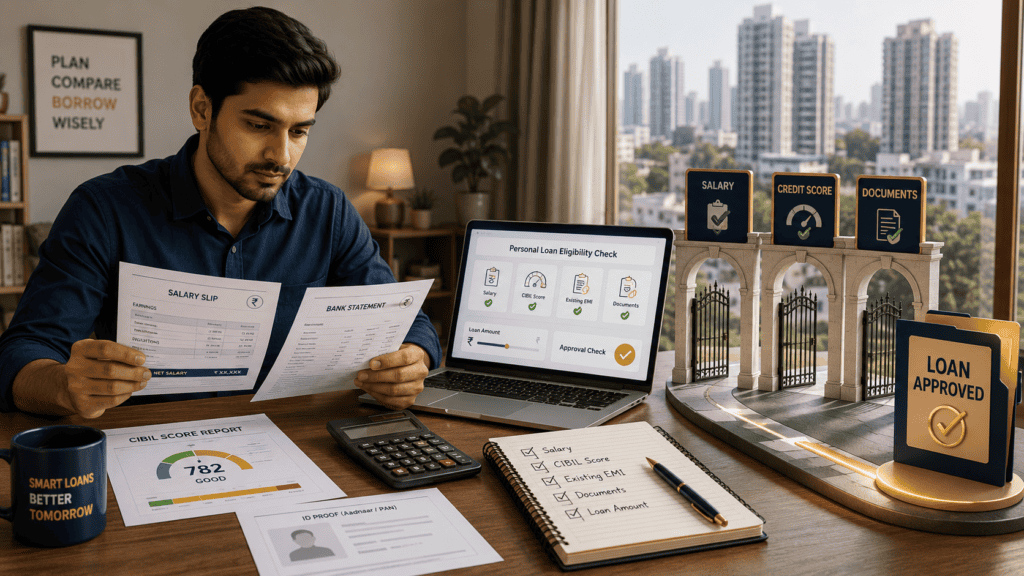
You have found a personal loan offer, and the interest rate looks manageable. But before you fill out that application, one question matters more than anything else: do you actually qualify? Personal loan eligibility is the set of checks a bank or NBFC runs before approving your application — and passing all of them is harder than most first-time borrowers expect.
Because personal loans are unsecured — no property or asset backs them — lenders rely entirely on your repayment capacity. Your salary, CIBIL score, existing EMIs, employment type, and documents all feed into that assessment at the same time. A high salary does not cancel out a poor credit score. Clean documents do not override a stretched EMI burden. Each factor works together.
This article explains exactly how personal loan eligibility works in India, what lenders check, how to estimate whether a proposed EMI is truly affordable, and what can get your application rejected even when your income looks sufficient on paper.
Quick Answer: Personal Loan Eligibility
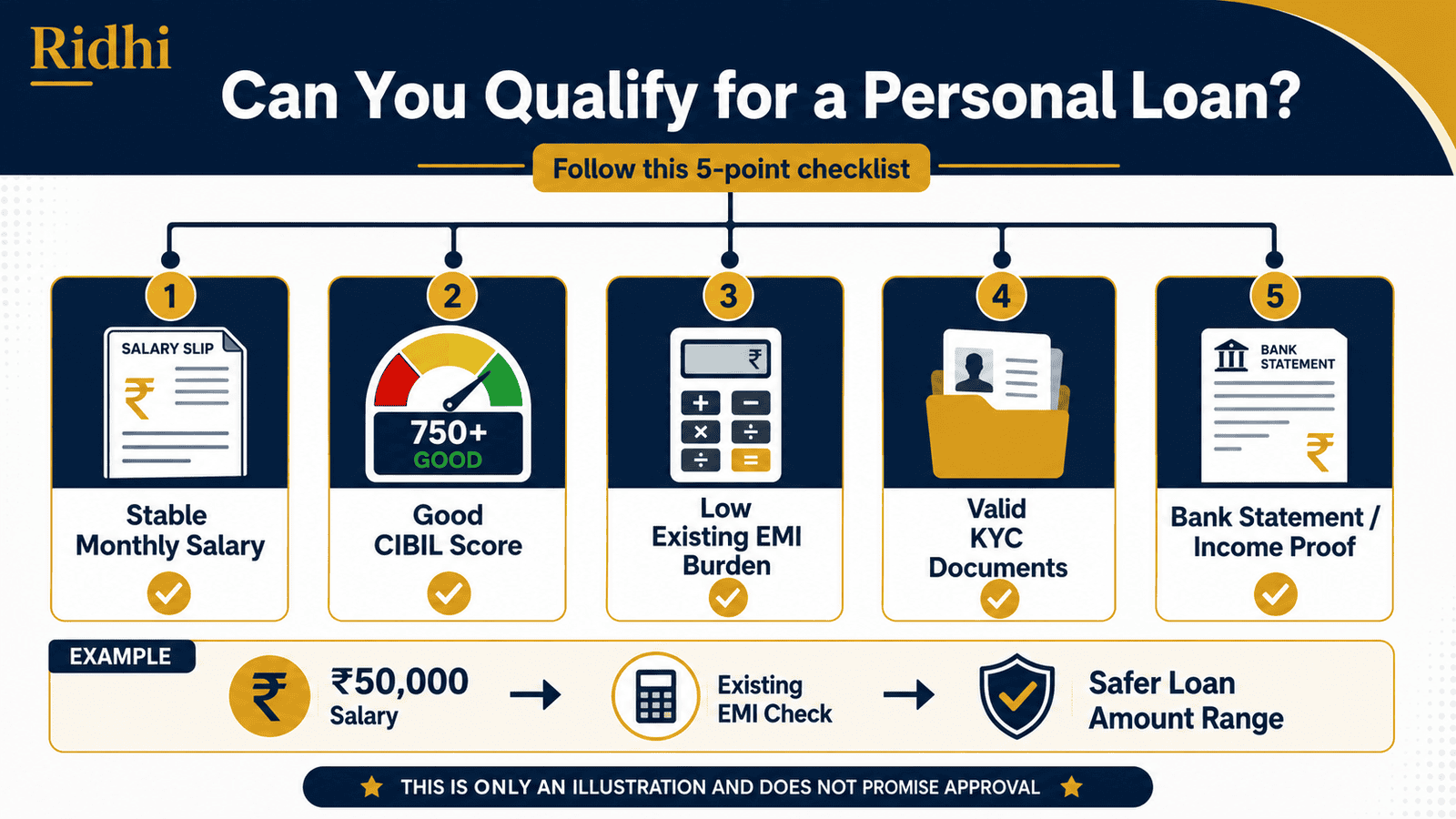
Personal loan eligibility means whether a bank or NBFC may approve your loan based on income, CIBIL score, existing EMIs, job stability and documents. Many lenders prefer a regular salary, clean repayment history and manageable EMI burden, such as total EMIs below a safe share of monthly income. Lender policies vary significantly — what qualifies at one bank may not at another.
Key Takeaways
- Salary alone does not decide approval — CIBIL score, existing EMIs, employment type, and document accuracy all matter equally in the lender’s assessment.
- Many lenders prefer a CIBIL score of 700 or above; a score below 650 significantly reduces approval chances at most mainstream banks.
- If your existing EMIs already consume more than 40–50% of monthly take-home income, lenders may reduce the approved loan amount or decline your application entirely.
- Applying to multiple lenders at once generates multiple hard enquiries on your credit report — each one can marginally lower your CIBIL score and reduce your chances further.
- Always compare total loan cost — principal plus total interest — not just the monthly EMI, before accepting any personal loan offer.
- A document mismatch between your salary slip, bank statement, and KYC can delay or reject your application even when your finances look strong.
Key Facts at a Glance
| Eligibility Factor | Why It Matters | What to Check Before Applying |
|---|---|---|
| Monthly Salary | Proves ability to service a new EMI from regular income | Minimum salary requirement varies by lender and city — check the lender’s official site directly |
| CIBIL Score | Reflects repayment history and overall credit behaviour | Most lenders prefer 700 or above — pull your free CIBIL report once a year from cibil.com |
| Existing EMI Burden (FOIR) | Shows how much income is already committed to other loan repayments | Calculate total EMIs as a share of monthly income — the lower the ratio, the stronger your repayment profile appears |
| Employment Type and Stability | Salaried employees in stable, recognised organisations are generally preferred | Confirm whether the lender accepts your employer type — PSU, MNC, listed private company, or MSME |
| KYC and Income Documents | Verify identity, address, income, and employment — all must be consistent | PAN, Aadhaar, salary slips, and bank statements must match each other and the application form |
| Processing Fee and Total Loan Cost | Affects the actual disbursed amount and the real cost of borrowing | Understand the loan fee impact before accepting any offer — a 2% processing fee on ₹2,00,000 means ₹4,000 is deducted upfront |
How Personal Loan Eligibility Works in India
A personal loan is an unsecured loan — meaning you do not pledge any property, gold, or asset to obtain it. That changes everything about how lenders evaluate you. With a home loan, the property itself is collateral. With a personal loan, the only security the lender has is your financial behaviour and your ability to repay from future income.
This is why lenders run a combined check across multiple factors simultaneously. One strong factor cannot rescue a weak one.
Income and Repayment Capacity
Your monthly income is the starting point. Lenders use it to judge whether you can service a new EMI without financial strain. Most banks and NBFCs set a minimum monthly salary requirement — this figure varies significantly between lenders and between cities. A threshold that qualifies in Mumbai may not apply in a smaller city, and the required amount can also depend on the loan size requested.
Income is not assessed in isolation. Lenders calculate your Fixed Obligation to Income Ratio — known as FOIR — which measures what share of your monthly income is already committed to existing loan repayments. If your FOIR rises too high after adding the proposed personal loan EMI, many lenders will reduce the approved loan amount or ask for a co-applicant, even if your salary headline looks comfortable.
CIBIL Score and Credit History
Your CIBIL score is a three-digit number between 300 and 900 generated by TransUnion CIBIL. It reflects how consistently you have repaid past loans and credit card dues. A higher score signals lower risk to the lender.
Most banks prefer a CIBIL score of 700 or above for personal loan approval. Some NBFCs may consider applicants with scores in the 650–699 range, often at higher interest rates. A score below 650 significantly reduces your chances at mainstream lenders. Missed EMIs, defaulted loans, or persistently high credit card utilisation all pull the score down.
To understand what factors build or damage your score and what counts as a strong CIBIL score for loan applications, read our guide: understand credit score.
Your credit report — the detailed history behind the score — also matters independently. Lenders look at how many active loans you carry, whether any payment is currently overdue, and how many times your report has been pulled recently by lenders through hard enquiries.
Existing EMIs and Debt Load
Every EMI you are already paying — home loan, car loan, credit card EMI conversion — reduces the income available for a new repayment. If you earn ₹55,000 per month and already pay ₹8,000 in EMIs, your effective free income for a new loan obligation is considerably lower than your salary suggests.
Lenders use FOIR as a hard underwriting criterion, not just a guideline. Borrowers with a high existing debt burden may receive a smaller loan than they applied for — or may be declined — regardless of salary level.
Employment Stability and Employer Type
Lenders prefer borrowers with stable, verifiable employment. For salaried applicants, this typically means a permanent role at an organisation the lender views as creditworthy — government departments, established private companies, listed corporations, or recognised MNCs.
Borrowers on probation, in short-term contract roles, or in jobs at smaller unlisted companies may face closer scrutiny. Some lenders require a minimum tenure in the current job — often at least six months to one year. Always check the specific lender’s eligibility criteria before applying.
KYC Documents and Income Proof
Even a financially strong applicant can face delays or rejection if documents are inconsistent. For a salaried personal loan application, lenders typically require:
- KYC documents: PAN card and Aadhaar card for identity and address verification
- Salary slips: Last 2–3 months, showing consistent salary amounts and employer details
- Bank statements: Last 3–6 months, showing regular salary credits and no dishonoured transactions
- Employment proof: Offer letter, appointment letter, or employer certificate where required
- Photograph: Passport-size photograph as per lender requirement
The name, address, and income figures across these documents must be consistent with each other and with what you declare on the application form. A discrepancy — different addresses on Aadhaar and bank statement, or a salary figure on the payslip that does not match the bank credit — can trigger manual review, delay disbursement, or cause rejection.
Each Lender Has Its Own Policy
There is no single national eligibility standard for personal loans in India. Every bank and NBFC sets its own minimum salary cutoff, preferred CIBIL score range, acceptable FOIR threshold, and document requirements. These vary further by city, loan amount, and specific lending product.
Checking eligibility on a lender’s official website — or speaking directly with a branch representative — before formally submitting an application is a better approach than applying based on industry averages you read on a comparison portal.
Real Example: Rohan’s Personal Loan Check
Rohan, 29, is an IT support executive in Pune earning ₹55,000 per month take-home. His family has had a medical emergency and he needs ₹2,00,000 urgently. He has one existing credit card EMI of ₹8,000 per month and wants to check whether a ₹2,00,000 personal loan for 24 months is affordable before he applies.
At an illustrative interest rate of 14% per annum, the monthly EMI on ₹2,00,000 for 24 months works out to approximately ₹9,600. His total repayment over 24 months would be approximately ₹2,30,400 — meaning total interest paid is approximately ₹30,400 on a ₹2,00,000 principal.
Combined EMI burden after the new loan: ₹8,000 + ₹9,600 = ₹17,600 per month. That is approximately 32% of his ₹55,000 salary — which most lenders would consider manageable.
However, approval is not confirmed by this number alone. Rohan’s CIBIL score, employer type, and document consistency will each still be assessed independently. Use our check loan EMI tool to run your own numbers before applying.
How to Calculate Whether Your EMI Is Affordable
EMI Burden Ratio = (All Existing EMIs + New Personal Loan EMI) ÷ Monthly Take-Home Salary × 100
This gives your total EMI-to-income ratio as a percentage. This is a conservative comfort check — not a formal bank approval formula. Each lender applies its own FOIR threshold internally.
Step 1: Monthly take-home salary = ₹55,000
Step 2: Existing EMIs = ₹8,000
Step 3: Proposed new personal loan EMI (₹2L, 24 months, 14% p.a.) ≈ ₹9,600
Step 4: Total EMI burden = ₹8,000 + ₹9,600 = ₹17,600
Step 5: Ratio = ₹17,600 ÷ ₹55,000 × 100 = approximately 32%
Step 6: Total loan cost = ₹2,30,400 (principal ₹2,00,000 + total interest ₹30,400)
| Scenario | Monthly EMI Burden (with ₹8K existing EMI) | Total Loan Cost |
|---|---|---|
| ₹2L at 14% for 24 months | ₹17,600 — approx. 32% of ₹55K salary | ₹2,30,400 |
| ₹2L at 18% for 24 months | ₹17,984 — approx. 33% of ₹55K salary | ₹2,39,616 (approx.) |
| ₹2L at 14% for 36 months | ₹14,829 — approx. 27% of ₹55K salary | ₹2,45,844 (approx.) |
A longer tenure reduces the monthly EMI but increases total interest paid. A higher interest rate raises both. For a deeper look at how much EMI burden is safe relative to your salary, read: safe EMI burden.
Comparison: Strong vs Weak Personal Loan Eligibility Profiles
| Profile Factor | Strong Profile | Weak Profile |
|---|---|---|
| CIBIL Score | 750 or above | Below 650 |
| Monthly Salary | Stable salary comfortably above lender minimum; regular salary credits in bank statement | Below lender minimum or irregular salary credits — raises income verification flags |
| Existing EMI Burden | Total EMIs well below 40% of monthly income; room for a new EMI without strain | Total EMIs above 50% of monthly income, or multiple active loans simultaneously |
| Employment Stability | Permanent employee at an established company; 1 year or more in current role | Probation period, short-term contract, or a very recent job change |
| Recent Credit Enquiries | No or very few hard enquiries in the last 6 months | Multiple recent enquiries — signals urgency to lenders or a pattern of rejections |
| Documents | Consistent name, address, and salary figures across PAN, Aadhaar, payslips, and bank statement | Mismatched address, inconsistent salary figures, or missing documents |
| Suggested Action | Compare lenders and apply selectively | Improve profile before applying |
How to Decide What’s Right for You
your total EMI burden after the new loan stays below 40% of monthly take-home, your CIBIL score is above 700, and your documents are consistent — you may be in a reasonable position to compare personal loan offers from two or three lenders before choosing.
the loan purpose is a genuine emergency — a medical expense, an unavoidable repair, or a time-sensitive obligation — and no lower-cost option is available, a personal loan may be practical even at a higher rate, provided the EMI is clearly affordable after essential monthly expenses.
your CIBIL score is below 700 — consider spending 3–6 months clearing overdue dues and reducing credit card utilisation before applying. A better score at the time of application may get you a lower interest rate and reduce your total cost meaningfully.
you were rejected by one lender — do not immediately apply to three more. Each formal application triggers a hard enquiry. Identify why the first application was declined, fix the underlying issue, and then apply to a single appropriate lender after improving your profile.
the loan is for a discretionary lifestyle purchase — travel, a gadget upgrade, or a non-essential event expense — calculate total cost including interest before deciding. What looks like a small EMI often means paying ₹20,000–₹60,000 more than the purchase price by the time the loan is repaid.
your monthly income comfortably covers the new EMI after essential expenses and a basic emergency reserve — do not take the loan. A stretched repayment schedule creates financial stress and risks missed EMIs, which damage your CIBIL score and make future borrowing more expensive.
Common Mistakes to Avoid
Applying to Multiple Lenders Simultaneously
Every formal loan application triggers a hard enquiry on your credit report — visible to every lender who checks your profile afterward.
Multiple hard enquiries in a short window signal financial urgency, which many lenders treat as a risk indicator. A lower score from enquiry accumulation may then lead to rejections from lenders who might otherwise have approved you.
Compare lenders using soft eligibility checks or pre-qualification tools first, then submit a formal application only to your best-fit lender. If prior enquiries have already damaged your score, read: improve your CIBIL.
Ignoring Existing EMI Burden When Calculating Affordability
Many borrowers estimate affordability based on salary alone and forget that existing EMIs reduce the income available for a new repayment.
If you earn ₹55,000 and already pay ₹20,000 in EMIs, adding a ₹9,600 personal loan EMI pushes your total EMI-to-income ratio above 54% — which most lenders flag as stretched. The resulting offer may be smaller than you need, or the application may be declined.
Always calculate combined EMI burden before applying, not after.
Submitting Inconsistent Documents
A name on PAN that does not exactly match Aadhaar, or a salary figure on a payslip that does not match the amount credited in your bank statement, raises verification flags that delay or block processing.
Even minor discrepancies — a middle name included on one document but not another — can trigger manual review. Verify all documents for consistency before submission.
Comparing Only EMI While Ignoring Total Interest Cost
A ₹2,00,000 loan at 18% p.a. for 36 months looks manageable at roughly ₹7,225 per month. But total repayment is approximately ₹2,60,100 — you pay ₹60,100 in interest on a ₹2,00,000 principal.
Always ask the lender for the total amount payable, not just the EMI figure. Rate, tenure, and fees together determine the real cost.
Applying with Recent Defaults or Overdue Payments Outstanding
An overdue credit card bill or a missed EMI — even from a few months ago — can materially affect your CIBIL score and trigger rejection even if your salary is strong.
Clear all outstanding dues before applying. Lenders check the full repayment history in your credit report, not just the headline score.
Not Reading the Loan Agreement Before Signing
Processing fees, prepayment penalties, and late payment charges are often detailed only in the loan agreement or the Key Fact Statement that lenders are required to provide.
A loan with a 2% processing fee on ₹2,00,000 means ₹4,000 is deducted before disbursement. You repay ₹2,00,000 but receive ₹1,96,000. Read the full sanction letter and loan agreement before signing.
When This May Not Be the Right Choice
A personal loan may not be suitable for every borrower, even if eligibility criteria are technically met.
If your combined EMI burden after the new loan exceeds 50% of monthly income, the repayment schedule leaves very little room for emergencies, essential expenses, or savings.
If the purpose is a non-essential lifestyle purchase — a holiday, gadgets, or a wedding upgrade — the total interest paid makes the effective cost significantly higher than the actual purchase price.
If you already carry high credit card balances or have unsettled dues on existing loans, adding a new personal loan worsens your overall debt load and increases the risk of a repayment spiral.
For some borrowers, a secured borrowing option — such as a loan against gold — may offer a significantly lower interest rate for the same immediate need. Before committing to an unsecured personal loan, consider reading: compare loan options.
If any of these apply to your situation, it may be worth exploring alternatives before committing.
Official Rules and Where to Verify
Personal loan eligibility criteria, interest rates, processing fees, and document requirements vary by lender and can change without advance notice. Do not rely on third-party comparison platforms or general articles — including this one — for final eligibility figures or current rates.
- RBI (rbi.org.in): Regulates banks and NBFCs; publishes guidelines on lending practices, fair lending norms, and borrower rights.
- TransUnion CIBIL (cibil.com): Official source for your CIBIL score and full credit report. One free credit report per year is available directly from the site.
- Lender’s official website: Current minimum salary threshold, CIBIL score preference, processing fee, interest rate range, and document checklist specific to that lender and product.
- Sanction letter and loan agreement: The final binding terms — always read in full before signing.
Rules, limits, and rates on this topic can change with each Budget or regulatory update. Always verify current figures directly from the official source before making any financial decision.
Expert Tips
- Pull your CIBIL report before any lender does: TransUnion CIBIL provides one free credit report per year at cibil.com. Check it for errors, overdue payments, or unfamiliar loan accounts before a lender sees it. Disputing an error on your report takes time — start early.
- Calculate total cost before the sales conversation: Use an EMI calculator to see principal plus total interest for different tenures and rates before speaking to any lender. Walking in knowing your numbers is a much stronger position than discovering the total cost during a loan pitch.
- Keep your bank statement clean for 3–6 months before applying: Regular salary credits, no dishonoured transactions, and no large unexplained debits present a clear income picture to underwriters. Frequent bounces or irregular credits raise questions that can slow processing or trigger rejection.
- Reduce high credit card utilisation before applying: Carrying a large outstanding balance on your credit card raises both your credit utilisation ratio and your FOIR simultaneously. Paying down even ₹15,000–₹20,000 in outstanding balance before applying may measurably improve your eligibility profile.
- Compare total interest, not just the headline rate: A lender offering 13% versus 14% for 24 months on ₹2,00,000 saves you approximately ₹2,000 in total interest paid — worth comparing before you commit to a specific lender.
- Ask about prepayment charges before accepting: Some personal loans carry prepayment penalties on outstanding principal. If you think you may repay early — from a bonus or increment — factor these charges into your total cost comparison before signing.
Frequently Asked Questions
What is personal loan eligibility?
Personal loan eligibility refers to the financial and documentation criteria a bank or NBFC uses to decide whether to approve a personal loan application. Key factors include monthly take-home income, CIBIL score, existing EMI obligations, employment stability, and the consistency and completeness of KYC and income documents. All factors are assessed together — no single criterion guarantees approval.
What is the minimum salary required for a personal loan in India?
Minimum salary requirements vary significantly between lenders and between cities. Many banks and NBFCs set a monthly salary threshold, but this figure differs by institution, loan amount requested, and employer type. There is no single national minimum. Check the specific lender’s official eligibility page before applying — industry-average figures from comparison platforms may not match what a particular lender actually requires.
What CIBIL score do I need to get a personal loan?
Many lenders prefer a CIBIL score of 700 or above for personal loan applications. Some NBFCs may consider applicants with scores between 650 and 699, typically at higher interest rates. A score below 650 significantly reduces approval chances at mainstream banks. The minimum preferred score also varies by lender, loan amount, and internal risk policy — there is no universal cutoff.
Which documents are required for a personal loan application?
For salaried applicants, lenders typically ask for PAN card and Aadhaar card for KYC, the last 2–3 months of salary slips, 3–6 months of bank statements showing regular salary credits, and sometimes an offer letter or employment certificate. Exact document requirements vary by lender — always confirm the full checklist directly with the lender before preparing your application to avoid missing any item.
Can I get a personal loan if I already have other EMIs?
Yes, in many cases — but existing EMIs reduce the amount a lender may approve. Lenders calculate your FOIR (Fixed Obligation to Income Ratio) to assess how much of your income is already committed. If adding the new personal loan EMI pushes your FOIR above the lender’s threshold, the approved loan amount may be lower than you requested, or the application may be declined.
Does checking personal loan eligibility affect my CIBIL score?
It depends on how you check. Using a soft eligibility check or a pre-qualification tool on a lender’s or comparison platform’s website typically does not affect your score. A formal loan application, however, triggers a hard enquiry that is recorded on your credit report. Multiple hard enquiries within a short period can cumulatively lower your CIBIL score and signal urgency to lenders.
What is FOIR and why does it matter for personal loan approval?
FOIR stands for Fixed Obligation to Income Ratio. It measures what percentage of your monthly take-home income is already committed to fixed repayments — existing EMIs, recurring loan obligations, and similar fixed outflows. Lenders use FOIR to judge whether you can comfortably carry an additional EMI. A high FOIR signals that your repayment capacity is already stretched, which can lead to a smaller approved amount or an outright decline.
What happens if my personal loan application is rejected?
A rejection is recorded on your credit report. Applying to more lenders immediately adds further hard enquiries and potential additional rejections — compounding the damage. Instead, request a reason for the rejection from the lender, address the underlying issue (low score, high FOIR, incomplete documents, or employer type), and then apply to a single appropriate lender once your profile is stronger.
Is a personal loan always more expensive than other loan options?
Personal loans are typically priced higher than secured loans because the lender accepts more risk with no collateral. Home loans and gold loans generally carry lower interest rates. If you have an eligible asset — gold, for instance — a secured loan against it may reduce your total interest cost significantly for the same borrowing need. Compare all available options before committing to an unsecured personal loan.
Final Verdict
Personal loan eligibility is not a single number — it is a combined assessment of your salary, CIBIL score, existing EMI load, employment stability, and document accuracy. No single strong factor guarantees approval, and lender policies vary considerably across banks and NBFCs.
Before you apply, estimate your EMI using a calculator, check your CIBIL report for accuracy, calculate your total EMI burden as a share of take-home income, and confirm current eligibility criteria directly on the lender’s official website. Do not compare EMI alone — know the total cost: principal plus total interest and all applicable fees. Rates vary by lender, credit score, and tenure.
Always verify the latest rules from official sources or consult a qualified professional before making any financial decision.
This article is for educational purposes only and should not be treated as personalised financial, tax, investment, insurance, or legal advice. Tax rules, interest rates, regulatory limits, and product features can change with each Budget or policy update. Please verify current rules from official government sources or consult a qualified and registered professional before making any financial decision.

Vikram Sethi writes about loans, EMI planning, credit score impact, borrowing costs, and repayment decisions for Indian borrowers. His content helps readers look beyond the monthly EMI and understand the full cost of borrowing, including principal, interest, processing fees, GST, insurance, prepayment charges, foreclosure fees, late payment penalties, and credit score impact.
He covers topics such as EMI calculators, home loan eligibility, personal loan eligibility, debt-to-income ratio, flat interest rate vs reducing balance, missed EMI consequences, loan prepayment vs part payment, home loan balance transfer, processing fees, gold loan vs personal loan, car loan vs cash purchase, top-up home loans, loan against PPF, and credit score basics.
Vikram’s writing style is practical, cautionary, and calculation-driven. He uses Indian examples, ₹ amounts, comparison tables, and decision frameworks to help borrowers compare options more carefully. His articles are educational and do not guarantee loan approval, interest rates, or savings. Readers should verify current rates, charges, eligibility, and terms directly with lenders before applying or refinancing.